Mustard Seed Faith – (Luke 17)

English: Mustard seeds by David Turner Februar...

English: Mustard seeds by David Turner February 23, 2005 Edited by Consequencefree to replace the coin with an SI measurement reference (Photo credit: Wikipedia)

In the opening verses of chapter 17, Jesus acknowledges that temptations are a part of life. But He warns about those who tempt others to sin. He repeats the thought of verse two in Matthew 18:6 and also in Mark 9:42. Particularly in Matthew, He seems to be talking about those who would cause children to stumble; and certainly the application is valid there as well. But He is, more to the point, speaking about those who are innocent – those who are trying to do what is right, as well as what we would call people who are babes in Christ. A horrible physical death as He describes here would be better than the eternal punishment that is for those who corrupt them .

The statement in verse 6 that Jesus makes about faith is a hyperbole. Jesus is not suggesting that we should expect to perform miraculous deeds because of our faith. Faith has great power indeed – if it is used according to God’s will. The trouble is usually with the strength of our faith. Peter was able to walk on water for a while, as Jesus willed him to. But when the storm surged against him, his faith faltered. And so it usually goes with all of us.

(This year’s reading plan for Luke, Acts, and 1 and 2 Chronicles averages just 15 verses per day – 5 days per week!)
Schedule for this week
Read or listen to audio of today’s selection from Luke here
Read or listen to audio of today’s selection from 1 Chronicles here

/Bob’s boy
___________________
some images © V. Gilbert & Arlisle F. Beers

Please note: I did not design the reading plan that I am following in my blog.  All of my comments in this blog, however, are solely my responsibility.  When reading ANY commentary, you should ALWAYS refer first to the scripture, which is God’s unchanging and unfailing word. Reading schedules, as well as a link to the site where you can get the reading plan that I’m currently following for yourself can be found on the “Bible Reading Schedules” page of my website at http://graceofourlord.com.  

Enhanced by Zemanta

Prayers of Thanksgiving

Group of Christians praying in the cave at Yeo...

Group of Christians praying in the cave at Yeoju Pyungkang Jeil Conference Center near Yeoju, Gyeonggi-do, South Korea. (Photo credit: Wikipedia)

Earlier his year, we began a series to help us develop our praying habits, with an emphasis on the ACTS method of prayer in this post. There is no requirement for any set formula for prayer, but the method referred to by the acronym can be useful. The elements of prayer represented by the ACTS method are adoration, confession, thanksgiving, and supplication.

Let’s take a moment to focus on the aspect of thanksgiving. Giving thanks to God for the things in our lives that we are blessed with is a very important part of prayer. We all should, of course, thank God for our food at meal time. And we often remember to thank Him for many other things. One way to “step up” the thanksgiving portion of our payers is by examining ourselves and our lives with respect not only to all that we have, but also by considering those who do not have many of the things that we are blessed with in our lives.

As with all prayer, a healthy reading of God’s word on a regular basis will sharpen our perspective by virtue of the personal growth that His wisdom imparts. But more powerful than anything else is a prayer that comes from within the heart. No matter what is going on in our lives, when we take the time to truly contemplate how blessed we are by God’s grace, it is impossible not to be grateful. Based on that assurance, I offer this simple prayer:

Our Holy Father in heaven
Creator of all that is and ever has been
I thank you for the love and sacrifice
of your son and our Savior, Jesus Christ
the author and perfecter of our faith,
And that because of that sacrifice,
we can come to you in prayer and bring our petitions.
I thank you, Father, for the life you have given me
and for the world that you spoke into existence
which holds so many great blessings for me.
Somewhere else, though another is hungry
yet because of your mercy, I am fed.
Though somewhere else, someone has no home
yet I am blessed with a warm and safe shelter daily.
And still you bless me further with good health
and with many dear friends and loved ones
and with brothers and sisters who care about me.
For these and for many other blessings, I thank you with all my heart
In Jesus name, Amen.

(This year’s reading plan for Luke, Acts, and 1 and 2 Chronicles averages just 15 verses per day – 5 days per week!)
Schedule for this week

/Bob’s boy
___________________
some images © V. Gilbert & Arlisle F. Beers

Please note: I did not design the reading plan that I am following in my blog.  All of my comments in this blog, however, are solely my responsibility.  When reading ANY commentary, you should ALWAYS refer first to the scripture, which is God’s unchanging and unfailing word. Reading schedules, as well as a link to the site where you can get the reading plan that I’m currently following for yourself can be found on the “Bible Reading Schedules” page of my website at http://graceofourlord.com.

Enhanced by Zemanta

Organization of David’s Kingdom – 1 Chronicles 27

As we can see David’s time coming to an end, his preparations for Solomon’s reign continues now beyond the Levites and into the military. The army mentioned here is not David’s more official force, but is best described as a very large citizen militia, consisting of 12 divisions of 24,000 men.

Samuel anoints David, Dura Europos, Syria, Dat...

Samuel anoints David, Dura Europos, Syria, Date: 3rd c. AD (Photo credit: Wikipedia)

The leaders of the tribes that are listed in verses 16-22 may be from the ranks of elders. We are not told. Nor are we given a reason for the omission of the tribes of Gad and Asher. Interestingly, “Aaron” is listed as a tribe in verse 17. The Lord’s wrath over the census that Joab ended up not finishing (2 Samuel 24:1-17) is only briefly mentioned in verse 24.

Verses 25-31 list 12 administrators over David’s treasuries, corporate workers of the field, and vast amounts of property. David and his kingdom were at a high point of wealth. Among the counselors and friends listed in verses 32-34 are Hushai and Ahithophel. No mention is made of Hushai’s role in David’s victory over Absalom (2 Samuel 15:32-37, 2 Samuel 16:15-17:16), nor of Ahithophel’s betrayal in that same ordeal.

(This year’s reading plan for Luke, Acts, and 1 and 2 Chronicles averages just 15 verses per day – 5 days per week!)
Schedule for this week
Read or listen to audio of today’s selection from Luke here
Read or listen to audio of today’s selection from 1 Chronicles here

/Bob’s boy
___________________
some images © V. Gilbert & Arlisle F. Beers

Please note: I did not design the reading plan that I am following in my blog.  All of my comments in this blog, however, are solely my responsibility.  When reading ANY commentary, you should ALWAYS refer first to the scripture, which is God’s unchanging and unfailing word. Reading schedules, as well as a link to the site where you can get the reading plan that I’m currently following for yourself can be found on the “Bible Reading Schedules” page of my website at http://graceofourlord.com.  

Enhanced by Zemanta

Paul’s Plea to Philemon

 We’re running a bit ahead of schedule this week for Luke 16, so we thought it would be a good time to take a look at Paul’s epistle to Philemon.

Paul’s letter to Philemon was a personal one, but it was also one that he intended to be read to the entire church, as they met in his home (verse 2). Philemon was a wealthy Christian in Colossae, and Paul probably befriended him during his three years in Ephesus, which was about 161 kilometers away. One of his bondservants, Onesimus, had run away, possibly even stealing some money from him (verses 18-19).

Philemon (New Testament person)

Philemon (New Testament person) (Photo credit: Wikipedia)

In a fortuitous coincidence, or more probably God’s providence, Onesimus had ended up in Rome while he was hiding, and had come into contact with Paul while he was in prison there. Presumably, it was during his first imprisonment there, and the letter was probably written about 62 A.D. – about the time that he wrote to Ephesus. After meeting Paul, Onesimus had become a Christian. Now Paul was sending him back to Philemon with the request that he receive his bondservant as he would receive Paul, and that he now should consider him a beloved brother.

Paul would have liked for Onesimus to stay and continue to help him while he was in prison, but he needed things to be made right between the two of them. Paul’s confidence that Philemon would respect his wishes and go beyond even what Paul was asking of him comes though loud and clear in this letter. Secular tradition has it that this same Onesimus became an important leader in the church. Whether that is true, we do not know for sure. But it seems that it was God’s will for Philemon’s forgiveness, the growth of brotherly love, and the service of Onesimus to make a difference in their lives, and in the lives of those in the church there. It was a great lesson in the providence and power of God in the lives of all those Christians.

It is notable that in this, the shortest epistle Paul had written, one of the people who Paul sends greetings from is Demas (verses 23-24). The letter was before Demas’ love for “this present world” had caused him to desert Paul and go to Thesslonica (2 Timothy 4:10).

(This year’s reading plan for Luke, Acts, and 1 and 2 Chronicles averages just 15 verses per day – 5 days per week!)
Schedule for this week
Read or listen to audio of today’s selection from Luke here
Read or listen to audio of today’s selection from 1 Chronicles here

/Bob’s boy
___________________
some images © V. Gilbert & Arlisle F. Beers

Please note: I did not design the reading plan that I am following in my blog.  All of my comments in this blog, however, are solely my responsibility.  When reading ANY commentary, you should ALWAYS refer first to the scripture, which is God’s unchanging and unfailing word. Reading schedules, as well as a link to the site where you can get the reading plan that I’m currently following for yourself can be found on the “Bible Reading Schedules” page of my website at http://graceofourlord.com.  

Enhanced by Zemanta

The Rich Man and Lazarus – (Luke 16)

Lazarus at the rich man's gate.

Lazarus at the rich man’s gate.

Jesus begins the story of the rich man and Lazarus in verse 19. For the record, Lazarus was a fairly common name, and it is mere coincidence that he has the same name as the brother of Martha and Mary, who Jesus raised from the dead in John 11:38-44. That Lazarus was a real man, and a friend to Jesus. This one is a character in a parable. Lazarus, a poor man who was covered with sores, had a habit of posting himself at the rich man’s gate, hoping to get a few scraps from the rich man’s table. The significance of the dogs that came and licked his sores is that he was exposed to the elements, and to wild animals. These were not AKC registered pets.

Lazarus died, and was carried by the angels to Abraham’s bosom. Then the rich man died was buried, and was in Hades in torment. He asks Abraham to send Lazarus to dip his finger in water to cool his tongue. Significantly, he still had no regard for the poor man, but looked on him as someone to serve him. But Abraham told him that their roles were reversed now. The poor man, who had known nothing of comfort was receiving his comfort now, in contrast to the anguish of the rich man. Abraham also pointed to a chasm that separated them, so that neither could cross to the other side.

Lazarus, not the brother of Mary and Martha, but another man by that name, was very poor. He lay near the table of a rich man and begged for scraps of food to be thrown to him. But Lazarus loved God and the rich man didn't, so Lazarus went to heaven and the rich man went to hell (Luke 16:19-31).

Lazarus, not the brother of Mary and Martha, but another man by that name, was very poor. He lay near the table of a rich man and begged for scraps of food to be thrown to him. But Lazarus loved God and the rich man didn’t, so Lazarus went to heaven and the rich man went to hell (Luke 16:19-31).

The rich man then asks Abraham to send Lazarus to warn his brothers, so that they will repent, reasoning that they will listen to someone who was raised from the dead. But Abraham said that if they will not listen to Moses and the prophets, they will not be convinced even by someone being raised from the dead. That is just so. Jesus Himself had been witnessed by some after He arose that also were not convinced to repent. There is a mistaken belief by many that the eyewitness of a miracle would convince an unbeliever, but we see over and over again in scripture that this is simply not true. Many of the Pharisees witnessed great miracles, and still plotted the death of Jesus. Those who are stoically predisposed not to believe will find an explanation within themselves that will reinforce their unbelief.

We must be careful about the descriptions of the circumstances of the rich man and Lazarus after they died. Remember that this is a parable. That does not mean that there are not aspects that can be equated to what the reality will be. But the clear picture we have seen in paintings and illustrations of this dividing line between the two probably does not accurately tell that story. The point is that the comfort and security that belongs to those who are saved will be totally unavailable to those who are lost.

Significant also is the fact that Abraham offers no hope at all to the rich man. That is because for those in that situation, there will no longer be any hope. Man has his entire life to act as a child of God. Once that life is done, the opportunity ends. A terrible tragedy, but one of which we have been repeatedly forewarned. If we do not believe it enough to obey, that is our own fault.

The love of this rich man for money and his ignoring the plight of this poor man so plainly close and available to easily be helped by his great wealth illustrates very well the lesson Jesus taught in the parable of the dishonest manager that this chapter opened with. His downfall was his love of money, at the exclusion of what is important. No man can serve God and money.


(This year’s reading plan for Luke, Acts, and 1 and 2 Chronicles averages just 15 verses per day – 5 days per week!)
Schedule for this week
Read or listen to audio of today’s selection from Luke here
Read or listen to audio of today’s selection from 1 Chronicles here

/Bob’s boy
___________________
some images © V. Gilbert & Arlisle F. Beers

Please note: I did not design the reading plan that I am following in my blog.  All of my comments in this blog, however, are solely my responsibility.  When reading ANY commentary, you should ALWAYS refer first to the scripture, which is God’s unchanging and unfailing word. Reading schedules, as well as a link to the site where you can get the reading plan that I’m currently following for yourself can be found on the “Bible Reading Schedules” page of my website at http://graceofourlord.com.  

Enhanced by Zemanta

Justification – (Luke 16)

Jesus had just told the parable of the dishonest manager, saying that you cannot serve God and money. Then we find in verse 14 that the Pharisees (who the text says were lovers of money) ridiculed Him. What follows this ridicule begins with Jesus giving it back to them in righteous rebuke. But then it appears that He drifts to a couple of unrelated and random subjects. But are they really?

English: Jesus disputes with the Pharisees. Fr...

English: Jesus disputes with the Pharisees. French School. In the Bowyer Bible in Bolton Museum, England. Print 3861. From “An Illustrated Commentary on the Gospel of Mark” by Phillip Medhurst. Section Q. disputes with the establishment. Mark 10:2-12, 11:27-33, 12:13-27, 12:35-37. http://pdfcast.org/pdf/an-illustrated-commentary-by-phillip-medhurst-on-the-gospel-of-mark-section-q-to-r (Photo credit: Wikipedia)

His initial answer is obviously addressed to the Pharisees because He addresses them in the second person, saying “You are those who justify yourselves before men, but God knows your hearts. For what is exalted among men is an abomination in the sight of God.” The Pharisees were very good at imposing laws on others that did not come from God, but they were equally adept at justifying whatever suited them.

So in verse 16, He tells them that “the Law and the prophets” were until John (the baptist). But then, the good news of the kingdom of God has begun to be preached. The last part of that verse is difficult, as it reads everyone forces his way into it. What this probably means is that everyone wants to get into the kingdom, but they want to do it on their own terms – rather than on God’s terms. He then says in verse 17 that it is easier for heaven and earth to pass away than for one “dot” of the law to become void.

To put that last part into perspective, we must refer to Matthew 5:18, which says not an iota, not a dot, will pass from the Law until all is accomplished, which means of course, until Jesus finishes what He came for. But the point is the rebuke of the Pharisees, who seek to justify what is an abomination to God. It was then that He pulled the next punch to illustrate the point, saying Everyone who divorces his wife and marries another commits adultery, and he who marries a woman divorced from her husband commits adultery.Of course, we know from Matthew 5:32 that the reason of sexual immorality is an exception to this, but that is beside the point. The mere fact that men – including the Pharisees – had continued to relax their standards concerning divorce did not negate what God had ordained.

Putting this all together in that perspective, it all also flows after the parable of the unjust steward. That parable also shows how men try to justify the wrong they do when it suits them to do so. It is a logical procession that Jesus obviously saw coming before He even began that parable.

(This year’s reading plan for Luke, Acts, and 1 and 2 Chronicles averages just 15 verses per day – 5 days per week!)
Schedule for this week
Read or listen to audio of today’s selection from Luke here
Read or listen to audio of today’s selection from 1 Chronicles here

/Bob’s boy
___________________
some images © V. Gilbert & Arlisle F. Beers

Please note: I did not design the reading plan that I am following in my blog.  All of my comments in this blog, however, are solely my responsibility.  When reading ANY commentary, you should ALWAYS refer first to the scripture, which is God’s unchanging and unfailing word. Reading schedules, as well as a link to the site where you can get the reading plan that I’m currently following for yourself can be found on the “Bible Reading Schedules” page of my website at http://graceofourlord.com.  

Enhanced by Zemanta

The Dishonest Manager – (Luke 16)

The “Parable of the Unjust Steward” (in some translations, it is the “dishonest manager”) is admittedly difficult to understand at a certain point. It is obvious to any honest 🙂 person that Jesus does not suggest that dishonesty is “commendable.” But the way that verses 8 and 9 are translated makes it difficult to precisely get the full meaning.

The steward or manager in question likely refers to a chief servant of a rich man’s household. He has been trusted with running the day to day affairs of the house, which include the buying and selling of goods produced by the land. Charges of waste by either incompetence of dishonesty (or both) are brought, and no denial is made. Instead, the steward (who knows he is losing his job) plots how he might make friends of those who are indebted to the lord of the house.

In one of Jesus' parables, an unjust steward was fired from his job. But he was shrewd, so he quickly called in his master's debtors and reduced or canceled their debts, so that he would have new friends (Luke 16:1-18).

In one of Jesus’ parables, an unjust steward was fired from his job. But he was shrewd, so he quickly called in his master’s debtors and reduced or canceled their debts, so that he would have new friends (Luke 16:1-18).

The steward conspires with several debtors to “cook the books” on each end, so that they will owe less money – reasoning that helping the debtors in this way will secure their good graces for himself in the future. Obviously, the debtors who went along with such a scheme were just as guilty as the steward.

The parable seems pretty straightforward up to that point. Then in verse 8, the lord of the house (having discovered the scheme) “commends” the steward for his shrewdness. It is pretty easy as well to understand this as a “I’ve gotta hand it to you” type of commendation. We are all smart enough to know that the lord of the house is not offering praise of approval to the man for stealing from him! The verse continues with Jesus’ own words: “For the sons of this world are more shrewd in dealing with their own generation than the sons of light.”

The “sons of this world” (referred to elsewhere as “sons of darkness”) and the “sons of light” are the same two opposing groups that have existed since the fall of man (Genesis 3:15). They are referred to elsewhere, such as by  Jesus in John 12:36, and by the apostle Paul in 1 Thessalonians 5:5.  Certainly, the “sons of this world” are more shrewd with their own kind.

Then comes the difficulty in verse 9:
“And I tell you, make friends for yourselves by means of unrighteous wealth, so that when it fails they may receive you into the eternal dwellings.”
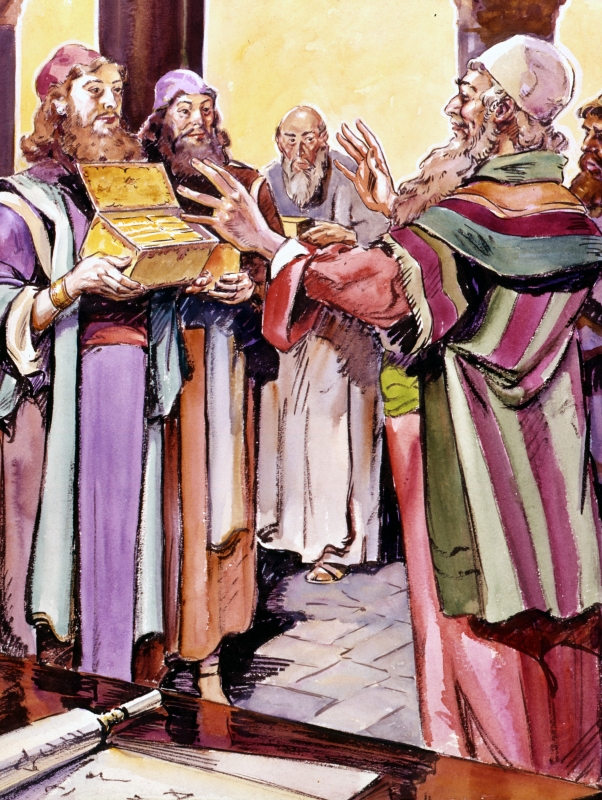
The parable of the talents, a story about faithful stewardship -- Matthew 25: 14-30.

The parable of the talents, a story about faithful stewardship — Matthew 25: 14-30.

We have read many commentaries that offer various explanations of this verse. Some are quite awful, frankly. One of the better ones says that this is sarcastic irony. There may be some validity in that analysis actually. But the most correct analysis (in our opinion) is that, properly translated, the verse fits into a rhetorical question. Some have pointed to this by such things as the combination of a subjunctive verb along with a future indicative verb in the Greek. We confess to being largely illiterate when it comes to Greek. But change the wording accordingly to “should you make friends for yourselves by means of unrighteous wealth, so that when it fails they may receive you into the eternal dwellings?” and it makes perfect sense.

Obviously, the answer is no. Jesus would certainly NOT want us to make friends by using unrighteous wealth. This holds true even if you hold that “unrighteous” in this case simply refers to all material wealth, and that it doesn’t mean anything bad. Making friends with wealth is not going to get you into any eternal dwelling!

The point is missed by most commentators. This is not really a lesson about wealth. Neither is it about prudent handling of your worldly affairs (the steward was a thief)! Nor is it specifically about making prudent preparations for your spirituality. It is about honesty. And it is about where, and to what (or whom) your heart belongs.

Jesus explains that very well Himself after the parable:

“One who is faithful in a very little is also faithful in much, and one who is dishonest in a very little is also dishonest in much.”
and
“No servant can serve two masters…you cannot serve God and money.”

Nuff said?

(This year’s reading plan for Luke, Acts, and 1 and 2 Chronicles averages just 15 verses per day – 5 days per week!)
Schedule for this week
Read or listen to audio of today’s selection from Luke here
Read or listen to audio of today’s selection from 1 Chronicles here

/Bob’s boy
___________________
some images © V. Gilbert & Arlisle F. Beers

Please note: I did not design the reading plan that I am following in my blog.  All of my comments in this blog, however, are solely my responsibility.  When reading ANY commentary, you should ALWAYS refer first to the scripture, which is God’s unchanging and unfailing word. Reading schedules, as well as a link to the site where you can get the reading plan that I’m currently following for yourself can be found on the “Bible Reading Schedules” page of my website at http://graceofourlord.com.  

Enhanced by Zemanta

With All Authority – Paul’s Epistle to Titus

Paul’s authorship of the letter to Titus has been questioned by a few scholars, largely because of the mention of having been on the island of Crete, when there is no other scriptural record of Paul having visited the island. But of course, the Bible is neither the biography of Paul, nor is it his journal. In truth, it is plain to see that Paul wrote this letter after he wrote his first letter to Timothy and before his second letter to him, which he wrote from his final imprisonment in Rome, while awaiting his death. By bits and pieces, we at least get a partial picture of Paul’s travels after his first imprisonment there.

Tradition says that after Paul was released from prison in Rome (before his second and final imprisonment), he and Titus traveled together for a while. They stopped in Crete, and when it was time for Paul to go, he left Titus behind to help the churches there.

Tradition says that after Paul was released from prison in Rome (before his second and final imprisonment), he and Titus traveled together for a while. They stopped in Crete, and when it was time for Paul to go, he left Titus behind to help the churches there.

Crete is one of the five largest islands in the Mediterranean, only about 1/3 the size of Sicily and Sardinia, but it is the largest of the Greek islands. It is about 160 miles from east to west, and about 37 miles at its widest point. From the familiarity that Paul clearly has with the island and its people (as expressed in this letter) he must have spent considerable time there, before leaving Titus with a charge to nurture the fledgling congregations there.

Among the things that Paul has to say to Titus here is to urge him to set about the work of “what remained” to be put in order, including the appointment of elders in every town. Just how many towns were involved in this effort, we do not know. Paul also lists some important qualifications for those who would be considered for that task (Titus 1:5-9). One reason for the urgency was that Paul expressed some concern about the problem of false teachers, including those of the circumcision party that had made their way even to the island already.

With respect to those false teachers and the “deceivers,” Paul tells Titus to be firm in teaching the truth while dealing with such matters. In chapter 2:15, he tells him to “exhort and rebuke with all authority. Let no one disregard you.” In chapter 3, he concludes the letter with good advice for living as a Christian, and avoiding controversy and dissensions. He asks Titus to do his best to come to Nicopolis, where Paul says he plans to spend the winter. It is unclear which Nicopolis he referred to, but it could have been Actia Nicopolis, of western Greece. It was once the capital of the Roman province of Epirus Vetus.

(This year’s reading plan for Luke, Acts, and 1 and 2 Chronicles averages just 15 verses per day – 5 days per week!)
Schedule for this week


/Bob’s boy


___________________


some images © V. Gilbert & Arlisle F. Beers


Please note: I did not design the reading plan that I am following in my blog.  All of my comments in this blog, however, are solely my responsibility.  When reading ANY commentary, you should ALWAYS refer first to the scripture, which is God’s unchanging and unfailing word. Reading schedules, as well as a link to the site where you can get the reading plan that I’m currently following for yourself can be found on the “Bible Reading Schedules” page of my website at http://graceofourlord.com.


Enhanced by Zemanta

Gatekeepers and Treasurers – 1 Chronicles 26

Among the Levites, the gatekeepers had the responsibility first and foremost of protecting the sanctuary from unlawful or unauthorized entry and defilement from such practices as idolatry. Their duties also included taking care of the temple treasuries and dedicated gifts, as well as maintenance of the building (as detailed in 1 Chronicles 9:22-32). It was likely this group that Hezekiah assembled to cleanse the temple in 2 Chronicles 29:3-11.

Ark of the Covenant.

Ark of the Covenant.

Among the gatekeepers were the families of Meshelemiah, Hoash, and Obed-edom. This is surely the same Obed-edom whose house the ark was to after the failed first attempt. It had remained there for three months (1 Chronicles 13:13-14, 2 Samuel 6:10-12).  This is significant in that Obed-edom was a Gittite (a resident of Gath). Was he a Gittite by birth geographically, but genealogically an Israelite? The Bible is silent about his participation, but we do know that the passages just cited say that God blessed his household and all that he had when the ark was left in his care. Where the Lord is concerned, that is enough.

The treasurers were from the sons of Gershom, Ladan, and other Kohathites. There were two separate treasuries that were kept near the gates. One contained the offerings and tithes of the people, while the other contained the spoils taken in battle and certain other dedicated gifts, such as  those dedicated by Samuel, Saul, David, and his commanders. The Izharites and Hebronites were appointed to oversee the territories of the Reubenites, Gadites, Manassites, and other areas west of the Jordan.

(This year’s reading plan for Luke, Acts, and 1 and 2 Chronicles averages just 15 verses per day – 5 days per week!)
Schedule for this week
Read or listen to audio of today’s selection from Luke here
Read or listen to audio of today’s selection from 1 Chronicles here

/Bob’s boy
___________________
some images © V. Gilbert & Arlisle F. Beers

Please note: I did not design the reading plan that I am following in my blog.  All of my comments in this blog, however, are solely my responsibility.  When reading ANY commentary, you should ALWAYS refer first to the scripture, which is God’s unchanging and unfailing word. Reading schedules, as well as a link to the site where you can get the reading plan that I’m currently following for yourself can be found on the “Bible Reading Schedules” page of my website at http://graceofourlord.com.  

Enhanced by Zemanta

The Prodigal Son, Part 2 – (Luke 15)

The younger son traveled back home to ask his father to take him in and let him work as one of his servants. But his father saw him coming from a long way off, and he ran to meet him. Though his father embraces him, he has come with a contrite heart and acknowledges his guilt. But his father had his servants to clothe him in the best manner he could, and he arranged for a feast to celebrate the return of the son, who for all practical purposes had been dead. But now the lost one had been found.

It is just so with God. There is no sin that we can do that, with a repentant heart, God will not eagerly forgive us. As His children, He joyfully accepts us back, no matter what. And Jesus has told us twice in this chapter how much joy there is in heaven when one sinner repents.

Return of the prodigal son

Return of the prodigal son

But the older son hears the celebration, and does not come to His father, but instead speaks to a servant to find out what is going on. What does that say about his relationship with his father, especially when he, in his anger, refused to go in? Though his father comes out and “entreats him,” he still will not relent, and he makes his displeasure, disdain, and even jealousy known to his father. He degenerates his younger brother for his sins, and cannot understand why the father is treating him so well. His father wants the elder son to join them, but he also wants him to understand that it is most appropriate to be joyous and to celebrate the return of one who was lost to him.

When the chapter started, back in verse 2, the Pharisees and scribes grumbled, saying, “This man receives sinners and eats with them” because Jesus was consorting with known sinners. Jesus had explained in two previous parables how much joy God has for the lost returning to him. But now He is describing the elder brother with the same attitude that the Pharisees had. They felt that they were entitled to a higher degree of regard because they had given years of service to keeping God’s law, as passed down through Moses (albeit, with much of their own agenda thrown into the mix).

God had entreated them to come in by sending his Son, but they had thus far rejected the idea in their anger and disdain for the sinners Jesus receives. The same would be true, even of other Jews, when Gentiles were openly received. The parable ended with the elder son still not coming in. Would he finally come in? The question for those Pharisees, if they heard and understood, was whether they would put away their foolish anger and pride, and come into God’s kingdom as well.

(This year’s reading plan for Luke, Acts, and 1 and 2 Chronicles averages just 15 verses per day – 5 days per week!)
Schedule for this week
Read or listen to audio of today’s selection from Luke here
Read or listen to audio of today’s selection from 1 Chronicles here

/Bob’s boy
___________________
some images © V. Gilbert & Arlisle F. Beers

Please note: I did not design the reading plan that I am following in my blog.  All of my comments in this blog, however, are solely my responsibility.  When reading ANY commentary, you should ALWAYS refer first to the scripture, which is God’s unchanging and unfailing word. Reading schedules, as well as a link to the site where you can get the reading plan that I’m currently following for yourself can be found on the “Bible Reading Schedules” page of my website at http://graceofourlord.com.  

Enhanced by Zemanta