Digging Up the Past – The House of David

We’ve written recently of some glaring examples of the secular world being so desperate to prove the Bible wrong that non-believing scholars often stick their feet in their mouths about the Bible’s historical accuracy. This post about the Hittites, and this one about the “camel fallacy” demonstrate this quite well. The March/April 2014 issue of Biblical Archaeology Review proclaimed that “Archaeology Confirms 50 Real People in the Bible.” This is fascinating reading, and it is especially satisfying that before the evidences were found, several of these real people were claimed by skeptics to have been merely mythological.

One such person was King David himself. Now don’t get us wrong. The evidence for a Davidic empire is not so overwhelming that all skeptics concede the point (it is the opinion of this blogger that some of those could not ever be given enough evidence to do so). But if this evidence was related to a historical king that was not written about in the bible, we would wager that there would be no doubters. The issue is presupposition – pure and simple.

The Tel Dan Stele resides in the Israel Museum

The Tel Dan Stele resides in the Israel Museum

Israeli archaeologist Avraham Biran began digging at Tel Dan in Israel in 1966. From 1993 – 1994, after nearly 30 years of excavations, his expedition uncovered a basalt (an igneous rock) stone with an inscription in Aramaic.  It has been dated to about the mid-800’s B.C. The inscription described military victories by an Aramaean king (almost certainly Hazael of Damascus). In the inscription, the king bragged about killing the king of Israel (Joram) and the king of Judah (Ahaziah) in one of his campaigns. Later, once the occupying forces were finally defeated at Dan, they broke the stone up and used the pieces in construction of their city gate; and this is how the expedition found it in the dig.

In 2 Kings 9, it was actually Jehu that assassinated these two kings. But the text does detail Hazael’s extensive fighting against both kings (2 Kings 9:14-16). It is not surprising that Hazael would erect this inscribed stone in Dan, which he occupied, taking credit for these assassinations in order to show his “bright feathers” for all men there to see. Though Jehu did the assassinations, Hazael was nonetheless responsible for the demise of their reigns in every other respect. More than one biblical passage make that clear, including 2 Chronicles 22:1-9, and 2 Kins 8:7-15, and 28. And in 1 Kings 19:15-17, God told Elisha:

“Go, return on your way to the wilderness of Damascus. And when you arrive, you shall anoint Hazael to be king over Syria. And Jehu the son of Nimshi you shall anoint to be king over Israel, and Elisha the son of Shaphat of Abel-meholah you shall anoint to be prophet in your place. And the one who escapes from the sword of Hazael shall Jehu put to death, and the one who escapes from the sword of Jehu shall Elisha put to death.”

Mesha Stele: stele of Mesha, king of Moab, rec...

Mesha Stele: stele of Mesha, king of Moab, recording his victories against the Kingdom of Israel. Basalt, ca. 800 BC. From Dhiban, now in Jordan. (Photo credit: Wikipedia)

A huge significance of the find in this dig is that the inscription refers to the kingdom of Judah as the “House of David.” It is the earliest known reference to it outside the Bible. A few naysayers, of course, say that all it proves is that there was a tribe of Israel and that they had a leader named David at one time. But they come off like whiny children who just cannot stand not getting their way. It is highly unlikely that this Aramaean king would be so proud as to erect this monument to boast about defeating relatives of a small tribal sheep-herder.

But there is more. The Moabite Stone or “Mesha Stele,” first discovered in 1868 contains the words “House of David” in the Moabite language, meaning that he was the beginning ruler of the dynasty. It is a ninth century B.C. inscription that the Moabite king Mesha had erected as bragging rights for his victory over the king of Israel and his accompanying armies. Though his boasting differs greatly from what the Bible tells us in 2 Kings 3, it is nonetheless important for several reasons beyond the confirmation it gives us from the “house of David” reference.

The Stele (now housed in the Louvre in France) also confirms by name two other kings written about by scripture (Mesha himself, and King Omri of Israel), the tribute extracted from the Moabites by Israel, and the tribe of Gad. It is also the oldest secular evidence we have of the Tetragrammaton YHWH (Yahweh) as the name that God revealed to Moses in Exodus 3:14. But it also was the best confirmation at the time of the existence of Moab itself – yet another factual place that skeptics had long doubted.

(This year’s reading plan for Luke, Acts, and 1 and 2 Chronicles averages just 15 verses per day – 5 days per week!)
Schedule for this week

/Bob’s boy
___________________
some images © V. Gilbert & Arlisle F. Beers

Please note: I did not design the reading plan that I am following in my blog.  All of my comments in this blog, however, are solely my responsibility.  When reading ANY commentary, you should ALWAYS refer first to the scripture, which is God’s unchanging and unfailing word. Reading schedules, as well as a link to the site where you can get the reading plan that I’m currently following for yourself can be found on the “Bible Reading Schedules” page of my website at http://graceofourlord.com.

Enhanced by Zemanta

An International Incident – 1 Chronicles 19-20

Landscape with David and Bathsheba

Landscape with David and Bathsheba (Photo credit: Wikipedia)

Most of the events of these two chapters are contained in chapters 10-11 of 2 Samuel, but there are some differences. Most conspicuously absent here is any reference to David’s sin with Bathsheba. This affair and betrayal of Uriah the Hittite took place at the time that “Joab led out the army and ravaged the country of the Ammonites and came and besieged Rabbah” (1 Chronicles 20:1).

Most scholars agree that the account is not left out simply to avoid showing David in a bad light. There are several things that demonstrate David’s goodness which the chronicler did not write about either. But the purpose of the chronicles was to preserve the knowledge (for the returning exiles and their descendants) of God’s covenant with David and reassure them that it was still a promise from God.

As chapter 19 opens, David sends messengers to give his condolences to  Hanun the son of Nahash the Ammonite because Nashash had “dealt kindly” with him. It is unknown what kindness that was. But Hanun, suspecting David’s motives and thinking his servants were spies, he shaved them and cut there clothes off at the hip, sending them on their way. After realizing the seriousness of the international incident he had created, Hanun hired chariots and horsemen from Mesopotamia and surrounding areas and kingdoms in a futile attempt to defeat David’s army.

English: The young Hebrew David hoists the hea...

English: The young Hebrew David hoists the head of the Philistine Goliath (Photo credit: Wikipedia)

After Joab “struck down Rabbah,” David accumulated much gold and other precious plunder – including a crown of gold that was taken from the king’s head. Verse 3 of chapter 20 says that they did the same to all of cities of the Ammonites. Then in verses 4-8, came the defeat of many Philistines, some of which were giants on the order of the Goliath that David killed when Saul was king. The Goliath here is not the same one, obviously.

The one mentioned in verse 6 with the extra digits had a condition called polydactyly, a condition that a small percentage of people are born with to this day – including yours truly (mine was an extra thumb). The man that holds the world record for the most digits is Akshat Saxena in India. He was born in 2010 with 7 digits on each hand and 10 digits on each foot, for a total of 34 digits!

(This year’s reading plan for Luke, Acts, and 1 and 2 Chronicles averages just 15 verses per day – 5 days per week!)
Schedule for this week
Read or listen to audio of today’s selection from Luke here
Read or listen to audio of today’s selection from 1 Chronicles here

/Bob’s boy
___________________
some images © V. Gilbert & Arlisle F. Beers

Please note: I did not design the reading plan that I am following in my blog.  All of my comments in this blog, however, are solely my responsibility.  When reading ANY commentary, you should ALWAYS refer first to the scripture, which is God’s unchanging and unfailing word. Reading schedules, as well as a link to the site where you can get the reading plan that I’m currently following for yourself can be found on the “Bible Reading Schedules” page of my website at http://graceofourlord.com.  

Enhanced by Zemanta

The Good Portion – (Luke 10)

The village that Jesus and His followers entered in verse 38 was likely Bethany. Though the text does not state specifically, Mary and Martha in these verses are surely the same two women that were the sisters of Lazarus  (John 11:1). Lazarus is not mentioned here, and some have speculated that  it may be because of Jesus’ personal relationship with the three siblings.


English: Jesus at the house of Mary and Martha

English: Jesus at the house of Mary and Martha (Photo credit: Wikipedia)


Those who were Jesus’ enemies were still in power when Luke was written (John was written later), and so some believe that, given the nature of the miracle Jesus performed on Lazarus, it was not desirable to call more attention to this family. This is thoughtful speculation, but it could be over-thinking the situation. The Holy Spirit determined what would be included in each gospel. Though there was much else that happened at their home, Luke had a certain point to make.


Martha was distracted with “much serving” as a hostess, while Mary sat at Jesus’ feet and listened to His teaching. Martha thought Mary should help her instead, and she told Jesus so. Jesus answered: “Martha, Martha, you are anxious and troubled about many things, but only one thing is necessary. Mary has chosen the good portion, which will not be taken away from her.”


This passage is here simply to remind us of how easy it is for us to become so busy and distracted, so anxious and worried about other things, that we forget about what is most important. Martha and Mary had the Son of God in their home as a guest teaching those present personally. Martha’s heart was in the right place wanting to be a good hostess to all present. But what Jesus had to offer her was more important, and the rest would keep.


(This year’s reading plan for Luke, Acts, and 1 and 2 Chronicles averages just 15 verses per day – 5 days per week!)
Schedule for this week
Read or listen to audio of today’s selection from Luke here
Read or listen to audio of today’s selection from 1 Chronicles here


/Bob’s boy


___________________


some images © V. Gilbert & Arlisle F. Beers


Please note: I did not design the reading plan that I am following in my blog.  All of my comments in this blog, however, are solely my responsibility.  When reading ANY commentary, you should ALWAYS refer first to the scripture, which is God’s unchanging and unfailing word. Reading schedules, as well as a link to the site where you can get the reading plan that I’m currently following for yourself can be found on the “Bible Reading Schedules” page of my website at http://graceofourlord.com.  


Enhanced by Zemanta

How Far Must I Take It? – (Luke 10)

The parable Jesus told about “the Good Samaritan” is probably the best known of all of His parables. Admittedly, most people probably don’t really know the story, but even those who wouldn’t know a Bible from the Encyclopedia Britannica at least know what people mean when they talk about someone acting as a “good Samaritan” today. It is such a great parable for many reasons, but perhaps it is so famous because it shows the best side of a person that maybe had reason not to act as they did.

The Parable of the Good Samaritan by Jan Wijna...

The Parable of the Good Samaritan by Jan Wijnants (1670) shows the Good Samaritan tending the injured man. (Photo credit: Wikipedia)

The story is told by Jesus to many who were present, but it was in answer to a certain lawyer’s questions. The context might make one wonder if this lawyer was one of “the seventy” who had just returned. But this was another time on the journey Jesus was on, and his attitude does not fit with those Jesus had just described as having their names “written in heaven.”

He had put Jesus to the test in verses 25-28, asking what the greatest commandment was when he already knew the answer, which he quoted from Deuteronomy 6:5 and Leviticus 19:18: “You shall love the Lord your God with all your heart and with all your soul and with all your strength and with all your mind, and your neighbor as yourself.” But then “desiring to justify himself,” he asks Jesus “who is my neighbor?”

What seems clear is that the lawyer wanted to apply the word neighbor in its most narrow sense. He certainly could not be expected to love everyone! But just how broadly should he apply it? This has given me pause to wonder how many times I have had this attitude myself. If I am to be truthful, it has happened many more times than I would like to admit.  That is the point Jesus was making to me, and others like me, in this parable.

English: Christ and the woman of Samaria at Ja...

English: Christ and the woman of Samaria at Jacob’s Well (Photo credit: Wikipedia)

The man “going down” from Jerusalem was obviously a Jew. The Jews and the Samaritans in those times did not get along well. Refer to the woman at the well in John 4:9, who asked Jesus “How is it that you, a Jew, ask for a drink from me, a woman of Samaria?” When the Israelites were taken captive by the Assyrians, the king brought foreigners from various places into the land, who inter-married with the Israelites that had been left behind (2 Kings 17:23-24). These Samaritans were considered “unclean,” and Jews would have nothing whatsoever to do with them.

The man from Jerusalem in the parable was beaten and robbed and left for dead. First a priest, and then a Levite pass this dying man on the side of the road without stopping. The Samaritan knew that this Jew (under other circumstances) might not give him the sweat from his brow even if he was dying of thirst. Yet he stopped, dressed his wounds, carried him to safety and went to considerable expense to see that he was cared for.

When Jesus told the lawyer “you go and do likewise,” He was speaking to me. That kind of love and care for even a stranger is what my Lord expects of me, and what, I know, I have not yet truly learned. But I am working on it. And just maybe with His help, I’ll get there.

(This year’s reading plan for Luke, Acts, and 1 and 2 Chronicles averages just 15 verses per day – 5 days per week!)
Schedule for this week
Read or listen to audio of today’s selection from Luke here
Read or listen to audio of today’s selection from 1 Chronicles here

/Bob’s boy
___________________
some images © V. Gilbert & Arlisle F. Beers

Please note: I did not design the reading plan that I am following in my blog.  All of my comments in this blog, however, are solely my responsibility.  When reading ANY commentary, you should ALWAYS refer first to the scripture, which is God’s unchanging and unfailing word. Reading schedules, as well as a link to the site where you can get the reading plan that I’m currently following for yourself can be found on the “Bible Reading Schedules” page of my website at http://graceofourlord.com.  

Enhanced by Zemanta

A Man, the Son of God – (Luke 10)

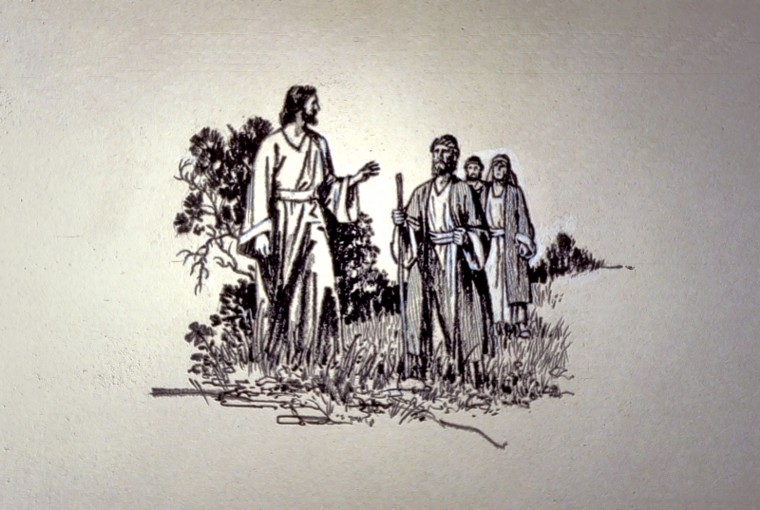
Jesus' disciples followed Him wherever he went, listening to Him and learning from Him. When He returned to heaven, they would lead the building of His church.

Jesus’ disciples followed Him wherever he went, listening to Him and learning from Him. When He returned to heaven, they would lead the building of His church.

In this part of the chapter, we get to see a side of Jesus that we rarely are privileged to see – and so do the disciples! We see here a very real and human connection with these excited disciples. The seventy (or seventy-two) return from the mission Jesus had sent them on, “filled with joy.” They excitedly told Jesus how they had even had authority over demons they had encountered among the people. Jesus states that He “saw Satan fall like lightning from heaven.”

It is unknown to us whether Jesus saw something in a vision while the seventy were about their work, but clearly He knew that what they were doing had diminished Satan’s power on earth. For His own reasons, God had allowed these demons to have much power over people in the time leading up to Jesus’ ministry. But this is the turning point. There would still be demon possessions during the apostolic age, but they would become much fewer in number as the lives on earth of the twelve came to an end. There is much we do not know about this subject, and there has been much speculation. But we must trust that God has told us what is important for us to know about it for now.

Jesus acknowledges the authority He has given them, and promises that nothing will hurt them (verse 19). But He stresses that what is important is the place they will have in heaven. But Jesus is obviously excited as well, and verse 21 says hat he “rejoiced in the Holy Spirit.” In His prayer to God, He praises Him for revealing these things that the disciples have seen to them instead of “the wise and understanding.” These were common ordinary people from all walks of life, yet God had seen fit to reveal to them what no others would see.

Elijah put his mantle or cloak on Elisha, showing him that he would succeed Elijah in his prophetic work (1 Kings 19:19-21)

Elijah put his mantle or cloak on Elisha, showing him that he would succeed Elijah in his prophetic work (1 Kings 19:19-21)

Jesus then turns to them and tells them that very thing – that they were blessed to see and hear what any of the prophets would have loved to have the privilege of witnessing. But none had that privilege. That blessing had been saved for these “children.” Jesus told His apostles in chapter 9 that he who is least will be great. Not one of us should think that we are not as important as others in His kingdom.

Christians must use the talents that each one has to do the most good for others that we can do. The elderly couple who visits the sick…the soccer Mom who cooks meals for shut-ins..the woman who teaches preschoolers Bible class…and those who send cards of encouragement or sympathy to their brothers and sisters. All of these are just as important as one who serves as a missionary in a foreign land.

(This year’s reading plan for Luke, Acts, and 1 and 2 Chronicles averages just 15 verses per day – 5 days per week!)
Schedule for this week
Read or listen to audio of today’s selection from Luke here
Read or listen to audio of today’s selection from 1 Chronicles here

/Bob’s boy
___________________
some images © V. Gilbert & Arlisle F. Beers

Please note: I did not design the reading plan that I am following in my blog.  All of my comments in this blog, however, are solely my responsibility.  When reading ANY commentary, you should ALWAYS refer first to the scripture, which is God’s unchanging and unfailing word. Reading schedules, as well as a link to the site where you can get the reading plan that I’m currently following for yourself can be found on the “Bible Reading Schedules” page of my website at http://graceofourlord.com.  


Enhanced by Zemanta

Who Hears You, Hears Me – (Luke 10)

Old Oil-press in Korazim Israel.

Old Oil-press in Korazim Israel. (Photo credit: Wikipedia)

We need look no further than the first verse in the tenth chapter of Luke for an example of minor manuscript differences. A great number of manuscripts that are very old and reliably used for translation state that Jesus sent out seventy others to go into the towns on His way to Jerusalem. But then many others that are very old and reliably used say that it was “seventy and two.” Either way, the gospel message is unaffected by the number.

In the same manner in which Jesus sent out the twelve apostles in chapter 9, He now sends out this group, telling them to go now and as they are – just as He told the twelve.  The statement that He was sending them out as sheep in the midst of wolves referred to the persecution that they were bound to encounter in some places. But in addition to the urgency of the mission, it could be that the command not to carry any possessions with them – including a money bag – had also to do with the dangers of being robbed and beaten. Such could happen even today for a pair of shoes.

The Destruction Of Sodom And Gomorrah, a paint...

The Destruction Of Sodom And Gomorrah, a painting by John Martin (painter), died 1854, thus 100 years. (Photo credit: Wikipedia)

Jesus tells them that if people receive them in a town, they are to eat what is set before them. This would be important for Him to say to them, since they would likely encounter Gentiles, as well as Jews. They were to heal the sick, as Jesus had given them authority and power over demons and disease as well. But regardless of whether they were well received or not, they were to tell the people who the kingdom of God has come near to them. Wherever they were not received, they were to “shake the dust” from their feet – and tell the people they were doing so.

He tells them that it will be better for Sodom and Gomorrah than for those who reject them which, one supposes, could be somewhat metaphoric. But He also says that Tyre and Sidon would have repented if they had seen the wonders He performed in Bethsaida and Chorazin, suggesting that there had been some rejection in the latter two towns that we are not told about in any of the gospels. He also includes Capernaum in these “curses” for lack of faith. Capernaum is just ruins now, some ruins have been excavated at Chorazin, but the location of Bethsaida is not agreed upon by all, so complete was its extinction.

Jesus told them: “The one who hears you hears me, and the one who rejects you rejects me, and the one who rejects me rejects him who sent me.”

(This year’s reading plan for Luke, Acts, and 1 and 2 Chronicles averages just 15 verses per day – 5 days per week!)
Schedule for this week
Read or listen to audio of today’s selection from Luke here
Read or listen to audio of today’s selection from 1 Chronicles here

/Bob’s boy
___________________
some images © V. Gilbert & Arlisle F. Beers

Please note: I did not design the reading plan that I am following in my blog.  All of my comments in this blog, however, are solely my responsibility.  When reading ANY commentary, you should ALWAYS refer first to the scripture, which is God’s unchanging and unfailing word. Reading schedules, as well as a link to the site where you can get the reading plan that I’m currently following for yourself can be found on the “Bible Reading Schedules” page of my website at http://graceofourlord.com.  
Enhanced by Zemanta

Do Not Grow Weary – (2 Thessalonians)

Paul’s second letter to the brethren at Thessalonica was probably written from Corinth about 49-51 A.D., shortly after his first letter. The reason for the second letter could be a sense of urgency because someone was sending letters to the church at certain locations falsely claiming to be from Paul or another apostle. Consider 2 Thessalonians 2:1-2:

“Now concerning the coming of our Lord Jesus Christ and our being gathered together to him, we ask you, brothers, not to be quickly shaken in mind or alarmed, either by a spirit or a spoken word, or a letter seeming to be from us, to the effect that the day of the Lord has come.”

Thessalonica

Thessalonica

Further evidence of this is found in 2 Thessalonians 3:17, where Paul closes the letter with: “I, Paul, write this greeting with my own hand. This is the sign of genuineness in every letter of mine; it is the way I write. The grace of our Lord Jesus Christ be with you all.” Such a wicked and cruel deception was probably done by someone simply wishing to discourage Gentiles from Christianity, or by someone whose only intention was to harm the church. Either way, the latter was the effect, of course.

We know that the Thessalonians already had some distress because in the first letter, Paul had needed to reassure them. False teachers had made them to grieve for those who had already “fallen asleep,” thinking that they were gone forever – that only those alive when Jesus returned would be taken to heaven. Paul devotes 1 Thessalonians 4:13-18 to explain to them concerning this. And just as in 1 Thessalonians, the bulk of this letter is geared toward the second coming of Jesus.

It seems now they had fallen prey to the idea that the second coming had already occurred, and they were very afraid of being left behind. To make matters worse, they were being persecuted – and that in itself just made these fears worse. It may be that this was the cause of another problem Paul addresses in the letter. In 2 Thessalonians 3:6-15, he spends some time speaking about reports he had received that there were those among them that had stopped working, and so they were sponging off of others and generally becoming “busybodies” in their idleness. Perhaps this false notion of the second coming had something to do with this problem.

Paul’s message was that unbelievers will be condemned, and the righteous will be saved when Jesus does return, and there will not be any that are not included. And of course, Christians should not take advantage of the charitable character of their fellow Christians, and should “not grow weary in doing good.”

(This year’s reading plan for Luke, Acts, and 1 and 2 Chronicles averages just 15 verses per day – 5 days per week!)
Schedule for this week

/Bob’s boy
___________________
some images © V. Gilbert & Arlisle F. Beers

Please note: I did not design the reading plan that I am following in my blog.  All of my comments in this blog, however, are solely my responsibility.  When reading ANY commentary, you should ALWAYS refer first to the scripture, which is God’s unchanging and unfailing word. Reading schedules, as well as a link to the site where you can get the reading plan that I’m currently following for yourself can be found on the “Bible Reading Schedules” page of my website at http://graceofourlord.com.

Enhanced by Zemanta

King David’s Favor With God (1 Chronicles 17-18)

English: Nathan advises King David

English: Nathan advises King David (Photo credit: Wikipedia)

It was important for the chronicler to communicate well the events of I Chronicles 17 to the post-exilic Jews because it contains the covenant of God with David. Covered first in 2 Samuel 7, it begins with David wanting to build God a house. But God tells Nathan the prophet to let David know that it would not be him that builds such a house. Instead, God promises that He would build David’s “house” – that David’s offspring (Jesus) would reign forever.

In answer to God’s covenant, David makes a prayer to God (verses 16-27). It is one of the longest prayers in the bible, and incredibly humble and heartfelt. It begins with “Who am I, O Lord God, and what is my house, that you have brought me thus far?” They are words that each of us should ask God in prayer as well. The blessings that He has given us and the promises He has made to us are no less magnificent and undeserved that those made to David.

Hama

Hama (Photo credit: Wikipedia)

Chapter 18 contains some stunning military victories, some of which were reported in 2 Samuel 8. Here, David defeats the Philistines, and also takes Gath. The Moabites are defeated and become servants to David. He also “defeated Hadadezer king of Zobah-Hamath, as he went to set up his monument at the river Euphrates.” The plunder he took from the cities of Hadadezer included 1,000 chariots, 7,000 horsemen, and 20,000 foot soldiers, and shields made of gold.

In addition, verse 9 tells us that Tou king of Hamath was so pleased when he heard of the defeat of Hadadezer that he sent his son with gifts of gold, silver and bronze that Solomon would later use in building the pillars and the sea, and the bronze vessels for the temple.  Hamath is associated with modern Hama, which is located on the Orontes River in western Syria. There is an article with a picture there of a noria (a machine for lifting water into an aqueduct) at this link to Ferrell’s Travel Blog. We also recommend this article at BiblePlaces.com and this one at BiblicalArcheology.org for information on discoveries related to Tou (also called Toi and possibly Taita).

The victories continue against the Syrians and 18,000 Edomites in the Valley of Salt. And the text says that God gave victory to him wherever he went. Verses 14-17 detail how just and fair David was as a ruler, and how stable and well-organized his administration was. Joab was established as military commander, and “Jehoshaphat the son of Ahilud was recorder; and Zadok the son of Ahitub and Ahimelech the son of Abiathar were priests; and Shavsha was secretary; and Benaiah the son of Jehoiada was over the Cherethites and the Pelethites; and David’s sons were the chief officials in the service of the king.”

(This year’s reading plan for Luke, Acts, and 1 and 2 Chronicles averages just 15 verses per day – 5 days per week!)
Schedule for this week
Read or listen to audio of today’s selection from Luke here
Read or listen to audio of today’s selection from 1 Chronicles here

/Bob’s boy
___________________
some images © V. Gilbert & Arlisle F. Beers

Please note: I did not design the reading plan that I am following in my blog.  All of my comments in this blog, however, are solely my responsibility.  When reading ANY commentary, you should ALWAYS refer first to the scripture, which is God’s unchanging and unfailing word. Reading schedules, as well as a link to the site where you can get the reading plan that I’m currently following for yourself can be found on the “Bible Reading Schedules” page of my website at http://graceofourlord.com.  

Enhanced by Zemanta

Hands on the Plow – (Luke 9)

In verse 37, Jesus comes down from the mountain after the transfiguration, and is again met by a crowd. But there was a man there whose son had been possessed by a demon since early childhood. This account is in all three synoptic gospels (Matthew 17:14-20, Mark 9:14-29), and reading them all helps to clarify. The symptoms the boy had have led some to conclude that he had epilepsy, but that is clearly not the case. And we certainly know that Jesus would know the difference between a disease and this demon.

Christ healing a boy with a demon

Christ healing a boy with a demon

This one is evidently a singularly malevolent demon, and the man tells Jesus that His disciples had been unable to cast it out. In verse one, we are told that Jesus “called the twelve together and gave them power and authority over all demons.” So Jesus’ remarks about faith are on target. In Mark, he tells them that this kind can only be driven out by prayer. It is the building of their faith through prayer that would have made the difference; and this is a point that Mark’s account expounds on. We may never have enough faith to move mountains, but together with the power Jesus had given them, His apostles certainly had it within reach!

As the disciples were excitedly regarding all these things He had done, Jesus again talks about His impending death, saying Let these words sink into your ears: The Son of Man is about to be delivered into the hands of men.” As Jesus well knows, they aren’t getting it. And the next verse lets us know that they are not supposed to “get it” yet really. Verse 45 says “But they did not understand this saying, and it was concealed from them, so that they might not perceive it. And they were afraid to ask him about this saying.” All of this would come together for them after Pentecost.

It is nearly comical that just after their failure of faith, the disciples begin arguing about which of them is “the greatest.” They do not yet understand what Jesus’ true mission is, nor what is to become of Him. They only imagine how prominently they will fit into His kingdom. The child He brings by His side in verse 47 illustrates that having proper regard for one so small in stature and station is akin to having regard for Jesus – and thus for God. Therefore, He tells them, whoever is “least” among them is the greatest. The meaning here is of being least in regard for one’s self. Putting one’s self last and others first is the message Jesus has hammered home again and again.

“No one who puts his hand to the plow and looks back is fit for the kingdom of God.” Luke 9:62

“No one who puts his hand to the plow and looks back is fit for the kingdom of God.” Luke 9:62

Jesus was rejected on the next part of their journey by a Samaritan village because “his face was set toward Jerusalem” (Jews and Samaritans had little regard for each other). The disciples wanted to cause  “fire to come down from heaven and consume them,” which again is almost comical considering recent events. One gets the idea they were becoming a bit “puffed up.” Jesus, of course, rebukes them for even asking such a thing.

Verses 57-62 speak of some who wanted to follow Jesus but had other matters to attend to. Jesus’ answers to them reflect the fact that He must move quickly, and much is left to do. This meant that those who would be physically following Him must make doing so the singular priority in their lives right away, due to that urgency. Now, we are not expected to fore-go even attending our parent’s funeral in order to serve the Lord. But the application to our lives is nonetheless clear. Once we become Christians, that commitment in our lives trumps everything.

(This year’s reading plan for Luke, Acts, and 1 and 2 Chronicles averages just 15 verses per day – 5 days per week!)
Schedule for this week
Read or listen to audio of today’s selection from Luke here
Read or listen to audio of today’s selection from 1 Chronicles here

/Bob’s boy
___________________
some images © V. Gilbert & Arlisle F. Beers

Please note: I did not design the reading plan that I am following in my blog.  All of my comments in this blog, however, are solely my responsibility.  When reading ANY commentary, you should ALWAYS refer first to the scripture, which is God’s unchanging and unfailing word. Reading schedules, as well as a link to the site where you can get the reading plan that I’m currently following for yourself can be found on the “Bible Reading Schedules” page of my website at http://graceofourlord.com.  

Enhanced by Zemanta

On Transfiguration, Revelation, and Crosses – Luke 9

The ninth chapter of Luke is not the longest chapter of this gospel, but there is a great deal going on in it as Luke picks up the pace in his account. After the feeding of the five thousand, we pick up in verse 18 with Jesus asking the disciples who people are saying that He is. Their answer is that they either say He is John the baptist, Elijah, or one of the other prophets (so in all cases, one raised from the dead). So the bulk of people that are referred to here are familiar enough with the signs and wonders that Jesus has done to know that He is definitely not some ordinary man. And in each case, they obviously believe that He was sent from God.

Jesus is transfigured on a mountain. Moses and Elijah join him, while Peter, James and John watch--Matthew 17 1-13; Mark 9 1-13; Luke 9 28-36.

Jesus is transfigured on a mountain. Moses and Elijah join him, while Peter, James and John watch–Matthew 17 1-13; Mark 9 1-13; Luke 9 28-36.

But now that Jesus has His disciples thinking about this, He wants to know what they have come to think about who He is. It is here that Luke records the fact that it was Peter who first spoke the correct answer – that He is the Christ (the long-awaited Messiah) and the Son of God. In verse 21, Jesus “strictly charged and commanded them” not to tell anyone else. But why is that? The Bible does not explicitly answer that question for us, but it is really not too difficult to figure out the answer from the other information we have in the Scripture.

Given the fact that the people, by and large, already believe that Jesus was sent from God, it would be very easy for most of them to believe that He is the Messiah, once that word started spreading. But what would the reaction be? Given also that Jesus knew that the sort of Messiah they were expecting was one that would lead them to the end of Roman dominance and lead Israel to its former place as a world power, belief in Him as the Messiah before His death could be problematic.

The crowds (5,000 men plus women and children most recently) had become vast in numbers. An expectation that Jesus was there to be their earthly king would result in chaos. It is in this light that Jesus tells them in verse 22 that He must “suffer many things and be rejected by the elders and chief priests and scribes, and be killed, and on the third day be raised.” Nothing could be allowed to hinder this – and it would happen on God’s timetable.

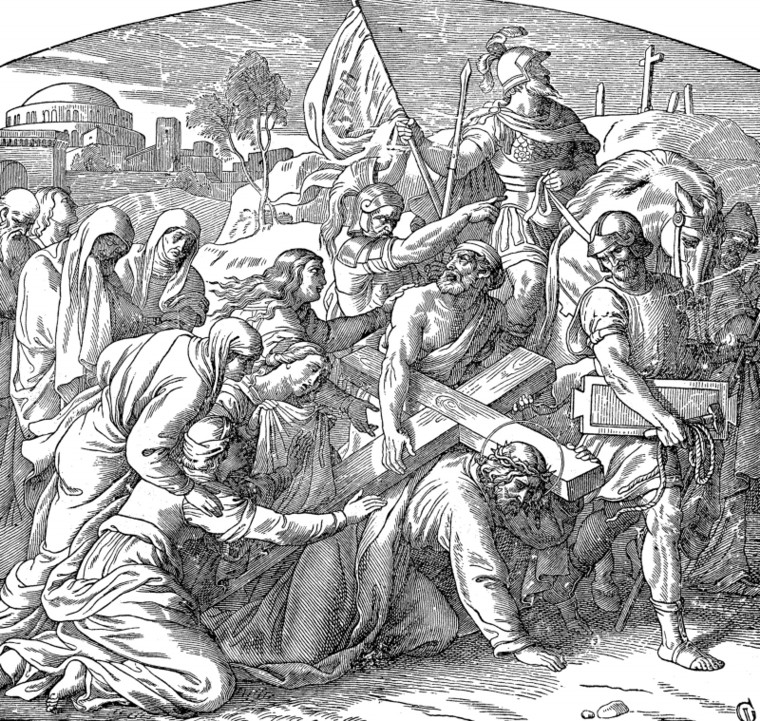
Simon of Cyrene is compelled to carry Jesus' cross

Simon of Cyrene is compelled to carry Jesus’ cross

In verse 23, Jesus talks to the disciples about what it will mean to follow Him. He speaks of it as “taking up” one’s cross and following Him. The context of the next few verses culminates with the statement that some of those present at that very moment would not “taste of death” before they see the kingdom of God. Being a disciple and following Him before such time would not have been an easy thing to do. But Jesus seems to be referring to the cost of following Him after He has risen, and the kingdom has been established.

Taking up one’s cross would mean bearing the burdens that discipleship that just might make life a great deal more difficult. Indeed, many of those first-century Christians would know persecution and suffering unimaginable to us. Jesus knew that many would even be killed for being a part of that kingdom. But those who would lose their lives would gain everlasting life with God. Those who would rather be safe and pursue worldly pleasure and gain, turning their backs on the kingdom, would suffer a worse fate in the end.  In a very real sense, taking up one’s cross often means doing what one would much rather not do.

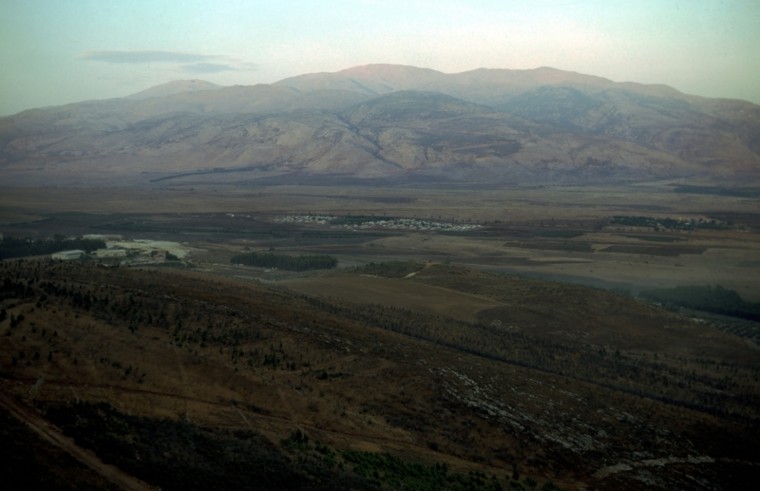
Eight days later, Jesus took Peter, James, and John with Him to “the mountain” to pray. Which mountain it was, we do not know. One traditional belief is that it was Mount Hermon because of its height. It is estimated that this mountain is about 45 kilometers from Capernaum, so it is definitely possible. Others believe that it was Mount Tabor. But the mountain is not the focus of the gospel in verses 28-36.

Mount Hermon is one traditional site for Jesus' transfiguration

Mount Hermon is one traditional site for Jesus’ transfiguration

As Jesus was praying, “the appearance of his face was altered, and his clothing became dazzling white.” We are not given much detail about just what was happening or in what way His face was altered. But clearly, the Holy Spirit brought about some changes to Him that were important to God’s plan. Peter and the others woke from a deep sleep to see two men talking with Him (Moses and Elijah). Luke says that they appeared in “glory” and they saw Jesus’ glory as He spoke with them. This is a term that was used in the Old Testament to describe the dramatic visual effect of the presence of God; and that is exactly what was going on here as well.

Peter, either having it revealed to him or learning from what he heard, knew who the two men were. But he did not understand what was happening, as he suggested they make some extra tents for them.  They became afraid as a cloud came and surrounded them. Then the voice of God sounded out as He told them “This is my Son, my Chosen One; listen to him!” Peter, James, and John probably would not fully understand until after Pentecost, but the point for them (and for us) was made when Moses and Elijah left, and Jesus alone was standing there. God was telling them that it was the words of His Son that they would listen to from now on – not Moses, and not the prophets.

Another point to ponder from the record of the transfiguration is the fact that Moses had died hundreds of years ago (Deuteronomy 34:5). Elijah had been taken up by God many “lifetimes” ago (2 Kings 2:1-12).  What does this tell us about life after death and everlasting life? It certainly tells us that we can count on God’s word, as always. But what conclusions should we draw from Moses’ presence? Something to ponder for perhaps another time.

(This year’s reading plan for Luke, Acts, and 1 and 2 Chronicles averages just 15 verses per day – 5 days per week!)
Schedule for this week
Read or listen to audio of today’s selection from Luke here
Read or listen to audio of today’s selection from 1 Chronicles here

/Bob’s boy
___________________
some images © V. Gilbert & Arlisle F. Beers

Please note: I did not design the reading plan that I am following in my blog.  All of my comments in this blog, however, are solely my responsibility.  When reading ANY commentary, you should ALWAYS refer first to the scripture, which is God’s unchanging and unfailing word. Reading schedules, as well as a link to the site where you can get the reading plan that I’m currently following for yourself can be found on the “Bible Reading Schedules” page of my website at http://graceofourlord.com.  

Enhanced by Zemanta