David Becomes King

In 1 Chronicles 11, all of the elders of Israel come to Hebron to meet with David following the death of Saul, and David is anointed king “according to the word of the Lord by Samuel” (1 Samuel 16:6-13). Then in verse 4, it immediately picks up with David and his troops going to “Jebus,” which is Jeusalem – which is occupied by the Jebusites. We are first told that the land of the Jebusites is Jerusalem back in Joshua 15:8, where the boundaries for the tribe of Judah are laid out in detail, as the Promised Land gets divided among the tribes. It is during this successful campaign upon what will become “the City of David,” that “Joab the son of Zeruiah” becomes commander of David’s army. This is because he took David up on his offer to make chief of the one who strikes first at the Jebusites.

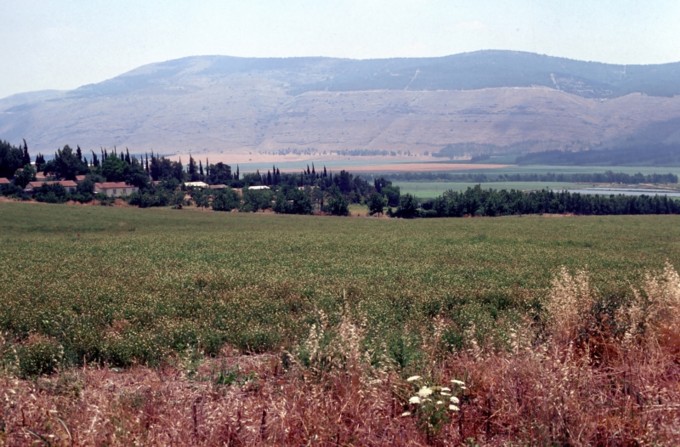
Valley_of_Rephaim_0114Beginning in verse 10, the chronicler introduces David’s “mighty men,” which we will read more about in chapter 12. There is some debate about the number (some count 37 as being named here). But generally, it seems that the main group of his mighty men were referred to as “the thirty,” and at same point, this number becomes a name for them despite the actual number (just as the apostles were referred to as “the twelve”). However, although there were those in the thirty that were regarded as “chiefs,” and greater than the others, there were three that were very special. Of the three, the foremost was Jashobeam, who is listed again in 1 Chronicles 27 as leader of a military division. It is supposed that as members of “the thirty” died, they were replaced with others, which made this an evolving list.

In verses 15-19, as the Philistines were camped in the Valley of Rephaim, their garrison was at Bethlehem. David remarked that he would love to have water from the well at Bethlehem. When three of the mighty men broke through the camp of the Philistines and brought back the water to David, he poured it out as an offering to the Lord – refusing to drink something obtained by such bravery by his men.

(This year’s reading plan for Luke, Acts, and 1 and 2 Chronicles averages just 15 verses per day – 5 days per week!)
Schedule for this week
Read or listen to audio of today’s selection from Luke here
Read or listen to audio of today’s selection from 1 Chronicles here

/Bob’s boy
___________________
some images © V. Gilbert & Arlisle F. Beers

Please note: I did not design the reading plan that I am following in my blog.  All of my comments in this blog, however, are solely my responsibility.  When reading ANY commentary, you should ALWAYS refer first to the scripture, which is God’s unchanging and unfailing word. Reading schedules, as well as a link to the site where you can get the reading plan that I’m currently following for yourself can be found on the “Bible Reading Schedules” page of my website at http://graceofourlord.com.  

Enhanced by Zemanta

Down To Capernaum

After Jesus left Nazareth in Luke 4, he went down to Capernaum. Here Luke mentions that Capernaum was in Galilee, which of course was for the benefit of Theophilus (and any Gentile reader), where He was teaching people on the Sabbath. Luke said that they were “astonished” at His teaching because His word “possessed authority.” This was an appropriate assessment, as it was a case of the word of God being taught by the Lord. It is with that same authority that He commands an unclean spirit to come out of a man in the synagogue, and the people marvel at that as well. And verse 37 says that “reports about him went out into every place in the surrounding region.”

Capernaum, Sea of Galilee

Capernaum, Sea of Galilee (Photo credit: Wikipedia)

In verse 38, Jesus goes to the home of  Peter, whose mother-in-law is very ill with a high fever. Here, he shows His authority over even sickness, as the scripture says He “stood over her and rebuked the fever, and it left her, and immediately she rose and began to serve them.” It is here that we learn that the “reports” about Him that are mentioned in verse 37 have caused a great many people to bring their sick and diseased relatives to Jesus to be healed; and He heals them all (verse 40).  We are also told that demons came out of many, and that they knew He was the Son of God. But Jesus rebuked them. He was not ready for this fact to become known far and wide.

The verses here in Luke and in other parts of the Gospels concerning demons can be difficult for us to understand because such things are so foreign to our experience. But there is much we do not know about where spirits and demons are concerned. For whatever reason, God allowed these spirits to dwell in and among many people just prior to and after Jesus’s time here on earth. We have some opinions about that, which we wrote about here in this article. Hopefully, that may be helpful to you in understanding better, but remember, it is just an opinion – hopefully, an informed opinion, but an opinion, just the same.

Verse 42, says that when it was day, He departed and went to a “desolate place.” This implies that He must have spent all night – from sunset on (see verse 40)  healing people. This verse indicates that He was tired and needed time alone. The people did not want Him to go, and went looking for Him. Verse 43 gives His response: “I must preach the good news of the kingdom of God to the other towns as well; for I was sent for this purpose.” And in verse 44, He begins preaching in synagogues throughout Judea.

For two good articles with pictures of Capernaum, please see this article with an aerial photo and this article with a picture of a partially reconstructed synagogue from Ferrell’s Travel Blog.

(This year’s reading plan for Luke, Acts, and 1 and 2 Chronicles averages just 15 verses per day – 5 days per week!)
Schedule for this week
Read or listen to audio of today’s selection from Luke here
Read or listen to audio of today’s selection from 1 Chronicles here

/Bob’s boy
___________________
some images © V. Gilbert & Arlisle F. Beers

Please note: I did not design the reading plan that I am following in my blog.  All of my comments in this blog, however, are solely my responsibility.  When reading ANY commentary, you should ALWAYS refer first to the scripture, which is God’s unchanging and unfailing word. Reading schedules, as well as a link to the site where you can get the reading plan that I’m currently following for yourself can be found on the “Bible Reading Schedules” page of my website at http://graceofourlord.com.  

Enhanced by Zemanta

The Rejected Servant

Not surprisingly, the rejection of Jesus in Luke 4 (beginning in verse 16) is often mistaken as being the same event as the one written about in Matthew 13:54-58 and Mark 6:1-6. Both the Luke event and the one in Matthew and Mark took place in His home town of Nazareth. But the one in Luke took place at the beginning of Jesus’ ministry.

Recall that the rejection written about by Matthew and Mark occurred after Jesus had explained the parables to his disciples (Matthew 13:36-52). It should not be surprising to us that Jesus would go back there, much less that he would be trying to teach them when he did. That second rejection was fairly uneventful, relatively speaking. This first rejection in Nazareth, however, resulted in a mob attempting to kill him.

After his temptations in the wilderness, Jesus returned  to Galilee, and the word was spreading about him. He taught in the synagogues, and verse 15 says He was “being glorified by all.”  Then we find Jesus in Nazareth in the synagogue on the Sabbath. Luke says that this was His custom, which is, of course, what we would expect.  He stood up to read, and the scroll of Isaiah was given to Him.  He quoted from Isaiah 61:1-2, which is part of what is known as the fifth “servant song” in Isaiah. This one would seem to speak to those returning from exile at the time Isaiah wrote it. And at first (although all eyes were on Him after reading it), many of those in the synagogue appeared not to “get it” at first.

Then, as understanding began to come to them, some reminded others that He was Joseph’s son. Jesus perceived the way they were headed, telling them that “no prophet is acceptable in his hometown.” He then cites 1 Kings 17:9, where Elijah (during the famine) was sent to the Gentile widow in Sidon. Next, He refers to 2 Kings 5:1-14, where (though there were plenty of lepers in Israel in Elisha’s time), only Naaman of Syria was cleansed.  The point of referring to these incidents was to underscore the unbelief that was widespread in Israel at the time, and the contrasting faith shown by these Gentiles.

Filled with rage, the people drove Him out to the edge of the hill on which the town was built, intending to throw Him down. It was the same murderous rage that nearly got Paul killed in Acts 22:17-22, as he also referred to Gentiles. But this was not the time for Jesus to be murdered, and so verse 30 says that He went away, “passing through their midst.”

(This year’s reading plan for Luke, Acts, and 1 and 2 Chronicles averages just 15 verses per day – 5 days per week!)
Schedule for this week
Read or listen to audio of today’s selection from Luke here
Read or listen to audio of today’s selection from 1 Chronicles here

/Bob’s boy
___________________
some images © V. Gilbert & Arlisle F. Beers

Please note: I did not design the reading plan that I am following in my blog.  All of my comments in this blog, however, are solely my responsibility.  When reading ANY commentary, you should ALWAYS refer first to the scripture, which is God’s unchanging and unfailing word. Reading schedules, as well as a link to the site where you can get the reading plan that I’m currently following for yourself can be found on the “Bible Reading Schedules” page of my website at http://graceofourlord.com.  
Enhanced by Zemanta

The End of Saul’s Royal Line – 1 Chronicles 10

The 10th chapter of 1 Chronicles covers the reign of Saul as king of Israel. Well, at least it “chronicles” the end of his reign. The chapter is only 13 verses long, and begins with Saul’s final battle with the Philistines at Mount Gilboa. It was there that Saul and his sons Jonathan, Abinadab, and Malchi-shua died. The story is first told in 1 Samuel 31, but we are given a few additional details here as well.

Mount Gilboa, site of Saul's last battle

Mount Gilboa, site of Saul’s last battle

After Saul fell on his sword, the Philistines took his head and “fastened” it in the temple of Dagon.  No explanation of that is given, and perhaps none is needed. Dagon was the Philistines’ fish-god, the idol of which God made some rather humorous sport in 1 Samuel 5, when the Philistines had captured the Ark of the Covenant and placed it in the house of Dagon. The men of Jabesh-gilead (which Saul had rescued at the beginning of his reign in 1 Samuel 11) learned of Saul’s fate, and rescued and buried the bodies of Saul and his sons.

In verses 13-14, the chronicler says that Saul died for “his breach of faith,” and tells of his disobedience and of consulting a medium for guidance instead of seeking guidance from the Lord. So, the last words written of Saul were “therefore the Lord put him to death and turned the kingdom over to David the son of Jesse.”

And so, the rest of the Books of Chronicles begins in chapter 11 with the reign of David and his descendants.

(This year’s reading plan for Luke, Acts, and 1 and 2 Chronicles averages just 15 verses per day – 5 days per week!)
Schedule for this week
Read or listen to audio of today’s selection from Luke here
Read or listen to audio of today’s selection from 1 Chronicles here

/Bob’s boy
___________________
some images © V. Gilbert & Arlisle F. Beers

Please note: I did not design the reading plan that I am following in my blog.  All of my comments in this blog, however, are solely my responsibility.  When reading ANY commentary, you should ALWAYS refer first to the scripture, which is God’s unchanging and unfailing word. Reading schedules, as well as a link to the site where you can get the reading plan that I’m currently following for yourself can be found on the “Bible Reading Schedules” page of my website at http://graceofourlord.com.  

Enhanced by Zemanta

The Tempting of Jesus

As Luke chapter four opens, Jesus is just returning from the Jordan River and His baptism, filled with the Holy Spirit. And it was the Spirit, Luke tells us, that led Him into the wilderness for 40 days, where He was tempted by the devil. The 40 days reminds us of the 40 days that Moses went without food in Exodus 34:28, as well as the 40 years that the Israelites spent wandering in the desert before entering the Promised Land (Numbers 14:34). The parallel with this latter seems significant. God provided manna for them daily, teaching them dependence on Him. The Spirit, it would seem, was leading Jesus to depend on faith that God would provide for Him. It was this faith that the devil was determined to derail.

There are those who have expressed the opinion that Jesus could not truly have sinned, since He was the Son of God. This opinion refers to what is called peccability,” from the Latin verb “peccare” – meaning to sin. If He had not been able to sin, there would have been no real temptation. But we know this to be false, as the Hebrew writer tells us in Hebrews 4:14-16.

The Temptation of Christ (detail)

The Temptation of Christ (detail) (Photo credit: Wikipedia)

John the baptist had indeed prepared the way for Him, and God knew that Jesus needed these tests. This was a great opportunity for Satan because he knew that Jesus’ ministry was about to begin. His hunger and weakness was very real after 40 days in the wilderness. The temptation to deviate from the Spirit’s direction and satisfy His own hunger would be great. Then Satan showed Jesus a large portion of what must have been the Roman Empire (the “kingdoms of the world” in verse 5) that could be under his authority if he would simply bow down to him. The last temptation would have made Jesus famous throughout the land, and nobody would have been able to doubt His greatness after throwing Himself down from the Temple. And after all, would God really allow harm to come to Him?

One of the lessons we can learn from these temptations that Jesus was able to overcome can be seen by looking at how Jesus answered the devil. In each case, he used the Scriptures to answer (Deuteronomy 8:3, Deuteronomy 6:13, and Deuteronomy 6:16). Jesus showed us that our best defense against temptations is a thorough knowledge of God’s word. By reading and studying the Bible, we come closer to God, and His word gives us the answers – the knowledge and understanding to get through the trials of this world.

(This year’s reading plan for Luke, Acts, and 1 and 2 Chronicles averages just 15 verses per day – 5 days per week!)
Schedule for this week
Read or listen to audio of today’s selection from Luke here
Read or listen to audio of today’s selection from 1 Chronicles here

/Bob’s boy
___________________
some images © V. Gilbert & Arlisle F. Beers

All of my comments in this blog, however, are solely my responsibility.  When reading ANY commentary, you should ALWAYS refer first to the scripture, which is God’s unchanging and unfailing word. Reading schedules can be found on the “Bible Reading Schedules” page of my website at http://graceofourlord.com.

Enhanced by Zemanta

Faith Based on Reason – Hittite Accuracy

Every word of God proves true; he is a shield to those who take refuge in him.
Do not add to his words, lest he rebuke you and you be found a liar.

Proverbs 30:5-6

As someone who has spent a substantial number of hours studying in the area of apologetics, the lack of respect by some people for the Bible as a historical source is a source of some irritation for me. Take the Apostle Paul, for example. A question I read recently about evidence for the existence of the man who wrote 13 of the 27 books of the New Testament, was answered by citing Clement of Rome’s letter to the church in Corinth in 95 C.E.  and Iraneus’s “Against Heresies” (written about 175 – 185 C.E.), among others. And yes, these are excellent secular examples of confirmation of what any Biblical scholar already knows about Paul. But personally, I prefer to refer to Luke’s account of his conversion, missionary journeys, etc. in the Book of Acts, or to Peter’s reference to him in 2 Peter 3:14-16.

Archaeologist Prof. Nelson Glueck in Israel, 1956

Archaeologist Prof. Nelson Glueck in Israel, 1956 (Photo credit: Wikipedia)

Seriously, I do understand the desire to find extra-biblical sources that confirm what is written in the Bible. It is comforting for the believer, and can be used as a tool in apologetics – if used correctly. But as Christians, we can be confident in what is written in the bible. We fully stand behind the famous words of one of the greatest archaeologists of the twentieth century, Nelson Glueck. In his book entitled “Rivers In the Desert: A History of the Negev,” he wrote “it may be stated categorically that no archaeological discovery has ever controverted a Biblical reference. Scores of archaeological findings have been made which confirm in clear outline or in exact detail historical statements in the Bible. And, by the same token, proper evaluation of biblical descriptions has often led to amazing discoveries. They form tesserae in the vast mosaic of the Bible’s almost incredibly correct historical memory”(p. 31).

In fact, the Bible is so reliable historically that any reference to an event, place, or date in the Bible that can be checked for accuracy in modern times has always ultimately stood the test. And you had better believe that many have tried very hard to disprove any part of it that they can. If it were just a matter of a few instances of proven facts, they could be explained away as simply some correct details being inserted into an otherwise flawed literary work. But when one begins to string hundreds of such instances together, the overwhelming weight of such evidence makes the divinely inspired nature of the Bible quite obvious.

For the rest of our time here, let us examine just one such instance. The Bible mentions the Hittite people over and over again in the Old Testament. They are first mentioned in Genesis 15:20 and can be found in all five of the Books of Law, and throughout the Books of History (for example, 2 Kings 7:6). But as recently as the 1800’s, skeptics claimed that the Hittites were a purely fictional product of the Bible because no secular evidence had ever been found that they even existed.

English: An ancient Hittite rhyton on display ...

English: An ancient Hittite rhyton on display at the Metropolitan Museum of Art, New York. (Photo credit: Wikipedia)

Then in 1882, Archibald Henry Sayce, a British philologist (the study of language in written historical sources), announced in a lecture to the Biblical Archaeology Society in London that not only had the Hittites existed, but that they could be described as the people of a lost empire. He believed that Boğazkale, a province of the Black Sea region of Turkey, was the capital of this empire. In 1906, Hugo Winckler, a German archaeologist and historian, excavated Boğazkale along with Ottoman Greek archaeologist Theodore Makridi Bey for 6 years, proving that the city was indeed part of a once great empire. Among the finds there, were more than 10,000 clay tablets, written in the Hittite language, that once deciphered, allowed them to begin dating the Hittites back to the 14th century B.C.

Again, this is but one example of such confirmation (and yes, vindication) of Biblical historicity. But it serves very well to emphasize the point made by the Apostle Peter as he quoted Isaiah 40:8 in 1 Peter 1:24-25: “The grass withers, the flower fades, but the word of our God will stand forever.”

(This year’s reading plan for Luke, Acts, and 1 and 2 Chronicles averages just 15 verses per day – 5 days per week!)
Schedule for this week

/Bob’s boy
___________________
some images © V. Gilbert & Arlisle F. Beers

Please note: I did not design the reading plan that I am following in my blog.  All of my comments in this blog, however, are solely my responsibility.  When reading ANY commentary, you should ALWAYS refer first to the scripture, which is God’s unchanging and unfailing word. Reading schedules, as well as a link to the site where you can get the reading plan that I’m currently following for yourself can be found on the “Bible Reading Schedules” page of my website at http://graceofourlord.com.  

Enhanced by Zemanta

Luke’s Controversial Genealogy

Verses 23-38 of Luke chapter 3 contain the genealogy of Jesus Christ. This genealogy differs from that contained in Matthew (Matthew 1:1-17) in a number of ways. In fact, the differences are so striking that the fact has generated considerable criticism from skeptics, as well as disagreement among scholars.


To begin with, the genealogy in Matt


Luke’s genealogy of Jesus, from the Book of Ke...

Luke’s genealogy of Jesus, from the Book of Kells, transcribed by Celtic monks circa 800 (Photo credit: Wikipedia)


hew goes forward, beginning from Abraham to David, then (through Solomon) on down to Joseph. The genealogy here in Luke goes backward – not to Solomon, but to Nathan, one of David’s other sons, and then all the way back to Adam. Clearly, the genealogy presented by Luke is that of Jesus’ mother, Mary.


Surprisingly though, there has been much scholarly resistance to this view, largely because it is Joseph that is named as the “son of Heli (Eli)” in verse 23. But the word “son” is often used quite loosely in the Bible. For example, a grandson, a great-grandson, or any descendant may be referred to as a “son” of a particular person (Jesus was called the Son of David by many – i.e. in Matthew 22:42). Use was made of the word “son” for a son-in-law as well (1 Samuel 24:16), especially where no male heir existed, as is believed to be the case with Mary and Heli. Some scholars explain this also with the significance of the absence of the article “the” (in the Greek) before Joseph’s name in Luke’s genealogy (Godet, Louis. A Commentary on the Gospel of St. Luke Edinburg: T&T Clark, 1893).


The second objection to the genealogy being through Mary’s blood line is that it would be a huge departure from Jewish tradition, where giving genealogies is concerned. This writer sees no problem with that for two important reasons. First, this is a very different genealogy, and the Holy Spirit had good reason for giving a second, very detailed genealogy of the Christ. One might think that breaking from tradition in giving that blood line might be expected, eh? Secondly, the Gospel of Luke (which, incidentally, was written in Greek – not Hebrew) was addressed to Gentiles, not really to Jews (specifically, of course, to Theophilus). Matthew was the Gospel that was written mainly for the benefit of Jews. In light of this, a departure from Jewish tradition in genealogies should not surprise us in the least.


Josiah - Jechoniah - Shealtiel

Josiah – Jechoniah – Shealtiel (Photo credit: Wikipedia)


Some also see the fact that Luke’s genealogy is through Mary’s line as an answer to the “Jeconiah objection.” As the last king of Judea before Babylonian captivity, Jeconiah was totally rejected by God, and Jeremiah 22:24-30 makes that rejection clear, saying that “none of his offspring shall succeed in sitting on the throne of David and ruling again in Judah.” In Matthew 1:12, we see that Jeconiah is in Joseph’s genealogy, so the argument goes that this fact disqualifies Jesus from being the Messiah. This, of course, is ridiculous because God obviously did not mean that no descendant would ever rule. That would have broken His covenant with David. And just a few verses later, in chapter 23 (Jeremiah 23:5) we get the rest of the story concerning Messianic prophecy:


“…the days are coming, declares the Lord, when I will raise up for David a righteous Branch, and he shall reign as king and deal wisely, and shall execute justice and righteousness in the land.”


Of course, Mary’s line includes a Zerubbabel and a Shealtiel in the genealogy given by Luke. But the Zerubbabel that 1 Chronicles 3:17-19 lists in Jeconiah’s line is the son of Pedaiah – not Shealtiel; and he doesn’t have a son named Rhesa. These certainly appear to be different people. Any internet search engine will tell you that Shealtiel is a family surname for many to this day, and Zerubbabel (meaning seed of Babylon) was likely not the name of just one man either, in light of the exile. So Mary’s line was not affected by the Jeconiah problem in the first place, and it is a moot point in the second place, proven by Jeremiah’s own prophecy.


But getting back to the beginning, Luke clearly lists a different heritage going through David’s son Nathan, rather than through Solomon, as Joseph’s line went. Luke’s words have stood the test of time in many areas that are beyond the scope of this subject. We should have no problem standing by his words here.


(This year’s reading plan for Luke, Acts, and 1 and 2 Chronicles averages just 15 verses per day – 5 days per week!)
Schedule for this week
Read or listen to audio of today’s selection from Luke here
Read or listen to audio of today’s selection from 1 Chronicles here


/Bob’s boy


___________________


some images © V. Gilbert & Arlisle F. Beers


All of my comments in this blog, however, are solely my responsibility.  When reading ANY commentary, you should ALWAYS refer first to the scripture, which is God’s unchanging and unfailing word. Reading schedules can be found on the “Bible Reading Schedules” page of my website at http://graceofourlord.com.


Enhanced by Zemanta

The Province of Yehud

As we come to the end of the genealogies of the first few chapters of 1 Chronicles, it should be apparent that beyond the main purpose that we discussed for preserving genealogies, there are other considerations. Although the exiles were free now, Judah (Yehud) was now just a small province of the Persian Empire. The meticulous detail that the chronicler documented also served to preserve a sense of heritage for the people that they desperately needed as a collective.

English: English translation of hebrew version...

English: English translation of hebrew version. Map of the twelve tribes of Israel, before the move of Dan to the North (Photo credit: Wikipedia)

Chapter 7 takes up just 40 verses to present some detail on the remaining tribes, and then chapter 8 begins with the genealogy of Saul from the tribe of Benjamin. Although Benjamin was already covered to some degree in chapter 7, this extra attention is warranted, not just because Saul came from that tribe. Together with the Levites, the tribes of Judah and Benjamin (along with some from Ephraim and Manasseh) make up the “lion’s share” of the post-exile core of Jerusalem (see Ezra 1:5, Nehemiah 11:4-9, 1 Chronicles 9:3).

Chapter 9 closes these genealogies with a reprisal of some of Saul’s roots, which account is preceded by some details of those who had various duties – particularly priests and Levites, with attention to gatekeepers, Levitical singers and musicians, and those with other temple duties.

With this section of the chronicles completed, we will begin next in chapter 10 with a very short chapter consisting of nothing more of Saul’s reign than its end. Then, the anointing of David as king will kick off the “meat and potatoes,” which is the rest of the Chronicles.

(This year’s reading plan for Luke, Acts, and 1 and 2 Chronicles averages just 15 verses per day – 5 days per week!)
Schedule for this week
Read or listen to audio of today’s selection from Luke here
Read or listen to audio of today’s selection from 1 Chronicles here

/Bob’s boy
___________________
some images © V. Gilbert & Arlisle F. Beers

All of my comments in this blog, however, are solely my responsibility.  When reading ANY commentary, you should ALWAYS refer first to the scripture, which is God’s unchanging and unfailing word. Reading schedules can be found on the “Bible Reading Schedules” page of my website at http://graceofourlord.com.

Enhanced by Zemanta

The Wheat and the Chaff

The baptisms performed by John the baptist, the truth in his preaching, and the authoritative warnings of the urgency of repentance were just some of the things that made the people who witnessed it all (and, no doubt, many who simply had heard about him) wonder if he was the Messiah that had been promised to come since the beginning (Genesis 3:15). Indeed, Luke 3:15 points out that many must have desperately wanted him to be “the one.” But verse 16 tells us how John answered that question:

“I baptize you with water, but he who is mightier than I is coming, the strap of whose sandals I am not worthy to untie. He will baptize you with the Holy Spirit and fire.”

Winnowing grain by tossing it into the wind so the chaff will blow away

Winnowing grain by tossing it into the wind so the chaff will blow away

The concept of being baptized with the Holy Spirit is fairly straightforward to us as Christians – followers of Christ, who have been baptized with true repentance have had their lives changed, and can be guided by the indwelling of the Holy Spirit. But what is meant by the statement that He will baptize with fire? The answer can be found in the following verse:

“His winnowing fork is in his hand, to clear his threshing floor and to gather the wheat into his barn, but the chaff he will burn with unquenchable fire.”

Rather than being something positive for Christ’s followers, the baptism by fire is the judgment for the unbelievers, with the unbelievers represented by “chaff” in that verse. Chaff is the dry, scaly, inedible casing of seed or grain. Before the invention of the threshing machine in the latter part of the 18th century, threshing was often done by placing the sheaves on the threshing floor and beating them or running over them. It was the most labor intensive part of the harvest. Afterward, the wheat would be separated by winnowing, often done with a winnowing fork by tossing the grain into the wind so that the chaff would be blown away. The chaff was often burned then to dispose of it.

The Baptism of Jesus

The Baptism of Jesus (Photo credit: Travis S.)

Luke then speaks in verse 18 of John’s distinction of being the first preacher of the “good news” of the kingdom of heaven – a very different sort of prophet from those who had come before him in the Old Testament. But not everyone was happy with the preaching of John the baptist (verse 19). Herod the Great’s son, Herod Antipas, had the title of “tetrarch,” which means “ruler of a quarter” (his father had divided Judea into districts, and he was given Galilee and Perea). He had divorced his first wife, and taken his brothers wife, Herodias. John’s condemnation of this and many evil acts done by the ruler resulted in Herod having him thrown in prison.

Verses 21-22 tell of Jesus submitting to the baptism, and of the sign of the Holy Spirit and God’s pleasure in His Son. Though these verses come after the verse about John’s imprisonment, one should not infer that Luke did not know of John’s role in Jesus’ baptism, as he acknowledges John’s role in Acts 1:22.

(This year’s reading plan for Luke, Acts, and 1 and 2 Chronicles averages just 15 verses per day – 5 days per week!)
Schedule for this week
Read or listen to audio of today’s selection from Luke here
Read or listen to audio of today’s selection from 1 Chronicles here

/Bob’s boy
___________________
some images © V. Gilbert & Arlisle F. Beers

All of my comments in this blog, however, are solely my responsibility.  When reading ANY commentary, you should ALWAYS refer first to the scripture, which is God’s unchanging and unfailing word. Reading schedules can be found on the “Bible Reading Schedules” page of my website at http://graceofourlord.com.

Enhanced by Zemanta

Preparing the Way

John the Baptist preaching repentance - polych...

John the Baptist preaching repentance – polychrome, Amiens cathedral (Photo credit: Wikipedia)

If this writer kept a “top ten list” of the most important chapters of scripture in the Bible, Luke Chapter 3 would almost certainly be in that list, for reasons that will hopefully become apparent by the end of this blog. In verse 7, John the Baptist is speaking to the crowds that came out to be baptized. In Matthew chapter 3, we are told that Pharisees and Saduccees were among those who had come. The impression that is most natural to take away from John’s harsh-sounding words here are that they are meant for those two groups. But just as likely, they are aimed at any of those who had come without true repentance on their minds. That is what John had been preaching – a baptism of repentance.

Referring to them as a “brood of vipers,” the question he poses is “who warned you to flee from the wrath to come?” Judging from the verses that follow, it seems that what he meant was “where did you get the idea that you can avoid the wrath that is to come simply by baptism – that is, without repentance?” “Bear fruits in keeping with repentance” means that they must not only repent, but they must show the change in their lives by how they live, and by how they treat others from this day forward. He then admonishes them not to have the idea in mind that because they are descendants of Abraham, they have nothing to fear. God, he tells them, can raise up children of Abraham from the stones present around them. In other words, it is not enough – God is not so impressed with their pedigree.

Jesus warned His disciples that the Temple would be completely destroyed. His prophecy was fulfilled in 70 A.D. by the Roman general Titus (Matthew 24:1-2)

Jesus warned His disciples that the Temple would be completely destroyed. His prophecy was fulfilled in 70 A.D. by the Roman general Titus (Matthew 24:1-2)

In verse 9, John tells them that already “the axe is laid to the root of the trees.” They do not know it, but the imminent destruction that this alludes to is the coming destruction that will result from the Jews’ rejection of Jesus. And “every tree,” he says, “that does not bear good fruit is cut down and thrown into the fire.” So when the various people asked what they were to do, everything that he tells each of them in verses 10-14 has to do with a complete change in the way John knows (from the Spirit) that they are living – mostly how unjust they are to others, especially the poor and down-trodden. That part is the same story throughout the Old and New Testaments – God has always cared very deeply about how those two groups of people are treated.

All of these things together make up the crux of what John’s commission by God is all about, as far as “to prepare the way” is concerned. This is part of what makes this chapter of Luke one of the most important in the New Testament. There has been no word from God for 400 years – since Malachi foretold the coming of John the Baptist in Malachi 3:1 and 4:5. Now comes John the Baptist, filled with the Holy Spirit and preaching a baptism of repentance for the forgiveness of sins.

Although baptism in some form did exist before John the Baptist received his calling from God, it was not a baptism of repentance, nor was it for the forgiveness of sins. There was no real forgiveness of sins under the Law of Moses because, as Paul said, it is impossible for the blood of bulls and goats to take away sins” (Hebrews 10:1-4). There was washing for purification, as first implemented with Aaron and his sons (Exodus 29:4, Leviticus 16:23-24), and for remedy of defilement (Numbers 19). And at some point (though not Biblically required), baptism (immersion in water) was added to circumcision as a requirement for Gentile proselytes to be converted to Judaism.

But now it was different. John the Baptist did not come up with the idea of this baptism on his own. It was part of “the word” that came from God (Luke 3:2-3). John the Baptist “prepared the way” for Jesus in three important ways that we can clearly see: 1) by proclaiming and practicing the baptism of repentance for the forgiveness of sins (Luke 3:3) 2) by proclaiming that the kingdom of heaven (and, necessarily, the Messiah’s arrival at last) was at hand (Matthew 3:2, Matthew 3:11-12), and 3) by clearly pointing his followers to Jesus as that long-awaited Messiah – the Son of God (John 1:29-34).

(This year’s reading plan for Luke, Acts, and 1 and 2 Chronicles averages just 15 verses per day – 5 days per week!)
Schedule for this week
Read or listen to audio of today’s selection from Luke here
Read or listen to audio of today’s selection from 1 Chronicles here

/Bob’s boy
___________________
some images © V. Gilbert & Arlisle F. Beers

All of my comments in this blog, however, are solely my responsibility.  When reading ANY commentary, you should ALWAYS refer first to the scripture, which is God’s unchanging and unfailing word. Reading schedules can be found on the “Bible Reading Schedules” page of my website at http://graceofourlord.com.

Enhanced by Zemanta