Micah of Moresheth-Gath

Often, when the Bible talks about or introduces a prophet or someone else of importance, it does so by referring to their lineage – usually their father (Isaiah “the son of Amoz,” Jonah “son of Amittai,” James and John  “sons of Zebedee”). But Micah is introduced as Micah “of Moresheth” (verse 1), otherwise known as Moresheth-gath (verse 14). Moresheth-Gath was a town in Judah’s Shephela – a lowland region in south-central Israel. It was captured by Sennacherib in 701 B.C.

A mound, or tell, of Maresha, one suggested site of Micah's hometown Moresheth.

A mound, or tell, of Maresha, one suggested site of Micah’s hometown Moresheth.

Verse one lists the kings of Judah during Micah’s time (Jotham 750 – 735 B.C., Ahaz 735 – 715 B.C., and Hezekiah 715 – 687 B.C.). This means that he was around roughly at the same time as Isaiah and Hosea. But since Uzziah (767 – 739 B.C.) is not listed, we can be fairly certain that he prophesied during the latter half of that century. He was from the southern kingdom, but prophesied to both the northern kingdom (Samaria here) and the southern kingdom. The message was of the same problems some of the other prophets spoke about – idolatry, of course, and social injustice (the rich oppressing the poor usually).

Assyria’s power was ever-increasing, but Israel was not economically affected during the first half of the eighth century. In fact, a wealthy upper class became increasingly prevalent. And along with them came more idolatry and more oppression of the poor. Then comes Ahaz, who was nothing more than a puppet for Assyria, followed by heavy taxes by the state of Assyria, which led to even more oppression of the poor. Micah’s message was that doom was coming. But he did offer hope in that there would ultimately be a restoration. He would have been there for the saving of Jerusalem from the Assyrians under Hezekiah (2 Kings 18-19), as well as for the ultimate defeat by the empire

In chapter 5, Micah brings the prophecy of a ruler to be born in Bethlehem – a town nobody would have considered important. Micah 5:2 is cited in Matthew 2:6 and John 7:42. The abiding theme of the book is of judgment and of salvation (compare chapter 2 with chapter 5). It is about a God who keeps His promises – even those that say He will bring destruction on the wicked if they do not repent. And it is about a God who is both a king and a shepherd, and will forgive and restore a remnant. But that king will exercise vengeance on the nations that do not obey (Micah 5:1-15).

/Bob’s boy
___________________
image © V. Gilbert & Arlisle F. Beers

Please note: I did not design the reading plan that I am following in my blog.  All of my comments in this blog, however, are solely my responsibility.  When reading ANY commentary, you should ALWAYS refer first to the scripture, which is God’s unchanging and unfailing word. Reading schedules, as well as a link to the site where you can get the reading plan that I’m currently following for yourself can be found on the “Bible Reading Schedules” page of my website at http://graceofourlord.com.  


Psalm 78:1-24 – Give Ear, O My People

English: Solomon and the Plan for the Temple, ...

English: Solomon and the Plan for the Temple, as in 1 Kings 6, illustration from a Bible card published by the Providence Lithograph Company (Photo credit: Wikipedia)

Today, we read the first 24 verses of this comparatively lengthy historical psalm, which according to the superscription was one of about a dozen written by Asaph – one of the singers at Solomon’s dedication of the temple (2 Chronicles 5:7-14). Verses 2-3 are somewhat familiar to Christians today, as Jesus referred to it in Matthew 13:35:

I will open my mouth in a parable;
I will utter dark sayings from of old,
things that we have heard and known,
that our fathers have told us

Parables and “dark sayings” (somewhat the kin of riddles) were used by great teachers to impart wisdom, while challenging and exercising the imagination more than to entertain. Obviously, as any good teacher knows, the more thought the student has to put into the lesson, the more that student will learn. One has to be interested in learning the subject in order to benefit – which is one reason Jesus used them.

Verses 5-8 speak of the covenant with Jacob and the tradition of fathers teaching their children about the covenant, the law, and the wondrous things that God has done for them. Verses 9-16 continue with the parting of the Red Sea (Exodus 14) and God’s providing of water from the rocks to an ungrateful and unfaithful people (Numbers 20:5-9). Verses 17-20 tell of their rebellion in the desert and how they tested the Lord (Numbers 20:2-4). Verses 21-24 recount how, though God’s anger was kindled against these people who did not trust Him despite all He had done, He still provided food for them in the form of manna from heaven (Exodus 16).

Read or listen to audio of ESV version of this selection from this link.

/Bob’s boy
___________________
some images © V. Gilbert & Arlisle F. Beers

Please note: I did not design the reading plan that I am following in my blog.  All of my comments in this blog, however, are solely my responsibility.  When reading ANY commentary, you should ALWAYS refer first to the scripture, which is God’s unchanging and unfailing word. Reading schedules, as well as a link to the site where you can get the reading plan that I’m currently following for yourself can be found on the “Bible Reading Schedules” page of my website at http://graceofourlord.com.  

Job 38:22-41 – The Lord Answering Job

snow_002In this second half of Job 38, God is continuing His answer to Job. Let us begin by addressing the criticism by skeptics of scientific inaccuracies. One should keep in mind that though such is not the purpose of this book, it has demonstrated several examples of scientific knowledge beyond the times when it was written. Take, for example, the understanding of the hydrological cycle demonstrated in Job 26:8 and 36:27-28.

But when reading the Book of Job – even this chapter- it is good to remember two things. First, like all Scripture, this is the inspired word of God poured out by the Spirit. Secondly, just like the other chapters of the book, it is very poetic, and it should be taken as it was written. For example, one would therefore not take a literal meaning from such things as the “storehouses of the snow”and the “storehouses of the hail” in verse 22, or the places “where light is distributed” and “the east wind is scattered” in verse 23. God is simply communicating to Job, in terms he can understand, that there is more going on with creation and how “all things hold together” (Colossians 1:17) than what is seen in the world by man.

That is the point of this chapter, and it is driven home in the last three verses, where God points out His care for every living creature that is, after all, His creation:

“Can you hunt the prey for the lion,
or satisfy the appetite of the young lions,
when they crouch in their dens
or lie in wait in their thicket?

Who provides for the raven its prey,
when its young ones cry to God for help,
and wander about for lack of food?”

Read or listen to audio of ESV version of this selection from this link.

/Bob’s boy
___________________
some images © V. Gilbert & Arlisle F. Beers

Please note: I did not design the reading plan that I am following in my blog.  All of my comments in this blog, however, are solely my responsibility.  When reading ANY commentary, you should ALWAYS refer first to the scripture, which is God’s unchanging and unfailing word. Reading schedules, as well as a link to the site where you can get the reading plan that I’m currently following for yourself can be found on the “Bible Reading Schedules” page of my website at http://graceofourlord.com.  For questions and help, please see the “FAQ” and “Summaries” pages there.

Psalm 89:27-52 – Will You Hide Yourself Forever?

In this second half of Psalm 89, it quickly becomes apparent that it must indeed have been written after the exile and the capture and deportation of king Jehoiachin. Where we pick up verse 27, the psalmist is still writing a rather long section that is quoting God – His promise and covenant with David (2 Samuel 7), as well as His warning to Solomon of what will happen if David’s heirs stray from Him (1 Kings 9).

The Anointing of Solomon by Cornelis de Vos. A...

The Anointing of Solomon by Cornelis de Vos. According to 1 Kings 1:39, Solomon was anointed by Zadok. (Photo credit: Wikipedia)

The psalmist is “reminding” the Lord of His promises, yet he acknowledges that the heirs to David’s throne did exactly what the Lord warned against. Still, he seems to be faltering in his confidence that God is going to keep His covenant with David alive now.  Verses 38-45 in particular accentuate that sentiment, and verse 39 specifically says so, saying “You have renounced the covenant with your servant; you have defiled his crown in the dust.” The latter part of that verse obviously refers to Jehoiachin’s fate.

Verse 46 is where the psalmist specifically acknowledges that the things that have happened are a result of God’s wrath against His unfaithful people: “How long, O Lord? Will you hide yourself forever? How long will your wrath burn like fire?” Verses 50-51 do indeed suggest a time before the Lord dealt with the Edomites and the others who betrayed Israel, as it speaks of all of the nations that now mock them.

In verse 49, the psalmist questions the Lord earnestly about when the end of His anger will come: “Lord, where is your steadfast love of old, which by your faithfulness you swore to David?” He ends his prayer with “Blessed be the Lord forever! Amen and Amen.”

Read or listen to audio of ESV version of this selection from this link.

/Bob’s boy
___________________
some images © V. Gilbert & Arlisle F. Beers

Please note: I did not design the reading plan that I am following in my blog.  All of my comments in this blog, however, are solely my responsibility.  When reading ANY commentary, you should ALWAYS refer first to the scripture, which is God’s unchanging and unfailing word. Reading schedules, as well as a link to the site where you can get the reading plan that I’m currently following for yourself can be found on the “Bible Reading Schedules” page of my website at http://graceofourlord.com.  

Proverbs 26 – Deceit In His Heart

Proverbs 26:24-26:

Whoever hates disguises himself with his lips
and harbors deceit in his heart;
when he speaks graciously, believe him not,
for there are seven abominations in his heart;
though his hatred be covered with deception,
his wickedness will be exposed in the assembly

We are sometimes in the company of those whose outward appearance is deceptive because they are capable of pretending to want to serve God. The reference to seven abominations just means that his heart is full of abomination. Those who harbor darkness hate the light (John 3:19-20), and the truth eventually will come out because his actions will betray him in time. For being “exposed,” look to Proverbs 10:9: “Whoever walks in integrity walks securely, but he who makes his ways crooked will be found out.”

Continuing on the subject of liars, we look now at the previous verse, verse 23:

Like the glaze covering an earthen vessel
are fervent lips with an evil heart

Corinth potteryThe Masoretic for this verse uses the words “silver of dross” where the ESV has adapted “glaze.” It is said that this waste product was (and indeed, still is) used to make a glaze that improves the look of cheap pottery. The inference here is that the valueless covering that makes the earthen vessel look good is like the earnest-sounding speech of one with an evil heart – it also has no value.

Read or listen to audio of ESV version of this selection from this link.

/Bob’s boy
___________________
some images © V. Gilbert & Arlisle F. Beers

Please note: I did not design the reading plan that I am following in my blog.  All of my comments in this blog, however, are solely my responsibility.  When reading ANY commentary, you should ALWAYS refer first to the scripture, which is God’s unchanging and unfailing word. Reading schedules, as well as a link to the site where you can get the reading plan that I’m currently following for yourself can be found on the “Bible Reading Schedules” page of my website at http://graceofourlord.com.  For questions and help, please see the “FAQ” and “Summaries” pages there.

Psalm 122 – A City Bound Firmly

English: picture of Jerusalem from mount zion

English: picture of Jerusalem from mount zion (Photo credit: Wikipedia)

This is the third of the 15 “Songs of Ascents” (see this previous post for more information). The superscription says that it is “of David.” It is a song of joy at the privilege of making a pilgrimage to Zion, God’s chosen city.  It resonates as well for Christians as we make our pilgrimage to the heavenly Jerusalem as stated in Hebrews 12:22-24:

“But you have come to Mount Zion and to the city of the living God, the heavenly Jerusalem, and to innumerable angels in festal gathering, and to the assembly of the firstborn who are enrolled in heaven, and to God, the judge of all, and to the spirits of the righteous made perfect, and to Jesus, the mediator of a new covenant, and to the sprinkled blood that speaks a better word than the blood of Abel.”

Read or listen to audio of ESV version of this selection from this link.

/Bob’s boy
___________________
some images © V. Gilbert & Arlisle F. Beers

Please note: I did not design the reading plan that I am following in my blog.  All of my comments in this blog, however, are solely my responsibility.  When reading ANY commentary, you should ALWAYS refer first to the scripture, which is God’s unchanging and unfailing word. Reading schedules, as well as a link to the site where you can get the reading plan that I’m currently following for yourself can be found on the “Bible Reading Schedules” page of my website at http://graceofourlord.com.  
Saving Nineveh – The Book of Jonah

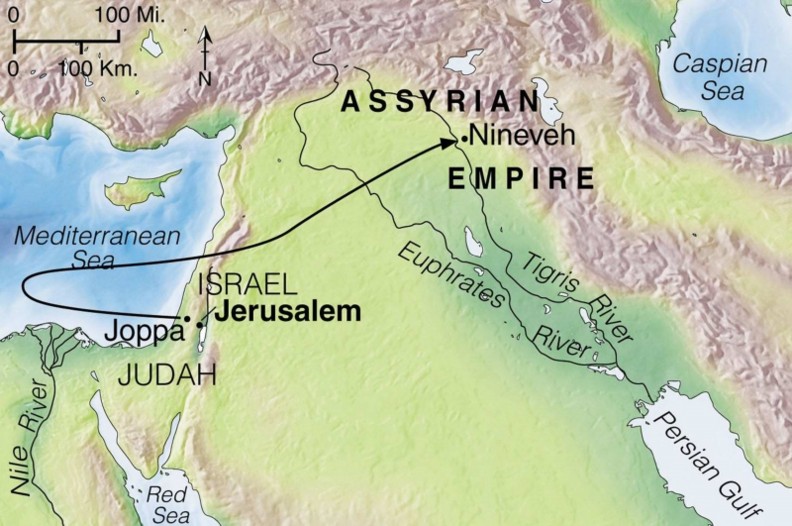
God told Jonah to go to Nineveh, the capital of the Assyrian Empire. Many of Jonah's countrymen had experienced the atrocities of these fierce people. The last place Jonah wanted to go was on a missionary trip to Nineveh! So he went in the opposite direction. He boarded a ship in Joppa that was headed for Tarshish. But Jonah could not run from God.

God told Jonah to go to Nineveh, the capital of the Assyrian Empire. Many of Jonah’s countrymen had experienced the atrocities of these fierce people. The last place Jonah wanted to go was on a missionary trip to Nineveh! So he went in the opposite direction. He boarded a ship in Joppa that was headed for Tarshish. But Jonah could not run from God.

Jonah was a prophet during the reign of Jeraboam II around 750 B.C. According to 2 Kings 14 23-28, he was the son of Amittai, hailing from Gath-hepher. Gath-hepher (meaning “winepress of the well”) was on Zebulun’s border in ancient Israel. The Book of Jonah has been the subject of some debate and there are those who consider it allegory. But such is not the case. Jesus certainly spoke of the events of the book as historical fact; and Jonah’s adventure is mentioned in Matthew 12:38-41, 16:4, Luke 11:29-32, among other passages.

As for the most famous part of the book, many are quick to point out that the Bible does not say that it was a whale that swallowed Jonah. God in fact, it says, appointed “a great fish” for the deed. The truth is that the taxonomies we use today for classifying such creatures did not exist in their present form, so the distinction between fish and mammals is purely academic and relevant only today. True enough, a creature other than a whale could have been responsible (one such suggestion is a “Sea Dog”). And there have been reports in the past of people surviving after having been swallowed and regurgitated by such. One such incident was reported in “The Boston Post-Boy, October 14, 1771” about a man named Marshall Jenkins (see this article on Christian Evidences) It hardly matters. In any event, it was a miraculous feat completely orchestrated by God for a specific purpose – just as that of the worm (Jonah 4:7).

But this miraculous event aside, the most important aspects of the Book of Jonah lay elsewhere. The Book of Jonah shows us God’s boundless compassion in multiple ways. Any time the early Christians of the first century began to question whether Gentiles were to be part of God’s plan of salvation, they needed only to look at this book. God sent Jonah to give His message to the Ninevites to give them the chance to repent. They were not part of Israel by any stretch of the imagination. But God cared about them, just as He tried to teach Jonah in Jonah 4:1-10.  In God’s eyes, everyone is worth saving.

Jonah sat under a goard vine, waiting and hoping for God to destroy Nineveh. But God taught him an important lesson about forgiveness through the vine (Jonah 3-4).

Jonah sat under a goard vine, waiting and hoping for God to destroy Nineveh. But God taught him an important lesson about forgiveness through the vine (Jonah 3-4).

Jonah’s attempted flight from God shows us a couple of things. First, and most obviously, we cannot hide anything from our Creator. Even the “smallest” of our deeds is known to Him. Secondly, as is shown repeatedly in scripture, when God wants something done, it gets done. He sent His only son to sacrifice His life for us, and establish His kingdom. The misunderstanding some have that Jesus somehow failed at that the first time, but will try again later, is ridiculous.

Finally, Jonah’s attitude and God’s reaction in chapter 4 should give us pause to think about our own compassion for our fellow man. How often do we view others with disdain or even contempt? How concerned are we really about salvation for those outside God’s kingdom? Have we truly committed ourselves to Christ if we are not willing – yes and even eager – to help others to work out their salvation?

Though only 4 chapters, the Book of Jonah is a powerful and important book of prophecy and teaching. Do yourself a favor and read these 47 verses if you have not done so in a while – and do so with these things in mind. It will enrich you in your walk with the Lord.

/Bob’s boy
___________________
image © V. Gilbert & Arlisle F. Beers

Please note: I did not design the reading plan that I am following in my blog.  All of my comments in this blog, however, are solely my responsibility.  When reading ANY commentary, you should ALWAYS refer first to the scripture, which is God’s unchanging and unfailing word. Reading schedules, as well as a link to the site where you can get the reading plan that I’m currently following for yourself can be found on the “Bible Reading Schedules” page of my website at http://graceofourlord.com.  

Psalm 18:25-50 – His Way Is Perfect

David, King Over All Israel, as in 2 Samuel 5:...

David, King Over All Israel, as in 2 Samuel 5:1-12, illustration from a Bible card published 1896 by the Providence Lithograph Company (Photo credit: Wikipedia)

In this second half of Psalm 18, David continues singing God’s praises for being a just and merciful God, and specifically for care and help He has given David. In verse 29, the phrase “and by my God I can leap over a wall” may refer to David’s victory over the stronghold of the Jebusites at Jerusalem in 2 Samuel 5:6-10.  Verses 31-45 continue in that line of thought, as David recounts his military victories, his leadership, and his prowess as a warrior.

But he does not do so in a boastful manner. Instead, he rightly gives all the credit and glory to God, where it belongs. In verse 34, he says that “He trains my hands for war.” In verses 39-40:

For you equipped me with strength for the battle;
you made those who rise against me sink under me.
You made my enemies turn their backs to me,
and those who hated me I destroyed

Verse 46 continues the words that now are the lyrics for the popular hymn “I Will Call Upon the Lord” (which began in verse 3): “the Lord lives, and blessed be my rock, and exalted be the God of my salvation.” In verse 49, David writes: “for this I will praise you, O Lord, among the nations, and sing to your name.” This verse is also written in 2 Samuel 22:50, and Paul sites them in Romans 15:9-12, as he explains that it was always God’s plan to include the Gentiles as the children of God through the Davidic line in Jesus Christ. To this point, verse 50 ties up the entire chapter into a succinct summary:

Great salvation he brings to his king,
and shows steadfast love to his anointed,
to David and his offspring forever

Read or listen to audio of ESV version of this selection from this link.

/Bob’s boy
___________________
some images © V. Gilbert & Arlisle F. Beers

Please note: I did not design the reading plan that I am following in my blog.  All of my comments in this blog, however, are solely my responsibility.  When reading ANY commentary, you should ALWAYS refer first to the scripture, which is God’s unchanging and unfailing word. Reading schedules, as well as a link to the site where you can get the reading plan that I’m currently following for yourself can be found on the “Bible Reading Schedules” page of my website at http://graceofourlord.com.  

Job 38:1-21 – The Lord Answers Job

A whirlwind in the ancient territory of Galatia, or modern Ankara, Turkey

A whirlwind in the ancient territory of Galatia, or modern Ankara, Turkey

Because of the length of chapter 38, we will examine it in two parts – the first of which in this blog will be verses 1-21. All throughout the book, Job has been requesting an audience with God, in order to plead his case. And God comes abruptly to him in this chapter. The first verse starts out -with Then the Lord answered Job out of the whirlwind and said:…” But it is the second verse that is the source of some debate.

The second verse reads “Who is this that darkens counsel by words without knowledge?” At first reading, it appears that in that sentence, He is referring to Job, and that seems to be the majority opinion. But some good arguments have been made that God is actually referring to the words of Elihu. As one commentator wrote, assigning these words to Job is a direct contradiction of Job 42:7-8, which clearly states that Job has spoken correctly of God. The debate goes on, and there are merits to both arguments (although some have even questioned the authenticity of the Elihu speeches, alleging that they were not part of the original text. We flatly reject that suggestion).

Arguments on both sides of this question are compelling, and although we lean toward the position that the Lord was indeed addressing Elihu, we must confess uncertainty. In the end, despite some truth, Elihu just got too much wrong (see previous posts on Chapters 35 and 37). Either way, the lessons of chapter 38 are the same, so the point is largely academic. That Elihu’s speeches add value to the book, is a concept we support for reasons listed in previous posts on those chapters.

earth003The Lord begins His dialog with Job, asking in several different ways where Job was when he gave birth to the universe, and what Job understands about the undertaking. Some take the statements about the earth’s foundation, where its “bases” were sunk, and the cornerstone being laid (verse 6) to mean that the Bible is assuming the world is flat. But like much of the “Wisdom Literature” the Book of Job is full of imagery; and like any poetry, one should consider that when studying these verses. Written long before mankind in general knew the word was round, many passages in the Bible demonstrate that God’s word was far ahead scientifically. For examples of passages about a round earth, see Job 26:10 and Isaiah 40:22.

Verse 7 speaks of the “sons of God” shouting for joy when God created the world. For this term, we can refer back to Job 1:6, which makes the same reference. See this previous post about chapter one for our comments about that. Keep in mind also that there is much we would like to know about many things not of this world, such as angels and demons, cherubim and seraphim, and urum and thummin that the Bible does not fully explain. God has His own reasons for what is included in the Scriptures and what is not. Such explanation is not necessary for salvation and instruction in same.

At first look at the remaining verse leading to verse 21, we may think that we know much more about some of those things than they did in Job’s time. But verse 17 reminds us that we know nothing about the experience of such things as death, and the state of our awareness in the immediate time afterward:

“Have you entered into the springs of the sea,
or walked in the recesses of the deep?
Have the gates of death been revealed to you,
or have you seen the gates of deep darkness?
Have you comprehended the expanse of the earth?
Declare, if you know all this.”

When we take up this chapter again, we will begin at verse 22.

Read or listen to audio of ESV version of this selection from this link.

/Bob’s boy
___________________
some images © V. Gilbert & Arlisle F. Beers

Please note: I did not design the reading plan that I am following in my blog.  All of my comments in this blog, however, are solely my responsibility.  When reading ANY commentary, you should ALWAYS refer first to the scripture, which is God’s unchanging and unfailing word. Reading schedules, as well as a link to the site where you can get the reading plan that I’m currently following for yourself can be found on the “Bible Reading Schedules” page of my website at http://graceofourlord.com.  For questions and help, please see the “FAQ” and “Summaries” pages there.

Psalm 89:1-26 – You Rule the Raging of the Sea

We will take up the first half of this rather long psalm today through verse 26. It is a community lament that many scholars attribute to the time after the fall of Jerusalem and the capture of king Jehoiachin. There is nothing in the text that this blogger can see to really confirm that, and a time that late for the writing of the entire psalm seems somewhat problematic. Adam Clarke suggested that a better translation would have been that it was for “the instruction of Ethan the Ezrahite.” So, the writer certainly could have adapted an earlier song of Ethan’s for this psalm.


English: The Harlot of Jericho and the Two Spi...

English: The Harlot of Jericho and the Two Spies, c. 1896-1902, by James Jacques Joseph Tissot (French, 1836-1902) or follower, gouache on board, 9 1/16 x 6 5/8 in. (23.1 x 16.9 cm), at the Jewish Museum, New York (Photo credit: Wikipedia)


We have stated before that the superscriptions at some of the Bible’s headings are not of the inspired word, and in many cases their application can be considered dubious. Still, those of a factual, rather than an interpretative nature have proven to be pretty reliable over time. In this superscription, the “maskil” is stated to be of “Ethan the Ezrahite.” He was probably a musician for corporate worship, and is probably the same one that is mentioned in 1 Chronicles 2:5-6, and certainly the same as mentioned in 1 Kings 4:29-31, where it was said of Solomon that he was wiser than Ethan the Ezrahite. Pretty impressive to have your wisdom compared to that of Solomon.


The chapter begins with praise for the steadfast love and faithfulness of the Lord to His people and to the promises He made to David (verses 1-4). Verses 5-13 are beautiful poetry offering praise to the mighty power of God over all things. “Rahab” in verse 10 does not refer to the woman who helped the Israelite spies in Joshua 2. It is a term that is ascribed to Egypt (and to monsters of the sea); and if one substitutes the work Egypt for Rahab in that verse, it makes sense.


Verses 14-18 praise God for being the strength and glory of His people. Verses 18-26 exalt God for choosing David, giving him strength and might over his enemies, and making the point that just as God had said that David was a man after His own heart, David would be faithful to the Lord, as shown in verse 26 below. It is very much a celebration of the throne and the line of David. But as we will see when we pick the chapter back up, there is more. Of David, it refers to God as saying (very much in the manner in which David wrote):


He shall cry to me, ‘You are my Father,
my God, and the Rock of my salvation.’


Read or listen to audio of ESV version of this selection from this link.


/Bob’s boy


___________________


some images © V. Gilbert & Arlisle F. Beers


Please note: I did not design the reading plan that I am following in my blog.  All of my comments in this blog, however, are solely my responsibility.  When reading ANY commentary, you should ALWAYS refer first to the scripture, which is God’s unchanging and unfailing word. Reading schedules, as well as a link to the site where you can get the reading plan that I’m currently following for yourself can be found on the “Bible Reading Schedules” page of my website at http://graceofourlord.com.