Psalm 7 – In You Do I Take Refuge

The superscript for this psalm calls it a Shiggaion of David.  The term is only used again in plural form in Habakkuk 3:1.  The best that we can surmise is that it may be a type of instrument or liturgical description pertaining to the psalm.  Cush the Benjamin had likely accused David concerning treason against Saul.  David is languishing here and it seems likely that he is experiencing guilt on his own part (see verses 3-5), possibly for his anguish over what his part had been in Doeg the Edominte’s betrayal and the resulting slaughter of the priests of Nob (1 Samuel 22:11-23)?

Nob, Shufat from north, the Tabernacle was here for awhile. David visited the priest Ahimelech here (1 Samuel 21). Because the priests helped David, Saul destroyed the priests and their city.

Nob, Shufat from north, the Tabernacle was here for awhile. David visited the priest Ahimelech here (1 Samuel 21). Because the priests helped David, Saul destroyed the priests and their city.

David’s guilt, though tempered with his anger with Doeg in Psalm 52, does not give him pause to absolve himself, but rather to pray to God for justice, even if that means his own complicity should result in his death at the hands of his pursuers.  He places his fate in the hand of his God in whom he places his confidence in His judgment of David’s heart and integrity (verse 8-16).  He expresses his certainty that God will do justly with the wicked in Verses 14-16: B

Behold, the wicked man conceives evil
and is pregnant with mischief
and gives birth to lies.
He makes a pit, digging it out,
and falls into the hole that he has made.

Read or listen to audio of ESV version of this selection from this link.

/Bob’s boy
___________________
some images © V. Gilbert & Arlisle F. Beers

Please note: I did not design the reading plan that I am following in my blog.  All of my comments in this blog, however, are solely my responsibility.  When reading ANY commentary, you should ALWAYS refer first to the scripture, which is God’s unchanging and unfailing word. Reading schedules, as well as a link to the site where you can get the reading plan that I’m currently following for yourself can be found on the “Bible Reading Schedules” page of my website at http://graceofourlord.com.  For questions and help, please see the “FAQ” and “Summaries” pages there.

Proverbs 12 – The Way of a Fool

Because of the nature of the book of Proverbs, and the impossibly of commenting on all of a single chapter in these short paragraphs,we choose to pick one or two verses on which to focus.. Please see our  previous post on study tips for Proverbs.

Today this blog will focus on a single short verse from chapter 12. verse 15 reads:

“The way of a fool is right in his own eyes, but a wise man listens to advice.”  

This has been the plague of men (and women) since  time began; and the more learned we become the worse it gets.  During the cycle of the Judges 17:6 and 21:25 in Israel,  the text says “In those days there was no king in Israel. Everyone did what was right in his own eyes.”  The people would fall into apostasy over and over again until God rescued them and they would start the cycle all over again.   People worshiped their idols and turned away from God until things got so bad that they ended up crying out to him, and then he would save and deliver them.  This continued throughout the kingship of David and even the author of this book.

Even Solomon allowed the women that he turned to lead him into idolatry.  God often has tolerated foolishness by the self-deception of man since time immemorial and has allowed him to continue to make those kinds of mistakes because we have our own freedom to make our mistakes.The wise man listens to the advice and wisdom of our God, His son, and the Holy Spirit.

We are brought up in a world that teaches our children macro-evolution that we are no more than advanced animals that, this world is all there is, and that the Bible is little more than a book of fables.  So-called educated men make it their purpose in life to convince people who there is no purpose in life.  But His evidence is all around us, including His attributes (Romans 1:20).  We exchange the wisdom of God for the foolishness of man that we call wisdom, in order to justify our own unrighteousness and worship our own idols of sin and depravity (Romans 1:22-23). We tell the child there is no God and that he was foolish to believe there is and then we  wonder why so many lose heart and hope.

We must give true wisdom to our children though God’s word to combat the lies that this world tells them about who we are and where we come from; and teach them where they can go.

Read or listen to audio of ESV version of this selection from this link.

/Bob’s boy
___________________
some images © V. Gilbert & Arlisle F. Beers

Please note: I did not design the reading plan that I am following in my blog.  All of my comments in this blog, however, are solely my responsibility.  When reading ANY commentary, you should ALWAYS refer first to the scripture, which is God’s unchanging and unfailing word. Reading schedules, as well as a link to the site where you can get the reading plan that I’m currently following for yourself can be found on the “Bible Reading Schedules” page of my website at http://graceofourlord.com.  For questions and help, please see the “FAQ” and “Summaries” pages there.

Psalm 119:17-24, Psalm 11 – A Sojourner on the Earth

Today’s reading of Psalm 119 begins with verse 17 and begins each line with the letter gimel.   The psalmist calls upon the lord to “deal bountifully” with him – knowing that he is undeserving and asks for his grace and mercy.  He acknowledges that this world is not his home (John 15:19).  He is just passing through. He says the Lord rebukes the insolent accursed ones, these would be the unfaithful.  The princes that plot against him are rulers among God’s people that might plot against him Though we do not know the author, one could apply this to many as in Daniel 6:4.  They tried to find something to charge him with, but could not.

Saul anointed king by Samuel.

Saul anointed king by Samuel.

Some have seen Psalm 11 as the advice to David  to flee, probably from Saul to the mountains.  He may have been advised to do so by those surrounding him, which is where the question comes.  That is about as good of a guess as any, but it has also been suggested that this was from David’s plight in 1 Samuel 23:9-14, when he had asked the Lord if the men of Keilah would surrender him to Saul.  When he was told of this, he prayed to God , and God told him they indeed would surrender him.

His friends had advised him of the impending attack, and were moved for him to hide himself in the hills.  But he had done so, he could have been guilty of not trusting the Lord following his prayer.  We can guess that under the lawless rule of Saul, the very foundations of society and of moral order were viewed as swept away. Then he recognizes that the Lord is in his holy temple (Habakuk 2:20).  He sees the righteous and will deal with the wicked.  The “upright shall behold his face” should be understood as to see Him as He is (1 John 3:2).

Read or listen to audio of ESV version of this selection from this link.

/Bob’s boy
___________________
some images © V. Gilbert & Arlisle F. Beers

Please note: I did not design the reading plan that I am following in my blog.  All of my comments in this blog, however, are solely my responsibility.  When reading ANY commentary, you should ALWAYS refer first to the scripture, which is God’s unchanging and unfailing word. Reading schedules, as well as a link to the site where you can get the reading plan that I’m currently following for yourself can be found on the “Bible Reading Schedules” page of my website at http://graceofourlord.com.  For questions and help, please see the “FAQ” and “Summaries” pages there.

Reading the Psalms

The book of Psalms is 150 poems written for our instruction, pleasure and benefit in prayer and praise to God.  They were used by the Jews and early Christians for songs of praise, and indeed many of the songs we sing in worship today God come from these pages.  Traditionally, they have been divided into five books, perhaps to signify the five books of the Pentateuch. It has the most authors of any book in the Bible.  Many we know or surmise by the superscripts, which though not inspired are ancient.  David is ascribed as the author of  73 of these and the new Testament also credits him with Psalm 2 (Acts 4:25) and Psalm 95 (Hebrews 4:7).


English: The Psalms scroll, one of the Dead Se...

English: The Psalms scroll, one of the Dead Sea scrolls. Hebrew transcription included. English translation available here. Français : le rouleau des Psaumes, l’un des manuscrits de la mer Morte. Une transcription en hébreu moderne est incluse. Une traduction anglaise est disponible ici. (Photo credit: Wikipedia)


This aligns very well with what the Book of Samuel tells us.  He was brought to Saul when he was king by his servants because of his skill in playing the Lyre (1 Samuel 16:16-23).  He was an accomplished songwriter, having written the song of the Bow lament in 2 Samuel 1:17-27, and his song of deliverance in 2 Samuel 22:1:23:7.   2 Samuel 23:1 calls him the sweet psalmist of Israel. The sons of Korah are attributed with about 25 psalms.  Korah was the grandson of Kohath who along with some of the Reubenites, rebelled against God, challenging Moses in Numbers 16. After his death, his sons were spared in Numbers 26:9-11, and under King David became great leaders of song and praise in the Temple and Tabernacle (1 Chronicles 6:31-39), responsible for such lines as “As the Deer Panteth for the Water.”   They are not in chronological order, else Psalm 95 would likely be first, as it is attributed to Moses.


More to come in another blog, but I will leave you with a link to an article that has tips for studying a Psalm, that I think are quite useful.  Please see “8 steps to Study a Psalm” and download the PDF for reference.


Summing Up


Each weekend, I post a small PDF of one week of chapter summaries (on the website’s “Summaries” page), current to the beginning of the previous week.  I have posted the summary for Week 3 (January 2013 Week 3) of the schedule I am following this year.  This short PDF documents contains condensed comments about Psalm 119:1-8, Psalm 1, Proverbs 10, Psalms 3-4, Job 1, and Psalm 9, with hyperlinks to the ESV version of each chapter for listening or reading, and joins the summaries for other weeks already posted there.


/Bob’s boy


___________________


image © V. Gilbert & Arlisle F. Beers


Please note: I did not design the reading plan that I am following in my blog.  All of my comments in this blog, however, are solely my responsibility.  When reading ANY commentary, you should ALWAYS refer first to the scripture, which is God’s unchanging and unfailing word. Reading schedules, as well as a link to the site where you can get the reading plan that I’m currently following for yourself can be found on the “Bible Reading Schedules” page of my website at http://graceofourlord.com.  For questions and help, please see the “FAQ” and “Summaries” pages there.


Psalm 8 – How Majestic Is Your Name

Isaac Watts wrote hymns from this psalm. It is also a great example of chiastic structure (ABC, CBA). The first sentence and last are identical.  Sandwiched in between, first comes God’s greatness, followed by the main points in verses 4 and 5, and then man’s position in the world because of God.   It is also a great passage written about God’s created man that is so easily applied to Jesus – this time by the Hebrew writer (Hebrews 2:6-8).  Jesus quotes verse two (“out of the mouths of babes”) in Matthew 21:16, when the chief priests and scribes became indignant from the shouts of the children of “Hosanna to the Son of David!” when he cleansed the Temple after his triumphal entry.

moneychangers

Jesus cleanses the temple; throwing moneychangers out and upsetting the tables with animals and birds –John 2: 12-22.

Verse two also clearly indicates that the psalmist’s praise to God comes on the heels of some victory over foes, but the psalm praises God’s majesty because of his creation of the heavens and the moon and stars which he set in place (Genesis 1:17).   Then he expresses wonder that this same great God made man “a little lower” than the heavenly beings (Genesis 1:26), and gave him dominion over all his works.

But Hebrews 2:10 ties both Old and New Testament together with such grace and beauty that we can only marvel:

For it was fitting that he, for whom and by whom all things exist, in bringing many sons to glory, should make the founder of their salvation perfect through suffering.

Read or listen to audio of ESV version of this selection from this link.

/Bob’s boy
___________________
some images © V. Gilbert & Arlisle F. Beers

Please note: I did not design the reading plan that I am following in my blog.  All of my comments in this blog, however, are solely my responsibility.  When reading ANY commentary, you should ALWAYS refer first to the scripture, which is God’s unchanging and unfailing word. Reading schedules, as well as a link to the site where you can get the reading plan that I’m currently following for yourself can be found on the “Bible Reading Schedules” page of my website at http://graceofourlord.com.  For questions and help, please see the “FAQ” and “Summaries” pages there.
Job 2 ( or Just When You Thought Things Were Bad Enough…)

"Job covered in boils" - from Martin Luther's Bible

“Job covered in boils” – from Martin Luther’s Bible

The opening of the second chapter of Job is exactly as written in Job 1:6-8.  These encounters between God and Satan, especially when one interjects the “sons of God,” are the subject of lots of varying interpretations among commentators; and trying to sort through those may well overwhelm you as much as it does this blogger.  Some see these “sons of God” as angels, and some see them as worshipers.  It is pointed out that in no part of the scriptures does it say that these events take place in heaven.  The righteous are said to come before the Lord every time we worship him.  It is also true that Jesus said that the angels see the face of God every day (Matthew 18:10), so they would hardly need to “present” themselves before Him.

Matthew Poole saw these encounters between God and Satan as parabolic, and it is also possible that he could be partially right about that.   But the question in the end is – Does it really matter?  Okay so here, admittedly, is one more opinion.  <Insert disclaimer here> The discourse between God and Satan is told in the word of God by His inspired writer, just as a prophet would tell us in a book that is both history and poetry.

The conversations between God and Satan in Job have three purposes in my view.  First, they tell us that Satan is a real adversary.  (“Be sober-minded; be watchful. Your adversary the devil prowls around like a roaring lion, seeking someone to devour.” 1 Peter 5:8).   Secondly, they serve to demonstrate that although God does not cause us to suffer, it is not His will to prevent evil from be-falling us at all times.  Third,  they assure us that Satan’s power is not unlimited.  God does have dominion over him.

So Satan struck Job with “loathsome sores” (some versions say “boils”) literally from head to toe.  Attempts have been made to assign a medical condition using the description of the breath and other symptoms in other chapters.  But again, does it matter?  The point is that he was in so much agony that he was using broken pottery to “scrape” himself (verse 8).  And he was so disfigured that his three friends (Eliphaz, Bildad, and Zophar, who we will get to know better) did not even recognize him, cried when they saw how bad he really was, and sat with him for a week without anyone even speaking.

The question of why Satan did not take the life of Job’s wife is answered in verse nine, as she tries to persuade Job to curse God, to give up, and to take his own life.

We will resume Job’s story next Thursday.  I think I need me some Psalms and Proverbs before then.

Read or listen to audio of ESV version of this selection from this link.

/Bob’s boy
___________________
some images © V. Gilbert & Arlisle F. Beers

Please note: I did not design the reading plan that I am following in my blog.  All of my comments in this blog, however, are solely my responsibility.  When reading ANY commentary, you should ALWAYS refer first to the scripture, which is God’s unchanging and unfailing word. Reading schedules, as well as a link to the site where you can get the reading plan that I’m currently following for yourself can be found on the “Bible Reading Schedules” page of my website at http://graceofourlord.com.  For questions and help, please see the “FAQ” and “Summaries” pages there.

Psalm 5-6 – Lead Me In Your Righteousness

Both of these Psalms are regarded generally as Psalms of Lament.  Both have the quite frequent musical direction in the superscript.  In Psalm 5, some versions say that it is “for the flute(s),” but that is far from settled.  The Hebrew word is “Nehiloth.”  Easton’s Bible Dictionary says: “It is probably derived from a root meaning “to bore,” “perforate,” and hence denotes perforated wind instruments of all kinds. The psalm may be thus regarded as addressed to the conductor of the temple choir which played on flutes and such-like instruments.”

Psalm 5’s label as a lament, though technically correct is unfortunate.  It is ascribed to David, and we do not know the time or circumstances that it occurred in his life, but like many other “Lament” psalms, it does contain pleas for deliverance from enemies.  But it is often called a “morning prayer” because of verse three, where he tells the Lord that He hears his voice in the morning as he offers his sacrifice – his worship to the Lord.

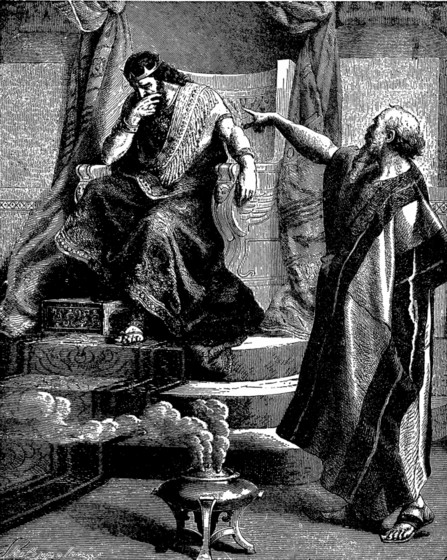
Nathan condemns David because of Bathsheba.

Nathan condemns David because of Bathsheba.

It is a reminder for us of the importance of personal prayer, and of worship.  Notice the repeated use (six times) of the word “my” in the first three verses – “give ear to my words…the sound of my cry…my King and my God…”   In verses 4-6, he acknowledges how God hates wickedness, the deceitful, the proud or boastful – all evildoers – and how they will not stand before him as the righteous (see also Psalm 1:5).  Clearly in verse 7, he considers the privilege he has to be able to come and worship Him, because of the Lord’s “steadfast love.”

Psalm 6 is one that many classify as one of penitence, although we are not told of what sin for which he is repenting.  It seems clear in verses 2-5 that he is ill – so much so that he believes he could die from whatever the illness might be.   It may, as some are often prone to think, that he feared his illness was God’s punishment for that sin (Job’s friends being a case in point).  In any case, he is not only gravely ill, and possibly in peril from his enemies (verses 8, 10), but he is also deeply ashamed of whatever wrong he has done.  But he knows that now that he has repented, “the Lord has heard my plea; the Lord accepts my prayer.” 

Both psalms serve as models of prayer and the privilege we have to worship the Lord and to receive His forgiveness and His care in times of trouble because of His “steadfast love” (5:7, 6:9).

Read or listen to audio of ESV version of this selection from this link.

/Bob’s boy
___________________
some images © V. Gilbert & Arlisle F. Beers

Please note: I did not design the reading plan that I am following in my blog.  All of my comments in this blog, however, are solely my responsibility.  When reading ANY commentary, you should ALWAYS refer first to the scripture, which is God’s unchanging and unfailing word. Reading schedules, as well as a link to the site where you can get the reading plan that I’m currently following for yourself can be found on the “Bible Reading Schedules” page of my website at http://graceofourlord.com.  For questions and help, please see the “FAQ” and “Summaries” pages there.

Proverbs 11 – The Integrity of the Upright

For helpful tips on reading the Book of Proverbs, see this previous post.

This is our day of the week for Proverbs this year, and today it is to Proverbs Chapter 11 that we turn.  And it is on three verses that we will focus. Verses 3, 5, and 6 all seem to say the same thing; and in truth they all convey much the same meaning, but there are some differences.  Let’s examine them all three, and then we’ll try to tie them all together.  First, let’s look at verse three:

“The integrity of the upright guides them,
but the crookedness of the treacherous destroys them.”

integrity

integrity (Photo credit: glsims99)

Integrity is a characteristic of the upright (those who live their lives according to God’s will).  It is that integrity which guides them in their daily lives.  The crookedness of the unfaithful is the converse.  The lack of integrity (here, “crookedness”) is a characteristic of those who are treacherous (the NKJV, the unfaithful).  That lack of integrity will destroy them.  Now verse five:

“The righteousness of the blameless keeps his way straight,
but the wicked falls by his own wickedness.”

None of us are truly “blameless” in the sense of being without sin.  What it means here is living a life that is above reproach – living in such a manner that would encourage others to serve God, rather than being a stumbling block.  Righteousness is being justified by the grace of Jesus Christ (Romans 3:20-24).  It is not earned, but it is freely given.  We can fall away from that righteousness (Romans 11:22, Galatians 5:4), but it is that righteousness that will keep the “blameless” on the right path. The wicked, on the other hand, fall by their own wickedness (more about that in a moment).  Finally, verse 6:

“The righteousness of the upright delivers them,
but the treacherous are taken captive by their lust.”

The grace of the Lord saves those who live according to His word.  But the treacherous are taken captive by their lust.  The NKJV substitutes “unfaithful,” but the “treacherous” defines it better – those who deceive, who pretend to have integrity, but secretly do not live that way.

cross-005Integrity is a commodity that seems to be in short supply at times.  But is integrity in every detail of our lives important?  What would you do for a million dollars?  Is your integrity for sale?  Sadly, the answer for many is yes.  Especially when it comes to “little things.”  A little “white lie” is sometimes necessary, right?  And so what if I really knew the clerk at the big store chain gave me too much money back?  Not my fault their employees can’t count change, is it?  But Jesus gave us the truth about this in Luke 16:10: “One who is faithful in a very little is also faithful in much, and one who is dishonest in a very little is also dishonest in much.

There are few people who want to be thought of by others as lacking in integrity.  So most people at least pretend to have it.  By the same token, even those that have wicked or deceptive intent, do not want to be thought of as such by others.  And so, the wicked, the deceivers, the unfaithful sometimes live out lives for a long time fooling many of the faithful (and the unfaithful as well) into believing they are something they are not.  But they are trapped by their own lust – their own wickedness brings them down.

Psalm 7:14-16 tells us how it comes about, speaking of the wicked who conceive evil and give birth to lies:

“He makes a pit, digging it out,
and falls into the hole that he has made.
His mischief returns upon his own head…”

Read or listen to audio of ESV version of this selection from this link.

/Bob’s boy
___________________
some images © V. Gilbert & Arlisle F. Beers

Please note: I did not design the reading plan that I am following in my blog.  All of my comments in this blog, however, are solely my responsibility.  When reading ANY commentary, you should ALWAYS refer first to the scripture, which is God’s unchanging and unfailing word. Reading schedules, as well as a link to the site where you can get the reading plan that I’m currently following for yourself can be found on the “Bible Reading Schedules” page of my website at http://graceofourlord.com.  For questions and help, please see the “FAQ” and “Summaries” pages there.

Psalm 119:9-16; Psalm 2 – Guarding Our Hearts By His Word

Note: Every Monday in 2013, along with another short chapter from the Book of Psalms, we are reading a stanza from Psalm 119.

Isaac Watts.

Isaac Watts. (Photo credit: Wikipedia)

Today’s reading of the second stanza, or strophe, of Psalm 119 is brought to you by the letter “Beth” or “Bet.”  The pictograph for this letter is of a house, and the letter is recognizable in several biblical places – such as Bethel (house of God), Bethlehem (house of bread), and Bethesda (house of grace).  The great Isaac Watts hymn “How Shall the Young Secure Their Hearts” is based on these verses.

In verses 9-10, the author calls upon the Lord to help him live his life according to God’s word because he realizes that only by giving our whole hearts to His will can we make our way through life remaining holy and pure from the world.   The emphasis in verse 11 is on thorough study of God’s word (storing it in our hearts). This was done by many of God’s people then by memorizing these psalms in days when the written word was of God was not so readily available as it is today.   We are encouraged to value His word as some would value riches, and mediate on what the Lord wants from us (verses 14-15).  We are to share His word with others (verse 13), and by our deeds make known that we delight in doing so because of His care for us (verses 13, 16).

Psalm 2 is one of the Messianic (sometimes called “royal”) psalms.  It starts out with the declaration of the foolishness of those who will reject God and His “anointed.”   We even see the actions of verse three today, as people in leadership positions, or who are considered wise, claim to be freeing people from “bonds” by having them reject God and His Son.  And though even entire nations rebel against Him, God will bring His judgment upon them in His time (verses 4-5).

Verse 6 prophesies the Messiah coming to His “holy hill” – Jerusalem.  Verse 7 is in the voice of the Messiah declaring that God is pleased with His Son, which is fulfilled in Matthew 3:17.  Verse 8 erases any doubt that these verses may be speaking of David as king, rather than being about the Messiah.  Verses 10-12 are a warning to rulers and leaders of nations that they should lead people in service to God, but these are often the very same people who lead others astray.

Read or listen to audio of ESV version of this selection from this link.

/Bob’s boy
___________________
some images © V. Gilbert & Arlisle F. Beers

Please note: I did not design the reading plan that I am following in my blog.  All of my comments in this blog, however, are solely my responsibility.  When reading ANY commentary, you should ALWAYS refer first to the scripture, which is God’s unchanging and unfailing word. Reading schedules, as well as a link to the site where you can get the reading plan that I’m currently following for yourself can be found on the “Bible Reading Schedules” page of my website at http://graceofourlord.com.  For questions and help, please see the “FAQ” and “Summaries” pages there.

The “Golden Alphabet” Psalm

Note: Every Monday in 2013, along with another short chapter from the Book of Psalms, we are reading a stanza from Psalm 119.  

Hinterglasbild Psalm 119, 22 (Text) Hammerhof,...

Hinterglasbild Psalm 119, 22 (Text) Hammerhof, Deggenhausertal (Photo credit: Wikipedia)

Psalm 119 is the longest Psalm, as well as the longest chapter in the Bible (176 verses), and is a literary marvel of God’s majestic word.  If you use a search engine on the Internet, you will find many interesting things about this psalm of all psalms.  Charles Spurgeon, in his seven volume “Treasury of David,” said “The Germans called it ‘The Christian’s golden A B C of the praise, love, power, and use of the Word of God’.”  It is the ultimate acrostic, separated into 22 stanzas (or strophes), each containing eight verses.  Each of those stanzas begins every single verse of the stanza with the same letter of the Hebrew alphabet, using all 22 letters of that alphabet in succession.  In most translations, the name of the Hebrew letter that a stanza represents serves as a heading over each stanza (Aleph, Beth, Gimel, Daleth, Heh, Vav, Zayin, Cheth, Teth, Yod, Kaph, Lamed, Mem, Nun, Samekh, Ayin, Peh, Tzaddi, Qoph, Resh, Shin, Tav).

The author and date that the psalm was written is unknown.  Spurgeon, Matthew Henry, and others extolled it as the work of David.  Others place the date sometime after Ezra, or in the days of Ezra and Nehemiah.  Still others (such as Adam Clarke) favor at least a pre-Exilic date, if not Davidian authorship.  Some commentators have stated that the rigid acrostic structure which the author imposed upon himself made it difficult to maintain continuity of thought and theme.  Others who have been more diligent in their study come to a very different conclusion!

The structure makes it in actuality a compilation of 22 psalms that come together in harmony with one central theme.  It contains ten synonyms for the “law” or word of God (eleven, if you count “truth”) that are repeated in almost every single verse.  It is a guide-book to God’s word,  It teaches us (among other things) about the love of God, what His word is, what it means for us, how we should live in view of His word, how our lives are affected by it, and how others are affected by the way we treat God’s word.

Hebrew children in Jesus Christ’s time and before were taught to memorize this great psalm; and the acrostic structure, along with the element of song, made that task easier.  If God had so much work put into writing something as complex as this psalm, He must have had a good reason.  He did indeed.  A careful study of this psalm over the course of this year – or any year – will be certain to enrich your life!

Summing Up

Each weekend, I post a small PDF of one week of chapter summaries (on the website’s “Summaries” page), current to the beginning of the previous week.  I have posted the summary for Week 2 (January 2013 Week 2) of the schedule I am following this year.  This short PDF documents contains condensed comments about Proverbs 5, 6, 7, 8, and 9, with hyperlinks to the ESV version of each chapter for listening or reading, and joins the summaries for other weeks already posted there.

/Bob’s boy
___________________
image © V. Gilbert & Arlisle F. Beers

Please note: I did not design the reading plan that I am following in my blog.  All of my comments in this blog, however, are solely my responsibility.  When reading ANY commentary, you should ALWAYS refer first to the scripture, which is God’s unchanging and unfailing word. Reading schedules, as well as a link to the site where you can get the reading plan that I’m currently following for yourself can be found on the “Bible Reading Schedules” page of my website at http://graceofourlord.com.  For questions and help, please see the “FAQ” and “Summaries” pages there.