The Events of the Days

The Books of I and II Chronicles, like Kings and Samuel, were originally one book. The Hebrew title for the book (“Dibre Hayyamim“) is often translated “The events (or annals) of the days.” We like the fact that the Septuagint calls it “the things omitted,” as that seems the very best description – for it contains much that Samuel and Kings do not.  But the overriding message throughout the book is the faithfulness of God to his covenant with His people through the house of David.

English: Table of nations according to genesis...

English: Table of nations according to genesis 10 Nederlands: Volkerenlijst naar genesis 10 (Photo credit: Wikipedia)

1 Chronicles 3:17-24 contains the names of a list of descendants of David that is at least 5 generations beyond the exile, and so it seems reasonable to date the beginning of the writings to at least 400 B.C., and possibly a few decades afterward. With the fall of Jerusalem and the destruction of the temple by the Babylonians under Nebuchadnezzar, the Davidic kingdom was overthrown, and there was no longer a nation of Judah. Babylon, however, fell to the Persians in 538 B.C., and after the decree of Cyrus, the returning exiles (with much help from Ezra and Nehemiah) eventually got the temple rebuilt, as well as the walls around Jerusalem. But where did that leave God’s people if there was no more monarchy of David’s house? What was God’s plan, and where did that leave the covenant made to David in 2 Samuel 7?

This is the main purpose of the Book of Chronicles – to reinforce faith in the promise of the Davidic throne through a clear and precise record of the nation’s history from the perspective of the remnant of the southern kingdom and its rulers. As the book was written, a start in rebuilding had been made in the temple and in Jerusalem, but the people must not repeat the mistakes of the past. And so those who had not been there must learn all about it.

The genealogy of the first nine chapters of 1 Chronicles begins in verses 1-3 of chapter one – from Adam to Noah and his three sons, Shem, Ham, and Japeth. From here, it begins to read very much like what we know now as “The Table of Nations” in Genesis 10. Verses 5-24 give us the sons of each of Noah’s sons, etc. down to Abraham, and thus the names of nations – many of which are very familiar to us now through geography, history, and other biblical reference, such as Canaan, Egypt, Cush, and Uz (from Job).

Verses 28-54 give us the generations from Abraham to Jacob (Israel), but only Jacob’s brother Esau is the focus of the genealogical record from verse 35 onward in this chapter. Jacob’s descendants will be covered at great length beginning in chapter 2. These 29 verses are all devoted to the nation of Edom, which Esau fathered, many of which would be bitter enemies with Israel and Judah in times to come.

(This year’s reading plan for Luke, Acts, and 1 and 2 Chronicles averages just 15 verses per day – 5 days per week!)
Schedule for this week

/Bob’s boy
___________________
some images © V. Gilbert & Arlisle F. Beers

Please note: I did not design the reading plan that I am following in my blog.  All of my comments in this blog, however, are solely my responsibility.  When reading ANY commentary, you should ALWAYS refer first to the scripture, which is God’s unchanging and unfailing word. Reading schedules, as well as a link to the site where you can get the reading plan that I’m currently following for yourself can be found on the “Bible Reading Schedules” page of my website at http://graceofourlord.com.  

Enhanced by Zemanta

Prophet of Hope – Zechariah

Zechariah (fresco by Michelangelo)

Zechariah (fresco by Michelangelo) (Photo credit: Wikipedia)

The Book of Zechariah begins in the first verse with the word of the Lord coming to this prophet in the eighth month of the second year of Darius’s reign. This is October/November of 520 B.C., and places it between Haggai 2:1 and 2:10. Zechariah was a priest. The text tells us that he was the grandson of Iddo, who was one of the Levitical priests that came back from Babylon with Zerubbabel, the grandson of king Jehoiachin (Nehemiah 12:1-4). 

Zechariah is sometimes referred to as the prophet of hope. The people had been back from captivity for twenty years. Taxes were high, especially in light of Darius’s preparations for his campaign against Egypt. Jerusalem was far from restored – in fact, the people felt like they were nothing on the world’s “stage.” The temple foundation had been started shortly after their return, but the effort had stalled due to opposition. Discouragement ruled the day, and the only thing to do seemed to be to just try to get by in the best ways that one could.

Zechariah's vision of the four horsemen (Zecha...

Zechariah’s vision of the four horsemen (Zechariah 6:1-8), engraving by Gustave Doré. (Photo credit: Wikipedia)

That is where Zechariah comes in, letting the people know that despite adversity from hostile enemies, they must remain faithful because God is in control. He was in control of everything before, during, and after captivity. He is in control of what is happening now, and He is in control of what will come to pass. The book is full of apocalyptic visions and oracles that read much like the apocalyptic literature that would come to be so popular, and filled with language and symbolism that would be very meaningful to the people of the times.

The first six chapters are a series of eight night visions that we could spend several pages discussing. They are a combination of reassurances of God’s favor for His people and of Messianic promise – restoring the covenant and the house of David. Chapter 7 takes up two years after these night visions, dealing with all of the fasting that the people are doing. The Lord has not commanded them to do so much fasting. What He wants from the people is for them to return to faithfulness and live by His commandments.

Concluding with chapters 9-14, various future events are addressed – at the forefront are God’s coming judgment on the nations that oppressed them and much emphasis on the coming Messiah. There is much encouragement in these chapters, but also warning – God has had more than enough of idolatry and wicked leadership! The future looks good indeed, but it depends on their faithfulness.

/Bob’s boy
___________________
image © V. Gilbert & Arlisle F. Beers


Restoring God’s House – Haggai

The biblical prophet Haggai. Woodcut from the ...

The biblical prophet Haggai. Woodcut from the Nuremberg Chronicle (Photo credit: Wikipedia)

On most of the occasions in scripture that we read of a prophet who had been preaching to God’s people about a particular subject, that prophet finds little good to come from the recipients of that preaching. A notable exception was Nineveh’s repentance when Jonah gave them God’s warning – but Jonah wasn’t exactly thrilled about that response, was he? Haggai and Zechariah are two exceptions that stand alone – at least as far as the rebuilding of the temple is concerned.

Haggai begins with reference to “the second year of Darius,” and that historically sets this book in the year 520 B.C. Chapter 1:1 gives us “the first day of the 6th month,” which makes the starting date of this book August 29, 520 B.C. It just doesn’t get any better than that with biblical dating. In fact, we get 5 such exact accounts of dates from Haggai. Just 24 days after Haggai’s first message, the people start work on the temple on September 21, 520 B.C. (Haggai 1:15 – the 24th day of the sixth month). Haggai 2:1 occurs in “the seventh month, on the twenty-first day of the month,” which is October 17, 520 B.C. Haggai 2:10 and 2:20 both happened on “the twenty-fourth day of the ninth month,” which is December18, 520.

Per the decree of Cyrus, the people began returning from captivity in 538 B.C. They started working on the temple in 537, but that ceased in 536 due to opposition (see Ezra 3:1-4:5). The work had been left unfinished for 18 years when the Book of Haggai begins. The reign of Cyrus the Great ended about 530 B.C. When his son Cambyses died in 522, a general, Darius I, rose to power in his place.

Haggai and Zechariah were present at the rebuilding of the Temple of God during the time of Ezra and Nehemiah, after the return from exile. The Medo-Persian Empire included the lands of Media and Persia, much of the area shown on this map and more. The Jewish exiles were concentrated in the area around Nippur in the Babylonian province. The decree by King Cyrus that allowed the Israelites to return to their homeland and rebuild the Temple was discovered in the palace at Ecbatana.

Haggai and Zechariah were present at the rebuilding of the Temple of God during the time of Ezra and Nehemiah, after the return from exile.
The Medo-Persian Empire included the lands of Media and Persia, much of the area shown on this map and more. The Jewish exiles were concentrated in the area around Nippur in the Babylonian province. The decree by King Cyrus that allowed the Israelites to return to their homeland and rebuild the Temple was discovered in the palace at Ecbatana.

Haggai picks up in verse one of the first chapter where Ezra 5:1 makes mention of the prophets Haggai and Zechariah, as it was after Haggai’s message that the temple construction was re-started. Then came Tattenai’s letter to Darius to try and stop the rebuilding. But the elders did not stop while they were waiting for the letter to reach him (Ezra 5:3-17). It was Darius’s decree (Ezra 6) that ensured the temple would be completed.

It was God’s will, of course, that ensured Darius would make such a decree. God called Haggai to move the people to action because they were stalled in completing the work of rebuilding the temple. Some form of “thus says the Lord” occurs 19 times in 38 verses, and the words”Lord of hosts” occurs 14 times, illustrating God’s sovereignty. Haggai’s message has them examine their situations and their lack of prosperity (Haggai 1:5-7, 2:15-19) in light of the work they had left unfinished. In chapter 2, the Lord (through Haggai) spoke to Zarubbabel, (who was in the line of David as the grandson of Jehoiachin) and Joshua, the High Priest.

The Lord intended to re-establish His people in their land, along with the house of David (Haggai 2:23). He had promised to bless the world through them (Haggai 2:9). There was a coming Messiah to prepare for. It was time to go to work!

/Bob’s boy
___________________
image © V. Gilbert & Arlisle F. Beers


Prophet Of Royal Blood? – Zephaniah

Stamped bulla sealed by a servant of King Heze...

Stamped bulla sealed by a servant of King Hezekiah, formerly pressed against a cord; unprovenanced Redondo Beach collection of antiquities (Photo credit: Wikipedia)

The prophet Zephaniah is introduced this way in verse one of chapter one of his book: “The word of the Lord that came to Zephaniah the son of Cushi, son of Gedaliah, son of Amariah, son of Hezekiah, in the days of Josiah the son of Amon, king of Judah.” Many believe that the Hezekiah mentioned here was King Hezekiah, who reined between 715 and 686 B.C.  If so, that would make Zephaniah his great-great-grandson. This would fit the timeline generally accepted for Zephaniah’s prophecy as during the reign of Josiah (640 – 609 B.C.)

There is some reason to believe that Zephaniah may have encouraged Josiah’s reforms. If so, since those reforms started in the 18th year of his reign (2 Kings 22-23), Zephaniah’s prophecies likely occurred before 622 -621 B.C.  Judah was at the height of its rampant immorality and idolatry pattern, with good king Josiah replacing two previous kings that were extremely wicked (Amon and Manasseh). His message, prevalent throughout the book, was “the day of the Lord is coming” – which always means that a time of decisive action by God is at hand.

Michelangelo's Hezekiah-Manasseh-Amon. Traditi...

Michelangelo’s Hezekiah-Manasseh-Amon. Traditionally Manasseh is the man on the right and Amon is the child on the left. (Photo credit: Wikipedia)

The first mention of the phrase in this book comes in Zephaniah 1:7, which also says “…the Lord has prepared a sacrifice and consecrated his guests.” That sacrifice is Judah, and verses 3-4 warn that God is bringing massive destruction on His people and Jerusalem. Verses 14-18 expound in darkly poetic terms on just what “the day of the Lord” will mean to them, and the picture cannot be ambiguous to anyone. Chapter 2 tells them what they should do – which of course is to repent. Zephaniah 3:1-4 present the reasons for God’s judgment on Jerusalem, placing blame on corrupt and evil leadership as well:

Woe to her who is rebellious and defiled,
the oppressing city!
She listens to no voice;
she accepts no correction.
She does not trust in the Lord;
she does not draw near to her God.

Her officials within her
are roaring lions;
her judges are evening wolves
that leave nothing till the morning.

Chapter 3:14-20 conclude with a promise of a glorious time of restoration and a Messianic future. It promises the survival of a remnant. The best advice for the faithful comes in Chapter 2:3:

Seek the Lord, all you humble of the land,
who do his just commands;
seek righteousness; seek humility;
perhaps you may be hidden
on the day of the anger of the Lord

The Book of Zephaniah seems to come very close to the time of the impending destruction by the Chaldeans. But the book does promise judgment on the other nations, particularly their wicked neighbors, for their complicity. Chapter 2:4-10 promises that the remnant of God’s people will have their day where those nations are concerned – promises that history itself has told us that God has kept:

For Gaza shall be deserted,
and Ashkelon shall become a desolation;
Ashdod’s people shall be driven out at noon,
and Ekron shall be uprooted.

Woe to you inhabitants of the seacoast,
you nation of the Cherethites!
The word of the Lord is against you,
O Canaan, land of the Philistines;
and I will destroy you until no inhabitant is left.

And you, O seacoast, shall be pastures,
with meadows for shepherds
and folds for flocks.
The seacoast shall become the possession
of the remnant of the house of Judah,
on which they shall graze,
and in the houses of Ashkelon
they shall lie down at evening.

For the Lord their God will be mindful of them
and restore their fortunes.
“I have heard the taunts of Moab
and the revilings of the Ammonites,
how they have taunted my people
and made boasts against their territory.

Therefore, as I live,” declares the Lord of hosts,
the God of Israel,
“Moab shall become like Sodom,
and the Ammonites like Gomorrah,
a land possessed by nettles and salt pits,
and a waste forever.

The remnant of my people shall plunder them,
and the survivors of my nation shall possess them.”
This shall be their lot in return for their pride,
because they taunted and boasted
against the people of the Lord of hosts.

/Bob’s boy
___________________
image © V. Gilbert & Arlisle F. Beers

Please note: I did not design the reading plan that I am following in my blog.  All of my comments in this blog, however, are solely my responsibility.  When reading ANY commentary, you should ALWAYS refer first to the scripture, which is God’s unchanging and unfailing word. Reading schedules, as well as a link to the site where you can get the reading plan that I’m currently following for yourself can be found on the “Bible Reading Schedules” page of my website at http://graceofourlord.com.  

Reversal of Fortunes – Nahum and Nineveh

If the Book of Jonah (see previous blog post) were a photograph, Nahum would be the negative. In what was likely the first half of the eighth century B.C., Jonah reluctantly ventured to Nineveh to warn them of the coming judgment of God for their wickedness. To Jonah’s complete dismay, Nineveh repented and God spared them.

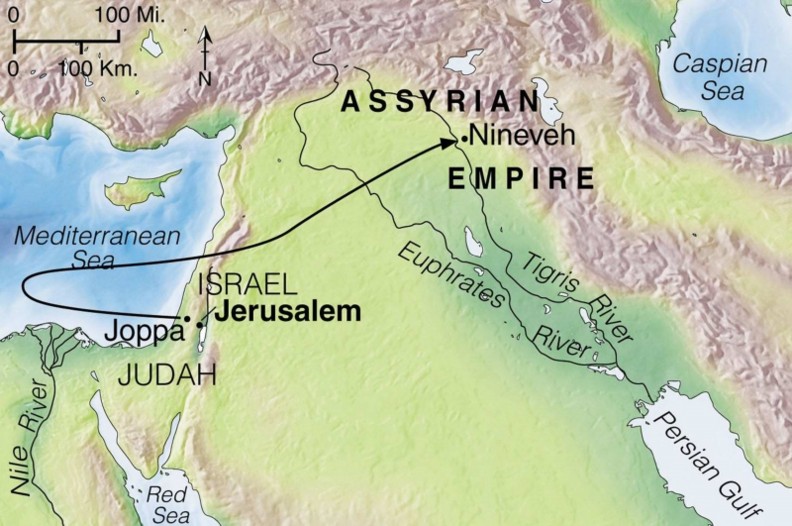
As Sennacherib beautified his capital city, Nineveh, Hezekiah withheld tribute and prepared for battle. The Assyrians advanced toward their rebellious western border, attacking swiftly down the Mediterranean coast. From Lachish, Sennacherib threatened to take Jerusalem, but Isaiah knew his threats would die with him on his return to Nineveh. This map shows the route of Assyrian conquest which started in Nineveh. God promised his people that Nineveh would not escape judgment.

As Sennacherib beautified his capital city, Nineveh, Hezekiah withheld tribute and prepared for battle. The Assyrians advanced toward their rebellious western border, attacking swiftly down the Mediterranean coast. From Lachish, Sennacherib threatened to take Jerusalem, but Isaiah knew his threats would die with him on his return to Nineveh. This map shows the route of Assyrian conquest which started in Nineveh. God promised his people that Nineveh would not escape judgment.

But that repentance did not last long. By 745 B.C. Tiglath-pileser III had made Assyria the most powerful in force in that part of the world., establishing their dominance with torture, massacres, and exiles on a horrific scale. The real estate of the Assyrians was greatly expanded by making vassal kingdoms of other countries (such as the northern kingdom of Israel and the southern kingdom of Judah) until Assyria “terminated” the Northern Kingdom in 722 B.C. Under Sennacherib’s reign (704 – 681 B.C.) Nineveh became the capital of Assyria.

More than a hundred years after Jonah, God sent Nahum to again announce judgment on Nineveh and the fall of Assyria itself. This time, there would be no repentance, and Nahum does not appear to have been reluctant in the least. Nahum 3:8-10 speaks of the destruction of Thebes (an ancient Egyptian city also called No-Amon in this book) in the past tense. We know that it fell to Assyria about 663 B.C. Assyria was conquered by the Medes and Babylonians in 612 B.C., making this book written between 663 and 612 B.C.

During this 50 year period, Assyria’s holdings and power were already in decline. Nahum’s first chapter reads like a prelude to battle, while the second and third chapters move into the real thing, with imagery that strongly suggests that the author saw much with his own eyes. True to the prophecy, Nineveh was destroyed, never to be rebuilt. The ruins lay close to the modern Iraqi city of Mosul.

/Bob’s boy
___________________
image © V. Gilbert & Arlisle F. Beers

Please note: I did not design the reading plan that I am following in my blog.  All of my comments in this blog, however, are solely my responsibility.  When reading ANY commentary, you should ALWAYS refer first to the scripture, which is God’s unchanging and unfailing word. Reading schedules, as well as a link to the site where you can get the reading plan that I’m currently following for yourself can be found on the “Bible Reading Schedules” page of my website at http://graceofourlord.com.  

Saving Nineveh – The Book of Jonah

God told Jonah to go to Nineveh, the capital of the Assyrian Empire. Many of Jonah's countrymen had experienced the atrocities of these fierce people. The last place Jonah wanted to go was on a missionary trip to Nineveh! So he went in the opposite direction. He boarded a ship in Joppa that was headed for Tarshish. But Jonah could not run from God.

God told Jonah to go to Nineveh, the capital of the Assyrian Empire. Many of Jonah’s countrymen had experienced the atrocities of these fierce people. The last place Jonah wanted to go was on a missionary trip to Nineveh! So he went in the opposite direction. He boarded a ship in Joppa that was headed for Tarshish. But Jonah could not run from God.

Jonah was a prophet during the reign of Jeraboam II around 750 B.C. According to 2 Kings 14 23-28, he was the son of Amittai, hailing from Gath-hepher. Gath-hepher (meaning “winepress of the well”) was on Zebulun’s border in ancient Israel. The Book of Jonah has been the subject of some debate and there are those who consider it allegory. But such is not the case. Jesus certainly spoke of the events of the book as historical fact; and Jonah’s adventure is mentioned in Matthew 12:38-41, 16:4, Luke 11:29-32, among other passages.

As for the most famous part of the book, many are quick to point out that the Bible does not say that it was a whale that swallowed Jonah. God in fact, it says, appointed “a great fish” for the deed. The truth is that the taxonomies we use today for classifying such creatures did not exist in their present form, so the distinction between fish and mammals is purely academic and relevant only today. True enough, a creature other than a whale could have been responsible (one such suggestion is a “Sea Dog”). And there have been reports in the past of people surviving after having been swallowed and regurgitated by such. One such incident was reported in “The Boston Post-Boy, October 14, 1771” about a man named Marshall Jenkins (see this article on Christian Evidences) It hardly matters. In any event, it was a miraculous feat completely orchestrated by God for a specific purpose – just as that of the worm (Jonah 4:7).

But this miraculous event aside, the most important aspects of the Book of Jonah lay elsewhere. The Book of Jonah shows us God’s boundless compassion in multiple ways. Any time the early Christians of the first century began to question whether Gentiles were to be part of God’s plan of salvation, they needed only to look at this book. God sent Jonah to give His message to the Ninevites to give them the chance to repent. They were not part of Israel by any stretch of the imagination. But God cared about them, just as He tried to teach Jonah in Jonah 4:1-10.  In God’s eyes, everyone is worth saving.

Jonah sat under a goard vine, waiting and hoping for God to destroy Nineveh. But God taught him an important lesson about forgiveness through the vine (Jonah 3-4).

Jonah sat under a goard vine, waiting and hoping for God to destroy Nineveh. But God taught him an important lesson about forgiveness through the vine (Jonah 3-4).

Jonah’s attempted flight from God shows us a couple of things. First, and most obviously, we cannot hide anything from our Creator. Even the “smallest” of our deeds is known to Him. Secondly, as is shown repeatedly in scripture, when God wants something done, it gets done. He sent His only son to sacrifice His life for us, and establish His kingdom. The misunderstanding some have that Jesus somehow failed at that the first time, but will try again later, is ridiculous.

Finally, Jonah’s attitude and God’s reaction in chapter 4 should give us pause to think about our own compassion for our fellow man. How often do we view others with disdain or even contempt? How concerned are we really about salvation for those outside God’s kingdom? Have we truly committed ourselves to Christ if we are not willing – yes and even eager – to help others to work out their salvation?

Though only 4 chapters, the Book of Jonah is a powerful and important book of prophecy and teaching. Do yourself a favor and read these 47 verses if you have not done so in a while – and do so with these things in mind. It will enrich you in your walk with the Lord.

/Bob’s boy
___________________
image © V. Gilbert & Arlisle F. Beers

Please note: I did not design the reading plan that I am following in my blog.  All of my comments in this blog, however, are solely my responsibility.  When reading ANY commentary, you should ALWAYS refer first to the scripture, which is God’s unchanging and unfailing word. Reading schedules, as well as a link to the site where you can get the reading plan that I’m currently following for yourself can be found on the “Bible Reading Schedules” page of my website at http://graceofourlord.com.  

The Vision of Obadiah (Minor Prophets Part 4)

Mountains of Edom rise abruptly out of the desert landscarpe forming a natural barrier against attack

Mountains of Edom rise abruptly out of the desert landscarpe forming a natural barrier against attack

Consisting of one chapter with 21 verses, Obadiah is the shortest book in the Old Testament. The superscription calls it the “Vision of Obadiah.” The subject of the book, made very clear from the start, is Edom. The nation of Edom was fathered by Jacob’s brother, Esau, as detailed in Genesis 36, so they were actually relatives of the Israelites. Deuteronomy 2 tells us that God had given the Edomites Mount Seir and the mountain land around it for them to live in, which goes to explain a bit about  verse 3’s description of them and their false sense of security:

The pride of your heart has deceived you,
you who live in the clefts of the rock,
in your lofty dwelling,
who say in your heart,
“Who will bring me down to the ground?”

Dating this book is not difficult. Verse 11 speaks of the fall of Jerusalem as a past event, and the fall of Edom itself as a future event. The former event was in 586 B.C., and Babylon took Edom down in 553 B.C. – a span of about 33 years. So the book was probably written during the first half of the Babylonian exile.   In 586, when Israel was being attacked, the Edomites who were the brother nation of Israel, joined in (instead of assisting them), as they were hoping to gain favor with Babylon. They brutalized them, plundered Jerusalem, and even thwarted the escape of those who would flee the destruction. This book foretells God’s vengeance on them for their part in the persecution of God’s people. It certainly answers the plea of Psalm 137:7.

Though the message is that those who oppose God and His people will get their just judgment (verse 15), the book ends with the promise of restoration for His covenant people and the promise of the kingdom (verses 19-21).

/Bob’s boy
___________________
image © V. Gilbert & Arlisle F. Beers


Amos, Shepherd of Tekoa (Minor Prophets Part 3)

Historical marker outside Hazor.

Historical marker outside Hazor.

We continue to stress the fact that the minor prophets are called such because of the short books of the Bible that they represent, not their importance. The Book of Amos is a great illustration of that. Though not the shortest book of the Old Testament, it only consists of nine chapters, and with the exception of chapter 5, none of them contain more than 17 verses (chapter 5 has a whopping 27). But we could take many more pages to comment on this book than would suit the purpose of this series (that purpose being to present a general overview of each of the books of the minor prophets).

The best place to begin is in the very first verse of the book, which tells us that Amos was one of the shepherds of Tekoa. Situated about 20 kilometers south of Jerusalem, Tekoa was referred to in 2 Samuel 14 as the place that the wise woman came from – the one that Joab used to deceive David, convincing him to let Absalom come home.  The same verse tells us that Amos made these prophecies during the days of Uzziah, king of Judah and Jeraboam, the son of Joash, king of Israel during the two years before “the earthquake.”

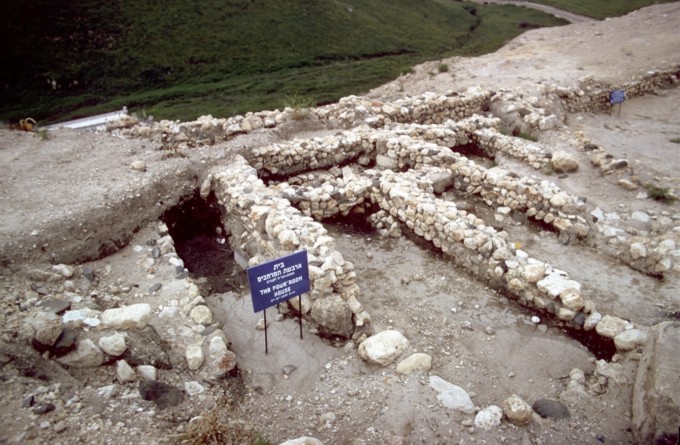
Before we get to the matter of the earthquake, let us address the date of the reigns of these two kings. Estimates of the reigns of these two kings range from about 800 B.C down to Uzziah’s death in about 739 B.C., leaving us with about a 60 year period when the prophecies could have occurred. Then there is the matter of this earthquake. The one mentioned is obviously one that was great in magnitude, as it was eventful enough to be used as a time reference here, and it is mentioned also in Zechariah 14:5. Excavations around Hazor in 1955 revealed evidence of an earthquake in the 8th century B.C. (some estimates are at 750 B.C. with a possible variance of 30 years). More than 50 years later, earthquake damage was still being discovered. More information can be found in this article at ICR.ORG and this article at the Jewish Virtual Library.

Hazor, house foundation

Hazor, house foundation

The book addresses the people of the northern kingdom, Through verse 5 of chapter 2, the judgment of the Lord against Israel’s enemies  (which the people expected) is prophesied. But what they did not expect, and had not counted on, was the judgment that would come to them for their injustice to the poor, and their pretense of worship to the Lord while they were actually doing nothing of the sort (the sarcasm in Amos 4:1-5 underscores this point). The Lord’s patience with them has come to an end (Amos 8:1-2). But He speaks in chapter 9 of a time when restoration will occur (note Amos 9:11, which is cited in Acts 15:16).

During this time, the northern kingdom was experiencing much prosperity, which they translated as a sign that God was pleased with them, and was blessing them. Amos’s message to them was exactly the opposite. A great deal of their wealth had been accumulated by their oppression of the poor. And their worship was more like an attempt at manipulating events in much of the same way that pagans worshiped their “gods.” Amos’s message was most unwelcome because it made the prediction that the “day of the Lord,” that they were expecting to usher in their further rise to power, would actually bring the end of their kingdom.

/Bob’s boy
___________________
image © V. Gilbert & Arlisle F. Beers

Please note: I did not design the reading plan that I am following in my blog.  All of my comments in this blog, however, are solely my responsibility.  When reading ANY commentary, you should ALWAYS refer first to the scripture, which is God’s unchanging and unfailing word. Reading schedules, as well as a link to the site where you can get the reading plan that I’m currently following for yourself can be found on the “Bible Reading Schedules” page of my website at http://graceofourlord.com.  


Major Prophets (part 5) – Book of Daniel

English: Shadrach, Meshach and Abednego in the...

English: Shadrach, Meshach and Abednego in the Furnace (Dan. 3:23-24,91-98) Русский: Седрах, Мисах и Авденаго в раскалённой печи (Дан. 3:23-24,91-98) (Photo credit: Wikipedia)

In 605 B.C., Nebuchadnezzar brought young men of noble heritage in Judah back for service in the king’s court. Daniel and his friends were part of one of these groups (Daniel 1:3). So his life in captivity was quite different from that of Ezekiel and many others less fortunate. According to Daniel 1:21, he served there until the first year of the reign of Cyrus, which would be about 538 B.C.

Daniel is a very important book in the Old Testament. It contains much prophecy that was fulfilled with undeniable accuracy (critics and skeptics notwithstanding). As has always been the case, even disputed passages have held up under the test of time (take, for example, Daniel’s use of the name Belshazzar in Daniel 5). It also teaches through Daniel’s life and that of his friends, Shadrach, Meshach,, and Abednego, a great deal about living faithfully under very great adversity. Finally, and most importantly, it teaches us much about the power of God, and His faithfulness to His word.

Daniel's Answer to the King

Daniel’s Answer to the King (Photo credit: Wikipedia)

The fulfilled prophecies from the Book of Daniel are a great source of assurance to believers for their accuracy. Skeptics and critics, as is always the case, dispute much concerning them of course. But they too have stood the test of time. A detailed account and analysis of all of these in one blog would be an exercise in futility. But for some great analysis of two of them, as well as answers for critics, take a look at this article from Apologetics Press concerning Daniel 2, and this article concerning prophecies in Daniel 8.

Belshazzar's Feast depicts a vision described ...

Belshazzar’s Feast depicts a vision described in the biblical Book of Daniel. –31&src= Daniel 5:1–31 (Photo credit: Wikipedia)

Summary

/Bob’s boy
___________________
image © V. Gilbert & Arlisle F. Beers

Please note: I did not design the reading plan that I am following in my blog.  All of my comments in this blog, however, are solely my responsibility.  When reading ANY commentary, you should ALWAYS refer first to the scripture, which is God’s unchanging and unfailing word. Reading schedules, as well as a link to the site where you can get the reading plan that I’m currently following for yourself can be found on the “Bible Reading Schedules” page of my website at http://graceofourlord.com.  

Major Prophets (part 4) – Ezekiel, the Captive’s Prophet

Engraved illustration of the "chariot vis...

Engraved illustration of the “chariot vision” of the Biblical book of Ezekiel, chapter 1, after an earlier illustration by Matthaeus (Matthäus) Merian (1593-1650), for his “Icones Biblicae” (a.k.a. “Iconum Biblicarum”). (Photo credit: Wikipedia)

Ezekiel was taken captive by the Babylonians in 597 B.C. and it was there that he was called to be a prophet of God to the other captives. It is uncertain what the “thirtieth year” (spoken of in the first verse) refers to. The best possibility we have heard is that it is the thirtieth year of his life. We learn in Numbers 4:46-49 that the span of a priest’s service is from the ages of thirty to fifty. Separated from the Temple by his captivity, Ezekiel would complete his entire priestly service there. His final vision (Ezekiel 40:1) is dated the 25th year of the exile, which would coincide with the timeline, making him fifty years old.

The first 24 chapters are of his preaching before the fall of Jerusalem. Chapters 25-32 are prophecies of how foreign nations must fall as well. Chapters 33-48 are his preaching and prophecies after the fall of Jerusalem. There were false prophets that were telling the people that the captivity would not last long, and that Jerusalem itself would stand. So the first 24 chapters are Ezekiel’s prophecies that such was not the case at all. Ezekiel continually preached for the full repentance of all, so that there would be some benefit to the years of captivity to come. But his message was not often well received.

Vision of Ezekiel

Vision of Ezekiel (Photo credit: Wikipedia)

The opening vision in chapters 1-3 describes the awesome picture of the coming of the glory of God (Ezekiel 1:1-28), and his call to prophecy which features the swallowing of the scroll that God gives to him (Ezekiel 3:1-3). This signifies God’s word permeating entirely through him, so that he would speak the will of God. But just as the Lord tells him, they will not listen to his message (Ezekiel 3:4-7).  The destruction that he prophecies to the people concerning Jerusalem is often as symbolic as his visions (see chapter 5 for example), but nonetheless graphic. In Ezekiel 3:16-27, God cast him in his role as “the watchman.”

As much of it is apocalyptic literature, some of Ezekiel’s prophecies in this book can be difficult to understand. As such, they are often misinterpreted and misused – like much of the Book of Daniel and the Book of Revelation. When reading, one should not lose sight of the intended audience – the captives in Babylon and those remaining free back in Judah. Context, as always, means everything. Though apocalyptic literature would become more popular in later times, there have been some who believe that Ezekiel’s writings made a significant contribution to the formation of such a genre.

Other highlights include the parable of the eagles and the vine (Ezekiel 17), the parable of the swords (Ezekiel 21), the vision of dry bones (Ezekiel 37:1-14), Gog and Magog (Ezekiel 38-39), the vision of the new temple (Ezekiel 40-42), and the flowing river (Ezekiel 46:17-47:12),

For some great reading on the stunning accuracy of Ezekiel’s prophecy of the fate of Tyre in chapter 26, see this article at Apologetics Press.

/Bob’s boy
___________________
image © V. Gilbert & Arlisle F. Beers

Please note: I did not design the reading plan that I am following in my blog.  All of my comments in this blog, however, are solely my responsibility.  When reading ANY commentary, you should ALWAYS refer first to the scripture, which is God’s unchanging and unfailing word. Reading schedules, as well as a link to the site where you can get the reading plan that I’m currently following for yourself can be found on the “Bible Reading Schedules” page of my website at http://graceofourlord.com.