Proverbs 8 – The Blessings of Wisdom

An Oxford degree ceremony — the Pro-Vice-Chanc...

An Oxford degree ceremony — the Pro-Vice-Chancellor in MA gown and hood, Proctor in official dress and new Doctors of Philosophy in scarlet full dress. Behind them, a bedel, another Doctor and Bachelors of Arts and Medicine. (Photo credit: Wikipedia)

Solomon begins by personifying Lady Wisdom further, summoning the reader to hear her call.  This is the ultimate of these chapters illuminating the two paths of wisdom and folly, or foolishness. The fact that the “fear of the Lord” is the beginning of all knowledge is again made infinitely plain in this chapter.  “She” begins by further developing the inclusion of righteousness as an integral part of wisdom (verses 6-9), the reasons for seeking it so earnestly (verses 10-11), and the benefits it provides mankind (verses 15-19).

She calls upon all the “children of man” (verse 4) – the simple, the fool, the learned – all who seek wisdom diligently will find it (verse 17).  But again, we are reminded of the difference between mere knowledge and true wisdom – the insight that comes to those who seek it without wickedness, who have prudence, who are just and seek justice, and those who abhor evil and are not full of pride, arrogance, and who avoid perverse speech.  True wisdom does not dwell in those who do not walk in the path that the Lord has made for us, no matter how “intelligent” that person may be.  Verses 8-9 make clear that only those who truly understand these facts will attain that wisdom, and that is so because those facts are clear for them to understand.  The unrighteous cannot have that understanding, and so they are denied true wisdom.

Verses 22 and following detail how wisdom “was” before God created the earth and all things universal, and how he delighted in his creation.  He created all things physical, all things invisible, and even the abstract.  There would not even be any concept of things such as beauty, love, truth, right, wrong, or even the concept of such things as a name or a number, but for the power of the Lord.  And Jesus, the Son, was there and is Himself that wisdom (1 Corinthians 1:22-24, 1 Cor 1:30, 1 Corinthians 8:6, Colossians 1:15-18).

Read or listen to audio of ESV version of this selection from this link.

/Bob’s boy
___________________
some images © V. Gilbert & Arlisle F. Beers

Please note: I did not design the reading plan that I am following in my blog.  All of my comments in this blog, however, are solely my responsibility.  When reading ANY commentary, you should ALWAYS refer first to the scripture, which is God’s unchanging and unfailing word. Reading schedules, as well as a link to the site where you can get the reading plan that I’m currently following for yourself can be found on the “Bible Reading Schedules” page of my website at http://graceofourlord.com.  For questions and help, please see the “FAQ” and “Summaries” pages there.

Proverbs 4 – A Father’s Wise Instruction

Father reads the Scriptures from a scroll to his family as the mother prepares food to eat.

Father reads the Scriptures from a scroll to his family as the mother prepares food to eat.

A quick plea – not for money (this site takes in no revenue, and NEVER will).  We appreciate SO MUCH the WordPress members who click the “Like” button on this blog!  And we certainly want that to continue!  But after finding out we had reached people in 122 countries last year, we decided to give Facebook a try.  We won’t go so far as to say you might help save a soul by clicking the “Like us on Facebook” button you now find on the right side-bar, but it will help our exposure, and who knows what ways God uses us…?

The assumption by some that these words from Solomon were ever intended solely for his own sons is completely shattered in verse one.  In the same sentence that he calls upon the reader (“O sons”) to hear, just exactly what they are to hear is said to be “a father’s instruction” – not your father’s instruction.  He then goes on to say how he received his own instruction from his father.  The Book of Proverbs is replete with the conveyance of the importance of the instruction given to children by a father and a mother.  But the message here is more than that.  It is the timeless wisdom passed on through generations both by earthly father to father, and by our heavenly Father.  God has made Himself known to all, both by His word and through the knowledge that He reveals to us daily in the world He created (Romans 1:18-20, Psalm 19:1-2).

Verse 7 may seem difficult to understand at first, but it simply means that in order to acquire wisdom, we have to work at it.  We have knowledge freely available to us, but wisdom only comes from searching through that knowledge for understanding – insight – and applying it to our lives.  This is true of worldly wisdom, and of the wisdom that comes to us by reverence for our Creator (“fear of the Lord”).  The wisdom and understanding both comes from, and leads to, the pursuit of a righteous and godly way of living, increasing its effectiveness in our lives as we gain it (verses 10-13).

Read or listen to audio of ESV version of this selection from this link.

/Bob’s boy
___________________
some images © V. Gilbert & Arlisle F. Beers

Please note: I did not design the reading plan that I am following in my blog.  All of my comments in this blog, however, are solely my responsibility.  When reading ANY commentary, you should ALWAYS refer first to the scripture, which is God’s unchanging and unfailing word. Reading schedules, as well as a link to the site where you can get the reading plan that I’m currently following for yourself can be found on the “Bible Reading Schedules” page of my website at http://graceofourlord.com.  For questions and help, please see the “FAQ” and “Summaries” pages there.

Proverbs 2 – The Value of Wisdom

English: Judgement of Solomon

English: Judgement of Solomon (Photo credit: Wikipedia)

It is generally thought by many that Solomon in these verses that contain the words “my son” is addressing his direct offspring in particular.  While that may certainly be the case, it is good to remember that these are the Spirit-inspired words of God; and they are meant for sons (and daughters) descended from this Davidic line (and that of Abraham) which includes all Christians, as confirmed in Galatians 3:29.

The seeking of wisdom that is being referred to in the verses here is done by getting to know God by studying His word.  If we diligently and earnestly seek that knowledge like the treasure that it is (verse 4), we will gain the understanding that we need.  But it takes more than that – we must apply it to our lives – holding fast and cherishing our integrity like a treasure as well (verse 7), for it is that sort of life, coupled with the thirst for knowledge of Him, that will bring wisdom into our hearts and make that knowledge pleasant to our souls (verse 10).  If we live in an upright manner, with integrity (verse 21) , we will have a home – in heaven – forever.

Read or listen to audio of ESV version of this selection from this link.

/Bob’s boy
___________________
some images © V. Gilbert & Arlisle F. Beers

Please note: I did not design the reading plan that I am following in my blog.  All of my comments in this blog, however, are solely my responsibility.  When reading ANY commentary, you should ALWAYS refer first to the scripture, which is God’s unchanging and unfailing word. Reading schedules, as well as a link to the site where you can get the reading plan that I’m currently following for yourself can be found on the “Bible Reading Schedules” page of my website at http://graceofourlord.com.  For questions and help, please see the “FAQ” and “Summaries” pages there.

January 2013 Reading Schedule Posted!

A big thank you to all who have read this blog during 2012!  While this blog is certainly not ever going to be the most popular WordPress “hangout,” we did just receive some statistics that are encouraging.  For example, the post on Peter’s rescue in Acts 12 received 652 views in one day. Not what we expected in the first year!  Thank you!

Here is the link to the 2013 reading schedule for January (January 2013 Reading Schedule).  In 2013, this blog will focus on the “Wisdom Literature” with a unique approach to Proverbs, Psalms, Song of Solomon, Ecclesiastes, Job, and as a special was to end 2013 the last week in December, the Book of James (often referred to as the “Proverbs of the New Testament”).  The first two weeks (beginning tomorrow 01/01/2013) we will read the first 9 chapters of Proverbs.  Theses chapters introduce the book, and what we actually know as “proverbs” do not really begin until chapter 10.

Psalm 1, Verse 1 and 2 in Biblia Hebraica Stut...

Psalm 1, Verse 1 and 2 in Biblia Hebraica Stuttgartensia (Photo credit: Wikipedia)

After those two weeks, we will settle into a schedule that adds variety to the five days per week of reading these books.  Each Monday in the first half of the year, we will read 8 verses of the longest chapter in the entire Bible – the 119th Psalm (with other, shorter Psalms included on many of those days).  This is a great Psalm that praises God and His word; and it is very rich in inspiration.  We will take a second look at these verses (and other Psalms) in the second half of the year from a fresh perspective. On Tuesdays, we will be reading from Proverbs with a similar approach.

On Wednesdays, we will be reading what are commonly called “lament” Psalms.  These are tremendously valuable in helping us with learning to call upon the Lord when life becomes very difficult, and even as tragedy and pain come our way.  Thursdays, we will read from the Book of Job, and on Fridays, we will be reading from other Psalms.

We will take a break at the end of June through July, and read through Ecclesiastes and Song of Solomon in their entirety, gaining much value learning about life, service to God, and the relationship of husbands and wives to each other.  Then we will resume the previously outlined schedule.

We are looking forward to what promises to be a very rewarding experience in God’s word in 2013!

/Bob’s boy
___________________
some images © V. Gilbert & Arlisle F. Beers

Please note: I did not design the reading plan that I am following in my blog.  All of my comments in this blog, however, are solely my responsibility.  When reading ANY commentary, you should ALWAYS refer first to the scripture, which is God’s unchanging and unfailing word. Reading schedules, as well as a link to the site where you can get the reading plan that I’m currently following for yourself can be found on the “Bible Reading Schedules” page of my website at http://graceofourlord.com.  For questions and help, please see the “FAQ” and “Summaries” pages there.
Looking to new Schedule \ Weeks 51 and 52 summaries posted

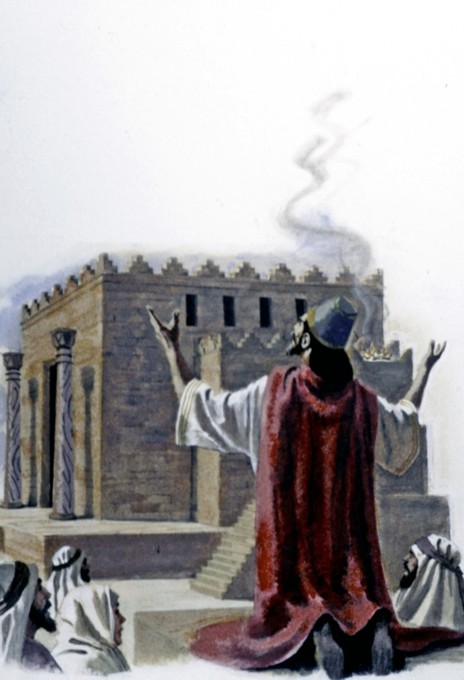
In Solomon's early years as king, when he built the Temple, he was a very godly man, offering a prayer of devotion to dedicate his finished Temple (1 Kings 8:22-61; 2 Chronicles 6:12--7:3).

In Solomon’s early years as king, when he built the Temple, he was a very godly man, offering a prayer of devotion to dedicate his finished Temple (1 Kings 8:22-61; 2 Chronicles 6:12–7:3).

In 2012, we have gone from the creation in Genesis to the end of Revelation studying the highlights of the Bible as the one story that it is (one chapter a day). What a year it has been!  This week, we will take a break from our reading in God’s word on Monday, and begin the new schedule of studying the “Wisdom Literature” in 2013 on New Year’s Day.  It is going to be a great year, and another very unique and, we trust, rewarding reading experience. We expect to see the completed schedule before Monday, and will post it then.  But we have reason to believe that we will start out in the Book of Proverbs.

We credit Solomon with the writing of Proverbs (we won’t debate the possibility of additional authors here), Ecclesiastes and Song of Solomon in particular, but much “non-inspired” literature is attributed to this king as well.  And we know that to be fact from what we are told in passages such as 1 Kings 4:29-34.  This passage starts with the great wisdom that God gave him (“And God gave Solomon wisdom and understanding beyond measure, and breadth of mind like the sand on the seashore) as a result of his request, which pleased the Lord (1 Kings 3:10-12).  Solomon reigned as king from about 970 – 931 B.C., and was the last king before the kingdom divided.

Summing Up

Each weekend, I post a small PDF of one week of chapter summaries (on the website’s “Summaries” page), current to the beginning of the previous week.  I have posted the summaries for Week 51 (December Week 3) and for Week 52 (December Week 4) of the schedule I have followed this year – the final two weeks for 2012!  The first of these short PDF documents contains condensed comments about Hebrews 6, 7, 8, 9, and 10, and the second about Hebrews 11, and Revelation 4, 5, 21, and 22 with hyperlinks to the ESV version of each chapter for listening or reading, and join the summaries for other weeks already posted there.

/Bob’s boy
___________________
image © V. Gilbert & Arlisle F. Beers

Please note: I did not design the reading plan that I am following in my blog.  All of my comments in this blog, however, are solely my responsibility.  When reading ANY commentary, you should ALWAYS refer first to the scripture, which is God’s unchanging and unfailing word. Reading schedules, as well as a link to the site where you can get the reading plan that I’m currently following for yourself can be found on the “Bible Reading Schedules” page of my website at http://graceofourlord.com.  For questions and help, please see the “FAQ” and “Summaries” pages there.

1 Kings 12 – The Kingdom Divided

Solomon’s son Rehoboam becomes king, but makes huge mistakes.  The life under Solomon had become hard labor – so much so that it seemed not much different from the slavery to Pharoah.  So the people come to Rehoboam asking him to lighten their load.  He foolishly listens to the counsel of the young men who had grown up with him, and ends up telling the people who had complained that he would make things harder for them (verses 13-14).  This also reminds of Pharoah’s response to Moses and Aaron in Exodus 5:1-21.

The United Kingdom of Solomon breaks up, with ...

The United Kingdom of Solomon breaks up, with Jeroboam ruling over the Northern Kingdom of Israel (in green on the map). (Photo credit: Wikipedia)

This leads to the division of the kingdom (verse 16).  Rehoboam tries to recover using his taskmaster, Adoram, but he is stoned to death and Rehoboam flees to Jerusalem.  Rehoboam assembles Judah and the tribe of Benjamin to try to regain the rest of the kingdom, but God sends word through Shemaiah for all the people not to fight against their relatives because “this thing is from me.”  So war is averted, and the people return to their homes.

But Jeroboam was fearful because the temple was in Jerusalem that people would return there to worship, and their hearts would be swayed to serve the house of David – Rehoboam.  So he fashioned golden calves and worship places at Dan and Bethel, telling the people (just as Aaron did in Exodus 32:4) “Behold your gods, O Israel, who brought you up out of the land of Egypt” (verse 28).  He also appointed priests who were not Levites.  This idol worship would be their downfall, and lead to their later exile, as the their minds had already begun to confuse the one true God with the rites of idol worship.  Many perversely saw themselves as worshiping Jehovah through these idols!  He even instituted his own feast in verse 33.

Read or listen to audio of ESV version of this selection from this link.

/Bob’s boy
___________________
some images © V. Gilbert & Arlisle F. Beers

Please note: I did not design the reading plan that I am following in my blog.  All of my comments in this blog, however, are solely my responsibility.  When reading ANY commentary, you should ALWAYS refer first to the scripture, which is God’s unchanging and unfailing word. Reading schedules, as well as a link to the site where you can get the reading plan that I’m currently following for yourself can be found on the “Bible Reading Schedules” page of my website at http://graceofourlord.com.  For questions and help, please see the “FAQ” and “Summaries” pages there.

1 Kings 11 – Solomon Turns From the Lord

English: Judgement of Solomon

English: Judgement of Solomon (Photo credit: Wikipedia)

The Lord’s warning in 1 Kings 9:6-9 seems pretty straightforward, and one would think that Solomon would have heed it.  But chapter 11 makes it clear that he did not.  God’s warnings concerning the king in Deuteronomy 17:14-17 were ignored, as well as what God said in Deuteronomy 7:3-5.  Solomon took 700 wives and 300 concubines (verse 3), and seemed to have married princesses from every Canaanite nation.  And just as warned over and over, they turned his heart to serving other “gods” (verse 5-8).  He even built places of worship to these idols, including Molech, whom the Bible writers associated with child sacrifice in, as we are told in Leviticus 18:21 and other passages.

The Lord’s anger with Solomon was great, and he told him that he would tear the kingdom away from him and give it to his servant (we meet him – Jeroboam – in verse 26) and he will indeed be the next king of Israel.  But God will not do this until Solomon dies, and he will leave one tribe with Solomon’s son for the sake of David (verse 13).  So God raises up adversaries against Solomon – Rezon rises up from the north, and Hadad rises up from the south.  Solomon now finds enemies on all sides. In verse 40, we find Solomon’s reaction to the promise of Jeroboam’s rise to king – he seeks to kill him, just as Saul did with David!  How far he has fallen.  Solomon dies in verse 43.  Verse 42 says that he reigned as king for 40 years.  Some believe that he wrote the book of Ecclesiastes in his later years


Read or listen to audio of ESV version of this selection from this link.

/Bob’s boy
___________________
some images © V. Gilbert & Arlisle F. Beers

Please note: I did not design the reading plan that I am following in my blog.  All of my comments in this blog, however, are solely my responsibility.  When reading ANY commentary, you should ALWAYS refer first to the scripture, which is God’s unchanging and unfailing word. Reading schedules, as well as a link to the site where you can get the reading plan that I’m currently following for yourself can be found on the “Bible Reading Schedules” page of my website at http://graceofourlord.com.  For questions and help, please see the “FAQ” and “Summaries” pages there.

Elijah’s Entrance \ Week 22 Summary Posted

Solomon and the Queen of Sheba.

Solomon and the Queen of Sheba. (Photo credit: Wikipedia)

We are moving along in the Books of Kings.  Like the Books of Samuel, 1 and 2 Kings were actually considered one book at one time.  It’s just sort of hard keeping scrolls that large :-).  More expedient to divide it up.  This week, we will skip over the visit of the Queen of Sheba in chapter 10 to read about Solomon’s greatest sins.  Then, we will move through the division of the kingdom, and Elijah defeating the prophets of Baal.  We will be in the 2nd book of Kings by weeks end.  Hope you are learning as much as I am in this “big picture” study of God’s word.

Summing Up

Each weekend, I am now posting a small PDF of one week of chapter summaries (on the website’s “Summaries” page), current to the beginning of the previous week.  I have posted the summary for Week 22 (May Week 4) of the schedule I am following.  This short PDF document contains condensed comments about 2 Samuel 15, 16, 17, 18, and 19, with hyperlinks to the ESV version of each chapter for listening or reading, and joins the summaries for other weeks already posted there.

/Bob’s boy
___________________
image © V. Gilbert & Arlisle F. Beers

Please note: I did not design the reading plan that I am following in my blog.  All of my comments in this blog, however, are solely my responsibility.  When reading ANY commentary, you should ALWAYS refer first to the scripture, which is God’s unchanging and unfailing word. Reading schedules, as well as a link to the site where you can get the reading plan that I’m currently following for yourself can be found on the “Bible Reading Schedules” page of my website at http://graceofourlord.com.  For questions and help, please see the “FAQ” and “Summaries” pages there.

1 Kings 8:1 – 9:9 – Ark Brought Into Temple

Sometime after the completion of construction of the temple, Solomon has the ark of the covenant, the tent of meeting (tabernacle), and all the holy vessels within brought from the old city of David so that the ark could be brought into the temple.  Like in the tabernacle (see Exodus 40), the inner sanctuary – or most holy place – is where the ark would be kept.  Only the priests could enter there (verse 6), and only they could “take up” the ark (verse 3).  Missing from the description of the contents of the ark are Aaron’s rod (Numbers 17:10-11) and the jar of manna (Exodus 16:32-34) that we are told were kept there at one time (Hebrews 9:1-5).  We are not told what had become of them.  After the priest’s came out, a cloud filled the temple as the glory of the Lord described in Exodus 40:34-38 – so that the priests were not able to even stand (verses 10-11).

English: image of Solomon and the covenant of ...

English: image of Solomon and the covenant of the ark, painted in 1747 (Photo credit: Wikipedia)

Solomon’s speech and his prayer to the Lord make up the rest of the chapter.  The prayer is beautiful and significant in that the people would eventually need all of the petitions of this prayer to be granted.  Solomon acknowledges in verses 27 and 29-30 that  God cannot be contained in an earthly dwelling, but that as the Lord had said, His name shall dwell there – the word “name” in biblical terms meaning all that constitutes the character and essence of all that He is.  And in place toward which His eyes are open.

The prayer consists of several petitions concerning granting mercy to the people when they repent of their sins during and after times including war, famine, drought, exile, and captivity – that the Lord would once again regard them as His people after repentance and “maintain their cause” (verse 49).  The Lord answers Solomon in 9:1-9 with a promise and a warning of what would happen if they turn aside, with a particular emphasis on warning against idolatry in verse 9.

Read or listen to audio of ESV version of this selection from this link.

/Bob’s boy
___________________
some images © V. Gilbert & Arlisle F. Beers

Please note: I did not design the reading plan that I am following in my blog.  All of my comments in this blog, however, are solely my responsibility.  When reading ANY commentary, you should ALWAYS refer first to the scripture, which is God’s unchanging and unfailing word. Reading schedules, as well as a link to the site where you can get the reading plan that I’m currently following for yourself can be found on the “Bible Reading Schedules” page of my website at http://graceofourlord.com.  For questions and help, please see the “FAQ” and “Summaries” pages there.

1 Kings 6 – Solomon Builds the Temple

The significance of verse one is that it gives us the ability to date the time of the Exodus – 480 years prior to the fourth year of Solomon’s reign.  The accepted date for that year of Salomon’s  reign is 966-967 BCE.  Although there is some argument for the application of the number of years, the more credible date for the Exodus seems to be about 1466-1467 BCE.  The detail of the temple’s construction is pretty specific, and was quite expensive (not all the gold used – most of it captured in the victorious the Israelites had over the various Canaanite cities).

English: Solomon and the Plan for the Temple, ...

English: Solomon and the Plan for the Temple, as in 1 Kings 6, illustration from a Bible card published by the Providence Lithograph Company (Photo credit: Wikipedia)

The exact dimensions are somewhat disputed due to the variance of the length of a cubit at different time, but as temple’s go, it would not have been the huge building that some of us might imagine. But the description is of a grandly beautiful temple for the Lord’s house.  God restates (in verse 11-13) the promises He made to David in 2 Samuel 7:11-16, but it is not an unconditional promise.  Note in verse 12, that God makes no promise to “hang around” if they are disobedient.

A beautiful structure indeed, but that obedience is more important to Him than the grandest of temples.  Remember that people (including the apostles) were very impressed with the temple that existed when Jesus was in Jerusalem.  But he foretold its utter destruction (as in Luke 21:5-6).

Read or listen to audio of ESV version of this selection from this link.

/Bob’s boy
___________________
some images © V. Gilbert & Arlisle F. Beers

Please note: I did not design the reading plan that I am following in my blog.  All of my comments in this blog, however, are solely my responsibility.  When reading ANY commentary, you should ALWAYS refer first to the scripture, which is God’s unchanging and unfailing word. Reading schedules, as well as a link to the site where you can get the reading plan that I’m currently following for yourself can be found on the “Bible Reading Schedules” page of my website at http://graceofourlord.com.  For questions and help, please see the “FAQ” and “Summaries” pages there.