King David’s Favor With God (1 Chronicles 17-18)

English: Nathan advises King David

English: Nathan advises King David (Photo credit: Wikipedia)

It was important for the chronicler to communicate well the events of I Chronicles 17 to the post-exilic Jews because it contains the covenant of God with David. Covered first in 2 Samuel 7, it begins with David wanting to build God a house. But God tells Nathan the prophet to let David know that it would not be him that builds such a house. Instead, God promises that He would build David’s “house” – that David’s offspring (Jesus) would reign forever.

In answer to God’s covenant, David makes a prayer to God (verses 16-27). It is one of the longest prayers in the bible, and incredibly humble and heartfelt. It begins with “Who am I, O Lord God, and what is my house, that you have brought me thus far?” They are words that each of us should ask God in prayer as well. The blessings that He has given us and the promises He has made to us are no less magnificent and undeserved that those made to David.

Hama

Hama (Photo credit: Wikipedia)

Chapter 18 contains some stunning military victories, some of which were reported in 2 Samuel 8. Here, David defeats the Philistines, and also takes Gath. The Moabites are defeated and become servants to David. He also “defeated Hadadezer king of Zobah-Hamath, as he went to set up his monument at the river Euphrates.” The plunder he took from the cities of Hadadezer included 1,000 chariots, 7,000 horsemen, and 20,000 foot soldiers, and shields made of gold.

In addition, verse 9 tells us that Tou king of Hamath was so pleased when he heard of the defeat of Hadadezer that he sent his son with gifts of gold, silver and bronze that Solomon would later use in building the pillars and the sea, and the bronze vessels for the temple.  Hamath is associated with modern Hama, which is located on the Orontes River in western Syria. There is an article with a picture there of a noria (a machine for lifting water into an aqueduct) at this link to Ferrell’s Travel Blog. We also recommend this article at BiblePlaces.com and this one at BiblicalArcheology.org for information on discoveries related to Tou (also called Toi and possibly Taita).

The victories continue against the Syrians and 18,000 Edomites in the Valley of Salt. And the text says that God gave victory to him wherever he went. Verses 14-17 detail how just and fair David was as a ruler, and how stable and well-organized his administration was. Joab was established as military commander, and “Jehoshaphat the son of Ahilud was recorder; and Zadok the son of Ahitub and Ahimelech the son of Abiathar were priests; and Shavsha was secretary; and Benaiah the son of Jehoiada was over the Cherethites and the Pelethites; and David’s sons were the chief officials in the service of the king.”

(This year’s reading plan for Luke, Acts, and 1 and 2 Chronicles averages just 15 verses per day – 5 days per week!)
Schedule for this week
Read or listen to audio of today’s selection from Luke here
Read or listen to audio of today’s selection from 1 Chronicles here

/Bob’s boy
___________________
some images © V. Gilbert & Arlisle F. Beers

Please note: I did not design the reading plan that I am following in my blog.  All of my comments in this blog, however, are solely my responsibility.  When reading ANY commentary, you should ALWAYS refer first to the scripture, which is God’s unchanging and unfailing word. Reading schedules, as well as a link to the site where you can get the reading plan that I’m currently following for yourself can be found on the “Bible Reading Schedules” page of my website at http://graceofourlord.com.  

Enhanced by Zemanta

Hands on the Plow – (Luke 9)

In verse 37, Jesus comes down from the mountain after the transfiguration, and is again met by a crowd. But there was a man there whose son had been possessed by a demon since early childhood. This account is in all three synoptic gospels (Matthew 17:14-20, Mark 9:14-29), and reading them all helps to clarify. The symptoms the boy had have led some to conclude that he had epilepsy, but that is clearly not the case. And we certainly know that Jesus would know the difference between a disease and this demon.

Christ healing a boy with a demon

Christ healing a boy with a demon

This one is evidently a singularly malevolent demon, and the man tells Jesus that His disciples had been unable to cast it out. In verse one, we are told that Jesus “called the twelve together and gave them power and authority over all demons.” So Jesus’ remarks about faith are on target. In Mark, he tells them that this kind can only be driven out by prayer. It is the building of their faith through prayer that would have made the difference; and this is a point that Mark’s account expounds on. We may never have enough faith to move mountains, but together with the power Jesus had given them, His apostles certainly had it within reach!

As the disciples were excitedly regarding all these things He had done, Jesus again talks about His impending death, saying Let these words sink into your ears: The Son of Man is about to be delivered into the hands of men.” As Jesus well knows, they aren’t getting it. And the next verse lets us know that they are not supposed to “get it” yet really. Verse 45 says “But they did not understand this saying, and it was concealed from them, so that they might not perceive it. And they were afraid to ask him about this saying.” All of this would come together for them after Pentecost.

It is nearly comical that just after their failure of faith, the disciples begin arguing about which of them is “the greatest.” They do not yet understand what Jesus’ true mission is, nor what is to become of Him. They only imagine how prominently they will fit into His kingdom. The child He brings by His side in verse 47 illustrates that having proper regard for one so small in stature and station is akin to having regard for Jesus – and thus for God. Therefore, He tells them, whoever is “least” among them is the greatest. The meaning here is of being least in regard for one’s self. Putting one’s self last and others first is the message Jesus has hammered home again and again.

“No one who puts his hand to the plow and looks back is fit for the kingdom of God.” Luke 9:62

“No one who puts his hand to the plow and looks back is fit for the kingdom of God.” Luke 9:62

Jesus was rejected on the next part of their journey by a Samaritan village because “his face was set toward Jerusalem” (Jews and Samaritans had little regard for each other). The disciples wanted to cause  “fire to come down from heaven and consume them,” which again is almost comical considering recent events. One gets the idea they were becoming a bit “puffed up.” Jesus, of course, rebukes them for even asking such a thing.

Verses 57-62 speak of some who wanted to follow Jesus but had other matters to attend to. Jesus’ answers to them reflect the fact that He must move quickly, and much is left to do. This meant that those who would be physically following Him must make doing so the singular priority in their lives right away, due to that urgency. Now, we are not expected to fore-go even attending our parent’s funeral in order to serve the Lord. But the application to our lives is nonetheless clear. Once we become Christians, that commitment in our lives trumps everything.

(This year’s reading plan for Luke, Acts, and 1 and 2 Chronicles averages just 15 verses per day – 5 days per week!)
Schedule for this week
Read or listen to audio of today’s selection from Luke here
Read or listen to audio of today’s selection from 1 Chronicles here

/Bob’s boy
___________________
some images © V. Gilbert & Arlisle F. Beers

Please note: I did not design the reading plan that I am following in my blog.  All of my comments in this blog, however, are solely my responsibility.  When reading ANY commentary, you should ALWAYS refer first to the scripture, which is God’s unchanging and unfailing word. Reading schedules, as well as a link to the site where you can get the reading plan that I’m currently following for yourself can be found on the “Bible Reading Schedules” page of my website at http://graceofourlord.com.  

Enhanced by Zemanta

The Unfolding of a Miracle – (Luke 9)

Luke, ever the accurate historian as has been proved time and gain, correctly refers to Herod Antipas as Herod the tetrarch in verse 7 of chapter 9. By this time, Herod has already had John the baptist beheaded, yet these stories of Jesus keep coming to him; and some people were saying that He was John – raised from the dead. Others said He was Elijah, and still others said that He was another one of the prophets. Verse 9 has Herod reassuring himself, but he resolved to meet Jesus face to face. One cannot help but wonder if guilt on Herod’s part has also placed some fear in his heart.

Luke’s account of the feeding of the Five Thousand

Meanwhile, Jesus’ apostles returned from the mission He had sent them on, and reported to Him all that had happened while they were gone. Jesus took them and went to Bethsaida, a town just east of where the Jordan River flowed into the Sea of Galilee. As usual, word spread quickly among the crowds, and they followed them. Jesus preached to them about the kingdom of God and healed those who needed healing among them.

The miraculous feeding of the 5,000 occurred on the shores of the Sea of Galilee near Bethsaida.

The miraculous feeding of the 5,000 occurred on the shores of the Sea of Galilee near Bethsaida.

As the end of the day was coming close, the apostles became concerned for the people, coming to Jesus to dismiss them, so they could find food and a place to stay. But Jesus told the apostles to feed them. Having only a couple of fish and five loaves of bread, they protested the impossibility of feeding five thousand men and all of the women and children as well. Having them sat in groups of about fifty each, he blessed the food, looking toward heaven.  Everyone ate until they were satisfied, and twelve baskets full of broken pieces were taken up afterward.

We are not told why Jesus had them separated into groups of “about fifty,” and speculation about that is futile, since the whole thing was miraculous anyway.  But one might wonder what the apostles saw, as they made sure that the food was passed around throughout what would have to be well over 100 of these groups of people. We cannot know how it all unfolded, but let’s try for a minute to just imagine what it could have been like.

When Jesus broke the loaves, He must have given portions to each of the twelve apostles. One can only imagine their sense of foreboding as they handed their portion off to the first group – no doubt expecting it to run out long before reaching the last of the fifty people in their first group. When that did not happen, and as each of the twelve transferred the food from one group to another, did they see the amount of food undiminished in quantity or was it gradually growing? It seems likely that the latter would be the case.

Imagine that sense of dread they felt initially turning first to surprise, and then to amazement. It is easy to imagine then that the excitement would build into a giddy and festive atmosphere that would be contagious to these crowds!

(This year’s reading plan for Luke, Acts, and 1 and 2 Chronicles averages just 15 verses per day – 5 days per week!)
Schedule for this week
Read or listen to audio of today’s selection from Luke here
Read or listen to audio of today’s selection from 1 Chronicles here

/Bob’s boy
___________________
some images © V. Gilbert & Arlisle F. Beers

Please note: I did not design the reading plan that I am following in my blog.  All of my comments in this blog, however, are solely my responsibility.  When reading ANY commentary, you should ALWAYS refer first to the scripture, which is God’s unchanging and unfailing word. Reading schedules, as well as a link to the site where you can get the reading plan that I’m currently following for yourself can be found on the “Bible Reading Schedules” page of my website at http://graceofourlord.com.  

Enhanced by Zemanta

Shake Off the Dust – (Luke 9)

The opening verses of Luke chapter 9 are about one of the times that Jesus sent His apostles out “to proclaim the kingdom of God and to heal.” In it, Luke tells us that He had given them the power and authority over all demons, and to cure diseases. Jesus gave them instructions about choosing who to stay with, and to “shake the dust from their feet” when they and their message are not well received. This is akin to what Jesus said about not casting “your pearls before swine” in Matthew 7:6. Wasting one’s time continuing to try to convince someone who refuses to hear the truth means time lost that could be used to help someone who will listen. Verse 6 tells us that “they departed and went through the villages, preaching the gospel and healing everywhere.” These facts are the only important points of these few verses.

Jesus' discples were honored to listen to Him teach daily. Jesus had special teaching for The Twelve, His twelve disciples or apostles

Jesus’ discples were honored to listen to Him teach daily. Jesus had special teaching for The Twelve, His twelve disciples or apostles

Nevertheless, we feel the need to address something of less importance here. This account is contained in all three synoptic gospels (see Matthew 10:5-15 and Mark 6:7-13), but there is some difference in the Greek, and in the way that the three writers use those different verbs that is very puzzling, when one compares them (Mark actually appears to tell them to take a staff, while the others say that Jesus said not to). This, of course, makes them very ripe for skeptics who devote their time to trying to prove that there are contradictions in God’s word. There is no contradiction, of course. But this is perhaps the most difficult example to understand, and requires no small amount of critical analysis in order to do so.

Before beginning this analysis, it is important to understand that all three gospel writers are trying to convey a couple of important facts that are related to the confusing language. The first is that the apostles’ mission in this instance is urgent, and time is of the essence. Jesus has plans to send out “the seventy-two” to do the same thing in Luke 10 after the apostles get back (notice that the 72 are told not to carry any sandals, etc.). This training is important, and He has much more training for His apostles, many more miracles to perform, and a great deal of other teaching to do before “His time” is up. Secondly, part of the training Jesus is giving them is to teach them to depend on (and trust) God for their needs.

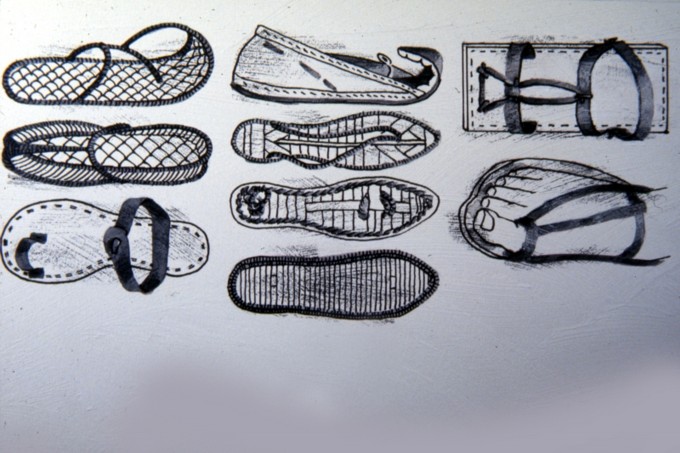
Bible-time shoes were often sandals, such as these.

Bible-time shoes were often sandals, such as these.

So in light of all of this, what the three gospel writers are conveying is that Jesus wants them to go now, and as they are, and do not take extra provisions. Matthew uses the Greek word “ktaomai,” meaning they are not to acquire or procure the things mentioned there. Mark uses the word “airo,” meaning “to take” – instructing them to take the things He tells them to, but not others, and to wear sandals, but to not put on two tunics.

But Luke, in telling them not to take the things mentioned here, does not use the word “ktaomai” because when he uses that word, he uses it in the sense of meaning “to buy or earn” (as in  Luke 18:12, Acts 1:18, and Acts 8:20). Instead, he uses the word “airo,” but he uses it in the sense of the meaning “to acquire” – meaning do not acquire these things (as in Luke 19:21-22). He certainly would not be telling them that they must take their sandals off and leave them behind!

(For a more detailed analysis, please see this article at ApologeticsPress.org).

(This year’s reading plan for Luke, Acts, and 1 and 2 Chronicles averages just 15 verses per day – 5 days per week!)
Schedule for this week
Read or listen to audio of today’s selection from Luke here
Read or listen to audio of today’s selection from 1 Chronicles here

/Bob’s boy
___________________
some images © V. Gilbert & Arlisle F. Beers

Please note: I did not design the reading plan that I am following in my blog.  All of my comments in this blog, however, are solely my responsibility.  When reading ANY commentary, you should ALWAYS refer first to the scripture, which is God’s unchanging and unfailing word. Reading schedules, as well as a link to the site where you can get the reading plan that I’m currently following for yourself can be found on the “Bible Reading Schedules” page of my website at http://graceofourlord.com.  

Enhanced by Zemanta

Cleansing Prayer

This year, we began a series intended to help us develop our praying habits with an emphasis on the ACTS method of prayer in this article. We continue to stress that there is no requirement for any set formula for prayer, but the method referred to by the acronym can be useful. The elements of prayer represented by the ACTS method are adoration, confession, thanksgiving, and supplication.

National Day of Prayer

National Day of Prayer (Photo credit: Wikipedia)

Today, let’s take a quick look at confession. This is the hardest part of prayer for some people. Most people do not want to admit that they have been wrong. Most of us like to think that we pretty much have it “all together.” And after all, most of try pretty hard to do the right thing most of the time. Except when we don’t. The problem sometimes comes in recognizing and admitting those times when we have been off the mark.

But everyone has sin in their lives, and none are any worse – or better – than any others. It is true for the preacher, the elders of the church, and even for the sweet old lady who loves everyone and never misses a service. Paul said in Romans 3:23 that “all have sinned and fall short of the glory of God.” 1 John 1:8 says that “If we say we have no sin, we deceive ourselves, and the truth is not in us.”

But because of the price Jesus paid for us, we have the grace of God, and can have His forgiveness for any sin in our lives. 1 John 1:9 says “if we confess our sins, he is faithful and just to forgive us our sins and to cleanse us from all unrighteousness.” What an awesome gift we have been given by our Lord! There is nothing that God will not forgive us for simply be asking in prayer!

Finding the right words to confess to God is easy if we study the scriptures daily, and speak from the heart. Here is a short example of doing so by borrowing from David’s earnest prayer to God for his sins in Psalm 51:1,and 10. We will leave you with that.

Holy Father,
Have mercy on me, O God,
according to your steadfast love;
according to your abundant mercy
blot out my transgressions.
Create in me a clean heart, O God,
and renew a right spirit within me.
In your Son’s name I pray this humble prayer. Amen.

(This year’s reading plan for Luke, Acts, and 1 and 2 Chronicles averages just 15 verses per day – 5 days per week!)
Schedule for this week

/Bob’s boy
___________________
some images © V. Gilbert & Arlisle F. Beers

Please note: I did not design the reading plan that I am following in my blog.  All of my comments in this blog, however, are solely my responsibility.  When reading ANY commentary, you should ALWAYS refer first to the scripture, which is God’s unchanging and unfailing word. Reading schedules, as well as a link to the site where you can get the reading plan that I’m currently following for yourself can be found on the “Bible Reading Schedules” page of my website at http://graceofourlord.com.

Enhanced by Zemanta

A Truly United Kingdom – (1 Chronicles 16)

The Sacrifice of the Old Covenant

The Sacrifice of the Old Covenant (Photo credit: Wikipedia)

Now that the Levites had successfully transported the Ark to Jerusalem, David begins celebrating in the most proper manner – with tribute to God. God’s people were in the middle of the greatest times that the united kingdom would know. And for the most part, it would last through Solomon’s reign. Second only to the dedication of the Temple by Solomon, this would be the greatest celebration of that time.

David had the ark of the covenant brought in to the tent that he had erected for it. They then had burnt offerings and peace offerings. The peace offering is sometimes called a fellowship, or more properly, a thanksgiving offering, and is introduced in Leviticus 3:1-17 and Leviticus 7:11-34. Afterwards, the celebration continued with every man and woman of the vast number of Israelites present being given “loaf of bread, a portion of meat, and a cake of raisins.”

English: Statue of King David by Nicolas Cordi...

English: Statue of King David by Nicolas Cordier in the Borghese Chapel of the Basilica di Santa Maria Maggiore. Français : Statue du roi David par Nicolas Cordier, dans la chapelle Borghèse de la basilique Sainte-Marie Majeure. Italiano: Statua del re Davide di Nicolas Cordier, nella Capella Borghese della Basilica di Santa Maria Maggiore in Roma. (Photo credit: Wikipedia)

David then appointed certain Levites to “minister before the ark” invoking thanks, praising the Lord, and playing harps, lyres, cymbals, and blowing trumpets. Chief among this group of Levites was Asaph who authored Psalms 50 and 73-83. Also among them was Benaiah, one of the most powerful of David’s “mighty men,” whose exploits (some of which are described in 2 Samuel 23:20-22) included the single-handed defeat of Moab’s two mightiest warriors. Verse 7 tells us that it was the first time that David appointed Asaph and his brothers to sing thanksgiving to the Lord.

Verses 8-36 contain David’s song of thanksgiving. It is a long and wonderful song of praise to the Lord; and parts of it are contained in Psalm 105:1–15, Psalm 96:1–13, and Psalm 106:1, 47–48. Verses 37-42 describe how David made ministering to the ark a long-term responsibility for Asaph and his brothers. He also left Obed-edom (and his 68 brothers!), along with Zadok the priest and his brothers to offer burnt offerings and perform other duties.

Finally, the ark was to get the care that it had once had when Moses was around; and the Levites would do what they were intended to do before the Lord in such a grand scale as Israel had not seen since long before Israel had its first king.

(This year’s reading plan for Luke, Acts, and 1 and 2 Chronicles averages just 15 verses per day – 5 days per week!)
Schedule for this week
Read or listen to audio of today’s selection from Luke here
Read or listen to audio of today’s selection from 1 Chronicles here

/Bob’s boy
___________________
some images © V. Gilbert & Arlisle F. Beers

Please note: I did not design the reading plan that I am following in my blog.  All of my comments in this blog, however, are solely my responsibility.  When reading ANY commentary, you should ALWAYS refer first to the scripture, which is God’s unchanging and unfailing word. Reading schedules, as well as a link to the site where you can get the reading plan that I’m currently following for yourself can be found on the “Bible Reading Schedules” page of my website at http://graceofourlord.com.  

Enhanced by Zemanta

Falling Asleep – (Luke 8)

Jesus returned from the country of the Gerasenes, and received a warm welcome from the crowd – very different from the send-off he just got. Then a man named Jairus came to Jesus. The  text says that he was a ruler of the synagogue, which probably means that he was in charge of keeping it maintained and arranging services. At any rate, falling at Jesus’ feet, as he did in verse 41, was way out of character for a man in his position. But his 12 year old daughter was dying. And of course, a father would do anything to save his child. And she was his only child.


Raising of the Daughter of Jairus

Raising of the Daughter of Jairus (Photo credit: Wikipedia)


As Jesus set out for his house, the crowds were thick and “pressed around Him.” There was a woman among them who had a “discharge of blood.” We do not know much about it, except that she had been afflicted with this for 12 years, and had spent all of her money on physicians to try and cure it. But according to Mark 5:22-34, it had become worse instead of better. She had it in her mind that if he could just touch Jesus’ garment, she would be healed. And so she pressed in through the throng, and did so. Jesus called out to find out who had touched Him, but He obviously knew very well who had done so. He wanted her to hear what He had to say; and He wanted the others to hear it as well. He told her that her faith had made her well.


Jesus and Jairus were met on the way by people from Jairus’ house, who told him that his daughter was already dead. But Jesus told him to just believe. Mark tells us that Peter, James, and John accompanied him inside when he arrived. Jesus told the weeping relatives that the girl was not dead, but only sleeping. But it was obvious to all present that she had in fact died.


Commentators have offered many explanations for why Jesus said that, when He had to have known that she had really died. But the answer is not nearly so complicated as many of them try to make it. There was no deception being attempted. There simply was no finality in her condition. To His way of thinking, the little girl was in fact only sleeping. Paul used this way of thinking to make the point about those who had died when he wrote his letter to the brethren at Thessolonica in 1 Thessalonians 4:13-15. In it, he speaks of them as those who had “fallen asleep.” Paul knew exactly what he was saying, just as Jesus did.


It seems clear that one of the messages of this account (which occurs in all three synoptic gospels) is about the hope that is ours because the Lord not only has power over disease and demons, but even over death – over which His victory will become complete and very personal before the end of Luke’s gospel.


(This year’s reading plan for Luke, Acts, and 1 and 2 Chronicles averages just 15 verses per day – 5 days per week!)
Schedule for this week
Read or listen to audio of today’s selection from Luke here
Read or listen to audio of today’s selection from 1 Chronicles here


/Bob’s boy


___________________


some images © V. Gilbert & Arlisle F. Beers


Please note: I did not design the reading plan that I am following in my blog.  All of my comments in this blog, however, are solely my responsibility.  When reading ANY commentary, you should ALWAYS refer first to the scripture, which is God’s unchanging and unfailing word. Reading schedules, as well as a link to the site where you can get the reading plan that I’m currently following for yourself can be found on the “Bible Reading Schedules” page of my website at http://graceofourlord.com.  


Enhanced by Zemanta

Who Then Is This? – (Luke 8)

In verse 22, Jesus has boarded a boat to go to “the other side of the lake.” That lake, of course, was the Sea of Galilee. Here Luke tells us that Jesus had fallen asleep, significant to us as a reminder that He was indeed a man. And as a man, He experienced fatigue, just as we do, and He did not hesitate to rest when He needed it – just as we must take time to do, when we can.

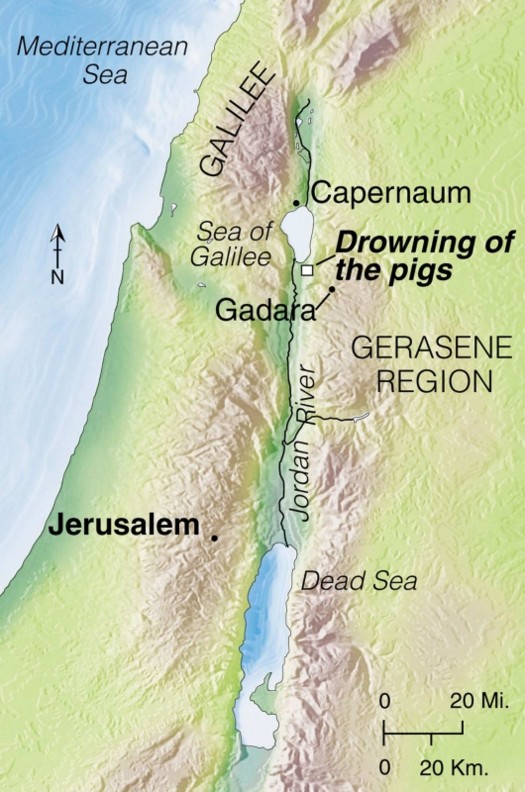
From Capernaum, Jesus and his disciples crossed the Sea of Galilee. A storm blew up unexpectedly, but Jesus calmed it. Landing in the region of the Gerasenes, Jesus sent demons out of a man and into a herd of pigs that plunged over a steep bank into the lake.

From Capernaum, Jesus and his disciples crossed the Sea of Galilee. A storm blew up unexpectedly, but Jesus calmed it. Landing in the region of the Gerasenes, Jesus sent demons out of a man and into a herd of pigs that plunged over a steep bank into the lake.

While He was sleeping, a storm came that was severe enough to begin to fill the vessel with water. Verse 23 confirms the severity, saying that they were indeed in danger. But Jesus remained asleep through it all, demonstrating that He must truly have been exhausted. When they woke him, they were frantic, letting Him know that they were about to die (verse 24). With His verbal command, the winds and the waves calmed, and He asked them where their faith was. The statement “who then is this, that he commands even winds and water, and they obey him?” betrays the fact that they really did not know for sure just who Jesus was yet.

From there, verse 26 says that they sailed to the country of the “Gerasenes” (some manuscripts have it as “Gadarenes”). This is the region around what was known as Gadara, which today is known as Umm Qais, just to the southeast of the Sea of Galilee. Here, Jesus met up with Legion (so-called because he had been possessed by many demons). He wore no clothes, and lived among the tombs. Verse 28 states that at various times, he had been bound and shackled, and placed under guard. But he would escape, and the demons would “drive him into the desert.”

Jesus commanded the demons out, and he cried out and fell down before him and said with a loud voice, “What have you to do with me, Jesus, Son of the Most High God? I beg you, do not torment me.” The demons begged him not cast them “into the abyss,” but to let them enter a herd of pigs that was on the hill. He gave them permission, and after they did, the herd rushed into the lake and drowned.

Christ at Gadara.

Christ at Gadara.

We have commented about such events as these in this age before in this previous post. These accounts are sometimes the source of embarrassment for the believer, and one of scoffing and derision for the unbeliever. But for whatever reason (some we covered in said article) God allowed these things to occur in the age just prior to Jesus’ birth, and into the apostolic age. We will cover this again at a later date. Suffice to say, there is much we do not know about the world of demons. But make no mistake, these were very real events.

The grateful man wanted to come with Jesus, but Jesus sent him away to “declare how much God has done for you,” which he did. The people of the region, however, were not so grateful, but full of fear because of Jesus; and they asked Him to leave. Jesus did depart in a boat, which serves as a lesson to us that if we do not want Him in our lives, He will, (and I am sure, does) accommodate us in that respect.

(This year’s reading plan for Luke, Acts, and 1 and 2 Chronicles averages just 15 verses per day – 5 days per week!)
Schedule for this week
Read or listen to audio of today’s selection from Luke here
Read or listen to audio of today’s selection from 1 Chronicles here

/Bob’s boy
___________________
some images © V. Gilbert & Arlisle F. Beers

Please note: I did not design the reading plan that I am following in my blog.  All of my comments in this blog, however, are solely my responsibility.  When reading ANY commentary, you should ALWAYS refer first to the scripture, which is God’s unchanging and unfailing word. Reading schedules, as well as a link to the site where you can get the reading plan that I’m currently following for yourself can be found on the “Bible Reading Schedules” page of my website at http://graceofourlord.com.  

Enhanced by Zemanta

They May Not Understand – (Luke 8)

The Parable of the Sower is recounted in all three synoptic gospels. We commented on Matthew 13’s account in this previous post. The other one is contained in Mark 4:1-20. A full reading of all three accounts gives us the best understanding. As is always the case with God’s word, anytime something is repeated, it is a sure sign of its great importance. Three detailed accounts of this parable underscores that point with resounding clarity.

Landscape with the Parable of the Sower

Landscape with the Parable of the Sower (Photo credit: Wikipedia)

But why is the parable of the sower so important? There are several reasons, and each reading seems to help understand more of them. This parable, as explained by Jesus in verses 9-15, explains “the why” of all of Jesus’ parables, along with Isaiah 6:9-10 (“seeing they may not see, and hearing they may not understand”). This prophetic passage spoke of those who would be eyewitnesses to Jesus, His miracles, and the truth about who He was – yet those who did not want the truth would not receive it.

But it is much more than that. The Parable of the Sower is the key to understanding much about all sorts of people, from total non-believers to dedicated Christians, and several levels in between. And it serves as a warning for us to not allow the pleasures of the world to consume us. It points to the very real possibility that we can encounter trials in this life that will test our faith, and not one of us is immune to falling away under such circumstances.

So how do we become the “good soil?” We do that in the same way that we cultivate a luxurious garden by preparing the soil. We must work the ground, constantly removing every rock that we can – and we do that one at a time, by leaning on the Lord and prayerfully asking for His help in doing so. “Pray without ceasing” is one of the secrets to becoming “good soil.” Another comes by feeding “the soil” the nutrients that are so vital to growth – and doing so regularly. And that comes through a steady diet of God’s word.

Verses 16-18 may seem somewhat difficult to understand, but it helps to read also Mark 4:21-25 and Matthew 10:26-27. Disciples of Jesus are not to hear and learn the truth and just go about their business as if that were enough. What we hear, we are to proclaim on the housetops, and we are to never stop learning and sharing the knowledge that we gain. Doing so, that knowledge will will increase in proportion to our efforts. But without those efforts, we will “lose” what we have gained.

(This year’s reading plan for Luke, Acts, and 1 and 2 Chronicles averages just 15 verses per day – 5 days per week!)
Schedule for this week
Read or listen to audio of today’s selection from Luke here
Read or listen to audio of today’s selection from 1 Chronicles here

/Bob’s boy
___________________
some images © V. Gilbert & Arlisle F. Beers

Please note: I did not design the reading plan that I am following in my blog.  All of my comments in this blog, however, are solely my responsibility.  When reading ANY commentary, you should ALWAYS refer first to the scripture, which is God’s unchanging and unfailing word. Reading schedules, as well as a link to the site where you can get the reading plan that I’m currently following for yourself can be found on the “Bible Reading Schedules” page of my website at http://graceofourlord.com.  
Enhanced by Zemanta

Women of Means – Luke 8

Verses 1-3 of Luke chapter 8 can tell us much about the ministry of our Lord Jesus, but the tendency is to rush right past them and into the rest of the chapter, as there is much going on here. But let’s focus for a moment on the women that traveled with Jesus as He went preaching through these villages. Only three are mentioned by name, but Luke says there were many others.

Susanna is one that is not mentioned again in the New Testament, so we only know what Luke tells us here – which is that she was either healed by Jesus of some infirmity or of demons. The same goes for Joanna, except that it is highly probable that she is the same Joanna that in Luke 24:1-11 was one of the women that discovered Jesus’ empty tomb and went to tell the apostles. Joanna was the wife of the manager of the household of Herod Antipas.

Magdala, near modern Migdal, was situated here along the Sea of Galilee. Magdala was the home of Mary Magdalene.

Magdala, near modern Migdal, was situated here along the Sea of Galilee. Magdala was the home of Mary Magdalene.

The other woman who is mentioned is “Mary, called Magdalene.” Of all the women in the New Testament, she has been given the most unfair extra-biblical treatment – even disregarding the book and subsequent movie, the Da Vinci Code (and we will), which has been more than adequately dealt with in other articles that we can point you to, if interested.

First, there is the false belief that Mary Magdalene was a prostitute, which we covered in this previous post about Jesus’ dinner with Simon the Pharisee. Then there is further confusion, as she is sometimes portrayed as the adulterous woman of John 8:3-11 that the scribes and Pharisees wanted to stone. Remember Jesus said “let him who is without sin cast the first stone?” Nope, that wasn’t Mary Magdalene either. In fact, there is not even a single mention of Mary of Magdala in the Bible in the context of sin! Here, we learn that she had seven demons that Jesus cast out – but no mention of sin.

Furthermore, the women that are mentioned along with her in these three verses all “provided for them out of their means” (“them” meaning Jesus and His ministry). So not only was Mary Magdalene not a prostitute, but she was evidently a woman of some means financially, who now devoted her life to the Lord. How did the truth become so twisted in so many ways about this woman? There have been several answers offered, but they all come down to the age-old problem. We often (even innocently) accept the words of men rather than searching God’s word for the truth.

(This year’s reading plan for Luke, Acts, and 1 and 2 Chronicles averages just 15 verses per day – 5 days per week!)
Schedule for this week
Read or listen to audio of today’s selection from Luke here
Read or listen to audio of today’s selection from 1 Chronicles here

/Bob’s boy
___________________
some images © V. Gilbert & Arlisle F. Beers

Please note: I did not design the reading plan that I am following in my blog.  All of my comments in this blog, however, are solely my responsibility.  When reading ANY commentary, you should ALWAYS refer first to the scripture, which is God’s unchanging and unfailing word. Reading schedules, as well as a link to the site where you can get the reading plan that I’m currently following for yourself can be found on the “Bible Reading Schedules” page of my website at http://graceofourlord.com.  

Enhanced by Zemanta