David’s Charge to Solomon – 1 Chronicles 28

English: Solomon and the Plan for the Temple, ...

English: Solomon and the Plan for the Temple, as in 1 Kings 6, illustration from a Bible card published by the Providence Lithograph Company (Photo credit: Wikipedia)

Chapter 28 is David’s official notice to all of the assembled officials of Israel at Jerusalem of Solomon’s charge to build the temple, as he explains to them the reasons for God’s choice of Solomon to build it. He then gives the charge to Solomon in their presence, saying:

“Be strong and courageous and do it. Do not be afraid and do not be dismayed, for the Lord God, even my God, is with you. He will not leave you or forsake you, until all the work for the service of the house of the Lord is finished.”

This is quoted from God’s charge to Joshua in Joshua 1:9 and also from Deuteronomy 1:21, and it is meant to encourage the young heir in the face of the most important task of his life. But he was not left to his own devices, for David gave him the plans for the entire thing in verses 11-19 in intricate detail – as the Lord had given it to him.

Just as was the case with the Tabernacle that Moses had to rally to construct in splendid detail, God provided the “blueprints” for the house that David’s son was to build with the help of all the Levites and craftsmen at his beck and call.

(This year’s reading plan for Luke, Acts, and 1 and 2 Chronicles averages just 15 verses per day – 5 days per week!)
Schedule for this week
Read or listen to audio of today’s selection from Luke here
Read or listen to audio of today’s selection from 1 Chronicles here

/Bob’s boy
___________________
some images © V. Gilbert & Arlisle F. Beers

Please note: I did not design the reading plan that I am following in my blog.  All of my comments in this blog, however, are solely my responsibility.  When reading ANY commentary, you should ALWAYS refer first to the scripture, which is God’s unchanging and unfailing word. Reading schedules, as well as a link to the site where you can get the reading plan that I’m currently following for yourself can be found on the “Bible Reading Schedules” page of my website at http://graceofourlord.com.  

Enhanced by Zemanta

Days of the Son of Man – Luke 17

The Destruction Of Sodom And Gomorrah, a paint...

The Destruction Of Sodom And Gomorrah, a painting by John Martin (painter), died 1854, thus 100 years. (Photo credit: Wikipedia)

Verses 20-37 of Luke 17 are admittedly difficult to put in context and understand. Many believe that Jesus is speaking of the final judgment, and there may be some of that mixed in here. But there are several clues that lead us to associate this with the coming judgment upon Jerusalem that will come in A.D. 70. Much of this is similar to the message contained in Matthew 24, which we discussed in this previous post.

One part that generates confusion for some is when the Pharisees ask Him when the kingdom of God will come in verse 20. Jesus tells them in verse 21 that the kingdom of God is in the midst of you.” Some translate that as “within you,” but that cannot be the case, as it is addressed to those who do not believe. Instead, Jesus is telling them that it has already arrived in the lives and the hearts of those who are already following Him.

Águia Romana / Roman Eagle

Águia Romana / Roman Eagle (Photo credit: Marcio Cabral de Moura)

If we take it a bite at a time from there, we can see in verses 22 and 23 that Jesus is telling them that there will be no mistaking the days of the Son of Man. Much of this sounds very much like the references to “the day of the Lord” that is spoken about on many occasions in the Old Testament, such as Zephaniah 1:14-18, Isaiah 13:9-11, Joel 2, and many other passages. That term always referred to a time of God taking some kind of decisive action.

He then compares it to the events of the Great Flood, and of Sodom and Gomorrah. In verse 37 He tells them “Where the corpse is, there the vultures will gather.” Some translations have “eagles” rather than “vultures,” which many associate with Rome, as it was a symbol of power for them. A coincidental translation? Perhaps, but perhaps not.

Zephaniah 1:14-18
Zephaniah 1:14-18

(This year’s reading plan for Luke, Acts, and 1 and 2 Chronicles averages just 15 verses per day – 5 days per week!)
Schedule for this week
Read or listen to audio of today’s selection from Luke here
Read or listen to audio of today’s selection from 1 Chronicles here

/Bob’s boy
___________________
some images © V. Gilbert & Arlisle F. Beers

Please note: I did not design the reading plan that I am following in my blog.  All of my comments in this blog, however, are solely my responsibility.  When reading ANY commentary, you should ALWAYS refer first to the scripture, which is God’s unchanging and unfailing word. Reading schedules, as well as a link to the site where you can get the reading plan that I’m currently following for yourself can be found on the “Bible Reading Schedules” page of my website at http://graceofourlord.com.  

Enhanced by Zemanta

Where Is the Gratitude? – Luke 17

English: This is a map of first century Iudaea...

English: This is a map of first century Iudaea Province that I created using Illustrator CS2. I traced this image for the general geographic features. I then manually input data from maps found in a couple of sources. Robert W. Funk and the Jesus Seminar. The Acts of Jesus. HarperSanFrancisco: 1998. p. xxiv. Michael Grant. Jesus: An Historian’s Review of the Gospels. Charles Scribner’s Sons: 1977. p. 65-67. John P. Meier. A Marginal Jew. Doubleday: 1991. p. 1:434. (Photo credit: Wikipedia)

In verse 7, Luke tells us that Jesus passed through Samaria on His way to Jerusalem from Galilee. Unless one took a very long route around and out of the way, and crossed the Jordan from the east, it was the only way. Not that Jesus would have wanted to avoid it, but some Jews hated Samaritans enough that they might.

He was met there by ten lepers who were standing far off. Under levitical law, they would be accustomed to doing so (Leviticus 14:1-8). They called to Him, saying Jesus, Master, have mercy on us.” Jesus told them to go and show themselves to the priests, and they were healed on the way. The text says that the one that turned back, fell on his face, and gave thanks to Jesus was a Samaritan.  And Jesus said “Was no one found to return and give praise to God except this foreigner?”

It could be that the others were Jews. Or it could be the case that some or all of the others were “foreigners” as well. Jesus was passing “between Samaria and Galilee,” verse 11 says. I don’t think it really matters, actually. But I think the fact that the one that came back and thanked Him was not a Jew did matter. And I believe that when Jesus said Rise and go your way; your faith has made you well,” He did not mean simply that the leper was healed. All of them had been cleansed. But this one, because of his faith, had been forgiven for his sins – just like the paralyzed man of Luke 5:17-26. This is just one more example of Jesus showing us grace for the gentiles that would be remembered after He was gone.

The second thing to take away from this is concerning the nine who did not return to give thanks. How loudly had they cried out to Him for mercy? I keep being reminded of a T-shirt I once saw that said something like “Did you cry out ‘Thank you, Lord’ as loudly as you cried ‘Help me Lord?'” How often do we lack gratitude to the Lord in the same way as those nine?

(This year’s reading plan for Luke, Acts, and 1 and 2 Chronicles averages just 15 verses per day – 5 days per week!)
Schedule for this week
Read or listen to audio of today’s selection from Luke here
Read or listen to audio of today’s selection from 1 Chronicles here

/Bob’s boy
___________________
some images © V. Gilbert & Arlisle F. Beers

Please note: I did not design the reading plan that I am following in my blog.  All of my comments in this blog, however, are solely my responsibility.  When reading ANY commentary, you should ALWAYS refer first to the scripture, which is God’s unchanging and unfailing word. Reading schedules, as well as a link to the site where you can get the reading plan that I’m currently following for yourself can be found on the “Bible Reading Schedules” page of my website at http://graceofourlord.com.  

Enhanced by Zemanta

Unworthy Servants – Luke 17

Photograph of an aristocrat from Bandoeng with...

Photograph of an aristocrat from Bandoeng with his servant. Español: Fotografía de un aristócrata de Bandoeng con su sirviente. Français: Photo d’un aristocrate de Bandoeng avec son serviteur Nederlands: Foto. Adellijke persoon uit Bandoeng met bediende. (Photo credit: Wikipedia)

In verse 7, Jesus begins asking his disciples whether (supposing one of them actually were in a position to have servants) they would tell them to drop what they were doing and come “recline at table.” And then asks whether one would normally thank their servant for doing what was commanded. We might see servants treated in such manner on television or in movies today, but such would not have been the custom in that place and time. Instead, Jesus says, they will tell the servant not only to come wait on them, but make sure they are dressed properly before doing so.

So, Jesus also says, when we have done all that we are commanded, we should realize that we are unworthy servants, who only have done our duty. This is certainly the attitude we should have as God’s children. It seems at first that Jesus is here in this chapter just throwing out random bits of spiritual wisdom. He begins the chapter talking about how we must forgive our brother when he repents, even if he has done wrong to us seven times. The number seven is not the limit, of course, but rather it represents countless instances (the number seven has always had great significance in scripture).

But does the brother that continues to do us wrong really deserve our forgiveness? Probably not. But by his repentance, he has done what he should do to be reconciled; and we are bound by God to forgive, just as he will forgive us. His worthiness is beside the point.  The second thing Jesus has spoken to in the previous verses is of boundless faith. We are capable of doing many great things that are according to God’s will if our faith is strong enough. It all begins by keeping His commandments, and realizing that by doing so, we have earned absolutely nothing. We only do our duty to Him by doing so.

We deserve nothing, but in our helpless unworthiness, we learn faith in the one true and living God because we know that we can trust Him. It is in this way, and with this attitude that we increase our faith day by day. Think of it as the surrender of doubt.

(This year’s reading plan for Luke, Acts, and 1 and 2 Chronicles averages just 15 verses per day – 5 days per week!)
Schedule for this week
Read or listen to audio of today’s selection from Luke here
Read or listen to audio of today’s selection from 1 Chronicles here

/Bob’s boy
___________________
some images © V. Gilbert & Arlisle F. Beers

Please note: I did not design the reading plan that I am following in my blog.  All of my comments in this blog, however, are solely my responsibility.  When reading ANY commentary, you should ALWAYS refer first to the scripture, which is God’s unchanging and unfailing word. Reading schedules, as well as a link to the site where you can get the reading plan that I’m currently following for yourself can be found on the “Bible Reading Schedules” page of my website at http://graceofourlord.com.  

Enhanced by Zemanta

Mustard Seed Faith – (Luke 17)

English: Mustard seeds by David Turner Februar...

English: Mustard seeds by David Turner February 23, 2005 Edited by Consequencefree to replace the coin with an SI measurement reference (Photo credit: Wikipedia)

In the opening verses of chapter 17, Jesus acknowledges that temptations are a part of life. But He warns about those who tempt others to sin. He repeats the thought of verse two in Matthew 18:6 and also in Mark 9:42. Particularly in Matthew, He seems to be talking about those who would cause children to stumble; and certainly the application is valid there as well. But He is, more to the point, speaking about those who are innocent – those who are trying to do what is right, as well as what we would call people who are babes in Christ. A horrible physical death as He describes here would be better than the eternal punishment that is for those who corrupt them .

The statement in verse 6 that Jesus makes about faith is a hyperbole. Jesus is not suggesting that we should expect to perform miraculous deeds because of our faith. Faith has great power indeed – if it is used according to God’s will. The trouble is usually with the strength of our faith. Peter was able to walk on water for a while, as Jesus willed him to. But when the storm surged against him, his faith faltered. And so it usually goes with all of us.

(This year’s reading plan for Luke, Acts, and 1 and 2 Chronicles averages just 15 verses per day – 5 days per week!)
Schedule for this week
Read or listen to audio of today’s selection from Luke here
Read or listen to audio of today’s selection from 1 Chronicles here

/Bob’s boy
___________________
some images © V. Gilbert & Arlisle F. Beers

Please note: I did not design the reading plan that I am following in my blog.  All of my comments in this blog, however, are solely my responsibility.  When reading ANY commentary, you should ALWAYS refer first to the scripture, which is God’s unchanging and unfailing word. Reading schedules, as well as a link to the site where you can get the reading plan that I’m currently following for yourself can be found on the “Bible Reading Schedules” page of my website at http://graceofourlord.com.  

Enhanced by Zemanta

Prayers of Thanksgiving

Group of Christians praying in the cave at Yeo...

Group of Christians praying in the cave at Yeoju Pyungkang Jeil Conference Center near Yeoju, Gyeonggi-do, South Korea. (Photo credit: Wikipedia)

Earlier his year, we began a series to help us develop our praying habits, with an emphasis on the ACTS method of prayer in this post. There is no requirement for any set formula for prayer, but the method referred to by the acronym can be useful. The elements of prayer represented by the ACTS method are adoration, confession, thanksgiving, and supplication.

Let’s take a moment to focus on the aspect of thanksgiving. Giving thanks to God for the things in our lives that we are blessed with is a very important part of prayer. We all should, of course, thank God for our food at meal time. And we often remember to thank Him for many other things. One way to “step up” the thanksgiving portion of our payers is by examining ourselves and our lives with respect not only to all that we have, but also by considering those who do not have many of the things that we are blessed with in our lives.

As with all prayer, a healthy reading of God’s word on a regular basis will sharpen our perspective by virtue of the personal growth that His wisdom imparts. But more powerful than anything else is a prayer that comes from within the heart. No matter what is going on in our lives, when we take the time to truly contemplate how blessed we are by God’s grace, it is impossible not to be grateful. Based on that assurance, I offer this simple prayer:

Our Holy Father in heaven
Creator of all that is and ever has been
I thank you for the love and sacrifice
of your son and our Savior, Jesus Christ
the author and perfecter of our faith,
And that because of that sacrifice,
we can come to you in prayer and bring our petitions.
I thank you, Father, for the life you have given me
and for the world that you spoke into existence
which holds so many great blessings for me.
Somewhere else, though another is hungry
yet because of your mercy, I am fed.
Though somewhere else, someone has no home
yet I am blessed with a warm and safe shelter daily.
And still you bless me further with good health
and with many dear friends and loved ones
and with brothers and sisters who care about me.
For these and for many other blessings, I thank you with all my heart
In Jesus name, Amen.

(This year’s reading plan for Luke, Acts, and 1 and 2 Chronicles averages just 15 verses per day – 5 days per week!)
Schedule for this week

/Bob’s boy
___________________
some images © V. Gilbert & Arlisle F. Beers

Please note: I did not design the reading plan that I am following in my blog.  All of my comments in this blog, however, are solely my responsibility.  When reading ANY commentary, you should ALWAYS refer first to the scripture, which is God’s unchanging and unfailing word. Reading schedules, as well as a link to the site where you can get the reading plan that I’m currently following for yourself can be found on the “Bible Reading Schedules” page of my website at http://graceofourlord.com.

Enhanced by Zemanta

Organization of David’s Kingdom – 1 Chronicles 27

As we can see David’s time coming to an end, his preparations for Solomon’s reign continues now beyond the Levites and into the military. The army mentioned here is not David’s more official force, but is best described as a very large citizen militia, consisting of 12 divisions of 24,000 men.

Samuel anoints David, Dura Europos, Syria, Dat...

Samuel anoints David, Dura Europos, Syria, Date: 3rd c. AD (Photo credit: Wikipedia)

The leaders of the tribes that are listed in verses 16-22 may be from the ranks of elders. We are not told. Nor are we given a reason for the omission of the tribes of Gad and Asher. Interestingly, “Aaron” is listed as a tribe in verse 17. The Lord’s wrath over the census that Joab ended up not finishing (2 Samuel 24:1-17) is only briefly mentioned in verse 24.

Verses 25-31 list 12 administrators over David’s treasuries, corporate workers of the field, and vast amounts of property. David and his kingdom were at a high point of wealth. Among the counselors and friends listed in verses 32-34 are Hushai and Ahithophel. No mention is made of Hushai’s role in David’s victory over Absalom (2 Samuel 15:32-37, 2 Samuel 16:15-17:16), nor of Ahithophel’s betrayal in that same ordeal.

(This year’s reading plan for Luke, Acts, and 1 and 2 Chronicles averages just 15 verses per day – 5 days per week!)
Schedule for this week
Read or listen to audio of today’s selection from Luke here
Read or listen to audio of today’s selection from 1 Chronicles here

/Bob’s boy
___________________
some images © V. Gilbert & Arlisle F. Beers

Please note: I did not design the reading plan that I am following in my blog.  All of my comments in this blog, however, are solely my responsibility.  When reading ANY commentary, you should ALWAYS refer first to the scripture, which is God’s unchanging and unfailing word. Reading schedules, as well as a link to the site where you can get the reading plan that I’m currently following for yourself can be found on the “Bible Reading Schedules” page of my website at http://graceofourlord.com.  

Enhanced by Zemanta

Paul’s Plea to Philemon

 We’re running a bit ahead of schedule this week for Luke 16, so we thought it would be a good time to take a look at Paul’s epistle to Philemon.

Paul’s letter to Philemon was a personal one, but it was also one that he intended to be read to the entire church, as they met in his home (verse 2). Philemon was a wealthy Christian in Colossae, and Paul probably befriended him during his three years in Ephesus, which was about 161 kilometers away. One of his bondservants, Onesimus, had run away, possibly even stealing some money from him (verses 18-19).

Philemon (New Testament person)

Philemon (New Testament person) (Photo credit: Wikipedia)

In a fortuitous coincidence, or more probably God’s providence, Onesimus had ended up in Rome while he was hiding, and had come into contact with Paul while he was in prison there. Presumably, it was during his first imprisonment there, and the letter was probably written about 62 A.D. – about the time that he wrote to Ephesus. After meeting Paul, Onesimus had become a Christian. Now Paul was sending him back to Philemon with the request that he receive his bondservant as he would receive Paul, and that he now should consider him a beloved brother.

Paul would have liked for Onesimus to stay and continue to help him while he was in prison, but he needed things to be made right between the two of them. Paul’s confidence that Philemon would respect his wishes and go beyond even what Paul was asking of him comes though loud and clear in this letter. Secular tradition has it that this same Onesimus became an important leader in the church. Whether that is true, we do not know for sure. But it seems that it was God’s will for Philemon’s forgiveness, the growth of brotherly love, and the service of Onesimus to make a difference in their lives, and in the lives of those in the church there. It was a great lesson in the providence and power of God in the lives of all those Christians.

It is notable that in this, the shortest epistle Paul had written, one of the people who Paul sends greetings from is Demas (verses 23-24). The letter was before Demas’ love for “this present world” had caused him to desert Paul and go to Thesslonica (2 Timothy 4:10).

(This year’s reading plan for Luke, Acts, and 1 and 2 Chronicles averages just 15 verses per day – 5 days per week!)
Schedule for this week
Read or listen to audio of today’s selection from Luke here
Read or listen to audio of today’s selection from 1 Chronicles here

/Bob’s boy
___________________
some images © V. Gilbert & Arlisle F. Beers

Please note: I did not design the reading plan that I am following in my blog.  All of my comments in this blog, however, are solely my responsibility.  When reading ANY commentary, you should ALWAYS refer first to the scripture, which is God’s unchanging and unfailing word. Reading schedules, as well as a link to the site where you can get the reading plan that I’m currently following for yourself can be found on the “Bible Reading Schedules” page of my website at http://graceofourlord.com.  

Enhanced by Zemanta

The Rich Man and Lazarus – (Luke 16)

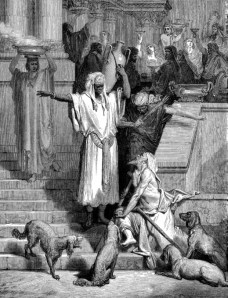
Lazarus at the rich man's gate.

Lazarus at the rich man’s gate.

Jesus begins the story of the rich man and Lazarus in verse 19. For the record, Lazarus was a fairly common name, and it is mere coincidence that he has the same name as the brother of Martha and Mary, who Jesus raised from the dead in John 11:38-44. That Lazarus was a real man, and a friend to Jesus. This one is a character in a parable. Lazarus, a poor man who was covered with sores, had a habit of posting himself at the rich man’s gate, hoping to get a few scraps from the rich man’s table. The significance of the dogs that came and licked his sores is that he was exposed to the elements, and to wild animals. These were not AKC registered pets.

Lazarus died, and was carried by the angels to Abraham’s bosom. Then the rich man died was buried, and was in Hades in torment. He asks Abraham to send Lazarus to dip his finger in water to cool his tongue. Significantly, he still had no regard for the poor man, but looked on him as someone to serve him. But Abraham told him that their roles were reversed now. The poor man, who had known nothing of comfort was receiving his comfort now, in contrast to the anguish of the rich man. Abraham also pointed to a chasm that separated them, so that neither could cross to the other side.

Lazarus, not the brother of Mary and Martha, but another man by that name, was very poor. He lay near the table of a rich man and begged for scraps of food to be thrown to him. But Lazarus loved God and the rich man didn't, so Lazarus went to heaven and the rich man went to hell (Luke 16:19-31).

Lazarus, not the brother of Mary and Martha, but another man by that name, was very poor. He lay near the table of a rich man and begged for scraps of food to be thrown to him. But Lazarus loved God and the rich man didn’t, so Lazarus went to heaven and the rich man went to hell (Luke 16:19-31).

The rich man then asks Abraham to send Lazarus to warn his brothers, so that they will repent, reasoning that they will listen to someone who was raised from the dead. But Abraham said that if they will not listen to Moses and the prophets, they will not be convinced even by someone being raised from the dead. That is just so. Jesus Himself had been witnessed by some after He arose that also were not convinced to repent. There is a mistaken belief by many that the eyewitness of a miracle would convince an unbeliever, but we see over and over again in scripture that this is simply not true. Many of the Pharisees witnessed great miracles, and still plotted the death of Jesus. Those who are stoically predisposed not to believe will find an explanation within themselves that will reinforce their unbelief.

We must be careful about the descriptions of the circumstances of the rich man and Lazarus after they died. Remember that this is a parable. That does not mean that there are not aspects that can be equated to what the reality will be. But the clear picture we have seen in paintings and illustrations of this dividing line between the two probably does not accurately tell that story. The point is that the comfort and security that belongs to those who are saved will be totally unavailable to those who are lost.

Significant also is the fact that Abraham offers no hope at all to the rich man. That is because for those in that situation, there will no longer be any hope. Man has his entire life to act as a child of God. Once that life is done, the opportunity ends. A terrible tragedy, but one of which we have been repeatedly forewarned. If we do not believe it enough to obey, that is our own fault.

The love of this rich man for money and his ignoring the plight of this poor man so plainly close and available to easily be helped by his great wealth illustrates very well the lesson Jesus taught in the parable of the dishonest manager that this chapter opened with. His downfall was his love of money, at the exclusion of what is important. No man can serve God and money.


(This year’s reading plan for Luke, Acts, and 1 and 2 Chronicles averages just 15 verses per day – 5 days per week!)
Schedule for this week
Read or listen to audio of today’s selection from Luke here
Read or listen to audio of today’s selection from 1 Chronicles here

/Bob’s boy
___________________
some images © V. Gilbert & Arlisle F. Beers

Please note: I did not design the reading plan that I am following in my blog.  All of my comments in this blog, however, are solely my responsibility.  When reading ANY commentary, you should ALWAYS refer first to the scripture, which is God’s unchanging and unfailing word. Reading schedules, as well as a link to the site where you can get the reading plan that I’m currently following for yourself can be found on the “Bible Reading Schedules” page of my website at http://graceofourlord.com.  

Enhanced by Zemanta

Justification – (Luke 16)

Jesus had just told the parable of the dishonest manager, saying that you cannot serve God and money. Then we find in verse 14 that the Pharisees (who the text says were lovers of money) ridiculed Him. What follows this ridicule begins with Jesus giving it back to them in righteous rebuke. But then it appears that He drifts to a couple of unrelated and random subjects. But are they really?

English: Jesus disputes with the Pharisees. Fr...

English: Jesus disputes with the Pharisees. French School. In the Bowyer Bible in Bolton Museum, England. Print 3861. From “An Illustrated Commentary on the Gospel of Mark” by Phillip Medhurst. Section Q. disputes with the establishment. Mark 10:2-12, 11:27-33, 12:13-27, 12:35-37. http://pdfcast.org/pdf/an-illustrated-commentary-by-phillip-medhurst-on-the-gospel-of-mark-section-q-to-r (Photo credit: Wikipedia)

His initial answer is obviously addressed to the Pharisees because He addresses them in the second person, saying “You are those who justify yourselves before men, but God knows your hearts. For what is exalted among men is an abomination in the sight of God.” The Pharisees were very good at imposing laws on others that did not come from God, but they were equally adept at justifying whatever suited them.

So in verse 16, He tells them that “the Law and the prophets” were until John (the baptist). But then, the good news of the kingdom of God has begun to be preached. The last part of that verse is difficult, as it reads everyone forces his way into it. What this probably means is that everyone wants to get into the kingdom, but they want to do it on their own terms – rather than on God’s terms. He then says in verse 17 that it is easier for heaven and earth to pass away than for one “dot” of the law to become void.

To put that last part into perspective, we must refer to Matthew 5:18, which says not an iota, not a dot, will pass from the Law until all is accomplished, which means of course, until Jesus finishes what He came for. But the point is the rebuke of the Pharisees, who seek to justify what is an abomination to God. It was then that He pulled the next punch to illustrate the point, saying Everyone who divorces his wife and marries another commits adultery, and he who marries a woman divorced from her husband commits adultery.Of course, we know from Matthew 5:32 that the reason of sexual immorality is an exception to this, but that is beside the point. The mere fact that men – including the Pharisees – had continued to relax their standards concerning divorce did not negate what God had ordained.

Putting this all together in that perspective, it all also flows after the parable of the unjust steward. That parable also shows how men try to justify the wrong they do when it suits them to do so. It is a logical procession that Jesus obviously saw coming before He even began that parable.

(This year’s reading plan for Luke, Acts, and 1 and 2 Chronicles averages just 15 verses per day – 5 days per week!)
Schedule for this week
Read or listen to audio of today’s selection from Luke here
Read or listen to audio of today’s selection from 1 Chronicles here

/Bob’s boy
___________________
some images © V. Gilbert & Arlisle F. Beers

Please note: I did not design the reading plan that I am following in my blog.  All of my comments in this blog, however, are solely my responsibility.  When reading ANY commentary, you should ALWAYS refer first to the scripture, which is God’s unchanging and unfailing word. Reading schedules, as well as a link to the site where you can get the reading plan that I’m currently following for yourself can be found on the “Bible Reading Schedules” page of my website at http://graceofourlord.com.  

Enhanced by Zemanta