Women of Means – Luke 8

Verses 1-3 of Luke chapter 8 can tell us much about the ministry of our Lord Jesus, but the tendency is to rush right past them and into the rest of the chapter, as there is much going on here. But let’s focus for a moment on the women that traveled with Jesus as He went preaching through these villages. Only three are mentioned by name, but Luke says there were many others.

Susanna is one that is not mentioned again in the New Testament, so we only know what Luke tells us here – which is that she was either healed by Jesus of some infirmity or of demons. The same goes for Joanna, except that it is highly probable that she is the same Joanna that in Luke 24:1-11 was one of the women that discovered Jesus’ empty tomb and went to tell the apostles. Joanna was the wife of the manager of the household of Herod Antipas.

Magdala, near modern Migdal, was situated here along the Sea of Galilee. Magdala was the home of Mary Magdalene.

Magdala, near modern Migdal, was situated here along the Sea of Galilee. Magdala was the home of Mary Magdalene.

The other woman who is mentioned is “Mary, called Magdalene.” Of all the women in the New Testament, she has been given the most unfair extra-biblical treatment – even disregarding the book and subsequent movie, the Da Vinci Code (and we will), which has been more than adequately dealt with in other articles that we can point you to, if interested.

First, there is the false belief that Mary Magdalene was a prostitute, which we covered in this previous post about Jesus’ dinner with Simon the Pharisee. Then there is further confusion, as she is sometimes portrayed as the adulterous woman of John 8:3-11 that the scribes and Pharisees wanted to stone. Remember Jesus said “let him who is without sin cast the first stone?” Nope, that wasn’t Mary Magdalene either. In fact, there is not even a single mention of Mary of Magdala in the Bible in the context of sin! Here, we learn that she had seven demons that Jesus cast out – but no mention of sin.

Furthermore, the women that are mentioned along with her in these three verses all “provided for them out of their means” (“them” meaning Jesus and His ministry). So not only was Mary Magdalene not a prostitute, but she was evidently a woman of some means financially, who now devoted her life to the Lord. How did the truth become so twisted in so many ways about this woman? There have been several answers offered, but they all come down to the age-old problem. We often (even innocently) accept the words of men rather than searching God’s word for the truth.

(This year’s reading plan for Luke, Acts, and 1 and 2 Chronicles averages just 15 verses per day – 5 days per week!)
Schedule for this week
Read or listen to audio of today’s selection from Luke here
Read or listen to audio of today’s selection from 1 Chronicles here

/Bob’s boy
___________________
some images © V. Gilbert & Arlisle F. Beers

Please note: I did not design the reading plan that I am following in my blog.  All of my comments in this blog, however, are solely my responsibility.  When reading ANY commentary, you should ALWAYS refer first to the scripture, which is God’s unchanging and unfailing word. Reading schedules, as well as a link to the site where you can get the reading plan that I’m currently following for yourself can be found on the “Bible Reading Schedules” page of my website at http://graceofourlord.com.  

Enhanced by Zemanta

Simon the Pharisee – Luke 7

Verses 36-50 of Luke chapter 6 prove again that among the hundreds to thousands of Pharisees who lived during the time of Jesus on earth, there were some whose minds were not completely closed, nor totally blind to the truth. One of them named Simon asked Jesus to eat with him. This in itself was a big deal because dining with someone else was viewed very much as an acceptance of that person, as well as of their behavior. Even though this was a very public dinner (as shown in verse 49), having Jesus at his own table was significant. Other Pharisees were very likely much taken aback at Simon for doing this. And so, Simon had invited Jesus into his house to “recline at table.”

anoints Jesus' feet in the house of Simon The Pharisee

anoints Jesus’ feet in the house of Simon The Pharisee

The appearance of the woman in Simon’s house, who would wash the feet of Jesus, may seem strange, but these large dinners attracted many types of people, some for their own entertainment value. There are some misconceptions about this woman, though, as well as some outright falsehoods that have been virtually perpetuated as fact. First, this is not the same woman who anointed Jesus in Matthew 26:6-12, Mark 14:3-8, or John 12:1-8. The woman in those accounts in Bethany was Mary the sister of Martha, and though the name of the man whose house they were in was Simon, it was Simon the leper, not Simon the Pharisee.

Secondly, this woman in Luke is unnamed to us. She is not Mary Magdalene, nor does the Scripture here in Luke say that she was a prostitute. Jesus did say that her sins were many, and that is a possibility, but we do not know. But again, she is not Mary Magdalene. Mary Magdalene is mentioned in chapter 8, but it is in a different setting with other women, and in a different context. We’ll have more to say about that when we come to that chapter. But there is no reason to think she or any of the other women mentioned in chapter 8 are this woman. In fact, at the end of chapter 7, this woman is told to “go in peace.” It is likely that she did just that.

The real point of the events of the verses is the lesson that Jesus gave to Simon about sin and forgiveness, as well as the notice that others paid to Jesus claiming the authority to forgive sins, which He obviously did have. The lesson Jesus gives Simon is that nobody’s sins are too numerous nor too great to be forgiven, and that those who have the most sin in their lives are likely more grateful for that forgiveness – the chance to begin anew.

Time and again, the Bible gives us reason to remember that we should never “write anyone off.” Nobody else’s sins are worse that our own in God’s eyes, nor are they any less deserving of forgiveness.

(This year’s reading plan for Luke, Acts, and 1 and 2 Chronicles averages just 15 verses per day – 5 days per week!)
Schedule for this week
Read or listen to audio of today’s selection from Luke here
Read or listen to audio of today’s selection from 1 Chronicles here

/Bob’s boy
___________________
some images © V. Gilbert & Arlisle F. Beers

Please note: I did not design the reading plan that I am following in my blog.  All of my comments in this blog, however, are solely my responsibility.  When reading ANY commentary, you should ALWAYS refer first to the scripture, which is God’s unchanging and unfailing word. Reading schedules, as well as a link to the site where you can get the reading plan that I’m currently following for yourself can be found on the “Bible Reading Schedules” page of my website at http://graceofourlord.com.  

Enhanced by Zemanta

Children of Wisdom – Luke 7

As the news spread about the miracles Jesus had done, including the raising of the dead son of the widow of Nain, the disciples of John the baptist made these things known to him, while he was in prison. John sent two of them to Jesus to ask “Are you the one who is to come, or shall we look for another?” Obviously, the mention of “the one” refers to the Messiah. This seems strange to us, in light of the fact that before he was imprisoned, John already pointed Jesus out as “the Lamb of God, who takes away the sin of the world!” (John 1:29).

English: Infant Jesus and John the Baptist, Mu...

English: Infant Jesus and John the Baptist, Museo del Prado (Photo credit: Wikipedia)

But we must remember that John the baptist was just a man, and he had his own weaknesses and trials (particularly at this time, being in prison), and he would have his own struggles with faith. We know that at the time he was “preparing the way” for Jesus he was full of the Spirit. Clearly that was the case when he made that statement as he saw Jesus approach him. But now that he was in prison, he hears of the things that Jesus has done, and perhaps like many others, he was expecting a much different Messiah – one who would be a great leader and perhaps lead Israel to their former greatness as a power – and out from under the dominance of the roman Empire.

Verse 21 says that Jesus healed many of diseases and evil spirits, and restored sight to blind people in that very hour. We can presume that to mean that the disciples John sent were witnesses to these things. When Jesus told them in verses 22-23 to go tell John about the blind, the deaf, the lame, etc., He knew that John would recognize these prophesies from Isaiah 29:18. After they left, Jesus spoke to the crowds about John. John had fulfilled the scriptures concerning what he was purposed by God to do, and Jesus pointed this out very well. Noting that some were deceived by his simple dress and his life of austerity, Jesus proclaimed in verse 27 that John was indeed nonetheless the one spoken of in Malachi 3:1, as the messenger sent to prepare the way.

Saint John the Baptist and the Pharisees

Saint John the Baptist and the Pharisees (Photo credit: Wikipedia)

One point that is easy to miss in all of this is the relationship in this passage between the expectation of the people toward the prophet and John’s own expectations about the Messiah. Jesus asked them what they expected to see when they went out in the wilderness, saying that “those who are dressed in splendid clothing and live in luxury are in kings’ courts.” By the same token, Jesus came as the Messiah, doing exactly what the prophet Isaiah said He would do, but people often do not see what is important if they look the wrong way. And he continues to emphasize these points in verse 31-34, as he describes the fickleness of that generation. Also not to be missed here is the affirmation that by rejecting the baptism of John, the Pharisees and lawyers had rejected the counsel of God (verse 3).

What did Jesus mean when he said in verse 28 “yet the one who is least in the kingdom of God is greater than he” (speaking of John)? I think this is simply a reference to the fact that he knew John would not live to be a part of the kingdom Jesus was establishing as His church. Almost certainly, John would have his place in heaven, but he would not be around to tell others of the good news of Jesus’ victory over death, and what it all means.

Finally, Jesus says that wisdom is justified by all her children.” Those who seek wisdom through the truth will find it. The point is made in Proverbs 8:34-36, speaking of wisdom in the first person:

“Blessed is the one who listens to me,
watching daily at my gates,
waiting beside my doors.
For whoever finds me finds life
and obtains favor from the Lord,
but he who fails to find me injures himself;
all who hate me love death.”

(This year’s reading plan for Luke, Acts, and 1 and 2 Chronicles averages just 15 verses per day – 5 days per week!)
Schedule for this week
Read or listen to audio of today’s selection from Luke here
Read or listen to audio of today’s selection from 1 Chronicles here

/Bob’s boy
___________________
some images © V. Gilbert & Arlisle F. Beers

Please note: I did not design the reading plan that I am following in my blog.  All of my comments in this blog, however, are solely my responsibility.  When reading ANY commentary, you should ALWAYS refer first to the scripture, which is God’s unchanging and unfailing word. Reading schedules, as well as a link to the site where you can get the reading plan that I’m currently following for yourself can be found on the “Bible Reading Schedules” page of my website at http://graceofourlord.com.  

Enhanced by Zemanta

Not Just Another Funeral – (Luke 7)

Nain, where Jesus raised the widow's son.

Nain, where Jesus raised the widow’s son.

The city of Nain mentioned in Luke chapter 7 is generally assumed to be where the small village of Nein is located, although the remains that have been uncovered suggest that Nain was much larger – more like the city that was mentioned by Luke. It is a short distance from Mount Tabor at the foot of a hill known as the “Little Hermon.” Luke says that it was soon after the healing of the Centurion’s servant that Jesus set out headed for the city. He had His disciples with Him, and a “great crowd” was following with Him as well. Just how large this group of people was, we do not know. But usually, when the Gospel writers spoke of a “great crowd,” it meant a very significant number of people (see below).

A man had died, and was being carried out of the city as they approached the gate; and there was what Luke describes as a “considerable crowd” (reasonable to assume that the “considerable crowd” was smaller than the “great crowd”) with her. Presumably, they were on their way to the burial-place for the man. In verse 13, Luke says that Jesus had compassion for her, as the woman wept for her lost son.

Being a widow and then losing a son meant much more than just a deeply sad feeling of loss for a woman of those times. Women of the day had little opportunity for earning income of their own. There were no social programs for her to rely on for financial support, of course. So not only was she suffering the loss of dear loved ones, but she was facing a very uncertain future, and financial hardship was certain to be a major concern.

English: Mount tabor view

English: Mount tabor view (Photo credit: Wikipedia)

As Jesus told her not to weep, he came up and touched the bier. A bier was a wooden platform on which a coffin was transported. Today, funeral homes usually move coffins around with a collapsible metal or aluminum bier. As He did so, all of those in the procession stood still. And then Jesus spoke to the dead man, telling him to arise. Imagine yourself for a moment, walking with such a procession to go to the burial of someone you knew when their lifeblood flowed, and hearing a stranger address the dead person, telling him to get up. Then imagine that dead friend actually raising up and start speaking to his pallbearers. Luke says in verse 16 that “fear seized them all.” I have no doubt that it did!

Then they all glorified God. It wasn’t hard to figure out that this had not been some parlor trick, and there was none other to attribute this miracle to but the Almighty Himself. Of Jesus they said “a great prophet has arisen among us!” and “God has visited his people!” Not surprisingly, verse 17 indicates that this “great crowd” spread the word about this miracle throughout Judea and the surrounding country. And what a celebration the widow, her son, and their friends and family would have that day! I sometimes wonder how many of the people like this that we read about became Christians after Jesus was crucified?

(This year’s reading plan for Luke, Acts, and 1 and 2 Chronicles averages just 15 verses per day – 5 days per week!)
Schedule for this week
Read or listen to audio of today’s selection from Luke here
Read or listen to audio of today’s selection from 1 Chronicles here

/Bob’s boy
___________________
some images © V. Gilbert & Arlisle F. Beers

Please note: I did not design the reading plan that I am following in my blog.  All of my comments in this blog, however, are solely my responsibility.  When reading ANY commentary, you should ALWAYS refer first to the scripture, which is God’s unchanging and unfailing word. Reading schedules, as well as a link to the site where you can get the reading plan that I’m currently following for yourself can be found on the “Bible Reading Schedules” page of my website at http://graceofourlord.com.  

Enhanced by Zemanta

Such Faith – (Luke 7)

After He finished the “Sermon on the Plain,” Jesus went back into Capernaum and was met by Jewish elders. They had been asked to come by a Roman Centurion. Originally, a Centurion commanded 80 men, but some estimates are that their command – a centuria or “century,” could contain up to 1000 soldiers. That number would likely be closer to the makeup of a “cohort,” which would be under the command of a senior Centurion. The average Roman soldier during this time earned about 225 denarii per year.  But the cost of the soldier’s food and his arms were both deducted from his pay!

English: Centurion (Roman army) historical ree...

English: Centurion (Roman army) historical reenactment Boulogne sur mer (France). Français : Centurion (armée Romaine) Reconstitution historique à Boulogne sur Mer en France. (Photo credit: Wikipedia)

On the other hand, estimates are that the most junior of Centurions was paid about 3,700 denarii per year, while a senior Centurion could earn as much as 15,000! This wide disparity meant that these officers would be considered quite wealthy by most Jews, among whom the Centurions lived. The reason for the Centurion sending the Jewish elders to Jesus was because he had heard of Jesus’ healings, and he had a “highly valued” servant that was dying from some illness. The elders pleaded with Jesus to help this Gentile soldier in this matter because he had built their synagogue, confirming that this Centurion was indeed wealthy.

But as Jesus and the elders approached their destination, they were met by people with a message from the Centurion, saying both that he was not worthy and that it was not necessary for Jesus to actually come to his home. Instead, he expressed his belief that Jesus could heal his servant just by saying that it was so – without even seeing his servant. And of course, he was right about that. Jesus’ statement that “even in Israel” he had not seen such faith serves as one more example that indicates the intentions the Lord had of including the Gentiles in His plan of salvation.

(This year’s reading plan for Luke, Acts, and 1 and 2 Chronicles averages just 15 verses per day – 5 days per week!)
Schedule for this week
Read or listen to audio of today’s selection from Luke here
Read or listen to audio of today’s selection from 1 Chronicles here

/Bob’s boy
___________________
some images © V. Gilbert & Arlisle F. Beers

Please note: I did not design the reading plan that I am following in my blog.  All of my comments in this blog, however, are solely my responsibility.  When reading ANY commentary, you should ALWAYS refer first to the scripture, which is God’s unchanging and unfailing word. Reading schedules, as well as a link to the site where you can get the reading plan that I’m currently following for yourself can be found on the “Bible Reading Schedules” page of my website at http://graceofourlord.com.  

Enhanced by Zemanta

Rising Star

The 13th chapter of 1 Chronicles takes up with David making plans to bring the ark of the covenant to Jerusalem. The ark symbolized God’s presence and His covenant under Moses. Though it was revered and kept holy, it had been seriously neglected throughout the reign of Saul, and had been in Kiriath-jearim for some time. Now David, attempting to assemble and unite the nation, was making plans to transport it from the house of Abinadab (1 Samuel 7:1).


The Chastisement of Uzzah

The Chastisement of Uzzah (Photo credit: Wikipedia)


So they loaded on a cart, and Uzzah and his brother drove the cart. But as the oxen stumbled, Uzzah reached out to take hold of it, and God struck him dead. David had gone about this all wrong. Only the Kohathites were allowed to carry the ark – with poles, for even they could not touch it “lest they die” (Numbers 3:29-31, Numbers 4:15). David was angry with God and afraid, and had the ark taken to the house of Obed-edom the Gittite, where it would remain until he could figure out the proper way to transport it.


Chapter 14 has David making moves to solidify Jerusalem as the focal point – the capital – of Israel. Hiram, the Gentile king of Tyre sent cedars, masons, and carpenters to help build David’s palace. His family grew greatly in number, as well as his strength. God gave him victories over the Philistines, and his fame spread. The chronicler tells us in verse 17 that “the Lord brought the fear of him upon all nations.” Under David, and with God’s blessing, the nation was becoming a real world power.


(This year’s reading plan for Luke, Acts, and 1 and 2 Chronicles averages just 15 verses per day – 5 days per week!)
Schedule for this week
Read or listen to audio of today’s selection from Luke here
Read or listen to audio of today’s selection from 1 Chronicles here


/Bob’s boy


___________________


some images © V. Gilbert & Arlisle F. Beers


Please note: I did not design the reading plan that I am following in my blog.  All of my comments in this blog, however, are solely my responsibility.  When reading ANY commentary, you should ALWAYS refer first to the scripture, which is God’s unchanging and unfailing word. Reading schedules, as well as a link to the site where you can get the reading plan that I’m currently following for yourself can be found on the “Bible Reading Schedules” page of my website at http://graceofourlord.com.  


Enhanced by Zemanta

Jesus – All About Love

From verse 27 of Luke 6 all the way to the last four verses, the remainder of the “Sermon on the Plain” is really about how we treat and care for one another. And these verses do resonate in the Sermon on the Mount in Matthew 7. Jesus begins with the admonishment about loving ones enemies and doing good to those who hate you. The point of verses 27-29 is not that we are supposed to let people “run over” us, but God’s people are not to be vindictive, vengeful, or unnecessarily combative.


Yew trees looking south towards Sermon on the ...

Yew trees looking south towards Sermon on the Mount (Photo credit: Wikipedia)


Verse 37 about not judging others is a favorite reference for those who wish to justify sinful behavior. But Jesus did not tell us that we should not point out to others when they are doing wrong. In fact, there are other passages that tell us that the opposite is true. But at the same time, we cannot properly love our fellow-man if we are harshly or hypocritically judgmental. It all comes down to what Jesus said in Matthew 22:37-39 is the second of the greatest commandments – to “love your neighbor as yourself.”


In the middle of all of this, Jesus tells us to give generously to those in need. Loving, forgiving, and overflowing with generosity – these are the traits, habits and hallmarks of the way the Lord wants His children to be toward our fellow-man. He could not have been clearer. In verse 31, Jesus paraphrases what we call the golden rule from His Sermon on the Mount – “And as you wish that others would do to you, do so to them.”


(This year’s reading plan for Luke, Acts, and 1 and 2 Chronicles averages just 15 verses per day – 5 days per week!)
Schedule for this week
Read or listen to audio of today’s selection from Luke here
Read or listen to audio of today’s selection from 1 Chronicles here


/Bob’s boy


___________________


some images © V. Gilbert & Arlisle F. Beers


Please note: I did not design the reading plan that I am following in my blog.  All of my comments in this blog, however, are solely my responsibility.  When reading ANY commentary, you should ALWAYS refer first to the scripture, which is God’s unchanging and unfailing word. Reading schedules, as well as a link to the site where you can get the reading plan that I’m currently following for yourself can be found on the “Bible Reading Schedules” page of my website at http://graceofourlord.com.  


Enhanced by Zemanta

Sermon On the Plain

Jesus came down with His apostles after naming them in Luke chapter 6, and stood “on a level place.” Here, verse 17 tells us that, along with His disciples, there was a “great multitude of people from all Judea and Jerusalem and the seacoast of Tyre and Sidon, who came to hear him and to be healed of their diseases.” And He healed them all.

Plain of Gennesaret near Capernaum

Plain of Gennesaret near Capernaum

What follows here in Luke is a sermon that many commentators have tried to “harmonize” with the “Sermon on the Mount” in Matthew 5-7.  The similarities are not nearly enough to make up for the differences in circumstances, timing, and content. This is why more astute scholars have dubbed this one as the “Sermon on the Plain.” The Beatitudes here are substantively different from those in Matthew – less of them, as well. The “woes” here are not in the sermon in Matthew at all. Jesus sat on a hill in Matthew. He stood on a level place here. He preached this sermon right after naming His apostles. The Sermon on the Mount in Matthew was long before that event. We could keep going, but you get the idea. It is no surprise that parts of Jesus’s messages bore repeating on numerous occasions.

So what about these woes? What is that all about? The answer comes from reading them in context with the corresponding beatitudes. Let’s take a look at them individually. The first beatitude says “Blessed are you who are poor, for yours is the kingdom of God.” The first woe says“but woe to you who are rich, for you have received your consolation.” Does Jesus mean that all of those who are poor are going to inherit the kingdom of God merely by virtue of their poverty?  Is he condemning people that are wealthy – and simply because they are wealthy? The answer, of course, is no on both counts. The point is that those who are poor should take heart in the fact that they have the blessed opportunity for eternal life with God. Those who are wealthy have that same opportunity, of course, if they do not allow their satisfaction with their wealth to be the driving force of their lives. Therein lies the danger of woe.

It is the same for the remaining beatitudes and woes, which describe opposite circumstances of life. There is great hope for all through Jesus Christ, but when this earthly life is going very well for people, some tend to be complacent and neglect the treasures they should be putting up in heaven.

(This year’s reading plan for Luke, Acts, and 1 and 2 Chronicles averages just 15 verses per day – 5 days per week!)
Schedule for this week
Read or listen to audio of today’s selection from Luke here
Read or listen to audio of today’s selection from 1 Chronicles here

/Bob’s boy
___________________
some images © V. Gilbert & Arlisle F. Beers

Please note: I did not design the reading plan that I am following in my blog.  All of my comments in this blog, however, are solely my responsibility.  When reading ANY commentary, you should ALWAYS refer first to the scripture, which is God’s unchanging and unfailing word. Reading schedules, as well as a link to the site where you can get the reading plan that I’m currently following for yourself can be found on the “Bible Reading Schedules” page of my website at http://graceofourlord.com.  

Enhanced by Zemanta

Twelve (extra) Ordinary Men

All four of the Gospels contain numerous references to Jesus going to God in prayer. On this occasion (in Luke 6:12), Luke says that he went to “the mountain” and spent the whole night in prayer. We do not know what mountain this was. It is reasonable to believe it was one located close to what was then Capernaum.

Ministry of the Apostles, a complex multi-figu...

Ministry of the Apostles, a complex multi-figure icon with a full-height image of Jesus Christ, surrounded by sectors with scenes of His disciples’ calling, ministry and martyrdom. Icon from the Yaroslavl Museum Preserve. (Photo credit: Wikipedia)

What was the occasion of such a lengthy and fervent time of prayer by the Son of God? The next verse gives us the answer, for when day came, He chose from among His disciples twelve men from various backgrounds, and named them “apostles,” a word very familiar to us. He chose this term because it describes what their mission would be very well. It comes from the Greek word “apostolos,” which means “messenger” or more aptly “one who is sent out.” This will become most appropriate when He gives them their “Great Commission.” The list of apostles also occurs in Matthew 10:2-4, and in Mark 3:14-19. There are some differences, but it is the same twelve men in those gospels as listed here in Luke. Like Simon, many were known by more than one name.

The first two are “Simon, whom he named Peter, and Andrew his brother” The next two listed are James and John (the sons of Zebedee), who were partners in fishing with Peter and Andrew. This James is sometimes called “James the greater” to distinguish him from the other apostle named James. John referred to himself as the “disciple whom Jesus loved” (John 13:23, John 20:2). Philip was one of the first disciples, but is not mentioned after Jesus’ ascension. He should not be confused with the Philip in the book of Acts that was a deacon.

The next apostle listed is Bartholomew, also known as Nathanael (John 1:44-49); and he is almost always mentioned along with Philip. Next was Matthew, also known as Levi, the tax collector, followed by Thomas (who, unfairly really, will always be remembered as “doubting Thomas”). Next come James the son of Alpheus (also known as James the less), and Simon “who was called the Zealot.” In the days before the destruction of Jerusalem in 70 A.D., the group of people known as Zealots were men who wished to overthrow the Roman government. It is unknown for certain whether the term here is meant in a religious sense or in that political sense. If the latter, it would mean that a change of heart and purpose occurred in his life after becoming a disciple. Otherwise, Jesus would not have made him an apostle.

English: Icon of James, the Just, brother of J...

English: Icon of James, the Just, brother of Jesus Português: Ícone de Tiago, o Justo, irmão de Jesus (Photo credit: Wikipedia)

Number eleven in the Gospel of Luke is “Judas the son of James,” known in Matthew as Thaddaeus. Some scholars believe that this is the Jude that wrote the book of Jude, but there are some problems with that. In the opening for the Book of Jude, he calls himself “the brother of James,” while he is listed here as the son of James. It is certainly possible for someone to have a brother with the same name as their father, but it is more likely that Jude was referring to a more well-known James – the brother of Jesus. If so, it would make that Jude the brother of Jesus also (both he and James called themselves “servants” of Jesus Christ in the scriptures). Jesus did have a brother named Jude, short for Judas (Matthew 13:55). But none of the apostles could have been brothers of Jesus. Though His brothers did come to believe in Him, at the time of John 7:5, they did not; and the circumstances in that passage occurred well after His apostles were named. The last apostle in the list is Judas Iscariot who, we all know, betrayed Jesus.

Twelve men who were just like you and me, who saw in Jesus salvation for the world. Their lives were never the same after meeting Him. And once Jesus went home, the Holy Spirit would make their understanding of what they were a part of complete. But for now, they have a lot to learn.

(This year’s reading plan for Luke, Acts, and 1 and 2 Chronicles averages just 15 verses per day – 5 days per week!)
Schedule for this week
Read or listen to audio of today’s selection from Luke here
Read or listen to audio of today’s selection from 1 Chronicles here

/Bob’s boy
___________________
some images © V. Gilbert & Arlisle F. Beers

Please note: I did not design the reading plan that I am following in my blog.  All of my comments in this blog, however, are solely my responsibility.  When reading ANY commentary, you should ALWAYS refer first to the scripture, which is God’s unchanging and unfailing word. Reading schedules, as well as a link to the site where you can get the reading plan that I’m currently following for yourself can be found on the “Bible Reading Schedules” page of my website at http://graceofourlord.com.  

Enhanced by Zemanta

Confrontation With Tradition

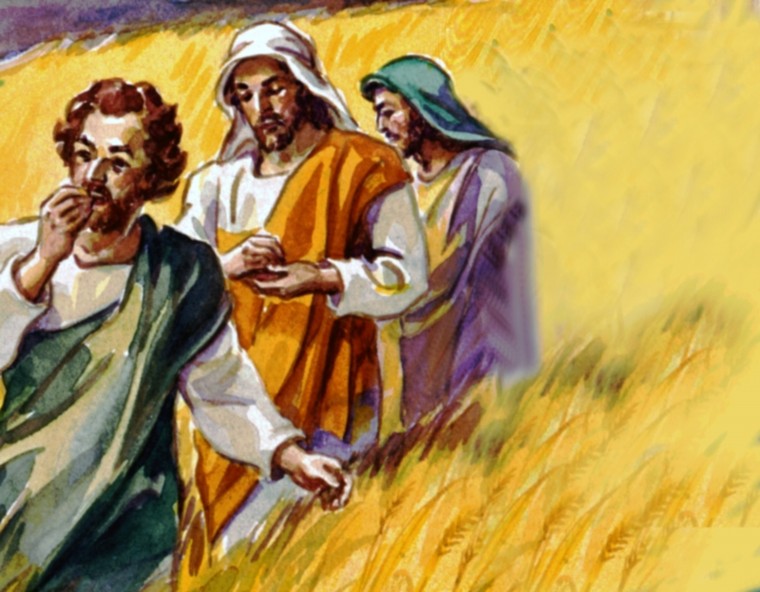
Chapter 6 of Luke contains a couple of the most misapplied and often misunderstood passages in the New Testament. The first comes in verses 1-5, where on a Sabbath, Jesus and his disciples were going through a field, and the disciples plucked and ate some heads of grain. Deuteronomy 23:25 clearly states specifically that this practice is allowed. But the Pharisees had made their own rules up concerning even the smallest of matters; and they had decided that the act of doing this fell into the category of “work,” which was forbidden on the Sabbath.

Jesus' disciples plucked and ate some heads of grain in a grainfield, but were chastized by the Pharisees for doing this on the Sabbath (Matthew 12:1-8; Mark 2:23-28; Luke 6:1-5)

Jesus’ disciples plucked and ate some heads of grain in a grainfield, but were chastized by the Pharisees for doing this on the Sabbath (Matthew 12:1-8; Mark 2:23-28; Luke 6:1-5)

When they confront Jesus, asking why his disciples do what is “unlawful” on the Sabbath, Jesus gives an answer, apparently without denying (at least in the Scripture) any wrong-doing. In His answer, He points them to how David and his men ate the “bread of the Presence” which was unlawful for any but the priests to eat (1 Samuel 21:1-6). The argument by critics and skeptics alike, is that here Jesus endorses “situation ethics.” This is the notion that there is no absolute right or wrong where human needs are concerned – that David and his men were guiltless because of David’s supposed authority and/or the situation that they are in.

This idea is just plain wrong. To begin with, Jesus stated plainly in verse 4 that what David did “is not lawful for any but the priests.” What Jesus did by bringing this up was to point out that David, whom they revered (and whom they would not dare to condemn) had indeed broken the law. Jesus’ disciples were guiltless of breaking any Mosaic law – only the man-made regulations that the Pharisees had imposed on top of, and without authority from, God’s law. Yet they were condemning His disciples. The Pharisees had appointed themselves as “rulers” of the Sabbath, but Jesus pointed out that it was He who was “lord of the Sabbath.”  In the Gospel of Luke, this is the beginning of the more disagreeable encounters with the Pharisees that was sure to make them angry with Jesus.

Verse 6 begins another encounter with the Pharisees that would serve to fan those flames. On another Sabbath, Jesus was teaching in the synagogue. A man was there with a withered hand, and the Pharisees and scribes were watching to see if Jesus would heal Him – so that they could “accuse Him” for working on the Sabbath, thereby violating Mosaic law. It is remarkable that these men could know that Jesus had the power to heal something as definitive as a physical deformity, yet not believe in Him as the Messiah. We can only surmise that they had no desire to believe, but instead wanted to make others believe his power was from evil.

Jesus, of course, knew their thoughts, and he invited the confrontation by telling the man to come to Him. Then, he looked at the group of Pharisees and asked “is it lawful on the Sabbath to do good or to do harm, to save life or to destroy it?” No answer to this question was recorded, so we can assume they gave none. But when he healed the man’s deformity, their anger was certainly kindled, as verse 11 states that they “discussed with one another what they might do to Jesus.”

(This year’s reading plan for Luke, Acts, and 1 and 2 Chronicles averages just 15 verses per day – 5 days per week!)
Schedule for this week
Read or listen to audio of today’s selection from Luke here
Read or listen to audio of today’s selection from 1 Chronicles here

/Bob’s boy
___________________
some images © V. Gilbert & Arlisle F. Beers

Please note: I did not design the reading plan that I am following in my blog.  All of my comments in this blog, however, are solely my responsibility.  When reading ANY commentary, you should ALWAYS refer first to the scripture, which is God’s unchanging and unfailing word. Reading schedules, as well as a link to the site where you can get the reading plan that I’m currently following for yourself can be found on the “Bible Reading Schedules” page of my website at http://graceofourlord.com.  

Enhanced by Zemanta