Psalm 9 – What about those Psalm Titles?

Psalm 9 has some notable characteristics, and is the subject of some disagreement among scholars, although toward minor matters.  To begin with, the psalm is an acrostic, though certainly not on the level of Psalm 119.  It uses the first eleven letters of the Hebrew alphabet,although one is missing.  There have been some that suggest Psalm 9 and 10 were once a single psalm because the latter is also an acrostic.  But they are much too different.  The insignificance of an acrostic in this case is such that some scholars have even questioned that as an intent. Then, there is the matter of the superscription or title.  As noted in this blog previously, these titles are not part of the inspired word, but they are ancient.  There are critics that dispute the accuracy of these titles when they explicitly link a psalm to a particular historical event in scripture or a location (such as being written when David was in the wilderness of Judah).  But such critics have not given convincing reason for such doubt.

It is important to remember that the Psalms were written for song and prayer, and have been used for both since the time they were written.  In the ESV, this one reads “To the choirmaster: according to Muth-labben. A Psalm of David.”  Those first three words occur 55 times in the superscriptions of chapters of the Book of Psalms.  Other translations read “For the chief musician…”  What follows is usually obvious musical instruction, such as “with stringed instrument.”

Smith's Bible Dictionary 1863

Smith’s Bible Dictionary 1863 (Photo credit: Wikipedia)

But occasionally, what follows may be simply be “a psalm of David,” which was undoubtedly instruction enough at one time as to its musical execution. Or, as in this case, what follows may be a phrase suggesting that it be sung a particular way, or set to the tune of another song known at the time the superscription was written.  Scholars do not agree on what the Hebrew letters that were transposed as Muth-labben actually mean.  The NKJV and RIV both take the stance that this means that the psalm is to be sung “to the tune of “Death of the Son.'”

Two other instructions are within the body of this Psalm.  One is “Selah,” which according to Smith’s Bible Dictionary:

“is found only in the poetical books of the Old Testament, occurs seventy-one times in the Psalms and three times in Habakkuk. It is probably a term which had a meaning in the musical nomenclature of the Hebrews, though what that meaning may have been is now a matter of pure conjecture. (Gesenius and Ewald and others think it has much the same meaning as our interlude,–a pause in the voices singing, while the instruments perform alone.)”

Before the word “Selah” in verse 16, we have another word (“Higgaion”), which is generally accepted as instruction for a pause of meditation (more info at this link to Topical Bible“).  Together with “Selah,” this would suggest a longer period of pause with musical direction and meditation following verse 16’s praise of God for what He has done, before continuing the psalm.
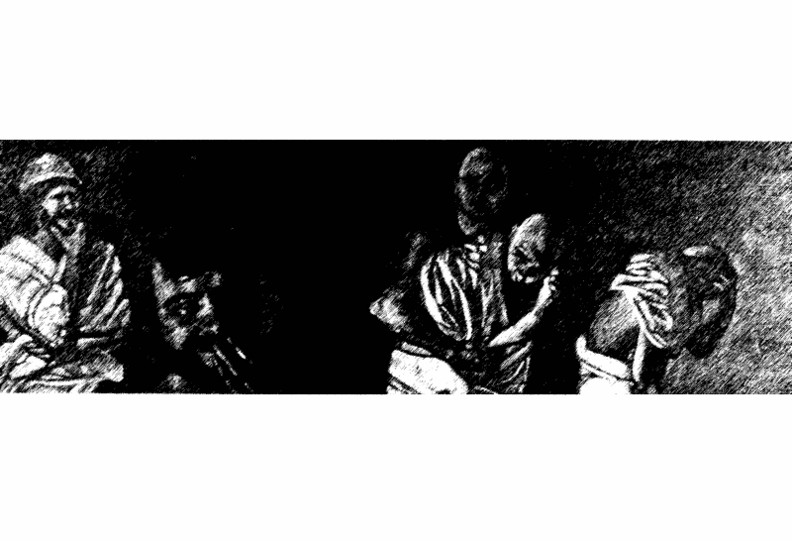
When Nahash, king of the Ammonites, died, David sent some men to his son Hanun to comfort them. Hanun insulted David's men by shaving their beards and cutting their robes off at the buttocks (2 Samuel 10:1-5)

When Nahash, king of the Ammonites, died, David sent some men to his son Hanun to comfort them. Hanun insulted David’s men by shaving their beards and cutting their robes off at the buttocks (2 Samuel 10:1-5)

Which brings us to another point over which there is some disagreement.  That is whether the psalm is about an actual victory already won over an enemy (see verse 4), a plea for God to grant such a victory (e.g. verse 13), or a statement of certainty by the psalmist that such victory would come (e.g. verse 3).  According to Coffman, George Rawlinson believed that the psalm is about David’s victory over Ammon and Syria (2 Samuel 10:6-14).

What the psalm is really about is thanksgiving and praise to God.  With the exception of the petitions in verses 19-20, almost the entire psalm praises God and thanks Him for all that He has done, and for His constant care.  That is the lesson of this psalm, what its words are to be used for, and how we should do the same:

“I will give thanks to the Lord with my whole heart;
I will recount all of your wonderful deeds.
I will be glad and exult in you;
I will sing praise to your name, O Most High.”

Read or listen to audio of ESV version of this selection from this link.

/Bob’s boy

Please “like” us on Facebook at  https://www.facebook.com/bobsboy01

___________________
some images © V. Gilbert & Arlisle F. Beers

Please note: I did not design the reading plan that I am following in my blog.  All of my comments in this blog, however, are solely my responsibility.  When reading ANY commentary, you should ALWAYS refer first to the scripture, which is God’s unchanging and unfailing word. Reading schedules, as well as a link to the site where you can get the reading plan that I’m currently following for yourself can be found on the “Bible Reading Schedules” page of my website at http://graceofourlord.com.  For questions and help, please see the “FAQ” and “Summaries” pages there.
Psalm 3-4 – Save Me, O My God

Chapter 3 is the first of the Psalms with a title (sometimes called a sub-script or superscription).  These titles are not part of the inspired word, but they are ancient.  And they have had their critics who question their accuracy, although we have been given no good reason for doing so.  This one reads “A Psalm of David, when he fled from Absalom his son,”  which refers to the events of 2 Samuel 15-17 (here, particularly to 2 Samuel 15:13-17).

How quickly and completely David’s fortunes had changed!  He was king, but his own son had conspired so successfully against him that David had to flee from Jerusalem, fearing that even the city he had built and loved would be destroyed if he remained, as Absalom now commanded more of his army than he did.  David was a hunted man, now in danger of losing even his life.  Yet the remarkable lesson for us in verses 1-6 is that this unbelievably painful crisis brought him closer to God, rather than leaving him feeling abandoned.

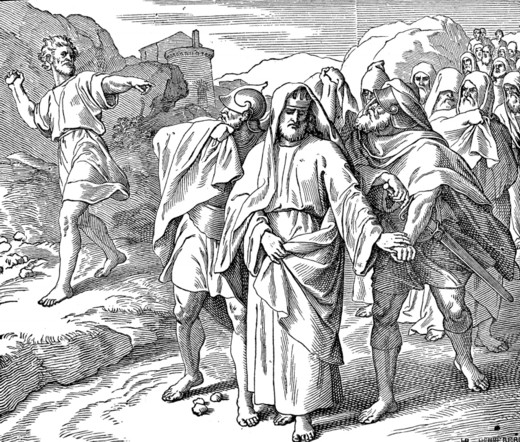
Shimei throwing stones at David.

Shimei throwing stones at David.

When reading in verse 2 that “many are saying of my soul, there is no salvation for him in God,” one cannot help but think of Shimei in 2 Samuel 16:7-8.  But David professes his faith that his enemies cannot stand against him with the Lord on his side (verses 7-8) – the same kind of faith Paul encourages in Romans 8:31 (“If God is for us, who can be against us?”).  As David gives all glory to the Lord, he unselfishly asks blessings on all His people (verse 8).

In verses 4 -5 of chapter 4, he tells us not to let our agitation and distress cause us to turn away from God into sin (see also Ephesians 4:26).  He calls upon us to put our trust in the Lord, and finishes the chapter praising God and declaring his confidence in verse 8: “In peace I will both lie down and sleep; for you alone, O Lord, make me dwell in safety.”

Though his situation was dire and the odds against him, David took comfort in knowing the Lord heard his cry, and He will hear ours.  He always does!

Read or listen to audio of ESV version of this selection from this link.

/Bob’s boy

Please “like” us on Facebook at  https://www.facebook.com/bobsboy01

___________________
some images © V. Gilbert & Arlisle F. Beers

Please note: I did not design the reading plan that I am following in my blog.  All of my comments in this blog, however, are solely my responsibility.  When reading ANY commentary, you should ALWAYS refer first to the scripture, which is God’s unchanging and unfailing word. Reading schedules, as well as a link to the site where you can get the reading plan that I’m currently following for yourself can be found on the “Bible Reading Schedules” page of my website at http://graceofourlord.com.  For questions and help, please see the “FAQ” and “Summaries” pages there.

1 Kings 8:1 – 9:9 – Ark Brought Into Temple

Sometime after the completion of construction of the temple, Solomon has the ark of the covenant, the tent of meeting (tabernacle), and all the holy vessels within brought from the old city of David so that the ark could be brought into the temple.  Like in the tabernacle (see Exodus 40), the inner sanctuary – or most holy place – is where the ark would be kept.  Only the priests could enter there (verse 6), and only they could “take up” the ark (verse 3).  Missing from the description of the contents of the ark are Aaron’s rod (Numbers 17:10-11) and the jar of manna (Exodus 16:32-34) that we are told were kept there at one time (Hebrews 9:1-5).  We are not told what had become of them.  After the priest’s came out, a cloud filled the temple as the glory of the Lord described in Exodus 40:34-38 – so that the priests were not able to even stand (verses 10-11).

English: image of Solomon and the covenant of ...

English: image of Solomon and the covenant of the ark, painted in 1747 (Photo credit: Wikipedia)

Solomon’s speech and his prayer to the Lord make up the rest of the chapter.  The prayer is beautiful and significant in that the people would eventually need all of the petitions of this prayer to be granted.  Solomon acknowledges in verses 27 and 29-30 that  God cannot be contained in an earthly dwelling, but that as the Lord had said, His name shall dwell there – the word “name” in biblical terms meaning all that constitutes the character and essence of all that He is.  And in place toward which His eyes are open.

The prayer consists of several petitions concerning granting mercy to the people when they repent of their sins during and after times including war, famine, drought, exile, and captivity – that the Lord would once again regard them as His people after repentance and “maintain their cause” (verse 49).  The Lord answers Solomon in 9:1-9 with a promise and a warning of what would happen if they turn aside, with a particular emphasis on warning against idolatry in verse 9.

Read or listen to audio of ESV version of this selection from this link.

/Bob’s boy
___________________
some images © V. Gilbert & Arlisle F. Beers

Please note: I did not design the reading plan that I am following in my blog.  All of my comments in this blog, however, are solely my responsibility.  When reading ANY commentary, you should ALWAYS refer first to the scripture, which is God’s unchanging and unfailing word. Reading schedules, as well as a link to the site where you can get the reading plan that I’m currently following for yourself can be found on the “Bible Reading Schedules” page of my website at http://graceofourlord.com.  For questions and help, please see the “FAQ” and “Summaries” pages there.

1 Kings 6 – Solomon Builds the Temple

The significance of verse one is that it gives us the ability to date the time of the Exodus – 480 years prior to the fourth year of Solomon’s reign.  The accepted date for that year of Salomon’s  reign is 966-967 BCE.  Although there is some argument for the application of the number of years, the more credible date for the Exodus seems to be about 1466-1467 BCE.  The detail of the temple’s construction is pretty specific, and was quite expensive (not all the gold used – most of it captured in the victorious the Israelites had over the various Canaanite cities).

English: Solomon and the Plan for the Temple, ...

English: Solomon and the Plan for the Temple, as in 1 Kings 6, illustration from a Bible card published by the Providence Lithograph Company (Photo credit: Wikipedia)

The exact dimensions are somewhat disputed due to the variance of the length of a cubit at different time, but as temple’s go, it would not have been the huge building that some of us might imagine. But the description is of a grandly beautiful temple for the Lord’s house.  God restates (in verse 11-13) the promises He made to David in 2 Samuel 7:11-16, but it is not an unconditional promise.  Note in verse 12, that God makes no promise to “hang around” if they are disobedient.

A beautiful structure indeed, but that obedience is more important to Him than the grandest of temples.  Remember that people (including the apostles) were very impressed with the temple that existed when Jesus was in Jerusalem.  But he foretold its utter destruction (as in Luke 21:5-6).

Read or listen to audio of ESV version of this selection from this link.

/Bob’s boy
___________________
some images © V. Gilbert & Arlisle F. Beers

Please note: I did not design the reading plan that I am following in my blog.  All of my comments in this blog, however, are solely my responsibility.  When reading ANY commentary, you should ALWAYS refer first to the scripture, which is God’s unchanging and unfailing word. Reading schedules, as well as a link to the site where you can get the reading plan that I’m currently following for yourself can be found on the “Bible Reading Schedules” page of my website at http://graceofourlord.com.  For questions and help, please see the “FAQ” and “Summaries” pages there.

1 Kings 3 – Solomon’s Wisdom

English: Solomon's Wealth and Wisdom, as in 1 ...

English: Solomon’s Wealth and Wisdom, as in 1 Kings 3:12-13, illustration from a Bible card published 1896 by the Providence Lithograph Company (Photo credit: Wikipedia)

There are some questionable events – some apparently foretelling, as well – in 1 Kings chapter 3.  The marriage alliance in verse 1 with Egypt does show the power that Solomon and his kingdom commanded now (Egypt rarely made such alliances),  but what about the command not to intermarry with foreigners because they will lead the people to serve other gods (Deuteronomy 7:3-4)?  The Hebrew verb in verse 1 is translated “intermarry” in Deuteronomy.

Then there is the matter of the people sacrificing at the “high places” in verse 2.  These are simply publicly accessible places to worship or sacrifice, and likely had been used in idol worship.  This is in direct conflict with what is commanded in Deuteronomy 12:1-5.  Allowing this to happen is certainly not what David meant when he admonished Solomon to “keep the charge of the Lord your God…” in 1 Kings 2:1-5.  And it foreshadows the great fall Solomon would take to idol worship in 1 Kings 11:4-8.

This is so far from the Solomon that we know and that pleased God so much in verse 9 by asking for an understanding mind to govern God’s people – to be able to discern between good and evil, when God had said “Ask what I shall give you.”  He could have asked for anything, but he chose that kind of wisdom – for an honorable purpose; and as a result, God gave him the riches and honor he did not ask for (verse 13).

As verse 3 says, “Solomon loved the Lord, walking in the statutes of David his father, only…”.  It is the exception in the rest of that verse that speaks of his heart being turned the wrong way.   Even the greatest wisdom, and starting out with your heart in the right place are not enough without the determination to “stay the course”  and always keep God first.

Read or listen to audio of ESV version of this selection from this link.

/Bob’s boy
___________________
some images © V. Gilbert & Arlisle F. Beers

Please note: I did not design the reading plan that I am following in my blog.  All of my comments in this blog, however, are solely my responsibility.  When reading ANY commentary, you should ALWAYS refer first to the scripture, which is God’s unchanging and unfailing word. Reading schedules, as well as a link to the site where you can get the reading plan that I’m currently following for yourself can be found on the “Bible Reading Schedules” page of my website at http://graceofourlord.com.  For questions and help, please see the “FAQ” and “Summaries” pages there.

1 Kings 2 – David’s Death \ Solomon Reigns

As David drew near to death, he gave Solomon his final instructions.  The first part, in verses 2-4, contains instructions on how to conduct himself, and on remaining faithful to God.  The words are just as God spoke to Joshua in his charge in Joshua 1:6-9.  The second part contains specific instructions on housekeeping.  Some of this concerned the fact that Abiathar must be dealt with, as well as Joab.  Both had been treasonous concerning Adonijah, and could not be trusted.  Then there was Shimei, the Benjaminite of the house of Saul that had cursed David so grievously during his flight from Absalom (2 Samuel 16:5-8).  David had promised that he would not kill him, but that promise is not inherited by Solomon, so David leaves his fate in Solomon’s hands.  David dies in verse 10; and verse 11 says that he had been king for 40 years.  In verse 12, Solomon’s “kingdom was firmly established.”

In verses 26-27, Solomon does deal with Abiathar, and he is removed from the priesthood.  As he was in the line of Eli, through Ithamar, this fulfills the prophecy to Eli in 1 Samuel 2:31-33 that his house and priestly line would be done away with.  Joab fled to the tent, grabbing the horns of the altar – thinking he would be safe there (verses 28-30).  But Exodus 21:12-14 makes it clear that is not the case for someone who had done willful murder, as Joab had done in the cases of Amasa (2 Samuel 20:10) and Abner (2 Samuel 3:27).  Solomon commands Shimei not to ever leave Jerusalem, or else he would be put to death.  This was presumably to keep him from returning to incite the Benjaminites to rebellion.  But verses 39-40 tell us that he violated that oath, and Solomon had him killed.

Adonijah had his mother request Abishag for his wife.  But Solomon sees what his mother apparently chose not to.  Abishag was technically part of David’s royal harem.  Adonijah had clearly not given up on his quest for the throne, and likely never would.  So Solomon wisely had him done away with (verses 22-25).

Read or listen to audio of ESV version of this selection from this link.

/Bob’s boy
___________________
some images © V. Gilbert & Arlisle F. Beers

Please note: I did not design the reading plan that I am following in my blog.  All of my comments in this blog, however, are solely my responsibility.  When reading ANY commentary, you should ALWAYS refer first to the scripture, which is God’s unchanging and unfailing word. Reading schedules, as well as a link to the site where you can get the reading plan that I’m currently following for yourself can be found on the “Bible Reading Schedules” page of my website at http://graceofourlord.com.  For questions and help, please see the “FAQ” and “Summaries” pages there.

1 Kings 1 – Solomon Anointed King

David had become old and could not get warm, so his servants provide a beautiful girl named Abishag to keep him warm.  The scripture says that he was only “of service” to him for that purpose, and attending to him (verse 4).  But she will become important later because of this service anyway.

David’s son Adonijah was the next one born after Absalom (verse 6), and must have supposed that entitled him to succeed David.   Verse 5 says that he “exalted himself, saying ‘I will be king.'”  Much different from the humble manner in which David patiently waited – all the time showing respect for “the Lord’s anointed,” Saul.   And the chariots and horsemen, as well as men to run before him, remind us very much of Absalom.  Verse 6 says that David never questioned or rebuked him, which is unfortunately consistent with his negligence as a father (2 Samuel 13:21-22, for example).  In verses 9-10, Adonijah only invited royal officials to his feast and sacrificing ceremony – carefully excluding David’s “mighty men” and his brother, Solomon.

The Anointing of Solomon by Cornelis de Vos. A...

The Anointing of Solomon by Cornelis de Vos. According to 1 Kings 1:39, Solomon was anointed by Zadok. (Photo credit: Wikipedia)

Nathan has enough of this, and talks to Bathsheba.  One at a time, they let him know that Adonijah has done this under his very nose, even though David had already determined that Solomon would be king.  So they challenged him to do something about it.  David finally takes action and has Solomon anointed as king, giving explicit instructions on parading him on David’s own mule with much fanfare (verses 32-35).

When Solomon shows up announced, the guests scattered, leaving Adonijah (verse 49).  At this point they were guilty of treason without question.  The matter is settled though, and Solomon showed forgiveness and mercy – but strength as well, with a warning accompanying the forgiving gesture in verse 52.

Read or listen to audio of ESV version of this selection from this link.

/Bob’s boy
___________________
some images © V. Gilbert & Arlisle F. Beers

Please note: I did not design the reading plan that I am following in my blog.  All of my comments in this blog, however, are solely my responsibility.  When reading ANY commentary, you should ALWAYS refer first to the scripture, which is God’s unchanging and unfailing word. Reading schedules, as well as a link to the site where you can get the reading plan that I’m currently following for yourself can be found on the “Bible Reading Schedules” page of my website at http://graceofourlord.com.  For questions and help, please see the “FAQ” and “Summaries” pages there.

Blog name changed / Week 21 Summary Posted

English: Solomon and the Plan for the Temple, ...

English: Solomon and the Plan for the Temple, as in 1 Kings 6, illustration from a Bible card published by the Providence Lithograph Company (Photo credit: Wikipedia)

Since “we” write under the pseudonym “Bob’s boy,” it makes more sense for the name of this blog to be “Bob’s boy’s Christianity blog.”  So that change has been made.  We have blogged through 1 and 2 Samuel, and will soon start turning from David to his son, Solomon.  Solomon is known for his wisdom.  We will learn that there is much more to his story than being the wisest man.  We’ll start with 1 Kings tomorrow.

Summing Up

Each weekend, I am now posting a small PDF of one week of chapter summaries (on the website’s “Summaries” page), current to the beginning of the previous week.  I have posted the summary for Week 21 (May Week 3) of the schedule I am following.  This short PDF document contains condensed comments about 2 Samuel 5, 6, 7, 11 and 12, with hyperlinks to the ESV version of each chapter for listening or reading, and joins the summaries for other weeks already posted there.

/Bob’s boy
___________________
image © V. Gilbert & Arlisle F. Beers

Please note: I did not design the reading plan that I am following in my blog.  All of my comments in this blog, however, are solely my responsibility.  When reading ANY commentary, you should ALWAYS refer first to the scripture, which is God’s unchanging and unfailing word. Reading schedules, as well as a link to the site where you can get the reading plan that I’m currently following for yourself can be found on the “Bible Reading Schedules” page of my website at http://graceofourlord.com.  For questions and help, please see the “FAQ” and “Summaries” pages there.

2 Samuel 19 – Joab Rebukes David

David’s mourning over Absalom is causing the victorious to slink away, hide in their homes, and wonder about the leadership of their king.  Joab rebukes David for this sharply, telling him that he is mourning those that despise him and showing contempt for those who had fought so valiantly for him.  David was going to lose them all – and the kingdom (verses 3-7).  So David pulls himself together and goes to the city gate to meet, greet, and show that he is in control now.

David replaces Joab as commander with Amasa in a surprise move.  It could partly be for Joab’s disregarding his instructions about Absalom, but verses 11-15 seem to indicate it was a move intended to help re-unify the country.  In verses 25-30, Mephibosheth seems convincing when he tells David that Ziba had slandered him in 2 Samuel 16:3.  David seems unsure who to believe, so he tells him he will divide the land when between them.  Mephibosheth lends himself even more credence when he replies that Ziba can just take it all.  It is enough that David had returned.  But we are in even less position to judge this than David was.

Shimei is pardoned for his treasonous actions in 2 Samuel 16:5-13, as he brings David a thousand men from the tribe of Benjamin, and David (to the disappointment of his mighty men) declares that he will not die.  This chapter tells of much strife between Israel and Judah; and the dispute will only worsen in the coming years (verses 9-15, 41-43).

Read or listen to audio of ESV version of this selection from this link.

/Bob’s boy
___________________
some images © V. Gilbert & Arlisle F. Beers

Please note: I did not design the reading plan that I am following in my blog.  All of my comments in this blog, however, are solely my responsibility.  When reading ANY commentary, you should ALWAYS refer first to the scripture, which is God’s unchanging and unfailing word. Reading schedules, as well as a link to the site where you can get the reading plan that I’m currently following for yourself can be found on the “Bible Reading Schedules” page of my website at http://graceofourlord.com.  For questions and help, please see the “FAQ” and “Summaries” pages there.

2 Samuel 18 – Absalom Killed

English: Gustave Doré : David mourning Absalom...

English: Gustave Doré : David mourning Absalom. Français : Extrait de la Bible illustrée de Gustave Doré : David inconsolable de la mort d’Absalom. (Photo credit: Wikipedia)

So David gathered his forces and re-supplied, and now these experienced warriors were ready to go on the offensive.  David divided the troops into three – command by Joab, Abishai, and Ittai the Gittite.  he sent them on their way with the admonition to “deal gently” with Absalom (verse 5).  The battle took place in the forest of Ephraim and spread over the face of the country – and twenty thousand were killed (verse 7-8).  In a freak accident, Absalom got stuck in the limbs of an oak (verse 9), and a man saw and told Joab.

Despite David’s instructions, Joab wasted no time in killing Absalom.  Probably he feared that if left alive, Absalom would have the chance to rise up again.  Verse 17-18 contrast the monument that Absalom in vanity had set up for himself with the anonymous pit covered with a pile of rocks that Joab and his men threw him into.

David’s immense grief in verses 31-33 serve as an exclamation point for us in the punishment predicted in 2 Samuel 12:10.

Photo of Absalom's Tomb in Kidron Valley - 1860s

Photo of Absalom’s Tomb in Kidron Valley – 1860s (Photo credit: Wikipedia)

The monument known as “Absalom’s Tomb” we see today in the Kidron Valley in Jerusalem is a structure that was built in a later period – possibly during the Roman rule.

Read or listen to audio of ESV version of this selection from this link.

/Bob’s boy
___________________
some images © V. Gilbert & Arlisle F. Beers

Please note: I did not design the reading plan that I am following in my blog.  All of my comments in this blog, however, are solely my responsibility.  When reading ANY commentary, you should ALWAYS refer first to the scripture, which is God’s unchanging and unfailing word. Reading schedules, as well as a link to the site where you can get the reading plan that I’m currently following for yourself can be found on the “Bible Reading Schedules” page of my website at http://graceofourlord.com.  For questions and help, please see the “FAQ” and “Summaries” pages there.