Psalm 132 – If Your Sons Keep My Covenant

David dances in the presence of the ark.

David dances in the presence of the ark. (Photo credit: Wikipedia)


This is psalm number 13 of the 15 “Songs of Ascents” (see this previous post for more information). Some have classified this as a post-exillic psalm, but that really does not appear to be the case. If one looks carefully at verses 8-10, it is evident that it was written at a time when the Ark of the Covenant was still in the possession of God’s people:


Arise, O Lord, and go to your resting place,
you and the ark of your might.
Let your priests be clothed with righteousness,
and let your saints shout for joy.
For the sake of your servant David,
do not turn away the face of your anointed one


Also, those verses are quoted at the dedication of Solomon’s temple in 2 Chronicles 6:41. Or perhaps, the passage here is a quotation of that scripture. Either way, the ark seems not to have been missing at the time. In verse 6, Ephrathah, is a district with villages called Bethlehem and Jaar – or Kiriath-jearim, where the ark had been left for a time before coming to Jerusalem (1 Samuel 7:1-2).


The song’s lyrics build the pilgrims’ excitement as they journey to Jerusalem for the Passover and other feasts; and gives them pause for remembering the promise of the Lord to have one of David’s line on the throne forever. this was a conditional promise, though, as they were reminded by the psalm itself in verse 12: “If your sons keep my covenant and my testimonies that I shall teach them, their sons also forever shall sit on your throne.”


Read or listen to audio of ESV version of this selection from this link.


/Bob’s boy


___________________


some images © V. Gilbert & Arlisle F. Beers


Please note: I did not design the reading plan that I am following in my blog.  All of my comments in this blog, however, are solely my responsibility.  When reading ANY commentary, you should ALWAYS refer first to the scripture, which is God’s unchanging and unfailing word. Reading schedules, as well as a link to the site where you can get the reading plan that I’m currently following for yourself can be found on the “Bible Reading Schedules” page of my website at http://graceofourlord.com.  


Psalm 108 – With God We Shall Do Valiantly

With few variances, most of Psalm 108 can be found in two other psalms. The first 5 verses are practically identical to Psalm 57:7-11. The last eight verses are almost identical to Psalm 60:5-12. So why the combination here repeated? As always, whenever God’s word contains passages that are repeated from another passage, it is a sure sign that they are very important.

David hid in one of the many caves near Adullam, a city 13 miles southwest of Bethlehem (1 Samuel 22: 1-12). David was in this area when three of his mighty men risked their lives to get him a drink of water from Bethlehem (2 Samuel 23: 13-17).

David hid in one of the many caves near Adullam, a city 13 miles southwest of Bethlehem (1 Samuel 22: 1-12). David was in this area when three of his mighty men risked their lives to get him a drink of water from Bethlehem (2 Samuel 23: 13-17).

The first five verses come from a psalm that we are fairly certain refers to David’s time when he had fled to a cave to escape from Saul’s murderous intentions. The coinciding verses are of praise to God for His love and faithfulness, written from the context of David’s thankfulness for being delivered. The last eight verses come from a psalm that appears to have been written on the heels of a great military defeat, in which the psalmist is entreating the Lord to again show His favor to His people.

The two parts were likely put together as a combination for a liturgical purpose during a time of great distress and unease concerning the future. Together, they remind God’s people of His matchless mercy and the care for which He regards His people. They make an outstanding unified plea for God’s help in the fight against “the foe” (Satan). But most importantly, it reminds us first that we cannot fight this enemy alone, and secondly, that we do not have to fight alone, for God is with us.

for vain is the salvation of man!
With God we shall do valiantly;
it is he who will tread down our foes

Read or listen to audio of ESV version of this selection from this link.

/Bob’s boy
___________________
some images © V. Gilbert & Arlisle F. Beers

Please note: I did not design the reading plan that I am following in my blog.  All of my comments in this blog, however, are solely my responsibility.  When reading ANY commentary, you should ALWAYS refer first to the scripture, which is God’s unchanging and unfailing word. Reading schedules, as well as a link to the site where you can get the reading plan that I’m currently following for yourself can be found on the “Bible Reading Schedules” page of my website at http://graceofourlord.com.  

Psalm 86 – Gladden the Soul of Your Servant

David hid in one of the many caves such as this near Adullam, a city 13 miles southwest of Bethlehem (1 Samuel 22: 1-12). David was in this area when three of his mighty men risked their lives to get him a drink of water from Bethlehem (2 Samuel 23: 13-17).

David hid in one of the many caves such as this near Adullam, a city 13 miles southwest of Bethlehem (1 Samuel 22: 1-12). David was in this area when three of his mighty men risked their lives to get him a drink of water from Bethlehem (2 Samuel 23: 13-17).

Psalm 86 is one of the lament psalms written by David. It is not clear whether verse 14’s “a band of ruthless men” that seek his life are Saul’s men or from the time that he had to flee Jerusalem because of Absalom’s conspiracy (2 Samuel 15-17). David’s prayer to God is for the preservation of his life, as well as the comfort of God’s care, and the lifting of his spirits in a time of unimaginable adversity.

Be gracious to me, O Lord,
for to you do I cry all the day.
Gladden the soul of your servant,
for to you, O Lord, do I lift up my soul

The entire chapter models prayer today for God’s people when they are weary or oppressed, saddened, anxious, or depressed, And it is full of praise to God for His mercy and graciousness, steadfast love, and faithfulness (verses 5, 10, 13, and 15). David glorifies the name of God, while presenting his petitions, and thanking Him for His care. And he expresses his trust in God to do what will be best for him (verses 10 and 13).

But you, O Lord, are a God merciful and gracious,
slow to anger and abounding in steadfast love and faithfulness.
Turn to me and be gracious to me;
give your strength to your servant,
and save the son of your maidservant

Read or listen to audio of ESV version of this selection from this link.

/Bob’s boy
___________________
some images © V. Gilbert & Arlisle F. Beers

Please note: I did not design the reading plan that I am following in my blog.  All of my comments in this blog, however, are solely my responsibility.  When reading ANY commentary, you should ALWAYS refer first to the scripture, which is God’s unchanging and unfailing word. Reading schedules, as well as a link to the site where you can get the reading plan that I’m currently following for yourself can be found on the “Bible Reading Schedules” page of my website at http://graceofourlord.com.  

1 Chronicles – The Annals of the Times

David bringing the Ark to Jerusalem

David bringing the Ark to Jerusalem

Like the Book of Samuel, 1 & 2 Chronicles were originally one book. The Hebrew title is “Dibre Hayyamim” (meaning “Events of the Times” or “Annals”), which can be assumed to have been abbreviated from “Sepher Dibre Hayyamim,” for “The Book of the Events of the Times.”  In the Septuagint, it is known as “Paraleipomena,” or “The Things Omitted,” suggesting information supplemental to The Books of Samuel and Kings. In fact, so much of the Scripture in the Books of Chronicles can be found in Kings that many people wonder why God would have wanted two such similar records.

There are a couple of very good answers to that question. As always, it is good to remember that any time we see something repeated in Scripture, it is a pretty good indication that it is important. Secondly, unlike Kings, the Books of Chronicles have little at all to say about the northern kingdom, but instead they are centered almost totally around Judah, or the southern kingdom. It is also argued that the perspective in the Chronicles is less from a historical viewpoint than it is for edification.

As an act of pride, King David forced Joab to take a census of men of military age. The Lord was displeased with David for this and sent a great plague.

As an act of pride, King David forced Joab to take a census of men of military age. The Lord was displeased with David for this and sent a great plague.

Jewish tradition holds that Ezra was the author, although there is nothing in the books to verify this. It was once believed that the Chronicles along with Ezra and Nehemiah were once one book, but most scholars now recognize them as separate works of approximately the same period. A post-exilic date of 450-400 BC for the Book seems to be validated by the mention of several descendants of David from the period in places such as 1 Chronicles 3:17-24.

The first nine chapters of 1 Chronicles are a lengthy list of genealogies that begin with Adam and conclude with that of the returning exiles. Such a long and tedious (to us) list provokes questions about the reason for them to be there at all.  In fact, they are important for more than one reason. First, it would be important to identify the Levites after returning from captivity in order to properly preserve the priesthood. Secondly, the proper heirs for the land could be identified for distribution to those returning to Jerusalem from captivity. Finally, it preserves the record of the lineage of David – important to validate the lineage of the Messiah.

Outline of 1 Chronicles

 /Bob’s boy

___________________
image © V. Gilbert & Arlisle F. Beers

Please note: I did not design the reading plan that I am following in my blog.  All of my comments in this blog, however, are solely my responsibility.  When reading ANY commentary, you should ALWAYS refer first to the scripture, which is God’s unchanging and unfailing word. Reading schedules, as well as a link to the site where you can get the reading plan that I’m currently following for yourself can be found on the “Bible Reading Schedules” page of my website at http://graceofourlord.com.  

Psalm 99, 100, 101

Moses and Aaron before Pharaoh (painting by Be...

Moses and Aaron before Pharaoh (painting by Benjamin West) (Photo credit: Wikipedia)

Psalm 99 celebrates the supremacy of God over His creation, enthroned upon the cherubim. Note that the text says that although He is great in Zion, He is exalted over all the peoples of the earth. The verses refer to Jacob, Moses, Aaron and Samuel by name – reminding the reader of the pillar of the cloud (Exodus 13:21),  the holy priesthood, God’s own holiness, his forgiving nature, and the promise of Him avenging wrongs. Psalm 100 is another hymn for giving thanks to God for His faithfulness to all generations, and His shepherding of us, the sheep of His pasture.

Psalm 101 is another royal hymn of David, making music to Lord, declaring his love to the Father for His holy justice, and pledging his faithfulness to Him. David promises to serve the people with integrity of heart and the expectation – yes even the requirement – that they respect one another as well as the Lord Himself.

No one who practices deceit
shall dwell in my house;
no one who utters lies
shall continue before my eyes.

Read or listen to audio of ESV version of this selection from this link.

/Bob’s boy
___________________
some images © V. Gilbert & Arlisle F. Beers

Please note: I did not design the reading plan that I am following in my blog.  All of my comments in this blog, however, are solely my responsibility.  When reading ANY commentary, you should ALWAYS refer first to the scripture, which is God’s unchanging and unfailing word. Reading schedules, as well as a link to the site where you can get the reading plan that I’m currently following for yourself can be found on the “Bible Reading Schedules” page of my website at http://graceofourlord.com.  


Psalms 96 – The Splendor of Holiness

ark_of_covenant_002Psalm 96 is part of David’s “Song of Thanks” to the Lord, which he had Asaph and his brothers sing after the arrival of the Ark in Jerusalem.  The psalm is found virtually word for word in 1 Chronicles 16:23-33.  The rest of that song, in verses 8-22 is taken from Psalms 105 and 106.

Like the previous psalm, this one urges praise to the Lord in song, and does so three times in the first two verses.  The notable theme throughout the psalm is its inclusion of all nations – all people – in praising and making offerings to the one true God.  The entirety of the nations, all the people of the world, are included 9 times in these 13 verses as belonging to, and ruled by, the Creator of the world.  The Gentiles and all people are called on to worship “in the splendor of holiness” the God, who unlike their “worthless idols,” will judge the world in righteousness and according to His faithfulness.

It is a testimony to the fact that is illustrated throughout the Bible that God’s people were given custodial responsibility for God’s word, but all nations were always intended to receive it, and His name would be great in all the world (Malachi 1:11).

Read or listen to audio of ESV version of this selection from this link.

/Bob’s boy
___________________
some images © V. Gilbert & Arlisle F. Beers

Please note: I did not design the reading plan that I am following in my blog.  All of my comments in this blog, however, are solely my responsibility.  When reading ANY commentary, you should ALWAYS refer first to the scripture, which is God’s unchanging and unfailing word. Reading schedules, as well as a link to the site where you can get the reading plan that I’m currently following for yourself can be found on the “Bible Reading Schedules” page of my website at http://graceofourlord.com.  For questions and help, please see the “FAQ” and “Summaries” pages there.

Psalms 73 – The Prosperity of the Wicked

Psalm 73 begins Book III, which is composed of psalms 73-83, known as the Asaph group. The rest of the psalms in Book III are supposed to be written by the Sons of Korah.  the first part of the psalm starts with a note about the psalmist’s envy of the wicked and their prosperity.

It is a characteristic generality that Satan has us draw, for not all wicked people behave as this describes, nor do all prosper.  But it is sometimes hard for the poor servant of the Lord who struggles from day-to-day to watch the easy life of those who never know what it is to struggle, and then behave and speak irreverently to God, and even to deny him.

poverty_01In that respect (economic snobbery not withstanding) the wealthy are not as fortunate as the poor because it is not very easy for those who do not depend on God for their daily bread to acknowledge their dependence on Him for anything else.  We do well to remember the 40 years that the Lord’s people spent in the wilderness with God providing their manna daily to teach them to depend on the Lord for all things.

With that, we should count ourselves blessed if we lack in earthly riches, for our reward comes later.

Whom have I in heaven but you?
And there is nothing on earth that I desire besides you…
For behold, those who are far from you shall perish;

you put an end to everyone who is unfaithful to you.
But for me it is good to be near God; I have made the Lord God my refuge,

that I may tell of all your work

Read or listen to audio of ESV version of this selection from this link.

/Bob’s boy
___________________
some images © V. Gilbert & Arlisle F. Beers

Please note: I did not design the reading plan that I am following in my blog.  All of my comments in this blog, however, are solely my responsibility.  When reading ANY commentary, you should ALWAYS refer first to the scripture, which is God’s unchanging and unfailing word. Reading schedules, as well as a link to the site where you can get the reading plan that I’m currently following for yourself can be found on the “Bible Reading Schedules” page of my website at http://graceofourlord.com.  For questions and help, please see the “FAQ” and “Summaries” pages there.

Psalms 62, 64 – My Soul Waits for God Alone

Psalm 13:5

Psalm 13:5 (Photo credit: [Share the Word])

The superscription of Psalm 62 reads “according to Jeduthun,” who along with his sons was set aside by David for musical service (1 Chronicles 16:7-42, 1 Chronicles 25:1-4).  The poetry of this psalm is so obviously David’s that there can be no doubt who wrote it (“my rock and my salvation, my fortress”).  This is sometimes known as the “only” psalm.  Some translations use the word “alone” in place of “only,” but it is used often: “For God alone my soul waits in silence.  He alone is my rock and my salvation.”  The psalm ends with the sweet prayer of praise:

“Once God has spoken;
twice have I heard this:
that power belongs to God,
and that to you, O Lord, belongs steadfast love”

In Psalm 64, David asks for God’s help against those who plot against him.  “The secret plots of the wicked” could refer to the early days of Absalom’s conspiracy (2 Samuel 15).  The message he bears to those who hear the song is one of hope.

Let the righteous one rejoice in the Lord
and take refuge in him!
Let all the upright in heart exult

Read or listen to audio of ESV version of this selection from this link.

/Bob’s boy
___________________
some images © V. Gilbert & Arlisle F. Beers

Please note: I did not design the reading plan that I am following in my blog.  All of my comments in this blog, however, are solely my responsibility.  When reading ANY commentary, you should ALWAYS refer first to the scripture, which is God’s unchanging and unfailing word. Reading schedules, as well as a link to the site where you can get the reading plan that I’m currently following for yourself can be found on the “Bible Reading Schedules” page of my website at http://graceofourlord.com.  For questions and help, please see the “FAQ” and “Summaries” pages there.

Psalms 72 – Blessed Be His Glorious Name Forever

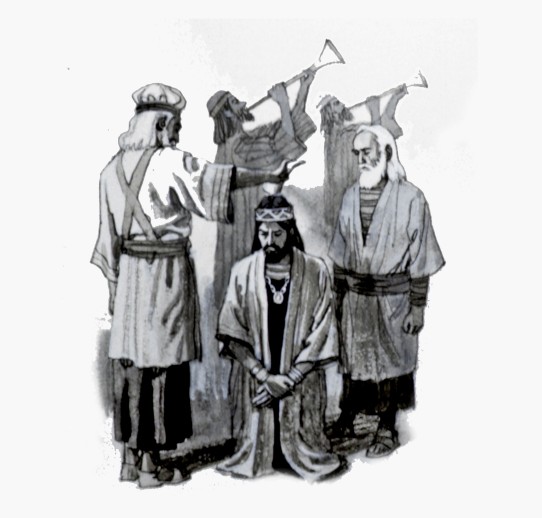
While David was still living, he arranged for his son Solomon to become king

While David was still living, he arranged for his son Solomon to become king

Psalm 72 is the last psalm in “book 2” of the Psalms, and contains the books doxology at the end.  The superscription deems it a song “of” Solomon, obviously as the young heir to David’s throne.  Some have attributed authorship to Solomon himself, but Matthew Henry’s view that it is David’s prayer on behalf of Solomon is likely correct.

There are some obvious Messianic aspects to the psalm in addition to the obvious parts in which there is fervent prayer for the earthly king.  The care for the poor and the needy in verse 4 certainly sounds like Jesus during His ministry; and verses 12-14 referring to one who delivers and redeems are pointing to Him as well.

The prayer ends with the doxology and praise to the Lord:  “Blessed be his glorious name forever; may the whole earth be filled with his glory!  Amen and Amen!”  The last line – “The prayers of David, the son of Jesse, are ended” could refer to this psalm, but could also refer to the assembling of this section of the psalms by the psalter.  Matthew Henry took the view that it referred to the ending of Psalms 71 and 72 as a whole, having been written in David’s old age.  Now with a young king to take his place, his “prayers have ended.”

Read or listen to audio of ESV version of this selection from this link.

/Bob’s boy
___________________
some images © V. Gilbert & Arlisle F. Beers

Please note: I did not design the reading plan that I am following in my blog.  All of my comments in this blog, however, are solely my responsibility.  When reading ANY commentary, you should ALWAYS refer first to the scripture, which is God’s unchanging and unfailing word. Reading schedules, as well as a link to the site where you can get the reading plan that I’m currently following for yourself can be found on the “Bible Reading Schedules” page of my website at http://graceofourlord.com.  For questions and help, please see the “FAQ” and “Summaries” pages there.
Psalm 61 – Lead Me to the Rock

As a lament, Psalm 61, though very short,  is one of the more beautiful, and one of the better known hymns that come from it is  “The Rock that is Higher than I” (verse 2).  Most scholars believe that this psalm was written during the time of Absalam’s conspiracy and David’s flight from Jerusalem (2 Samuel 15-18).  It is viewed as an individual lament, as David is asking the Lord to “hear my cry” (verse 1) and “prolong the life of the king” (verse 6).

mountain_003But as short as it is, it obviously is more than that, and it is easy to see why it has been popular for so long as both a congregational song and morning prayer.  Consider verse 2 “from the end of the earth I call to you when my heart is faint. Lead me to the rock that is higher than I.”  Then consider verse 5: “you have given me the heritage of those who fear your name.” 

That heritage is the covenant God made with David in 2 Samuel 7 – that of our Lord Jesus coming through the Davidic line.  The rest of verse 6 and verse 7 cinch it, as David finishes his prayer making it obvious that it was written after that covenant was made: “Prolong the life of the king; may his years endure to all generations! May he be enthroned forever before God…”

Read or listen to audio of ESV version of this selection from this link.

/Bob’s boy
___________________
some images © V. Gilbert & Arlisle F. Beers

Please note: I did not design the reading plan that I am following in my blog.  All of my comments in this blog, however, are solely my responsibility.  When reading ANY commentary, you should ALWAYS refer first to the scripture, which is God’s unchanging and unfailing word. Reading schedules, as well as a link to the site where you can get the reading plan that I’m currently following for yourself can be found on the “Bible Reading Schedules” page of my website at http://graceofourlord.com.  For questions and help, please see the “FAQ” and “Summaries” pages there.