Women of Means – Luke 8

Verses 1-3 of Luke chapter 8 can tell us much about the ministry of our Lord Jesus, but the tendency is to rush right past them and into the rest of the chapter, as there is much going on here. But let’s focus for a moment on the women that traveled with Jesus as He went preaching through these villages. Only three are mentioned by name, but Luke says there were many others.

Susanna is one that is not mentioned again in the New Testament, so we only know what Luke tells us here – which is that she was either healed by Jesus of some infirmity or of demons. The same goes for Joanna, except that it is highly probable that she is the same Joanna that in Luke 24:1-11 was one of the women that discovered Jesus’ empty tomb and went to tell the apostles. Joanna was the wife of the manager of the household of Herod Antipas.

Magdala, near modern Migdal, was situated here along the Sea of Galilee. Magdala was the home of Mary Magdalene.

Magdala, near modern Migdal, was situated here along the Sea of Galilee. Magdala was the home of Mary Magdalene.

The other woman who is mentioned is “Mary, called Magdalene.” Of all the women in the New Testament, she has been given the most unfair extra-biblical treatment – even disregarding the book and subsequent movie, the Da Vinci Code (and we will), which has been more than adequately dealt with in other articles that we can point you to, if interested.

First, there is the false belief that Mary Magdalene was a prostitute, which we covered in this previous post about Jesus’ dinner with Simon the Pharisee. Then there is further confusion, as she is sometimes portrayed as the adulterous woman of John 8:3-11 that the scribes and Pharisees wanted to stone. Remember Jesus said “let him who is without sin cast the first stone?” Nope, that wasn’t Mary Magdalene either. In fact, there is not even a single mention of Mary of Magdala in the Bible in the context of sin! Here, we learn that she had seven demons that Jesus cast out – but no mention of sin.

Furthermore, the women that are mentioned along with her in these three verses all “provided for them out of their means” (“them” meaning Jesus and His ministry). So not only was Mary Magdalene not a prostitute, but she was evidently a woman of some means financially, who now devoted her life to the Lord. How did the truth become so twisted in so many ways about this woman? There have been several answers offered, but they all come down to the age-old problem. We often (even innocently) accept the words of men rather than searching God’s word for the truth.

(This year’s reading plan for Luke, Acts, and 1 and 2 Chronicles averages just 15 verses per day – 5 days per week!)
Schedule for this week
Read or listen to audio of today’s selection from Luke here
Read or listen to audio of today’s selection from 1 Chronicles here

/Bob’s boy
___________________
some images © V. Gilbert & Arlisle F. Beers

Please note: I did not design the reading plan that I am following in my blog.  All of my comments in this blog, however, are solely my responsibility.  When reading ANY commentary, you should ALWAYS refer first to the scripture, which is God’s unchanging and unfailing word. Reading schedules, as well as a link to the site where you can get the reading plan that I’m currently following for yourself can be found on the “Bible Reading Schedules” page of my website at http://graceofourlord.com.  

Enhanced by Zemanta

It’s the Camel Fallacy (Again!)

If one has studied apologetics for a considerable length of time, the recent news stories about the camel bones proving the Bible wrong might very well lead one to react by saying “again? seriously?” The whole thing has been answered quite thoroughly many times already. And not so surprising is the glaring fact that only when disputing the Bible would a conclusion based upon a logical fallacy be so widely reported in the media.

Camel_220214In case you haven’t seen any of the stories, here is a brief summary. The Bible first begins to mention camels as domesticated (in the sense of someone possessing them, rather than simply being in the wild) in Genesis 12:16. Abram and Sarai have come to Egypt, and it is Pharoah that has them, among his other livestock. But we find Abraham himself, Isaac, and Jacob all in possession of the humped animal as well; and the time period is generally accepted as being from 2000 – 1500 BCE.

The source of the dispute is the fact that researchers from Tel Aviv University have studied the bones of camels found at the site of ancient copper mines near the Dead Sea. Through radiocarbon dating, they have determined that the camels were used in those operations around the end of the 10th century BCE. In fairness to these learned researchers, it should be pointed out that (despite what the news stories say) these researchers only wrote one thing in their report that is related to the “patriarchal narrative” (that would be the word of God, folks):

“This together with the depiction of camels in the Patriarchal narrative, has generated extensive discussion regarding the date of the earliest domestic camel in the southern Levant.”
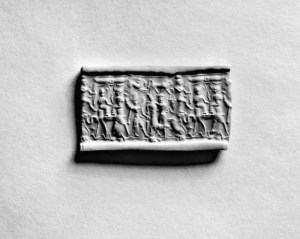
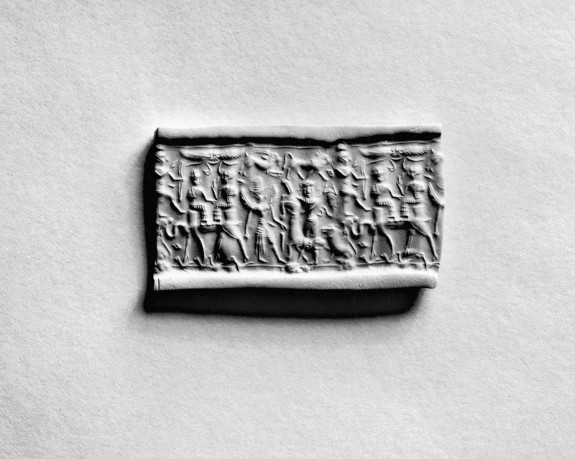
This seal shows a divine couple sitting on the two humps of a Bactrian camel, one of the earliest images of this animal. Above them hovers a winged rosette, which is a protective emblem. A smaller figure holding a bow stands on the head and neck of the camel. A winged female deity, stands off to the side, facing a contest between a man and a beast. The surrounding space is filled with a variety of animals, including a lion, scorpion, bull, and gazelle. 1800-1650 BC (Syria II-III)

This seal shows a divine couple sitting on the two humps of a Bactrian camel, one of the earliest images of this animal. Above them hovers a winged rosette, which is a protective emblem. A smaller figure holding a bow stands on the head and neck of the camel. A winged female deity, stands off to the side, facing a contest between a man and a beast. The surrounding space is filled with a variety of animals, including a lion, scorpion, bull, and gazelle. 1800-1650 BC (Syria II-III)

That’s it. All of the other titles in articles (some we list below) contain things that these researchers did not say. Okay, so now that we have covered that, what is the big deal? Well, since no bones of camels have been found in Israel at sites known to be older than that date, that has led others to the conclusion that there were no domesticated camels in Israel prior to the 10th century BCE. This would mean that the writers of the Old Testament books had to have just inserted camels into the narrative mistakenly because they didn’t exist there at the time they were writing about.

The headlines of the fore-mentioned news stories range from simply misleading and erroneous to downright irresponsible, outlandish, and even insulting. The Huffington Post’s headline reads “Major Discrepancy in the Bible.” The New York Times article proclaims “Camels Had No Business in Genesis,” and writes: “These anachronisms are telling evidence that the Bible was written or edited long after the events it narrates and is not always reliable as verifiable history.” The “Fashion Times” article headlines the “trending news” “Historical ERROR in Bible’s Old Testament, REVEALED.” We’re still mystified as to what camels and the Bible (error or no error) could possibly have to do with the world of fashion, but we digress.

The logical fallacy here is one known by several names:  “argumentum ad ignorantiam,” “appeal to ignorance” or “absence of eveidence.” One common comment about this is that “absence of evidence is not evidence of absence.” This is certtainly true. But in Todd Bolen’s article at BiblePlaces.com (“The Domestication of the Camel: Observations from Heide”), he quotes the following – more aptly put:

A camel in the Haran area, Turkey, known as Charran in ancient Mesopotamia.

A camel in the Haran area, Turkey, known as Charran in ancient Mesopotamia.

“Proving that something did not exist at some time and place in the past is every archaeologist’s nightmare because proof of its existence may, despite all claims to the contrary, be unearthed at some future date.” (p. 337, Heide, Martin, 2011 “The Domestication of the Camel: Biological, Archaeological and Inscriptional Evidence from Mesopotamia, Egypt, Israel and Arabia, and Literary Evidence from the Hebrew Bible”).

We recently underscored that point when we wrote in this previous post about the fact that skeptics claimed for a very long time that the Hittites were a figment of the Bible writers’ imaginations because no evidence had ever been found of their existence. That is, not until such evidence was found. Then it was discovered that they were a vast empire that dated back to the 14th century BCE.

We could easily be persuaded to believe that the camel was not widely used for domestic purposes by the common people until after the 10th century BCE in Israel, which would be one possible explanation of why a plethora of camel bones from earlier periods has not been found. We should remember that Pharaoh and yes, even Abraham, Isaac, and Jacob had been men of considerable wealth (Genesis 13:2, Genesis 26:12-13, Genesis 30:42-43). Many have suggested that Abraham brought his camels from Egypt, and that is certainly possible. But we should also remember that he had been in Mesopotamia – Haran (Genesis 12:4), and Mesopotamia’s ancient domestication of camels is just as well-documented.

So these wild leaps of unwarranted conclusions give skeptics and scoffers fodder to fan the flames of their frivolous fancies. And we find the unbelievers saying “well of course,  the Bible is not an accurate historical record” (a statement already proven time and again to be so absurd that it hardly deserves comment). And many of those who know that the Bible is the word of God – just wait for the truth. And if perchance convincing physical evidence is found in our lifetimes that categorically dates camel bones in Israel much earlier, you can be sure that the news will be relegated to a small blurb in a very inconspicuous place in most publications.

As for us, we know that Proverbs 30:5 is right: “Every word of God proves true.”

If you want to read the truth about what we know outside of the Bible concerning this subject, we suggest the following articles as examples:

“Abraham’s Camels” – ApologeticsPress.org
“The Annual Camels-Disprove-the-Bible Story” – Todd Bolen, BiblePlaces.com
“The Latest Challenge to the Bible’s Accuracy: Abraham’s Anachronistic Camels?”- ChristianityToday.com
“Bronze Age Camel Petroglyphs In The Wadi Nasib, Sinai” – BibleArcheology.org
“The Domestication of the Camel: Biological, Archaeological and Inscriptional Evidence from Mesopotamia, Egypt, Israel and Arabia, and Literary Evidence from the Hebrew Bible” – Martin Heide

(This year’s reading plan for Luke, Acts, and 1 and 2 Chronicles averages just 15 verses per day – 5 days per week!)
Schedule for this week

/Bob’s boy
___________________
some images © V. Gilbert & Arlisle F. Beers

Please note: I did not design the reading plan that I am following in my blog.  All of my comments in this blog, however, are solely my responsibility.  When reading ANY commentary, you should ALWAYS refer first to the scripture, which is God’s unchanging and unfailing word. Reading schedules, as well as a link to the site where you can get the reading plan that I’m currently following for yourself can be found on the “Bible Reading Schedules” page of my website at http://graceofourlord.com.  

Ark Movement 101 – 1 Chronicles 15

After the fiasco in chapter 13 of 1 Chronicles when the transportation of the ark was so badly mishandled that Uzzah was killed, it remained at the home of Obed-edom while David figured out what to do. And figure it out, he did. The material of chapter 15 focuses much less on David himself than was the case when this event was described in 2 Samuel 6:12-23. It is clear that David sought guidance from the Levites, and the instructions contained in Mosaic Law concerning proper handling of the ark were followed in exacting detail.

English: Jerusalem Model, The city of David, t...

English: Jerusalem Model, The city of David, the Pool of Siloam and the southern wall of Mount Moriah Deutsch: Jerusalem Modell, Davidstadt, im Vordergrund der Teich von Siloah und die Südmauer des Tempelberges Français : Maquette de Jérusalem, la Ville de David. Au premier plan, la piscine de Siloé et la muraille sud du Mont du Temple (Photo credit: Wikipedia)

David summoned “all of Israel” to participate in this event, which we can suppose to mean that he brought many from each tribe. And the Levites were at center stage because this could only be executed by them. Descendants of each of Levi’s sons (Kohath, Gershon, and Merari – verses 4-10) brought many with them, led by their chiefs; and the priests, Zadok and Abiathar were charged with consecrating themselves and their brethren for the task. This time, the Levites carried the ark with the poles, as set forth in Mosaic Law (Numbers 4:6-9; Numbers 4:15).

Singers and those who would play musical instruments (including Asaph, author of several Psalms – verse 19) were appointed and given detailed tasks. David wore an ephod over fine linen for the occasion, and he, his commanders and the Levites set out with the ark in grand procession and jubilant song, as they brought the ark to Jerusalem and the temporary tent that would hold it there.

But David’s wife, Michal (referred to in verse 29 simply as the daughter of Saul) watched through the window as David danced and celebrated the event and “despised him in her heart.” Her contempt for him here would define their estrangement from that point forward.

(This year’s reading plan for Luke, Acts, and 1 and 2 Chronicles averages just 15 verses per day – 5 days per week!)
Schedule for this week
Read or listen to audio of today’s selection from Luke here
Read or listen to audio of today’s selection from 1 Chronicles here

/Bob’s boy
___________________
some images © V. Gilbert & Arlisle F. Beers

Please note: I did not design the reading plan that I am following in my blog.  All of my comments in this blog, however, are solely my responsibility.  When reading ANY commentary, you should ALWAYS refer first to the scripture, which is God’s unchanging and unfailing word. Reading schedules, as well as a link to the site where you can get the reading plan that I’m currently following for yourself can be found on the “Bible Reading Schedules” page of my website at http://graceofourlord.com.  

Enhanced by Zemanta

Simon the Pharisee – Luke 7

Verses 36-50 of Luke chapter 6 prove again that among the hundreds to thousands of Pharisees who lived during the time of Jesus on earth, there were some whose minds were not completely closed, nor totally blind to the truth. One of them named Simon asked Jesus to eat with him. This in itself was a big deal because dining with someone else was viewed very much as an acceptance of that person, as well as of their behavior. Even though this was a very public dinner (as shown in verse 49), having Jesus at his own table was significant. Other Pharisees were very likely much taken aback at Simon for doing this. And so, Simon had invited Jesus into his house to “recline at table.”

anoints Jesus' feet in the house of Simon The Pharisee

anoints Jesus’ feet in the house of Simon The Pharisee

The appearance of the woman in Simon’s house, who would wash the feet of Jesus, may seem strange, but these large dinners attracted many types of people, some for their own entertainment value. There are some misconceptions about this woman, though, as well as some outright falsehoods that have been virtually perpetuated as fact. First, this is not the same woman who anointed Jesus in Matthew 26:6-12, Mark 14:3-8, or John 12:1-8. The woman in those accounts in Bethany was Mary the sister of Martha, and though the name of the man whose house they were in was Simon, it was Simon the leper, not Simon the Pharisee.

Secondly, this woman in Luke is unnamed to us. She is not Mary Magdalene, nor does the Scripture here in Luke say that she was a prostitute. Jesus did say that her sins were many, and that is a possibility, but we do not know. But again, she is not Mary Magdalene. Mary Magdalene is mentioned in chapter 8, but it is in a different setting with other women, and in a different context. We’ll have more to say about that when we come to that chapter. But there is no reason to think she or any of the other women mentioned in chapter 8 are this woman. In fact, at the end of chapter 7, this woman is told to “go in peace.” It is likely that she did just that.

The real point of the events of the verses is the lesson that Jesus gave to Simon about sin and forgiveness, as well as the notice that others paid to Jesus claiming the authority to forgive sins, which He obviously did have. The lesson Jesus gives Simon is that nobody’s sins are too numerous nor too great to be forgiven, and that those who have the most sin in their lives are likely more grateful for that forgiveness – the chance to begin anew.

Time and again, the Bible gives us reason to remember that we should never “write anyone off.” Nobody else’s sins are worse that our own in God’s eyes, nor are they any less deserving of forgiveness.

(This year’s reading plan for Luke, Acts, and 1 and 2 Chronicles averages just 15 verses per day – 5 days per week!)
Schedule for this week
Read or listen to audio of today’s selection from Luke here
Read or listen to audio of today’s selection from 1 Chronicles here

/Bob’s boy
___________________
some images © V. Gilbert & Arlisle F. Beers

Please note: I did not design the reading plan that I am following in my blog.  All of my comments in this blog, however, are solely my responsibility.  When reading ANY commentary, you should ALWAYS refer first to the scripture, which is God’s unchanging and unfailing word. Reading schedules, as well as a link to the site where you can get the reading plan that I’m currently following for yourself can be found on the “Bible Reading Schedules” page of my website at http://graceofourlord.com.  

Enhanced by Zemanta

Children of Wisdom – Luke 7

As the news spread about the miracles Jesus had done, including the raising of the dead son of the widow of Nain, the disciples of John the baptist made these things known to him, while he was in prison. John sent two of them to Jesus to ask “Are you the one who is to come, or shall we look for another?” Obviously, the mention of “the one” refers to the Messiah. This seems strange to us, in light of the fact that before he was imprisoned, John already pointed Jesus out as “the Lamb of God, who takes away the sin of the world!” (John 1:29).

English: Infant Jesus and John the Baptist, Mu...

English: Infant Jesus and John the Baptist, Museo del Prado (Photo credit: Wikipedia)

But we must remember that John the baptist was just a man, and he had his own weaknesses and trials (particularly at this time, being in prison), and he would have his own struggles with faith. We know that at the time he was “preparing the way” for Jesus he was full of the Spirit. Clearly that was the case when he made that statement as he saw Jesus approach him. But now that he was in prison, he hears of the things that Jesus has done, and perhaps like many others, he was expecting a much different Messiah – one who would be a great leader and perhaps lead Israel to their former greatness as a power – and out from under the dominance of the roman Empire.

Verse 21 says that Jesus healed many of diseases and evil spirits, and restored sight to blind people in that very hour. We can presume that to mean that the disciples John sent were witnesses to these things. When Jesus told them in verses 22-23 to go tell John about the blind, the deaf, the lame, etc., He knew that John would recognize these prophesies from Isaiah 29:18. After they left, Jesus spoke to the crowds about John. John had fulfilled the scriptures concerning what he was purposed by God to do, and Jesus pointed this out very well. Noting that some were deceived by his simple dress and his life of austerity, Jesus proclaimed in verse 27 that John was indeed nonetheless the one spoken of in Malachi 3:1, as the messenger sent to prepare the way.

Saint John the Baptist and the Pharisees

Saint John the Baptist and the Pharisees (Photo credit: Wikipedia)

One point that is easy to miss in all of this is the relationship in this passage between the expectation of the people toward the prophet and John’s own expectations about the Messiah. Jesus asked them what they expected to see when they went out in the wilderness, saying that “those who are dressed in splendid clothing and live in luxury are in kings’ courts.” By the same token, Jesus came as the Messiah, doing exactly what the prophet Isaiah said He would do, but people often do not see what is important if they look the wrong way. And he continues to emphasize these points in verse 31-34, as he describes the fickleness of that generation. Also not to be missed here is the affirmation that by rejecting the baptism of John, the Pharisees and lawyers had rejected the counsel of God (verse 3).

What did Jesus mean when he said in verse 28 “yet the one who is least in the kingdom of God is greater than he” (speaking of John)? I think this is simply a reference to the fact that he knew John would not live to be a part of the kingdom Jesus was establishing as His church. Almost certainly, John would have his place in heaven, but he would not be around to tell others of the good news of Jesus’ victory over death, and what it all means.

Finally, Jesus says that wisdom is justified by all her children.” Those who seek wisdom through the truth will find it. The point is made in Proverbs 8:34-36, speaking of wisdom in the first person:

“Blessed is the one who listens to me,
watching daily at my gates,
waiting beside my doors.
For whoever finds me finds life
and obtains favor from the Lord,
but he who fails to find me injures himself;
all who hate me love death.”

(This year’s reading plan for Luke, Acts, and 1 and 2 Chronicles averages just 15 verses per day – 5 days per week!)
Schedule for this week
Read or listen to audio of today’s selection from Luke here
Read or listen to audio of today’s selection from 1 Chronicles here

/Bob’s boy
___________________
some images © V. Gilbert & Arlisle F. Beers

Please note: I did not design the reading plan that I am following in my blog.  All of my comments in this blog, however, are solely my responsibility.  When reading ANY commentary, you should ALWAYS refer first to the scripture, which is God’s unchanging and unfailing word. Reading schedules, as well as a link to the site where you can get the reading plan that I’m currently following for yourself can be found on the “Bible Reading Schedules” page of my website at http://graceofourlord.com.  

Enhanced by Zemanta

Not Just Another Funeral – (Luke 7)

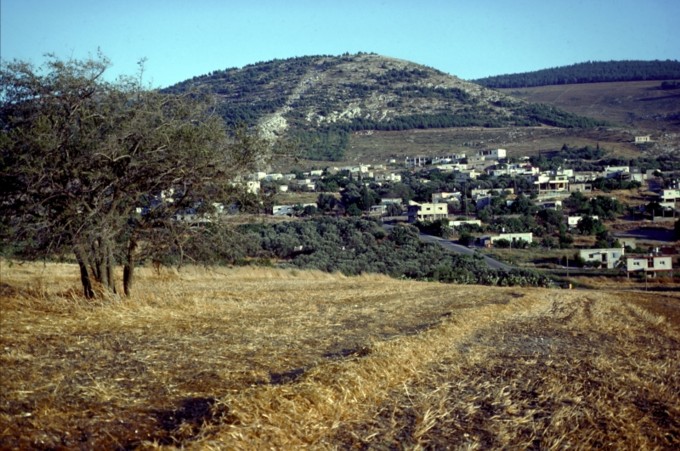
Nain, where Jesus raised the widow's son.

Nain, where Jesus raised the widow’s son.

The city of Nain mentioned in Luke chapter 7 is generally assumed to be where the small village of Nein is located, although the remains that have been uncovered suggest that Nain was much larger – more like the city that was mentioned by Luke. It is a short distance from Mount Tabor at the foot of a hill known as the “Little Hermon.” Luke says that it was soon after the healing of the Centurion’s servant that Jesus set out headed for the city. He had His disciples with Him, and a “great crowd” was following with Him as well. Just how large this group of people was, we do not know. But usually, when the Gospel writers spoke of a “great crowd,” it meant a very significant number of people (see below).

A man had died, and was being carried out of the city as they approached the gate; and there was what Luke describes as a “considerable crowd” (reasonable to assume that the “considerable crowd” was smaller than the “great crowd”) with her. Presumably, they were on their way to the burial-place for the man. In verse 13, Luke says that Jesus had compassion for her, as the woman wept for her lost son.

Being a widow and then losing a son meant much more than just a deeply sad feeling of loss for a woman of those times. Women of the day had little opportunity for earning income of their own. There were no social programs for her to rely on for financial support, of course. So not only was she suffering the loss of dear loved ones, but she was facing a very uncertain future, and financial hardship was certain to be a major concern.

English: Mount tabor view

English: Mount tabor view (Photo credit: Wikipedia)

As Jesus told her not to weep, he came up and touched the bier. A bier was a wooden platform on which a coffin was transported. Today, funeral homes usually move coffins around with a collapsible metal or aluminum bier. As He did so, all of those in the procession stood still. And then Jesus spoke to the dead man, telling him to arise. Imagine yourself for a moment, walking with such a procession to go to the burial of someone you knew when their lifeblood flowed, and hearing a stranger address the dead person, telling him to get up. Then imagine that dead friend actually raising up and start speaking to his pallbearers. Luke says in verse 16 that “fear seized them all.” I have no doubt that it did!

Then they all glorified God. It wasn’t hard to figure out that this had not been some parlor trick, and there was none other to attribute this miracle to but the Almighty Himself. Of Jesus they said “a great prophet has arisen among us!” and “God has visited his people!” Not surprisingly, verse 17 indicates that this “great crowd” spread the word about this miracle throughout Judea and the surrounding country. And what a celebration the widow, her son, and their friends and family would have that day! I sometimes wonder how many of the people like this that we read about became Christians after Jesus was crucified?

(This year’s reading plan for Luke, Acts, and 1 and 2 Chronicles averages just 15 verses per day – 5 days per week!)
Schedule for this week
Read or listen to audio of today’s selection from Luke here
Read or listen to audio of today’s selection from 1 Chronicles here

/Bob’s boy
___________________
some images © V. Gilbert & Arlisle F. Beers

Please note: I did not design the reading plan that I am following in my blog.  All of my comments in this blog, however, are solely my responsibility.  When reading ANY commentary, you should ALWAYS refer first to the scripture, which is God’s unchanging and unfailing word. Reading schedules, as well as a link to the site where you can get the reading plan that I’m currently following for yourself can be found on the “Bible Reading Schedules” page of my website at http://graceofourlord.com.  

Enhanced by Zemanta

Such Faith – (Luke 7)

After He finished the “Sermon on the Plain,” Jesus went back into Capernaum and was met by Jewish elders. They had been asked to come by a Roman Centurion. Originally, a Centurion commanded 80 men, but some estimates are that their command – a centuria or “century,” could contain up to 1000 soldiers. That number would likely be closer to the makeup of a “cohort,” which would be under the command of a senior Centurion. The average Roman soldier during this time earned about 225 denarii per year.  But the cost of the soldier’s food and his arms were both deducted from his pay!

English: Centurion (Roman army) historical ree...

English: Centurion (Roman army) historical reenactment Boulogne sur mer (France). Français : Centurion (armée Romaine) Reconstitution historique à Boulogne sur Mer en France. (Photo credit: Wikipedia)

On the other hand, estimates are that the most junior of Centurions was paid about 3,700 denarii per year, while a senior Centurion could earn as much as 15,000! This wide disparity meant that these officers would be considered quite wealthy by most Jews, among whom the Centurions lived. The reason for the Centurion sending the Jewish elders to Jesus was because he had heard of Jesus’ healings, and he had a “highly valued” servant that was dying from some illness. The elders pleaded with Jesus to help this Gentile soldier in this matter because he had built their synagogue, confirming that this Centurion was indeed wealthy.

But as Jesus and the elders approached their destination, they were met by people with a message from the Centurion, saying both that he was not worthy and that it was not necessary for Jesus to actually come to his home. Instead, he expressed his belief that Jesus could heal his servant just by saying that it was so – without even seeing his servant. And of course, he was right about that. Jesus’ statement that “even in Israel” he had not seen such faith serves as one more example that indicates the intentions the Lord had of including the Gentiles in His plan of salvation.

(This year’s reading plan for Luke, Acts, and 1 and 2 Chronicles averages just 15 verses per day – 5 days per week!)
Schedule for this week
Read or listen to audio of today’s selection from Luke here
Read or listen to audio of today’s selection from 1 Chronicles here

/Bob’s boy
___________________
some images © V. Gilbert & Arlisle F. Beers

Please note: I did not design the reading plan that I am following in my blog.  All of my comments in this blog, however, are solely my responsibility.  When reading ANY commentary, you should ALWAYS refer first to the scripture, which is God’s unchanging and unfailing word. Reading schedules, as well as a link to the site where you can get the reading plan that I’m currently following for yourself can be found on the “Bible Reading Schedules” page of my website at http://graceofourlord.com.  

Enhanced by Zemanta

Nailed To the Cross – Epistle To Colossae

Paul’s letter to the Colossians is one of the four “prison epistles” (he also wrote letters to the Ephesians, the Philippians, and to Philemon while in prison).  The date of writing is generally thought to be about 62 A.D., which assumes that he wrote it from prison in Rome after his fateful voyage in Acts 27-28.

English: Saint Epaphroditus Русский: Ап. Епафр...

English: Saint Epaphroditus Русский: Ап. Епафродит. Миниатюра из греко-груз. рукописи. XV в. (РНБ. О. I.58. Л. 114 об.) (Photo credit: Wikipedia)

Some scholars believe that Paul did not have a hand in establishing the church at Colossae personally. This is partially due to the reference in verse 7 to them having learned the truth from Epaphras. But if one reads verse 6 along with it, the mention of Epaphras appears to be an additional source of preaching of the gospel to the brethren there. It is likely that he at least had a hand in it, and we find it difficult to believe (as some have stated) that he never even visited them – especially being at Ephesus for three years during his third missionary journey. Regardless, Paul’s letter to them demonstrates no small measure of familiarity, and it should be noted that Philemon, to whom another prison epistle was written, was himself a Colossian. And Timothy, who apparently acted as Paul’s secretary for this letter (verse 1), was likely no stranger to them either.

Some parts of this letter appear to be addressing a problem with false teachers, possibly rising from within the ranks of the brethren, just as he warned the Ephesian elders about in Acts 20:28-30. One passage that particularly seems to allude to this is in Colossians 4:18, which says “let no one disqualify you, insisting on asceticism and worship of angels, going on in detail about visions, puffed up without reason by his sensuous mind…”

But the overriding message to the brethren at Colossae (and to us) is about the gift of life given to us by Jesus. It is summarily contained in great detail in chapter 2:8-15. There, Paul speaks of Jesus Christ as deity and “the head of all rule and authority,” with whom we have been buried in baptism. And we, who were dead in our sins, have had our debts paid for us by Him and they were “nailed to the cross.”

(This year’s reading plan for Luke, Acts, and 1 and 2 Chronicles averages just 15 verses per day – 5 days per week!)
Schedule for this week

/Bob’s boy
___________________
some images © V. Gilbert & Arlisle F. Beers

Please note: I did not design the reading plan that I am following in my blog.  All of my comments in this blog, however, are solely my responsibility.  When reading ANY commentary, you should ALWAYS refer first to the scripture, which is God’s unchanging and unfailing word. Reading schedules, as well as a link to the site where you can get the reading plan that I’m currently following for yourself can be found on the “Bible Reading Schedules” page of my website at http://graceofourlord.com.

Enhanced by Zemanta

Rising Star

The 13th chapter of 1 Chronicles takes up with David making plans to bring the ark of the covenant to Jerusalem. The ark symbolized God’s presence and His covenant under Moses. Though it was revered and kept holy, it had been seriously neglected throughout the reign of Saul, and had been in Kiriath-jearim for some time. Now David, attempting to assemble and unite the nation, was making plans to transport it from the house of Abinadab (1 Samuel 7:1).


The Chastisement of Uzzah

The Chastisement of Uzzah (Photo credit: Wikipedia)


So they loaded on a cart, and Uzzah and his brother drove the cart. But as the oxen stumbled, Uzzah reached out to take hold of it, and God struck him dead. David had gone about this all wrong. Only the Kohathites were allowed to carry the ark – with poles, for even they could not touch it “lest they die” (Numbers 3:29-31, Numbers 4:15). David was angry with God and afraid, and had the ark taken to the house of Obed-edom the Gittite, where it would remain until he could figure out the proper way to transport it.


Chapter 14 has David making moves to solidify Jerusalem as the focal point – the capital – of Israel. Hiram, the Gentile king of Tyre sent cedars, masons, and carpenters to help build David’s palace. His family grew greatly in number, as well as his strength. God gave him victories over the Philistines, and his fame spread. The chronicler tells us in verse 17 that “the Lord brought the fear of him upon all nations.” Under David, and with God’s blessing, the nation was becoming a real world power.


(This year’s reading plan for Luke, Acts, and 1 and 2 Chronicles averages just 15 verses per day – 5 days per week!)
Schedule for this week
Read or listen to audio of today’s selection from Luke here
Read or listen to audio of today’s selection from 1 Chronicles here


/Bob’s boy


___________________


some images © V. Gilbert & Arlisle F. Beers


Please note: I did not design the reading plan that I am following in my blog.  All of my comments in this blog, however, are solely my responsibility.  When reading ANY commentary, you should ALWAYS refer first to the scripture, which is God’s unchanging and unfailing word. Reading schedules, as well as a link to the site where you can get the reading plan that I’m currently following for yourself can be found on the “Bible Reading Schedules” page of my website at http://graceofourlord.com.  


Enhanced by Zemanta

Jesus – All About Love

From verse 27 of Luke 6 all the way to the last four verses, the remainder of the “Sermon on the Plain” is really about how we treat and care for one another. And these verses do resonate in the Sermon on the Mount in Matthew 7. Jesus begins with the admonishment about loving ones enemies and doing good to those who hate you. The point of verses 27-29 is not that we are supposed to let people “run over” us, but God’s people are not to be vindictive, vengeful, or unnecessarily combative.


Yew trees looking south towards Sermon on the ...

Yew trees looking south towards Sermon on the Mount (Photo credit: Wikipedia)


Verse 37 about not judging others is a favorite reference for those who wish to justify sinful behavior. But Jesus did not tell us that we should not point out to others when they are doing wrong. In fact, there are other passages that tell us that the opposite is true. But at the same time, we cannot properly love our fellow-man if we are harshly or hypocritically judgmental. It all comes down to what Jesus said in Matthew 22:37-39 is the second of the greatest commandments – to “love your neighbor as yourself.”


In the middle of all of this, Jesus tells us to give generously to those in need. Loving, forgiving, and overflowing with generosity – these are the traits, habits and hallmarks of the way the Lord wants His children to be toward our fellow-man. He could not have been clearer. In verse 31, Jesus paraphrases what we call the golden rule from His Sermon on the Mount – “And as you wish that others would do to you, do so to them.”


(This year’s reading plan for Luke, Acts, and 1 and 2 Chronicles averages just 15 verses per day – 5 days per week!)
Schedule for this week
Read or listen to audio of today’s selection from Luke here
Read or listen to audio of today’s selection from 1 Chronicles here


/Bob’s boy


___________________


some images © V. Gilbert & Arlisle F. Beers


Please note: I did not design the reading plan that I am following in my blog.  All of my comments in this blog, however, are solely my responsibility.  When reading ANY commentary, you should ALWAYS refer first to the scripture, which is God’s unchanging and unfailing word. Reading schedules, as well as a link to the site where you can get the reading plan that I’m currently following for yourself can be found on the “Bible Reading Schedules” page of my website at http://graceofourlord.com.  


Enhanced by Zemanta