An International Incident – 1 Chronicles 19-20

Landscape with David and Bathsheba

Landscape with David and Bathsheba (Photo credit: Wikipedia)

Most of the events of these two chapters are contained in chapters 10-11 of 2 Samuel, but there are some differences. Most conspicuously absent here is any reference to David’s sin with Bathsheba. This affair and betrayal of Uriah the Hittite took place at the time that “Joab led out the army and ravaged the country of the Ammonites and came and besieged Rabbah” (1 Chronicles 20:1).

Most scholars agree that the account is not left out simply to avoid showing David in a bad light. There are several things that demonstrate David’s goodness which the chronicler did not write about either. But the purpose of the chronicles was to preserve the knowledge (for the returning exiles and their descendants) of God’s covenant with David and reassure them that it was still a promise from God.

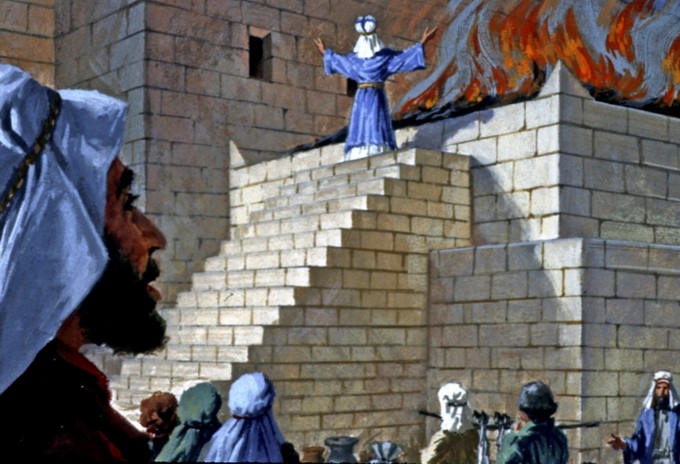
As chapter 19 opens, David sends messengers to give his condolences to  Hanun the son of Nahash the Ammonite because Nashash had “dealt kindly” with him. It is unknown what kindness that was. But Hanun, suspecting David’s motives and thinking his servants were spies, he shaved them and cut there clothes off at the hip, sending them on their way. After realizing the seriousness of the international incident he had created, Hanun hired chariots and horsemen from Mesopotamia and surrounding areas and kingdoms in a futile attempt to defeat David’s army.

English: The young Hebrew David hoists the hea...

English: The young Hebrew David hoists the head of the Philistine Goliath (Photo credit: Wikipedia)

After Joab “struck down Rabbah,” David accumulated much gold and other precious plunder – including a crown of gold that was taken from the king’s head. Verse 3 of chapter 20 says that they did the same to all of cities of the Ammonites. Then in verses 4-8, came the defeat of many Philistines, some of which were giants on the order of the Goliath that David killed when Saul was king. The Goliath here is not the same one, obviously.

The one mentioned in verse 6 with the extra digits had a condition called polydactyly, a condition that a small percentage of people are born with to this day – including yours truly (mine was an extra thumb). The man that holds the world record for the most digits is Akshat Saxena in India. He was born in 2010 with 7 digits on each hand and 10 digits on each foot, for a total of 34 digits!

(This year’s reading plan for Luke, Acts, and 1 and 2 Chronicles averages just 15 verses per day – 5 days per week!)
Schedule for this week
Read or listen to audio of today’s selection from Luke here
Read or listen to audio of today’s selection from 1 Chronicles here

/Bob’s boy
___________________
some images © V. Gilbert & Arlisle F. Beers

Please note: I did not design the reading plan that I am following in my blog.  All of my comments in this blog, however, are solely my responsibility.  When reading ANY commentary, you should ALWAYS refer first to the scripture, which is God’s unchanging and unfailing word. Reading schedules, as well as a link to the site where you can get the reading plan that I’m currently following for yourself can be found on the “Bible Reading Schedules” page of my website at http://graceofourlord.com.  

Enhanced by Zemanta

King David’s Favor With God (1 Chronicles 17-18)

English: Nathan advises King David

English: Nathan advises King David (Photo credit: Wikipedia)

It was important for the chronicler to communicate well the events of I Chronicles 17 to the post-exilic Jews because it contains the covenant of God with David. Covered first in 2 Samuel 7, it begins with David wanting to build God a house. But God tells Nathan the prophet to let David know that it would not be him that builds such a house. Instead, God promises that He would build David’s “house” – that David’s offspring (Jesus) would reign forever.

In answer to God’s covenant, David makes a prayer to God (verses 16-27). It is one of the longest prayers in the bible, and incredibly humble and heartfelt. It begins with “Who am I, O Lord God, and what is my house, that you have brought me thus far?” They are words that each of us should ask God in prayer as well. The blessings that He has given us and the promises He has made to us are no less magnificent and undeserved that those made to David.

Hama

Hama (Photo credit: Wikipedia)

Chapter 18 contains some stunning military victories, some of which were reported in 2 Samuel 8. Here, David defeats the Philistines, and also takes Gath. The Moabites are defeated and become servants to David. He also “defeated Hadadezer king of Zobah-Hamath, as he went to set up his monument at the river Euphrates.” The plunder he took from the cities of Hadadezer included 1,000 chariots, 7,000 horsemen, and 20,000 foot soldiers, and shields made of gold.

In addition, verse 9 tells us that Tou king of Hamath was so pleased when he heard of the defeat of Hadadezer that he sent his son with gifts of gold, silver and bronze that Solomon would later use in building the pillars and the sea, and the bronze vessels for the temple.  Hamath is associated with modern Hama, which is located on the Orontes River in western Syria. There is an article with a picture there of a noria (a machine for lifting water into an aqueduct) at this link to Ferrell’s Travel Blog. We also recommend this article at BiblePlaces.com and this one at BiblicalArcheology.org for information on discoveries related to Tou (also called Toi and possibly Taita).

The victories continue against the Syrians and 18,000 Edomites in the Valley of Salt. And the text says that God gave victory to him wherever he went. Verses 14-17 detail how just and fair David was as a ruler, and how stable and well-organized his administration was. Joab was established as military commander, and “Jehoshaphat the son of Ahilud was recorder; and Zadok the son of Ahitub and Ahimelech the son of Abiathar were priests; and Shavsha was secretary; and Benaiah the son of Jehoiada was over the Cherethites and the Pelethites; and David’s sons were the chief officials in the service of the king.”

(This year’s reading plan for Luke, Acts, and 1 and 2 Chronicles averages just 15 verses per day – 5 days per week!)
Schedule for this week
Read or listen to audio of today’s selection from Luke here
Read or listen to audio of today’s selection from 1 Chronicles here

/Bob’s boy
___________________
some images © V. Gilbert & Arlisle F. Beers

Please note: I did not design the reading plan that I am following in my blog.  All of my comments in this blog, however, are solely my responsibility.  When reading ANY commentary, you should ALWAYS refer first to the scripture, which is God’s unchanging and unfailing word. Reading schedules, as well as a link to the site where you can get the reading plan that I’m currently following for yourself can be found on the “Bible Reading Schedules” page of my website at http://graceofourlord.com.  

Enhanced by Zemanta

A Truly United Kingdom – (1 Chronicles 16)

The Sacrifice of the Old Covenant

The Sacrifice of the Old Covenant (Photo credit: Wikipedia)

Now that the Levites had successfully transported the Ark to Jerusalem, David begins celebrating in the most proper manner – with tribute to God. God’s people were in the middle of the greatest times that the united kingdom would know. And for the most part, it would last through Solomon’s reign. Second only to the dedication of the Temple by Solomon, this would be the greatest celebration of that time.

David had the ark of the covenant brought in to the tent that he had erected for it. They then had burnt offerings and peace offerings. The peace offering is sometimes called a fellowship, or more properly, a thanksgiving offering, and is introduced in Leviticus 3:1-17 and Leviticus 7:11-34. Afterwards, the celebration continued with every man and woman of the vast number of Israelites present being given “loaf of bread, a portion of meat, and a cake of raisins.”

English: Statue of King David by Nicolas Cordi...

English: Statue of King David by Nicolas Cordier in the Borghese Chapel of the Basilica di Santa Maria Maggiore. Français : Statue du roi David par Nicolas Cordier, dans la chapelle Borghèse de la basilique Sainte-Marie Majeure. Italiano: Statua del re Davide di Nicolas Cordier, nella Capella Borghese della Basilica di Santa Maria Maggiore in Roma. (Photo credit: Wikipedia)

David then appointed certain Levites to “minister before the ark” invoking thanks, praising the Lord, and playing harps, lyres, cymbals, and blowing trumpets. Chief among this group of Levites was Asaph who authored Psalms 50 and 73-83. Also among them was Benaiah, one of the most powerful of David’s “mighty men,” whose exploits (some of which are described in 2 Samuel 23:20-22) included the single-handed defeat of Moab’s two mightiest warriors. Verse 7 tells us that it was the first time that David appointed Asaph and his brothers to sing thanksgiving to the Lord.

Verses 8-36 contain David’s song of thanksgiving. It is a long and wonderful song of praise to the Lord; and parts of it are contained in Psalm 105:1–15, Psalm 96:1–13, and Psalm 106:1, 47–48. Verses 37-42 describe how David made ministering to the ark a long-term responsibility for Asaph and his brothers. He also left Obed-edom (and his 68 brothers!), along with Zadok the priest and his brothers to offer burnt offerings and perform other duties.

Finally, the ark was to get the care that it had once had when Moses was around; and the Levites would do what they were intended to do before the Lord in such a grand scale as Israel had not seen since long before Israel had its first king.

(This year’s reading plan for Luke, Acts, and 1 and 2 Chronicles averages just 15 verses per day – 5 days per week!)
Schedule for this week
Read or listen to audio of today’s selection from Luke here
Read or listen to audio of today’s selection from 1 Chronicles here

/Bob’s boy
___________________
some images © V. Gilbert & Arlisle F. Beers

Please note: I did not design the reading plan that I am following in my blog.  All of my comments in this blog, however, are solely my responsibility.  When reading ANY commentary, you should ALWAYS refer first to the scripture, which is God’s unchanging and unfailing word. Reading schedules, as well as a link to the site where you can get the reading plan that I’m currently following for yourself can be found on the “Bible Reading Schedules” page of my website at http://graceofourlord.com.  

Enhanced by Zemanta

The Events of the Days

The Books of I and II Chronicles, like Kings and Samuel, were originally one book. The Hebrew title for the book (“Dibre Hayyamim“) is often translated “The events (or annals) of the days.” We like the fact that the Septuagint calls it “the things omitted,” as that seems the very best description – for it contains much that Samuel and Kings do not.  But the overriding message throughout the book is the faithfulness of God to his covenant with His people through the house of David.

English: Table of nations according to genesis...

English: Table of nations according to genesis 10 Nederlands: Volkerenlijst naar genesis 10 (Photo credit: Wikipedia)

1 Chronicles 3:17-24 contains the names of a list of descendants of David that is at least 5 generations beyond the exile, and so it seems reasonable to date the beginning of the writings to at least 400 B.C., and possibly a few decades afterward. With the fall of Jerusalem and the destruction of the temple by the Babylonians under Nebuchadnezzar, the Davidic kingdom was overthrown, and there was no longer a nation of Judah. Babylon, however, fell to the Persians in 538 B.C., and after the decree of Cyrus, the returning exiles (with much help from Ezra and Nehemiah) eventually got the temple rebuilt, as well as the walls around Jerusalem. But where did that leave God’s people if there was no more monarchy of David’s house? What was God’s plan, and where did that leave the covenant made to David in 2 Samuel 7?

This is the main purpose of the Book of Chronicles – to reinforce faith in the promise of the Davidic throne through a clear and precise record of the nation’s history from the perspective of the remnant of the southern kingdom and its rulers. As the book was written, a start in rebuilding had been made in the temple and in Jerusalem, but the people must not repeat the mistakes of the past. And so those who had not been there must learn all about it.

The genealogy of the first nine chapters of 1 Chronicles begins in verses 1-3 of chapter one – from Adam to Noah and his three sons, Shem, Ham, and Japeth. From here, it begins to read very much like what we know now as “The Table of Nations” in Genesis 10. Verses 5-24 give us the sons of each of Noah’s sons, etc. down to Abraham, and thus the names of nations – many of which are very familiar to us now through geography, history, and other biblical reference, such as Canaan, Egypt, Cush, and Uz (from Job).

Verses 28-54 give us the generations from Abraham to Jacob (Israel), but only Jacob’s brother Esau is the focus of the genealogical record from verse 35 onward in this chapter. Jacob’s descendants will be covered at great length beginning in chapter 2. These 29 verses are all devoted to the nation of Edom, which Esau fathered, many of which would be bitter enemies with Israel and Judah in times to come.

(This year’s reading plan for Luke, Acts, and 1 and 2 Chronicles averages just 15 verses per day – 5 days per week!)
Schedule for this week

/Bob’s boy
___________________
some images © V. Gilbert & Arlisle F. Beers

Please note: I did not design the reading plan that I am following in my blog.  All of my comments in this blog, however, are solely my responsibility.  When reading ANY commentary, you should ALWAYS refer first to the scripture, which is God’s unchanging and unfailing word. Reading schedules, as well as a link to the site where you can get the reading plan that I’m currently following for yourself can be found on the “Bible Reading Schedules” page of my website at http://graceofourlord.com.  

Enhanced by Zemanta

Update – Luke, Acts, and Chronicles!

English: the first page of the Gospel of Luke

English: the first page of the Gospel of Luke (Photo credit: Wikipedia)

It’s official. We decided to map out a reading schedule for the blog ourselves this year. The schedule for January has been posted here on the “Schedules” page. We will read a chapter a week of the Gospel of Luke (24) chapters, and then about June, we will start reading the Book of Acts (28 chapters). In addition, we will  read 1 and 2 Chronicles (a total of 65 chapters) this year. Why the Book of Chronicles? Due to an unfortunate placement in our Bibles just after 1 and 2 Kings, these two books are probably the most neglected books of the bible – next to Revelation. Since some of the text in 2 Samuel and in the Books of Kings is contained word for word, most of us get to Chronicles and figure – why read that again?

Well, surprise! the Books of Chronicles are actually very unique in their perspective, and contain much more than a mere repetition of other passages. In fact, our first blog of this year’s schedule (to be published in a couple of hours) will focus on an introduction to Chronicles that we hope you will find informative and helpful.

English: I took photo with Canon camera.

English: I took photo with Canon camera. (Photo credit: Wikipedia)

We will begin the first week with Luke chapter one and the first chapter of 1 Chronicles! The best part is that the pace of reading necessary to keep up with this schedule is quite easy. Although there will be weeks when we may cover 20 to 30 verses per day, on the average, it will only take 15 verses per day to read these four books this year!

Finally, a reading plan that practically anyone can keep up with! 15 verses per day, and you get the whole story of the birth, life, death, and resurrection of our Lord, followed by the details of how the Apostles carried out the commission he gave to them. And all the while, you will learn much of the history of God’s people from the time of Saul, then David, all the way to the end of the Babylonian exile!

And on Sundays, we will be focusing on other New Testament books, the subject of apologetics, and (we feel most importantly) ways to enrich your prayer life. We invite you to join us this year in what we feel will be a very enlightening year of reading and commentary in God’s word

/Bob’s boy
Enhanced by Zemanta

2 Chronicles – The Events of the Days

The Book of 2 Chronicles starts out in verse 1 saying “Solomon the son of David established himself in his kingdom, and the Lord his God was with him and made him exceedingly great.” It ends in chapter 36 with the proclamation of Cyrus, inviting the exiles to return to Judea and rebuild. This spans a time period of about 430 years. The capstone chapter is chapter 34, which begins the reign of King Josiah and his dramatic reforms and restoration.

During the eighteenth year of King Josiah's reign, he held a great Passover festival to celebrate the restored Temple 2 Chronicles 35:1-27)

During the eighteenth year of King Josiah’s reign, he held a great Passover festival to celebrate the restored Temple 2 Chronicles 35:1-27)

As the temple was being repaired, the priest Hilkiah found the book of the law in the house of the Lord. Then Shaphan the scribe read it to Josiah. When the great king realized the extent of the utter failure of his people in serving the Lord, he became extremely upset (2 Chronicles 34:19-24). At his bidding, Hilkiah went to Huldah the prophetess, who issued the news of the dire fate that awaited the people. Thus began a period of great change that put off the wrath of the Lord until Josiah’s death in 2 Chronicles 35. But the evil returned under the reign of his son, Jehoiakim (2 Chronicles 36:1-5).

Key events of 2 Chronicles

Solomon’s wisdom and prosperity  (2 Chronicles  1)
The building of the Temple (2 Chronicles 3–5:1)
Ark transported to the Temple (2 Chronicles 5:2–12)
God’s glory fills the temple (2 Chronicles 5:13–14)
Solomon blesses the people and consecrates the temple (2 Chronicles 6)
Fire from the Lord consumes the sacrifices (2 Chronicles 7:1–7)
Feast of Tabernacles and covenant confirmation (2 Chronicles 7:8–22)
Queen of Sheba visits (2 Chronicles 9:1–12)
Death of Solomon (2 Chronicles 9:29–31)

Division of the kingdom (2 Chronicles 10:1–11:23)
Reign of Rehoboam (Judah) (2 Chronicles 12:13–16)
War between Judah and Israel (2 Chronicles 13:1–22)
Asa’s reforms (2 Chronicles 15:8–19)
Asa defeats Syria (2 Chronicles 16:1–10)
Expansion of Judah (2 Chronicles 17:10–19)
Jehoshaphat’s alliance with Ahab and the death of Ahab (2 Chronicles 18:1–34)
Jehoshaphat’s reforms and his reign (2 Chronicles 19:1–20:37)

/Bob’s boy
___________________
image © V. Gilbert & Arlisle F. Beers

Please note: I did not design the reading plan that I am following in my blog.  All of my comments in this blog, however, are solely my responsibility.  When reading ANY commentary, you should ALWAYS refer first to the scripture, which is God’s unchanging and unfailing word. Reading schedules, as well as a link to the site where you can get the reading plan that I’m currently following for yourself can be found on the “Bible Reading Schedules” page of my website at http://graceofourlord.com.  

1 Chronicles – The Annals of the Times

David bringing the Ark to Jerusalem

David bringing the Ark to Jerusalem

Like the Book of Samuel, 1 & 2 Chronicles were originally one book. The Hebrew title is “Dibre Hayyamim” (meaning “Events of the Times” or “Annals”), which can be assumed to have been abbreviated from “Sepher Dibre Hayyamim,” for “The Book of the Events of the Times.”  In the Septuagint, it is known as “Paraleipomena,” or “The Things Omitted,” suggesting information supplemental to The Books of Samuel and Kings. In fact, so much of the Scripture in the Books of Chronicles can be found in Kings that many people wonder why God would have wanted two such similar records.

There are a couple of very good answers to that question. As always, it is good to remember that any time we see something repeated in Scripture, it is a pretty good indication that it is important. Secondly, unlike Kings, the Books of Chronicles have little at all to say about the northern kingdom, but instead they are centered almost totally around Judah, or the southern kingdom. It is also argued that the perspective in the Chronicles is less from a historical viewpoint than it is for edification.

As an act of pride, King David forced Joab to take a census of men of military age. The Lord was displeased with David for this and sent a great plague.

As an act of pride, King David forced Joab to take a census of men of military age. The Lord was displeased with David for this and sent a great plague.

Jewish tradition holds that Ezra was the author, although there is nothing in the books to verify this. It was once believed that the Chronicles along with Ezra and Nehemiah were once one book, but most scholars now recognize them as separate works of approximately the same period. A post-exilic date of 450-400 BC for the Book seems to be validated by the mention of several descendants of David from the period in places such as 1 Chronicles 3:17-24.

The first nine chapters of 1 Chronicles are a lengthy list of genealogies that begin with Adam and conclude with that of the returning exiles. Such a long and tedious (to us) list provokes questions about the reason for them to be there at all.  In fact, they are important for more than one reason. First, it would be important to identify the Levites after returning from captivity in order to properly preserve the priesthood. Secondly, the proper heirs for the land could be identified for distribution to those returning to Jerusalem from captivity. Finally, it preserves the record of the lineage of David – important to validate the lineage of the Messiah.

Outline of 1 Chronicles

 /Bob’s boy

___________________
image © V. Gilbert & Arlisle F. Beers

Please note: I did not design the reading plan that I am following in my blog.  All of my comments in this blog, however, are solely my responsibility.  When reading ANY commentary, you should ALWAYS refer first to the scripture, which is God’s unchanging and unfailing word. Reading schedules, as well as a link to the site where you can get the reading plan that I’m currently following for yourself can be found on the “Bible Reading Schedules” page of my website at http://graceofourlord.com.