Job 34:16-37 – For You Must Choose

The Wrath of Elihu, from the Butts set. Pen an...

The Wrath of Elihu, from the Butts set. Pen and black ink, gray wash, and watercolour, over traces of graphite (Photo credit: Wikipedia)


When writing about this chapter, Coffman made the observation that the entire Book of Job appears to have the purpose of showing man that it is a fallacy to believe that God immediately punishes man on this earth for his sins. That does indeed ring out as a clear assessment of one of the biggest lessons we learn from the book. And Elihu does himself make a substantial contribution to that outlook, as his reasoning and his accusations are both more hurtful to Job, and greatly indicative of an outlook on God and His ways that is simply and terribly wrong.


But it is Elihu’s statements attacking Job’s character that are the most surprising about Elihu’s mistakes. He says in verse 35 that “‘Job speaks without knowledge; his words are without insight.’” Then, at the end of the chapter, Elihu makes what are perhaps his cruelest statements considering Job:


Would that Job were tried to the end,
because he answers like wicked men.
For he adds rebellion to his sin;
he claps his hands among us
and multiplies his words against God.”


Read or listen to audio of ESV version of this selection from this link.


/Bob’s boy


___________________


some images © V. Gilbert & Arlisle F. Beers


Please note: I did not design the reading plan that I am following in my blog.  All of my comments in this blog, however, are solely my responsibility.  When reading ANY commentary, you should ALWAYS refer first to the scripture, which is God’s unchanging and unfailing word. Reading schedules, as well as a link to the site where you can get the reading plan that I’m currently following for yourself can be found on the “Bible Reading Schedules” page of my website at http://graceofourlord.com.  For questions and help, please see the “FAQ” and “Summaries” pages there.


Job 34:1-15 – The Almighty Will Not Pervert Justice

Elihu continues his rebuke of Job, beginning with a call for the wise men to test his words with their ears. He says that Job has claimed that he is in the right, and that God has taken that away from him, so that now he is counted as a liar, even though he is right.  At this, Elihu becomes even more insulting to Job that any of the others had been in the previous chapters. Verses 7 and 8 pose the insulting statement/questions:

What man is like Job,
who drinks up scoffing like water,
who travels in company with evildoers
and walks with wicked men?

The Wrath of Elihu, from the Butts set. Pen an...

The Wrath of Elihu, from the Butts set. Pen and black ink, gray wash, and watercolour, over traces of graphite (Photo credit: Wikipedia)

Although Job has made the point that the wicked and the righteous suffer the same fates in life on this earth, he did not make the statement that Elihu claims he made in verse 9: “For he has said, ‘It profits a man nothing that he should take delight in God.’” He uses this deception to spring into his defense of God, making observations that nobody – not even Job – has dispute with. He says that God does not do wickedly, and will not pervert justice. And it is here that he does sound like the three friends, as he says in verse 11: “For according to the work of a man he will repay him, and according to his ways he will make it befall him.”

Read or listen to audio of ESV version of this selection from this link.

/Bob’s boy
___________________
some images © V. Gilbert & Arlisle F. Beers

Please note: I did not design the reading plan that I am following in my blog.  All of my comments in this blog, however, are solely my responsibility.  When reading ANY commentary, you should ALWAYS refer first to the scripture, which is God’s unchanging and unfailing word. Reading schedules, as well as a link to the site where you can get the reading plan that I’m currently following for yourself can be found on the “Bible Reading Schedules” page of my website at http://graceofourlord.com.  For questions and help, please see the “FAQ” and “Summaries” pages there.

Job 33 – Elihu Rebukes Job

Elihu, the newest addition to the gathering around Job, finally gets into his speech in this chapter and offers up a slightly different point of view from that of Job’s three friends. He tells Job that in spite of his protests of innocence, he is indeed guilty, and that he needs to own up to it and accept God’s punishments for the corrective measures that Elihu claims them to be.


The Wrath of Elihu, from the Butts set. Pen an...

The Wrath of Elihu, from the Butts set. Pen and black ink, gray wash, and watercolour, over traces of graphite (Photo credit: Wikipedia)


Although Job had never claimed to be completely without sin at all, Elihu makes it sound as if he had, and he rebukes Job sternly for his denial. He launches into a long and involved description of the physical punishments that God brings upon people for their sins, explaining that God is to be praised for doing so because by those actions, he is attempting to bring man “back from the pit.” Of course, Elihu gives no explanation of what the authority is by which he has come to know these things – probably because there is none?


All in all, Elihu says nothing in this chapter to improve the assessment that we made of him in the previous chapter. Still, he continues to make such authority claims even in the last verse: “…listen to me; be silent, and I will teach you wisdom.”


Read or listen to audio of ESV version of this selection from this link.


/Bob’s boy


___________________


some images © V. Gilbert & Arlisle F. Beers


Please note: I did not design the reading plan that I am following in my blog.  All of my comments in this blog, however, are solely my responsibility.  When reading ANY commentary, you should ALWAYS refer first to the scripture, which is God’s unchanging and unfailing word. Reading schedules, as well as a link to the site where you can get the reading plan that I’m currently following for yourself can be found on the “Bible Reading Schedules” page of my website at http://graceofourlord.com.  For questions and help, please see the “FAQ” and “Summaries” pages there.
 

Job 32 – Elihu Rebukes Job’s Three Friends

The Wrath of Elihu, from the Butts set. Pen an...

The Wrath of Elihu, from the Butts set. Pen and black ink, gray wash, and watercolour, over traces of graphite (Photo credit: Wikipedia)

In Chapter 32, we are introduced to a new character – Elihu. We are not told exactly when he joined the company of job and his three friends, but he has apparently been listening for some time. So far, this one has not said anything because he is younger in age than all of the others present, including Job. So out of respect for them, and in anticipation of hearing some wisdom, he has remained silent.

Elihu does not say much in this chapter, but he has more to say in the coming chapters. Mostly, he is angry with Job for being “wise in his own eyes,” and angry at the three because they have nothing wise to say to refute him. One writer said of Elihu’s entire speeches that it was nothing but a lot of “rigamarole.” Apparently, the Lord did not have much higher of an opinion, as we shall see in later chapters that He says “Who is this that darkeneth counsel by words without knowledge?”

Read or listen to audio of ESV version of this selection from this link.

/Bob’s boy
___________________
some images © V. Gilbert & Arlisle F. Beers

Please note: I did not design the reading plan that I am following in my blog.  All of my comments in this blog, however, are solely my responsibility.  When reading ANY commentary, you should ALWAYS refer first to the scripture, which is God’s unchanging and unfailing word. Reading schedules, as well as a link to the site where you can get the reading plan that I’m currently following for yourself can be found on the “Bible Reading Schedules” page of my website at http://graceofourlord.com.  For questions and help, please see the “FAQ” and “Summaries” pages there.

Job 31 – Job’s Final Appeal

English: Job's Sons and Daughters Overwhelmed ...

English: Job’s Sons and Daughters Overwhelmed by Satan, by William Blake. (Photo credit: Wikipedia)

This chapter is the last part of the trilogy of Job’s last speech that was started in chapter  29. He begins in verses 1-4 with testimony that he has not been guilty of lust. He follows that by further referring to his truthfulness, and the fact that he has not committed adultery (verses 4-12). He attests to his good treatment of his servants, generosity with sojourners, and compassion for the poor and needy. In verses 35-37, he again states his wish that his offenses would be numbered, so that he could make a full accounting of his actions – in order to refute the charges, of course.

All of this does indeed serve to show that Job has always behaved in a manner than reflects high moral and ethical standards. And he is very believable, if for no other reason than the fact that he calls for more curses upon himself if it can be shown that he has not done so. People of those times would never make such brash statements if they were indeed guilty. And to Job’s credit, he gives godly reason for his own godly behavior – “What would be my portion from God above and my heritage from the Almighty on high?”

Read or listen to audio of ESV version of this selection from this link.

/Bob’s boy
___________________
some images © V. Gilbert & Arlisle F. Beers

Please note: I did not design the reading plan that I am following in my blog.  All of my comments in this blog, however, are solely my responsibility.  When reading ANY commentary, you should ALWAYS refer first to the scripture, which is God’s unchanging and unfailing word. Reading schedules, as well as a link to the site where you can get the reading plan that I’m currently following for yourself can be found on the “Bible Reading Schedules” page of my website at http://graceofourlord.com.  For questions and help, please see the “FAQ” and “Summaries” pages there.

Job 30 – My Soul Is Poured Out Within Me

In the previous chapter, Job recounted the days before his tragedies when he not only was respected, but had the ability to help those in need.  Chapter 30, on the other hand, begins with “but now…,” as he enumerates many of the ways his life has changed for the worse.

Job's Evil Dreams (illustration)

Job’s Evil Dreams (illustration) (Photo credit: Wikipedia)

Now the losses that Job refers to involve his relationship with God, as well as the relationships he longs to have back with his fellow-man. Once again, Job’s character shines through his suffering and his mourning. Indeed, verses 9 and 16 begin recounting more of these reversals in fortune with “and now…” and “but now,” with verses 16-17 demonstrating some of the chapter’s most poetic, if pathetic, verses:

“And now my soul is poured out within me;
days of affliction have taken hold of me.
The night racks my bones,
and the pain that gnaws me takes no rest”

Verses 1-9 describe the lot of those who refused to work and were too proud too beg. This left them scrounging in the desert for sustenance, shunned by society. Even these looked at Job in disdain. But verse 24 demonstrates his deepest despair, as Job mourns his perceived loss of relationship with God: “Yet does not one in a heap of ruins stretch out his hand, and in his disaster cry for help?”  Job retains his love for God, though he believes that the Lord has abandoned him.

Read or listen to audio of ESV version of this selection from this link.

/Bob’s boy
___________________
some images © V. Gilbert & Arlisle F. Beers

Please note: I did not design the reading plan that I am following in my blog.  All of my comments in this blog, however, are solely my responsibility.  When reading ANY commentary, you should ALWAYS refer first to the scripture, which is God’s unchanging and unfailing word. Reading schedules, as well as a link to the site where you can get the reading plan that I’m currently following for yourself can be found on the “Bible Reading Schedules” page of my website at http://graceofourlord.com.  For questions and help, please see the “FAQ” and “Summaries” pages there.

Job 29 – A King Among His Troops

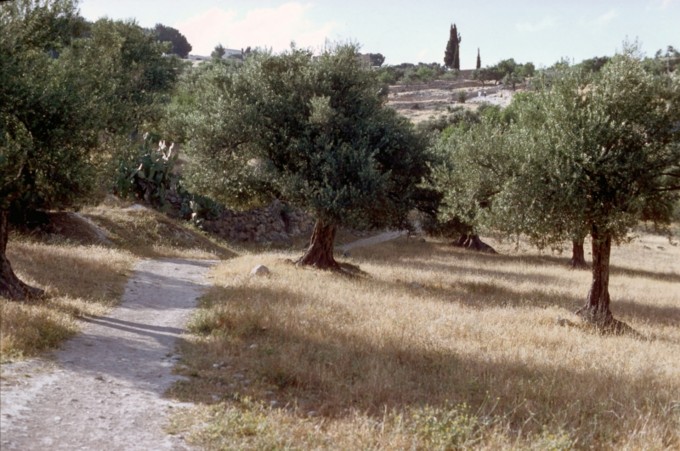
Grove of olive trees at Bethany

Grove of olive trees at Bethany

Chapter’s 29-31 make up Job’s last speeches. In this one, Job remembers how happy he was before all of these troubles began. He looks back longingly to those days, believing that God was with him then – and that such is no longer the case (verses 2-5). In verse 6, he remembers “when my steps were washed with butter, and the rock poured out for me streams of oil.” This is likely a reference to his great wealth, which included much cattle and olive groves.

Job fondly remembers that he had his own place at the city gate (always the gathering place for the important men of a city in those days). He was respected and deferred to by the young men as well as the old – and even the nobles and princes (verses 7-10). His thoughts and opinions were valued, and many sought his counsel. He then spends some time remembering how he helped the poor, the orphans, the lame, and those who were oppressed by the unrighteous.

As he speaks of all of these things, he does not do so in a manner that is boastful or vain. And he does not long for such times simply because he longs for the respect of his station in life. Job was happy in those time because of the good that he was able to do to others. We were made to serve to serve God, and to serve our fellow-man. Of the things that he has lost, being deprived of his health and his wealth, as well as being held in disdain and shunned by others has cost him something much more dear. Job has been deprived of his ability to serve, and he knows what many of us never learn. We are happiest when we serve others.

Read or listen to audio of ESV version of this selection from this link.

/Bob’s boy
___________________
some images © V. Gilbert & Arlisle F. Beers

Please note: I did not design the reading plan that I am following in my blog.  All of my comments in this blog, however, are solely my responsibility.  When reading ANY commentary, you should ALWAYS refer first to the scripture, which is God’s unchanging and unfailing word. Reading schedules, as well as a link to the site where you can get the reading plan that I’m currently following for yourself can be found on the “Bible Reading Schedules” page of my website at http://graceofourlord.com.  For questions and help, please see the “FAQ” and “Summaries” pages there.

Job 24 – Against the Light

There is a lot of confusion, debate, and disagreement about some of the text of chapter 24.  Much of the verbiage in verse 18 and following seems so counter to what Job has been arguing that some translations insert an “implied” beginning to verse 18 of the words “you say.”  This actually seems right to the flow of the text upon careful reflection.  In any event, the complaining point Job begins the chapter with is one of wonder at why God does not punish the wicked in judgment for their deeds now – for all the world to see.

wicked_003He then lists the more despicable acts that the wicked regularly commit with impunity, making the point that swift justice against them is certainly warranted.  Then in verses 18-20, Job states the viewpoint of the way things work against the wicked that his friends have expressed.  Yet he returns to a condemnation of the acts of the wicked in verse 21, followed by the somewhat startling observation that it appears that God actually prolongs their lives, gives them security, and even helps them to “rise up” at times when they are in despair of life.

It is the opinion of this blogger that the meat of Job’s viewpoint lies in verse 24, where he makes the case that the wicked are often exalted for a while in this life, but when they are gone, that is when they are “brought low and gathered up like all others;they are cut off like the heads of grain.”

Job is certain of his position and flatly challenges his friends to refute him in verse 25: “If it is not so, who will prove me a liar and show that there is nothing in what I say?”

Read or listen to audio of ESV version of this selection from this link.

/Bob’s boy
___________________
some images © V. Gilbert & Arlisle F. Beers

Please note: I did not design the reading plan that I am following in my blog.  All of my comments in this blog, however, are solely my responsibility.  When reading ANY commentary, you should ALWAYS refer first to the scripture, which is God’s unchanging and unfailing word. Reading schedules, as well as a link to the site where you can get the reading plan that I’m currently following for yourself can be found on the “Bible Reading Schedules” page of my website at http://graceofourlord.com.  For questions and help, please see the “FAQ” and “Summaries” pages there.

Job 23 – Where Is God?

gavelIn spite of the harshness of Eliphaz’s last speech, Job chooses to ignore it. Perhaps he had grown weary of the effort.  That seems to be the case with Bildad and Zophar, as they have become silent.  Instead, Job returns to voicing his wish to lay his case out to God – so sure was he that he is innocent of grievous sin.  Note that Job does not consider himself to be without sin at all.  He simply is convicted that he is innocent enough that his judge (God) would acquit him of whatever sins are imagined against him.

But though he remains steadfast in his belief that he has not departed from the words of the Lord, his fear of God is fierce, and the last few lines are the most poetic of the chapter:

Therefore I am terrified at his presence;
when I consider, I am in dread of him.
God has made my heart faint;
the Almighty has terrified me;
yet I am not silenced because of the darkness,
nor because thick darkness covers my face.

Read or listen to audio of ESV version of this selection from this link.

/Bob’s boy
___________________
some images © V. Gilbert & Arlisle F. Beers

Please note: I did not design the reading plan that I am following in my blog.  All of my comments in this blog, however, are solely my responsibility.  When reading ANY commentary, you should ALWAYS refer first to the scripture, which is God’s unchanging and unfailing word. Reading schedules, as well as a link to the site where you can get the reading plan that I’m currently following for yourself can be found on the “Bible Reading Schedules” page of my website at http://graceofourlord.com.  For questions and help, please see the “FAQ” and “Summaries” pages there.

Job 22 – Can a man be profitable to God?

Job_007Chapter 22 begins what is known as the third cycle of speeches in the Book of Job, and this chapter contains Eliphaz’s last attempt at breaking Job’s resolve to claim his innocence.  By now, Zophar has apparently dropped out of the argument, and Bildad will begin another short variance in position during this cycle.  But it is Eliphaz who, here in this chapter, launches the most vicious attack yet.  Interestingly enough, all three men by their attacks on Job, have sincerely believed that they were defending God by doing so.

But Eliphaz, unable to think of any way to “put Job in his place” by any other means, resorts to wildly false accusation using nothing more than an imagination fueled by jealousy and vindictiveness.  It is truly shameful and tasteless, but clearly this locomotive is mercifully expelling its last bit of steam, and all four will sit back and wonder at their own positions throughout the previous debates.  Job’s “friends” will have the most to consider in that respect.

Read or listen to audio of ESV version of this selection from this link.

/Bob’s boy
___________________
some images © V. Gilbert & Arlisle F. Beers

Please note: I did not design the reading plan that I am following in my blog.  All of my comments in this blog, however, are solely my responsibility.  When reading ANY commentary, you should ALWAYS refer first to the scripture, which is God’s unchanging and unfailing word. Reading schedules, as well as a link to the site where you can get the reading plan that I’m currently following for yourself can be found on the “Bible Reading Schedules” page of my website at http://graceofourlord.com.  For questions and help, please see the “FAQ” and “Summaries” pages there.