On Transfiguration, Revelation, and Crosses – Luke 9

The ninth chapter of Luke is not the longest chapter of this gospel, but there is a great deal going on in it as Luke picks up the pace in his account. After the feeding of the five thousand, we pick up in verse 18 with Jesus asking the disciples who people are saying that He is. Their answer is that they either say He is John the baptist, Elijah, or one of the other prophets (so in all cases, one raised from the dead). So the bulk of people that are referred to here are familiar enough with the signs and wonders that Jesus has done to know that He is definitely not some ordinary man. And in each case, they obviously believe that He was sent from God.

Jesus is transfigured on a mountain. Moses and Elijah join him, while Peter, James and John watch--Matthew 17 1-13; Mark 9 1-13; Luke 9 28-36.

Jesus is transfigured on a mountain. Moses and Elijah join him, while Peter, James and John watch–Matthew 17 1-13; Mark 9 1-13; Luke 9 28-36.

But now that Jesus has His disciples thinking about this, He wants to know what they have come to think about who He is. It is here that Luke records the fact that it was Peter who first spoke the correct answer – that He is the Christ (the long-awaited Messiah) and the Son of God. In verse 21, Jesus “strictly charged and commanded them” not to tell anyone else. But why is that? The Bible does not explicitly answer that question for us, but it is really not too difficult to figure out the answer from the other information we have in the Scripture.

Given the fact that the people, by and large, already believe that Jesus was sent from God, it would be very easy for most of them to believe that He is the Messiah, once that word started spreading. But what would the reaction be? Given also that Jesus knew that the sort of Messiah they were expecting was one that would lead them to the end of Roman dominance and lead Israel to its former place as a world power, belief in Him as the Messiah before His death could be problematic.

The crowds (5,000 men plus women and children most recently) had become vast in numbers. An expectation that Jesus was there to be their earthly king would result in chaos. It is in this light that Jesus tells them in verse 22 that He must “suffer many things and be rejected by the elders and chief priests and scribes, and be killed, and on the third day be raised.” Nothing could be allowed to hinder this – and it would happen on God’s timetable.
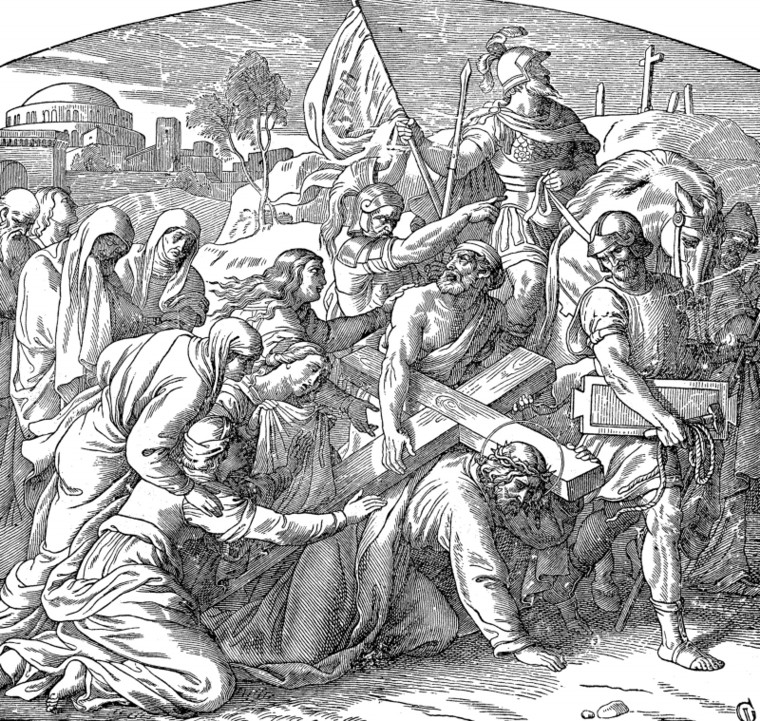
Simon of Cyrene is compelled to carry Jesus' cross

Simon of Cyrene is compelled to carry Jesus’ cross

In verse 23, Jesus talks to the disciples about what it will mean to follow Him. He speaks of it as “taking up” one’s cross and following Him. The context of the next few verses culminates with the statement that some of those present at that very moment would not “taste of death” before they see the kingdom of God. Being a disciple and following Him before such time would not have been an easy thing to do. But Jesus seems to be referring to the cost of following Him after He has risen, and the kingdom has been established.

Taking up one’s cross would mean bearing the burdens that discipleship that just might make life a great deal more difficult. Indeed, many of those first-century Christians would know persecution and suffering unimaginable to us. Jesus knew that many would even be killed for being a part of that kingdom. But those who would lose their lives would gain everlasting life with God. Those who would rather be safe and pursue worldly pleasure and gain, turning their backs on the kingdom, would suffer a worse fate in the end.  In a very real sense, taking up one’s cross often means doing what one would much rather not do.

Eight days later, Jesus took Peter, James, and John with Him to “the mountain” to pray. Which mountain it was, we do not know. One traditional belief is that it was Mount Hermon because of its height. It is estimated that this mountain is about 45 kilometers from Capernaum, so it is definitely possible. Others believe that it was Mount Tabor. But the mountain is not the focus of the gospel in verses 28-36.
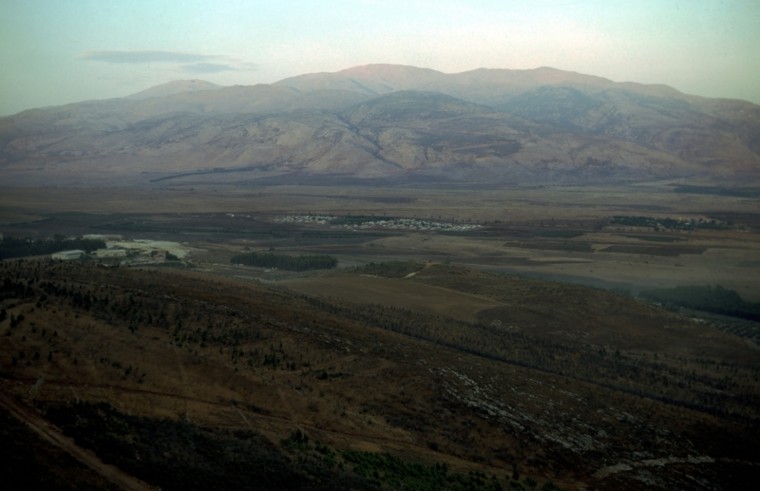
Mount Hermon is one traditional site for Jesus' transfiguration

Mount Hermon is one traditional site for Jesus’ transfiguration

As Jesus was praying, “the appearance of his face was altered, and his clothing became dazzling white.” We are not given much detail about just what was happening or in what way His face was altered. But clearly, the Holy Spirit brought about some changes to Him that were important to God’s plan. Peter and the others woke from a deep sleep to see two men talking with Him (Moses and Elijah). Luke says that they appeared in “glory” and they saw Jesus’ glory as He spoke with them. This is a term that was used in the Old Testament to describe the dramatic visual effect of the presence of God; and that is exactly what was going on here as well.

Peter, either having it revealed to him or learning from what he heard, knew who the two men were. But he did not understand what was happening, as he suggested they make some extra tents for them.  They became afraid as a cloud came and surrounded them. Then the voice of God sounded out as He told them “This is my Son, my Chosen One; listen to him!” Peter, James, and John probably would not fully understand until after Pentecost, but the point for them (and for us) was made when Moses and Elijah left, and Jesus alone was standing there. God was telling them that it was the words of His Son that they would listen to from now on – not Moses, and not the prophets.

Another point to ponder from the record of the transfiguration is the fact that Moses had died hundreds of years ago (Deuteronomy 34:5). Elijah had been taken up by God many “lifetimes” ago (2 Kings 2:1-12).  What does this tell us about life after death and everlasting life? It certainly tells us that we can count on God’s word, as always. But what conclusions should we draw from Moses’ presence? Something to ponder for perhaps another time.

(This year’s reading plan for Luke, Acts, and 1 and 2 Chronicles averages just 15 verses per day – 5 days per week!)
Schedule for this week
Read or listen to audio of today’s selection from Luke here
Read or listen to audio of today’s selection from 1 Chronicles here

/Bob’s boy
___________________
some images © V. Gilbert & Arlisle F. Beers

Please note: I did not design the reading plan that I am following in my blog.  All of my comments in this blog, however, are solely my responsibility.  When reading ANY commentary, you should ALWAYS refer first to the scripture, which is God’s unchanging and unfailing word. Reading schedules, as well as a link to the site where you can get the reading plan that I’m currently following for yourself can be found on the “Bible Reading Schedules” page of my website at http://graceofourlord.com.  

Enhanced by Zemanta

The Unfolding of a Miracle – (Luke 9)

Luke, ever the accurate historian as has been proved time and gain, correctly refers to Herod Antipas as Herod the tetrarch in verse 7 of chapter 9. By this time, Herod has already had John the baptist beheaded, yet these stories of Jesus keep coming to him; and some people were saying that He was John – raised from the dead. Others said He was Elijah, and still others said that He was another one of the prophets. Verse 9 has Herod reassuring himself, but he resolved to meet Jesus face to face. One cannot help but wonder if guilt on Herod’s part has also placed some fear in his heart.

Luke’s account of the feeding of the Five Thousand

Meanwhile, Jesus’ apostles returned from the mission He had sent them on, and reported to Him all that had happened while they were gone. Jesus took them and went to Bethsaida, a town just east of where the Jordan River flowed into the Sea of Galilee. As usual, word spread quickly among the crowds, and they followed them. Jesus preached to them about the kingdom of God and healed those who needed healing among them.

The miraculous feeding of the 5,000 occurred on the shores of the Sea of Galilee near Bethsaida.

The miraculous feeding of the 5,000 occurred on the shores of the Sea of Galilee near Bethsaida.

As the end of the day was coming close, the apostles became concerned for the people, coming to Jesus to dismiss them, so they could find food and a place to stay. But Jesus told the apostles to feed them. Having only a couple of fish and five loaves of bread, they protested the impossibility of feeding five thousand men and all of the women and children as well. Having them sat in groups of about fifty each, he blessed the food, looking toward heaven.  Everyone ate until they were satisfied, and twelve baskets full of broken pieces were taken up afterward.

We are not told why Jesus had them separated into groups of “about fifty,” and speculation about that is futile, since the whole thing was miraculous anyway.  But one might wonder what the apostles saw, as they made sure that the food was passed around throughout what would have to be well over 100 of these groups of people. We cannot know how it all unfolded, but let’s try for a minute to just imagine what it could have been like.

When Jesus broke the loaves, He must have given portions to each of the twelve apostles. One can only imagine their sense of foreboding as they handed their portion off to the first group – no doubt expecting it to run out long before reaching the last of the fifty people in their first group. When that did not happen, and as each of the twelve transferred the food from one group to another, did they see the amount of food undiminished in quantity or was it gradually growing? It seems likely that the latter would be the case.

Imagine that sense of dread they felt initially turning first to surprise, and then to amazement. It is easy to imagine then that the excitement would build into a giddy and festive atmosphere that would be contagious to these crowds!

(This year’s reading plan for Luke, Acts, and 1 and 2 Chronicles averages just 15 verses per day – 5 days per week!)
Schedule for this week
Read or listen to audio of today’s selection from Luke here
Read or listen to audio of today’s selection from 1 Chronicles here

/Bob’s boy
___________________
some images © V. Gilbert & Arlisle F. Beers

Please note: I did not design the reading plan that I am following in my blog.  All of my comments in this blog, however, are solely my responsibility.  When reading ANY commentary, you should ALWAYS refer first to the scripture, which is God’s unchanging and unfailing word. Reading schedules, as well as a link to the site where you can get the reading plan that I’m currently following for yourself can be found on the “Bible Reading Schedules” page of my website at http://graceofourlord.com.  

Enhanced by Zemanta

Shake Off the Dust – (Luke 9)

The opening verses of Luke chapter 9 are about one of the times that Jesus sent His apostles out “to proclaim the kingdom of God and to heal.” In it, Luke tells us that He had given them the power and authority over all demons, and to cure diseases. Jesus gave them instructions about choosing who to stay with, and to “shake the dust from their feet” when they and their message are not well received. This is akin to what Jesus said about not casting “your pearls before swine” in Matthew 7:6. Wasting one’s time continuing to try to convince someone who refuses to hear the truth means time lost that could be used to help someone who will listen. Verse 6 tells us that “they departed and went through the villages, preaching the gospel and healing everywhere.” These facts are the only important points of these few verses.

Jesus' discples were honored to listen to Him teach daily. Jesus had special teaching for The Twelve, His twelve disciples or apostles

Jesus’ discples were honored to listen to Him teach daily. Jesus had special teaching for The Twelve, His twelve disciples or apostles

Nevertheless, we feel the need to address something of less importance here. This account is contained in all three synoptic gospels (see Matthew 10:5-15 and Mark 6:7-13), but there is some difference in the Greek, and in the way that the three writers use those different verbs that is very puzzling, when one compares them (Mark actually appears to tell them to take a staff, while the others say that Jesus said not to). This, of course, makes them very ripe for skeptics who devote their time to trying to prove that there are contradictions in God’s word. There is no contradiction, of course. But this is perhaps the most difficult example to understand, and requires no small amount of critical analysis in order to do so.

Before beginning this analysis, it is important to understand that all three gospel writers are trying to convey a couple of important facts that are related to the confusing language. The first is that the apostles’ mission in this instance is urgent, and time is of the essence. Jesus has plans to send out “the seventy-two” to do the same thing in Luke 10 after the apostles get back (notice that the 72 are told not to carry any sandals, etc.). This training is important, and He has much more training for His apostles, many more miracles to perform, and a great deal of other teaching to do before “His time” is up. Secondly, part of the training Jesus is giving them is to teach them to depend on (and trust) God for their needs.

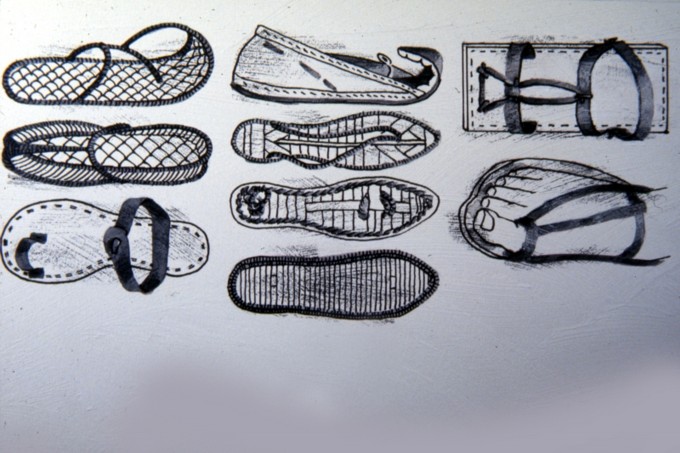
Bible-time shoes were often sandals, such as these.

Bible-time shoes were often sandals, such as these.

So in light of all of this, what the three gospel writers are conveying is that Jesus wants them to go now, and as they are, and do not take extra provisions. Matthew uses the Greek word “ktaomai,” meaning they are not to acquire or procure the things mentioned there. Mark uses the word “airo,” meaning “to take” – instructing them to take the things He tells them to, but not others, and to wear sandals, but to not put on two tunics.

But Luke, in telling them not to take the things mentioned here, does not use the word “ktaomai” because when he uses that word, he uses it in the sense of meaning “to buy or earn” (as in  Luke 18:12, Acts 1:18, and Acts 8:20). Instead, he uses the word “airo,” but he uses it in the sense of the meaning “to acquire” – meaning do not acquire these things (as in Luke 19:21-22). He certainly would not be telling them that they must take their sandals off and leave them behind!

(For a more detailed analysis, please see this article at ApologeticsPress.org).

(This year’s reading plan for Luke, Acts, and 1 and 2 Chronicles averages just 15 verses per day – 5 days per week!)
Schedule for this week
Read or listen to audio of today’s selection from Luke here
Read or listen to audio of today’s selection from 1 Chronicles here

/Bob’s boy
___________________
some images © V. Gilbert & Arlisle F. Beers

Please note: I did not design the reading plan that I am following in my blog.  All of my comments in this blog, however, are solely my responsibility.  When reading ANY commentary, you should ALWAYS refer first to the scripture, which is God’s unchanging and unfailing word. Reading schedules, as well as a link to the site where you can get the reading plan that I’m currently following for yourself can be found on the “Bible Reading Schedules” page of my website at http://graceofourlord.com.  

Enhanced by Zemanta

A Truly United Kingdom – (1 Chronicles 16)

The Sacrifice of the Old Covenant

The Sacrifice of the Old Covenant (Photo credit: Wikipedia)

Now that the Levites had successfully transported the Ark to Jerusalem, David begins celebrating in the most proper manner – with tribute to God. God’s people were in the middle of the greatest times that the united kingdom would know. And for the most part, it would last through Solomon’s reign. Second only to the dedication of the Temple by Solomon, this would be the greatest celebration of that time.

David had the ark of the covenant brought in to the tent that he had erected for it. They then had burnt offerings and peace offerings. The peace offering is sometimes called a fellowship, or more properly, a thanksgiving offering, and is introduced in Leviticus 3:1-17 and Leviticus 7:11-34. Afterwards, the celebration continued with every man and woman of the vast number of Israelites present being given “loaf of bread, a portion of meat, and a cake of raisins.”

English: Statue of King David by Nicolas Cordi...

English: Statue of King David by Nicolas Cordier in the Borghese Chapel of the Basilica di Santa Maria Maggiore. Français : Statue du roi David par Nicolas Cordier, dans la chapelle Borghèse de la basilique Sainte-Marie Majeure. Italiano: Statua del re Davide di Nicolas Cordier, nella Capella Borghese della Basilica di Santa Maria Maggiore in Roma. (Photo credit: Wikipedia)

David then appointed certain Levites to “minister before the ark” invoking thanks, praising the Lord, and playing harps, lyres, cymbals, and blowing trumpets. Chief among this group of Levites was Asaph who authored Psalms 50 and 73-83. Also among them was Benaiah, one of the most powerful of David’s “mighty men,” whose exploits (some of which are described in 2 Samuel 23:20-22) included the single-handed defeat of Moab’s two mightiest warriors. Verse 7 tells us that it was the first time that David appointed Asaph and his brothers to sing thanksgiving to the Lord.

Verses 8-36 contain David’s song of thanksgiving. It is a long and wonderful song of praise to the Lord; and parts of it are contained in Psalm 105:1–15, Psalm 96:1–13, and Psalm 106:1, 47–48. Verses 37-42 describe how David made ministering to the ark a long-term responsibility for Asaph and his brothers. He also left Obed-edom (and his 68 brothers!), along with Zadok the priest and his brothers to offer burnt offerings and perform other duties.

Finally, the ark was to get the care that it had once had when Moses was around; and the Levites would do what they were intended to do before the Lord in such a grand scale as Israel had not seen since long before Israel had its first king.

(This year’s reading plan for Luke, Acts, and 1 and 2 Chronicles averages just 15 verses per day – 5 days per week!)
Schedule for this week
Read or listen to audio of today’s selection from Luke here
Read or listen to audio of today’s selection from 1 Chronicles here

/Bob’s boy
___________________
some images © V. Gilbert & Arlisle F. Beers

Please note: I did not design the reading plan that I am following in my blog.  All of my comments in this blog, however, are solely my responsibility.  When reading ANY commentary, you should ALWAYS refer first to the scripture, which is God’s unchanging and unfailing word. Reading schedules, as well as a link to the site where you can get the reading plan that I’m currently following for yourself can be found on the “Bible Reading Schedules” page of my website at http://graceofourlord.com.  
Enhanced by Zemanta

Falling Asleep – (Luke 8)

Jesus returned from the country of the Gerasenes, and received a warm welcome from the crowd – very different from the send-off he just got. Then a man named Jairus came to Jesus. The  text says that he was a ruler of the synagogue, which probably means that he was in charge of keeping it maintained and arranging services. At any rate, falling at Jesus’ feet, as he did in verse 41, was way out of character for a man in his position. But his 12 year old daughter was dying. And of course, a father would do anything to save his child. And she was his only child.


Raising of the Daughter of Jairus

Raising of the Daughter of Jairus (Photo credit: Wikipedia)


As Jesus set out for his house, the crowds were thick and “pressed around Him.” There was a woman among them who had a “discharge of blood.” We do not know much about it, except that she had been afflicted with this for 12 years, and had spent all of her money on physicians to try and cure it. But according to Mark 5:22-34, it had become worse instead of better. She had it in her mind that if he could just touch Jesus’ garment, she would be healed. And so she pressed in through the throng, and did so. Jesus called out to find out who had touched Him, but He obviously knew very well who had done so. He wanted her to hear what He had to say; and He wanted the others to hear it as well. He told her that her faith had made her well.


Jesus and Jairus were met on the way by people from Jairus’ house, who told him that his daughter was already dead. But Jesus told him to just believe. Mark tells us that Peter, James, and John accompanied him inside when he arrived. Jesus told the weeping relatives that the girl was not dead, but only sleeping. But it was obvious to all present that she had in fact died.


Commentators have offered many explanations for why Jesus said that, when He had to have known that she had really died. But the answer is not nearly so complicated as many of them try to make it. There was no deception being attempted. There simply was no finality in her condition. To His way of thinking, the little girl was in fact only sleeping. Paul used this way of thinking to make the point about those who had died when he wrote his letter to the brethren at Thessolonica in 1 Thessalonians 4:13-15. In it, he speaks of them as those who had “fallen asleep.” Paul knew exactly what he was saying, just as Jesus did.


It seems clear that one of the messages of this account (which occurs in all three synoptic gospels) is about the hope that is ours because the Lord not only has power over disease and demons, but even over death – over which His victory will become complete and very personal before the end of Luke’s gospel.


(This year’s reading plan for Luke, Acts, and 1 and 2 Chronicles averages just 15 verses per day – 5 days per week!)
Schedule for this week
Read or listen to audio of today’s selection from Luke here
Read or listen to audio of today’s selection from 1 Chronicles here


/Bob’s boy


___________________


some images © V. Gilbert & Arlisle F. Beers


Please note: I did not design the reading plan that I am following in my blog.  All of my comments in this blog, however, are solely my responsibility.  When reading ANY commentary, you should ALWAYS refer first to the scripture, which is God’s unchanging and unfailing word. Reading schedules, as well as a link to the site where you can get the reading plan that I’m currently following for yourself can be found on the “Bible Reading Schedules” page of my website at http://graceofourlord.com.  


Enhanced by Zemanta

Who Then Is This? – (Luke 8)

In verse 22, Jesus has boarded a boat to go to “the other side of the lake.” That lake, of course, was the Sea of Galilee. Here Luke tells us that Jesus had fallen asleep, significant to us as a reminder that He was indeed a man. And as a man, He experienced fatigue, just as we do, and He did not hesitate to rest when He needed it – just as we must take time to do, when we can.

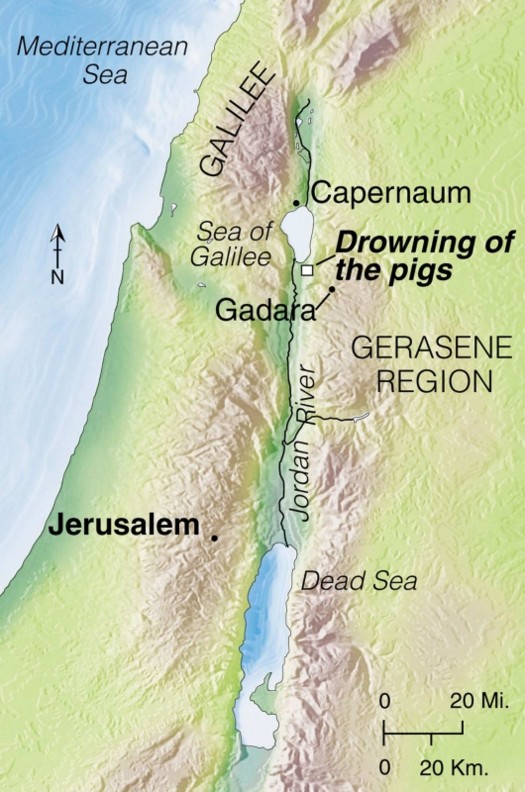
From Capernaum, Jesus and his disciples crossed the Sea of Galilee. A storm blew up unexpectedly, but Jesus calmed it. Landing in the region of the Gerasenes, Jesus sent demons out of a man and into a herd of pigs that plunged over a steep bank into the lake.

From Capernaum, Jesus and his disciples crossed the Sea of Galilee. A storm blew up unexpectedly, but Jesus calmed it. Landing in the region of the Gerasenes, Jesus sent demons out of a man and into a herd of pigs that plunged over a steep bank into the lake.

While He was sleeping, a storm came that was severe enough to begin to fill the vessel with water. Verse 23 confirms the severity, saying that they were indeed in danger. But Jesus remained asleep through it all, demonstrating that He must truly have been exhausted. When they woke him, they were frantic, letting Him know that they were about to die (verse 24). With His verbal command, the winds and the waves calmed, and He asked them where their faith was. The statement “who then is this, that he commands even winds and water, and they obey him?” betrays the fact that they really did not know for sure just who Jesus was yet.

From there, verse 26 says that they sailed to the country of the “Gerasenes” (some manuscripts have it as “Gadarenes”). This is the region around what was known as Gadara, which today is known as Umm Qais, just to the southeast of the Sea of Galilee. Here, Jesus met up with Legion (so-called because he had been possessed by many demons). He wore no clothes, and lived among the tombs. Verse 28 states that at various times, he had been bound and shackled, and placed under guard. But he would escape, and the demons would “drive him into the desert.”

Jesus commanded the demons out, and he cried out and fell down before him and said with a loud voice, “What have you to do with me, Jesus, Son of the Most High God? I beg you, do not torment me.” The demons begged him not cast them “into the abyss,” but to let them enter a herd of pigs that was on the hill. He gave them permission, and after they did, the herd rushed into the lake and drowned.

Christ at Gadara.

Christ at Gadara.

We have commented about such events as these in this age before in this previous post. These accounts are sometimes the source of embarrassment for the believer, and one of scoffing and derision for the unbeliever. But for whatever reason (some we covered in said article) God allowed these things to occur in the age just prior to Jesus’ birth, and into the apostolic age. We will cover this again at a later date. Suffice to say, there is much we do not know about the world of demons. But make no mistake, these were very real events.

The grateful man wanted to come with Jesus, but Jesus sent him away to “declare how much God has done for you,” which he did. The people of the region, however, were not so grateful, but full of fear because of Jesus; and they asked Him to leave. Jesus did depart in a boat, which serves as a lesson to us that if we do not want Him in our lives, He will, (and I am sure, does) accommodate us in that respect.

(This year’s reading plan for Luke, Acts, and 1 and 2 Chronicles averages just 15 verses per day – 5 days per week!)
Schedule for this week
Read or listen to audio of today’s selection from Luke here
Read or listen to audio of today’s selection from 1 Chronicles here

/Bob’s boy
___________________
some images © V. Gilbert & Arlisle F. Beers

Please note: I did not design the reading plan that I am following in my blog.  All of my comments in this blog, however, are solely my responsibility.  When reading ANY commentary, you should ALWAYS refer first to the scripture, which is God’s unchanging and unfailing word. Reading schedules, as well as a link to the site where you can get the reading plan that I’m currently following for yourself can be found on the “Bible Reading Schedules” page of my website at http://graceofourlord.com.  

Enhanced by Zemanta

They May Not Understand – (Luke 8)

The Parable of the Sower is recounted in all three synoptic gospels. We commented on Matthew 13’s account in this previous post. The other one is contained in Mark 4:1-20. A full reading of all three accounts gives us the best understanding. As is always the case with God’s word, anytime something is repeated, it is a sure sign of its great importance. Three detailed accounts of this parable underscores that point with resounding clarity.

Landscape with the Parable of the Sower

Landscape with the Parable of the Sower (Photo credit: Wikipedia)

But why is the parable of the sower so important? There are several reasons, and each reading seems to help understand more of them. This parable, as explained by Jesus in verses 9-15, explains “the why” of all of Jesus’ parables, along with Isaiah 6:9-10 (“seeing they may not see, and hearing they may not understand”). This prophetic passage spoke of those who would be eyewitnesses to Jesus, His miracles, and the truth about who He was – yet those who did not want the truth would not receive it.

But it is much more than that. The Parable of the Sower is the key to understanding much about all sorts of people, from total non-believers to dedicated Christians, and several levels in between. And it serves as a warning for us to not allow the pleasures of the world to consume us. It points to the very real possibility that we can encounter trials in this life that will test our faith, and not one of us is immune to falling away under such circumstances.

So how do we become the “good soil?” We do that in the same way that we cultivate a luxurious garden by preparing the soil. We must work the ground, constantly removing every rock that we can – and we do that one at a time, by leaning on the Lord and prayerfully asking for His help in doing so. “Pray without ceasing” is one of the secrets to becoming “good soil.” Another comes by feeding “the soil” the nutrients that are so vital to growth – and doing so regularly. And that comes through a steady diet of God’s word.

Verses 16-18 may seem somewhat difficult to understand, but it helps to read also Mark 4:21-25 and Matthew 10:26-27. Disciples of Jesus are not to hear and learn the truth and just go about their business as if that were enough. What we hear, we are to proclaim on the housetops, and we are to never stop learning and sharing the knowledge that we gain. Doing so, that knowledge will will increase in proportion to our efforts. But without those efforts, we will “lose” what we have gained.

(This year’s reading plan for Luke, Acts, and 1 and 2 Chronicles averages just 15 verses per day – 5 days per week!)
Schedule for this week
Read or listen to audio of today’s selection from Luke here
Read or listen to audio of today’s selection from 1 Chronicles here

/Bob’s boy
___________________
some images © V. Gilbert & Arlisle F. Beers

Please note: I did not design the reading plan that I am following in my blog.  All of my comments in this blog, however, are solely my responsibility.  When reading ANY commentary, you should ALWAYS refer first to the scripture, which is God’s unchanging and unfailing word. Reading schedules, as well as a link to the site where you can get the reading plan that I’m currently following for yourself can be found on the “Bible Reading Schedules” page of my website at http://graceofourlord.com.  

Enhanced by Zemanta

Women of Means – Luke 8

Verses 1-3 of Luke chapter 8 can tell us much about the ministry of our Lord Jesus, but the tendency is to rush right past them and into the rest of the chapter, as there is much going on here. But let’s focus for a moment on the women that traveled with Jesus as He went preaching through these villages. Only three are mentioned by name, but Luke says there were many others.

Susanna is one that is not mentioned again in the New Testament, so we only know what Luke tells us here – which is that she was either healed by Jesus of some infirmity or of demons. The same goes for Joanna, except that it is highly probable that she is the same Joanna that in Luke 24:1-11 was one of the women that discovered Jesus’ empty tomb and went to tell the apostles. Joanna was the wife of the manager of the household of Herod Antipas.

Magdala, near modern Migdal, was situated here along the Sea of Galilee. Magdala was the home of Mary Magdalene.

Magdala, near modern Migdal, was situated here along the Sea of Galilee. Magdala was the home of Mary Magdalene.

The other woman who is mentioned is “Mary, called Magdalene.” Of all the women in the New Testament, she has been given the most unfair extra-biblical treatment – even disregarding the book and subsequent movie, the Da Vinci Code (and we will), which has been more than adequately dealt with in other articles that we can point you to, if interested.

First, there is the false belief that Mary Magdalene was a prostitute, which we covered in this previous post about Jesus’ dinner with Simon the Pharisee. Then there is further confusion, as she is sometimes portrayed as the adulterous woman of John 8:3-11 that the scribes and Pharisees wanted to stone. Remember Jesus said “let him who is without sin cast the first stone?” Nope, that wasn’t Mary Magdalene either. In fact, there is not even a single mention of Mary of Magdala in the Bible in the context of sin! Here, we learn that she had seven demons that Jesus cast out – but no mention of sin.

Furthermore, the women that are mentioned along with her in these three verses all “provided for them out of their means” (“them” meaning Jesus and His ministry). So not only was Mary Magdalene not a prostitute, but she was evidently a woman of some means financially, who now devoted her life to the Lord. How did the truth become so twisted in so many ways about this woman? There have been several answers offered, but they all come down to the age-old problem. We often (even innocently) accept the words of men rather than searching God’s word for the truth.

(This year’s reading plan for Luke, Acts, and 1 and 2 Chronicles averages just 15 verses per day – 5 days per week!)
Schedule for this week
Read or listen to audio of today’s selection from Luke here
Read or listen to audio of today’s selection from 1 Chronicles here

/Bob’s boy
___________________
some images © V. Gilbert & Arlisle F. Beers

Please note: I did not design the reading plan that I am following in my blog.  All of my comments in this blog, however, are solely my responsibility.  When reading ANY commentary, you should ALWAYS refer first to the scripture, which is God’s unchanging and unfailing word. Reading schedules, as well as a link to the site where you can get the reading plan that I’m currently following for yourself can be found on the “Bible Reading Schedules” page of my website at http://graceofourlord.com.  
Enhanced by Zemanta

It’s the Camel Fallacy (Again!)

If one has studied apologetics for a considerable length of time, the recent news stories about the camel bones proving the Bible wrong might very well lead one to react by saying “again? seriously?” The whole thing has been answered quite thoroughly many times already. And not so surprising is the glaring fact that only when disputing the Bible would a conclusion based upon a logical fallacy be so widely reported in the media.

Camel_220214In case you haven’t seen any of the stories, here is a brief summary. The Bible first begins to mention camels as domesticated (in the sense of someone possessing them, rather than simply being in the wild) in Genesis 12:16. Abram and Sarai have come to Egypt, and it is Pharoah that has them, among his other livestock. But we find Abraham himself, Isaac, and Jacob all in possession of the humped animal as well; and the time period is generally accepted as being from 2000 – 1500 BCE.

The source of the dispute is the fact that researchers from Tel Aviv University have studied the bones of camels found at the site of ancient copper mines near the Dead Sea. Through radiocarbon dating, they have determined that the camels were used in those operations around the end of the 10th century BCE. In fairness to these learned researchers, it should be pointed out that (despite what the news stories say) these researchers only wrote one thing in their report that is related to the “patriarchal narrative” (that would be the word of God, folks):

“This together with the depiction of camels in the Patriarchal narrative, has generated extensive discussion regarding the date of the earliest domestic camel in the southern Levant.”

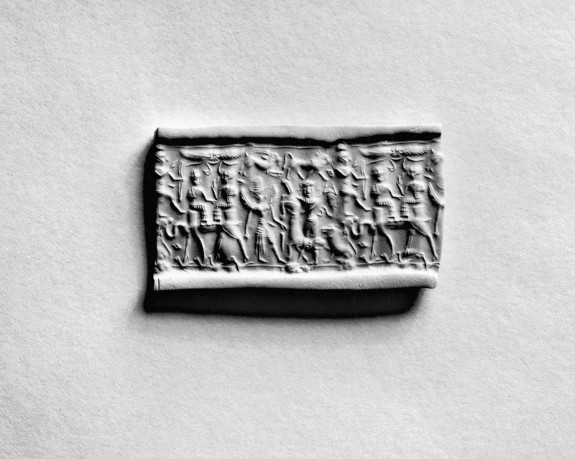
This seal shows a divine couple sitting on the two humps of a Bactrian camel, one of the earliest images of this animal. Above them hovers a winged rosette, which is a protective emblem. A smaller figure holding a bow stands on the head and neck of the camel. A winged female deity, stands off to the side, facing a contest between a man and a beast. The surrounding space is filled with a variety of animals, including a lion, scorpion, bull, and gazelle. 1800-1650 BC (Syria II-III)

This seal shows a divine couple sitting on the two humps of a Bactrian camel, one of the earliest images of this animal. Above them hovers a winged rosette, which is a protective emblem. A smaller figure holding a bow stands on the head and neck of the camel. A winged female deity, stands off to the side, facing a contest between a man and a beast. The surrounding space is filled with a variety of animals, including a lion, scorpion, bull, and gazelle. 1800-1650 BC (Syria II-III)

That’s it. All of the other titles in articles (some we list below) contain things that these researchers did not say. Okay, so now that we have covered that, what is the big deal? Well, since no bones of camels have been found in Israel at sites known to be older than that date, that has led others to the conclusion that there were no domesticated camels in Israel prior to the 10th century BCE. This would mean that the writers of the Old Testament books had to have just inserted camels into the narrative mistakenly because they didn’t exist there at the time they were writing about.

The headlines of the fore-mentioned news stories range from simply misleading and erroneous to downright irresponsible, outlandish, and even insulting. The Huffington Post’s headline reads “Major Discrepancy in the Bible.” The New York Times article proclaims “Camels Had No Business in Genesis,” and writes: “These anachronisms are telling evidence that the Bible was written or edited long after the events it narrates and is not always reliable as verifiable history.” The “Fashion Times” article headlines the “trending news” “Historical ERROR in Bible’s Old Testament, REVEALED.” We’re still mystified as to what camels and the Bible (error or no error) could possibly have to do with the world of fashion, but we digress.

The logical fallacy here is one known by several names:  “argumentum ad ignorantiam,” “appeal to ignorance” or “absence of eveidence.” One common comment about this is that “absence of evidence is not evidence of absence.” This is certtainly true. But in Todd Bolen’s article at BiblePlaces.com (“The Domestication of the Camel: Observations from Heide”), he quotes the following – more aptly put:

A camel in the Haran area, Turkey, known as Charran in ancient Mesopotamia.

A camel in the Haran area, Turkey, known as Charran in ancient Mesopotamia.

“Proving that something did not exist at some time and place in the past is every archaeologist’s nightmare because proof of its existence may, despite all claims to the contrary, be unearthed at some future date.” (p. 337, Heide, Martin, 2011 “The Domestication of the Camel: Biological, Archaeological and Inscriptional Evidence from Mesopotamia, Egypt, Israel and Arabia, and Literary Evidence from the Hebrew Bible”).

We recently underscored that point when we wrote in this previous post about the fact that skeptics claimed for a very long time that the Hittites were a figment of the Bible writers’ imaginations because no evidence had ever been found of their existence. That is, not until such evidence was found. Then it was discovered that they were a vast empire that dated back to the 14th century BCE.

We could easily be persuaded to believe that the camel was not widely used for domestic purposes by the common people until after the 10th century BCE in Israel, which would be one possible explanation of why a plethora of camel bones from earlier periods has not been found. We should remember that Pharaoh and yes, even Abraham, Isaac, and Jacob had been men of considerable wealth (Genesis 13:2, Genesis 26:12-13, Genesis 30:42-43). Many have suggested that Abraham brought his camels from Egypt, and that is certainly possible. But we should also remember that he had been in Mesopotamia – Haran (Genesis 12:4), and Mesopotamia’s ancient domestication of camels is just as well-documented.

So these wild leaps of unwarranted conclusions give skeptics and scoffers fodder to fan the flames of their frivolous fancies. And we find the unbelievers saying “well of course,  the Bible is not an accurate historical record” (a statement already proven time and again to be so absurd that it hardly deserves comment). And many of those who know that the Bible is the word of God – just wait for the truth. And if perchance convincing physical evidence is found in our lifetimes that categorically dates camel bones in Israel much earlier, you can be sure that the news will be relegated to a small blurb in a very inconspicuous place in most publications.

As for us, we know that Proverbs 30:5 is right: “Every word of God proves true.”

If you want to read the truth about what we know outside of the Bible concerning this subject, we suggest the following articles as examples:

“Abraham’s Camels” – ApologeticsPress.org
“The Annual Camels-Disprove-the-Bible Story” – Todd Bolen, BiblePlaces.com
“The Latest Challenge to the Bible’s Accuracy: Abraham’s Anachronistic Camels?”- ChristianityToday.com
“Bronze Age Camel Petroglyphs In The Wadi Nasib, Sinai” – BibleArcheology.org
“The Domestication of the Camel: Biological, Archaeological and Inscriptional Evidence from Mesopotamia, Egypt, Israel and Arabia, and Literary Evidence from the Hebrew Bible” – Martin Heide

(This year’s reading plan for Luke, Acts, and 1 and 2 Chronicles averages just 15 verses per day – 5 days per week!)
Schedule for this week

/Bob’s boy
___________________
some images © V. Gilbert & Arlisle F. Beers

Please note: I did not design the reading plan that I am following in my blog.  All of my comments in this blog, however, are solely my responsibility.  When reading ANY commentary, you should ALWAYS refer first to the scripture, which is God’s unchanging and unfailing word. Reading schedules, as well as a link to the site where you can get the reading plan that I’m currently following for yourself can be found on the “Bible Reading Schedules” page of my website at http://graceofourlord.com.  

Ark Movement 101 – 1 Chronicles 15

After the fiasco in chapter 13 of 1 Chronicles when the transportation of the ark was so badly mishandled that Uzzah was killed, it remained at the home of Obed-edom while David figured out what to do. And figure it out, he did. The material of chapter 15 focuses much less on David himself than was the case when this event was described in 2 Samuel 6:12-23. It is clear that David sought guidance from the Levites, and the instructions contained in Mosaic Law concerning proper handling of the ark were followed in exacting detail.

English: Jerusalem Model, The city of David, t...

English: Jerusalem Model, The city of David, the Pool of Siloam and the southern wall of Mount Moriah Deutsch: Jerusalem Modell, Davidstadt, im Vordergrund der Teich von Siloah und die Südmauer des Tempelberges Français : Maquette de Jérusalem, la Ville de David. Au premier plan, la piscine de Siloé et la muraille sud du Mont du Temple (Photo credit: Wikipedia)

David summoned “all of Israel” to participate in this event, which we can suppose to mean that he brought many from each tribe. And the Levites were at center stage because this could only be executed by them. Descendants of each of Levi’s sons (Kohath, Gershon, and Merari – verses 4-10) brought many with them, led by their chiefs; and the priests, Zadok and Abiathar were charged with consecrating themselves and their brethren for the task. This time, the Levites carried the ark with the poles, as set forth in Mosaic Law (Numbers 4:6-9; Numbers 4:15).

Singers and those who would play musical instruments (including Asaph, author of several Psalms – verse 19) were appointed and given detailed tasks. David wore an ephod over fine linen for the occasion, and he, his commanders and the Levites set out with the ark in grand procession and jubilant song, as they brought the ark to Jerusalem and the temporary tent that would hold it there.

But David’s wife, Michal (referred to in verse 29 simply as the daughter of Saul) watched through the window as David danced and celebrated the event and “despised him in her heart.” Her contempt for him here would define their estrangement from that point forward.

(This year’s reading plan for Luke, Acts, and 1 and 2 Chronicles averages just 15 verses per day – 5 days per week!)
Schedule for this week
Read or listen to audio of today’s selection from Luke here
Read or listen to audio of today’s selection from 1 Chronicles here

/Bob’s boy
___________________
some images © V. Gilbert & Arlisle F. Beers

Please note: I did not design the reading plan that I am following in my blog.  All of my comments in this blog, however, are solely my responsibility.  When reading ANY commentary, you should ALWAYS refer first to the scripture, which is God’s unchanging and unfailing word. Reading schedules, as well as a link to the site where you can get the reading plan that I’m currently following for yourself can be found on the “Bible Reading Schedules” page of my website at http://graceofourlord.com.  

Enhanced by Zemanta