Psalm 19 – The Perfect Law of the Lord

Jupiter

Jupiter

This is truly one of the greatest psalms and a magnificent prayer.  It brims with the majesty of God’s creation, His love, and His power.   It opens with the assurance that the very heavens declare the glory of God, and the sky above, his handiwork.  The poetry of verses 4-6 brings the sun to the forefront of His creation, pointing the way to all things, as none remain hidden when it rises it the heavens.

Just as His creation of our universe is evident in all we see around us, the truth and beauty of His rules, His commandments come to be understood as the perfection of divine law when we understand that living in His light and be His precepts makes our lives better.  The foolish of heart will never see this, and they are to be pitied, for His way is truly sweeter than honey and more precious than gold.

The prayer of this chapter ends with great awe and perfect reverence, and is a great model for prayer for us today:

Let the words of my mouth and the meditation of my heart
be acceptable in your sight,
O Lord, my rock and my redeemer

Read or listen to audio of ESV version of this selection from this link.

/Bob’s boy
___________________
some images © V. Gilbert & Arlisle F. Beers

Please note: I did not design the reading plan that I am following in my blog.  All of my comments in this blog, however, are solely my responsibility.  When reading ANY commentary, you should ALWAYS refer first to the scripture, which is God’s unchanging and unfailing word. Reading schedules, as well as a link to the site where you can get the reading plan that I’m currently following for yourself can be found on the “Bible Reading Schedules” page of my website at http://graceofourlord.com.  For questions and help, please see the “FAQ” and “Summaries” pages there.

Psalm 17 – In the Shadow of Your Wings

Only 5 psalms (17, 86, 90, 102, and 140) are called prayers in the superscript, although many more than that are prayers.  There is no reason to ascribe this one to anyone other than David.  His enemies were varied – the Philistines certainly had no love for him (1 Samuel 18:27), within the kingdom itself there was, of course, Saul (1 Samuel 19:11-20); and within his own family there was Absolam, and all those who conspired with him against David (2 Samuel 15:11-17).

wings-02The prayer asks for God’s assurance that he is in the right, and that his enemies will not prevail against him.  He expresses his faith that God will hear him and will answer.  The symbol of wings as protection in verse 8 is repeated often in scripture, especially the poetry of the psalms, but also in Matthew 23:37.

The psalm continues in verses 6-7 with the translation in the ESV of God’s steadfast love, but the word in Hebrew is “hesed” – which involves great mercy, faithfulness to fulfill promises, and His majestic covenant love.  He proclaims God as his savior, and we are reminded of the saving grace of the Son of God who is our own defender and Savior.

Read or listen to audio of ESV version of this selection from this link.

/Bob’s boy
___________________
some images © V. Gilbert & Arlisle F. Beers

Please note: I did not design the reading plan that I am following in my blog.  All of my comments in this blog, however, are solely my responsibility.  When reading ANY commentary, you should ALWAYS refer first to the scripture, which is God’s unchanging and unfailing word. Reading schedules, as well as a link to the site where you can get the reading plan that I’m currently following for yourself can be found on the “Bible Reading Schedules” page of my website at http://graceofourlord.com.  For questions and help, please see the “FAQ” and “Summaries” pages there.

Psalm 119:33-40; Psalm 14 – The Fool Says, There Is No God

heiToday’s reading of Psalm 119 is brought to you by the 5th letter of the Hebrew Aleph-Bet, “He” or “Hei.”   The numeric value is of course, five. The pictograph for Hey looks like a man with his arms raised ().  The meaning of the name “Hey” is “look,” or “behold!”

This stanza, or strophe, brings to us a thought which stands apart from the other eight verses – verse 37 “Turn my eyes from looking at worthless things,” which points to the lust of the eyes that has been the ruin of men (and women) for all time.  Proverbs 23:31 warns of looking at wine “when it is red, when it sparkles in the cup and goes down smoothly.”  Isaiah 33:15 reminds that a righteous man “shuts his eyes from looking on evil.”

Verse 36 is cited in  1 Kings 8:58, where Solomon gives his benediction prior to sacrifice before the new temple, and verse 38 may well be pointing to the Davidic promise of 2 Samuel 7:25.

Psalm 14 is almost identical to Psalm 53, and is a “wisdom” psalm in every sense of the word.  The way of the fool, who today would term himself an atheist, is what Coffman referred to when he wrote of the “judicial hardening of man.” What happens when men are hardened? (1) They are blinded (2 Corinthians 4:4), meaning that they are incapable of seeing or understanding the plainest truth. (2) ‘Their foolish heart (the scriptural heart is the mind) is darkened (Romans 1:21), with the meaning that an essential element of human intelligence has been judiciously removed by God Himself. (3) They become vain in their reasonings (Romans 1:21). (4) They become fools (Romans 1:22), and (5) God gives them up (Romans 1:22,26,28).

Read or listen to audio of ESV version of this selection from this link.

/Bob’s boy
___________________
some images © V. Gilbert & Arlisle F. Beers

Please note: I did not design the reading plan that I am following in my blog.  All of my comments in this blog, however, are solely my responsibility.  When reading ANY commentary, you should ALWAYS refer first to the scripture, which is God’s unchanging and unfailing word. Reading schedules, as well as a link to the site where you can get the reading plan that I’m currently following for yourself can be found on the “Bible Reading Schedules” page of my website at http://graceofourlord.com.  For questions and help, please see the “FAQ” and “Summaries” pages there.

Psalms 20-21 – Trust in the Name of the Lord Our God

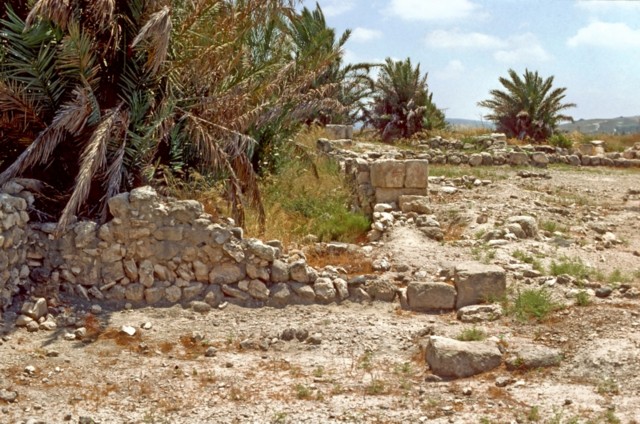
Megiddo - residence of Solomon's chariot commanders.

Megiddo – residence of Solomon’s chariot commanders.

Psalm 20 is clearly a battle hymn for David.  The suggestion of the absence of chariots and horses points to a time before Solomon (“Some trust in chariots and some in horses, but we trust in the name of the Lord our God“), for when know that Solomon as king had many of both (1 Kings 10:26). Verse 8’s continuation of the characterization of verse 7 (“They collapse and fall, but we rise and stand upright”) is a reference to the grace of God, rather than the might of his people.

Psalm 21 is can be divided into two sections at verse 7.  The first half deals with the king’s blessings in the face of his enemies.  The second half, beginning in verse 8 describes God’s vengeance upon them, and his “destroying them” in his wrath.  Verse 13 concludes with praise to God for his strength and power.

Read or listen to audio of ESV version of this selection from this link.

/Bob’s boy
___________________
some images © V. Gilbert & Arlisle F. Beers

Please note: I did not design the reading plan that I am following in my blog.  All of my comments in this blog, however, are solely my responsibility.  When reading ANY commentary, you should ALWAYS refer first to the scripture, which is God’s unchanging and unfailing word. Reading schedules, as well as a link to the site where you can get the reading plan that I’m currently following for yourself can be found on the “Bible Reading Schedules” page of my website at http://graceofourlord.com.  For questions and help, please see the “FAQ” and “Summaries” pages there.

Psalm 13, 16 – How Long, O Lord?

Psalm 13 is the “How long” psalm repeated four times in the first two verses; and begins with the question of how long the Lord will leave the psalmist feeling abandoned.  In the end, however, he acknowledges the grace of the Lord, and the many ways He has blessed him.  Unlike many of us, he recognizes how prosperous and happy he is.

“But I have trusted in your steadfast love;
my heart shall rejoice in your salvation.
I will sing to the Lord,
because he has dealt bountifully with me.”

Coffman’s observation was that “It is strange indeed that children of God are not exempt from such feelings of abandonment and despair, and we are left in wondering as to why it should be so. Perhaps the Lord wishes to drive us to our knees repeatedly that we should ever rely upon Him and not upon ourselves.” 

He then notes the connection this psalm has with our prayer life:

‘Prayer is not only the proper reaction of the godly to trouble, it is also the effective medicine against depression in the face of it.’

Just as the Lord has given us freedom of will to serve Him or not, he puts no hedge around us where the cares of the world are concerned (Job 1:10).  In the same vein of thought are these words accredited to Martin Luther:

‘Hope itself despairs, and despair yet hopes, and only that unspeakable groaning is audible with which the Holy Spirit, who moves over the waters covered with darkness, intercedes for us.

The risen Lord: He is not here in the grave.

The risen Lord: He is not here in the grave.

Psalm 16 is unquestionably Messianic in nature, and Peter cites it as such in Acts 2:25-28 and in verse 31, he identifies it his sermon as such.  Paul cited the 10th verse as well when he preached the resurrection of Jesus to the people of Antioch of Pisidia in Acts 13:35.  The presence of the Lord at the psalmist’s right hand is the source of his strength, then followed by the reference to the pleasures forevermore  abounding at the right hand of God.

Read or listen to audio of ESV version of this selection from this link.

/Bob’s boy
___________________
some images © V. Gilbert & Arlisle F. Beers

Please note: I did not design the reading plan that I am following in my blog.  All of my comments in this blog, however, are solely my responsibility.  When reading ANY commentary, you should ALWAYS refer first to the scripture, which is God’s unchanging and unfailing word. Reading schedules, as well as a link to the site where you can get the reading plan that I’m currently following for yourself can be found on the “Bible Reading Schedules” page of my website at http://graceofourlord.com.  For questions and help, please see the “FAQ” and “Summaries” pages there.

Psalm 119:25-32; Psalm 12 – Among the Children of Man

hebrew alphabet stencil

hebrew alphabet stencil (Photo credit: Shira Golding)

Verses 25-32 of Psalm 119 are brought to you by the fourth letter of the letter of the Hebrew alphabet, Daleth.  The psalmist admits that his soul – who he is – clings to the dust from which he was made (verse 25) ; but he implores God to teach him the truth of His righteous commandments, so that he will cling to Him, enlarging our hearts is akin to enlarging breadth of hour minds (1 Kings 4:29, 2 Corinthians 6:11, 13).

Psalm 12 is a chiasmus, as the first and last verses contain the phrase “the sons of man” (or in some versions, “the children of man”) in a parallel structure. In the former, the faithful have vanished from among them.  In the latter, vile wickedness is exalted among them.  This A-B-B-A  structure can be observed in Psalm 2, 10, and 11 as well.  The call for the cutting off of lying and boastful lips is a reference to those who believe they are lord over the needy and the poor.  But God is the great almighty and as Isaiah in 33:10 foretells, (because of their groaning) “Now I will arise,” says the Lord, now I will lift myself up; now I will be exalted.”

Read or listen to audio of ESV version of this selection from this link.

/Bob’s boy
___________________
some images © V. Gilbert & Arlisle F. Beers

Please note: I did not design the reading plan that I am following in my blog.  All of my comments in this blog, however, are solely my responsibility.  When reading ANY commentary, you should ALWAYS refer first to the scripture, which is God’s unchanging and unfailing word. Reading schedules, as well as a link to the site where you can get the reading plan that I’m currently following for yourself can be found on the “Bible Reading Schedules” page of my website at http://graceofourlord.com.  For questions and help, please see the “FAQ” and “Summaries” pages there.

Psalm 10 – Why Do You Hide Yourself?

A drawing of balances, or scales, of Bible times. A standard weight was placed on one side, and the object or objects to be weighed were placed on the other side.

A drawing of balances, or scales, of Bible times. A standard weight was placed on one side, and the object or objects to be weighed were placed on the other side.

Psalm 10 is often considered to be an acrostic continuation of Psalm 9, and differences aside there is some merit in that view beginning with the fact that the psalmist in chapter 10 recounts the deeds of the wicked and speaks of his denial of God (verse 4) in the third person.  And he reminds us that the wicked who oppress the poor will “be caught in the schemes that they have devised”. – always an abomination to the Lord.  God has always cared deeply about the poor (Micah 6:9-11, Leviticus 19:9-11).

It is not the psalmist himself that believes the wicked will continue to prosper forever, nor that God himself does not know , for he says of their attitude in verse 11 “He says in his heart, ‘God has forgotten, he has hidden his face, he will never see it.'”.

But God does see and he will mete out his vengeance one day, just as HE has before in His own time”

 “O Lord, you hear the desire of the afflicted;
you will strengthen their heart; you will incline your ear
to do justice to the fatherless and the oppressed,
so that man who is of the earth may strike terror no more.”

Read or listen to audio of ESV version of this selection from this link.

/Bob’s boy
___________________
some images © V. Gilbert & Arlisle F. Beers

Please note: I did not design the reading plan that I am following in my blog.  All of my comments in this blog, however, are solely my responsibility.  When reading ANY commentary, you should ALWAYS refer first to the scripture, which is God’s unchanging and unfailing word. Reading schedules, as well as a link to the site where you can get the reading plan that I’m currently following for yourself can be found on the “Bible Reading Schedules” page of my website at http://graceofourlord.com.  For questions and help, please see the “FAQ” and “Summaries” pages there.

Psalm 7 – In You Do I Take Refuge

The superscript for this psalm calls it a Shiggaion of David.  The term is only used again in plural form in Habakkuk 3:1.  The best that we can surmise is that it may be a type of instrument or liturgical description pertaining to the psalm.  Cush the Benjamin had likely accused David concerning treason against Saul.  David is languishing here and it seems likely that he is experiencing guilt on his own part (see verses 3-5), possibly for his anguish over what his part had been in Doeg the Edominte’s betrayal and the resulting slaughter of the priests of Nob (1 Samuel 22:11-23)?

Nob, Shufat from north, the Tabernacle was here for awhile. David visited the priest Ahimelech here (1 Samuel 21). Because the priests helped David, Saul destroyed the priests and their city.

Nob, Shufat from north, the Tabernacle was here for awhile. David visited the priest Ahimelech here (1 Samuel 21). Because the priests helped David, Saul destroyed the priests and their city.

David’s guilt, though tempered with his anger with Doeg in Psalm 52, does not give him pause to absolve himself, but rather to pray to God for justice, even if that means his own complicity should result in his death at the hands of his pursuers.  He places his fate in the hand of his God in whom he places his confidence in His judgment of David’s heart and integrity (verse 8-16).  He expresses his certainty that God will do justly with the wicked in Verses 14-16: B

Behold, the wicked man conceives evil
and is pregnant with mischief
and gives birth to lies.
He makes a pit, digging it out,
and falls into the hole that he has made.

Read or listen to audio of ESV version of this selection from this link.

/Bob’s boy
___________________
some images © V. Gilbert & Arlisle F. Beers

Please note: I did not design the reading plan that I am following in my blog.  All of my comments in this blog, however, are solely my responsibility.  When reading ANY commentary, you should ALWAYS refer first to the scripture, which is God’s unchanging and unfailing word. Reading schedules, as well as a link to the site where you can get the reading plan that I’m currently following for yourself can be found on the “Bible Reading Schedules” page of my website at http://graceofourlord.com.  For questions and help, please see the “FAQ” and “Summaries” pages there.

Psalm 119:17-24, Psalm 11 – A Sojourner on the Earth

Today’s reading of Psalm 119 begins with verse 17 and begins each line with the letter gimel.   The psalmist calls upon the lord to “deal bountifully” with him – knowing that he is undeserving and asks for his grace and mercy.  He acknowledges that this world is not his home (John 15:19).  He is just passing through. He says the Lord rebukes the insolent accursed ones, these would be the unfaithful.  The princes that plot against him are rulers among God’s people that might plot against him Though we do not know the author, one could apply this to many as in Daniel 6:4.  They tried to find something to charge him with, but could not.

Saul anointed king by Samuel.

Saul anointed king by Samuel.

Some have seen Psalm 11 as the advice to David  to flee, probably from Saul to the mountains.  He may have been advised to do so by those surrounding him, which is where the question comes.  That is about as good of a guess as any, but it has also been suggested that this was from David’s plight in 1 Samuel 23:9-14, when he had asked the Lord if the men of Keilah would surrender him to Saul.  When he was told of this, he prayed to God , and God told him they indeed would surrender him.

His friends had advised him of the impending attack, and were moved for him to hide himself in the hills.  But he had done so, he could have been guilty of not trusting the Lord following his prayer.  We can guess that under the lawless rule of Saul, the very foundations of society and of moral order were viewed as swept away. Then he recognizes that the Lord is in his holy temple (Habakuk 2:20).  He sees the righteous and will deal with the wicked.  The “upright shall behold his face” should be understood as to see Him as He is (1 John 3:2).

Read or listen to audio of ESV version of this selection from this link.

/Bob’s boy
___________________
some images © V. Gilbert & Arlisle F. Beers

Please note: I did not design the reading plan that I am following in my blog.  All of my comments in this blog, however, are solely my responsibility.  When reading ANY commentary, you should ALWAYS refer first to the scripture, which is God’s unchanging and unfailing word. Reading schedules, as well as a link to the site where you can get the reading plan that I’m currently following for yourself can be found on the “Bible Reading Schedules” page of my website at http://graceofourlord.com.  For questions and help, please see the “FAQ” and “Summaries” pages there.

Reading the Psalms

The book of Psalms is 150 poems written for our instruction, pleasure and benefit in prayer and praise to God.  They were used by the Jews and early Christians for songs of praise, and indeed many of the songs we sing in worship today God come from these pages.  Traditionally, they have been divided into five books, perhaps to signify the five books of the Pentateuch. It has the most authors of any book in the Bible.  Many we know or surmise by the superscripts, which though not inspired are ancient.  David is ascribed as the author of  73 of these and the new Testament also credits him with Psalm 2 (Acts 4:25) and Psalm 95 (Hebrews 4:7).


English: The Psalms scroll, one of the Dead Se...

English: The Psalms scroll, one of the Dead Sea scrolls. Hebrew transcription included. English translation available here. Français : le rouleau des Psaumes, l’un des manuscrits de la mer Morte. Une transcription en hébreu moderne est incluse. Une traduction anglaise est disponible ici. (Photo credit: Wikipedia)


This aligns very well with what the Book of Samuel tells us.  He was brought to Saul when he was king by his servants because of his skill in playing the Lyre (1 Samuel 16:16-23).  He was an accomplished songwriter, having written the song of the Bow lament in 2 Samuel 1:17-27, and his song of deliverance in 2 Samuel 22:1:23:7.   2 Samuel 23:1 calls him the sweet psalmist of Israel. The sons of Korah are attributed with about 25 psalms.  Korah was the grandson of Kohath who along with some of the Reubenites, rebelled against God, challenging Moses in Numbers 16. After his death, his sons were spared in Numbers 26:9-11, and under King David became great leaders of song and praise in the Temple and Tabernacle (1 Chronicles 6:31-39), responsible for such lines as “As the Deer Panteth for the Water.”   They are not in chronological order, else Psalm 95 would likely be first, as it is attributed to Moses.


More to come in another blog, but I will leave you with a link to an article that has tips for studying a Psalm, that I think are quite useful.  Please see “8 steps to Study a Psalm” and download the PDF for reference.


Summing Up


Each weekend, I post a small PDF of one week of chapter summaries (on the website’s “Summaries” page), current to the beginning of the previous week.  I have posted the summary for Week 3 (January 2013 Week 3) of the schedule I am following this year.  This short PDF documents contains condensed comments about Psalm 119:1-8, Psalm 1, Proverbs 10, Psalms 3-4, Job 1, and Psalm 9, with hyperlinks to the ESV version of each chapter for listening or reading, and joins the summaries for other weeks already posted there.


/Bob’s boy


___________________


image © V. Gilbert & Arlisle F. Beers


Please note: I did not design the reading plan that I am following in my blog.  All of my comments in this blog, however, are solely my responsibility.  When reading ANY commentary, you should ALWAYS refer first to the scripture, which is God’s unchanging and unfailing word. Reading schedules, as well as a link to the site where you can get the reading plan that I’m currently following for yourself can be found on the “Bible Reading Schedules” page of my website at http://graceofourlord.com.  For questions and help, please see the “FAQ” and “Summaries” pages there.