The Savior Slain and Risen \ Week 36 summary posted

This week, we will read first about the crucifixion.  Then we will spend the rest of the week with some details of the time after the Lord’s resurrection from the perspective of the gospels of Matthew, Luke and John.  We know from 1 Corinthians 15:5-9 that Jesus appeared to more than five hundred in the forty days before His ascension to heaven.  We will focus in the next few days mostly on the time from His appearance to the disciples onward.  Today though, let us spend a bit of time on the first hours of the day of His resurrection.

The Garden Tomb in Jerusalem, one traditional site of Jesus’ burial. It is safe to say that it is not the tomb of Jesus, but it is useful as a realistic example.

We need to keep a few things in mind.  First, as is often the case with the Scriptures, events recorded in the four gospels are not always in chronological order.  Also, as we have discussed before, each of the four was written to a different audience; and we find things phrased differently, as well as additional events in one gospel not found in another.  Finally, we have seen time and again that there are some things we would like to know that the scriptures just do not tell us.  In this case, the commentator James Burton Coffman says it best: “…it was part of the Father’s wisdom to give men just the amount of revelation which would leave them free to make their own moral decision.

The resurrection accounts of the gospels are favorite citations for those unbelievers who feel compelled to invest their time trying to find alleged contradictions.  Of course, such allegations are baseless.  Putting the four gospel accounts together gives us a more complete picture of the events of that great morning.  For a complete comprehensive and easy to read harmonization of the four gospels, I recommend the following book (also available in Kindle format): “The Fourfold Gospel” by John McGarvey (ISBN-10 # 1936341018, ISBN-13 # 978-1936341016).

Keeping Coffman’s caveat  in mind, the following is a summary of the events in all four gospels (Matthew 28:1-10, Mark 16:1-8, Luke 24:1-12, and John 20:1-18) of the early morning of the resurrection up to Jesus’ first appearances to Mary Magdalene and the other women:

1.  Several women came to the tomb of Jesus before dawn on the first day of the week (Sunday) with spices to anoint His body.  From the four gospels, we know that group included at minimum Mary Magdalene, Mary the mother of James (Jesus’ mother), Salome, and Joanna.

2. The Sabbath ended at sundown on Saturday.  The key sentence in Luke 23:56 is that on the Sabbath, the women “rested according to the commandment.”  This means that they would not be preparing the spices and ointments until the Sabbath was over (at sundown).

3. The women set out for the tomb with the spices while it was still dark on the first day of the week.  The translation of the grammar used in Mark confuses many, but the key to understanding is that Mark 16:1-2 simply distinguishes the fact that when they went very early on the first day of the week, they did it in the morning – not just after sundown on Saturday!

4. There was a great earthquake, and an angel of the Lord descended from heaven and rolled away the stone and sat on it.  The fear that brought to the guards is stated – along with the statement that they became like dead men.  Perhaps they were just paralyzed with fear, or perhaps they were made unable to move.  We are not told.  The point is that the seal was broken, and the stone would not be allowed to be moved back in front of the tomb.

The Garden Tomb in Jerusalem, one traditional site of Jesus’ burial. It is safe to say that it is not the tomb of Jesus, but it is useful as a realistic example.

5.  At this point, we know from John that it was Mary Magdalene who ran to tell Peter and John that (as she believes) someone has taken the body.  John and Mark both indicate that Mary had left the other women.  While she is gone, two angels speak to the women she had separated from, telling them that Jesus had risen and they must tell the disciples “and Peter” that He is risen and that they must go to Galilee. Many of the guards leave to go tell the Sanhedrin what has happened, while the other women leave to find the disciples.  It is important to get word to all the disciples.  But Peter is mentioned separately probably because it is important that in his grief, he does not think he would be cast off because of his denial (in Matthew 26:69-75).

6. Peter and John run to the tomb and eventually both go inside and leave, satisfied that Jesus is gone.  John “believes” but Peter is puzzled about what happened.  They went back home and the other women would come tell them (as well as the other disciples) what the angels had said to them.

7. Mary, back at the tomb weeping after Peter and John had left, now looks into it for the first time and sees it empty except for the angels – sitting at the head and foot where Jesus had laid.  Perhaps from her tears blinding her or perhaps prevented from truly “seeing” (as with the disciples in Luke 24:16), she does not react to the angels or recognize Jesus until He calls her name (John 20:16).  Jesus tells her not to delay by clinging to Him, but to go to tell the disciples that He is going to His Father (and their Father).

8. Mary does go and tell the disciples that she has seen the Lord.  The other women are met by Jesus on their way (Matthew 28:9); and they are allowed the delay briefly, as they take hold of His feet and worship Him.  Then He sends them to continue on to the disciples as well.

Summing Up

Each weekend, I am now posting a small PDF of one week of chapter summaries (on the website’s “Summaries” page), current to the beginning of the previous week.  I have posted the summary for Week 36 (September Week 1) of the schedule I am following.  This short PDF document contains condensed comments about John 12, Matt 24 and 25, John 13, and John 14, with hyperlinks to the ESV version of each chapter for listening or reading, and joins the summaries for other weeks already posted there.

/Bob’s boy
___________________
image © V. Gilbert & Arlisle F. Beers

Please note: I did not design the reading plan that I am following in my blog.  All of my comments in this blog, however, are solely my responsibility.  When reading ANY commentary, you should ALWAYS refer first to the scripture, which is God’s unchanging and unfailing word. Reading schedules, as well as a link to the site where you can get the reading plan that I’m currently following for yourself can be found on the “Bible Reading Schedules” page of my website at http://graceofourlord.com.  For questions and help, please see the “FAQ” and “Summaries” pages there.
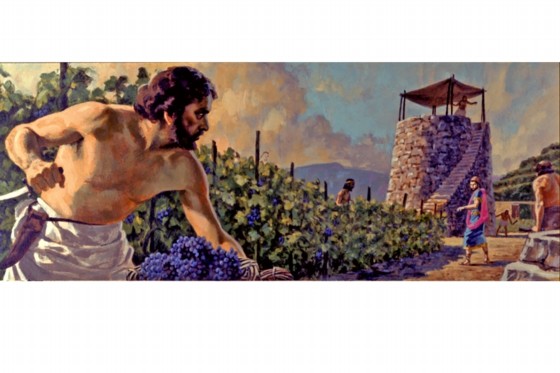
Luke 20 – The Wicked Tenants

In Jesus’ parable; wicked vineyard tenants murdered servants the owner had sent, and eventually murdered the owner’s son. This was an illustration of the wicked leaders who would murder God’s own Son, Jesus (Matthew 21:33-46).

In the parable of the wicked tenants in verses 9-16 , the word for owner in the “owner of the vineyard” is the same as “lord.”  The three servants he sent to the tenants represent the prophets.  The fruit of the vineyards they are seeking represents Israel’s obedience to God.  Then, sending his “beloved son” reminds us of what God said (“This is my beloved Son…”) at Jesus’ baptism in Matthew 3:17.  The tenants killing the owner’s son alludes to His coming death.  When Jesus says that the vineyard owner would come and destroy those tenants, it seems likely to be referring first to the destruction of Jerusalem that will come in A.D. 70. But in a larger sense, it speaks to the final judgment.  Those hearing the parable say “Surely not!” as they perceive that the parable applies to the people of Israel.  Would God take away the land and give it to other people?  But He looks directly at them and says ““What then is this that is written:
“The stone that the builders rejected
has become the cornerstone?”
This is from Psalm 118:22, referred to as well in Isaiah 28:16, and is quoted by Peter in Acts 4:11 and 1 Peter 2:7.

A denarius minted circa 18 BC. Obverse: CAESAR...

A denarius minted circa 18 BC. Obverse: CAESAR AVGVSTVS; reverse: DIVVSIVLIV(S) (Photo credit: Wikipedia)

In verse 19, the scribes and chief priests were predictably angry, as they knew the parable was directed at them.  So they sent people to try to trap him with sedition against the Roman government.  Jesus’ answer in verse 25 was “render to Caesar the things that are Caesar’s, and to God the things that are God’s.” This can be read in different ways, given that He had asked whose image was on the denarius.  One interpretation is that we are made in God’s image, and thus we must render ourselves to God’s service.

The Sadducees do not believe in the resurrection, so they try to test him in verses 27-33 with a scenario revolving around the teaching of Moses.  But in verse 37 (and in Matthew 22:31-32) Jesus quotes Moses’ encounter with God at the burning bush in Exodus 3:6, explaining that God is the God of the living.

Read or listen to audio of ESV version of this selection from this link.

/Bob’s boy
___________________
some images © V. Gilbert & Arlisle F. Beers

Please note: I did not design the reading plan that I am following in my blog.  All of my comments in this blog, however, are solely my responsibility.  When reading ANY commentary, you should ALWAYS refer first to the scripture, which is God’s unchanging and unfailing word. Reading schedules, as well as a link to the site where you can get the reading plan that I’m currently following for yourself can be found on the “Bible Reading Schedules” page of my website at http://graceofourlord.com.  For questions and help, please see the “FAQ” and “Summaries” pages there.

Luke 15 – The Parable of the Prodigal Son

As Jesus was teaching, the tax collectors and sinners had gathered around him.  We are not told what the latter were guilty of, but they obviously had a dubious reputation because of it.  The Pharisee and scribes, of course, were looking for anything to use against Jesus; and they began grumbling about the company He was keeping.  Of the three parables Jesus then tells in this chapter, the parable of the prodigal son is the most famous.  But all three make the point about those who are lost, best stated in verse 7 by Jesus – “there will be more joy in heaven over one sinner who repents than over ninety-nine righteous persons who need no repentance.”

Frans Francken (II) - The Parable of the Prodi...

Frans Francken (II) – The Parable of the Prodigal Son – WGA8205 (Photo credit: Wikipedia)

The image in verse 20 of the father running to his son to embrace him when he returned should be comforting to anyone who has fallen away from the Lord and wants to return.  No matter what we have done, God wants us to come back to Him, and will receive us gladly.  The elder son is upset that his father is celebrating the return of his prodigal brother who, in verse 30,  he does not even want to acknowledge as such (“this son”) because of his anger.  After all, he had remained behind and did not “devour” his father’s “property with prostitutes” (verse 30).   Why should his brother deserve to be received that way?  God will forgive in the same way; and we must realize that it is not because any of us deserve that forgiveness.

Read or listen to audio of ESV version of this selection from this link.

/Bob’s boy
___________________
some images © V. Gilbert & Arlisle F. Beers

Please note: I did not design the reading plan that I am following in my blog.  All of my comments in this blog, however, are solely my responsibility.  When reading ANY commentary, you should ALWAYS refer first to the scripture, which is God’s unchanging and unfailing word. Reading schedules, as well as a link to the site where you can get the reading plan that I’m currently following for yourself can be found on the “Bible Reading Schedules” page of my website at http://graceofourlord.com.  For questions and help, please see the “FAQ” and “Summaries” pages there.

Luke 10 – Jesus Sends Out the Seventy-Two

Most translations have the number as seventy-two in verse one and in verse 17, but some have it as seventy.  There are many old and reliable manuscripts that have it each way, and there is no effect on doctrine either way.  The laborers are those who proclaim the gospel, and their harvest is in gaining more laborers to further God’s kingdom.  “Peace” in verses 5-6 has a deeper meaning than we associate it with, and carries with it a blessing – in this case, the blessing of salvation (see also Luke 7:50, 8:48), but only if it is received (accepted). “Greet no one on the road” in verse 4 is most likely an expression of the urgency of the mission, as in 2 Kings 4:29 when Elisha sent his servant to the Shunammite’s son.  Likewise in verse 7, they are not to waste any time going from one household to another, but accept the hospitably provided because the laborer deserves his wages.  Paul refers to this in 1 Corinthians 9:14, and quotes it as scripture in 1 Timothy 5:18.  In verses 10-16, those who do not receive them are rejecting Jesus, and so are rejecting the one who sent Him – God.

When they returned, they were filled with joy at the success of their mission, noting that “even the demons are subject to us in your name!”  Jesus may be speaking in verse 18 of a heavenly vision He saw while they were about their business, or of something more specific.  The message is that their use of the authority He had given to them had diminished the authority that Satan had.  In verse 21 of His prayer, he is thanking God that those who were children in His kingdom had been given these gifts of understanding, favoring them over those who are wise in their own eyes (Job 37:24). Verses 23-24 are a reminder of how long the prophets have been looking ahead to these times when the Messiah would come and work these wonders, yet these disciples have been blessed to see it with their own eyes!

Verse 25’s beginning with “lawyer stood up to put him to the test” suggests another occasion or location in which others were sitting while Jesus taught. He asks what he should do to inherit eternal life.  Note that Jesus does not tell him that being saved is a result of his own actions.  Rather he asks the counter-questions “What is written in the law?” and “how do you read it?”  The lawyer then quotes Deuteronomy 6:5 and Leviticus 19:18, which Jesus approves.  In verse 29, though, the lawyer is trying to define the meaning of “neighbor” in a narrow way, so that he can be justified in not treating most people with that sort of love and compassion.

The Parable of the Good Samaritan that Jesus answers with in verses 30-35 is one of the most famous.  But it is much more than a simple story of a good-hearted man helping a stranded stranger on the side of the road – which is what most people associate with it.  It is the story of a man who was undoubtedly Jewish (traveling from Jerusalem to Jericho), who was beaten and left for dead by robbers (who could also have been Jewish).  He was passed by, and his dire situation ignored by first a Jewish priest, and then a Levite.  By definition, all would certainly be his kinsmen and his neighbors.  But the one who does help him is a Samaritan, a group of people that Jews had anything but love for, and the feeling was mutual (John 4:9).  Yet, the Samaritan not only had compassion and came to stop the bleeding and clean the wounds.  He then carried the man back to town to an inn, and stayed with him overnight, caring for him.  The next day, he gave the innkeeper his own money to look after him for a couple of days while he is gone, promising to stand good for any other expenses.

Being a compassionate neighbor in this case meant this Samaritan giving no small amount of time, effort and money to help someone in need, when that person most likely would have considered him an enemy.  So if we are to love our neighbor as ourselves, we must truly love even our enemies (Matthew 5:44).

Side note: Though the Bible does not tell us where the inn was, a site has been identified and associated with the parable, and has become a museum.  You can read about it in this article at BibleArchaeology.org.

Read or listen to audio of ESV version of this selection from this link.

/Bob’s boy
___________________
some images © V. Gilbert & Arlisle F. Beers

Please note: I did not design the reading plan that I am following in my blog.  All of my comments in this blog, however, are solely my responsibility.  When reading ANY commentary, you should ALWAYS refer first to the scripture, which is God’s unchanging and unfailing word. Reading schedules, as well as a link to the site where you can get the reading plan that I’m currently following for yourself can be found on the “Bible Reading Schedules” page of my website at http://graceofourlord.com.  For questions and help, please see the “FAQ” and “Summaries” pages there.

Luke 9 – The Transfiguration

Mount Hermon is one possible location for the Transfiguration. Caesarea Philippi is near the base of it.

The first 27 verses of this chapter consist of details told in Mark 6 (sending out the Apostles, and the feeding of the five thousand) and Matthew 16 (Peter’s confession, and Jesus’ foretelling of His death and resurrection.   Jesus took Peter, John, and James with Him in verse 28 to pray on the mountain where they witnessed an unforgettable sight, as His appearance and even His clothing are transformed; and Moses and Elijah (representing the Law and the Prophets) appeared and spoke of Jesus departure “he was about to accomplish at Jerusalem.”  This of course , refers to what follows His coming crucifixion and resurrection.  Just as Peter speaks hastily again (verse 33), they hear the voice of God declaring what Peter had said – that Jesus is the son of God.   Peter assumed that Moses and Elijah would stay with them, but they were gone after God spoke, saying “Listen to Him.”  The presence and removal of those two seems significant, as well understand the scriptures today.

As Jesus foretells His death and resurrection in verse 44, verse 45 is one of a few verses that tell us how understanding and recognition was concealed from the disciples at various times until after Jesus departed following His resurrection (see also Luke 18:34 and Luke 24:16).  It is no small wonder then, that they began debating their own importance over each other.  Jesus settles the dispute with another statement in verse 48 that they would not yet understand  – “he who is least among you all is the one who is great.”  He would have more to say about this in Luke 22:26.

The lessons of verses 57-62 are in light of the urgency of the moment at which Jesus encounters them.  Two say that they want to follow Him, and He tells another to follow Him.  He tells one that he will have to make sacrifices in order to do so (verse 58).  The other two speak of matters important to them at the time that they want to take care of first (59, 61).  This was no time for other priorities; and though these instances refer to a more physical following, the application for us is the same – that following Jesus must take first priority in our lives.

Read or listen to audio of ESV version of this selection from this link.

/Bob’s boy
___________________
some images © V. Gilbert & Arlisle F. Beers

Please note: I did not design the reading plan that I am following in my blog.  All of my comments in this blog, however, are solely my responsibility.  When reading ANY commentary, you should ALWAYS refer first to the scripture, which is God’s unchanging and unfailing word. Reading schedules, as well as a link to the site where you can get the reading plan that I’m currently following for yourself can be found on the “Bible Reading Schedules” page of my website at http://graceofourlord.com.  For questions and help, please see the “FAQ” and “Summaries” pages there.

Luke 7 – Who Is This?

A centurion was a Roman soldier in charge of a hundred men.  This one was a friend to the Jewish people (see verses 3-5).  When Jesus went with the elders to go to heal the centurion’s servant, he sent people to meet Jesus along the way, and told him not to trouble Himself.  Verses 6-8 show his faith in Jesus was strong enough to believe that his servant would be healed simply by Jesus saying so.  Jesus’s statement in verse 9 “I tell you, not even in Israel have I found such faith”  foreshadows the welcoming of Gentiles into the kingdom.

When a widow of Nain lost her only son, Jesus raised him from the dead, a mighty miracle — Luke 7: 11-17.

His compassion for the widow whose son had died (his death would also mean economic hardship for her) causes him to bring her son back to life in front of a great crowd of people, including those carrying the body.  Imagine the fear among them as he sat up and spoke!  His fame grew even more as verse 17 says “this report about him spread through the whole of Judea and all the surrounding country.”  As word spread back to John the Baptist, he sent two disciples to go and ask Jesus point-blank if He really was the Messiah.  Apparently, even John was expecting a very different savior than this.  After they witnessed Jesus healing numerous people (verse 21), he sent them back to him quoting from Isaiah 35:5-6 and 61:1.

The woman whose sins He forgives in verses 36-50 is not Mary who anoints His feet before the crucifixion in John 12:3-8.  The Pharisee (who we learn in verse 40 is named Simon) had invited Jesus into his home to eat, and did not know that Jesus knew what he was thinking.  He was convinced that Jesus could not be a” prophet,” or else He would not be letting a known sinful woman like this touch Him.  Jesus answers with a short parable and a question, and forgives the woman of her sins, prompting those at table to say in verse 49 “Who is this, who even forgives sins?”

Read or listen to audio of ESV version of this selection from this link.

/Bob’s boy
___________________
some images © V. Gilbert & Arlisle F. Beers

Please note: I did not design the reading plan that I am following in my blog.  All of my comments in this blog, however, are solely my responsibility.  When reading ANY commentary, you should ALWAYS refer first to the scripture, which is God’s unchanging and unfailing word. Reading schedules, as well as a link to the site where you can get the reading plan that I’m currently following for yourself can be found on the “Bible Reading Schedules” page of my website at http://graceofourlord.com.  For questions and help, please see the “FAQ” and “Summaries” pages there.

Luke 6 – Jesus is Lord of the Sabbath

Verses 1-5 have been used to link Biblical teaching to situation ethics, but this comes from a lack of understanding of the scriptures.  The disciples in verse 1 plucked and ate the grain with their hands, not with a sickle.  This was expressly allowed in the Law given in Deuteronomy 23:24-25.  But the Pharisees had made their own interpretation and decided it was the law, rather than God’s word.  Jesus challenged them to speak against David and his men eating the Bread of the Presence, or shewbread (1 Samuel 21:1-6) – which He said in verse 4 was unlawful.  He settles the matter in verse 5, saying that He is “lord of the Sabbath,”  with the unstated conclusion that the Pharisees are not.

English: A dispute with the pharisees. Passeri...

English: A dispute with the pharisees. Passeri. In the Bowyer Bible in Bolton Museum, England. Print 4384. From “An Illustrated Commentary on the Gospel of Mark” by Phillip Medhurst. Section D. Jesus confronts uncleanness. Mark 1:21-45, 2:1-12, 5:1-20, 25-34, 7:24-30. http://pdfcast.org/pdf/an-illustrated-commentary-by-phillip-medhurst-on-the-gospel-of-mark-section-d (Photo credit: Wikipedia)

Verses 6-11 are another Sabbath encounter with the Pharisees, as Jesus was teaching in the synagogue.  Knowing that they are waiting to see if He will heal the man with the withered hand, He poses the question of whether it was lawful to do harm or to do good on the Sabbath.  They would not answer, but when he healed the man, they were angry.  Notice that their malice and desire to do harm to Him blinds them to the fact that the miracles prove He is the son of God.

In verses 12-16, after spending all night in prayer, He chose the twelve apostles from his disciples.   Verses 17-19 show the magnitude of the vast amounts of people He ministers to in the rest of this chapter.  People from Tyre and Sidon would almost certainly be Gentiles.

Some believe that the rest of this chapter is just Luke’s account of the Sermon on the Mount, but we must realize that similar sermons by the Lord would be taught at different times and to different crowds.  Note that in verse 17, after having spent the night praying on the mountain, He “he came down with them and stood on a level place.”  This has resulted in people referring to this as the Sermon on the Plain.  In comparing the “blessed” and the “woes” in this sermon, Jesus is not saying that it is wrong to be rich or that the poor are more righteous.  He is stating the poor and those less fortunate who are in His kingdom will have their reward, while those who may be rich but not part of the faithful already have their reward.

Read or listen to audio of ESV version of this selection from this link.

/Bob’s boy
___________________
some images © V. Gilbert & Arlisle F. Beers

Please note: I did not design the reading plan that I am following in my blog.  All of my comments in this blog, however, are solely my responsibility.  When reading ANY commentary, you should ALWAYS refer first to the scripture, which is God’s unchanging and unfailing word. Reading schedules, as well as a link to the site where you can get the reading plan that I’m currently following for yourself can be found on the “Bible Reading Schedules” page of my website at http://graceofourlord.com.  For questions and help, please see the “FAQ” and “Summaries” pages there.

Luke 2 – The Birth of Jesus Christ

Verses 1-20 deal with the miraculous birth of Jesus.   The circumstances of His birth, the lack of great wealth on the part of His parents, and even the people who this scripture places with Him all point to a King that was not just for the favored few.

The Roman emperor Caesar Augustus was born about 62 BC, and reigned from about 32 BC until his death in about 14 AD.  Joseph and Mary had gone to Bethlehem (the city of David, of whose lineage Joseph was descended) from Nazareth because of a decree by Caesar Augustus that all subjects of the Roman Empire must be registered for the purpose of taxation.    Of course, had there been no such decree, something else would have brought them there anyway because God’s prophets had already told us that the Messiah would be born in Bethlehem (see Micah 5:2).  Verse 7 says that Mary “gave birth to her firstborn son and wrapped him in swaddling cloths and laid him in a manger, because there was no place for them in the inn.”  Those were the signs that the angel of the Lord, who appeared to some shepherds, told them to look for when they went to see for themselves (verses 8-13).

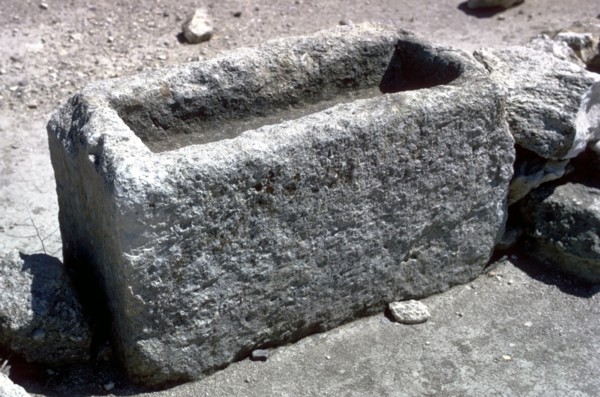
Stone manger from Bible times, perhaps similar to the one that cradled the baby Jesus in Bethlehem. The manger held food for animals.

At the end of eight days, he was circumcised (according to God’s commandment to Abraham in Genesis 17:12); and named Jesus – just as Mary had been told before He was conceived (Luke 1:31-32).  Verse 22 would be 33 days later in which they would have journeyed to Jerusalem (Leviticus 12:3-8) to make their sacrifice according to the Law given to Moses.  Joseph and Mary would not have the means to offer a lamb, but would obey the Law of the Lord.  We do not know anything else about the man Simeon in verses 25-35.  The scripture says that the Holy Spirit had revealed to him that he would see the Christ before he died, so he had obviously found favor with God.  As he held the savior in his arms, his words affirm that verse 10’s reference to “all people” means Jews and Gentiles alike as, in verse 32, he calls Jesus “a light for revelation to the Gentiles, and for glory to your people Israel.”  Verses 36-38 recount more of God’s revelations about Jesus to his humblest of servants.  The family then returned to Nazareth, where verse 40 tells us that Jesus grew in wisdom and “the favor of God was upon him.”

Naturally, as verse 41 says, his parents returned to Jerusalem every year to observe the Feast of the Passover.  On the occasion of verse 42, he was 12 years old.  This may be about 7 AD, as the best estimates (contrary to what many people might assume), are that He was born about 5 BC.   It seems more than a bit strange to us that Joseph and Mary did not notice he had remained behind in Jerusalem until they well on their way back to Nazareth (verses 43-44), but we must remember that such a journey during an important festival would have had them traveling with a large group of family and friends that trusted and cared for one another.  When they returned to Jerusalem to search for Him, they finally found Him in the Temple – and as verses 46-47 say, amazing the teachers there.  He demonstrates that He already knows He is the Son of God, as He says in verse 49 “Why were you looking for me? Did you not know that I must be in my Father’s house?”

Read or listen to audio of ESV version of this selection from this link.

/Bob’s boy
___________________
some images © V. Gilbert & Arlisle F. Beers

Please note: I did not design the reading plan that I am following in my blog.  All of my comments in this blog, however, are solely my responsibility.  When reading ANY commentary, you should ALWAYS refer first to the scripture, which is God’s unchanging and unfailing word. Reading schedules, as well as a link to the site where you can get the reading plan that I’m currently following for yourself can be found on the “Bible Reading Schedules” page of my website at http://graceofourlord.com.  For questions and help, please see the “FAQ” and “Summaries” pages there.
Luke 1 – The Birth of John the Baptist

Luke, who also wrote the Book Acts, addressed this book specifically to Theophilus, who was likely a government official (note the way that he refers to him in verse 3).   As it opens, it has been 400 years since Malachi prophesied.  John the Baptist’s father, Zechariah, was a priest.  In those days, the priests were separated in divisions, each of which served for a week – except during times of major feasts, such as Passover or the Feast of Tabernacles.    Zechariah was chosen by lot to serve in the Temple (verses 8-9).  Zechariah (as he and his wife Elizabeth were childless and advanced in years) had no doubt prayed often for a child.  An angel of the Lord appeared to him and told him they would have a son, and that his name would be John.  He was not to drink wine or strong drink, and would be filled with the Holy Spirit “even from his mother’s womb” (indicating he would then already be a human person), and would “make ready for the Lord” (verses 11-17).  Also, jumping ahead to (verses 41-44), upon Mary’s visit, Elizabeth’s baby leaped for joy in her womb.

Birth of St. John the Baptist, depicting Zecha...

Birth of St. John the Baptist, depicting Zechariah writing, “His name is John”. (Photo credit: Wikipedia)

Both as a rebuke for his unbelief, as well as the sign he asked for, the angel Gabriel told Zechariah that he would be unable speak until his son was born (verses 18-23), and  Elizabeth did conceive.  The “sixth month” in verse 26 refers to the sixth month of Elizabeth’s pregnancy.  At this time, the Angel Gabriel appeared to a virgin (Mary), who was pledged to be married to Joseph, who was of the house of David (verses 26-27).  The reference to Nazareth being a city of Galilee is confirmation that Luke’s intended audience was unfamiliar with the territory.  Mary is told that she would have a son and name him Jesus, that God would give him the throne of his father, David, and that “he will reign over the house of Jacob forever, and of his kingdom there will be no end” (verses 28-33). He also tells her of her relative, Elizabeth’s pregnancy.  Verses 46-55 are Mary’s praise to the Lord, and are known as Mary’s song.

When Elizabeth bore her child, the neighbors expected them to name him Zechariah after his father, but she insisted that he would be called John.  Not satisfied, they tried to get Zechariah to give them a sign (since he still could not speak).  He wrote on a tablet that “his name is John,” and immediately he could speak again – because then all that the angel of the Lord had said to him previously had come to pass.  Verses 65-66 indicate that the word of this miraculous birth and Zechariah’s change became famous very quickly.  Zechariah’s prophecy in verses 67-79 verify that the fulfillment of God’s promise to his people through Abraham – and the Messianic age – had indeed begun!

Side note: Excavations at Nazareth by archaeologists have located tombs, olive presses and other indications that it was a small agricultural community.  The most interesting discovery of the past few years is that of a first-century house there.  A very good article on this discovery can be found at this article at BiblePlaces.com.

Read or listen to audio of ESV version of this selection from this link.

/Bob’s boy
___________________
some images © V. Gilbert & Arlisle F. Beers

Please note: I did not design the reading plan that I am following in my blog.  All of my comments in this blog, however, are solely my responsibility.  When reading ANY commentary, you should ALWAYS refer first to the scripture, which is God’s unchanging and unfailing word. Reading schedules, as well as a link to the site where you can get the reading plan that I’m currently following for yourself can be found on the “Bible Reading Schedules” page of my website at http://graceofourlord.com.  For questions and help, please see the “FAQ” and “Summaries” pages there.