Stephen, the Sanhedrin, and Saul \ Week 38 summary posted

Paul escaping Damascus in a basket

We are continuing in Acts this week with the selection of seven “table servants” – one of which is Stephen.  Then we will read of his arrest, his appearance before the Sanhedrin, and his historic, eloquent, and aptly accusatory speech to them – a moving and unforgettable account of the bravery of this man.  Then, we will move to chapter 8 to find Saul of Tarsus ravaging the church, as he persecutes and even brings about the death of more Christians – deeds that he would very soon come to great sorrow for, as he encounters the Lord.  His life is forever changed, and we are all the better for it.  But this week will also give us Phillip and the Ethiopian Eunuch; and Peter will have an important revelation.  What a week in God’s word!

Summing Up

Each weekend, I am now posting a small PDF of one week of chapter summaries (on the website’s “Summaries” page), current to the beginning of the previous week.  I have posted the summary for Week 38 (September Week 3) of the schedule I am following.  This short PDF document contains condensed comments about Matthew 27, 28, John 20, 21, and Luke 24, with hyperlinks to the ESV version of each chapter for listening or reading, and joins the summaries for other weeks already posted there.

/Bob’s boy
___________________
image © V. Gilbert & Arlisle F. Beers

Please note: I did not design the reading plan that I am following in my blog.  All of my comments in this blog, however, are solely my responsibility.  When reading ANY commentary, you should ALWAYS refer first to the scripture, which is God’s unchanging and unfailing word. Reading schedules, as well as a link to the site where you can get the reading plan that I’m currently following for yourself can be found on the “Bible Reading Schedules” page of my website at http://graceofourlord.com.  For questions and help, please see the “FAQ” and “Summaries” pages there.

Acts 5 – Ananias and Sapphira

The Death of Ananias, by Raphael

The Death of Ananias, by Raphael (Photo credit: Wikipedia)

As is often the case with Scripture, context is everything in this chapter.  As chapter 4 closes, the young church was growing with the Apostles leading them; and the unity among the believers was amazing.  People were selling their own possessions, and bringing the proceeds to the Apostles to help provide for others who were in need.  It was in that spirit that we were introduced to Barnabas of Cyprus in Acts 4:36 (we will read more about Barnabas in later chapters).  As Peter makes clear, the property that had belonged to Ananias and Sapphira was theirs to do as they wished.  Their sin was in trying to fraudulently claim that they had sold land and were giving the entire proceeds to the apostles to help those in need.  The lie would certainly be found out. The credibility of the Apostles would be harmed – how can they be said to be guided by the Holy Spirit and not know these people were perpetrating such fraud?  The unity of the believers would certainly suffer.  God would not allow this to happen.

Verse 12 lets us know that the Apostles had worked many signs and wonders.  Note that the verse does not refer to 120 people having done so, again affirming that it was the twelve who received the baptism of the Holy Spirit in chapter 2.  And despite Peter and John’s earlier arrest, they were all together in Solomon’s Portico again. Verse 13 simply means that even the non-believers that did not join them held them in high esteem.  But verse 14 declares that the church was growing faster than ever, with both men and women.  People were also bringing their loved ones from all around to be healed.

The high priest and the rest of the Sadducees were jealous of the attention and the esteem everyone had for the apostles, and had them arrested.  But in verse 19, an angel of the Lord let them out and told them to go teach – this time in the Temple.  They did exactly that at daybreak.  The words the angel used were “…speak to the people all the words of this Life”  – the eternal life that Jesus spoke of in John 17:1.  There are some who believe that early Christianity may have been referred to as both “the Life” and “the Way.”  The former is unsure, but we do know that the latter is true.  It is first mentioned in Acts 9:1-2.

Apostles Peter and John by Pieter Aertsen (157...

Apostles Peter and John by Pieter Aertsen (1575). Oil on wood, 55.5 76 cm. The Hermitage, St. Petersburg (Photo credit: Wikipedia)

When the council sent men to bring the Apostles to them from prison, they returned to let them know that they not only were not in the prison – but they were teaching in the Temple.  When they brought them from the Temple, they did it quietly.  The popularity of the Apostles made the officers afraid of the people.  At the Sanhedrin, the high priest reminded them that they had been warned not to teach in the name of Jesus, saying “you intend to bring this man’s blood upon us.”   But Peter and the Apostles again boldly declare that they will obey God – that He raised Jesus, whom they had killed, and that they are witnesses, as is the Holy Spirit.  The council was furious, wanting to kill them all.  But Gamaliel, a Pharisee, reminded them that two others had gathered a following, but had died and the movement fizzled.  His argument was that they should let this one fizzle out as well – either it would do so, or it was indeed from God.

Gamaliel’s advice was taken, but the Apostles were beaten (verse 40) before they were released.  This would have been a brutal beating – probably less severe that the scourging Jesus had received, but likely would have been the traditional 39 stripes for each of them.  Upon release, the attitude of the Twelve was to rejoice.  Verse 42 confirms “…every day, in the temple and from house to house, they did not cease teaching and preaching that the Christ is Jesus.”

Read or listen to audio of ESV version of this selection from this link.

/Bob’s boy
___________________
some images © V. Gilbert & Arlisle F. Beers

Please note: I did not design the reading plan that I am following in my blog.  All of my comments in this blog, however, are solely my responsibility.  When reading ANY commentary, you should ALWAYS refer first to the scripture, which is God’s unchanging and unfailing word. Reading schedules, as well as a link to the site where you can get the reading plan that I’m currently following for yourself can be found on the “Bible Reading Schedules” page of my website at http://graceofourlord.com.  For questions and help, please see the “FAQ” and “Summaries” pages there.

Acts 4 – Peter and John Before the Council

While Peter and John were still speaking to the people who had flocked to hear, the priests and the Sadducees became “greatly annoyed” (verse 2).  There were several reasons for them to be disturbed over this sermon.  To begin with, the Sadducees did not believe in resurrection at all (Acts 23:8).  Secondly, they had themselves condemned Jesus to death.  As Campbell wrote in his commentary: “the great popularity of the gospel message threatened their political base, promised to hold them up before the people as murderers, as ignoramuses concerning the Holy Scriptures, and as deserving of universal contempt.”  Peter and John were arrested and put into custody until the next day.  But verse 5 says that many more who had heard “the word” believed. “The word” was the same as it is today: Jesus, the Son of God, has risen from the dead, and it is only through Him “by which we must be saved!”  The number of men alone in the Lord’s church now came to about 5,000.

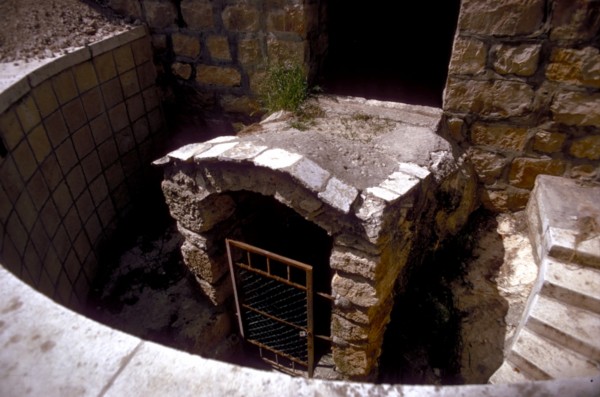
Sanhedrin, Jewish high council chambers.

The next day, Peter and John faced Annas the high priest, Caiaphas and the rest of the Sadducees, and the elders and scribes, who asked them by what power or what name they had acted. Peter, who had earlier feared these men enough to deny that he even knew the Lord, was now filled with the Holy Spirit.  In verses 8-11, with respect but also with boldness of conviction, he eloquently told them that the lame man had been healed by the name of Jesus Christ of Nazareth, whom they crucified. The reference to Jesus being the cornerstone, rejected by the builders (them) was from Psalm 118:22 and Isaiah 28:16.

After deliberating, the council knew they had no just charge to bring against them, but they warned them not to speak or teach in the name of Jesus any more.  The truth still meant nothing to the Sanhedrin.  But Peter and John would only say that they would have to judge whether it is right to listen to God or the council.  They would speak the truth.  The council gave them another warning before releasing them.  God, through Peter and John, had given these men the chance to repent and they chose to reject the Lord again.

Back with their friends they lifted their voices in prayer to God, quoting Psalm 2:1-2 in verses 25-26 and asking God to “look upon their threats and grant to your servants to continue to speak your word with all boldness.”  In verse 31, when they finished praying “the place in which they were gathered together was shaken, and they were all filled with the Holy Spirit.”  God had given His response.

Read or listen to audio of ESV version of this selection from this link.

/Bob’s boy
___________________
some images © V. Gilbert & Arlisle F. Beers

Please note: I did not design the reading plan that I am following in my blog.  All of my comments in this blog, however, are solely my responsibility.  When reading ANY commentary, you should ALWAYS refer first to the scripture, which is God’s unchanging and unfailing word. Reading schedules, as well as a link to the site where you can get the reading plan that I’m currently following for yourself can be found on the “Bible Reading Schedules” page of my website at http://graceofourlord.com.  For questions and help, please see the “FAQ” and “Summaries” pages there.

Acts 3 – Peter Speaks in Solomon’s Portico


As chapter 3 begins, we know that the Apostles had already been working miracles (Acts 2:43).  Now as Peter and John were going to the Temple, a man who had been lame from birth was carried to the gate of the Temple that was called the “Beautiful Gate,” where he was placed with enough regularity (daily) that he was familiar to the other people who came to the Temple (verse 10).  Looking to Peter and John, the man was asking for alms (gifts of charity), but instead Peter lifts him up and heals him in Jesus’ name.  The sight of the man “clinging” to Peter and John, leaping and praising God, quickly drew another multitude of people from all over.  And verse 10 says “they were filled with wonder and amazement,” as they recognized the man who had always been lame.

This model shows how Solomon's Porch, the eastern part of the Temple wall, may have looked in the time of Jesus.

This model shows how Solomon’s Porch, the eastern part of the Temple wall, may have looked in the time of Jesus.

Solomon’s Portico, according to the historian Josephus (Antiquities 20:9, section 7), was a portion of the Temple that still remained from Solomon’s time when Herod built the current Temple.  It was in this colonnade where Jesus had nearly been arrested during the Feast of Dedication (John 10:22-23), as He told the Jews that He was indeed the Son of God.  Here, Peter addresses this host of people, asking first why they are staring as if he and John had made the man walk by their own power.  He then repeats that they had “killed the Author of life, whom God raised from the dead” (verse 15), and that God had foretold it by all of His prophets.

The message is again to repent (verse 19).  In verse 13, Peter ties Jesus to the promises made to Abraham; and in verses 22 and following, he refers to the prophecies of Moses (Deuteronomy 18:15), Samuel, and all the prophets who came after them.  In verse 26, Peter saying “God, having raised up his servant, sent him to you first…,” as he alludes to the Great Commission.

Read or listen to audio of ESV version of this selection from this link.

/Bob’s boy
___________________
some images © V. Gilbert & Arlisle F. Beers

Please note: I did not design the reading plan that I am following in my blog.  All of my comments in this blog, however, are solely my responsibility.  When reading ANY commentary, you should ALWAYS refer first to the scripture, which is God’s unchanging and unfailing word. Reading schedules, as well as a link to the site where you can get the reading plan that I’m currently following for yourself can be found on the “Bible Reading Schedules” page of my website at http://graceofourlord.com.  For questions and help, please see the “FAQ” and “Summaries” pages there.


Acts 2 – Peter’s Sermon at Pentecost

At Pentecost, a priest presented two loaves of leavened bread, representing the thanks of all Israelites. It also commemorated the giving of the Law at Mount Sinai.

There were three annual feasts at which Mosaic Law required every male to be present – Passover, the Feast of Weeks, and the Feast of Tabernacles.    The Feast of Weeks was also known as the firstfruits of wheat Harvest, the Feat of Ingathering (Exodus 34:22-23, Numbers 28:26-31), and Pentecost.  Pentecost also commemorated the giving of the Law at Mount Sinai.  The day of Pentecost was the fiftieth day after Passover.  The name comes from a Greek adjective meaning “fiftieth.”  In this instance, counting up from Passover fifty days, the day fell on Sunday.  Jesus was crucified on Friday.  Appropriately, both His resurrection and the Holy Spirit immersion for the Apostles both occurred on Sunday.

The first four verses describe one of the most momentous occasions in the entire Bible.  The description of the sound and of the visual display – “rested on each one of them” – is of an awesome event, but what happened was much more magnificent than just this spectacular sensory description.  Some commentators ascribe what took place in these verses to have happened to about 120 people.  But in doing so, one has to take the context of  verse 1 (“they were all together in one place”) all the way back to the 15th verse of chapter one.  But the actual context of verse 1 is more properly associated with the verses just prior to it, particularly verse 26 – the last verse of chapter one (“And they” – the apostles – “cast lots for them, and the lot fell on Matthias, and he was numbered with the eleven apostles.”)  It is helpful to remember that the chapter divisions are not inspired, but made later by ordinary men (and sometimes in unfortunate  placement of location in the text).

This Holy Spirit baptism was for the twelve apostles, and it was expected and foretold for them alone by Jesus in several verses (Luke 24:49, John 14:26, and Acts 1:4-5, to name a few).  The power (to which Jesus referred) that it gave to them was the ability to recall all that He had taught them and finally understand the whole true meaning of His words.  It was the power to understand the full meaning of His death and resurrection, and to know with certainty the whole truth about the will of God and what is expected of us. It provided the very basis of the authority for the teaching of the Apostles from that point forward.  From this moment forward, that authority is evident in even the way they speak, for they speak for the Lord.

The significance of the Apostles speaking in other tongues on this occasion was two-fold.  First, Luke tells us in verses 5 and 9-11 that there were people from a list of nations that named most of the Roman world of the first century.  The “sound like a mighty rushing wind” and that of the twelve Apostles speaking in other languages quickly attracted a “multitude” of people, a great many of whom were amazed, as each heard them speaking in his own language.  Getting the attention of such a large number of people was undoubtedly one of the goals.  But just as importantly, what they witnessed proved that “the mighty works of God” (verse 11) being spoken of were voiced by authority not coming from ordinary men.

Tomb of David; one traditional site; Bethlehem.

Peter begins his sermon by telling them that what they were witnesses to was prophesied by Joel (Joel 2:28-32).  Then he begins telling them about Jesus, how David prophesied of his death and his resurrection without his flesh seeing corruption.  He quotes David from Psalm 110 and Psalm 16:8-11.  Then in verse 36, he tells them that they crucified the Messiah – the one that God had made “Lord and Christ.”  Verse 37 says they were cut to the heart, and wanted to know what they should do.  Verses 38-39 were the most important answer to any question ever asked:

“Repent and be baptized every one of you in the name of Jesus Christ for the forgiveness of your sins, and you will receive the gift of the Holy Spirit. For the promise is for you and for your children and for all who are far off, everyone whom the Lord our God calls to himself.”

The church was begun that very day with “about three thousand souls” being added!

Read or listen to audio of ESV version of this selection from this link.

/Bob’s boy
___________________
some images © V. Gilbert & Arlisle F. Beers

Please note: I did not design the reading plan that I am following in my blog.  All of my comments in this blog, however, are solely my responsibility.  When reading ANY commentary, you should ALWAYS refer first to the scripture, which is God’s unchanging and unfailing word. Reading schedules, as well as a link to the site where you can get the reading plan that I’m currently following for yourself can be found on the “Bible Reading Schedules” page of my website at http://graceofourlord.com.  For questions and help, please see the “FAQ” and “Summaries” pages there.

Acts 1 – The Promise of the Holy Spirit

Luke begins this book by stating that Jesus presented the Apostles with many proofs, and taught them about the Kingdom in the forty days after raising Himself.  He also repeated the fact that Jesus had ordered the Apostles to remain in Jerusalem to await the baptism of the Holy Spirit.  Verse 6 shows that they were still expecting an earthly Kingdom – for the Messiah to restore Israel to a place of power.  Not so much correcting as informing them, He tells them that they will be given power by the Holy Spirit, and will be His witnesses.  Jesus will very much still be at work through these Apostles in building His church.  After His ascension, they returned from Olivet to Jerusalem.  A Sabbath days’ journey in verse 12 refers to the maximum distance a Jew was supposed to travel on the Sabbath under Rabbinical tradition (not commandment of God) – equal to about 6/10 mile.

Jerusalem: looking east from the Hinnom Valley toward the Temple area and the Mount of Olives.

Back in Jerusalem, they devoted themselves to prayer along with the women and Jesus’ earthly brothers.  It appears that at this point, all of Mary’s sons had come around to belief (his family had even thought Him mad, and sought to seize Him in Mark 3:21).  In verses 15-20, Peter speaks to all who were in their company at the time (about 120), and spoke of the words of David through the Holy Spirit being fulfilled throughout all of the events they had witnessed since John the Baptist, and even in Judas’ betrayal.  Now it was time to select a replacement for Judas.  The scripture he quotes in this regard is from Psalm 69:25 and Psalm 109:8.  Matthias was chosen as the new Apostle.

Read or listen to audio of ESV version of this selection from this link.

/Bob’s boy
___________________
some images © V. Gilbert & Arlisle F. Beers

Please note: I did not design the reading plan that I am following in my blog.  All of my comments in this blog, however, are solely my responsibility.  When reading ANY commentary, you should ALWAYS refer first to the scripture, which is God’s unchanging and unfailing word. Reading schedules, as well as a link to the site where you can get the reading plan that I’m currently following for yourself can be found on the “Bible Reading Schedules” page of my website at http://graceofourlord.com.  For questions and help, please see the “FAQ” and “Summaries” pages there.

Opening Acts \ Week 37 summary posted

English: Papyrus fragment of the 9th century w...

English: Papyrus fragment of the 9th century written in Serto variant. A passage from the Acts of the Apostles is recognizable. (Photo credit: Wikipedia)

All through this year, we have read through God’s word with the promise of the Messiah.  Jesus came and fulfilled the prophecies we have read, and last week we read of His crucifixion and resurrection.  Now what?  Now, we turn the page to the book of Acts – traditionally called “The Acts of the Apostles.”  The book begins with Jesus’ last conversation with the Apostles.   Then as promised, the Holy Spirit comes to help them with the beginning of the church and the work of the Great Commission.

Summing Up

Each weekend, I am now posting a small PDF of one week of chapter summaries (on the website’s “Summaries” page), current to the beginning of the previous week.  I have posted the summary for Week 37 (September Week 2) of the schedule I am following.  This short PDF document contains condensed comments about John 15, 16, 17, 18, and Matthew 26, with hyperlinks to the ESV version of each chapter for listening or reading, and joins the summaries for other weeks already posted there.

/Bob’s boy
___________________
image © V. Gilbert & Arlisle F. Beers

Please note: I did not design the reading plan that I am following in my blog.  All of my comments in this blog, however, are solely my responsibility.  When reading ANY commentary, you should ALWAYS refer first to the scripture, which is God’s unchanging and unfailing word. Reading schedules, as well as a link to the site where you can get the reading plan that I’m currently following for yourself can be found on the “Bible Reading Schedules” page of my website at http://graceofourlord.com.  For questions and help, please see the “FAQ” and “Summaries” pages there.

Luke 24 – On the Road to Emmaus

(Note: for a summary of the events of this chapter from the resurrection at dawn to Jesus’ first appearances to Mary Magdalene and the other women, please see post at this link.  After the resurrection, Jesus – as He had told the disciples in Matthew 26:32 that He would meet them there – would be with them at the Sea of Galilee, and at a mountain there that He directs them to.  But several other events occur before and after this, the details of which are interspersed throughout the gospels in Matthew 28 and John 20.  And events in a single chapter are in some cases separated by days, and even weeks, as Jesus remained for forty days before the ascension.)
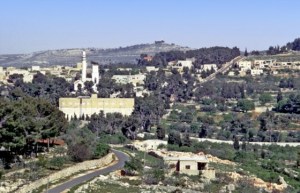
El Kubeibeh, also spelled el-Qubeibeh, is the most likely, of the four traditional sites, as the site of Bible-time Emmaus, on the road to which Jesus appeared to Cleopas and a friend after his resurrection

It is still Sunday, the day that Jesus rose; and two of His disciples were traveling to the village of Emmaus.  One was named Cleopas, but we do not know the name of the other.  We are told in verse 16 that “their eyes were kept from recognizing him” when Jesus drew near.  When He asks them about the conversation they are having, the two men proceed to tell him about Jesus of Nazareth.  They speak of how great he was, how the chief priests and rulers condemned and crucified him.  And now, they say, some women of their company had been to his tomb and found it empty – a fact which others confirmed!  They are clearly distressed.

Jesus then gave them a mild rebuke for being slow to believe what the prophets had spoken.  He then interpreted Scriptures from Moses and the prophets concerning the Christ.   As they reached the village, they urged him to stay with them, as the evening would be coming soon.  He blessed and broke bread with them, and it was at this point that their eyes were opened and they recognized him.  Jesus then vanished from their sight.

That very hour, they went back to Jerusalem and found the eleven, who confirmed to the two traveler’s that yes, Jesus has risen (verse 34) and has appeared to Simon (Peter).  No details here or in the other three gospels are given of that appearance to Peter (although Paul does speak of it in 1 Corinthians 15:5). But given Peter’s intense grief over his denial of Jesus, it was important to reach him quickly; and it was important to get to the rest of the eleven this day as well.

In the 40 days from His resurrection to his ascension to heaven, Jesus appeared many times to His disciples.

Jesus then entered while the men were talking, and they were frightened, as if He was a spirit.  He had them touch him, and even ate some fish in front of them – spending some time to assure them both that he was a living man, and the same Jesus they had known.  He then opened their minds to the Scriptures concerning Him.  Jesus then tells them a bit about the witness they will bear to the world in the great commission, but he says they must stay in Jerusalem until they are “clothed with power from on high” (the coming of the Holy Spirit in Acts).  When He tells them to stay in Jerusalem, he means after he is gone.  They will be with him at the Sea of Galilee (John 21:1), and on a mountain in Galilee that He has directed them to (Matthew 28:16) before his ascension.  Galilee is three days journey from Jerusalem.

Bethany is about two miles east of Jerusalem, on the east slope of the Mount of Olives.

Luke records Jesus’ ascension to heaven (at the end of forty days) in verses 50-53, as he leads them from Jerusalem to Bethany.  We are told in verses 52-53 that they “returned to Jerusalem with great joy, and were continually in the temple blessing God.”

Side note: Why did Jesus appear to them in Jerusalem, when He knew that they would meet Him in Galilee – and He had told Mary Magdalene and other disciples as well?  Peter and the other apostles, as well as many other disciples (witness the “road to Emmaus account) were grief-stricken, traumatized, and even afraid for their own lives (John 20:19).  Two very well-written articles that deal with this subject can be found here and here.

Read or listen to audio of ESV version of this selection from this link.

/Bob’s boy
___________________
some images © V. Gilbert & Arlisle F. Beers

Please note: I did not design the reading plan that I am following in my blog.  All of my comments in this blog, however, are solely my responsibility.  When reading ANY commentary, you should ALWAYS refer first to the scripture, which is God’s unchanging and unfailing word. Reading schedules, as well as a link to the site where you can get the reading plan that I’m currently following for yourself can be found on the “Bible Reading Schedules” page of my website at http://graceofourlord.com.  For questions and help, please see the “FAQ” and “Summaries” pages there.

John 21 – Jesus Appears to the Other Disciples

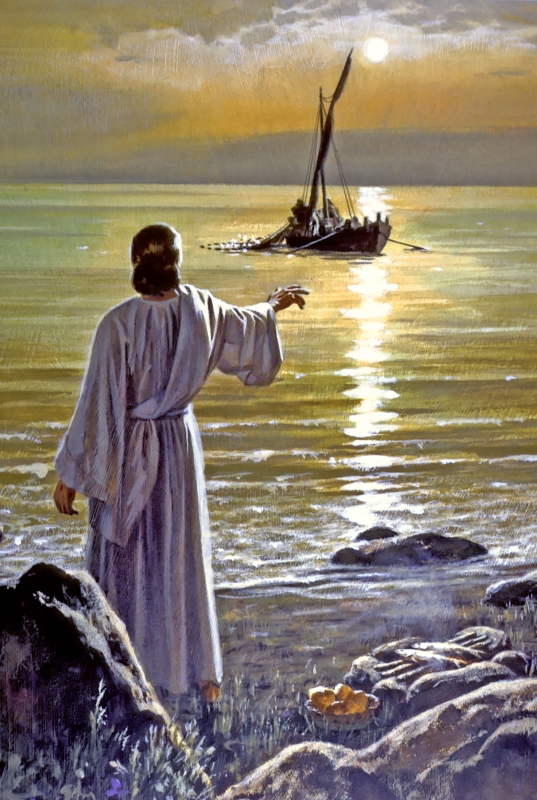
In this final chapter of John’s gospel, Jesus appears to seven of the disciples that have gone fishing on the Sea of Tiberias (Sea of Galilee).  Appearing to them 100 yards from shore at daybreak, they did not recognize Him until they cast their net out where He told them – and then were unable to haul it in, so great was the catch (verse 6).  John must have at once been reminded of the similar incident in Luke 5:4-6, as he exclaimed to Peter that “It is the Lord!”  Peter, impulsive as usual, jumps in to swim to shore while the others drag the fish with the boat.  Jesus had a fire going, and was cooking them breakfast.  There have been many attempts to make some symbolic interpretation of the number of fish they caught (153) in verse 11, but fishermen naturally counted their fish before taking them to market.  Verse 12 is simply an indication that even though they knew this was Jesus, the disciples were still getting used to the fact that He was alive again.

Verses 15-19 make up the “feed my sheep” conversation between Jesus and Peter.  Much has been written and discussed about the two different Greek words for love (agape and phileo) that are in the text.  But the two words are used interchangeably in the book of John, and even throughout the Septuagint.  It is no more valid to make something different of this than the two different words this very same text uses for “feed” and even “sheep.”  There are only two things of significance.  One is that Peter denied Jesus three times; and though it grieved Peter (verse 17) that Jesus asked him whether He loved Him a third time, Jesus knew that it would also be somewhat of a comfort to Peter later.  The command to him to “feed my sheep” came from “the Good Shepherd” Himself (John 10:11,14) for Peter and the other apostles, and is carried forward to all elders to “shepherd the flock of God that is among you” (1 Peter 5:1-4, Acts 20:28).  With verses 18-19, Jesus foretells Peter’s being bound and led to his own crucifixion.

As this gospel wraps up, “the disciple whom Jesus loved” wants us to know that Jesus did so much more while He was here than was written about.

Read or listen to audio of ESV version of this selection from this link.

/Bob’s boy
___________________
some images © V. Gilbert & Arlisle F. Beers

Please note: I did not design the reading plan that I am following in my blog.  All of my comments in this blog, however, are solely my responsibility.  When reading ANY commentary, you should ALWAYS refer first to the scripture, which is God’s unchanging and unfailing word. Reading schedules, as well as a link to the site where you can get the reading plan that I’m currently following for yourself can be found on the “Bible Reading Schedules” page of my website at http://graceofourlord.com.  For questions and help, please see the “FAQ” and “Summaries” pages there.

John 20 – Jesus Appears to Thomas

(Note: for a summary of the events of this chapter from the resurrection at dawn to Jesus’ first appearances to Mary Magdalene and the other women, please see post at this link.  After the resurrection, Jesus – as He had told the disciples in Matthew 26:32 that He would meet them there – would be with them at the Sea of Galilee, and at a mountain there that He directs them to.  But several other events occur before and after this, the details of which are interspersed throughout the gospels in Matthew 28 and John 20.  And events in a single chapter are in some cases separated by days, and even weeks, as Jesus remained for forty days before the ascension.)

In the evening of the day of the resurrection, verse 19 tells us, the disciples had the doors locked where they were “for fear of the Jews.”  But Jesus comes and stands among them.  This is not to imply that the risen Lord was now some disembodied spirit.  But a locked door was certainly no challenge to the Lord, who had raised the dead.  He showed them His hands and His side’ and in verses 21-23, John gives his account of a foretaste of the Holy Spirit to come to them when He leaves.   Verse 23 confirms what He told them in Matthew 18:18.

English: The Incredulity of Saint Thomas by Ca...

English: The Incredulity of Saint Thomas by Caravaggio. Found at http://www.christusrex.org/www2/art/images/carav10.jpg. Category:Artistic portrayals of Jesus Category:Images of paintings (Photo credit: Wikipedia)

The “doubting Thomas” verses are next as Thomas was not with the others on the above occasion.  When the others told Thomas they had seen the Lord, he said “Unless I see in his hands the mark of the nails, and place my finger into the mark of the nails, and place my hand into his side, I will never believe.”  Eight days later, Jesus again enters where they are locked in and He has Thomas do exactly those things.  When Thomas acknowledges Him as the Lord, Jesus says “Have you believed because you have seen me? Blessed are those who have not seen and yet have believed.”

Though there still remains one chapter in the gospel of John, he ends this chapter by stating that Jesus did many wondrous things that were not written in his gospel.  But he says it was written “that you may believe that Jesus is the Christ, the Son of God, and that by believing you may have life in his name.”

Read or listen to audio of ESV version of this selection from this link.

/Bob’s boy
___________________
some images © V. Gilbert & Arlisle F. Beers

Please note: I did not design the reading plan that I am following in my blog.  All of my comments in this blog, however, are solely my responsibility.  When reading ANY commentary, you should ALWAYS refer first to the scripture, which is God’s unchanging and unfailing word. Reading schedules, as well as a link to the site where you can get the reading plan that I’m currently following for yourself can be found on the “Bible Reading Schedules” page of my website at http://graceofourlord.com.  For questions and help, please see the “FAQ” and “Summaries” pages there.