Psalm 22 – Why Have You Forsaken Me?

And about the ninth hour Jesus cried out with a loud voice, saying, “Eli, Eli, lema sabachthani?” that is, “My God, my God, why have you forsaken me?”  Matthew 27:44

From Halley’s Handbook of the Bible (Halley, Henry H., Zondervan, 1961)

The Crucifixion, seen from the Cross, by James...

The Crucifixion, seen from the Cross, by James Tissot, 19th century. (Photo credit: Wikipedia)

“This sounds like a cry of anguish from David, but though written a thousand years before Jesus, it is so vivid a description of the crucifixion of Jesus that one would think of the writer as being personally present at the Cross. Jesus’ dying words (Psalms 22:1 Matthew 27:44), the sneers of his enemies (Psalms 22:7-8, Matthew 27:39-40, the piercing of his hands and feet (Psalms 22:16, John 20:25) and the casting of lots for his garments (Psalms 22:18, Matthew 27:39) are some of the events here described. None of these statements are applicable to David, or to any other known event or person in the history of mankind, except the crucifixion of the Son of God.”

Peter (Acts 2:30-35) preached: ‘David, being a prophet … he foresaw and spoke of … the Christ.’ This basic truth is reiterated again and again in the inspired New Testament.  There are than nine New Testament references which tie the meaning of this psalm irrevocably to the prophecy of our Lord’s crucifixion.  And then, regarding the resurrection, Hebrews 2:12 recounts verses 22-24.

But what of Jesus’ cry in verse one to the Lord.  Why would he speak of God forsaking Him? Burton Coffman’s summary of his thoughts on the subject ring very true:

“Jesus’ quoting the first line of this Psalm during his agony upon the Cross has led to many opinions. It has been supposed that Christ here merely quoted these words from the psalm to call attention to the whole bundle of prophecies in it which were being fulfilled literally at that very time. It is also believed by many that God Himself did indeed, for a little while, withdraw his presence from Christ in order to make it possible for Christ to die. There is much in the sacred Scriptures to commend this view.

Christ is spoken of in Heb. 2:9 as the One, who by the grace of God did indeed, ‘Taste of death for every man.’ Isaiah tells us that, ‘God laid upon him (Jesus) the iniquity of us all’ (Isaiah 53:6). Paul mentioned that God Himself ‘Set forth the Christ to be a propitiation’ (Romans 3:25), or an atonement, for the sins of all men. ‘Christ died for our sins’ (1 Corinthians 15:3); and ‘Him (Christ) who knew no sin, God made to be sin on our behalf; that we might become the righteousness of God in Him’ (2 Corinthians 5:21).

The ultimate consequence of sin is separation from God; and, in Christ’s becoming a substitute for sinful men upon the cross, he not only tasted of death, but also tasted the terrible consequences of sin in that soul-torturing experience of separation from the Creator. It is our understanding of Christ’s plaintive cry, ‘My God, why hast thou forsaken me,’ that Jesus did indeed, momentarily, taste the awful agony of separation from the Father. ‘For a moment in that last agony, the Perfect Man was alone with the sins of the whole world.'”

Read or listen to audio of ESV version of this selection from this link.

/Bob’s boy
___________________
some images © V. Gilbert & Arlisle F. Beers

Please note: I did not design the reading plan that I am following in my blog.  All of my comments in this blog, however, are solely my responsibility.  When reading ANY commentary, you should ALWAYS refer first to the scripture, which is God’s unchanging and unfailing word. Reading schedules, as well as a link to the site where you can get the reading plan that I’m currently following for yourself can be found on the “Bible Reading Schedules” page of my website at http://graceofourlord.com.  For questions and help, please see the “FAQ” and “Summaries” pages there.

A Soft Answer Turns Away Wrath

How often is our own anger provoked by someone else that makes us feel insignificant – that our worth counts for nothing?  We would do well to remember this when we encounter someone whose wrath is obvious in both their demeanor and tone.  Consider Gideon’s response to the men of Ephraim in Judges 8:1-3 when they complained that he had only called them out belatedly.  But Gideon’s praise of their accomplishments turned away they wrath.

David and Jonathan were best friends, but Jonathan's crippled son Mephibosheth could have claimed his grandfather Saul's throne. Despite that, David was kind to him, and brought him into the palace to live (2 Samuel 9).

David and Jonathan were best friends, but Jonathan’s crippled son Mephibosheth could have claimed his grandfather Saul’s throne. Despite that, David was kind to him, and brought him into the palace to live (2 Samuel 9).

Now look instead to David’s encounter with Nabal in 1 Samuel 25:10-13, where he insulted David and his mighty men.  It was only Abigail’s soft and wise words in 1 Samuel 25:23-30 that quieted David’s anger, and kept him from doing what he would surely come to regret.

Sometimes the soft answer that is needed in such situations is simply that of kindness.  Everyone wants and deserves to feel that they are important – that what they need, and what they feel matters.  It does matter to God.  It mattered to Jesus (Matthew 7:12).  Shouldn’t it matter to us?

Read or listen to audio of ESV version of this selection from this link.

/Bob’s boy
___________________
some images © V. Gilbert & Arlisle F. Beers

Please note: I did not design the reading plan that I am following in my blog.  All of my comments in this blog, however, are solely my responsibility.  When reading ANY commentary, you should ALWAYS refer first to the scripture, which is God’s unchanging and unfailing word. Reading schedules, as well as a link to the site where you can get the reading plan that I’m currently following for yourself can be found on the “Bible Reading Schedules” page of my website at http://graceofourlord.com.  For questions and help, please see the “FAQ” and “Summaries” pages there.
Proverbs 14 – A Scoffer Seeks Wisdom in Vain

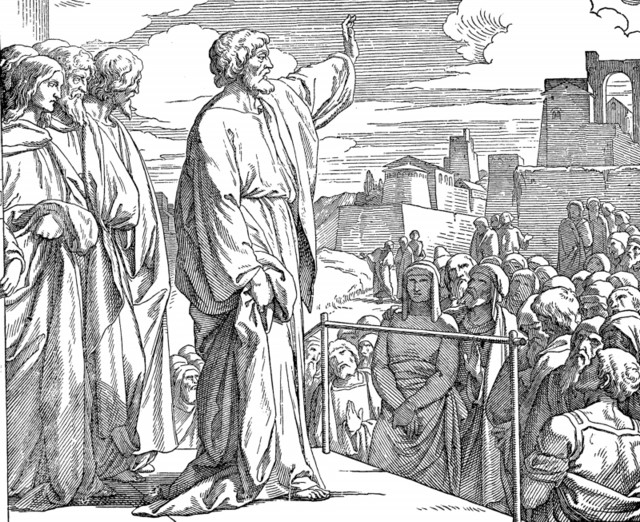
Paul preaches on Mars' Hill.

Paul preaches on Mars’ Hill.

Verse 6 of Proverbs chapter 14 states that “A scoffer seeks wisdom in vain, but knowledge is easy for a man of understanding.”  It is one of the great curiosities, and one could also say tragedies, of human nature that men have often come into a position in which they could gain real knowledge if not for their own pride.  Herod had a great opportunity, and Luke 23:8 tells us that he was even glad when he saw Jesus, “for he had long desired to see him, because he had heard about him, and he was hoping to see some sign done by him.” But instead he treated Him with contempt and mocked him.  He could have had answers to all that matters, but he came away with nothing.  One could also point to some of those at the Areopagus on the occasion of Paul’s address in Acts 17:16-28.

Those who insist on leaning upon their own understanding risk being doomed to the same fate as any fool.  Jesus, speaking of his parables in Matthew 13, quoting Isaiah 6:9-10 said “You will indeed hear but never understand, and you will indeed see but never perceive.”

Read or listen to audio of ESV version of this selection from this link.

/Bob’s boy
___________________
some images © V. Gilbert & Arlisle F. Beers

Please note: I did not design the reading plan that I am following in my blog.  All of my comments in this blog, however, are solely my responsibility.  When reading ANY commentary, you should ALWAYS refer first to the scripture, which is God’s unchanging and unfailing word. Reading schedules, as well as a link to the site where you can get the reading plan that I’m currently following for yourself can be found on the “Bible Reading Schedules” page of my website at http://graceofourlord.com.  For questions and help, please see the “FAQ” and “Summaries” pages there.

Job 3 – Whatever I dread befalls me

Job finally breaks the silence of the last week as it would seem he can no longer bear it.    We have no way of knowing what has been going through his mind in the last week, but surely he has been tempted to turn his anger toward God.  Still, he does not sin and curse God, as God  in His wisdom already knew he would not.  True enough that he did greatly lament his own birth, but even the great prophet Jeremiah did so (Jeremiah 20:14-18) in his sorrow over his persecution.

Still, it is all too easy for us to be tempted to judge Job and others, for who among us has not himself suffered?  And is our suffering not just as severe for us at times?  When we have been hurt, do we cry out and long for death?  If we do not, does that make our grief and pain less significant?

We all do suffer – some more than others – at times, and if we are truthful, as great as our pain may be; and as bad as it may get for many of us, it is doubtful that we go through the degree of anguish and pain that Job has already experienced in the first two chapters of this book.

Job's happy days.

Job’s happy days.

But who is anyone else to judge this, and what yardstick will they use to do so?  That of what we read of Job – or (more likely) their own?  We will get to know Job’s friends much better in the coming days, but if you cut through all of the criticism that we and others direct at those friends (and truly they will show their own flaws as well), we should not lose sight of the fact that they came and stayed with Job when he was at his lowest, spoke not a word until he spoke, and only now will speak as they believe they may be able to help him understand why these terrible things have happened to him – as well how he might “fix it.”

Our desire to think of ourselves as compassionate, and “being there” for our friends as Job’s three friends are there is admirable, but we must not presume to “know how they feel.”  No matter how seemingly large or small the trial or pain, no two people handle grief, depression, or pain in the same way.  All Job knows, is that when all that he has lost began to go wrong, it just kept coming!  And his worst fears and dreads became realized again and again (verse 25-26):

“For the thing that I fear comes upon me,
and what I dread befalls me.
I am not at ease, nor am I quiet;
I have no rest, but trouble comes.”

Re: Job 2:10 “In all this Job did not sin with his lips.”  He epitomized Jesus’ words; and with of all their faults, Job’s friends did show compassion, for as much as he still obeyed Matthew 22:37 (cited from Deuteronomy 6:5), they demonstrated their love for him as in Matthew 22:39: “You shall love your neighbor as yourself.”  

Read or listen to audio of ESV version of this selection from this link.

/Bob’s boy
___________________
some images © V. Gilbert & Arlisle F. Beers

Please note: I did not design the reading plan that I am following in my blog.  All of my comments in this blog, however, are solely my responsibility.  When reading ANY commentary, you should ALWAYS refer first to the scripture, which is God’s unchanging and unfailing word. Reading schedules, as well as a link to the site where you can get the reading plan that I’m currently following for yourself can be found on the “Bible Reading Schedules” page of my website at http://graceofourlord.com.  For questions and help, please see the “FAQ” and “Summaries” pages there.

Psalm 8 – How Majestic Is Your Name

Isaac Watts wrote hymns from this psalm. It is also a great example of chiastic structure (ABC, CBA). The first sentence and last are identical.  Sandwiched in between, first comes God’s greatness, followed by the main points in verses 4 and 5, and then man’s position in the world because of God.   It is also a great passage written about God’s created man that is so easily applied to Jesus – this time by the Hebrew writer (Hebrews 2:6-8).  Jesus quotes verse two (“out of the mouths of babes”) in Matthew 21:16, when the chief priests and scribes became indignant from the shouts of the children of “Hosanna to the Son of David!” when he cleansed the Temple after his triumphal entry.

moneychangers

Jesus cleanses the temple; throwing moneychangers out and upsetting the tables with animals and birds –John 2: 12-22.

Verse two also clearly indicates that the psalmist’s praise to God comes on the heels of some victory over foes, but the psalm praises God’s majesty because of his creation of the heavens and the moon and stars which he set in place (Genesis 1:17).   Then he expresses wonder that this same great God made man “a little lower” than the heavenly beings (Genesis 1:26), and gave him dominion over all his works.

But Hebrews 2:10 ties both Old and New Testament together with such grace and beauty that we can only marvel:

For it was fitting that he, for whom and by whom all things exist, in bringing many sons to glory, should make the founder of their salvation perfect through suffering.

Read or listen to audio of ESV version of this selection from this link.

/Bob’s boy
___________________
some images © V. Gilbert & Arlisle F. Beers

Please note: I did not design the reading plan that I am following in my blog.  All of my comments in this blog, however, are solely my responsibility.  When reading ANY commentary, you should ALWAYS refer first to the scripture, which is God’s unchanging and unfailing word. Reading schedules, as well as a link to the site where you can get the reading plan that I’m currently following for yourself can be found on the “Bible Reading Schedules” page of my website at http://graceofourlord.com.  For questions and help, please see the “FAQ” and “Summaries” pages there.

Job 2 ( or Just When You Thought Things Were Bad Enough…)

"Job covered in boils" - from Martin Luther's Bible

“Job covered in boils” – from Martin Luther’s Bible

The opening of the second chapter of Job is exactly as written in Job 1:6-8.  These encounters between God and Satan, especially when one interjects the “sons of God,” are the subject of lots of varying interpretations among commentators; and trying to sort through those may well overwhelm you as much as it does this blogger.  Some see these “sons of God” as angels, and some see them as worshipers.  It is pointed out that in no part of the scriptures does it say that these events take place in heaven.  The righteous are said to come before the Lord every time we worship him.  It is also true that Jesus said that the angels see the face of God every day (Matthew 18:10), so they would hardly need to “present” themselves before Him.

Matthew Poole saw these encounters between God and Satan as parabolic, and it is also possible that he could be partially right about that.   But the question in the end is – Does it really matter?  Okay so here, admittedly, is one more opinion.  <Insert disclaimer here> The discourse between God and Satan is told in the word of God by His inspired writer, just as a prophet would tell us in a book that is both history and poetry.

The conversations between God and Satan in Job have three purposes in my view.  First, they tell us that Satan is a real adversary.  (“Be sober-minded; be watchful. Your adversary the devil prowls around like a roaring lion, seeking someone to devour.” 1 Peter 5:8).   Secondly, they serve to demonstrate that although God does not cause us to suffer, it is not His will to prevent evil from be-falling us at all times.  Third,  they assure us that Satan’s power is not unlimited.  God does have dominion over him.

So Satan struck Job with “loathsome sores” (some versions say “boils”) literally from head to toe.  Attempts have been made to assign a medical condition using the description of the breath and other symptoms in other chapters.  But again, does it matter?  The point is that he was in so much agony that he was using broken pottery to “scrape” himself (verse 8).  And he was so disfigured that his three friends (Eliphaz, Bildad, and Zophar, who we will get to know better) did not even recognize him, cried when they saw how bad he really was, and sat with him for a week without anyone even speaking.

The question of why Satan did not take the life of Job’s wife is answered in verse nine, as she tries to persuade Job to curse God, to give up, and to take his own life.

We will resume Job’s story next Thursday.  I think I need me some Psalms and Proverbs before then.

Read or listen to audio of ESV version of this selection from this link.

/Bob’s boy
___________________
some images © V. Gilbert & Arlisle F. Beers

Please note: I did not design the reading plan that I am following in my blog.  All of my comments in this blog, however, are solely my responsibility.  When reading ANY commentary, you should ALWAYS refer first to the scripture, which is God’s unchanging and unfailing word. Reading schedules, as well as a link to the site where you can get the reading plan that I’m currently following for yourself can be found on the “Bible Reading Schedules” page of my website at http://graceofourlord.com.  For questions and help, please see the “FAQ” and “Summaries” pages there.

Proverbs 11 – The Integrity of the Upright

For helpful tips on reading the Book of Proverbs, see this previous post.

This is our day of the week for Proverbs this year, and today it is to Proverbs Chapter 11 that we turn.  And it is on three verses that we will focus. Verses 3, 5, and 6 all seem to say the same thing; and in truth they all convey much the same meaning, but there are some differences.  Let’s examine them all three, and then we’ll try to tie them all together.  First, let’s look at verse three:

“The integrity of the upright guides them,
but the crookedness of the treacherous destroys them.”

integrity

integrity (Photo credit: glsims99)

Integrity is a characteristic of the upright (those who live their lives according to God’s will).  It is that integrity which guides them in their daily lives.  The crookedness of the unfaithful is the converse.  The lack of integrity (here, “crookedness”) is a characteristic of those who are treacherous (the NKJV, the unfaithful).  That lack of integrity will destroy them.  Now verse five:

“The righteousness of the blameless keeps his way straight,
but the wicked falls by his own wickedness.”

None of us are truly “blameless” in the sense of being without sin.  What it means here is living a life that is above reproach – living in such a manner that would encourage others to serve God, rather than being a stumbling block.  Righteousness is being justified by the grace of Jesus Christ (Romans 3:20-24).  It is not earned, but it is freely given.  We can fall away from that righteousness (Romans 11:22, Galatians 5:4), but it is that righteousness that will keep the “blameless” on the right path. The wicked, on the other hand, fall by their own wickedness (more about that in a moment).  Finally, verse 6:

“The righteousness of the upright delivers them,
but the treacherous are taken captive by their lust.”

The grace of the Lord saves those who live according to His word.  But the treacherous are taken captive by their lust.  The NKJV substitutes “unfaithful,” but the “treacherous” defines it better – those who deceive, who pretend to have integrity, but secretly do not live that way.

cross-005Integrity is a commodity that seems to be in short supply at times.  But is integrity in every detail of our lives important?  What would you do for a million dollars?  Is your integrity for sale?  Sadly, the answer for many is yes.  Especially when it comes to “little things.”  A little “white lie” is sometimes necessary, right?  And so what if I really knew the clerk at the big store chain gave me too much money back?  Not my fault their employees can’t count change, is it?  But Jesus gave us the truth about this in Luke 16:10: “One who is faithful in a very little is also faithful in much, and one who is dishonest in a very little is also dishonest in much.

There are few people who want to be thought of by others as lacking in integrity.  So most people at least pretend to have it.  By the same token, even those that have wicked or deceptive intent, do not want to be thought of as such by others.  And so, the wicked, the deceivers, the unfaithful sometimes live out lives for a long time fooling many of the faithful (and the unfaithful as well) into believing they are something they are not.  But they are trapped by their own lust – their own wickedness brings them down.

Psalm 7:14-16 tells us how it comes about, speaking of the wicked who conceive evil and give birth to lies:

“He makes a pit, digging it out,
and falls into the hole that he has made.
His mischief returns upon his own head…”

Read or listen to audio of ESV version of this selection from this link.

/Bob’s boy
___________________
some images © V. Gilbert & Arlisle F. Beers

Please note: I did not design the reading plan that I am following in my blog.  All of my comments in this blog, however, are solely my responsibility.  When reading ANY commentary, you should ALWAYS refer first to the scripture, which is God’s unchanging and unfailing word. Reading schedules, as well as a link to the site where you can get the reading plan that I’m currently following for yourself can be found on the “Bible Reading Schedules” page of my website at http://graceofourlord.com.  For questions and help, please see the “FAQ” and “Summaries” pages there.

Proverbs 10 – Integrity and Love

Today, we begin our weekly Tuesday reading of the chapters in Proverbs which look more like what we would expect from the book.  Chapter 10 has 32 verses; but for today, this blog will look closer at just three that deal with integrity and love. For tips on getting the most out of Proverbs, see this previous post.

“Whoever walks in integrity walks securely,but he who makes his ways crooked will be found out.” (Proverbs 10:9)

heart001If we consistently try to do the right thing in all situations, refusing to compromise on truth, honor, and good will toward others, it fosters a peace within us.  When we know that our intentions are pure, our conscience gives us serenity.  We know that we will bring no justifiable harm upon ourselves because of our own actions, nor will we be as likely to bring others to harm.  But, as 1 Timothy 5:25-26 agrees, those who scheme and connive, who try to hide their corrupt actions and their deceitful heart cannot keep such a secret forever.  How many times in the last few years have we known of someone, famous or not so famous, whose scandalous behavior over a period of years finally came out?  The shame they brought upon themselves was bad enough, but what about the people close to them that were hurt?  Integrity matters – to God, and to us.

“Hatred stirs up strife, but love covers all offenses.” (Proverbs 10:12)

“The one who conceals hatred has lying lips, and whoever utters slander is a fool.” (Proverbs 10:18)

It is easy to move many people to discord, gossip, and to be hurtful to one another by our own hateful thoughts, words, or actions. Sometimes people do so without realizing they are doing wrong.  It is a matter of the heart; and the cure is love. James 5:20 and 1 Peter 4:8 repeat that “love covers a multitude of sins.”  When we seek to think of, and to do good to, others in a manner that shows we truly care about them, that love affects us  as well.  The reason that “love covers all offenses” is that it changes us – our hearts, our minds, and our lives.  It makes us better and happier men and women.  It was this wisdom that Jesus was trying to convey when he said that loving your neighbor was the second greatest commandment in Matthew 22:37-39.

The first part of verse 18 makes it clear that it is not enough to just hide ones hatred for someone and keep ones mouth shut about it.  Your words then betray you and make you worse than a mere hater, because you become a liar as well.  The change must come from within the heart.  The second part of the verse (“whoever utters slander is a fool”) ties the two verses together.  The answer is not to just “let it all out” and speak ill of those for whom you hold ill will, for by doing so, you harm them as well as yourself.

Wisdom demands that we examine our own thoughts and actions, and let the Lord speak to us through His word, helping us to shape our lives and our hearts.  What can we do this week to show someone we care about them?

Read or listen to audio of ESV version of this selection from this link.

/Bob’s boy

Please “like” us on Facebook at  https://www.facebook.com/bobsboy01

___________________
some images © V. Gilbert & Arlisle F. Beers

Please note: I did not design the reading plan that I am following in my blog.  All of my comments in this blog, however, are solely my responsibility.  When reading ANY commentary, you should ALWAYS refer first to the scripture, which is God’s unchanging and unfailing word. Reading schedules, as well as a link to the site where you can get the reading plan that I’m currently following for yourself can be found on the “Bible Reading Schedules” page of my website at http://graceofourlord.com.  For questions and help, please see the “FAQ” and “Summaries” pages there.

Proverbs 6 – Practical Warnings

English: The signature of John Hancock on an e...

English: The signature of John Hancock on an envelope. Restored by Jim S. (Photo credit: Wikipedia)

The first five verses of this chapter deal with the issue of putting up security for someone else.  This would be today’s equivalent of co-signing a note for someone.  Certainly, many of us have done this sort of thing for one of our children; and the verses are not saying that putting up security like that even for someone other than our children is sinful – or even morally wrong.  But it is certainly unwise, and so much so, that the reader is urged to get out of it at once. In verse 2, being “snared in the words of your mouth” are the same as putting one’s signature on a promissory note.

Getting out of such an obligation these days is not so simple, but the point is – a wise person would not obligate himself in such a manner.  Doing so places one – and maybe also one’s own family – in peril of great loss, at the mercy of someone who ultimately may have nothing to lose (the actual debtor).  And if that becomes a reality, we have only helped them bring damnation upon themselves by not doing the right thing!  If we want to, and can afford to help someone out, give them a generous gift instead.  Such is wiser, and certainly approved of by the Lord.

Verses 6-11 warn us that laziness and being unprepared can result in great poverty, while verses 12-15 admonish that evil behavior such as knowingly cheating others will “catch up” with such a person, and often in a horrific way (certainly to be the case after life’s end).  Verses 16-19 list seven things that God finds truly despicable.  Read through these, and notice that every one of them is a deed that is bound to bring harm to others.  God cares deeply about how we treat each other.  That fact resonates in book after book, and chapter after chapter of His word; and Jesus makes that clear in Matthew 7:12 and Mark 12:30-31. Verses 20-35 are more warnings against sexual immorality in general, and adultery in particular.


Read or listen to audio of ESV version of this selection from this link.

/Bob’s boy
___________________
some images © V. Gilbert & Arlisle F. Beers

Please note: I did not design the reading plan that I am following in my blog.  All of my comments in this blog, however, are solely my responsibility.  When reading ANY commentary, you should ALWAYS refer first to the scripture, which is God’s unchanging and unfailing word. Reading schedules, as well as a link to the site where you can get the reading plan that I’m currently following for yourself can be found on the “Bible Reading Schedules” page of my website at http://graceofourlord.com.  For questions and help, please see the “FAQ” and “Summaries” pages there.

Proverbs 5 – Warning Against Adultery

After the opening verses, again admonishing the reader to both hear and to understand, the chapter immediately begins its warning against sexual promiscuity.  Most people rightly see the particular application to young people.  But the message to parents is somewhat more subtle if one does not focus on it.  Take verse 23 in particular: “He dies for lack of discipline.”   Nothing should be more sobering to parents than this warning about how much is at stake.

Bible-time weddings were festive occasions, sometimes lasting a week or more, with great celebration and joy.

Bible-time weddings were festive occasions, sometimes lasting a week or more, with great celebration and joy.

Our young people today more than ever grow up in a world that is rich in media that glorifies sexual immorality, with role models and adults in positions of authority that do little to contradict (and most often, reinforce) this outlook.  It is the job of the parent to educate the souls of the little ones entrusted to them concerning the intention God has for right use of the sexual relationship – between a husband and wife.   Verses 15-20 (“Drink water from your own cistern…” and “…let them be for yourself alone…””) remind of Jesus in Matthew 19:4-5, quoting Genesis 2:24: “the two shall become one flesh.”

Read or listen to audio of ESV version of this selection from this link.

/Bob’s boy
___________________
some images © V. Gilbert & Arlisle F. Beers

Please note: I did not design the reading plan that I am following in my blog.  All of my comments in this blog, however, are solely my responsibility.  When reading ANY commentary, you should ALWAYS refer first to the scripture, which is God’s unchanging and unfailing word. Reading schedules, as well as a link to the site where you can get the reading plan that I’m currently following for yourself can be found on the “Bible Reading Schedules” page of my website at http://graceofourlord.com.  For questions and help, please see the “FAQ” and “Summaries” pages there.