Matthew 7 – The Sermon on the Mount – part 3

Verse 1 is one of the few verses that many people who know little else about the Bible are familiar with; and it is wrongly used both as self-justification and to rebuke criticism of wrong-doing.  The verse denounces compassion-less condemnation and hypocritical judgment of others – not any judgment at all.  In fact, verse 6 requires judgment on our part, and if we could not judge at all, how could we ever determine what was right or wrong.  The problem also comes into play when people want to put us on the spot, asking if we believe one person or even a group of people will go to heaven.  Thank the Lord that such judgment is not our responsibility!  It sometimes takes tremendous courage to speak up to someone who is doing wrong.  You run the risk of hurting their feelings or more likely, making them angry – and even alienating yourself from people you care about.  But if you believe that someone is living in a way in which they risk losing their soul and you say nothing, is that not terribly wrong of you?

Verse 6 simply means that there comes a time when, try as we might, we must realize that we are not going to be able to persuade some people to serve the Lord, and we must move on.  Verses 7-11 do not make God the vending machine of prayer that grants every wish if we just ask for something.  Not all things we wish for are best for us or for His purposes. Certainly God answers prayers, and many times, that answer from our perspective is “yes,”  – other times we must be patient and see that His way is better for all in the long-term scheme.   But the good gifts spoken of here are more spiritual in nature, as Jesus is making the point that the kingdom is open to all, and not just a select few.

The Golden Rule of verse 12 should come naturally to those who love the Lord with all their heart, and their neighbor as themselves.  Verses 13-14 mean that though the way to heaven can be difficult with all of the temptation around us, the other way – the easy way – leads to destruction. Verses 15-20 are great advice for knowing who the many false prophets are – just like a good tree or a bad tree, you will know by their fruits.  What is the result of their influence on others?  This will always show the truth of the matter.

Verses 21-23 do not refer to people who are completely lacking in religious fervor.  The key point is the latter part of verse 21 “the one who does the will of my Father who is in heaven.”  There are many who do great works and genuinely consider themselves to be righteous, but have never fully submitted to the Lord’s authority.  Partial obedience, or subverting God’s commands to fit  man’s own desires has never been good enough, and never will be – it is still disobedience (see James 2:8-11).  Note that those referred to in those verses listed the works that they had done, missing the point entirely concerning where salvation comes from. It comes from the Lord’s grace, and that grace does not negate the requirement for full obedience!

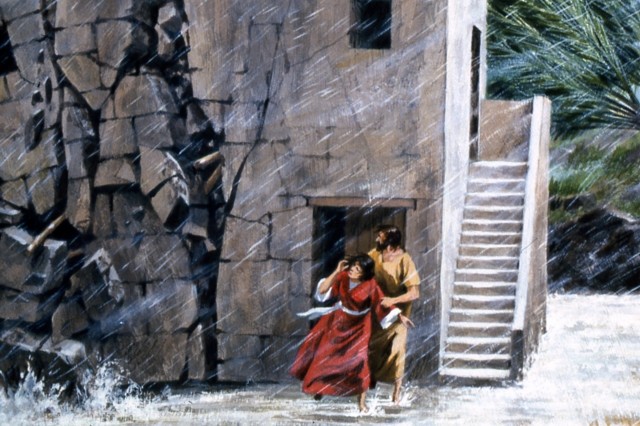
Most everyone who went to Bible class as a child knows something of the story of the wise man who built his house on the rock,  and the foolish man who built on the sand.  As Jesus concludes this powerful sermon, He uses this analogy to demonstrate that all of things that He is teaching us in this sermon constitute the foundation for the “house” that we are building with our lives.  By using all of these principles, we are building on a solid foundation (rock).  Ignoring some of them, we will still get the house built, and it may appear to be fine.  But when the storms of life come, the lack of a solid foundation may well result in disaster – and the final outcome (the eternal one) will certainly be a great fall.

Read or listen to audio of ESV version of this selection from this link.

/Bob’s boy
___________________
some images © V. Gilbert & Arlisle F. Beers

Please note: I did not design the reading plan that I am following in my blog.  All of my comments in this blog, however, are solely my responsibility.  When reading ANY commentary, you should ALWAYS refer first to the scripture, which is God’s unchanging and unfailing word. Reading schedules, as well as a link to the site where you can get the reading plan that I’m currently following for yourself can be found on the “Bible Reading Schedules” page of my website at http://graceofourlord.com.  For questions and help, please see the “FAQ” and “Summaries” pages there.

Matthew 5 – The Sermon on the Mount

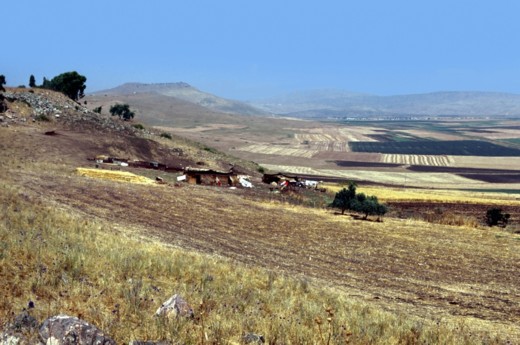
Though we do not really know the location, the Horns of Hattin (above) is one traditional site of the Sermon on the Mount.

Matthew 5 begins what we know as the Sermon on the Mount, and is certainly the best sermon of all time (it is, after all, quite literally the Word from God).  Volumes have been written about chapter 5 alone, so this blog certainly cannot do an adequate job of commentary, but neither should it skip quickly through it.  One can study it over and over and learn something new about being a part of His kingdom each time, and apply it to virtually any question about sin.  Matthew 4:23-25 tells us to some extent how much the Lord’s fame had spread as he taught, proclaimed the gospel, and healed the afflicted – and we can get some idea of the “great crowds” that had begun following Him.  Many of them were hoping for a much different king, and an entirely different type of kingdom, than that which Jesus was proclaiming; but He well described that kingdom to Pilate in John 18:36.

Verses 3-12 contain what we refer to as the Beatitudes.  The translation of the word “blessed” in these verses is confusing to some, as it varies from “happy” to “fortunate.”  “Fortunate” is closer to the real meaning here (someone who is “mourning,” for example, could hardly be described as “happy”), and it relates more to a state of being in a relationship with God that results from His approval.  None of the qualities in these statements refer to a condition that people are born with, inherit, or come by naturally.  Nor are they intended as prescriptions for behavior, some of which the unconverted world at large can simply adopt for the good of mankind.

These are traits of character and attitude that reflect the qualities that Christians must have.  But they are not, as some have suggested, lofty goals – all of which no one person could possibly achieve.  In each one, Jesus says “Blessed are.. ,” indicating that there are people who have these qualities, and that we can ourselves be the people that he describes – that we as Christians, in fact, must be those people.  Yet, we must understand that while having these qualities is what defines us as His people, our place in His kingdom is not something we earn by doing so.  It is, in fact, our full understanding of that fact which enables us to have those qualities in the first place.  It is the understanding that it is only by His grace – totally undeserved on our part – that we have salvation (Ephesians 2:8).  But it is also our commitment to putting the needs, and even the importance of other people above that of our own that must shape our lives.  All of these beatitudes illustrate these two facts, and point clearly to what Jesus Himself said are the two greatest commandments (Matthew 22:35-40).

“Blessed are the poor in spirit, for theirs is the kingdom of heaven”

The “poor in spirit” refers to a condition of the heart much like the tax collector in the parable Jesus tells in Luke 18:11-14.  The latter part of verse 14  says it well – “everyone who exalts himself will be humbled, but the one who humbles himself will be exalted.”  It is likewise the same realization that Job came to when he at last got his audience with God in Job 42:1-6 – that our we are nothing compared to our Creator.

“Blessed are those who mourn, for they shall be comforted”

This refers to same sort of godly grief that comes from the remorse for our disobedience to God personally, as in 2 Corinthians 7:9-11, as well as mourning for the sins of others, as in Psalm 119:136.

“Blessed are the meek, for they shall inherit the earth”
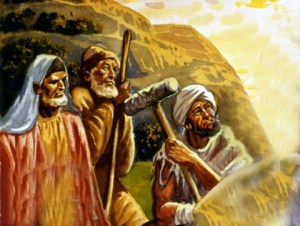
Men listening to Jesus’ Sermon on the Mount

Unfortunately, most people translate meekness into weakness, but that is not what is meant here.  This meekness comes from the conscious decision to control even one’s own strength because of a redirected purpose – that of serving God, and of being genuinely concerned for the salvation of others, instead of serving ourselves.  It is the antithesis of being overly concerned (and sometimes even obsessed) about personal advancement or correcting a perceived injustice to ourselves – to the detriment of others.  They will “inherit the earth” because they put their trust in God, rather than themselves, even if that means being gentle at times when they could use force instead (Psalm 37:11-13).

“Blessed are those who hunger and thirst for righteousness, for they shall be satisfied”

Few that will read this have ever known the sort of immense hunger that comes from being deprived of food for a very long time, but it is this sort of very deep hunger and thirst that is referred to here.  When one becomes a Christian, he commits himself to being a new creature, putting his old pursuit of life behind him (2 Corinthians 5:17), and then thirsts for knowledge and righteousness that comes from the right relationship with God (Romans 12:2).  It is the kind of thirst spoken of in Psalm 42:1-2.

“Blessed are the merciful, for they shall receive mercy”

The mercy referred to here is the sort of mercy Jesus taught in the parable of the unforgiving servant (Matthew 18:23-35), as well as the mercy that equates to compassion, as in the parable of the good Samaritan (Luke 10:25-37).

“Blessed are the pure in heart, for they shall see God”

This purity in heart is what Jesus speaks of in Matthew 15:18-20, and is the sort of sincere devotion to striving for good that we are encouraged to emulate in Philippians 4:8.

“Blessed are the peacemakers, for they shall be called sons of God”

This does not refer to those who settle disputes or conflicts with others, though that sort of peace certainly may be a bi-product of it.  But the word used for peace, shalom, had a much more meaningful usage.  Here it relates not just to striving to be without conflict, but a deep and compassionate desire to instill well-being in one’s self, and especially in others, by having a right relationship with God (Colossians 3:12-15) that encourages others to do the same.  We have peace with God through Jesus (Romans 5:1), and it is in Him through which we are all sons of God (Galatians 3:26).

“Blessed are those who are persecuted for righteousness’ sake, for theirs is the kingdom of heaven”

Jesus used a parable about a Good Samaritan to teach about mercy

Those who serve the Lord have been hated by others for all time.  Genesis 3:15 tells us that it will be that way as the Lord put enmity (a condition of hostility and animosity) between the devil’s offspring and us.  That enmity was there throughout the Old Testament just as with Cain and Abel.  It was there at the time of Jesus, as Herod and others later even sought to kill the Son of God; and that hostility non-believers have for God and His people is still in evidence today.  Jesus named them for who they serve in John 8:44; and Paul explains in Romans 8:7 that those who are hostile to God cannot submit to His law.  This is at the root of their animosity toward God’s people.

Verses 13-16 are referred to as the Similitudes, comparing Christians to salt and light.  The salt they were familiar with would not have come from the round box with a metal spout, but probably from the Dead Sea, containing much impurity that over time would have the salt leached out.  Jesus says that Christians are the salt of the earth.  One way that we can lose our effectiveness (the savor) as such is by allowing our worship, and even the preaching of the Gospel itself, to become watered down by compromising in it so that we may please men, rather than remaining true to God’s commands.  We remain the light of the world by staying true to His commands and letting the world see the results of the beatitudes in our lives.  Verse 20 would be a fairly shocking statement, as the Pharisees certainly would have considered themselves to be the most righteous of all.

Verses 21-30 tell us that although murder and adultery both are certainly wrong, sin is a problem of the heart (going back to the 6th beatitude) as well.  When we allow anger and lust to take it over, we have sinned.  In verses 29-30, tearing an eye out or cutting a hand off are not literal suggestions (one could still lust with one eye, after all).  The verses illustrate how important it is to remove ourselves completely from anything that makes us prone to fall away from the Lord.

Verses 31-32 make it clear that God takes the marriage relationship very seriously; and as Matthew 19:3-9 states, God intended from the beginning for that relationship to be between one man and one woman forever.  Unfortunately, many people have considered the entire lesson of verses 33-37 to be that one should not take an oath, even in a judicial circumstance.  While a Christian should consider that carefully in his heart, that does not seem to be the point that Jesus was making.  Look further – in Matthew 23:16-22 – and consider that the Pharisees distinguished one oath from another, in order to excuse being deceptive – as if a lie would actually not be a lie if that by which you swear was not counted as binding.  If people have to constantly wonder whether or not something one says may be true, one is hardly demonstrating that he hungers and thirsts after righteousness.

One should not take verses 38-42 to mean that there is never an appropriate time to take action or defend against evil.  Once again, a proper reading of  the rest of the New Testament will demonstrate that such is not the case.  But the Pharisees had corrupted the Old Testament law to extend the right of personal revenge to new heights.  Instead, Jesus teaches (and Paul states it well in Romans 12:17-21) that we should not resist evil with evil, but we rather overcome evil with good.

This magnificent chapter concludes in verses 43-48 with the command that we should love even our enemies, and even pray for those who persecute us.  Apart from the fact that it is the right thing to do, and that it is commanded by God, this just makes good sense when we think about it.  If we truly pray for the salvation of those who do wrong to us, we are praying for their hearts and lives to become blessed as in the beatitudes of this chapter.  If that prayer is granted, how could that person continue to do us evil!

Read or listen to audio of ESV version of this selection from this link.

/Bob’s boy
___________________
some images © V. Gilbert & Arlisle F. Beers

Please note: I did not design the reading plan that I am following in my blog.  All of my comments in this blog, however, are solely my responsibility.  When reading ANY commentary, you should ALWAYS refer first to the scripture, which is God’s unchanging and unfailing word. Reading schedules, as well as a link to the site where you can get the reading plan that I’m currently following for yourself can be found on the “Bible Reading Schedules” page of my website at http://graceofourlord.com.  For questions and help, please see the “FAQ” and “Summaries” pages there.

Week 30 summary posted

Sea of Galilee

Last week, we reached the beginning of the ministry of Jesus.  The Messiah has finally come!  But He is not the king that people were expecting, and his mission is not to lead the Jews to great power as a nation, nor lead them to victory over the Roman Empire by the sword.  His will be a different kingdom, and all will be welcome.

Summing Up

Each weekend, I am now posting a small PDF of one week of chapter summaries (on the website’s “Summaries” page), current to the beginning of the previous week.  I have posted the summary for Week 30 (July Week 4) of the schedule I am following.  This short PDF document contains condensed comments about Nehemiah 4, 6, 8, 13, and Malachi 4, with hyperlinks to the ESV version of each chapter for listening or reading, and joins the summaries for other weeks already posted there.

/Bob’s boy
___________________
image © V. Gilbert & Arlisle F. Beers

Please note: I did not design the reading plan that I am following in my blog.  All of my comments in this blog, however, are solely my responsibility.  When reading ANY commentary, you should ALWAYS refer first to the scripture, which is God’s unchanging and unfailing word. Reading schedules, as well as a link to the site where you can get the reading plan that I’m currently following for yourself can be found on the “Bible Reading Schedules” page of my website at http://graceofourlord.com.  For questions and help, please see the “FAQ” and “Summaries” pages there.

Matthew 4 – Jesus Begins His Ministry

In verse 1, Jesus is led into the wilderness to be tempted by the devil.  God never tempts anyone to do wrong (James 1:13), but He has sometimes used situations to test someone’s faithfulness and character (see  Hebrews 11:17).  This testing had a purpose from the devil’s perspective (to derail God’s plan for the redemption of man, by preventing Jesus from being without sin).  The purpose from the perspective of God’s plan was that by having suffered from temptation himself (Hebrews 2:18), he understands how temptation affects us, and He is strengthened as our savior.  It also reinforces for us the value of knowing God’s word.

English: View of the Kidron Valley from the Ol...

English: View of the Kidron Valley from the Old City of Jerusalem. (Photo credit: Wikipedia)

Hungry from fasting forty days, which compares to the 40 years of the testing of the people of Israel in the wilderness, the ability to use His power to feed himself in verse 3 would be a substantial temptation.  Jesus quotes the latter part of Deuteronomy 8:3 in verse 4 as an answer to the devil.  The devil’s quotation of Psalm 91:11-13 in the second  temptation of verses 5-6 is a deliberate misuse of the scripture – God does not encourage people to place themselves in needless danger.   The pinnacle of the Temple would likely be the southeast corner – some 300 feet above the Kidron Valley.  Such a feat would have been a great shortcut to achieve fame and attract people to Him, but would subvert God’s plan.  Jesus then answers in verse 7 by quoting from Deuteronomy 6:16.   The last temptation in verse 8 offers yet another opportunity to reign as king by nothing short of the worst kind of idolatry and betrayal of God; and is answered by a quote from Deuteronomy 6:13.

Then, returning to Galilee to avoid the area where John the Baptist was arrested (verse 12), in verses 13-16, he fulfills the prophecy of Isaiah 9:1-2.  Reinforcing John the Baptist’s message, Jesus preaches for the people to “Repent, for the kingdom of heaven is at hand.”  This simply refers to the kingdom as a new period of the reign of God in people’s hearts and in their lives, shortly to come.  The calling of His disciples in verses 18-22 at first reading makes one think that these men dropped everything all of a sudden to follow a complete stranger.  But John 1:35-42 demonstrates a prior relationship.  Now He was calling them to be apostles.   Verses 23-25 detail the great following that He was accumulating, and the wonders such as healing the sick that He began doing.

Read or listen to audio of ESV version of this selection from this link.

/Bob’s boy
___________________
some images © V. Gilbert & Arlisle F. Beers

Please note: I did not design the reading plan that I am following in my blog.  All of my comments in this blog, however, are solely my responsibility.  When reading ANY commentary, you should ALWAYS refer first to the scripture, which is God’s unchanging and unfailing word. Reading schedules, as well as a link to the site where you can get the reading plan that I’m currently following for yourself can be found on the “Bible Reading Schedules” page of my website at http://graceofourlord.com.  For questions and help, please see the “FAQ” and “Summaries” pages there.

Matthew 3 – The Baptism of Jesus

Matthew chapter 3 begins with John the Baptist preaching in the Judean wilderness, telling everyone to “Repent, for the kingdom of heaven is at hand” – which Jesus Himself will proclaim as well.  John’s manner of dress in verse 4 is distinctly similar to that described of Elijah in 2 Kings 1:8, and that appearance, as well as the diet described, were common to the desert people, who would also be the poorer people of the land.  This new and increasingly well-known prophet was attracting much attention from the people, and the religious community (see John 1:19-38).  In verse 7, both Pharisees and Sadducees were coming out to watch his baptisms – no doubt with bad intentions toward him.

The Jordan River

The Jordan River (Photo credit: Wikipedia)

The word “Pharisee” means “separated one,” and they were the more popular of the Jewish sects of the times.  Many seemed very self-righteous, and imposed strict adherence to teachings and “rules” that were not commanded by God’s word.  The term “Sadducees” came from the sons of Zadok, who was the high priest during the days of David and Solomon (1 Kings 1:32-34).   They were known as aristocrats and political opportunists; and they had much political power. Baptism had been required of Gentiles converting to Judaism, but now John was preaching and performing baptism (immersing people in the river Jordan) for repentance – a term not only for remorse and confession, but also for “turning” one’s thinking, way of living, and even one’s mind around to different way.

As verse 3 confirms that John is the one prophesied in Isaiah 40:3,  he is preparing the way for Jesus to be revealed to Israel (John 1:31).  When Jesus comes to have John baptize Him, John is reluctant because he knows He needs no repentance.  But Jesus reminds him in verse 15 that it was God who had told John to start baptizing people in the first place, and how he would know that Jesus is the Son of God (John 1:31-34).  John gives first person account of that in those verses.

Read or listen to audio of ESV version of this selection from this link.

/Bob’s boy
___________________
some images © V. Gilbert & Arlisle F. Beers

Please note: I did not design the reading plan that I am following in my blog.  All of my comments in this blog, however, are solely my responsibility.  When reading ANY commentary, you should ALWAYS refer first to the scripture, which is God’s unchanging and unfailing word. Reading schedules, as well as a link to the site where you can get the reading plan that I’m currently following for yourself can be found on the “Bible Reading Schedules” page of my website at http://graceofourlord.com.  For questions and help, please see the “FAQ” and “Summaries” pages there.

Luke 2 – The Birth of Jesus Christ

Verses 1-20 deal with the miraculous birth of Jesus.   The circumstances of His birth, the lack of great wealth on the part of His parents, and even the people who this scripture places with Him all point to a King that was not just for the favored few.

The Roman emperor Caesar Augustus was born about 62 BC, and reigned from about 32 BC until his death in about 14 AD.  Joseph and Mary had gone to Bethlehem (the city of David, of whose lineage Joseph was descended) from Nazareth because of a decree by Caesar Augustus that all subjects of the Roman Empire must be registered for the purpose of taxation.    Of course, had there been no such decree, something else would have brought them there anyway because God’s prophets had already told us that the Messiah would be born in Bethlehem (see Micah 5:2).  Verse 7 says that Mary “gave birth to her firstborn son and wrapped him in swaddling cloths and laid him in a manger, because there was no place for them in the inn.”  Those were the signs that the angel of the Lord, who appeared to some shepherds, told them to look for when they went to see for themselves (verses 8-13).

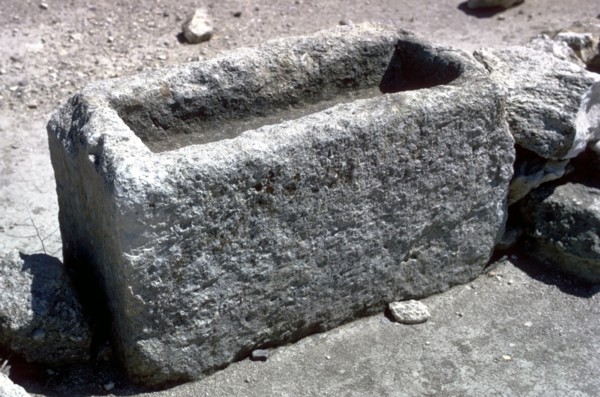
Stone manger from Bible times, perhaps similar to the one that cradled the baby Jesus in Bethlehem. The manger held food for animals.

At the end of eight days, he was circumcised (according to God’s commandment to Abraham in Genesis 17:12); and named Jesus – just as Mary had been told before He was conceived (Luke 1:31-32).  Verse 22 would be 33 days later in which they would have journeyed to Jerusalem (Leviticus 12:3-8) to make their sacrifice according to the Law given to Moses.  Joseph and Mary would not have the means to offer a lamb, but would obey the Law of the Lord.  We do not know anything else about the man Simeon in verses 25-35.  The scripture says that the Holy Spirit had revealed to him that he would see the Christ before he died, so he had obviously found favor with God.  As he held the savior in his arms, his words affirm that verse 10’s reference to “all people” means Jews and Gentiles alike as, in verse 32, he calls Jesus “a light for revelation to the Gentiles, and for glory to your people Israel.”  Verses 36-38 recount more of God’s revelations about Jesus to his humblest of servants.  The family then returned to Nazareth, where verse 40 tells us that Jesus grew in wisdom and “the favor of God was upon him.”

Naturally, as verse 41 says, his parents returned to Jerusalem every year to observe the Feast of the Passover.  On the occasion of verse 42, he was 12 years old.  This may be about 7 AD, as the best estimates (contrary to what many people might assume), are that He was born about 5 BC.   It seems more than a bit strange to us that Joseph and Mary did not notice he had remained behind in Jerusalem until they well on their way back to Nazareth (verses 43-44), but we must remember that such a journey during an important festival would have had them traveling with a large group of family and friends that trusted and cared for one another.  When they returned to Jerusalem to search for Him, they finally found Him in the Temple – and as verses 46-47 say, amazing the teachers there.  He demonstrates that He already knows He is the Son of God, as He says in verse 49 “Why were you looking for me? Did you not know that I must be in my Father’s house?”

Read or listen to audio of ESV version of this selection from this link.

/Bob’s boy
___________________
some images © V. Gilbert & Arlisle F. Beers

Please note: I did not design the reading plan that I am following in my blog.  All of my comments in this blog, however, are solely my responsibility.  When reading ANY commentary, you should ALWAYS refer first to the scripture, which is God’s unchanging and unfailing word. Reading schedules, as well as a link to the site where you can get the reading plan that I’m currently following for yourself can be found on the “Bible Reading Schedules” page of my website at http://graceofourlord.com.  For questions and help, please see the “FAQ” and “Summaries” pages there.

John 1 – The Word Became Flesh

The message of the gospel of John can be summed up in one statement – “Jesus is the son of God.”  His gospel is full of passages that illustrate that fact, but nowhere is it made clearer than in the language of chapter 1:1-4.  John leaves no doubt, as it begins with an echo of the opening of the Book of Genesis:

“In the beginning was the Word, and  the Word was with God, and the Word was God.
 He was in the beginning with God.
 All things were made through him, and without him was not any thing made that was made.
 In him was life, and the life was the light of men.”

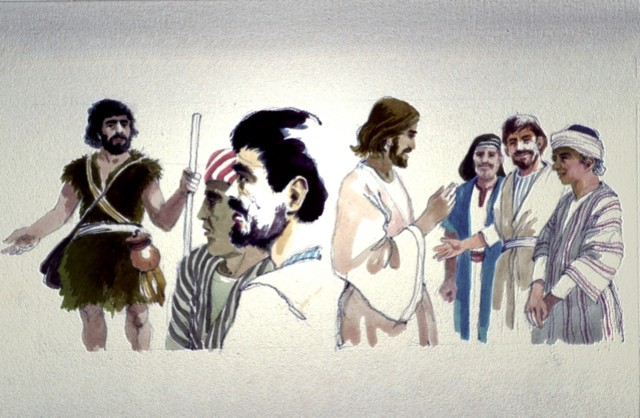
Andrew, Peter’s brother, heard John the Baptist speak. They became disciples of Jesus. Peter, along with James and John formed the inner circle of Jesus’ disciples.

This reference to Jesus as “the Word” has meaning throughout the Old Testament.  Two of many examples are seen as God brings things into existence by His very Word (Genesis 1:3), or accomplishes whatever His purpose may be by His Word, which He sends out (Isaiah 55:10-11).  This is used by John again in his 1st epistle (1 John 1:1-3), as he adds the fact that he and the other apostles had physical contact with this Word, the Lord Jesus Christ.  The Word is also referred to as living and active, for example in Hebrews 4:12.  Jesus confirms that He was with God in the beginning in John 17:5; and John specifically identifies the word in verses 14-17:

“And the Word became flesh and dwelt among us, and we have seen his glory, glory as of the only Son from the Father, full of grace and truth.
(John bore witness about him, and cried out, “This was he of whom I said, ‘He who comes after me ranks before me, because he was before me.’”)
For from his fullness we have all received, grace upon grace.
For the law was given through Moses; grace and truth came through Jesus Christ. “

John moves swiftly from this powerful and awesome account to the testimony of John the Baptist.  In verses 29-34, this John identifies Jesus as the “Lamb of God” – which they would not yet fully understand – and gives evidence of his own special revelation that he received from God, concerning His son.  In verses 19-23, John the Baptist,appearing before the priests and then the Pharisees, denied that he himself was the Christ, or Elijah.  “The Prophet” that they ask him about could be  a misunderstanding by them of the promise of a “new prophet like me” to lead them, which Moses spoke of in Deuteronomy 18:15-16.  He leaves no doubt in verse 23 though, that his baptism is to prepare the way for the Messiah, as he clearly states that he is the one referred to in Isaiah 40:3.

The chapter ends with Jesus calling the first of His disciples, some of which He undoubtedly already had a relationship with.  But Nathanael marvels that he knows him, and realizes that He truly is the Son of God (verses 48-49) because of it.  Jesus tells them that they will see much greater things to come. Verse 51 is a very clear reference to Jacob’s dream in Genesis 28:12.

Read or listen to audio of ESV version of this selection from this link.

/Bob’s boy
___________________
some images © V. Gilbert & Arlisle F. Beers

Please note: I did not design the reading plan that I am following in my blog.  All of my comments in this blog, however, are solely my responsibility.  When reading ANY commentary, you should ALWAYS refer first to the scripture, which is God’s unchanging and unfailing word. Reading schedules, as well as a link to the site where you can get the reading plan that I’m currently following for yourself can be found on the “Bible Reading Schedules” page of my website at http://graceofourlord.com.  For questions and help, please see the “FAQ” and “Summaries” pages there.

Beginning the New Testament \ Week 29 summary posted

Jesus’ earthly story begins in the town of Bethlehem in the Roman province of Judea.

Last week, we wrapped up our reading of the Old Testament in this year-long study of the Bible as a complete story.  This week, we begin our reading in the New Testament with John chapter 1.  Why start there instead of in Matthew?  Don’t worry, we will look at the life of Jesus in chronological order.  John 1 is God’s word about Jesus, as to who He really is.  Next in Luke 1, we will read the account of the birth of John the Baptist, and the promise of the birth of Jesus.  Then, we will pick up the story of Jesus and his ministry in Matthew, as we continue the story of God’s plan for our salvation.

Summing Up

Each weekend, I am now posting a small PDF of one week of chapter summaries (on the website’s “Summaries” page), current to the beginning of the previous week.  I have posted the summary for Week 29 (July Week 3) of the schedule I am following.  This short PDF document contains condensed comments about Ezra 1, 3, 6, Nehemiah 1, and Nehemiah 2, with hyperlinks to the ESV version of each chapter for listening or reading, and joins the summaries for other weeks already posted there.

/Bob’s boy
___________________
image © V. Gilbert & Arlisle F. Beers

Please note: I did not design the reading plan that I am following in my blog.  All of my comments in this blog, however, are solely my responsibility.  When reading ANY commentary, you should ALWAYS refer first to the scripture, which is God’s unchanging and unfailing word. Reading schedules, as well as a link to the site where you can get the reading plan that I’m currently following for yourself can be found on the “Bible Reading Schedules” page of my website at http://graceofourlord.com.  For questions and help, please see the “FAQ” and “Summaries” pages there.

Isaiah 53 – The Suffering Servant

In chapters 46 -53, the prophet Isaiah introduces four “Servant” songs.  The fourth, the Suffering Servant begun in chapter 52:13-15, continues here in chapter 53.  It is considered one of the most important prophecies of Jesus in the Old Testament.   Twelve verses that foretell the most important event in mankind’s history!  The people are expecting that the Messiah as king will lead them to  military  and political greatness – possibly becoming a great world power.  Isaiah says that when he arrives, they won’t even get it.  The “Arm of the Lord” in verse one refers to God’s power in action.   This verse is referred to in John 12:37-38, and John goes on in 39-41 to quote Isaiah 6:10, elaborating on their blindness, and the hardness of their hearts.  Verses 2-3 show that he will be an outwardly unimpressive man from humble beginnings, rather than a majestically handsome ruler from the elite.  The  “dry ground” of verse two refers to the fallen kingdom of David.

The heart of the song is verses 4-6, as he bore the sins of the world though he was himself innocent – pierced for our transgressions (also see Matthew 8:17).  The event of the crucifixion of Jesus could not be better summed up by these verses.  Notice the words “pierced, crushed, chastisement, wounds.”   Isaiah stresses how much God punished the rejected servant for the sins of all.   Verses 7-8, led like a lamb led to slaughter or a sheep that before its shearers is silent – innocent, yet submissive.

The prophecy of verse 9 (“And they made his grave with the wicked and with a rich man in his death, although he had done no violence, and there was no deceit in his mouth”) is fulfilled in Matthew 27:57-60.  Verses 10-12 make it plain that it was the will of God to crush Him; and the result is not regret, but a sense of triumph and accomplishment.  The crux of verse 10 – “he shall see his offspring” (the new Israel); “he shall prolong his days” (the resurrection); “the will of the Lord shall prosper in his hand” (God’s plans are carried out).

Isaiah points ahead to the greatest act of love ever done for man!

Read or listen to audio of ESV version of this selection from this link.

/Bob’s boy
___________________
some images © V. Gilbert & Arlisle F. Beers

Please note: I did not design the reading plan that I am following in my blog.  All of my comments in this blog, however, are solely my responsibility.  When reading ANY commentary, you should ALWAYS refer first to the scripture, which is God’s unchanging and unfailing word. Reading schedules, as well as a link to the site where you can get the reading plan that I’m currently following for yourself can be found on the “Bible Reading Schedules” page of my website at http://graceofourlord.com.  For questions and help, please see the “FAQ” and “Summaries” pages there.

Daniel 2 – Nebuchadnezzar’s Dream

Nebuchadnezzar’s Dream is troubling him, and so he seeks the usual counsel of wise men to interpret it.  In the ancient cultures, a king’s dream was important to him for knowing what he might have to prepare for.  But the dream that God had given him had been made so important that he wanted to be certain that the one who interprets it does not do so falsely.  So his command to the wise men is that they will tell him his dream first – and then interpret it.  Of course none of them can do that; and the king orders all of the wise men destroyed – an order which would include Daniel and his companions (verses 12-13).

In a show of great faith, Daniel requested an appointment with the king to make the interpretation (verses 14-16).  He prays and has Hananiah, Mishael, and Azariah (Shadrach, Meshach, and Abednego) pray as well; and the Lord makes the dream and its meaning known to him.  He praises God for the knowledge in verses 20-23, and gives him the credit in verses 27-28 when he appears before the king.  Daniel recounts the dream first, and then interprets it to Nebuchadnezzar in verses 31-45.  The statue in the dream is a representation of the four great kingdoms that would dominate the history of the world.  The current Babylonian empire was the first.  The Medo-Persian empire ruled by Cyrus beginning in 539 b.c., and then Greece, under Alexander the Great, in about 331.  These latter two are explicitly named in his vision in Daniel 8:20-21.  The fourth is the Roman Empire.  After that, the God of heaven would establish an everlasting kingdom (verse 44), pointing to the Christ.  Compare verses 44-45 to Luke 20:17-18.

Nebuchadnezzar shows his gratitude in verses 46-49, and made Daniel chief prefect over all the wise men of Babylon.  At Daniel’s request, he appointed Shadrach, Meshach, and Abednego over the affairs of the province.  These young men, by being in position to look out for the welfare of the society they lived in, would be promoting their own welfare as well – just as Jeremiah had advised in Jeremiah 29:5-7.

Read or listen to audio of ESV version of this selection from this link.

/Bob’s boy
___________________
some images © V. Gilbert & Arlisle F. Beers

Please note: I did not design the reading plan that I am following in my blog.  All of my comments in this blog, however, are solely my responsibility.  When reading ANY commentary, you should ALWAYS refer first to the scripture, which is God’s unchanging and unfailing word. Reading schedules, as well as a link to the site where you can get the reading plan that I’m currently following for yourself can be found on the “Bible Reading Schedules” page of my website at http://graceofourlord.com.  For questions and help, please see the “FAQ” and “Summaries” pages there.