Understanding the Cross of Christ – Part 5 (The Anointed One and His Sacrifice)

This series began in Part One as a search for a more meaningful answer to an aspiring young Christian’s question: “Why did God send His only son to die?”  The short answer “to save us from our sins,” while correct, really only serves to raise more questions.  In part 2, we looked at what sin is, why it matters so much to God, and why it should matter to us.  In part 3, we delved into God’s response to sin.  In all of that discussion, we have made great mention of the fact that God has a plan for our salvation.  In part 4, we looked at how Jesus really fits into that plan.  But what were God’s people looking for in a Messiah?  And why did God plan such a horrible death for Him?

The “Missed” Messiah
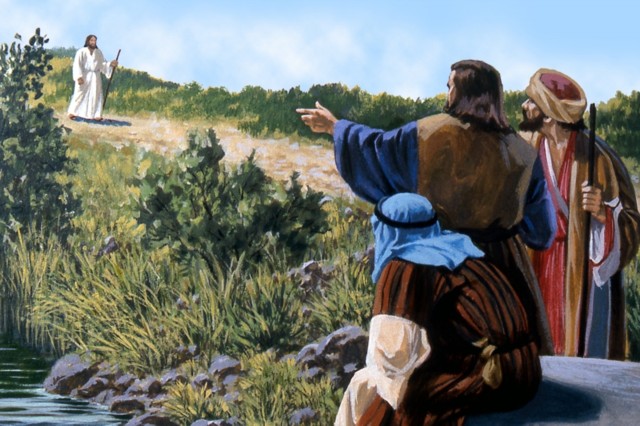
John 1:29-41

John the Baptist told his disciples that Jesus was the Lamb of God, the Messiah, God’s Son, who would give his life for his followers — John 1:29-41

The Jews had been waiting for the Messiah to come for thousands of years.  But what kind of Messiah were they expecting – especially during the time that Jesus actually did come?  By and large, what many of them were hungry for in a Messiah was one that would lead Israel to greatness as a power in the world.  After all, he was to be the son of David.  They wanted him to be a great military leader that would first defeat the Romans who ruled and oppressed them.

But for people at that time,  getting them out from under the thumb of Roman rule was just the beginning.  They wanted a king that would eventually lead them to be the kind of power in the world that Israel enjoyed being during the reign of David – mighty and feared – possibly even to replace the Romans as the great power of the world.

In Matthew 2:1-5, when Herod learned of the birth of the Christ, the chief priests and scribes quoted Micah 5:2 in Matthew 2:6, saying:

“And you, O Bethlehem, in the land of Judah,
are by no means least among the rulers of Judah;
for from you shall come a ruler
who will shepherd my people Israel.”

So Herod feared for his position, because he too assumed this Messiah would be a king of an earthly kingdom.  In John 6:15, when Jesus was at the height of his popularity with the people, the multitudes were ready to make that kingship a reality in their own way:

“Perceiving then that they were about to come and take him by force to make him king, Jesus withdrew again to the mountain by himself.”

And in Acts 1:6, just before Jesus ascended to heaven, the apostles (not yet having received the Holy Spirit) demonstrated that they still didn’t “get it” either: (“So when they had come together, they asked him, ‘Lord, will you at this time restore the kingdom to Israel?’”).  So focused were so many of the people of that time on an earthly kingship for the Messiah, that they overlooked completely prophecies such as that of the “Suffering Servant” in Isaiah 53 or others such as Psalm 16:8-11 (“you will not abandon my soul to Sheol, or let your holy one see corruption”) that clearly predicted a different course for God’s anointed.

Sadly, many of those who longed most for the coming of the Messiah completely missed Him, when he was right under their very noses.

Why Death on a Cross?

Although the crucifixion of Jesus is the most famous of all time, it was not an uncommon means of execution from about 500 BC until the 4th century AD – one that was used by the Romans, certain Greek-Macedonian states, and the Carthaginian empire, to name a few.  The Jews of Jesus’ time would have been very familiar with this means of execution.  This brutal and very public display of execution was usually reserved for those who committed the most heinous of crimes.  It was abolished by Emperor Constantine I in about 337 AD.

English: The Crucifixion, Genoa Svenska: "...

English: The Crucifixion, Genoa Svenska: “Korsfästelsen”. Chiesa del Gesù, Genua. (Photo credit: Wikipedia)

So with respect to fulfilling the Scriptures concerning the suffering that the Messiah would have to endure, crucifixion fit into that plan perfectly, as only an execution inflicted with torture could.  A quick death by some other means (such as beheading in the case of the apostle James (Acts 12:1-5) ), while certainly painful, would not serve to accomplish the intense suffering prophesied in such passages as in Isaiah 53, nor the wounding predicted in that same passage and others such as Zechariah 12:10.  Accompanied by the beatings and scourging (Matthew 27:25-26, John 19:1), it also fulfilled the prophecy in Isaiah 52:13-14 of the Messiah being so disfigured from them that He was hardly recognizable.  Moreover, being “lifted up” on the cross was the fate Jesus prophesied for Himself (John 3:14-15, Matthew 20:17-19, John 8:28), as well as that prophesied in Isaiah 52:13.

What Did the Death of Jesus Really Cost?

It is important to understand how much love was involved in the sacrifice of Jesus on that cross.  Almost everyone in our society has at least heard John 3:16 quoted (“For God so loved the world, that he gave his only Son, that whoever believes in him should not perish but have eternal life”).  But how often is that verse quoted without much thought behind it?   After all, He was the Son of God, right?  It is easy to forget how much He gave up, and how human He became for us.  To be sure, God reveals to us what we need to know, but He does not reveal everything there is to know about many things; and that includes His relationship as the Father to Jesus as the Son.

Jesus clearly speaks of himself and God as separate entities (John 5:30).  God also does the same in such verses as Matthew 3:16-17 (“This is my beloved Son, with whom I am well pleased.”).   Yet John 1:1 makes it clear that Jesus (“the Word”) was God.  Peter (2 Peter 1:1) and Paul (Titus 2:11-13) both tell us that Jesus is “God and Savior.”  Philippians 2:5-6 speaks of Jesus having been in the form of God and having equality with God.  Even Thomas, having his doubt removed after the resurrection, recognized this as he exclaimed in John 20:28“My Lord and my God!”   So the answer, in our limited ability to understand such things, is that Jesus was both God and a separate being – the Son.

The relevance of all of this to the willing sacrifice of Jesus is that God’s love for us prompted Him to have His only Son – and in a very real sense (the depths of which we cannot fully understand) a part of Himself – to come into this world as a physical man, to live and love as a man, to feel pain and sorrow just as we do, and to suffer and die a cruel and tortuous death at the hands of the very people He was trying to save.

In Part 6, we will conclude this series with a look at more of what Jesus’ death and resurrection accomplished, as well as what is required of us to gain our salvation.

/Bob’s boy
___________________
image © V. Gilbert & Arlisle F. Beers

Please note: I did not design the reading plan that I am following in my blog.  All of my comments in this blog, however, are solely my responsibility.  When reading ANY commentary, you should ALWAYS refer first to the scripture, which is God’s unchanging and unfailing word. Reading schedules, as well as a link to the site where you can get the reading plan that I’m currently following for yourself can be found on the “Bible Reading Schedules” page of my website at http://graceofourlord.com.  For questions and help, please see the “FAQ” and “Summaries” pages there.

Understanding the Cross of Christ – Part 4 – (God’s Plan)

This series began in Part One as a search for a more meaningful answer to an aspiring young Christian’s question: “Why did God send His only son to die?”  The short answer “to save us from our sins,” while correct, really only serves to raise more questions.  In part 2, we looked at what sin is, why it matters so much to God, and why it should matter to us.  In part 3, we delved into God’s response to sin.  In all of that discussion, we have made great mention of the fact that God has a plan for our salvation.  Now, in part 4, let us look at how Jesus really fits into that plan.

So how does Jesus fit into this plan of God’s?

If you were to say that Jesus, in fact, is God’s plan for our salvation, you would be correct.  God first promised this savior in Genesis 3:15, when sin first entered the world.  The verse reads in the ESV:

I will put enmity between you and the woman,
and between your offspring and her offspring;
he shall bruise your head,
and you shall bruise his heel.

The enmity that God refers to here is opposition to Satan through the offspring born of the woman.  Clearly, the “he” in the verse that will “bruise your head” is that offspring.  What is meant by bruising the head is the complete victory over the evil one that had the power over death, as told to us in Hebrews 2:14-15.  As for how the Crucifixion can be classified as  the bruising of the heel, consider that Jesus overcame death itself, and that the ultimate fate of Satan is his utter destruction (Revelation 20:10).

There are a great many prophecies throughout the Bible that promise the coming of this Messiah  – many more than we can include in this outline.  But the most important of these is arguably that which is written in 2 Samuel 7, where God makes a covenant with David which promises a kingdom from his offspring that will endure forever.  He would be the son of God (Psalm 2:7).  It is through this offspring of David that the one promised in Genesis 3 will come.  He would be sacrificed for our transgressions (Isaiah 53:5-12).  And most importantly, he would be risen from the dead (Psalm 16:10, Psalm 49:15).

Who was Jesus really, and where did He come from?

Let us begin with his name.  Most people know of Him as Jesus Christ.  He has been known this way for so long that many people actually assume that His last name – His surname – was Christ.  But that is, of course, not the case.  Over the years the reference to Him as Jesus the Christ has simply been shortened.  The Hebrew for Messiah and the Greek for Christ (Khristos) both mean anointed or “anointed one.”

Most people know that He was born in Bethlehem of a virgin, and many have wondered what the point is of the long genealogy written in Matthew 1:1-17.   This was to document the fact that Jesus’ birth came forth through the line of King David.  The names of many of those in that genealogical record are found in books of the Bible (the Old Testament) written in the inspired word of God over many hundreds of years.

But though Jesus was born of a woman, just as had been prophesied, that is not the entire significance of His origin.  In John 1:1-18, we are told that before He came to live as a man, Jesus was with God since the beginning of time:

“He was in the beginning with God. All things were made through him, and without him was not any thing made that was made.”

Some say that Jesus never claimed to be deity, but that is certainly not true.  In John 10:30, he told the Jewish leaders at the temple “I and the Father are one.”  And in John 8:58, he told them “before Abraham was, I am,” which was clearly a reference to the way God identified Himself to Moses in Exodus 3:14.

Paul, in his letter to the Philippians in Philippians 2:5-8, summed up how much Jesus gave up to come to Earth, to become a man, and to suffer a cruel death:

“Have this mind among yourselves, which is yours in Christ Jesus, who, though he was in the form of God, did not count equality with God a thing to be grasped, but emptied himself, by taking the form of a servant, being born in the likeness of men. And being found in human form, he humbled himself by becoming obedient to the point of death, even death on a cross.”

As we near the conclusion of this series, we will  examine how Jesus measures up with what the people were expecting from the Messiah that had been anticipated for well over a thousand years, what His death meant then and, more importantly, what it means to us now.

/Bob’s boy

___________________
image © V. Gilbert & Arlisle F. Beers

Please note: I did not design the reading plan that I am following in my blog.  All of my comments in this blog, however, are solely my responsibility.  When reading ANY commentary, you should ALWAYS refer first to the scripture, which is God’s unchanging and unfailing word. Reading schedules, as well as a link to the site where you can get the reading plan that I’m currently following for yourself can be found on the “Bible Reading Schedules” page of my website at http://graceofourlord.com.  For questions and help, please see the “FAQ” and “Summaries” pages there.

Psalms 41 – Even My Close Friend

Hushai was a counselor for King David, but when Absalom rebelled against his father David, David asked Hushai to pretend to shift loyalty to Absalom, but act instead as a spy. Absalom accepted Hushai's advice instead of the advice of Ahithophel, so Ahithophel committed suicide (2 Samuel 17:1-14).

Hushai was a counselor for King David, but when Absalom rebelled against his father David, David asked Hushai to pretend to shift loyalty to Absalom, but act instead as a spy. Absalom accepted Hushai’s advice instead of the advice of Ahithophel, so Ahithophel committed suicide (2 Samuel 17:1-14).

Traditionally, the Hebrew text divided the psalms into five books, the last of which in each finishes with a doxology (a short hymn of praise to God, which occurs here in verse 13); and chapter 41 concludes book one.  As is the case with many psalms, this one has meaning for the situation in David’s life at the time, as well as having application for the Jesus the Messiah.

communion trayMany consider that this psalm was written at a time when David suffered from a great illness that may have facilitated Absalom’s rebellion (2 Samuel 15).  The word “poor” in verse one is sometimes translated “weak,” which especially fits verses 1-8.  Jesus applies verse 9 to Judas in John 13:18.  In David’s case, the identity of the close friend of that verse is believed by many to be Ahithophel (2 Samuel 15:31).  The reference to the resurrection and ascension to heaven are hard to miss in verses 10-12, with the enemy in verse 11 clearly as Satan.  And verse 9 unmistakably points to Judas during Jesus’ act of instituting the Lord’s supper:

“Even my close friend in whom I trusted,
who ate my bread, has lifted his heel against me”

Read or listen to audio of ESV version of this selection from this link.

/Bob’s boy
___________________
some images © V. Gilbert & Arlisle F. Beers

Please note: I did not design the reading plan that I am following in my blog.  All of my comments in this blog, however, are solely my responsibility.  When reading ANY commentary, you should ALWAYS refer first to the scripture, which is God’s unchanging and unfailing word. Reading schedules, as well as a link to the site where you can get the reading plan that I’m currently following for yourself can be found on the “Bible Reading Schedules” page of my website at http://graceofourlord.com.  For questions and help, please see the “FAQ” and “Summaries” pages there.

Understanding the Cross of Christ – Part 3 (God’s Response To Sin)

cross03In part 1 of this series, we began looking for a more informative answer to my young friend’s question (“Why would God send His only son to die?”).  The answer is of course that it was God’s plan for our salvation all along.  But a better explanation would really be aided by a better understanding of sin, atonement, and ultimately, propitiation.  In part 2, we looked at what sin is, why it matters so much to God, and why it should matter to us.  And now we turn to God’s response to sin – which, come to that, is also one of the reasons that it matters to us.

What are the consequences of sin?

Adam and Eve expelled

When Adam and Eve obeyed Satan instead of God, God sent them from the Garden of Eden and posted an angelic being at the doorway of Eden to prevent them from entering it again (Genesis 3).

Of course, God’s first response to sin was to Adam and Eve after the fall of man, but He has given man many other earthly responses to sin.  God was so grieved by man’s wickedness that He “struck down every living creature” (that wasn’t on the ark) in a global flood in Genesis 6-8. God promised His judgment on the Canaanites in Genesis 15:13-21 and again in Deuteronomy 9:4-5 , well in advance of the Israelites’ entry into the promised land in Joshua 3.  And just as he warned them 1,000 years earlier in Deuteronomy 28:49-63, God had His people removed and taken captive for their continued disobedience, and their cherished holy city was burned (2 Kings 17, 2 Kings 24, 2 Chronicles 36:17-21).  Of course, all of these, and many other earthly judgments God has brought to pass, pale in comparison to God’s promise of eternal separation from Him and the punishment that awaits the sinful in the end – in contrast to the reward that awaits the faithful (Matthew 8:11-12, Matthew 25:45-46).

Why does God require a price to be paid for sin?

Abraham covenant-01

The Lord spoke personally with Abraham, entering into a lasting covenant with him (Genesis 17).

It is a fact that it is no accident that the Creator of life demands discipline, and that the blueprints He gives us for living our lives result in the best that life has to offer for us.  Godly living in the long and short-term always has born out that constant truth – His ways are best for us.  And it is His will for all of us to be saved (1 Timothy 2:3-4) So why does God demand a price for sin?  As we noted in part 2, God is too pure to tolerate sin (Habakkuk 1:13).  But just as importantly, He is a fair and just God (Psalm 25:8-14, 2 Thessalonians 1:6-10, Deuteronomy 32:4).  He has promised to reward us for our righteousness, just as He has promised to punish sin. He is faithful and true to all of His promises.  If it were not so – if He simply turned a blind eye to sin – how could we count on Him to keep the other promises He has made to us?

How was sin dealt with in the Old Testament?

Sacrifices and offerings to God were made by presenting them to a Levitical priest (a descendant of Levi, one of the 12 sons of Jacob).  Non-priests could not make an approach to God.  The different types of offerings are described in Leviticus 1-7.  Only the High Priest – from Aaron through the end of Eleazor’s line – approached God in the innermost part of the Tabernacle (the Most Holy place), as they did to make offering on the Day of Atonement.  This occurrence simply put off the judgment of the Lord for their sins in the past year (Leviticus 16:34).  These sacrifices and the old law were merely a shadow of the promise of what was to come (Hebrews 10:1-4).

Levitical_priesthood_diagram-01

The Levitical Priesthood

God had set apart the Levites (Numbers 3:12) and established the priesthood for His people through the lines of the three sons of Levi – all with special duties.  These were the Gershonites (Numbers 4:24-26; 7:7-8), Kohathites (Numbers 3:29-32, 1 Chron 15:1-15), and the Merarites (Numbers 3:36-37; 4:29-33).  Moses and Aaron were sons of Kohath; and it was through Aaron’s line that the priesthood continued until the destruction of Jerusalem in 70 A.D., by way of his sons Eleazor, Ithamar, and Nadab and Abihu. The latter two met their end (and that of their lines) in Leviticus 10.  Ithamar’s line ended  in 2 Kings 2:26-27 with Abiathar.  Eleazor’s line lived on until the destruction of Jerusalem in 70 A.D.

All through these ages, the promise loomed ahead of something better.  A promise that was made first in Genesis 3:15-17, and would be repeated and expounded throughout the Old Testament.  We will look closer at that promise as this series continues in part 4, taking a look at how Jesus fits into God’s plan for our salvation.

/Bob’s boy
___________________
image © V. Gilbert & Arlisle F. Beers

Please note: I did not design the reading plan that I am following in my blog.  All of my comments in this blog, however, are solely my responsibility.  When reading ANY commentary, you should ALWAYS refer first to the scripture, which is God’s unchanging and unfailing word. Reading schedules, as well as a link to the site where you can get the reading plan that I’m currently following for yourself can be found on the “Bible Reading Schedules” page of my website at http://graceofourlord.com.  For questions and help, please see the “FAQ” and “Summaries” pages there.

Understanding the Cross of Christ – Part 2 (What is Sin?)

This series began in Part One as a search for a more meaningful answer to an aspiring young Christian’s question: “Why did God send His only son to die?”  The short answer “to save us from our sins,” while correct, really only serves to raise more questions.  Whether the question comes from a young person or someone older, I should be able to do better.  Hopefully I will be more prepared to answer that question by the end of this series.

A real understanding of the answer to this question naturally begins with understanding some things about sin.  So as we turn to that subject, the first set of questions we brought up in part one center around just what the problem is with sin.

What is sin anyway?

English: Man's Sin, and God's Promise; as in G...

English: Man’s Sin, and God’s Promise; as in Genesis 3:1-6, 13-15; illustration from a Bible card published by the Providence Lithograph Company (Photo credit: Wikipedia)

Simply put, sin is that which is contrary to God’s will, His commandments, even that which is against His very nature.  Sin came into the world in what we know as “the fall” way back in Genesis 3.  At that time, man had a practical paradise on earth, as well the blessing of being really close to God.  But despite clear warning, he threw it all away in rebellion against the Lord, and nothing has been the same since that time.  God’s first reference to sin as a word in the scripture appears in Genesis 4, when Cain had become angry.  God had warned him that sin was “crouching at his door,” after which he in fact murdered his own brother.  Since that time, many specific acts that are sinful have been named in the Bible.  Some of those are named by Paul as “works of the flesh” in Galatians 5:19-20.  The fact that this is not a complete list of all sins is obvious, and made clear by the words “and things like these” at the end of the passage.

We know that those things in Paul’s letter to the Galatians are wrong.  We even know that such things as lying and murder are wrong.  But if there is no clearly exhaustive list of sins in the Bible to which we can refer, how should one know what else may be sinful?   The answer is by studying God’s word – the Scriptures.  The more we learn by reading and hearing God’s word, the more we know about what is right, what is wrong, and what is abhorrent to God (Proverbs 6:16-19, for example).   But we usually have to look no further than our own hearts.  God gave us a conscience; and if we truly examine ourselves with honesty, our internal conflict will betray our true knowledge of what God really expects from us (Romans 2:14-16).

English: The Story of Cain and Abel; as in Gen...

English: The Story of Cain and Abel; as in Genesis 4:3-15; illustration from a Bible card published by the Providence Lithograph Company (Photo credit: Wikipedia)

So why does sin matter so much to God?

God has revealed Himself in many ways to us.  One of those of those ways is by His word. One could write a dissertation on that very subject, but we should know that the Bible declares (among other things) that God is the very definition of goodness and faithfulness, and that He has enduring and steadfast love (Psalm 100:5) – indeed that He is love (1 John 4:8)!  And from His word, we know that He is truth and holiness (Leviticus 19:2) – that He is light, and in Him is no darkness (1 John 1:5).  There is no evil in His character, and He is too pure to tolerate sin or evil (Habakkuk 1:13).

Why should sin matter to us?

We will have more to say about this in Part Three of this series.  But sin is important to us first and foremost because it separates us from God.  That separation is absolutely the worst thing that has ever happened to mankind.  It separated man from God after “the fall” of Genesis 3, and God has been at work to restore that relationship with Him ever since then.  The good news is that He has a plan to do just that very thing; and that hope for us has always pointed to the Cross.

On a Sunday within the next few short weeks, we will present part three of this series with a look at God’s response to sin. as we begin to examine His plan for our salvation and hope for being with Him forever.

/Bob’s boy
___________________
image © V. Gilbert & Arlisle F. Beers

Please note: I did not design the reading plan that I am following in my blog.  All of my comments in this blog, however, are solely my responsibility.  When reading ANY commentary, you should ALWAYS refer first to the scripture, which is God’s unchanging and unfailing word. Reading schedules, as well as a link to the site where you can get the reading plan that I’m currently following for yourself can be found on the “Bible Reading Schedules” page of my website at http://graceofourlord.com.  For questions and help, please see the “FAQ” and “Summaries” pages there.

Proverbs 8 – The Blessings of Wisdom

An Oxford degree ceremony — the Pro-Vice-Chanc...

An Oxford degree ceremony — the Pro-Vice-Chancellor in MA gown and hood, Proctor in official dress and new Doctors of Philosophy in scarlet full dress. Behind them, a bedel, another Doctor and Bachelors of Arts and Medicine. (Photo credit: Wikipedia)

Solomon begins by personifying Lady Wisdom further, summoning the reader to hear her call.  This is the ultimate of these chapters illuminating the two paths of wisdom and folly, or foolishness. The fact that the “fear of the Lord” is the beginning of all knowledge is again made infinitely plain in this chapter.  “She” begins by further developing the inclusion of righteousness as an integral part of wisdom (verses 6-9), the reasons for seeking it so earnestly (verses 10-11), and the benefits it provides mankind (verses 15-19).

She calls upon all the “children of man” (verse 4) – the simple, the fool, the learned – all who seek wisdom diligently will find it (verse 17).  But again, we are reminded of the difference between mere knowledge and true wisdom – the insight that comes to those who seek it without wickedness, who have prudence, who are just and seek justice, and those who abhor evil and are not full of pride, arrogance, and who avoid perverse speech.  True wisdom does not dwell in those who do not walk in the path that the Lord has made for us, no matter how “intelligent” that person may be.  Verses 8-9 make clear that only those who truly understand these facts will attain that wisdom, and that is so because those facts are clear for them to understand.  The unrighteous cannot have that understanding, and so they are denied true wisdom.

Verses 22 and following detail how wisdom “was” before God created the earth and all things universal, and how he delighted in his creation.  He created all things physical, all things invisible, and even the abstract.  There would not even be any concept of things such as beauty, love, truth, right, wrong, or even the concept of such things as a name or a number, but for the power of the Lord.  And Jesus, the Son, was there and is Himself that wisdom (1 Corinthians 1:22-24, 1 Cor 1:30, 1 Corinthians 8:6, Colossians 1:15-18).

Read or listen to audio of ESV version of this selection from this link.

/Bob’s boy
___________________
some images © V. Gilbert & Arlisle F. Beers

Please note: I did not design the reading plan that I am following in my blog.  All of my comments in this blog, however, are solely my responsibility.  When reading ANY commentary, you should ALWAYS refer first to the scripture, which is God’s unchanging and unfailing word. Reading schedules, as well as a link to the site where you can get the reading plan that I’m currently following for yourself can be found on the “Bible Reading Schedules” page of my website at http://graceofourlord.com.  For questions and help, please see the “FAQ” and “Summaries” pages there.

2012 in review for Bob’s boy’s Christianity blog

The WordPress.com stats helper monkeys prepared a 2012 annual report for this blog.

Wow, What a year! We started this blog in January of 2012, changing over from a simple email sent daily to a few friends.  We never dreamed it would be so successful.  Don’t get us wrong, we’re not ever going to be one of the most popular spots in the blogging world.  But it just goes to show that simply offering the truth of God’s word with no motive other than the hope of helping others get to heaven really does still work.  we think that’s…well, just awesome.  Our God is an awesome God!

Some of the statistics that surprised us the most were the fact that people in 122 countries have viewed our pages!  And the largest number of viewers for one day was 652 (the post in Acts 12 of Peter’s rescue)!

Here’s an excerpt:

600 people reached the top of Mt. Everest in 2012. This blog got about 8,300 views in 2012. If every person who reached the top of Mt. Everest viewed this blog, it would have taken 14 years to get that many views.

Click here to see the complete report.

Revelation 22 – Jesus Is Coming

The imagery used here to describe heaven, the dwelling place of God and our Lord Jesus (and one day us as well) in these first few verses harkens back to Ezekiel 47:1-12.  No longer will there be anything accursed, verse 3 says; and the tree of life will be there (see Genesis 2:9).  This seems to be a symbol for the restored condition of things as they were between man and God before the fall (Genesis 3).

cross-005Verse 6 is a reminder that the other events spoken of in this book are to occur soon, but Jesus reminds that He is coming back (verse 7).  John affirms in verse 8 that it was he that received all of these visions; and he fell down to worship the angel who showed him, but was rebuked for doing so, as the angel reminded him that only the Lord was to be worshiped.

Jesus again promises that He is coming to bring his recompense for each of us for what we have done (Isaiah 62:11).  Verse 13 (“I am the Alpha and the Omega, the first and the last, the beginning and the end”) signifies the eternal supremacy of God and His Son.  Verse 17 repeats the promise that eternal life is available freely to all who will come – Jesus paid the price for it already.

John finishes the New Testament with the yearning call to Jesus as Lord to come.  Then finally, and appropriately: “The grace of the Lord Jesus be with all. Amen.”

Amen, indeed!

Read or listen to audio of ESV version of this selection from this link.

/Bob’s boy
___________________
some images © V. Gilbert & Arlisle F. Beers

Please note: I did not design the reading plan that I am following in my blog.  All of my comments in this blog, however, are solely my responsibility.  When reading ANY commentary, you should ALWAYS refer first to the scripture, which is God’s unchanging and unfailing word. Reading schedules, as well as a link to the site where you can get the reading plan that I’m currently following for yourself can be found on the “Bible Reading Schedules” page of my website at http://graceofourlord.com.  For questions and help, please see the “FAQ” and “Summaries” pages there.

Revelation 4 – The Throne in Heaven

John’s vision here begins with a door open into heaven.  The first voice he hears in verse one is generally accepted to be that of Jesus.  John had heard that voice on earth.  As John is then aware of being fully in the manifested presence of the Holy Spirit, the visions that occur after that remind us of a similar reference in Ezekiel 3:12-15.   Much interpretation of the detail of the imagery that follows has been made to the point of extremity.  One writer noted: One who adapts Biblical images as freely as he (John) has in this chapter should not be expected to preserve an undeviating consistency in his pictures. They are for kindling the imagination, not for transference to the drawing board.

Nero's human torches of Christians

Nero’s human torches of Christians

No matter what interpretation you give each of these eleven verses, keep in mind the original audience.  These were persecuted Christians, many of whom may have known people – even had loved ones – that had been killed because of their faith in the Lord.  But they were holding on to that faith while looking toward heaven.  Here, as instructed by the Lord in Revelation 1:10-11, John gives them a grand glimpse of that splendor in the sort of literary imagery that was common to their day.  In the middle of the Lord’s battle with Satan, John gets that look at the throne of our Creator in heaven, and the worship that He worthily receives there.

Read or listen to audio of ESV version of this selection from this link.

/Bob’s boy
___________________
some images © V. Gilbert & Arlisle F. Beers

Please note: I did not design the reading plan that I am following in my blog.  All of my comments in this blog, however, are solely my responsibility.  When reading ANY commentary, you should ALWAYS refer first to the scripture, which is God’s unchanging and unfailing word. Reading schedules, as well as a link to the site where you can get the reading plan that I’m currently following for yourself can be found on the “Bible Reading Schedules” page of my website at http://graceofourlord.com.  For questions and help, please see the “FAQ” and “Summaries” pages there.

Reading Revelation \ Week 50 summary posted

This week, we will start with one more chapter from the Epistle to the Hebrews, then we will finish the year with four chapters from the Book of Revelation.  We cannot do justice to the latter in just four days of reading,  but we can get an overview of how the book brings an ending to the story of the Bible we began in Genesis this year.  This book is intimidating to many people, and it certainly can be challenging.  It is also one of the most misunderstood and misinterpreted books of the Bible.  But it is not as difficult to read or to understand if one keeps in mind the context in which it was written.

The Angel Appears to John. The book of Revelat...

The Angel Appears to John. The book of Revelation. 13th century manuscript. British Library, London. (Photo credit: Wikipedia)

John wrote this epistle (yes Revelation is a letter) to Christians in the first century about first century times; and it was intended to strengthen their faith and hope during times that were extremely difficult – and promised to become even more so.  There was much Apocalyptic literature around in those times, and people were used to such imagery and symbolism.  But those same two things have led many scholars to come away with misguided ideas – such as the supposition that Jesus failed at a first attempt to establish an earthly kingdom, and is going to do it successfully (for a thousand years?) in the future.  The very idea of the Lord failing at anything is ludicrous, and shows a total misunderstanding of what the kingdom is in the first place.  Also, where many commentators and scholars go awry is in trying to give prophetic (and often even literal) meaning to every single detail.   Others want part of a passage full of imagery to be literal, and part to be figurative, so they can “pigeon-hole” it into the prophetic word they wish it to be.

For those interested in a more in-depth reading of Revelation, we would like to recommend a very well-written and informative book that aids in understanding Apocalyptic literature contained in such books of the Bible as Isaiah, Daniel, Ezekiel, Joel, and yes, Revelation in particular.  The name of the book is “Understanding Apocalyptic Literature (A Guide to the Book of Revelation)” by Mark Roberts.  It is an easy read – less than 100 pages; and this writer benefited enormously from reading it before tackling Revelation during last year’s full Bible reading schedule.  It is well worth the very low price (5.99 at the time of this writing), and can be purchased at this link.

It is helpful first to understand what Apocalyptic literature is.  The word Apocalypse is associated today with an “end of time” situation, the end of the world in particular.  But that is a view of the term that has been perverted over time.  Translated literally from Greek, it is “a disclosure of knowledge, hidden from humanity in an era dominated by falsehood and misconception.”

Page 289r: The Opening of the Fifth and Sixth ...

Page 289r: The Opening of the Fifth and Sixth Seals, Revelation 6:9-16 (Photo credit: Wikipedia)

There is tremendous value to the Book of Revelation for us today, as with all of God’s word.  But we must remember that as Revelation 1:1, and other passages of the book state, it was to show “the things that must soon take place.”  It does not predict things like the tragedy of 9-11, or even good things like the establishment of the United Nations, as some have claimed.  “Revelation does not address life in our times because that was of no interest or help to its original audiences… It promises God’s action soon” (Roberts, 2011).

So what understanding should one have after reading the Book of Revelation?  If you come away with the assurance that, although there is great evil in the world and it wants to thwart and utterly defeat the followers of Jesus Christ, that there is more to be hopeful for than just this earthly life, and that in the end, Jesus will be triumphant, then you have understood the message of the book as it was intended.

Works Cited

Roberts, Mark.  “Understanding Apocalyptic Literature” A Guide to the Book of Revelation.  Temple Terrace, Florida: Florida College Press, 2011.

Summing Up

Each weekend, I am now posting a small PDF of one week of chapter summaries (on the website’s “Summaries” page), current to the beginning of the previous week.  I have posted the summary for Week 50 (December Week 2) of the schedule I am following.  This short PDF document contains condensed comments about 1 Peter 1, 1 Peter 2, and Hebrews 3, 4, and 5, with hyperlinks to the ESV version of each chapter for listening or reading, and joins the summaries for other weeks already posted there.

/Bob’s boy
___________________
image © V. Gilbert & Arlisle F. Beers

Please note: I did not design the reading plan that I am following in my blog.  All of my comments in this blog, however, are solely my responsibility.  When reading ANY commentary, you should ALWAYS refer first to the scripture, which is God’s unchanging and unfailing word. Reading schedules, as well as a link to the site where you can get the reading plan that I’m currently following for yourself can be found on the “Bible Reading Schedules” page of my website at http://graceofourlord.com.  For questions and help, please see the “FAQ” and “Summaries” pages there.