Exodus 10 – The Eighth and Ninth Plagues

Moses and Aaron return to Pharaoh at God’s instruction; and in verses 3-6 they tell him of the great destruction that the locusts are about to cause on the land because of his defiance of the Lord.  In verse 7, his servants come to the same conclusion that his “magicians” did previously, and basically ask him how much longer he plans to keep this up and let the people suffer.  So Pharaoh calls Moses and Aaron back in, but still he thinks he is the one that is in control, rather than the Lord, and tries granting them half-concession (v. 8-11).  Partial obedience is no obedience where the Lord is concerned!

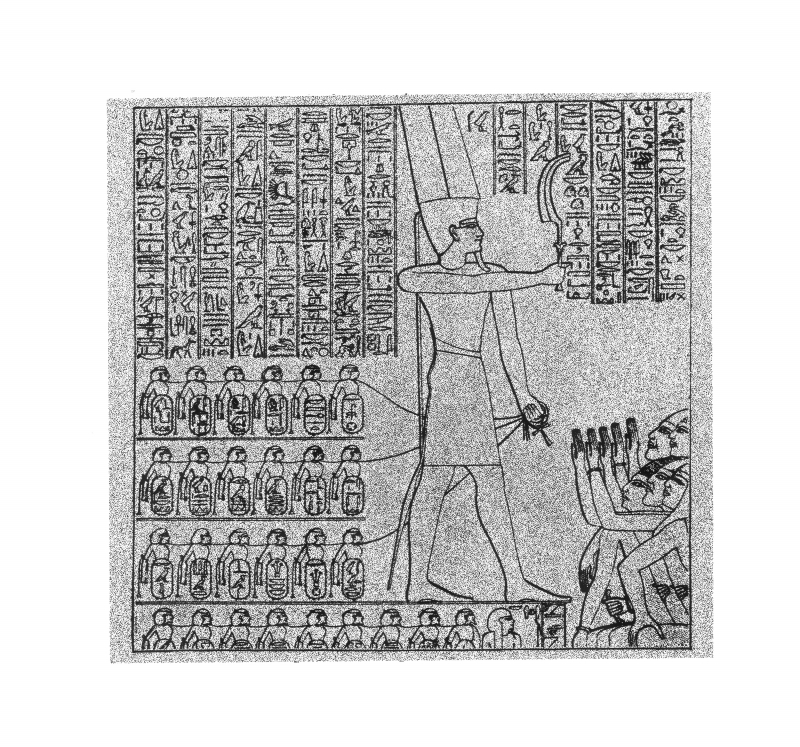
Not a green thing remained, neither tree nor plant...

“So Moses stretched out his staff over the land of Egypt” (verse 13-15), and the destruction by the locusts is devastating.  Pharaoh offers fake repentance; and the next plague – of darkness – makes foolish their worship of the sun, as the people of Israel enjoy light through it all (verse 23).  Still, he tries partial obedience.   But Moses, having now matured in the Lord, lets him know this is not acceptable in verses 25-26.

The events of God’s word as written in Hebrew are not always chronologically placed in succession; and some believe that the exchange between Pharaoh and Moses in 27-28 actually occurred during the warning about the tenth plague in 11:8.  This seems to be given some credence by Moses’ statement in verse 29, “As you say! I will not see your face again.”

Read or listen to audio of ESV version of this selection from this link.

/Robert
___________________
image © V. Gilbert & Arlisle F. Beers

Please note: I did not design the reading plan that I am following in my blog.  All of my comments in this blog, however, are solely my responsibility.  When reading ANY commentary, you should ALWAYS refer first to the scripture, which is God’s unchanging and unfailing word. Reading schedules, as well as a link to the site where you can get the reading plan that I’m currently following for yourself can be found on the “Bible Reading Schedules” page of my website at http://graceofourlord.com.  For questions and help, please see the “FAQ” and “Summaries” pages there.

Exodus 9 – The Fifth, Sixth, and Seventh Plagues

There is a lot going on in this chapter as God accomplishes His objectives.  It is helpful, though to step back for a moment and fully realize that is precisely what He is doing.  Freeing the descendants of Israel (Jacob), and even placing them in the land He had promised would be easily accomplished by the creator of the universe – as would punishing Pharaoh for his defiance.  He gets all of those things done in His own time, but He is teaching His people, and the world in the process.

The Fifth Plague: Egyptian Livestock Die

The plagues, as assaults upon the foolishness of the worship of specific false “gods,” exposes such man-made creations as the empty promises that they are, which ultimately can facilitate the very destruction that falls on those that worship them.  The same can be said of the empty things that man tends to “worship” today – fortune, sex, and selfish pleasure, to name a few.  Those same plagues demonstrate that all of the things of the earth itself come from our one true God, who shows Himself in these verses to be sovereign over them all.

Further comments on Pharaoh’s “heart condition”

(I apologize for the length of today’s blog, but I feel the need to give my comments about this subject more adequately because of its troubling nature to some people – and because of the urgency of what it means to us today)

Notice again in verse 34, as in Exodus 8:15 and 8:32, the text says that Pharaoh hardened his heart – just as we are told elsewhere in these chapters, as well as other books (such as in 1 Samuel 6:6). Most honest readers will admit to being somewhat disturbed at some point by the other passages in Exodus that refer to God being the one that hardens Pharaoh’s heart – as if God actually caused Pharaoh’s own demise, when he might otherwise have been repentant.  And indeed many commentators and theologians, by their interpretations, have not only failed to adequately dispel those concerns, rather their analysis has often actually increased those feelings.

While it is true that the Lord is sovereign over all, and can choose to show mercy on whom He wishes (as Paul reminds us in Romans 9:16-18), the suggestion that He in any way was the cause of Pharaoh’s failure to obey is a terrible misunderstanding of the scripture as it was written, and indeed the very nature of our Lord.  God tells us in his word that he “desires all people to be saved” (1 Timothy 2:4), and God never lies (Titus 1:1-2).  Moreover, He is without injustice, as said beautifully in the NKJV version of Deut 32:4:

He is the Rock, His work is perfect;
For all His ways are justice,
A God of truth and without injustice;
Righteous and upright is He.

The Lord’s part in the hardening of Pharaoh’s heart was that He forced him over and over again into a position that he would not otherwise have been in – to face undeniably, the impotence of his false “gods,” to see for himself the might and sovereign power of the one true God – and knowing this, to make up his mind whether he would obey or defy.  God absolutely knew Pharaoh’s heart, but know this for certain – Pharaoh chose to defy the Lord.

This is where the relevance for us today is so sad because we see it for (in?) ourselves far too often.  By our continued defiance to God, insisting instead to live in sin and worship our own “gods,” we are quite capable of hardening our own hearts.   Paul warns in Romans 8:7-8, which I quote below (keeping in mind that the “mind set on the flesh” refers to both unbelievers and to those unwilling to truly repent, who are by definition in bondage to sin):

7 For the mind that is set on the flesh is hostile to God,
for it does not submit to God’s law;
indeed, it cannot.
8 Those who are in the flesh cannot please God.

Read or listen to audio of ESV version of this selection from this link.

/Robert
___________________
image © V. Gilbert & Arlisle F. Beers

Please note: I did not design the reading plan that I am following in my blog.  All of my comments in this blog, however, are solely my responsibility.  When reading ANY commentary, you should ALWAYS refer first to the scripture, which is God’s unchanging and unfailing word. Reading schedules, as well as a link to the site where you can get the reading plan that I’m currently following for yourself can be found on the “Bible Reading Schedules” page of my website at http://graceofourlord.com.  For questions and help, please see the “FAQ” and “Summaries” pages there.


Exodus 6 – God Promises Deliverance

Speaking of Himself in third person in verse 1, God tells Moses that he will see what the Lord will do, as he delivers them with “a strong hand”.  God is very patient with Moses and his doubt, as He is building faith – the faith, not only of Moses and Aaron, but of the people of Israel as a whole.   He restates His covenant with them in verses 3-4.

God is specific about what He wants Moses to say to the people in this chapter, as others.  But verse 9 says that “they did not listen to Moses, because of their broken spirit and harsh slavery”.  This did not come as a surprise to Lord.  He knew they would not listen at that point, but He also knew that they and their children’s children would remember the things that He had Moses tell them over and over (as in verses 6-8) – “I am the Lord” — “I will redeem you” — “I will take you to be my people” — “I will deliver you”  — “and you shall know that I am the Lord your God”.

Moses is discouraged, but God tells him to go again to Pharaoh, and tells him in no uncertain terms that he and Aaron will in fact be bringing the people of Israel out of Egypt (verse 13)!  The genealogies beginning in verse 14 are intended to demonstrate to the reader how Moses and Aaron descend from the house of Israel (Jacob), just like any one of more than 600, 000 others (Exodus 12:37).

Verse 30 shows that Moses is still not convinced that anyone will listen to him now.

Read or listen to audio of ESV version of this selection from this link.

/Robert
___________________
image © V. Gilbert & Arlisle F. Beers

Please note: I did not design the reading plan that I am following in my blog.  All of my comments in this blog, however, are solely my responsibility.  When reading ANY commentary, you should ALWAYS refer first to the scripture, which is God’s unchanging and unfailing word. Reading schedules, as well as a link to the site where you can get the reading plan that I’m currently following for yourself can be found on the “Bible Reading Schedules” page of my website at http://graceofourlord.com.  For questions and help, please see the “FAQ” and “Summaries” pages there.

Exodus 2 – The Birth of Moses

Now the daughter of Pharaoh came down to bathe at the river, while her young women walked beside the river. She saw the basket among the reeds and sent her servant woman, and she took it.

After he is born, Moses’ mother is unable to hide him after three months, and places him in a basket in the reeds by the riverbank (verse 3).  After Pharaoh’s daughter “draws” him out, Moses’ own sister summons the courage to ask her if she should get a Hebrew woman to nurse the child for her (verse 7).  So of course, she fetches Moses’ own mother for the task!

Stephen tells us in Acts 7:23, that Moses was 40 years old when verses 11-15 take place; and Moses flees for his life to Midian (where he will stay for another 40 years, as we are told in Acts 7:30).  The father of the woman who will become his wife is referred to as Reuel in verse 18, but we will come to know him as Jethro.

 God Hears Israel’s Groaning – As the people cry out because of their slavery, verse 24 says that “God remembered his covenant with Abraham, with Isaac, and with Jacob”.  God never forgets.  When the scripture says “God remembered,” it means He has decided the time has come for what He wants to happen next concerning that person or event (as in Gen 8:1).

Read or listen to audio of ESV version of this selection from this link.

/Robert
___________________
image © V. Gilbert & Arlisle F. Beers

Please note: I did not design the reading plan that I am following in my blog.  All of my comments in this blog, however, are solely my responsibility.  When reading ANY commentary, you should ALWAYS refer first to the scripture, which is God’s unchanging and unfailing word. Reading schedules, as well as a link to the site where you can get the reading plan that I’m currently following for yourself can be found on the “Bible Reading Schedules” page of my website at http://graceofourlord.com.  For questions and help, please see the “FAQ” and “Summaries” pages there.


Genesis 46 – Joseph Brings His Family to Egypt

The Lord tells Israel in verse 2 that Egypt is where he should now go, and where he will become a great nation. Remember, God had forbidden his father Isaac to go there during a previous famine (Gen 26:1-5).  So Jacob, his sons and daughters, and all of their families set out for Egypt.  The Lord, through Moses, remembers his sons – and their sons in the text; and verse 26 tells us that the number of Jacob’s descendants (not including his sons’ wives) was 66.  Add Israel himself, Joseph and his two sons, and there were 70 (verse 27).  That number will multiply by more that 80,000 – to over 600,000 at Sinai (Num 1:44-46) after Moses has led them out of Egypt in Exodus 12:51.

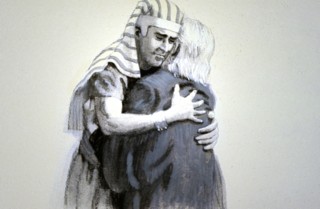
Joseph and Israel have an emotional reunion in Goshen, and Joseph reveals how they will be (for now) left to their own devices there in verses 31-34 because “every shepherd is an abomination to the Egyptians”.

(Side note: “Ferrell’s Travel Blog” has several articles, accompanied with some photographs, concerning Goshen.  Two that I find interesting are “Why were shepherds detestable to Egyptians?” and “The Land of Rameses“)

Read or listen to audio of ESV version of this selection from this link.

/Robert
___________________
image © V. Gilbert & Arlisle F. Beers

Please note: I did not design the reading plan that I am following in my blog.  All of my comments in this blog, however, are solely my responsibility.  When reading ANY commentary, you should ALWAYS refer first to the scripture, which is God’s unchanging and unfailing word. Reading schedules, as well as a link to the site where you can get the reading plan that I’m currently following for yourself can be found on the “Bible Reading Schedules” page of my website at http://graceofourlord.com.  For questions and help, please see the “FAQ” and “Summaries” pages there.


Genesis 45 – Joseph Provides for His Brothers and Family

Judah’s speech evokes high emotion in Joseph, and he finally reveals himself to his now speechless brothers.  When they were brought back to this governor accused of theft, they must have thought that life had turned about as badly as it could get.  Now they find out that this powerful ruler is the brother they sold into slavery!  But Joseph is quick to reassure them in verses 5 and 7 that God is working through him and intends to continue to do so through their descendants. This does not absolve them of their guilt, but it shows God’s power to use even the worst actions of men for good!

With Pharaoh’s pleasure, and even his own instruction for providing for them generously (verses 16-18), Joseph sends them back to bring their father, Israel and the rest of their families to Egypt to dwell in the land of Goshen.  Israel is unbelieving at first, but when convinced, is very happy (verse 28).

Read or listen to audio of ESV version of this selection from this link.

/Robert
___________________
image © V. Gilbert & Arlisle F. Beers

Please note: I did not design the reading plan that I am following in my blog.  All of my comments in this blog, however, are solely my responsibility.  When reading ANY commentary, you should ALWAYS refer first to the scripture, which is God’s unchanging and unfailing word. Reading schedules, as well as a link to the site where you can get the reading plan that I’m currently following for yourself can be found on the “Bible Reading Schedules” page of my website at http://graceofourlord.com.  For questions and help, please see the “FAQ” and “Summaries” pages there.


Genesis 44 – Joseph Tests His Brothers

When Joseph sends them away, he has his steward once again place their money in their sacks.  But this time, he has his silver cup placed in Benjamin’s bag and he has them followed, accused of theft, and brought back.  The brothers who have carried the burden of their guilt for so long are convinced that God himself has brought this on them for what they did to Joseph so many years ago.

Joseph tells them that the rest of them can go, but Benjamin will remain as his slave.  The brothers are purposely placed in the position of losing their younger brother – and facing Jacob’s (Israel’s) devastation.  Judah begins a passionate plea of repentance in verse 18, offering himself in his younger brother’s place.  Remember, it was Judah’s idea to have Joseph sold instead of killing him in Gen 37:26-28.

The change that has taken place in his brothers is no doubt what Joseph was looking (and hoping) for.

(Side note: Here is a link to a lengthy, but very interesting article from the publishers of “Bible and Spade” magazine calledThe Joseph Narrative (Genesis 37, 39–50)that includes information about Egyptian captives from Canaan)

Read or listen to audio of ESV version of this selection from this link.

___________________

Please note: I did not design the reading plan that I am following in my blog.  All of my comments in this blog, however, are solely my responsibility.  When reading ANY commentary, you should ALWAYS refer first to the scripture, which is God’s unchanging and unfailing word. Reading schedules, as well as a link to the site where you can get the reading plan that I’m currently following for yourself can be found on the “Bible Reading Schedules” page of my website at http://graceofourlord.com.  For questions and help, please see the “FAQ” and “Summaries” pages there.
/Robert

Genesis 43 – Joseph’s Brothers Return to Egypt

The grain that Joseph’s brothers brought back from Egypt has run out.  Jacob (who is referred to as “Israel” more times in this chapter than previously) knows that the brothers must go back for more, but it is Judah who speaks up convinces his father to entrust Benjamin to him (verse 9).  In stark contrast to Reuben, he places the responsibility for the boy’s safety on his own shoulders; and Israel is resigned that there just is no choice, and fears he may not see them again (verse 14).  So he sends them with gifts and a double portion of money, and they return to Joseph.

When they are brought to Joseph’s house, their fears mount (verse 18), but instead of harsh treatment, they are fed and treated well.  Joseph’s love and compassion for his younger brother is great, and Benjamin receives five times the amount of food that his brothers get.  Joseph has plans for little brother.

Read or listen to audio of ESV version of this selection from this link.

___________________

Please note: I did not design the reading plan that I am following in my blog.  All of my comments in this blog, however, are solely my responsibility.  When reading ANY commentary, you should ALWAYS refer first to the scripture, which is God’s unchanging and unfailing word. Reading schedules, as well as a link to the site where you can get the reading plan that I’m currently following for yourself can be found on the “Schedules” page of my website at http://graceofourlord.com.  For questions and help, please see the “FAQ” and “Summaries” pages there.
/Robert