In the Presence of All Peoples

In verses 22-24 of Luke chapter 2, we learn that Mary and Joseph have brought Jesus to Jerusalem to make an offering once the days of her purification following childbirth are complete. This is in accord with the Law of Moses given in Leviticus 12:3-8, and it means that it was 40 days after his birth. The offering is to be a lamb and a turtle-dove or pigeon unless she cannot afford a lamb, in which case it would be two turtle-doves or two pigeons. Since Joseph was not a man with much wealth, the offering would be the latter.

St Joseph with the Infant Jesus (c. 1635), at ...

St Joseph with the Infant Jesus (c. 1635), at the Hermitage, in St. Petersburg. Oil on canvas, 126 x 101 cm. (Photo credit: Wikipedia)

Beginning in verse 25, we are told of a righteous and devout man who was there that was filled with the Holy Spirit. The text says that he was waiting for”the consolation of Israel,” which is to say that he was waiting for God to send the Messiah to redeem His people. In fact, verse 26 says that the Holy Spirit had revealed that he would see the Christ in his lifetime. There are some scholars (particularly Dr. John Lightfoot) that believed this Simeon was the son of a great philosopher and doctor of that day, Hillel, and that Simeon was also president of the Sanhedrin. If true, this would mean that he was also the father of Gamaliel, who Saul of Tarsus studied under. All very interesting, and we are sure, quite educated calculations, but still historically unsubstantiated.

As he took the child in his arms, he offered his blessing to God, saying “…that you have prepared in the presence of all peoples, a light for revelation to the Gentiles, and for glory to your people Israel.”  Filled with the Holy Spirit, Simeon already knew what many would not figure out until after Jesus’ death and resurrection – that he had come for the Gentiles as well. He then blessed the parents, and addressed Mary with some prophecy in verses 34-35 that points to the rise of many ordinary men to be His apostles, the fall of unbelievers such as Annas and Caiaphas, and a darker prophecy of Mary’s heartbreaking witness of her son’s death (“a sword will pierce through your own soul”).

In verses 36-38, we are told of a prophetess named Anna, who was “advanced in years.” The words “did not depart from the temple” simply refer to the fact that despite her age, she did not forsake her temple duties. Verse 38 says of her: “and coming up at that very hour she began to give thanks to God and to speak of him to all who were waiting for the redemption of Jerusalem.” “To speak of him” refers to Jesus, not God, as is obvious from the context.

So we can deduce from these two accounts, that a number of people were being told of the fact that this child was the long-awaited Messiah.

(This year’s reading plan for Luke, Acts, and 1 and 2 Chronicles averages just 15 verses per day – 5 days per week!)
Schedule for this week
Read or listen to audio of today’s selection from Luke here
Read or listen to audio of today’s selection from 1 Chronicles here

/Bob’s boy
___________________
some images © V. Gilbert & Arlisle F. Beers

All of my comments in this blog, however, are solely my responsibility.  When reading ANY commentary, you should ALWAYS refer first to the scripture, which is God’s unchanging and unfailing word. Reading schedules can be found on the “Bible Reading Schedules” page of my website at http://graceofourlord.com.

Enhanced by Zemanta

The Birth of John the Baptist

In Luke 1:57, Elizabeth  bears a son, and all of their friends and relatives rejoiced with her. On the eighth day, they came to circumcise him, according to Mosaic Law (Genesis 17:12, Leviticus 12:3). Everyone fully expected the child to be named Zechariah after his father, but when Elizabeth told them that his name was John, they appealed to Zechariah to make a sign – as he was still mute.

When Zechariah wrote that the child’s name was John as well, he then became able to speak again, praising God. This event, together with the very fact that this couple beyond child-bearing years now had a son, spread news and wonder throughout the hill country that God’s hand was surely involved. This child, they knew, was going to be special.

Birth of St. John the Baptist, depicting Zecha...

Birth of St. John the Baptist, depicting Zechariah writing, “His name is John”. (Photo credit: Wikipedia)

Zechariah, filled with the Holy Spirit, began to prophesy and from verses 68-79, he says a great deal about his son and his calling, as well as the coming savior, that he would not have known without such divine guidance. In verse 69, the “horn of salvation” that God has raised up is of course, Jesus. The horn was a symbol of strength and power, and is referred to in many Bible passages, including Hannah’s song in 1 Samuel 2. In the ensuing verses, he continues to speak of this salvation in terms of the covenant with Abraham and his descendants.

Then, in verse 79, he addresses the child, saying that he “will be called the prophet of the Most High; for you will go before the Lord to prepare his ways, to give knowledge of salvation to his people in the forgiveness of their sins…” The first part is in keeping with what is foretold in Malachi 3:1, and Isaiah 40:3. And true forgiveness of sins is part of the new covenant that was promised in Jeremiah 31:31-34, which is affirmed by Jesus during the institution of the Lord’s Supper in Matthew 26:28, when he spoke of “my blood of the covenant, which is poured out for many for the forgiveness of sins.

In confirmation of just how special this child was to be, verse 80 tells the reader that he “grew and became strong in spirit, and he was in the wilderness until the day of his public appearance to Israel.” John the Baptist would wait for his calling from the Lord.

(This year’s reading schedule for Luke, Acts, and 1 and 2 Chronicles averages just 15 verses per day – 5 days per week!)
Read or listen to audio of today’s selection from Luke here
Read or listen to audio of today’s selection from 1 Chronicles here

/Bob’s boy
___________________
some images © V. Gilbert & Arlisle F. Beers

All of my comments in this blog, however, are solely my responsibility.  When reading ANY commentary, you should ALWAYS refer first to the scripture, which is God’s unchanging and unfailing word. Reading schedules can be found on the “Bible Reading Schedules” page of my website at http://graceofourlord.com.

Enhanced by Zemanta

Introductions Continue – Proverbs

Book Of Proverbs

Book Of Proverbs (Photo credit: neonbubble)

This week, we will finish our reading of the first nine chapters of Proverbs, before setting into our regular schedule for the year (for more details on that schedule, see this previous post).  These first nine chapters are a series of discourses that convey the message about wisdom that Holy Spirit is teaching us in this book – about life itself, service to God, and our salvation.  A proper understanding of these nine chapters will prepare us for the actual proverbs of the remainder of the book.  Much of the proverbs themselves are self-explanatory, but the knowledge they convey takes a little work to gain the insight Solomon speaks of (Proverbs 4:1).  After this week, we will find a “voice” to express what this writer is taking away from some of those proverbs.

Summing Up

Each weekend this year (beginning next weekend), I will be posting a small PDF of one week of the daily reading summaries (on the website’s “Summaries” page), current to the beginning of the previous week.  I will post the summary for Week 1 (January 2013 Week 1) of the schedule I am following this year next weekend.

/Bob’s boy
___________________
image © V. Gilbert & Arlisle F. Beers

Please note: I did not design the reading plan that I am following in my blog.  All of my comments in this blog, however, are solely my responsibility.  When reading ANY commentary, you should ALWAYS refer first to the scripture, which is God’s unchanging and unfailing word. Reading schedules, as well as a link to the site where you can get the reading plan that I’m currently following for yourself can be found on the “Bible Reading Schedules” page of my website at http://graceofourlord.com.  For questions and help, please see the “FAQ” and “Summaries” pages there.
Revelation 4 – The Throne in Heaven

John’s vision here begins with a door open into heaven.  The first voice he hears in verse one is generally accepted to be that of Jesus.  John had heard that voice on earth.  As John is then aware of being fully in the manifested presence of the Holy Spirit, the visions that occur after that remind us of a similar reference in Ezekiel 3:12-15.   Much interpretation of the detail of the imagery that follows has been made to the point of extremity.  One writer noted: One who adapts Biblical images as freely as he (John) has in this chapter should not be expected to preserve an undeviating consistency in his pictures. They are for kindling the imagination, not for transference to the drawing board.

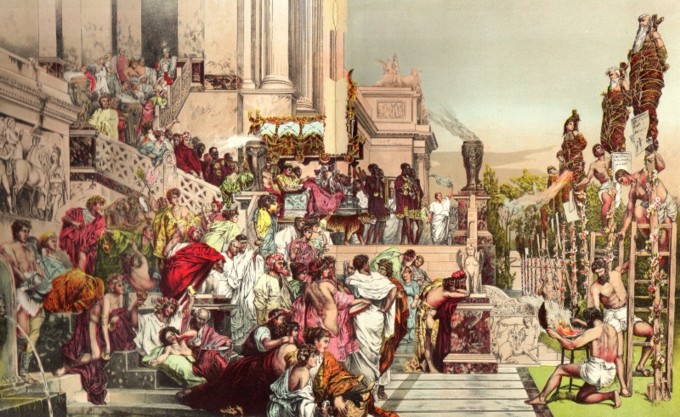
Nero's human torches of Christians

Nero’s human torches of Christians

No matter what interpretation you give each of these eleven verses, keep in mind the original audience.  These were persecuted Christians, many of whom may have known people – even had loved ones – that had been killed because of their faith in the Lord.  But they were holding on to that faith while looking toward heaven.  Here, as instructed by the Lord in Revelation 1:10-11, John gives them a grand glimpse of that splendor in the sort of literary imagery that was common to their day.  In the middle of the Lord’s battle with Satan, John gets that look at the throne of our Creator in heaven, and the worship that He worthily receives there.

Read or listen to audio of ESV version of this selection from this link.

/Bob’s boy
___________________
some images © V. Gilbert & Arlisle F. Beers

Please note: I did not design the reading plan that I am following in my blog.  All of my comments in this blog, however, are solely my responsibility.  When reading ANY commentary, you should ALWAYS refer first to the scripture, which is God’s unchanging and unfailing word. Reading schedules, as well as a link to the site where you can get the reading plan that I’m currently following for yourself can be found on the “Bible Reading Schedules” page of my website at http://graceofourlord.com.  For questions and help, please see the “FAQ” and “Summaries” pages there.

Hebrews 10 – The Full Assurance of Faith

In the previous chapters of this letter, the writer has been driving home the superiority of the new covenant, and of Jesus as our high priest.  He continues in verse one, stating that the law was just “a shadow of the good things to come instead of the true form of these realities.”    The sacrifices of old, year after year, were just a temporary forgiveness of sins because “it is impossible for the blood of bulls and goats to take away sins.”  But Jesus Christ came to do God’s will (verses 5-7 quote Psalm 40:6-8), and offered Himself up as a single sacrifice for all time (verses 10-12).

Crucifixion

Crucifixion (Photo credit: Wikipedia)

Verses 19-23 bring it all home.  Whereas before we as servants of God could not enter the holy place, Jesus has torn the curtain – the veil – open for all time (an allusion to the literal event of Matthew 27:51-52 when Jesus was crucified).  And because we have “a great priest over the house of God,” we can draw near with confidence, clean from evil conscience, and with a true heart – full of the assurance of faith that our sins are forgiven.  We can now hold fast to our hope without wavering because “he who promised is faithful.”

Verses 24-25 are quoted often to remind us that we need to be faithful in attendance of worship, as it says:

“…let us consider how to stir up one another to love and good works, not neglecting to meet together, as is the habit of some, but encouraging one another…”

Those who claim they can serve the Lord themselves without being part of a worship service ignore this passage at their own peril.  How can we “stir up one another” or “encourage one another” if we do not meet together, as the writer, inspired by the Holy Spirit, says?  Verse 26, and following, warn of the danger of trying to “go it alone.” It is far too easy to slip away from the path, and back into sin.  As verse 31 says, “It is a fearful thing to fall into the hands of the living God.”

We need each other because that encouragement, those things that “stir up one another” help give us endurance.  And we “have need of endurance, so that when you have done the will of God you may receive what is promised.”

Read or listen to audio of ESV version of this selection from this link.

/Bob’s boy
___________________
some images © V. Gilbert & Arlisle F. Beers

Please note: I did not design the reading plan that I am following in my blog.  All of my comments in this blog, however, are solely my responsibility.  When reading ANY commentary, you should ALWAYS refer first to the scripture, which is God’s unchanging and unfailing word. Reading schedules, as well as a link to the site where you can get the reading plan that I’m currently following for yourself can be found on the “Bible Reading Schedules” page of my website at http://graceofourlord.com.  For questions and help, please see the “FAQ” and “Summaries” pages there.
Hebrews 6 – The Certainty of God’s Promise

The Hebrew writer continues in this chapter after his rebuke to the recipients of the letter in chapter 5, stating that it is time to move from “the elementary doctrine of Christ and go on to maturity….” This does not mean that the first principles of Christianity to which he refers are unimportant, or that they should be forgotten.  Rather, it is time for them to grow into maturity spiritually;  and they will do that (as will we) by diligently studying the Scriptures and “by constant practice to distinguish good from evil” as stated in 5:14.

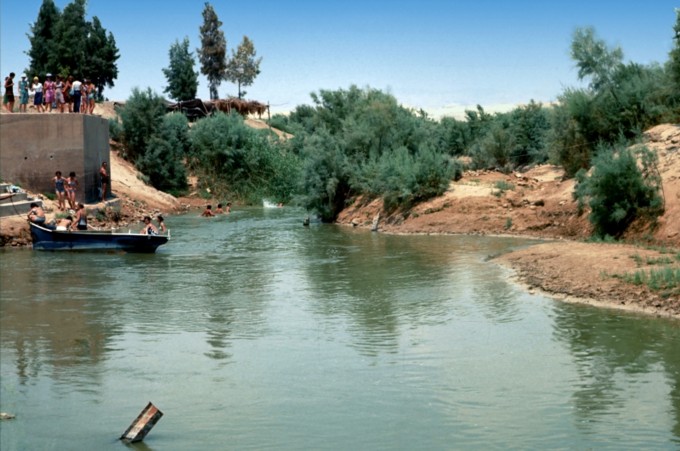
Jordan River, traditional site of Jesus' baptism

Jordan River, traditional site of Jesus’ baptism

Verses 4-8 do not refer to sin that is unforgivable by God.  As 1 John 1:7 says the blood of Jesus his Son cleanses us from all sin.”  But the text does make it plain that those who have been saved can fall away from the Lord, and we must be careful.  When he says that it is impossible to bring such a person who once “shared in the Holy Spirit” back to repentance, he means it is impossible for his fellow Christians to bring that person to repentance if his heart has been hardened.  Nothing is impossible for God, however, and He has and does bring some who have fallen into apostasy back.  But living a life of sin once one has known the truth can result in a condition of heart and spirit from which there is no return.

Verses 13-20 remind us of the promise God made to Abraham and his heirs – that He made it with an oath, and it is impossible for God to lie (Titus 1:1-2), promising the faithful heirs eternal life.  And as Christians, baptized into Christ, we are those heirs (Galatians 3:27-29).  As verses 19-20 conclude, we have that hope as a steadfast anchor through Jesus “having become a high priest forever after the order of Melchizedek.”

Read or listen to audio of ESV version of this selection from this link.

/Bob’s boy
___________________
some images © V. Gilbert & Arlisle F. Beers

Please note: I did not design the reading plan that I am following in my blog.  All of my comments in this blog, however, are solely my responsibility.  When reading ANY commentary, you should ALWAYS refer first to the scripture, which is God’s unchanging and unfailing word. Reading schedules, as well as a link to the site where you can get the reading plan that I’m currently following for yourself can be found on the “Bible Reading Schedules” page of my website at http://graceofourlord.com.  For questions and help, please see the “FAQ” and “Summaries” pages there.

Acts 15 – The Jerusalem Council

Despite Peter’s vision, and the fact that the Holy Spirit was given to the Gentiles in chapter 10, the acceptance of Gentiles in the church was still meeting resistance. In Acts 6:7, we are told of a significant number of priests that believed and were added to the church.  Many of these would be of the Pharisaic party referred to in verse 5.  There were people being taught that all had to be circumcised and to keep the law of Moses, causing Christianity to be looked upon as a sect of Judaism (and to some, a sect that had gone very wrong).  The time had come to deal with this issue once and for all.

Paul had been given his revelation on the matter, as the Lord had told Ananias in Acts 9:15 that “he is a chosen instrument of mine to carry my name before the Gentiles…”  He and Barnabas and others were appointed to go to Jerusalem to speak to the apostles and elders about the matter.  In verse 3, we have them passing through Phoenicia and Samaria, bringing great joy as they describe the conversion of the Gentiles.

Peter spoke to the council in verses 7-11, reminding them of the gift of the Holy Spirit.  Then Paul and Barnabas related the signs and wonders God had done through them on their journey.  James, the Lord’s brother, then affirms by quoting Amos 9:11-12 in verses 16-18.  The apostles then chose men to go with Paul and Barnabas to Antioch, and sent a letter with them, affirming with one accord that the Gentiles were not to be burdened with the requirements that the circumcision party was trying to impose.  The stipulations referred to in verses 20 and 29 were to make clear that they were to abstain from behavior that would make them  appear to the world as the idol-worshipers that were so common (sexual immorality was a predominant theme in idol worship).

Pamphylia hill country, Turkey, a small Roman province in southern Asia Minor during Paul’s time. Paul preached here on his First Missionary Journey. Later, John Mark left Paul and Barnabas and went home.

Paul and Barnabas stayed in Antioch (of Syria) preaching for a while, then prepared to re-visit the cities where they had been.  Verse 39 describes “a sharp disagreement” between the two.  Barnabas wanted to take Mark with them.  But verse 38 says that “Paul thought best not to take with them one who had withdrawn from them in Pamphylia and had not gone with them to the work.”  Separating, Barnabas and Mark went to Cyprus, and Paul took Silas and went through Syria and Cilicia.  The Scripture does not elaborate on this, but it has been pointed out that the disagreement had the end result of making their efforts doubly fruitful.

Read or listen to audio of ESV version of this selection from this link.

/Bob’s boy
___________________
some images © V. Gilbert & Arlisle F. Beers

Please note: I did not design the reading plan that I am following in my blog.  All of my comments in this blog, however, are solely my responsibility.  When reading ANY commentary, you should ALWAYS refer first to the scripture, which is God’s unchanging and unfailing word. Reading schedules, as well as a link to the site where you can get the reading plan that I’m currently following for yourself can be found on the “Bible Reading Schedules” page of my website at http://graceofourlord.com.  For questions and help, please see the “FAQ” and “Summaries” pages there.

Acts 11 – Peter Reports to the Church

The old city of Jerusalem and the Temple area is at the right. At the left is Mount Zion, the City of David. The gold-domed building is the Dome of the Rock

Chapter 10 ended with Cornelius, his family, and friends receiving the Holy Spirit; and then “they asked him (Peter) to remain for some days.”  Just how long “some days” turned out to be we are not told.  But by the time Peter returned to Jerusalem, news that the “Gentiles also had received the word of God” had already spread back to the other apostles and the brothers and sisters throughout Judea.  In verse 2, Peter was getting criticism from the “circumcision party.”  This would be a group of Christians who probably had a strict “Pharisaic” background either personally or by association.  They would likely expect that Gentiles who wanted to be Christians would have to first convert to Judaism, even going so far as to be circumcised and would need to live according to Jewish ritual law.  Their indignation was at Peter having eaten with these uncircumcised Gentiles after he left Joppa for Caesarea.

Peter responds by first telling them of his own vision, then that of Cornelius.  He then relates how “the Holy Spirit fell on them” just as had happened to the apostles at Pentecost.  That settled the matter – there were none present who could consider any alternative to the obvious conclusion.  So “they glorified God, saying, “Then to the Gentiles also God has granted repentance that leads to life.”  Though the matter would still be debated, God’s will was clearly going to be done.

Persecution scattered the believers into Phoenicia, Cyprus, and Antioch, and the gospel went with them. Most spoke only to Jews, but in Antioch some Gentiles were converted. The church sent Barnabas to investigate, and he was pleased with what he found. Barnabas went to Tarsus to bring Saul (Paul) back to Antioch.

Verses 19-21 relate how a great number of those who had been scattered from Jerusalem after the stoning of Stephen had preached the word to others.  But some had not exclusively taught Jews.  Instead, many coming to Antioch had preached the word of Jesus to the Hellenists; and many had believed.  When word of this reached Jerusalem, they sent Barnabas, who found them faithful.  Barnabas, encouraged and full of the Spirit, went to Tarsus to find Paul; and together they taught in Antioch for a year.  It was in Antioch, according to verse 26, where the disciples were first called Christians.

One of the gifts of the Holy Spirit, given to others by the Apostles during those days, was the gift of prophecy.  One disciple with that gift foretold a great famine (verse 28).  Historians believe that this famine that took place during the reign of Claudius (Tiberius Claudius Caesar Augustus Germanicus, Roman emperor from A.D. 41-54) was in the years 45–47 A.D.  This would be confirmed by Galatians 2:1, where Paul states that his second visit to Jerusalem referred to in verse 30 was 14 years after his conversion, which would be circa 47 A.D.

Read or listen to audio of ESV version of this selection from this link.

/Bob’s boy
___________________
some images © V. Gilbert & Arlisle F. Beers

Please note: I did not design the reading plan that I am following in my blog.  All of my comments in this blog, however, are solely my responsibility.  When reading ANY commentary, you should ALWAYS refer first to the scripture, which is God’s unchanging and unfailing word. Reading schedules, as well as a link to the site where you can get the reading plan that I’m currently following for yourself can be found on the “Bible Reading Schedules” page of my website at http://graceofourlord.com.  For questions and help, please see the “FAQ” and “Summaries” pages there.

Acts 10 – Peter’s Vision

The book of Acts just continues to present us with such momentous occasions; and chapter 10 is clearly one of special significance.  Cornelius of Caesarea was a Gentile soldier of an Italian cohort.  a cohort could consist of from 600 – 1000 men, with 6 centurions in charge.  A centurion was paid anywhere from 5 to as much as 20 times as much as the average Roman soldier, so Cornelius was likely considered wealthy.  Identified in several verses as a God-fearer, he would have been attached to a synagogue and a believer in God, but not circumcised.  An angel came to him in a vision telling him to have Peter brought to him, as well as where to find him.

Joppa, today called Jaffa, was once the seaport for Jerusalem. Hiram sent cedar logs from Lebanon to King Solomon for the Temple, floating them to Joppa (2 Chronicles 2:15). From Joppa the prophet Jonah ran away from God ( Book of Jonah), sailing from there toward Tarshish. Here Peter raised Tabitha, or Dorcas, from the dead (Acts 9:36-42). Later he was staying here at the house of Simon the Tanner when he saw a vision of unclean animals, which led him to visit Cornelius’ house in Caesarea and win him to Christ. This is the traditional site of the home of Simon the Tanner.

Meanwhile, on the housetop at the home of  Simon the tanner, Peter had a vision of his own (verses 9-16) that was perplexing to him at first.  The vision occurred three times of all sorts of animals descending from heaven that he was commanded to eat – some of whom were unclean by Jewish law.  Peter argued at first, but the voice said to him “What God has made clean, do not call common.”  Peter would come to understand that this landmark vision was not referring just to animals and food, but also to men.  While he was still sorting through this, the Spirit told him about Cornelius’s men who were now at his gate – that he was to go with them.

Being led by the Spirit, Peter judiciously took some of the brothers with them for witnesses of what was to occur.  When they arrived from Joppa into Caesarea, Cornelius had gathered his friends and family and fell at Peter’s feet.  Whatever was in Cornelius’ heart, Peter knew it was wrong to allow that sort of worship, and rebuked him in verse 26.  In verses 28-29, Peter acknowledges that under Jewish tradition, coming to the house of a Gentile (let alone, eating with them) would make one ceremonially unclean, but says that God has told him that he “should not call any person common or unclean.”  So, he asks why Cornelius has sent for him.

When Peter visited the Roman centurion Cornelius, this important soldier fell at Peter’s feet.

So Cornelius tells him of his vision and that all present were commanded to hear what Peter has to say.  With that, Peter preaches to them about Jesus and forgiveness of sins through His name.  It was then that the Holy Spirit fell upon all present.  The baptism of the Holy Spirit had previously been done directly from God to only the apostles, with it given to others only through the apostles laying on hands.  But now, to the amazement of all circumcised believers who had come with Peter (verse 45), this second baptism was being poured out even to Gentiles.

Peter, acknowledging the gift that was given to them, then commanded that they be baptized with water as well.  Peter’s perspective had changed forever concerning non-Jews.  Now the Lord’s Kingdom would grow even faster!  But this new perspective would not come without some resistance to change.

Read or listen to audio of ESV version of this selection from this link.

/Bob’s boy
___________________
some images © V. Gilbert & Arlisle F. Beers

Please note: I did not design the reading plan that I am following in my blog.  All of my comments in this blog, however, are solely my responsibility.  When reading ANY commentary, you should ALWAYS refer first to the scripture, which is God’s unchanging and unfailing word. Reading schedules, as well as a link to the site where you can get the reading plan that I’m currently following for yourself can be found on the “Bible Reading Schedules” page of my website at http://graceofourlord.com.  For questions and help, please see the “FAQ” and “Summaries” pages there.

Acts 7 – Stephen’s Speech and Stoning

Before the Sanhedrin, the Jewish council, Stephen gave a stirring sermon about Jesus. For this, he was stoned to death, becoming a martyr for Jesus (Acts 7:1-34).

Chapter 7 opens with Stephen at the Sanhedrin being asked by the high priest “Are these things so?”  The charges against Stephen from lies and twisted quotations of Jesus were that he “never ceases to speak words against this holy place and the law,” and that they had heard him say “that this Jesus of Nazareth will destroy this place and will change the customs that Moses delivered to us” (Acts 6:13-14).

Did Stephen, full of the Holy Spirit, already know the fate that awaited him?  Perhaps.  The possibility must have been obvious.  He does not actually address the charges against him, which hints that he must have known that such would be pointless. Instead, the speech that follows is a long account of the history of Israel, their continued blessings given by God, and their rejection of the Lord time and time again.

The Spirit brought him to full remembrance of the Scriptures in this account; and he concludes in verses 51-53 with a direct accusation on his own accusers.  He first quotes God’s own description of their forefathers as stiff-necked people (Exodus 33:3), uncircumcised in heart and ears (Ezekiel 44:7).  He goes further though, first referring to their father’s having killed the prophets, as Jesus had spoken in Matthew 23:29-31,37.  Then he turns the tables on them completely – charging them in verses 52-53 with the murder of “the Righteous One, whom you have now betrayed and murdered, you who received the law as delivered by angels and did not keep it.”

Saul watches approvingly while men stone Stephen to death (Acts 7:35-60). Later, when Saul became Paul the Apostle, this scene must have given him great sorrow and remorse, deeply regretting his part in Stephen’s martyrdom.

This indictment by Stephen of these men was received with so much rage that mob rule prevailed.  Stephen was taken from the city and stoned to death.  The Jews who had no legal right to execution under Roman law nevertheless had it carried out with haste as their anger burned.  In verse 58, the so-called “witnesses” cast the first stones, according to the law (Deuteronomy 13:9).  These laid there garments at the feet of young Saul of Tarsus (stoning was hard work, and the outer garments would be in the way), who stood by and watched, as Stephen was killed.  The vision Stephen had in verse 56 of Jesus at the right hand of God was undoubtedly for his own encouragement.

Read or listen to audio of ESV version of this selection from this link.

/Bob’s boy
___________________
some images © V. Gilbert & Arlisle F. Beers

Please note: I did not design the reading plan that I am following in my blog.  All of my comments in this blog, however, are solely my responsibility.  When reading ANY commentary, you should ALWAYS refer first to the scripture, which is God’s unchanging and unfailing word. Reading schedules, as well as a link to the site where you can get the reading plan that I’m currently following for yourself can be found on the “Bible Reading Schedules” page of my website at http://graceofourlord.com.  For questions and help, please see the “FAQ” and “Summaries” pages there.