Psalm 25 – Remember Not the Sins of My Youth

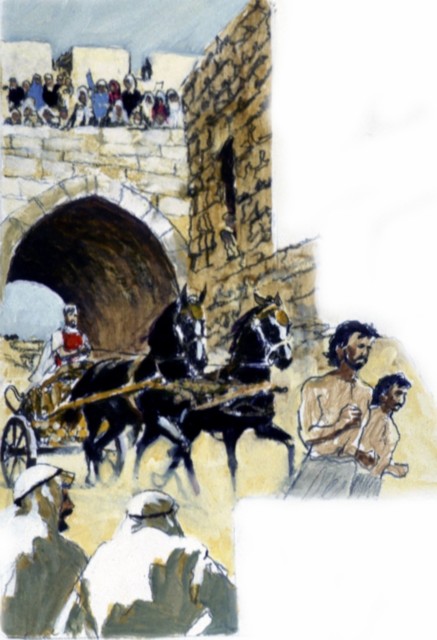
David's son Absalom plotted to rebel against David, seize his father's throne and become king. To win favor with the people, he bought a beautiful chariot and horses and rode through the streets of Jerusalem in great honor (2 Samuel 15:1-6).

David’s son Absalom plotted to rebel against David, seize his father’s throne and become king. To win favor with the people, he bought a beautiful chariot and horses and rode through the streets of Jerusalem in great honor (2 Samuel 15:1-6).

Because of the line this blog’s title, it is generally thought that David wrote this psalm in his latter years.  Some claim it to not be a psalm of personal penitence, but rather one that was meant to be used by anyone in distress.  But a time frame just before the Absalom conspiracy is quite likely when considering the penitential aspect of David’s sin with Bathsheba, as well as the mention of strength and number of his foes (verse 19).  It is otherwise a very recognizable psalm as one of the more well-known hymns still sung today – “Unto thee O Lord.”  It is one of the acrostic psalms, although some commentators state that it is imperfect.  But Spurgeon disagrees, stating that in the original text, the twenty-two verses follow the Aleph-bet in perfect order.

Read or listen to audio of ESV version of this selection from this link.

/Bob’s boy
___________________
some images © V. Gilbert & Arlisle F. Beers

Please note: I did not design the reading plan that I am following in my blog.  All of my comments in this blog, however, are solely my responsibility.  When reading ANY commentary, you should ALWAYS refer first to the scripture, which is God’s unchanging and unfailing word. Reading schedules, as well as a link to the site where you can get the reading plan that I’m currently following for yourself can be found on the “Bible Reading Schedules” page of my website at http://graceofourlord.com.  For questions and help, please see the “FAQ” and “Summaries” pages there.

Psalm 30 – Joy Comes with the Morning

The superscript for this psalm generates some discussion because David, of course, was not around for the dedication of the temple.  That happened during Solomon’s reign.  This of course would not preclude the psalm from having been used on that occasion, but that context is not the nature way that these superscripts are generally phrased.  Others have suggested that it was actually during re-dedication of David’s palace after reclaiming it from Absalom.  One other school of thought is that the psalm was composed during dedication of the threshing floor of Araunah (2 Samuel 24:18-25), after the terrible pestilence that claimed the lives of 70,000.

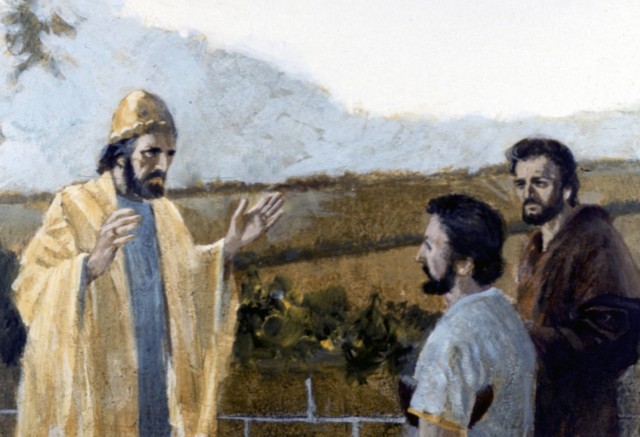
David instructs Joab to number the people.

David instructs Joab to number the people.

This latter seems quite likely, and the reference to the Lord’s anger does lend some credence to it.  David referred to his former view of his prosperity in verse 6, and the fact that it was his own self-glorification that had led to his command for the numbering of his forces makes for a convincing argument for this explanation. The lesson for us could also be in how quickly our fortunes may be turned when we forget to depend upon the Lord.  As Clarke noted “Peace and prosperity had seduced the heart of David, and led him to suppose that his mountain – his dominion, stood so strong, that adversity could never affect him.”  We must never forget that all that we are blessed with comes from the Lord, and any or all of it could be lost in the twinkling of an eye.  Entire life savings have been wiped out by recent economic tragedy, loved ones we depend on sometimes die.  It is the Lord that is always our rock and our salvation.

Read or listen to audio of ESV version of this selection from this link.

/Bob’s boy
___________________
some images © V. Gilbert & Arlisle F. Beers

Please note: I did not design the reading plan that I am following in my blog.  All of my comments in this blog, however, are solely my responsibility.  When reading ANY commentary, you should ALWAYS refer first to the scripture, which is God’s unchanging and unfailing word. Reading schedules, as well as a link to the site where you can get the reading plan that I’m currently following for yourself can be found on the “Bible Reading Schedules” page of my website at http://graceofourlord.com.  For questions and help, please see the “FAQ” and “Summaries” pages there.

Psalm 119:49-56; Psalm 26 – Your Promise Gives Me Life

ZayinToday’s stanza of Psalm 119 is brought to you by the seventh letter of the Aleph-Bet, Zayin.  The pictograph is sometimes represented as a sword with a crown or sometimes as a plow or a sickle .   It is interesting that in light of the fact that most commentators disagree on the time frame for authorship of this psalm, some cannot even agree with their own assessment.  Adam Clarke, for example, was convinced at one point that it was written during Babylonian captivity, yet at other times thought that it may well have come from David’s hand after all.  Both views have merit especially in this stanza, or strophe.  Verses 49-50 certainly hint at one who is eagerly looking forward to the promised return from captivity, which is his comfort in this time of affliction.

It is better in our case to apply it to ourselves as was no doubt the intent in the first place.  We take comfort in the promises that God has made to us all in His Son, Jesus Christ.  It is His victory over death that should make the promise of eternal life a burning fire within our souls.    And our love for the Lord should give us righteous indignation at a wicked world that ignores His commandments and glorifies sin as if it were something to be admired.

Psalm 26 is sometimes thought to be written by David when he was accused of treachery against then king, Saul.  He prays to the Lord for vindication against his accusers, and declares his adherence to God’s rule and to his own integrity, which he refers to again in verse 11.  He humbly pleads with the Lord to “Prove me, O Lord, and try me; test my heart and my mind.”  Integrity is a watchword for David in many of his psalms, and it comes through loud and clear in this one, as he expresses his confidence in his commitment to it, all made possible by the faithfulness of the Lord and His graciousness to his servant.

Read or listen to audio of ESV version of this selection from this link.

/Bob’s boy
___________________
some images © V. Gilbert & Arlisle F. Beers

Please note: I did not design the reading plan that I am following in my blog.  All of my comments in this blog, however, are solely my responsibility.  When reading ANY commentary, you should ALWAYS refer first to the scripture, which is God’s unchanging and unfailing word. Reading schedules, as well as a link to the site where you can get the reading plan that I’m currently following for yourself can be found on the “Bible Reading Schedules” page of my website at http://graceofourlord.com.  For questions and help, please see the “FAQ” and “Summaries” pages there.

Psalm 22 – Why Have You Forsaken Me?

And about the ninth hour Jesus cried out with a loud voice, saying, “Eli, Eli, lema sabachthani?” that is, “My God, my God, why have you forsaken me?”  Matthew 27:44

From Halley’s Handbook of the Bible (Halley, Henry H., Zondervan, 1961)

The Crucifixion, seen from the Cross, by James...

The Crucifixion, seen from the Cross, by James Tissot, 19th century. (Photo credit: Wikipedia)

“This sounds like a cry of anguish from David, but though written a thousand years before Jesus, it is so vivid a description of the crucifixion of Jesus that one would think of the writer as being personally present at the Cross. Jesus’ dying words (Psalms 22:1 Matthew 27:44), the sneers of his enemies (Psalms 22:7-8, Matthew 27:39-40, the piercing of his hands and feet (Psalms 22:16, John 20:25) and the casting of lots for his garments (Psalms 22:18, Matthew 27:39) are some of the events here described. None of these statements are applicable to David, or to any other known event or person in the history of mankind, except the crucifixion of the Son of God.”

Peter (Acts 2:30-35) preached: ‘David, being a prophet … he foresaw and spoke of … the Christ.’ This basic truth is reiterated again and again in the inspired New Testament.  There are than nine New Testament references which tie the meaning of this psalm irrevocably to the prophecy of our Lord’s crucifixion.  And then, regarding the resurrection, Hebrews 2:12 recounts verses 22-24.

But what of Jesus’ cry in verse one to the Lord.  Why would he speak of God forsaking Him? Burton Coffman’s summary of his thoughts on the subject ring very true:

“Jesus’ quoting the first line of this Psalm during his agony upon the Cross has led to many opinions. It has been supposed that Christ here merely quoted these words from the psalm to call attention to the whole bundle of prophecies in it which were being fulfilled literally at that very time. It is also believed by many that God Himself did indeed, for a little while, withdraw his presence from Christ in order to make it possible for Christ to die. There is much in the sacred Scriptures to commend this view.

Christ is spoken of in Heb. 2:9 as the One, who by the grace of God did indeed, ‘Taste of death for every man.’ Isaiah tells us that, ‘God laid upon him (Jesus) the iniquity of us all’ (Isaiah 53:6). Paul mentioned that God Himself ‘Set forth the Christ to be a propitiation’ (Romans 3:25), or an atonement, for the sins of all men. ‘Christ died for our sins’ (1 Corinthians 15:3); and ‘Him (Christ) who knew no sin, God made to be sin on our behalf; that we might become the righteousness of God in Him’ (2 Corinthians 5:21).

The ultimate consequence of sin is separation from God; and, in Christ’s becoming a substitute for sinful men upon the cross, he not only tasted of death, but also tasted the terrible consequences of sin in that soul-torturing experience of separation from the Creator. It is our understanding of Christ’s plaintive cry, ‘My God, why hast thou forsaken me,’ that Jesus did indeed, momentarily, taste the awful agony of separation from the Father. ‘For a moment in that last agony, the Perfect Man was alone with the sins of the whole world.'”

Read or listen to audio of ESV version of this selection from this link.

/Bob’s boy
___________________
some images © V. Gilbert & Arlisle F. Beers

Please note: I did not design the reading plan that I am following in my blog.  All of my comments in this blog, however, are solely my responsibility.  When reading ANY commentary, you should ALWAYS refer first to the scripture, which is God’s unchanging and unfailing word. Reading schedules, as well as a link to the site where you can get the reading plan that I’m currently following for yourself can be found on the “Bible Reading Schedules” page of my website at http://graceofourlord.com.  For questions and help, please see the “FAQ” and “Summaries” pages there.

A Soft Answer Turns Away Wrath

How often is our own anger provoked by someone else that makes us feel insignificant – that our worth counts for nothing?  We would do well to remember this when we encounter someone whose wrath is obvious in both their demeanor and tone.  Consider Gideon’s response to the men of Ephraim in Judges 8:1-3 when they complained that he had only called them out belatedly.  But Gideon’s praise of their accomplishments turned away they wrath.

David and Jonathan were best friends, but Jonathan's crippled son Mephibosheth could have claimed his grandfather Saul's throne. Despite that, David was kind to him, and brought him into the palace to live (2 Samuel 9).

David and Jonathan were best friends, but Jonathan’s crippled son Mephibosheth could have claimed his grandfather Saul’s throne. Despite that, David was kind to him, and brought him into the palace to live (2 Samuel 9).

Now look instead to David’s encounter with Nabal in 1 Samuel 25:10-13, where he insulted David and his mighty men.  It was only Abigail’s soft and wise words in 1 Samuel 25:23-30 that quieted David’s anger, and kept him from doing what he would surely come to regret.

Sometimes the soft answer that is needed in such situations is simply that of kindness.  Everyone wants and deserves to feel that they are important – that what they need, and what they feel matters.  It does matter to God.  It mattered to Jesus (Matthew 7:12).  Shouldn’t it matter to us?

Read or listen to audio of ESV version of this selection from this link.

/Bob’s boy
___________________
some images © V. Gilbert & Arlisle F. Beers

Please note: I did not design the reading plan that I am following in my blog.  All of my comments in this blog, however, are solely my responsibility.  When reading ANY commentary, you should ALWAYS refer first to the scripture, which is God’s unchanging and unfailing word. Reading schedules, as well as a link to the site where you can get the reading plan that I’m currently following for yourself can be found on the “Bible Reading Schedules” page of my website at http://graceofourlord.com.  For questions and help, please see the “FAQ” and “Summaries” pages there.

The Pool of Gibeon

The Pool of Gibeon, where Ishmael dumped the bodies of seventy men he murdered after he murdered Gedaliah, governor of Judah.

The Pool of Gibeon, where Ishmael dumped the bodies of seventy men he murdered after he murdered Gedaliah, governor of Judah.

In 2 Samuel chapter 2, a battle ensued at Gibeon in which Abner and the servants of Saul’s son Ish-bosheth were defeated by the servants of David.  There was a meeting at the “pool of Gibeon” prior to that.  This pool was also the location where Ishmael deceived and slaughtered the seventy in Jeremiah 41.

Excavations at Gibeon (located about 6 miles from Jerusalem at tel el-jib) revealed an elaborate water system. One part of that system is a huge circular shaft (37 feet in diameter).  It was cut into the bedrock about 82 feet deep.  At the bottom of it, there was the water table that formed a pool. The pool was reached by a staircase that was also cut into the limestone. More information can be found in this article at Ferrell’s Travel Blog.

Tomorrow, we start week 8 in our reading schedule.

/Bob’s boy
___________________
image © V. Gilbert & Arlisle F. Beers

Please note: I did not design the reading plan that I am following in my blog.  All of my comments in this blog, however, are solely my responsibility.  When reading ANY commentary, you should ALWAYS refer first to the scripture, which is God’s unchanging and unfailing word. Reading schedules, as well as a link to the site where you can get the reading plan that I’m currently following for yourself can be found on the “Bible Reading Schedules” page of my website at http://graceofourlord.com.  For questions and help, please see the “FAQ” and “Summaries” pages there.

Psalm 17 – In the Shadow of Your Wings

Only 5 psalms (17, 86, 90, 102, and 140) are called prayers in the superscript, although many more than that are prayers.  There is no reason to ascribe this one to anyone other than David.  His enemies were varied – the Philistines certainly had no love for him (1 Samuel 18:27), within the kingdom itself there was, of course, Saul (1 Samuel 19:11-20); and within his own family there was Absolam, and all those who conspired with him against David (2 Samuel 15:11-17).

wings-02The prayer asks for God’s assurance that he is in the right, and that his enemies will not prevail against him.  He expresses his faith that God will hear him and will answer.  The symbol of wings as protection in verse 8 is repeated often in scripture, especially the poetry of the psalms, but also in Matthew 23:37.

The psalm continues in verses 6-7 with the translation in the ESV of God’s steadfast love, but the word in Hebrew is “hesed” – which involves great mercy, faithfulness to fulfill promises, and His majestic covenant love.  He proclaims God as his savior, and we are reminded of the saving grace of the Son of God who is our own defender and Savior.

Read or listen to audio of ESV version of this selection from this link.

/Bob’s boy
___________________
some images © V. Gilbert & Arlisle F. Beers

Please note: I did not design the reading plan that I am following in my blog.  All of my comments in this blog, however, are solely my responsibility.  When reading ANY commentary, you should ALWAYS refer first to the scripture, which is God’s unchanging and unfailing word. Reading schedules, as well as a link to the site where you can get the reading plan that I’m currently following for yourself can be found on the “Bible Reading Schedules” page of my website at http://graceofourlord.com.  For questions and help, please see the “FAQ” and “Summaries” pages there.

Psalms 20-21 – Trust in the Name of the Lord Our God

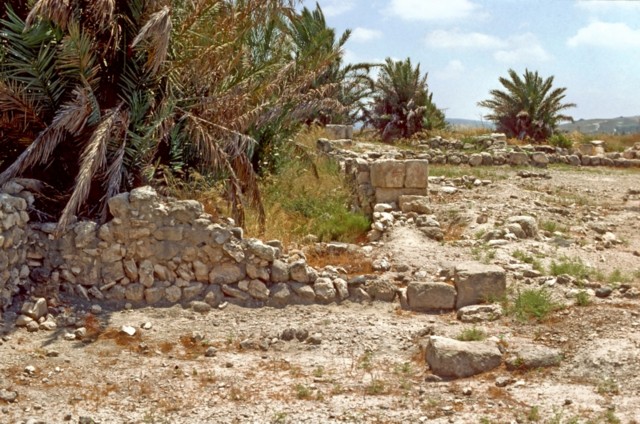
Megiddo - residence of Solomon's chariot commanders.

Megiddo – residence of Solomon’s chariot commanders.

Psalm 20 is clearly a battle hymn for David.  The suggestion of the absence of chariots and horses points to a time before Solomon (“Some trust in chariots and some in horses, but we trust in the name of the Lord our God“), for when know that Solomon as king had many of both (1 Kings 10:26). Verse 8’s continuation of the characterization of verse 7 (“They collapse and fall, but we rise and stand upright”) is a reference to the grace of God, rather than the might of his people.

Psalm 21 is can be divided into two sections at verse 7.  The first half deals with the king’s blessings in the face of his enemies.  The second half, beginning in verse 8 describes God’s vengeance upon them, and his “destroying them” in his wrath.  Verse 13 concludes with praise to God for his strength and power.

Read or listen to audio of ESV version of this selection from this link.

/Bob’s boy
___________________
some images © V. Gilbert & Arlisle F. Beers

Please note: I did not design the reading plan that I am following in my blog.  All of my comments in this blog, however, are solely my responsibility.  When reading ANY commentary, you should ALWAYS refer first to the scripture, which is God’s unchanging and unfailing word. Reading schedules, as well as a link to the site where you can get the reading plan that I’m currently following for yourself can be found on the “Bible Reading Schedules” page of my website at http://graceofourlord.com.  For questions and help, please see the “FAQ” and “Summaries” pages there.

Psalm 7 – In You Do I Take Refuge

The superscript for this psalm calls it a Shiggaion of David.  The term is only used again in plural form in Habakkuk 3:1.  The best that we can surmise is that it may be a type of instrument or liturgical description pertaining to the psalm.  Cush the Benjamin had likely accused David concerning treason against Saul.  David is languishing here and it seems likely that he is experiencing guilt on his own part (see verses 3-5), possibly for his anguish over what his part had been in Doeg the Edominte’s betrayal and the resulting slaughter of the priests of Nob (1 Samuel 22:11-23)?

Nob, Shufat from north, the Tabernacle was here for awhile. David visited the priest Ahimelech here (1 Samuel 21). Because the priests helped David, Saul destroyed the priests and their city.

Nob, Shufat from north, the Tabernacle was here for awhile. David visited the priest Ahimelech here (1 Samuel 21). Because the priests helped David, Saul destroyed the priests and their city.

David’s guilt, though tempered with his anger with Doeg in Psalm 52, does not give him pause to absolve himself, but rather to pray to God for justice, even if that means his own complicity should result in his death at the hands of his pursuers.  He places his fate in the hand of his God in whom he places his confidence in His judgment of David’s heart and integrity (verse 8-16).  He expresses his certainty that God will do justly with the wicked in Verses 14-16: B

Behold, the wicked man conceives evil
and is pregnant with mischief
and gives birth to lies.
He makes a pit, digging it out,
and falls into the hole that he has made.

Read or listen to audio of ESV version of this selection from this link.

/Bob’s boy
___________________
some images © V. Gilbert & Arlisle F. Beers

Please note: I did not design the reading plan that I am following in my blog.  All of my comments in this blog, however, are solely my responsibility.  When reading ANY commentary, you should ALWAYS refer first to the scripture, which is God’s unchanging and unfailing word. Reading schedules, as well as a link to the site where you can get the reading plan that I’m currently following for yourself can be found on the “Bible Reading Schedules” page of my website at http://graceofourlord.com.  For questions and help, please see the “FAQ” and “Summaries” pages there.

Psalm 5-6 – Lead Me In Your Righteousness

Both of these Psalms are regarded generally as Psalms of Lament.  Both have the quite frequent musical direction in the superscript.  In Psalm 5, some versions say that it is “for the flute(s),” but that is far from settled.  The Hebrew word is “Nehiloth.”  Easton’s Bible Dictionary says: “It is probably derived from a root meaning “to bore,” “perforate,” and hence denotes perforated wind instruments of all kinds. The psalm may be thus regarded as addressed to the conductor of the temple choir which played on flutes and such-like instruments.”

Psalm 5’s label as a lament, though technically correct is unfortunate.  It is ascribed to David, and we do not know the time or circumstances that it occurred in his life, but like many other “Lament” psalms, it does contain pleas for deliverance from enemies.  But it is often called a “morning prayer” because of verse three, where he tells the Lord that He hears his voice in the morning as he offers his sacrifice – his worship to the Lord.

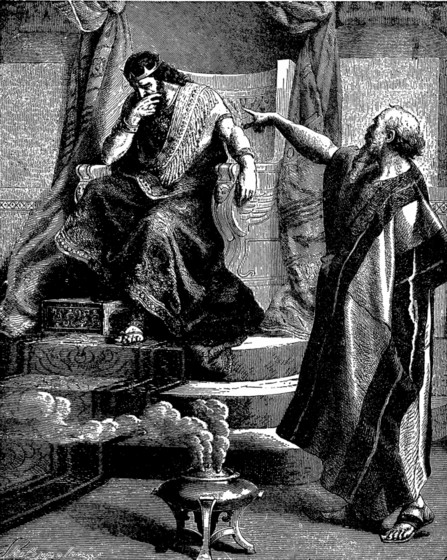
Nathan condemns David because of Bathsheba.

Nathan condemns David because of Bathsheba.

It is a reminder for us of the importance of personal prayer, and of worship.  Notice the repeated use (six times) of the word “my” in the first three verses – “give ear to my words…the sound of my cry…my King and my God…”   In verses 4-6, he acknowledges how God hates wickedness, the deceitful, the proud or boastful – all evildoers – and how they will not stand before him as the righteous (see also Psalm 1:5).  Clearly in verse 7, he considers the privilege he has to be able to come and worship Him, because of the Lord’s “steadfast love.”

Psalm 6 is one that many classify as one of penitence, although we are not told of what sin for which he is repenting.  It seems clear in verses 2-5 that he is ill – so much so that he believes he could die from whatever the illness might be.   It may, as some are often prone to think, that he feared his illness was God’s punishment for that sin (Job’s friends being a case in point).  In any case, he is not only gravely ill, and possibly in peril from his enemies (verses 8, 10), but he is also deeply ashamed of whatever wrong he has done.  But he knows that now that he has repented, “the Lord has heard my plea; the Lord accepts my prayer.” 

Both psalms serve as models of prayer and the privilege we have to worship the Lord and to receive His forgiveness and His care in times of trouble because of His “steadfast love” (5:7, 6:9).

Read or listen to audio of ESV version of this selection from this link.

/Bob’s boy
___________________
some images © V. Gilbert & Arlisle F. Beers

Please note: I did not design the reading plan that I am following in my blog.  All of my comments in this blog, however, are solely my responsibility.  When reading ANY commentary, you should ALWAYS refer first to the scripture, which is God’s unchanging and unfailing word. Reading schedules, as well as a link to the site where you can get the reading plan that I’m currently following for yourself can be found on the “Bible Reading Schedules” page of my website at http://graceofourlord.com.  For questions and help, please see the “FAQ” and “Summaries” pages there.