Sermon On the Plain

Jesus came down with His apostles after naming them in Luke chapter 6, and stood “on a level place.” Here, verse 17 tells us that, along with His disciples, there was a “great multitude of people from all Judea and Jerusalem and the seacoast of Tyre and Sidon, who came to hear him and to be healed of their diseases.” And He healed them all.

Plain of Gennesaret near Capernaum

Plain of Gennesaret near Capernaum

What follows here in Luke is a sermon that many commentators have tried to “harmonize” with the “Sermon on the Mount” in Matthew 5-7.  The similarities are not nearly enough to make up for the differences in circumstances, timing, and content. This is why more astute scholars have dubbed this one as the “Sermon on the Plain.” The Beatitudes here are substantively different from those in Matthew – less of them, as well. The “woes” here are not in the sermon in Matthew at all. Jesus sat on a hill in Matthew. He stood on a level place here. He preached this sermon right after naming His apostles. The Sermon on the Mount in Matthew was long before that event. We could keep going, but you get the idea. It is no surprise that parts of Jesus’s messages bore repeating on numerous occasions.

So what about these woes? What is that all about? The answer comes from reading them in context with the corresponding beatitudes. Let’s take a look at them individually. The first beatitude says “Blessed are you who are poor, for yours is the kingdom of God.” The first woe says“but woe to you who are rich, for you have received your consolation.” Does Jesus mean that all of those who are poor are going to inherit the kingdom of God merely by virtue of their poverty?  Is he condemning people that are wealthy – and simply because they are wealthy? The answer, of course, is no on both counts. The point is that those who are poor should take heart in the fact that they have the blessed opportunity for eternal life with God. Those who are wealthy have that same opportunity, of course, if they do not allow their satisfaction with their wealth to be the driving force of their lives. Therein lies the danger of woe.

It is the same for the remaining beatitudes and woes, which describe opposite circumstances of life. There is great hope for all through Jesus Christ, but when this earthly life is going very well for people, some tend to be complacent and neglect the treasures they should be putting up in heaven.

(This year’s reading plan for Luke, Acts, and 1 and 2 Chronicles averages just 15 verses per day – 5 days per week!)
Schedule for this week
Read or listen to audio of today’s selection from Luke here
Read or listen to audio of today’s selection from 1 Chronicles here

/Bob’s boy
___________________
some images © V. Gilbert & Arlisle F. Beers

Please note: I did not design the reading plan that I am following in my blog.  All of my comments in this blog, however, are solely my responsibility.  When reading ANY commentary, you should ALWAYS refer first to the scripture, which is God’s unchanging and unfailing word. Reading schedules, as well as a link to the site where you can get the reading plan that I’m currently following for yourself can be found on the “Bible Reading Schedules” page of my website at http://graceofourlord.com.  

Enhanced by Zemanta

Twelve (extra) Ordinary Men

All four of the Gospels contain numerous references to Jesus going to God in prayer. On this occasion (in Luke 6:12), Luke says that he went to “the mountain” and spent the whole night in prayer. We do not know what mountain this was. It is reasonable to believe it was one located close to what was then Capernaum.

Ministry of the Apostles, a complex multi-figu...

Ministry of the Apostles, a complex multi-figure icon with a full-height image of Jesus Christ, surrounded by sectors with scenes of His disciples’ calling, ministry and martyrdom. Icon from the Yaroslavl Museum Preserve. (Photo credit: Wikipedia)

What was the occasion of such a lengthy and fervent time of prayer by the Son of God? The next verse gives us the answer, for when day came, He chose from among His disciples twelve men from various backgrounds, and named them “apostles,” a word very familiar to us. He chose this term because it describes what their mission would be very well. It comes from the Greek word “apostolos,” which means “messenger” or more aptly “one who is sent out.” This will become most appropriate when He gives them their “Great Commission.” The list of apostles also occurs in Matthew 10:2-4, and in Mark 3:14-19. There are some differences, but it is the same twelve men in those gospels as listed here in Luke. Like Simon, many were known by more than one name.

The first two are “Simon, whom he named Peter, and Andrew his brother” The next two listed are James and John (the sons of Zebedee), who were partners in fishing with Peter and Andrew. This James is sometimes called “James the greater” to distinguish him from the other apostle named James. John referred to himself as the “disciple whom Jesus loved” (John 13:23, John 20:2). Philip was one of the first disciples, but is not mentioned after Jesus’ ascension. He should not be confused with the Philip in the book of Acts that was a deacon.

The next apostle listed is Bartholomew, also known as Nathanael (John 1:44-49); and he is almost always mentioned along with Philip. Next was Matthew, also known as Levi, the tax collector, followed by Thomas (who, unfairly really, will always be remembered as “doubting Thomas”). Next come James the son of Alpheus (also known as James the less), and Simon “who was called the Zealot.” In the days before the destruction of Jerusalem in 70 A.D., the group of people known as Zealots were men who wished to overthrow the Roman government. It is unknown for certain whether the term here is meant in a religious sense or in that political sense. If the latter, it would mean that a change of heart and purpose occurred in his life after becoming a disciple. Otherwise, Jesus would not have made him an apostle.

English: Icon of James, the Just, brother of J...

English: Icon of James, the Just, brother of Jesus Português: Ícone de Tiago, o Justo, irmão de Jesus (Photo credit: Wikipedia)

Number eleven in the Gospel of Luke is “Judas the son of James,” known in Matthew as Thaddaeus. Some scholars believe that this is the Jude that wrote the book of Jude, but there are some problems with that. In the opening for the Book of Jude, he calls himself “the brother of James,” while he is listed here as the son of James. It is certainly possible for someone to have a brother with the same name as their father, but it is more likely that Jude was referring to a more well-known James – the brother of Jesus. If so, it would make that Jude the brother of Jesus also (both he and James called themselves “servants” of Jesus Christ in the scriptures). Jesus did have a brother named Jude, short for Judas (Matthew 13:55). But none of the apostles could have been brothers of Jesus. Though His brothers did come to believe in Him, at the time of John 7:5, they did not; and the circumstances in that passage occurred well after His apostles were named. The last apostle in the list is Judas Iscariot who, we all know, betrayed Jesus.

Twelve men who were just like you and me, who saw in Jesus salvation for the world. Their lives were never the same after meeting Him. And once Jesus went home, the Holy Spirit would make their understanding of what they were a part of complete. But for now, they have a lot to learn.

(This year’s reading plan for Luke, Acts, and 1 and 2 Chronicles averages just 15 verses per day – 5 days per week!)
Schedule for this week
Read or listen to audio of today’s selection from Luke here
Read or listen to audio of today’s selection from 1 Chronicles here

/Bob’s boy
___________________
some images © V. Gilbert & Arlisle F. Beers

Please note: I did not design the reading plan that I am following in my blog.  All of my comments in this blog, however, are solely my responsibility.  When reading ANY commentary, you should ALWAYS refer first to the scripture, which is God’s unchanging and unfailing word. Reading schedules, as well as a link to the site where you can get the reading plan that I’m currently following for yourself can be found on the “Bible Reading Schedules” page of my website at http://graceofourlord.com.  

Enhanced by Zemanta

Confrontation With Tradition

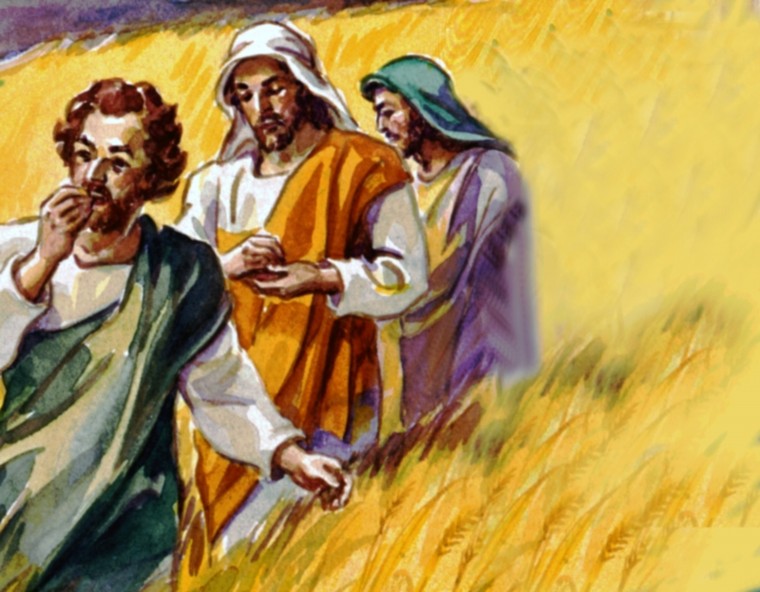
Chapter 6 of Luke contains a couple of the most misapplied and often misunderstood passages in the New Testament. The first comes in verses 1-5, where on a Sabbath, Jesus and his disciples were going through a field, and the disciples plucked and ate some heads of grain. Deuteronomy 23:25 clearly states specifically that this practice is allowed. But the Pharisees had made their own rules up concerning even the smallest of matters; and they had decided that the act of doing this fell into the category of “work,” which was forbidden on the Sabbath.

Jesus' disciples plucked and ate some heads of grain in a grainfield, but were chastized by the Pharisees for doing this on the Sabbath (Matthew 12:1-8; Mark 2:23-28; Luke 6:1-5)

Jesus’ disciples plucked and ate some heads of grain in a grainfield, but were chastized by the Pharisees for doing this on the Sabbath (Matthew 12:1-8; Mark 2:23-28; Luke 6:1-5)

When they confront Jesus, asking why his disciples do what is “unlawful” on the Sabbath, Jesus gives an answer, apparently without denying (at least in the Scripture) any wrong-doing. In His answer, He points them to how David and his men ate the “bread of the Presence” which was unlawful for any but the priests to eat (1 Samuel 21:1-6). The argument by critics and skeptics alike, is that here Jesus endorses “situation ethics.” This is the notion that there is no absolute right or wrong where human needs are concerned – that David and his men were guiltless because of David’s supposed authority and/or the situation that they are in.

This idea is just plain wrong. To begin with, Jesus stated plainly in verse 4 that what David did “is not lawful for any but the priests.” What Jesus did by bringing this up was to point out that David, whom they revered (and whom they would not dare to condemn) had indeed broken the law. Jesus’ disciples were guiltless of breaking any Mosaic law – only the man-made regulations that the Pharisees had imposed on top of, and without authority from, God’s law. Yet they were condemning His disciples. The Pharisees had appointed themselves as “rulers” of the Sabbath, but Jesus pointed out that it was He who was “lord of the Sabbath.”  In the Gospel of Luke, this is the beginning of the more disagreeable encounters with the Pharisees that was sure to make them angry with Jesus.

Verse 6 begins another encounter with the Pharisees that would serve to fan those flames. On another Sabbath, Jesus was teaching in the synagogue. A man was there with a withered hand, and the Pharisees and scribes were watching to see if Jesus would heal Him – so that they could “accuse Him” for working on the Sabbath, thereby violating Mosaic law. It is remarkable that these men could know that Jesus had the power to heal something as definitive as a physical deformity, yet not believe in Him as the Messiah. We can only surmise that they had no desire to believe, but instead wanted to make others believe his power was from evil.

Jesus, of course, knew their thoughts, and he invited the confrontation by telling the man to come to Him. Then, he looked at the group of Pharisees and asked “is it lawful on the Sabbath to do good or to do harm, to save life or to destroy it?” No answer to this question was recorded, so we can assume they gave none. But when he healed the man’s deformity, their anger was certainly kindled, as verse 11 states that they “discussed with one another what they might do to Jesus.”

(This year’s reading plan for Luke, Acts, and 1 and 2 Chronicles averages just 15 verses per day – 5 days per week!)
Schedule for this week
Read or listen to audio of today’s selection from Luke here
Read or listen to audio of today’s selection from 1 Chronicles here

/Bob’s boy
___________________
some images © V. Gilbert & Arlisle F. Beers

Please note: I did not design the reading plan that I am following in my blog.  All of my comments in this blog, however, are solely my responsibility.  When reading ANY commentary, you should ALWAYS refer first to the scripture, which is God’s unchanging and unfailing word. Reading schedules, as well as a link to the site where you can get the reading plan that I’m currently following for yourself can be found on the “Bible Reading Schedules” page of my website at http://graceofourlord.com.  

Enhanced by Zemanta

About the Recent Debate…

This past week, a much publicized debate occurred between Bill Nye, the popular ’90’s TV icon known as “the Science Guy,” and Ken Ham, the CEO of the “Answers In Genesis” organization that maintains a website presence with a staff of scientists of their own. The subject of the debate was, as is always the case, in the form of a question. The question that was debated in this instance was “Is creation a viable model of origins. As expected, both of these highly intelligent, educated men presented their positions well. Mr Ham remarked that this type of debate has occurred much less frequently since their popularity 30 years ago or so. What he didn’t say was that the reason is largely because the atheists and agnostics have increasingly avoided these debates because they usually did not do so well. It sometimes works out that way when you go up against the truth.

A message from the founder

A message from the founder (Photo credit: ellenm1)

I understand there were no moments when one of the debaters was totally embarrassed by the other. To my knowledge, there were no mass baptisms following the debate. Neither were there mass closings of churches due to loss of faith. And I suspect that most of the people who watched or listened to the debate did not change from non-believer to believer or vice-versa directly afterward. Those who look at the evidence of the natural world in such cases (on both sides) do so with their own presuppositions and an epistemology that they are mostly committed to; and most of them usually leave with their original worldview mostly intact. 

Don’t get me wrong – I love apologetics. I have spent hundreds upon hundreds of hours studying apologetics, and will likely continue to do so until the day that I die. The more I study – the more evidence from the natural world that I examine, the more certain I become of what I already know to be the truth: “In the beginning, God created the heavens and the earth.” It is the same for bible study. I have read the entire Bible – all of it at least once; and I have spent countless hours studying it. And something occurred to me a long time ago. I am convinced that it is not possible to read and study – and I mean TRULY study – the Bible with an open mind and not realize that it really is the word of God. Take one of the caveats out of that sentence, and yeah maybe. But really study it with an open mind, and I do not believe you can miss knowing that Romans 1:19-20 nails it:

For what can be known about God is plain to them, because God has shown it to them. For his invisible attributes, namely, his eternal power and divine nature, have been clearly perceived, ever since the creation of the world, in the things that have been made. So they are without excuse.

Bill Nye the Science Guy at The UP Experience ...

Bill Nye the Science Guy at The UP Experience 2010. Note: this photo is Creative Commons Attribution. You are welcome to use it with “photo by Ed Schipul” (Photo credit: Wikipedia)

But I really don’t like watching debates any more. In fact, I did not watch very much of this past week’s debate. There, I’ve said it. Fortunately, there is no apologist’s registration card or anything that I now have to surrender. But it’s true. Now, I did tune in to pieces of the recording, and heard much of what I expected. I have read and listened to media about a great deal of what “AnswersInGenesis.org” publishes on their website – and I agree with most of it. Their scientists are top-notch, everything is peer-reviewed, and I love reading it.

And Mr. (Dr.?) Nye was quite eloquent in the segments that I saw. He did use a couple of the emotional plea bits that we have come to expect from non-believers arguing their position. You know the type of statement – “you (Christians) seem to think all of the other faiths (some of them much older than your Bible) are all wrong.” To his credit, he didn’t use the old “are you saying my dear sweet mother is going to hell?” bit that Dan Barker used in a debate a few years ago. But like other debates I have seen in recent years, I just didn’t feel good watching it. I do still listen to one debate that I have probably heard 50 or more times – “The Great Debate” between the late Dr. Greg Bahnsen and Dr. Gordon Stein in 1985. Dr. Bahnsen gave us what I believe was the greatest example of defending the faith of our time. I really never seem to tire of it – because, to me, it was a masterpiece.

bibles

bibles (Photo credit: fancycwabs)

But these other debates just make me sad. And I don’t mean just a little bit. They truly get me depressed; and it’s not hard for me to figure out why. Bill Nye was made in God’s image too. To hear and watch a man with such a brilliant mind (who truly believes in what he is saying), and know that if he continues on the path he is on that he will be lost – that just really hurts my heart. It would be different if I could just believe that he was some sort of monster – an evil man. But I happen to believe that the opposite is true – that he is probably a very good man. He, no doubt, has a family that he loves and who love him; and I am sure that he is good to them. No, I just cannot bring myself to truly dislike the man. And so, the debate makes me sad for him. And sad for all of the others who applaud his efforts to show that only idiots believe the Bible is the word of God.

Something else that makes me sad about it is motivation. I can’t help wondering why those who claim not to believe in God feel the need to evangelize people. It just seems that they feel the need to convince themselves, and that by convincing as many other people as possible, they can feel more confident in their own unbelief. After all, if absolutely nobody but Bill Nye was an unbeliever, it would be hard for him to keep that belief very strong. What I think that Bill Nye – and others like him – just don’t get, is that our (the Christian’s) motivation has nothing to do with anything like that. They seem to believe that we are all about imposing our beliefs on others needlessly. They cannot understand that we evangelize because we want to share something very good with others – and that our desire to help others get to heaven is genuine. That’s it, folks. No ulterior motive.

cross_080214And so, I have said a few prayers for Bill Nye, and for those who believe as he does. There is always hope. And that is one of the answers to the question of why I continue to study apologetics so hard; and why I will engage in casual debate myself. The most important reason is, of course, 1 Peter 3:15“in your hearts honor Christ the Lord as holy, always being prepared to make a defense to anyone who asks you for a reason for the hope that is in you.”

And then there is the hope that we have for those who are lost. I must get over the sadness, and thank the Lord that it is not my job to judge. I also thank Him that it is not my responsibility to see to it that every person I meet becomes a believer. Those who simply will not ever believe are spiritually dead, and I cannot raise the dead. It IS my job to speak up, though. It IS my job to try to “plant the seed” of truth any time I have an opportunity. God will take it from there, and I am truly thankful for that.

I find comfort often by thinking of it this way. In the beginning, before sin came into the world, everything was very good. In the end, no matter who is saved and who is lost, God is still in control, and He will make it all very good again. That is where faith truly comes in. I still have to learn to trust Him more.

/Bob’s boy

(This year’s reading plan for Luke, Acts, and 1 and 2 Chronicles averages just 15 verses per day – 5 days per week!)
Schedule for this week

___________________
some images © V. Gilbert & Arlisle F. Beers

All of my comments in this blog are solely my responsibility.  When reading ANY commentary, you should ALWAYS refer first to the scripture, which is God’s unchanging and unfailing word. Reading schedules, as well as a link to the site where you can get the reading plan that I’m currently following for yourself can be found on the “Bible Reading Schedules” page of my website at http://graceofourlord.com.  

Enhanced by Zemanta

Men of a Single Mind

English: Statue of King David by Nicolas Cordi...

English: Statue of King David by Nicolas Cordier in the Borghese Chapel of the Basilica di Santa Maria Maggiore. Français : Statue du roi David par Nicolas Cordier, dans la chapelle Borghèse de la basilique Sainte-Marie Majeure. Italiano: Statua del re Davide di Nicolas Cordier, nella Capella Borghese della Basilica di Santa Maria Maggiore in Roma. (Photo credit: Wikipedia)


The information contained in chapter 12 of 1 Chronicles is not found anywhere else in the Scriptures. It begins with a remembrance of the time when David was at Ziklag, and many mighty men joined him as warriors. We learn here many were Gadites, and that some of them even came from Saul’s own tribe – the Benjaminites. All were described as mighty warriors, and verse 14 says that the Gadites “were officers of the army; the least was a match for a hundred men and the greatest for a thousand.”  


When the men from Benjamin and Judah came, David questioned whether their loyalties to Saul would result in his betrayal. The chief of them, Amasai, had divine guidance it seems, as his words were those of a prophet:


“We are yours, O David,
and with you, O son of Jesse!
Peace, peace to you,
and peace to your helpers!
For your God helps you.”


Verse 19 continues with some defections by the tribe of Manasseh, and then verse 23 jumps ahead about seven years to “the present” as David is about to be crowned king. There were literally thousands of warriors that came to David from all over the twelve tribes to pledge their loyalty, and to celebrate the new kingship. In fact, the chronicler says “all the rest of Israel were of a single mind to make David king.” It was a proud and unified time in the history of God’s people.


(This year’s reading plan for Luke, Acts, and 1 and 2 Chronicles averages just 15 verses per day – 5 days per week!)
Schedule for this week
Read or listen to audio of today’s selection from Luke here
Read or listen to audio of today’s selection from 1 Chronicles here


/Bob’s boy


___________________


some images © V. Gilbert & Arlisle F. Beers


Please note: I did not design the reading plan that I am following in my blog.  All of my comments in this blog, however, are solely my responsibility.  When reading ANY commentary, you should ALWAYS refer first to the scripture, which is God’s unchanging and unfailing word. Reading schedules, as well as a link to the site where you can get the reading plan that I’m currently following for yourself can be found on the “Bible Reading Schedules” page of my website at http://graceofourlord.com.  


Enhanced by Zemanta

Luke 5 – Levi, the Tax Collector

Luke gives us just five verses in chapter five about the tax collector Levi. As was true of many others in those times, he was known by another name – one that is more familiar to most of us, Matthew. One might wonder why people with the occupation of being a tax collector are spoken of so harshly by people in the Bible (particularly the pious Pharisees).

English: Jesus disputes with the Pharisees. Fr...

English: Jesus disputes with the Pharisees. French School. In the Bowyer Bible in Bolton Museum, England. Print 3861. From “An Illustrated Commentary on the Gospel of Mark” by Phillip Medhurst. Section Q. disputes with the establishment. Mark 10:2-12, 11:27-33, 12:13-27, 12:35-37. http://pdfcast.org/pdf/an-illustrated-commentary-by-phillip-medhurst-on-the-gospel-of-mark-section-q-to-r (Photo credit: Wikipedia)

These tax collectors were part of a system of “tax farming.” Although the practice existed in other countries, it was set up in the Roman Empire by the Roman tribune, Gaius Sempronius Gracchus in 123 B.C.  In Roman provinces, the taxes owed to the empire by an entire region might be paid by one wealthy individual, who in turn would “farm out” the collection of taxes from the people. It was a system that fostered corruption and fraud; and any Jew that involved himself in the practice was especially despised by the people.

We are not told specifically that Matthew was guilty of any of those practices, but are left with that impression; and the company he keeps (verse 29) certainly suggests it as well. Just as was true of Peter, Andrew, James, and John, we should not assume that this was Jesus’ first encounter with Levi (Matthew) in his Capernaum “home base.” This was likely a relationship that he had begun to nurture some time ago, and the feast that he prepared for Jesus suggests this as well.

Of course, the Pharisees were scandalized that Jesus was eating with Levi and his tax collector friends, and they and their scribes “grumbled” at his disciples because of his propensity to eat with sinners of all types. His answer was “Those who are well have no need of a physician, but those who are sick. I have not come to call the righteous but sinners to repentance.” And it is that love that Jesus has for the lost that we must always remember. If Jesus had come to earth today instead of then, what sorts of people would he have been seen with? And what would the reaction be from those of us who try to serve God? Do we spend enough time and energy on, or associate at all with people we believe to be lost?

The Pharisees question the lack of fasting by Jesus’ disciples in the final verses of the chapter. It must be remembered that the frequent fasting that was especially characteristic of the teaching of the Pharisees was not based on any Biblical authority. The Day of Atonement in Leviticus 16:29-31 was the only Scripture that appeared to require fasting. His answer comparing Himself to a bridegroom, and the reference to being “taken away,” would be mysterious to them, but Luke’s readers will understand it in relation to His crucifixion.

It is doubtful as well that they understood the meaning behind the parable that followed. The new garments and new wineskins are obvious references to the new kingdom and the new covenant. Those like the Pharisees, who are so heavily invested in the old law, will have a difficult time accepting the change.

(This year’s reading plan for Luke, Acts, and 1 and 2 Chronicles averages just 15 verses per day – 5 days per week!)
Schedule for this week
Read or listen to audio of today’s selection from Luke here
Read or listen to audio of today’s selection from 1 Chronicles here

/Bob’s boy
___________________
some images © V. Gilbert & Arlisle F. Beers

Please note: I did not design the reading plan that I am following in my blog.  All of my comments in this blog, however, are solely my responsibility.  When reading ANY commentary, you should ALWAYS refer first to the scripture, which is God’s unchanging and unfailing word. Reading schedules, as well as a link to the site where you can get the reading plan that I’m currently following for yourself can be found on the “Bible Reading Schedules” page of my website at http://graceofourlord.com.  

Enhanced by Zemanta

Extraordinary Things

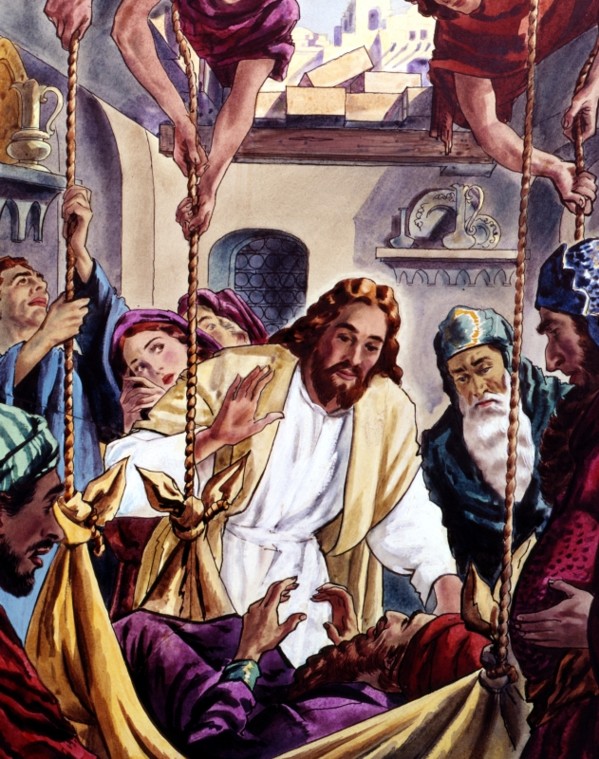
Luke brings us the story of Jesus healing a paralytic man. This one is told in all three of the synoptic Gospels. In verse 17 of chapter 5, Luke is illustrating just how much Jesus’ notoriety had increased following the cleansing of the leper. Among those who were listening to Him teach were Pharisees and “teachers of the law” (scribes) who had come from every village of Galilee and Judea, as well as some from Jerusalem. So the size of this gathering was quite substantial.

Jesus healed a paralyzed man who was let down to Him through a roof (Matthew 9:1-8; Luke 5:12-26).

Jesus healed a paralyzed man who was let down to Him through a roof (Matthew 9:1-8; Luke 5:12-26).

Each of the Gospels holds some details not contained in the other two concerning the account of this event, which only serves to make the independent accounts more credible. Though Luke does not say what city Jesus is in at this time, by reading about it in Matthew 9:1-8 and in Mark 2:1-12, we find that He is “at home” in Capernaum. Capernaum was where He lived then – at least “home base.” Luke does not tell us at what home or building He was teaching when this occurred. Wherever they were, the crowd was so large that the men who had brought a paralyzed man on a bed could not get through the thick of it. So they went on the roof and removed enough tiles to lower the bed down to Jesus so that He could heal the man.

Surely, the men that went to all this trouble were relatives of the paralyzed man. Their desperate act of faith certainly got the attention of Jesus. When He told the paralyzed man that His sins were forgiven, it provoked a reaction from the Pharisees and scribes that were present. They were thinking that Jesus was guilty of blasphemy, since only God can forgive sins. It was the thought Jesus expected from them, and He then demonstrated His divine authority by having the paralyzed man walk – not just get up and walk, but carry his own bed with him.

This left the Pharisees and scribes there with the conclusion that Jesus had given them – He has the authority to forgive sins.  Almost everywhere that we read of Pharisees, we read of a negative response from them toward Jesus. But this was not universally the case. It is estimated that there were literally thousands of Pharisees in those days – and though many were blind to the truth where Jesus was concerned, not all of them were. Consider Nichodemus, for example (John 3:1-2).  Here in verse 26, Luke says “…amazement seized them all, and they glorified God and were filled with awe…”

(This year’s reading plan for Luke, Acts, and 1 and 2 Chronicles averages just 15 verses per day – 5 days per week!)
Schedule for this week
Read or listen to audio of today’s selection from Luke here
Read or listen to audio of today’s selection from 1 Chronicles here

/Bob’s boy
___________________
some images © V. Gilbert & Arlisle F. Beers

Please note: I did not design the reading plan that I am following in my blog.  All of my comments in this blog, however, are solely my responsibility.  When reading ANY commentary, you should ALWAYS refer first to the scripture, which is God’s unchanging and unfailing word. Reading schedules, as well as a link to the site where you can get the reading plan that I’m currently following for yourself can be found on the “Bible Reading Schedules” page of my website at http://graceofourlord.com.  

Enhanced by Zemanta

A Cure For What Ails Me

English: Gerhard Amauer Hansen, Norwegian bact...

English: Gerhard Amauer Hansen, Norwegian bacteriologist who discovered the bacillum for leprosy. Since this photograph was likely taken before 1923 as Hansen died in 1912, it is public domain in the United States. (Photo credit: Wikipedia)

The leper that came to Jesus to be cleansed in verse 12 of Luke chapter 5 may have had one of many skin diseases that in biblical times was referred to as leprosy – not necessarily what we know today as leprosy, which is also known as Hansen’s disease (named for the physician, Gerhard Armauer Hansen, who discovered the bacteria that caused it). But it may very well have been this form of leprosy. It is beside the point, however. There are several things that are significant about this account, which occurs in verses 12-16 – none of which have to do with leprosy.

First, there is the matter of the miracle itself. Verse 13 tells us that Jesus stretched out His hand and touched the leper, and immediately, the leprosy left him. That was it – it was gone. Secondly, it is quite significant that Jesus touched Him at all. Such a thing simply was not done. Nothing was known by people then about bacteria or “germs,” but the public health was protected by the fact that such a condition made the sufferer ceremonially unclean, and thus they had to be separated from everyone else until the condition healed – after which a ritual of cleansing would be performed. Once Jesus had cured his disease, He instructed the man to go to a priest to make an offering – as the law of Moses commanded “for a proof to them.” The proof would be the priest’s use of the offering for cleansing, and would serve to allow the man to be among others again. The details of all of this can be found in Leviticus 14:2-32.

A third matter of significance here is that Jesus instructed the man to “tell no one.” Certainly, He knew that the man was going to tell the priest, and that word of what had occurred would be made known. He was admonished not to run to tell others right away, but to take care of the requirements of the law of Moses straightaway. One effect this would also have would be to minimize the spreading of the news which would bring a flood of people to Jesus for more healing. Even so, verse 15, says, it brought more crowds of people – both to hear God’s word, and for more healings.

Olive Trees in the Garden of Gethsemane, on the Mount of Olives.

Olive Trees in the Garden of Gethsemane, on the Mount of Olives.

All of this is important in its own way, but there is also a point made that may not be so obvious. Besides the fact that Jesus came to sacrifice Himself for our sins, and the plan of salvation that He gave to us, He also left us with divine guidance for our lives here on earth – and as is often the case with the word of the Lord, that guidance can have great benefit to us in the here and now, as well as our long-term good. Verse 16 says that as more and more demands were made on His time and energy, “he would withdraw to desolate places and pray.”

Jesus was fully God, but had come here as a man with emotions, stress thresholds, and the ability to be physically taxed and to become fatigued. Throughout His ministry, we read in each of the Gospels of times when He went to be alone, to rest when weary, and to spend time talking at length to God. I find that the days in which I make the time to talk to God at greater length are the days that my anxiety and stress – my entire well being is the most improved. If our Lord and savior needed to do this when He was here in order to keep his “battery charged,” is it any wonder that we should need to do these things as well? The Lord does not want us to be lazy, but He knows better than we do that we must “close shop,” shut things down and rest, and most importantly, spend time in prayer with God.

(This year’s reading plan for Luke, Acts, and 1 and 2 Chronicles averages just 15 verses per day – 5 days per week!)
Schedule for this week
Read or listen to audio of today’s selection from Luke here
Read or listen to audio of today’s selection from 1 Chronicles here

/Bob’s boy
___________________
some images © V. Gilbert & Arlisle F. Beers

Please note: I did not design the reading plan that I am following in my blog.  All of my comments in this blog, however, are solely my responsibility.  When reading ANY commentary, you should ALWAYS refer first to the scripture, which is God’s unchanging and unfailing word. Reading schedules, as well as a link to the site where you can get the reading plan that I’m currently following for yourself can be found on the “Bible Reading Schedules” page of my website at http://graceofourlord.com.  

Enhanced by Zemanta

No Chance Encounter

Plain of Gennesaret, bordering the northwestern side of the Sea of Galilee. After feeding the 5,000, Jesus crossed the Sea to this region, where he healed many.

Plain of Gennesaret, bordering the northwestern side of the Sea of Galilee. After feeding the 5,000, Jesus crossed the Sea to this region, where he healed many.

Luke’s account in the opening verses of chapter 5 are of what quickly became a frequent occurrence around Jesus. As word spread about Jesus and the word of God which He spoke, as well as the miracles that He did, the crowds “pressing in on Him” sometimes became an issue that He had to withdraw from. In this case, Luke says that He was standing by the Lake of Gennesaret. This name is the Greek form of “Chinnereth,” which was a town allotted to Naphtali in Joshua 19:35.  The body of water is also known as Lake Tiberias and, more familiarly, the Sea of Galilee.

Jesus saw two boats beside the lake, and the fishermen were not in them. They were done with their night of fishing and were washing their nets, making ready to put them away until another day. He got into one that belonged to “Simon Peter,” and began to teach the people from the boat. This is not the only time that Jesus used a boat to get some breathing room, and it should not be mistaken for the time he did so in Matthew 13, when he told the parable of the sower and other parables. That will come later in the Gospel of Luke. Note that here in this chapter, Luke does not put the emphasis on the sermon, but on the interaction between Jesus and the fishermen that would be His new disciples.

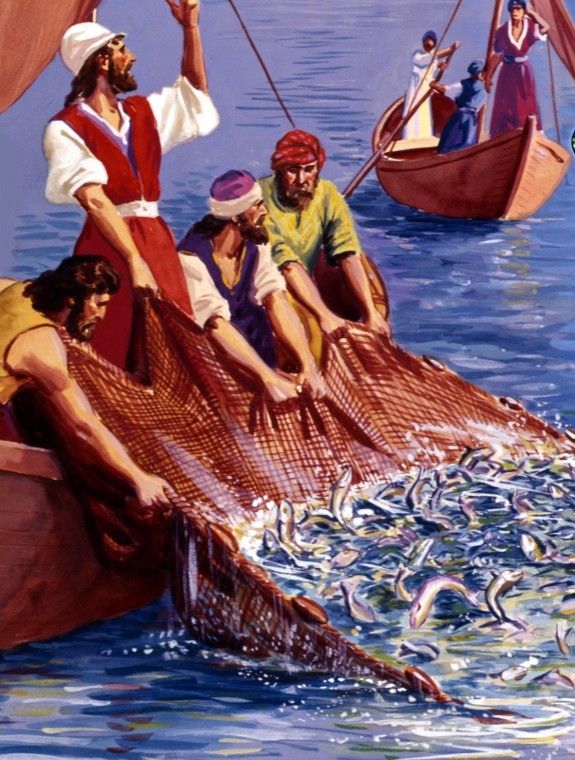
Jesus performs a miracle, helping the disciples catch many fish -- Matthew 4: 13-16; Luke 5: 1-11.

Jesus performs a miracle, helping the disciples catch many fish —Luke 5: 1-11.

Notice Peter’s slight irritation with Jesus’ instructions to put the nets out in deep water. The fishermen had completed a night of fruitless work, and were doubtless tired and quite unhappy with the results of that labor. Yet, to his credit, he does as Jesus says, and the haul was enough for both boats to be overloaded. Peter then realized that this was no ordinary man – that He was sent from God, and that they had been a part of something very special. He bowed down to him, declaring his sinful nature, surely regretting his doubt. But Jesus told him, his brother Andrew, and his partners (two brothers that were the sons of Zebedee, James and John) that they would now be “catching men.”

When they got their boats to shore, they left everything and followed Jesus. The speed of the narrative here, and especially in the Gospel of Mark, makes us think that these were strangers to Jesus that immediately left their worldly possessions on a shoestring encounter. We should notice, however, that Mark tells us that James and John were in another boat a little farther along (Mark 1:16-20). It is unlikely that this was just a chance encounter with Peter and the others for the first time. Jesus boarded Peter’s boat as someone who was familiar to him. We can easily deduce that there was already a relationship between them, as well as with James and John. And the casual mention of the astonishment of the latter two also indicates some discussion (and certainly no small amount of excitement) had taken place once ashore.

(This year’s reading plan for Luke, Acts, and 1 and 2 Chronicles averages just 15 verses per day – 5 days per week!)
Schedule for this week
Read or listen to audio of today’s selection from Luke here
Read or listen to audio of today’s selection from 1 Chronicles here

/Bob’s boy
___________________
some images © V. Gilbert & Arlisle F. Beers

Please note: I did not design the reading plan that I am following in my blog.  All of my comments in this blog, however, are solely my responsibility.  When reading ANY commentary, you should ALWAYS refer first to the scripture, which is God’s unchanging and unfailing word. Reading schedules, as well as a link to the site where you can get the reading plan that I’m currently following for yourself can be found on the “Bible Reading Schedules” page of my website at http://graceofourlord.com.  

Enhanced by Zemanta

Toward More Effective Prayer

Christians praying in Goma, DR of Congo.

Christians praying in Goma, DR of Congo. (Photo credit: Wikipedia)

Last month we began a series intended to help us develop our praying habits with an emphasis on the ACTS method of prayer in this article. Most Christians pray every day. Many of us pray several times each day, giving thanks to God before eating each meal,  before going to sleep, and whenever else we find the opportunity.

Some of us have our own special times when we approach God at length in prayer. Any time we talk to God in prayer is beneficial to us. It really is not complicated – prayer is simply talking to God. But most of us want to grow – to become better at praying, especially when we pray in public; and we do grow each time that we pray. The best way to improve one’s prayer life is to read and meditate on God’s word, and then pray – and do so often!

As we study and meditate on God’s word, we will often be inclined in our prayers to quote parts of a particular passage that has become familiar to us, and that is perfectly fine. Some of the most powerful prayers in the Bible use verbiage that is contained elsewhere in God’s word. Why would it not be acceptable in our own prayers? In fact, some of the most effective and encouraging prayers we’ve heard contained references to Scripture.

As we have stated, there is no one formula for prayer. But we most often begin with the “adoration” that the ACTS method refers to. And the beginning is a great place for us to start this year of learning to pray better. With adoration, we recognize the greatness of our Lord God, and acknowledge the depths of His power and glory. Consider David’s prayer in 1 Chronicles 29:11-13:

Yours, O Lord, is the greatness and the power and the glory and the victory and the majesty,
for all that is in the heavens and in the earth is yours.
Yours is the kingdom, O Lord, and you are exalted as head above all.
Both riches and honor come from you, and you rule over all.
In your hand are power and might, and in your hand it is to make great and to give strength to all.
And now we thank you, our God, and praise your glorious name

We will leave you to meditate on the following short prayer. If it sounds familiar, it is because the words are adapted from Psalm 19:1, 14; Acts 17:28, and James 1:17. A lot of scripture for a short prayer, but it does serve to illustrate how easy it is to adapt God’s word to our prayers in a meaningful way. With the exception of a bit of thanksgiving, it contains only the “ACTS” element of adoration, but it is a prayer nonetheless.

Oh Lord our God,
In whom we live and move and have our being;
The heavens declare your glory, and the sky above proclaims your handiwork.
We thank you for every good gift, and every perfect gift that comes from above,
Coming down from the Father of lights
With whom there is no variation and no shadow due to change.
In the name of your Son, Jesus, we pray.
Amen.

(This year’s reading plan for Luke, Acts, and 1 and 2 Chronicles averages just 15 verses per day – 5 days per week!)
Schedule for this week

/Bob’s boy
___________________
some images © V. Gilbert & Arlisle F. Beers

Please note: I did not design the reading plan that I am following in my blog.  All of my comments in this blog, however, are solely my responsibility.  When reading ANY commentary, you should ALWAYS refer first to the scripture, which is God’s unchanging and unfailing word. Reading schedules, as well as a link to the site where you can get the reading plan that I’m currently following for yourself can be found on the “Bible Reading Schedules” page of my website at http://graceofourlord.com.  

Enhanced by Zemanta