Exodus 9 – The Fifth, Sixth, and Seventh Plagues

There is a lot going on in this chapter as God accomplishes His objectives.  It is helpful, though to step back for a moment and fully realize that is precisely what He is doing.  Freeing the descendants of Israel (Jacob), and even placing them in the land He had promised would be easily accomplished by the creator of the universe – as would punishing Pharaoh for his defiance.  He gets all of those things done in His own time, but He is teaching His people, and the world in the process.

The Fifth Plague: Egyptian Livestock Die

The plagues, as assaults upon the foolishness of the worship of specific false “gods,” exposes such man-made creations as the empty promises that they are, which ultimately can facilitate the very destruction that falls on those that worship them.  The same can be said of the empty things that man tends to “worship” today – fortune, sex, and selfish pleasure, to name a few.  Those same plagues demonstrate that all of the things of the earth itself come from our one true God, who shows Himself in these verses to be sovereign over them all.

Further comments on Pharaoh’s “heart condition”

(I apologize for the length of today’s blog, but I feel the need to give my comments about this subject more adequately because of its troubling nature to some people – and because of the urgency of what it means to us today)

Notice again in verse 34, as in Exodus 8:15 and 8:32, the text says that Pharaoh hardened his heart – just as we are told elsewhere in these chapters, as well as other books (such as in 1 Samuel 6:6). Most honest readers will admit to being somewhat disturbed at some point by the other passages in Exodus that refer to God being the one that hardens Pharaoh’s heart – as if God actually caused Pharaoh’s own demise, when he might otherwise have been repentant.  And indeed many commentators and theologians, by their interpretations, have not only failed to adequately dispel those concerns, rather their analysis has often actually increased those feelings.

While it is true that the Lord is sovereign over all, and can choose to show mercy on whom He wishes (as Paul reminds us in Romans 9:16-18), the suggestion that He in any way was the cause of Pharaoh’s failure to obey is a terrible misunderstanding of the scripture as it was written, and indeed the very nature of our Lord.  God tells us in his word that he “desires all people to be saved” (1 Timothy 2:4), and God never lies (Titus 1:1-2).  Moreover, He is without injustice, as said beautifully in the NKJV version of Deut 32:4:

He is the Rock, His work is perfect;
For all His ways are justice,
A God of truth and without injustice;
Righteous and upright is He.

The Lord’s part in the hardening of Pharaoh’s heart was that He forced him over and over again into a position that he would not otherwise have been in – to face undeniably, the impotence of his false “gods,” to see for himself the might and sovereign power of the one true God – and knowing this, to make up his mind whether he would obey or defy.  God absolutely knew Pharaoh’s heart, but know this for certain – Pharaoh chose to defy the Lord.

This is where the relevance for us today is so sad because we see it for (in?) ourselves far too often.  By our continued defiance to God, insisting instead to live in sin and worship our own “gods,” we are quite capable of hardening our own hearts.   Paul warns in Romans 8:7-8, which I quote below (keeping in mind that the “mind set on the flesh” refers to both unbelievers and to those unwilling to truly repent, who are by definition in bondage to sin):

7 For the mind that is set on the flesh is hostile to God,
for it does not submit to God’s law;
indeed, it cannot.
8 Those who are in the flesh cannot please God.

Read or listen to audio of ESV version of this selection from this link.

/Robert
___________________
image © V. Gilbert & Arlisle F. Beers

Please note: I did not design the reading plan that I am following in my blog.  All of my comments in this blog, however, are solely my responsibility.  When reading ANY commentary, you should ALWAYS refer first to the scripture, which is God’s unchanging and unfailing word. Reading schedules, as well as a link to the site where you can get the reading plan that I’m currently following for yourself can be found on the “Bible Reading Schedules” page of my website at http://graceofourlord.com.  For questions and help, please see the “FAQ” and “Summaries” pages there.
 

Exodus 8 – The Second, Third, and Fourth Plagues

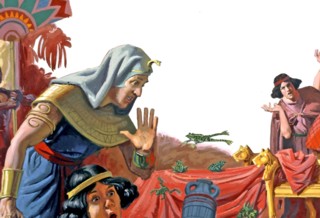
The Lord was very deliberate, as is always the case, in His choices of the particular forms of plagues that he would introduce through Moses and Aaron.  Though we might not fully understand them all, it is clear that the “gods” of the Egyptians were being mocked, and thus shown not to be the real God.  The first one of this chapter (the second plague) – of frogs – in verses 1-15 was obviously chosen to show the foolishness of worshiping their false god Heket (or Heqet), the Egyptian frog-goddess.

"...shall come up into your house and into your bedroom..."

The cycle that will be repeated in other plagues begins:

  1. The hardship on Pharaoh and the people (just think about v. 3-4, and later about verse 13!)
  2. Pharaoh sees God’s power, promises to Moses, and asks him to “plead with the Lord” (v. 8)
  3. The respite (v. 12-13)
  4. Pharaoh then hardens his heart again and will not listen (v. 15).

Once again, the “magicians” do their thing; and again, they are powerless to reverse the plague – hence number 2 above, as the Lord intended. They were unable to mimic the third plague in v. 16-19, and tell Pharaoh that “This is the finger of God”, but he just returns to step 4 above.  Many believe that the fourth plague of v. 20 ff was of the “biting” type of fly.  The difference with this plague in v. 22-24 was that God would bring this upon the Egyptians, and not His people – so that they would “know that I am the Lord in the midst of the earth.”

(Side Note: Interesting articles about the mythological frog goddess can be found at “Ancient Egypt Online” and at “Ancient Egypt: the Mythology“.  Both sites also have information on the mythological “god” Khephera, which may have to do with the insect plagues.)  For this writer’s interpretation of the references that these chapters make to the “hardening of Pharaoh’s heart,” please see previous post for  Exodus 7, but especially tomorrow’s posting for Exodus 9.

Read or listen to audio of ESV version of this selection from this link.

/Robert
___________________
image © V. Gilbert & Arlisle F. Beers

Please note: I did not design the reading plan that I am following in my blog.  All of my comments in this blog, however, are solely my responsibility.  When reading ANY commentary, you should ALWAYS refer first to the scripture, which is God’s unchanging and unfailing word. Reading schedules, as well as a link to the site where you can get the reading plan that I’m currently following for yourself can be found on the “Bible Reading Schedules” page of my website at http://graceofourlord.com.  For questions and help, please see the “FAQ” and “Summaries” pages there.

Exodus 7 – Moses and Aaron Before Pharaoh

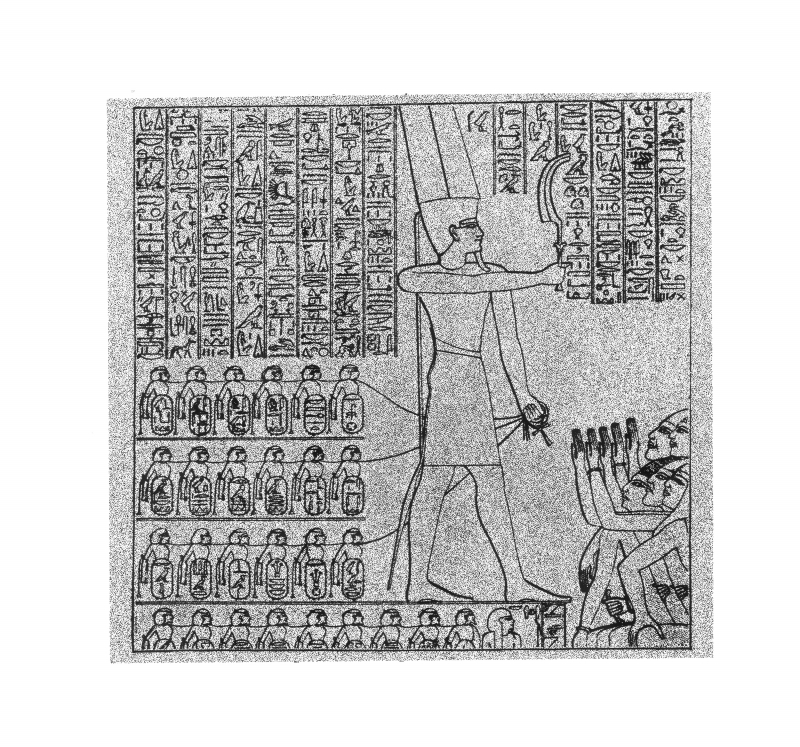
God reassures (and encourages) Moses in verse 1 and is scripting their audience with Pharaoh, as shown in verse 2.  The repeated mention of the hardening of Pharaoh’s heart by God in verse 3 and elsewhere is troubling for some people.  This is best understood as further hardening – Pharaoh has already made it very clear that he does not know the Lord (Exodus 5:2) – and Pharaoh has “gods” of his own.  The sense of the word “know” as it is used here is as much about defiance, as it is about being ignorant of His identity.  The plagues to come shortly will not only demonstrate who the real God is (verse 5 “The Egyptians shall know that I am the Lord”), they will show those “gods” to be false and powerless.

The Lord does all of this to demonstrate His power to them, and to “the people of Israel.”  Note the repetition throughout these early chapters in Exodus (and later chapters as well) of the theme “I am the Lord” and “you shall know that I am the Lord your God.  The Lord is making clear who He is, and that He is keeping the promises He made to their fathers.  He mentions those promises made to Abraham, to Isaac and to Jacob together (as in Exodus 6:8) often in these chapters in order to drive this home.

Modern day Nile river

Moses and Aaron present the first sign with staff, as God had instructed.  We do not know if the mimicry of Pharaoh’s “magicians” in verse 11 is some sort of trick or by some evil or demonic supernatural power.  But see in verse 12, that their “parlor games” are swallowed up quite literally by what God has done.  Then, the first plague – turning the water in the Nile to blood – is introduced by Aaron’s staff, as God commanded.  Once more, the mimicry of these “magicians” might be impressive if instead they reversed the effects of the plague – but they cannot truly fight God!  And now, the Egyptian people suffer because of their ruler’s heart (verses 23-24).

(Side note: A very interesting explanation of the Egyptian “gods” relative to their being mocked by each of the 10 plagues in this and following chapters can be found in this link to an article by Dr. David Livingston calledThe Plagues and The Exodus)

Read or listen to audio of ESV version of this selection from this link.

/Robert
___________________
image © V. Gilbert & Arlisle F. Beers

Please note: I did not design the reading plan that I am following in my blog.  All of my comments in this blog, however, are solely my responsibility.  When reading ANY commentary, you should ALWAYS refer first to the scripture, which is God’s unchanging and unfailing word. Reading schedules, as well as a link to the site where you can get the reading plan that I’m currently following for yourself can be found on the “Bible Reading Schedules” page of my website at http://graceofourlord.com.  For questions and help, please see the “FAQ” and “Summaries” pages there.

Exodus 6 – God Promises Deliverance

Speaking of Himself in third person in verse 1, God tells Moses that he will see what the Lord will do, as he delivers them with “a strong hand”.  God is very patient with Moses and his doubt, as He is building faith – the faith, not only of Moses and Aaron, but of the people of Israel as a whole.   He restates His covenant with them in verses 3-4.

God is specific about what He wants Moses to say to the people in this chapter, as others.  But verse 9 says that “they did not listen to Moses, because of their broken spirit and harsh slavery”.  This did not come as a surprise to Lord.  He knew they would not listen at that point, but He also knew that they and their children’s children would remember the things that He had Moses tell them over and over (as in verses 6-8) – “I am the Lord” — “I will redeem you” — “I will take you to be my people” — “I will deliver you”  — “and you shall know that I am the Lord your God”.

Moses is discouraged, but God tells him to go again to Pharaoh, and tells him in no uncertain terms that he and Aaron will in fact be bringing the people of Israel out of Egypt (verse 13)!  The genealogies beginning in verse 14 are intended to demonstrate to the reader how Moses and Aaron descend from the house of Israel (Jacob), just like any one of more than 600, 000 others (Exodus 12:37).

Verse 30 shows that Moses is still not convinced that anyone will listen to him now.

Read or listen to audio of ESV version of this selection from this link.

/Robert
___________________
image © V. Gilbert & Arlisle F. Beers

Please note: I did not design the reading plan that I am following in my blog.  All of my comments in this blog, however, are solely my responsibility.  When reading ANY commentary, you should ALWAYS refer first to the scripture, which is God’s unchanging and unfailing word. Reading schedules, as well as a link to the site where you can get the reading plan that I’m currently following for yourself can be found on the “Bible Reading Schedules” page of my website at http://graceofourlord.com.  For questions and help, please see the “FAQ” and “Summaries” pages there.
Exodus 5 – Making Bricks Without Straw

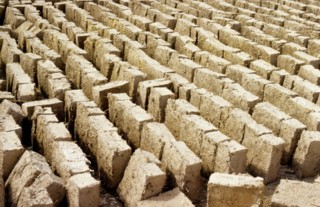
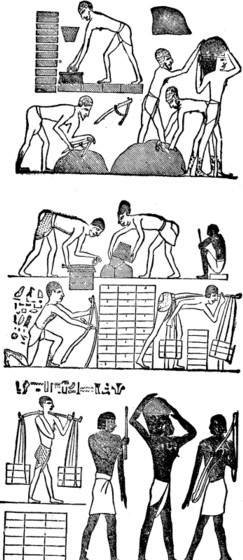
Just as God had told Moses would be the case, Pharaoh does not let the people go, or even grant the request to let them go worship (verses 3-4).  Instead, he states that because of Moses and Aaron, they are idle now; and he orders that they make their same quota of daily bricks without being given any straw.

Sun-dried mud bricks that could be similar to what was made in Biblical times

This means they have to labor and spend time to gather their own straw before they can even begin the work they were already doing previously (verse 11).  When they are not as productive, they are then beaten.  The foremen of the people then grow angry at Moses and Aaron for getting them in this situation.

Moses is discouraged and seems to think that he was right in the first place – surely God had made a terrible mistake in sending him to speak in His behalf – and now look what has happened to the people!  Moses has some growing to do before he will learn to trust the Lord any better than they have so far (verses 22-23).  Like Moses, we do not know all of God’s intentions, or understand all of His reasons or His timing.  But He is going to accomplish what He wills, and He will use whoever He chooses in order to do it – and in His own time.

(Side note: Interesting – to me at least – article in this link about brick making at BibleStudyTools.com)

Read or listen to audio of ESV version of this selection from this link.

/Robert
___________________
image © V. Gilbert & Arlisle F. Beers

Please note: I did not design the reading plan that I am following in my blog.  All of my comments in this blog, however, are solely my responsibility.  When reading ANY commentary, you should ALWAYS refer first to the scripture, which is God’s unchanging and unfailing word. Reading schedules, as well as a link to the site where you can get the reading plan that I’m currently following for yourself can be found on the “Bible Reading Schedules” page of my website at http://graceofourlord.com.  For questions and help, please see the “FAQ” and “Summaries” pages there.
 

Exodus 3 – The Burning Bush

The last time the scripture recorded God speaking was over 400 years ago to Jacob (Israel) to tell him to go ahead and leave Canaan for Egypt.  In verse 2, “the angel of the Lord appeared” to Moses at Horeb “in a flame of fire out of the midst of a bush”.  The ground is holy (verse 5) because of the presence of the Lord, who tells Moses of his plans (verse 8) to deliver “the people of Israel” to the land He promised Abraham would belong to his offspring in Genesis 13:14-17.

When asked His name, the reply in verse 14 “I am who I am” basically means the one who is, always has been, and always will be.  It does not mean that Moses did not know who the one true God is.  This is how Moses is to refer to “the God of your fathers, the God of Abraham, the God of Isaac, and the God of Jacob” when speaking of Him to his people – as well as to the polytheistic people of the land where they are now captive.

In verses 20-22, God tells Moses how he will deliver them with the power of His hand, and the “victory” over their captors will be signified by their “plundering” them (as is done by victorious armies).  But in this case, it will be done simply by the people asking for the treasures!   This emphasizes well that when God shows His power, it is awesome indeed!

(Side note: As this chapter introduces the name of Yahweh (the Hebrew contained no consonants, so the Lord is referred to in the text as “YHWH”), you may be interested in a great article on Gordon Franz’s site “Life and Land Seminars”, entitled “Yahweh Inscription Discovered at Mount Sinai!“.  Further illustration that although genuine secular evidences are plentiful, men need to take care in trying to use them to prove the Bible is true.  His summary at the end of that article is right on the mark!  Bear in mind, however, that I do not know if his opinion of claims about the disputed location of Mt. Sinai is correct.)

Read or listen to audio of ESV version of this selection from this link.

/Robert
___________________
image © V. Gilbert & Arlisle F. Beers

Please note: I did not design the reading plan that I am following in my blog.  All of my comments in this blog, however, are solely my responsibility.  When reading ANY commentary, you should ALWAYS refer first to the scripture, which is God’s unchanging and unfailing word. Reading schedules, as well as a link to the site where you can get the reading plan that I’m currently following for yourself can be found on the “Bible Reading Schedules” page of my website at http://graceofourlord.com.  For questions and help, please see the “FAQ” and “Summaries” pages there.


Exodus 2 – The Birth of Moses

Now the daughter of Pharaoh came down to bathe at the river, while her young women walked beside the river. She saw the basket among the reeds and sent her servant woman, and she took it.

After he is born, Moses’ mother is unable to hide him after three months, and places him in a basket in the reeds by the riverbank (verse 3).  After Pharaoh’s daughter “draws” him out, Moses’ own sister summons the courage to ask her if she should get a Hebrew woman to nurse the child for her (verse 7).  So of course, she fetches Moses’ own mother for the task!

Stephen tells us in Acts 7:23, that Moses was 40 years old when verses 11-15 take place; and Moses flees for his life to Midian (where he will stay for another 40 years, as we are told in Acts 7:30).  The father of the woman who will become his wife is referred to as Reuel in verse 18, but we will come to know him as Jethro.

 God Hears Israel’s Groaning – As the people cry out because of their slavery, verse 24 says that “God remembered his covenant with Abraham, with Isaac, and with Jacob”.  God never forgets.  When the scripture says “God remembered,” it means He has decided the time has come for what He wants to happen next concerning that person or event (as in Gen 8:1).

Read or listen to audio of ESV version of this selection from this link.

/Robert
___________________
image © V. Gilbert & Arlisle F. Beers

Please note: I did not design the reading plan that I am following in my blog.  All of my comments in this blog, however, are solely my responsibility.  When reading ANY commentary, you should ALWAYS refer first to the scripture, which is God’s unchanging and unfailing word. Reading schedules, as well as a link to the site where you can get the reading plan that I’m currently following for yourself can be found on the “Bible Reading Schedules” page of my website at http://graceofourlord.com.  For questions and help, please see the “FAQ” and “Summaries” pages there.


Exodus 1 – Israel Increases Greatly in Egypt

Highlights we have passed over in Genesis – As Israel (Jacob) nears death, he takes Joseph’s sons, Ephraim and Manasseh as his own (Gen 48:5). That is why there is not tribe of Joseph in the “Twelve Tribes of Israel”.  These two make up the “half-tribes”.  Jacob sets Joseph and Ephraim apart, and once again the younger is blessed above the first-born as he says that “his offspring shall become a multitude of nations” (Gen 48:19). He makes it clear that he is to be buried in Canaan, where his people shall end up, and blesses all of his sons. Chapter 49 is full of poetic imagery and prophecy, much of it (particularly verses 8-12) pointing to the empire of King David, and ultimately, the Lord Jesus, the Messiah.  In chapter 50, Pharaoh allows Joseph to bury his father in Canaan, and Genesis concludes with the death of Joseph.  And so, God’s word picks up 400 years later…

Genesis 15:13-14:
Then the Lord said to Abram, “Know for certain that your offspring will be sojourners in a land that is not theirs and will be servants there, and they will be afflicted for four hundred years. 14 But I will bring judgment on the nation that they serve, and afterward they shall come out with great possessions.

Pharaoh Oppresses Israel

The 12 sons of Israel (Jacob) (and Joseph’s sons, Ephraim and Manasseh) have long since died; and their descendants, now referred to as “the people of Israel” have multiplied greatly – to the extent that the ruler of Egypt fears their numbers.  So they are ruthlessly made slaves (verse 13), and the mid-wives instructed to kill all newborn sons.  But the midwives feared God (verse 17), and they let them live.  “And the people multiplied greatly and grew very strong” (verse 20), as God had promised Abraham in Genesis 13:16.  Pharaoh then ordered his people to cast every son that is born to the Hebrews into the Nile.

Read or listen to audio of ESV version of this selection from this link.

/Robert
___________________
image © V. Gilbert & Arlisle F. Beers

Please note: I did not design the reading plan that I am following in my blog.  All of my comments in this blog, however, are solely my responsibility.  When reading ANY commentary, you should ALWAYS refer first to the scripture, which is God’s unchanging and unfailing word. Reading schedules, as well as a link to the site where you can get the reading plan that I’m currently following for yourself can be found on the “Bible Reading Schedules” page of my website at http://graceofourlord.com.  For questions and help, please see the “FAQ” and “Summaries” pages there.
 

Preview – “Jumping Forward” to Exodus \ Feb Week 1 Summary Posted

Building Better Bible Habits

Three quick tips for making Bible reading a habit in your life

  • Plan – to keep the “appointment”
    • Set aside a time (maybe even a second, backup time) that is just for you to spend with the Lord each day.  Repetition, as with anything, is the key.  It takes 2-3 weeks of doing something regularly to make it a habit in your life.
  • “Arm” yourself – keep it handy!
    • I love reading from my regular “hold it in my hands” Bible.  But I make use of free Bible apps on my electronic devices, so no matter where I go I can use “down time” to read the Bible whenever I want.
  • Listening counts!
    • If you have never tried audio, give it a shot! It is a very handy way to get your “reading” in.  There are many resources for your PC, eReader, phone or tablet. Many of them pay for great voices to do the reading. YouVersion.com and ESVBible.org are just two of many providers.

Remember, even a little bit of reading any part of the Bible each day is better than none at all.   Hearing from the Lord is what matters!

As for this blog’s “jump” to Exodus:

We will move on from Genesis 46 on Wednesday, all the way to Exodus and the story of its author Moses.  Why skip so many chapters?  As this plan attempts to help us get the story of the Bible as a whole this year, some choices must be made as to where to move forward. That does not mean the chapters we will jump over are unimportant, though.  As the longest book of the Bible in terms of time-span, Genesis covers a couple thousand years; and it is proper to note that from the end of the book (chapter 50) to Exodus 1, about 400 years pass before the Lord’s word to us begins again.  This is because the events of those years were not what the Lord intended for Moses to relate to us for our instruction concerning salvation and the coming of the Messiah and our savior, Jesus Christ.  That story resumes in Exodus 1, where we will take it up on Thursday.

Summing Up

Each weekend, I am now posting a page-length PDF of one week of chapter summaries (on the website’s “Summaries” page), current to the beginning of the previous week.  I have posted the summary for Week 6 (February Week 1) of the schedule I am following.  This short PDF document contains condensed comments about Genesis chapters 29, 30, 31, 32 and 37, with hyperlinks to the ESV version of each chapter for listening or reading, and joins the summaries for other weeks already posted there.

___________________
Please note: I did not design the reading plan that I am following in my blog.  All of my comments in this blog, however, are solely my responsibility.  When reading ANY commentary, you should ALWAYS refer first to the scripture, which is God’s unchanging and unfailing word. Reading schedules, as well as a link to the site where you can get the reading plan that I’m currently following for yourself can be found on the “Bible Reading Schedules” page of my website at http://graceofourlord.com.  For questions and help, please see the “FAQ” and “Summaries” pages there.
/Robert