2 Samuel 12 – Nathan Rebukes David

The Lord has decided that it is time to call David into account for his sin with Bathsheba, so He sends Nathan with the words to rebuke him.  Nathan tells David a moving story about a poor man who had a single lamb that he had loved and raised as one of his own children.  And there was a rich man who didn’t want to take any lamb’s from his own flock for food preparation, so he took the poor man’s beloved lamb to prepare a dinner.

English: Nathan Rebukes David, as in 2 Samuel ...

English: Nathan Rebukes David, as in 2 Samuel 12; watercolor circa 1896–1902 by James Tissot (Photo credit: Wikipedia)

David became very angry, saying that this rich man should die for what he has done, and declares that this man will repay “fourfold” for this act “with no pity.” In verse 7, Nathan tells David “You are the man!”  He then proceeds to tell him all that the Lord has done for him, and how David has despised the word of God with this evil.  He has taken Uriah’s wife and stuck him down “with the sword of the Ammonites.”  This point from verse 9 is sometimes missed when we read about God’s anger with David over this.  The Ammonites were some of the very people, God had brought the Israelites to the promised land to get rid of.  Now David has used those people to help him with his evil deed.

The next words from God in verses 10-11 foretell the great anguish David will face  – the sword will never leave his house, and God “will raise up evil against you out of your own house. And I will take your wives before your eyes and give them to your neighbor, and he shall lie with your wives in the sight of this sun.”

And then in verse 12 – “For you did it secretly, but I will do this thing before all Israel and before the sun.”  David, in contrast to Saul, takes responsibility for his action and confesses that he has sinned against God. Here, we see David acting as the true leader and the man of God that he should be, but his sin will cost him.  David wrote Psalm 51, as he repented for his sin.  The child Bathsheba conceived from their adulterous affair dies (verse 23), but that is far from the end of David’s troubles, as we will see in chapters ahead.

We do not know how much time passed until verse 24 when Solomon was born, but 1 Chronicles 3:5 suggests that he was the fourth son of David by Bathsheba.

Verses 26-31 are important, not just for the military victory over the Ammonites, but for the gold and precious metals for Israel’s treasury – as well as the crown for David, taken from the Ammonite king.

Read or listen to audio of ESV version of this selection from this link.

/Bob’s boy
___________________
some images © V. Gilbert & Arlisle F. Beers

Please note: I did not design the reading plan that I am following in my blog.  All of my comments in this blog, however, are solely my responsibility.  When reading ANY commentary, you should ALWAYS refer first to the scripture, which is God’s unchanging and unfailing word. Reading schedules, as well as a link to the site where you can get the reading plan that I’m currently following for yourself can be found on the “Bible Reading Schedules” page of my website at http://graceofourlord.com.  For questions and help, please see the “FAQ” and “Summaries” pages there.

2 Samuel 11 – David and Bathsheba

We have moved past chapters 8-10 in which David enjoys some key military victories, and in chapter 9, he seeks a survivor of Saul’s house so that he could show kindness to them for Jonathan’s sake.  He finds Miphibosheth, Jonathan’s son, who is lame.  From that day forward, he eats at David’s table.

But chapter 11 focuses on David’s great sin, for which he will pay most dearly.  It is the story of one of the Bible’s greatest men brought to the deepest depravity and callousness by lust and adultery.  It is most disappointing to see a great man of God fall so low.  When David saw her in verse 3 from his roof bathing, his first sin was lust – the right thing would have been to turn away.  When he inquired about her, he is told that she is the wife of Uriah the Hittite.  We find out in 2 Samuel 23:39 that this is one of David’s closest warriors – his famous “mighty men” listed in 23:8-39.  He did battle for David loyally, and probably considered him his friend.

King David Handing the Letter to Uriah (1611) ...

King David Handing the Letter to Uriah (1611) by Pieter Lastman, oil on panel, 51.1 x 61.3 cm, Detroit Institute of Arts (Photo credit: Wikipedia)

David is powerful, and only he can be blamed for this adultery.  When she becomes pregnant, David plots Uriah’s death.  To make things worse, before he returns to battle, Uriah shows his great character and loyalty in verse 11.  Then David sends him to battle with the note containing instructions for Uriah’s death delivered by his own hand!  Joab carries out this sickening deed, and in verse 26 we are told that Bathsheba mourned for her husband.  When the mourning was over, David took her as his wife, and she bore him a son.

This is not the David we know, nor is it the man after God’s own heart that we have read about for so many chapters; and verse 27 tells us that it “displeased the Lord.”  This seems like a very mild statement, and we will see God forgive David.  But the consequences for this deed will be anything but mild.

Sin often has its consequences – for us, and for others; and God never promises to “fix” all the damage we bring on ourselves and others.  We cannot plan to sin, thinking that we will just ask God to forgive us later,  and that He will simply do our bidding – repairing for us all the heartache we may have caused from our sin.  But through or savior Jesus Christ, we can obtain the forgiveness for any sin we truly repent about – no matter how terrible we think of what we have done.

Read or listen to audio of ESV version of this selection from this link.

/Bob’s boy
___________________
some images © V. Gilbert & Arlisle F. Beers

Please note: I did not design the reading plan that I am following in my blog.  All of my comments in this blog, however, are solely my responsibility.  When reading ANY commentary, you should ALWAYS refer first to the scripture, which is God’s unchanging and unfailing word. Reading schedules, as well as a link to the site where you can get the reading plan that I’m currently following for yourself can be found on the “Bible Reading Schedules” page of my website at http://graceofourlord.com.  For questions and help, please see the “FAQ” and “Summaries” pages there.

2 Samuel 7 – The Lord’s Covenant with David

If you asked this blogger for an opinion of the most important passages in the Bible,  it would be a tough task.  But the seventh chapter of 2 Samuel would definitely make the short list.  This is where God makes His covenant with David (although the word covenant itself is not used here, see Psalm 89).  Again, this passage is so important, we will find it again in 1 Chronicles 17.

Nathan advises King David

Nathan advises King David (Photo credit: Wikipedia)

The chapter begins with David in his majestic home built of cedars, realizing that while God has made his kingdom great, David has not built a temple (a fine house) for God.  At first, the prophet Nathan tells David to go ahead – “for the Lord is with you” (verse 3).  But Nathan was wrong, and the Lord let him know that he should tell David not to do it. we will find out in 1 Chronicles 22:7-9 more reasons why God does not want David to build him a house.  But that is not the important message the Lord wants delivered here.

Instead, the Lord proclaims that He will establish David’s house, raise up his offspring, and establish his kingdom forever (verses 12-16 – compare to the Hebrew writer’s words about Jesus in  Hebrews 1:1-5). The comparison there seems similar to the explanation of the covenant with Abraham and his offspring that we find in Galatians 3:11-16 (especially verse 16), although Solomon is clearly the intended for the “short-term” kingdom.  But the kingdom that will last forever will be of Jesus the Christ (Acts 2:25-34).

Notice the prayer from David in verses 18-29 – full of intimate feelings of humility, thanksgiving, honor and respect (David uses the phrase “O Lord God” eight times).  Truly one of the great prayers of the Bible, and fitting to the momentous news he has received from God.  David indicates that he understands the monumental result of this news, but is filled with wonder, that God has chosen him to do his this great thing through.

Read or listen to audio of ESV version of this selection from this link.

/Bob’s boy
___________________
some images © V. Gilbert & Arlisle F. Beers

Please note: I did not design the reading plan that I am following in my blog.  All of my comments in this blog, however, are solely my responsibility.  When reading ANY commentary, you should ALWAYS refer first to the scripture, which is God’s unchanging and unfailing word. Reading schedules, as well as a link to the site where you can get the reading plan that I’m currently following for yourself can be found on the “Bible Reading Schedules” page of my website at http://graceofourlord.com.  For questions and help, please see the “FAQ” and “Summaries” pages there.

2 Samuel 6 – The Ark Brought to Jerusalem

The story of the ark being brought to Jerusalem is told here, and the first attempt does not go well.  The ark was one of the “holy things,” with which they communed with the Lord – but though the Levite priests.  The detail given by the Lord for its construction was exquisite (Exodus 25:10-22, and Exodus 37:1-9).  The Koathites were to carry it – by poles through the rings.  Even they could not touch it, or they would die (Numbers 4:4-15).  None but the priests themselves could touch the holy things, as God had set the Levites apart (consecrated) for himself.

The Chastisement of Uzzah

The Chastisement of Uzzah (Photo credit: Wikipedia)

But they set out to bring it to Jerusalem on a cart, much as the manner in which the Philistines returned it in 1 Samuel 6:7.  The oxen stumbled, and Uzzah reached out to take hold of it (the right thing to do, one might think). But as we have learned, when God says He will do something, He always does it.  God keeps ALL of His promises!  David and those transporting the Ark showed no respect for the Lord, and Uzzah was now dead because of his sin.

Three months pass after this incident (verse 11) before David again transports it.  This second attempt is mentioned briefly here, but in more detail in 1 Chronicles 15, as this story is told there again. As our reading has shown before, when God says something more than once, we should pay attention!  This time, the Levites carry it to Jerusalem properly.

Michal’s disdain and David’s rejection of her afterward is important to us because she will not bear him a child – Saul’s line will not be extended through the house of David.  Contrary to the picture some have painted, David was not dancing naked, but wearing a linen ephod – a simple garment as the priests wore (verse 14, and 1 Chronicles 15:27).  He had taken off his kingly robes to honor the Lord (verse 21).

When Jesus laid down His life for us and the temple curtain was torn (Matthew 27:51), Jesus became like our “ark”, just as He is our Priest, through which we can approach the Father (Hebrews 5:1-10).  Do we honor and respect this most holy and precious son of our Lord, whose very name is even used today by many to casually swear?

Read or listen to audio of ESV version of this selection from this link.

/Bob’s boy
___________________
some images © V. Gilbert & Arlisle F. Beers

Please note: I did not design the reading plan that I am following in my blog.  All of my comments in this blog, however, are solely my responsibility.  When reading ANY commentary, you should ALWAYS refer first to the scripture, which is God’s unchanging and unfailing word. Reading schedules, as well as a link to the site where you can get the reading plan that I’m currently following for yourself can be found on the “Bible Reading Schedules” page of my website at http://graceofourlord.com.  For questions and help, please see the “FAQ” and “Summaries” pages there.

2 Samuel 5 – David Anointed King of Israel

Ophel (City of David), Jerusalem, Israel. The ...

Ophel (City of David), Jerusalem, Israel. The Kidron Valley and Mount of Olives are in the background. (Photo credit: Wikipedia)

The kingdom has become unified, and David has now become king of all Israel, just as God intended.  Now he wants Jerusalem, but the Jebusites are in the way, and they do not think David and his army are a threat (verse 6).  But his army is victorious, 1 Chronicles 11:6-9 tell us that it was this battle that resulted in Joab becoming his commander.  David took the stronghold at Zion, and it became the City of David.

Then David went up against the Philistines, whom he heard were after him (verse 20).  He defeated them at Baal-perazim (verse 20), and they left their idols there.  This is a bit ironic, as it was the Philistines who had captured the ark of the covenant in 1 Samuel 4:1-11.  It is in  1 Chronicles 14:12 that we learn that David had these idols burned.

Verse 11 tells us that “Hiram king of Tyre sent messengers to David, and cedar trees, also carpenters and masons who built David a house.”  It is unsure whether this is the same king Hiram of Tyre that in 1 Kings 5:1–18 provided David’s son, Solomon with the cedars to build the temple – or maybe his son.  But David and his kingdom have become greater and greater (verse 10).

Read or listen to audio of ESV version of this selection from this link.

/Bob’s boy
___________________
some images © V. Gilbert & Arlisle F. Beers

Please note: I did not design the reading plan that I am following in my blog.  All of my comments in this blog, however, are solely my responsibility.  When reading ANY commentary, you should ALWAYS refer first to the scripture, which is God’s unchanging and unfailing word. Reading schedules, as well as a link to the site where you can get the reading plan that I’m currently following for yourself can be found on the “Bible Reading Schedules” page of my website at http://graceofourlord.com.  For questions and help, please see the “FAQ” and “Summaries” pages there.

Starting 2 Samuel \ Week 19 Summary Posted

David, King Over All Israel, as in 2 Samuel 5:...

David, King Over All Israel, as in 2 Samuel 5:1-12, illustration from a Bible card published 1896 by the Providence Lithograph Company (Photo credit: Wikipedia)

This week, we move on to 2 Samuel and a new king (David).  As Israel becomes unified, we start with chapter 5, and by chapter 7, we will see the promise of our Lord Jesus from the house of this king.

Summing Up

Each weekend, I am now posting a small PDF of one week of chapter summaries (on the website’s “Summaries” page), current to the beginning of the previous week.  I have posted the summary for Week 19 (May Week 1) of the schedule I am following.  This short PDF document contains condensed comments about 1 Samuel 8, 9, 10-11, 12 and 13, with hyperlinks to the ESV version of each chapter for listening or reading, and joins the summaries for other weeks already posted there.

/Bob’s boy
___________________
image © V. Gilbert & Arlisle F. Beers

Please note: I did not design the reading plan that I am following in my blog.  All of my comments in this blog, however, are solely my responsibility.  When reading ANY commentary, you should ALWAYS refer first to the scripture, which is God’s unchanging and unfailing word. Reading schedules, as well as a link to the site where you can get the reading plan that I’m currently following for yourself can be found on the “Bible Reading Schedules” page of my website at http://graceofourlord.com.  For questions and help, please see the “FAQ” and “Summaries” pages there.

1 Samuel 28 – Saul and the Medium of En-dor

As we forge ahead in chapter 28, Saul has gone from bad to worse.  Samuel has died. His madness and jealousy of David (in spite of knowing God was on David’s side) drove him to kill all the priests and women and children at Nob (1 Samuel 22:16-21), and Abiathar has fled to be with David.  Now the Philistines threaten to split the kingdom in two, and he has cut himself off from God.  So he decides to consult a medium – expressly forbidden in Leviticus 19:31 and elsewhere.

Apparition of the spirit of Samuel to Saul, by...

Apparition of the spirit of Samuel to Saul, by Salvator Rosa, 1668. (Photo credit: Wikipedia)

At Endor, he tells the medium to he wants to talk to Samuel.  We are not told that it is actually Samuel who does appear, but he speaks of the Lord and of Saul as Samuel would.  The surprise and shriek from the woman could indicate that God just allowed it. There is much we do not know about demons in the Bible and of this type of thing that the it strictly warns us from.  But whatever the case, the news is not good for Saul, as he is told that he and his sons would all die the next day.

Having fasted (probably for this event), the news is the last straw for the weak Samuel.  He finally consents to eat somethings at the urging of his servants – with the medium!  No man who thought himself righteous would eat in such company under any circumstances in that land and time.

Read or listen to audio of ESV version of this selection from this link.

/Bob’s boy
___________________
some images © V. Gilbert & Arlisle F. Beers

Please note: I did not design the reading plan that I am following in my blog.  All of my comments in this blog, however, are solely my responsibility.  When reading ANY commentary, you should ALWAYS refer first to the scripture, which is God’s unchanging and unfailing word. Reading schedules, as well as a link to the site where you can get the reading plan that I’m currently following for yourself can be found on the “Bible Reading Schedules” page of my website at http://graceofourlord.com.  For questions and help, please see the “FAQ” and “Summaries” pages there.

1 Samuel 19 – Saul Tries to Kill David

"David and Jonathan," by Rembrandt. ...

“David and Jonathan,” by Rembrandt. Jonathan is the figure in the turban. Hermitage News (Photo credit: Wikipedia)

As we move to chapter 19, David’s skill as a warrior is proven, his reputation has grown and Saul has become more jealous and paranoid than ever.  His plan for David to be killed by Philistines backfired, and David’s prowess and reputation increased.  As part of that failed plan, Saul had promised his daughter Michal.  Now the one he feared most was his son-in-law!  Saul knew not only that his daughter loved David, but he also knew that the Lord was with David (1 Samuel 18:28).  So by plotting against David, he was fighting against God, and he knew it.  What madness!

Saul’s son, Jonathan, loved David.  Contrary to what some would have you believe, their relationship was simply one of deep brotherly love and respect.  Also, we tend to think of them as close in age, but this was probably far from the case.  Remember, Jonathan was commanding troops while David was still a very young boy before even being anointed (1 Samuel 13:2-3).  So Jonathan intercedes and convinces Saul not to kill David, and he again defeats the Philistines for the kingdom, as war broke out again (verse 8).

"Saul Tries to Kill David"

“Saul Tries to Kill David” (Photo credit: Wikipedia)

But God had to get David trained and ready to lead the people.  So in His wisdom, He again sent a harmful spirit to Saul.  Saul tried to pin David to the wall with his spear when he was playing the lyre in his house, but David escaped.  When he sent them to his home, his daughter had already warned David, and he escapes through the window.  He went to Samuel, and they went to Naioth in Ramah. In verses 20-24 Saul’s messengers, and even Saul himself are overcome with the Spirit of the lord and Saul is stripped of his kingly robes – just as he would be stripped of his throne.

Michal lets David escape from the window. A pa...

Michal lets David escape from the window. A painting by Gustave Doré, 1865. (Photo credit: Wikipedia)

What about the idol from the house of her father that Michal used to deceive her father’s messengers (verses 13-16)?  Could be the spoils of war that Saul had kept.  he never has been shown in the scripture to be a man after the Lord’s heart – that was David.

Read or listen to audio of ESV version of this selection from this link.

/Robert
___________________
some images © V. Gilbert & Arlisle F. Beers

Please note: I did not design the reading plan that I am following in my blog.  All of my comments in this blog, however, are solely my responsibility.  When reading ANY commentary, you should ALWAYS refer first to the scripture, which is God’s unchanging and unfailing word. Reading schedules, as well as a link to the site where you can get the reading plan that I’m currently following for yourself can be found on the “Bible Reading Schedules” page of my website at http://graceofourlord.com.  For questions and help, please see the “FAQ” and “Summaries” pages there.

1 Samuel 17 – David and Goliath

Valley of Elah

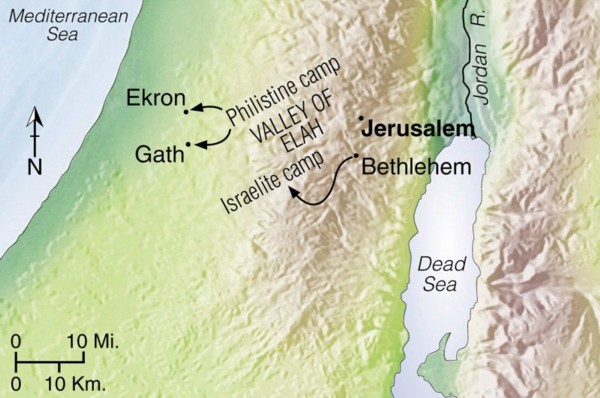
One of the most famous chapters in the Bible begins with the Philistines camped at Socoh and Saul and his army gathered at the Valley of Elah.  Defeating them here was crucial, as control of this valley would give the Philistines an entrance into the hill country of Judah.  Goliath of Gath was their champion. A champion is a man comes forward to fight between the two enemy’s battle lines. Here Goliath challenges on behalf of the Philistines any champion that Israel will dare to confront him.  The survivor’s army would share the victory with him.  The actual size of this “giant” of a man is much debated, depending on the standard of the cubit one chooses to use (and the poor fellow that .  But it is sufficient to say that a warrior, whether approaching either 8 feet or 9 feet tall, would be most intimidating – then and now.

The Israel army is taunted daily by him (verse 16) as the actual battle continued (verses 19-21).  David arrives, and though his brother Eliab chastises him for leaving the sheep (verse 28), he continues inquiring about the champion.  Where Saul shows fear and a lack of confidence (verses 11, 33), David shows defiance and certainty that he will prevail because of God.  Even when relating his own killing of lions and bears (verses 34, 36), David points out that it was God who delivered him, just as he would do with “this uncircumcised Philistine”  because “he has defied the armies of the living God.”

Saul consents to let David go and outfits him with his armor, but it was not accustomed to it (verse 39) and sheds it.  Armed with his staff, a sling and stones he chose from the brook, he defiantly confronts Goliath, who is insulted by being challenged by such an unimposing enemy and , over-confident, curses David.  David tells him he will defeat him because the Lord will deliver him – and that he will cut off his head.  David does strike him to the ground with a stone embedded in his forehead.  The Lord was indeed with him.

(Side Note: There is an article at BiblePlaces.com on excavation at the site of Gath (Tel es-Safi) that has discovered a shard of pottery with the name Goliath inscribed, showing, at the least, that names similar to “Goliath”  were used around the 9th – 10th century BCE in that area)

Read or listen to audio of ESV version of this selection from this link.

/Bob’s boy
___________________
some images © V. Gilbert & Arlisle F. Beers

Please note: I did not design the reading plan that I am following in my blog.  All of my comments in this blog, however, are solely my responsibility.  When reading ANY commentary, you should ALWAYS refer first to the scripture, which is God’s unchanging and unfailing word. Reading schedules, as well as a link to the site where you can get the reading plan that I’m currently following for yourself can be found on the “Bible Reading Schedules” page of my website at http://graceofourlord.com.  For questions and help, please see the “FAQ” and “Summaries” pages there.

1 Samuel 16 – David Anointed King

Samuel anointing king David

Samuel anointing king David (Photo credit: Wikipedia)

The Lord sends Samuel to the house of Jesse (son of Ruth and Boaz) to anoint one of his sons as the new king.  When Samuel arrives, he is sure that the tall one, Eliab, must be the one.  But God tells him that he is not, and that He does not judge man by appearance, but by their heart.  After going through all of Jesse’s sons, he finds that the least likely, David (the youngest, who is tending the sheep) is actually the one.  Once again, we find it to be the case that God often uses the one we least expect for His work.

Samuel anointed him in verse 13 and “the Spirit of the Lord rushed upon David from that day forward.”  Then, verse 14 tells us that “the Spirit of the Lord departed from Saul,” making a significant statement of the rejection and shift of favor. Some commentators take the meaning of the “harmful spirit” that tormented Saul as being a mental disorder.  Others see it as more demonic.  Either way, Saul clearly is irrational at many times from this point forward.  By God’s providence, his servants suggest music to soothe him, and they just happen to know of a skillful musician with a lyre – David, who becomes favored in Saul’s court for this, as well as becoming Saul’s armor-bearer.

Read or listen to audio of ESV version of this selection from this link.

/Robert
___________________
some images © V. Gilbert & Arlisle F. Beers

Please note: I did not design the reading plan that I am following in my blog.  All of my comments in this blog, however, are solely my responsibility.  When reading ANY commentary, you should ALWAYS refer first to the scripture, which is God’s unchanging and unfailing word. Reading schedules, as well as a link to the site where you can get the reading plan that I’m currently following for yourself can be found on the “Bible Reading Schedules” page of my website at http://graceofourlord.com.  For questions and help, please see the “FAQ” and “Summaries” pages there.