Psalms 96 – The Splendor of Holiness

ark_of_covenant_002Psalm 96 is part of David’s “Song of Thanks” to the Lord, which he had Asaph and his brothers sing after the arrival of the Ark in Jerusalem.  The psalm is found virtually word for word in 1 Chronicles 16:23-33.  The rest of that song, in verses 8-22 is taken from Psalms 105 and 106.

Like the previous psalm, this one urges praise to the Lord in song, and does so three times in the first two verses.  The notable theme throughout the psalm is its inclusion of all nations – all people – in praising and making offerings to the one true God.  The entirety of the nations, all the people of the world, are included 9 times in these 13 verses as belonging to, and ruled by, the Creator of the world.  The Gentiles and all people are called on to worship “in the splendor of holiness” the God, who unlike their “worthless idols,” will judge the world in righteousness and according to His faithfulness.

It is a testimony to the fact that is illustrated throughout the Bible that God’s people were given custodial responsibility for God’s word, but all nations were always intended to receive it, and His name would be great in all the world (Malachi 1:11).

Read or listen to audio of ESV version of this selection from this link.

/Bob’s boy
___________________
some images © V. Gilbert & Arlisle F. Beers

Please note: I did not design the reading plan that I am following in my blog.  All of my comments in this blog, however, are solely my responsibility.  When reading ANY commentary, you should ALWAYS refer first to the scripture, which is God’s unchanging and unfailing word. Reading schedules, as well as a link to the site where you can get the reading plan that I’m currently following for yourself can be found on the “Bible Reading Schedules” page of my website at http://graceofourlord.com.  For questions and help, please see the “FAQ” and “Summaries” pages there.
Job 24 – Against the Light

There is a lot of confusion, debate, and disagreement about some of the text of chapter 24.  Much of the verbiage in verse 18 and following seems so counter to what Job has been arguing that some translations insert an “implied” beginning to verse 18 of the words “you say.”  This actually seems right to the flow of the text upon careful reflection.  In any event, the complaining point Job begins the chapter with is one of wonder at why God does not punish the wicked in judgment for their deeds now – for all the world to see.

wicked_003He then lists the more despicable acts that the wicked regularly commit with impunity, making the point that swift justice against them is certainly warranted.  Then in verses 18-20, Job states the viewpoint of the way things work against the wicked that his friends have expressed.  Yet he returns to a condemnation of the acts of the wicked in verse 21, followed by the somewhat startling observation that it appears that God actually prolongs their lives, gives them security, and even helps them to “rise up” at times when they are in despair of life.

It is the opinion of this blogger that the meat of Job’s viewpoint lies in verse 24, where he makes the case that the wicked are often exalted for a while in this life, but when they are gone, that is when they are “brought low and gathered up like all others;they are cut off like the heads of grain.”

Job is certain of his position and flatly challenges his friends to refute him in verse 25: “If it is not so, who will prove me a liar and show that there is nothing in what I say?”

Read or listen to audio of ESV version of this selection from this link.

/Bob’s boy
___________________
some images © V. Gilbert & Arlisle F. Beers

Please note: I did not design the reading plan that I am following in my blog.  All of my comments in this blog, however, are solely my responsibility.  When reading ANY commentary, you should ALWAYS refer first to the scripture, which is God’s unchanging and unfailing word. Reading schedules, as well as a link to the site where you can get the reading plan that I’m currently following for yourself can be found on the “Bible Reading Schedules” page of my website at http://graceofourlord.com.  For questions and help, please see the “FAQ” and “Summaries” pages there.

Psalms 80, 120 – In My Distress I Called

Thought to have been written during the time of captivity, the community lament of Psalm 80 makes pleas to the “Shepherd of Israel” to come and save them.  Verse 2’s mention of Ephraim, Benjamin, and Manasseh serves to include the whole of Israel.  Ephraim and Manasseh represent the northern kingdom, while the tribe of Benjamin remained with Judah after the division.  The phrase “let your face shine” in verses 3 and 7 remind of Aaron’s blessing in Numbers 6:24-25.   The psalm speaks of Israel as a vine, a metaphor that the Scriptures use often (Isaiah 5:1-3, Jeremiah 2:21, Jeremiah 12:10, Ezekiel 17:6).  Then in John 15:1-5, Jesus speaks of Himself as the true vine.

Ruins of the southern wall of the ancient Temple of Jerusalem which date from Herod's time.

Ruins of the southern wall of the ancient Temple of Jerusalem which date from Herod’s time.

Psalm 120 is the first of 15 psalms with the superscription “a song of ascents” (Psalms 120-134).  They are a widely varied collection of psalms, ranging from laments to thanksgiving psalms to royal psalms.  We are unsure what is the significance of the word, although many say that these were songs that were sung on “the steps,” which is one meaning for the word.

The best guess we have read is that they were songs that were sung during pilgrimage to the various feasts of the year, which would indicate the “ascent” to Jerusalem for worship.  Still, the most interesting view is the belief of some Jews that there are 15 of them because there were 15 steps from the “Court of the Women” to the “Court of the Men” in the Temple.

This one is an individual lament from someone who has been living among ungodly people who are hostile to him.  In verse 5, Meschech and Kedar are thought by most to represent places of barbarians.  Meshech was in Asia Minor near the Black Sea, and Kedar was in the Syrian desert to the south of Damascus.

Read or listen to audio of ESV version of this selection from this link.

/Bob’s boy
___________________
some images © V. Gilbert & Arlisle F. Beers

Please note: I did not design the reading plan that I am following in my blog.  All of my comments in this blog, however, are solely my responsibility.  When reading ANY commentary, you should ALWAYS refer first to the scripture, which is God’s unchanging and unfailing word. Reading schedules, as well as a link to the site where you can get the reading plan that I’m currently following for yourself can be found on the “Bible Reading Schedules” page of my website at http://graceofourlord.com.  For questions and help, please see the “FAQ” and “Summaries” pages there.

Proverbs 11:14 – Guidance

Where there is no guidance, a people falls,
but in an abundance of counselors there is safety

Everyone at some time in their life needs guidance from others.  When we are children, we need the guidance of our parents, of course (though we often begin to think otherwise as teenagers).  It is often desirable to obtain the guidance of counselors at school or the guidance for planning our education that can be provided at college.  We often seek guidance from professionals who are experts in various fields, such as financial planners, attorneys, and accountants.  And sometimes we merely need the advice of a trusted friend.

Ephesus, in modern Turkey, is the best-preserved classical city on the Mediterranean, and one of the best places in the world to get the feeling for what life was like for early Christians in Roman times.

Ephesus, in modern Turkey, is the best-preserved classical city on the Mediterranean, and one of the best places in the world to get the feeling for what life was like for early Christians in Roman times.

God, in His wisdom, has always known what is best for us; and He certainly knows the value that other people with experience in different matters bring to our lives when we need them.  Though not the only reason, this is one good reason that God’s word is so full of admonishment about the commandments to listen to the elders of our congregation – those whose job it is to “shepherd the flock” (1 Peter 5:2).

The scriptures list some specific qualifications in 1 Timothy 3:1-7 and Titus 1:5-9 that those who are to serve as elders should have.  Many of these qualifications have to do with how he is thought of by others in the community, which is not surprising, since one’s reputation is most often a product of his behavior. The result of experience combined with admirable behavior is the sort of wisdom that God’s word teaches throughout the Book of Proverbs.

The leadership of our shepherds  is one that comes with an awesome responsibility, for they will be held accountable for their failure to lead the flock in a manner that is responsible in the Lord’s eyes.  They must constantly be on guard to ensure the scriptural teaching of God’s word, and for seeing to the spiritual well-being of His sheep.  Paul considered this responsibility so great that he summoned the Ephesian elders to meet with him over many miles journey as he bid them farewell in Acts 20:18-35.

It is absolutely true that many small but strong congregations function well without the benefit of qualified elders.  But where there are sufficient numbers in a congregation that qualified men are available to serve, it is imperative that such men are carefully chosen so that the souls of the local people are well nurtured and protected from false teaching which may lead to apostasy.

Read or listen to audio of ESV version of this selection from this link.

/Bob’s boy
___________________
some images © V. Gilbert & Arlisle F. Beers

Please note: I did not design the reading plan that I am following in my blog.  All of my comments in this blog, however, are solely my responsibility.  When reading ANY commentary, you should ALWAYS refer first to the scripture, which is God’s unchanging and unfailing word. Reading schedules, as well as a link to the site where you can get the reading plan that I’m currently following for yourself can be found on the “Bible Reading Schedules” page of my website at http://graceofourlord.com.  For questions and help, please see the “FAQ” and “Summaries” pages there.

Psalm 95 – Make a Joyful Noise

mountains_004Psalms 95 – 100 are six of the psalms from Book 4 that eloquently express the divine kingship of God, and almost all of them urge praise to him in song – the phrase “make a joyful noise” is repeated in some of them.   It is a call to worship that is still appropriate for churches today, and that phrase is used over and over in hymns and religious themes for worship.  This psalm is a celebration of God most high as Creator and God over all.  It is He who owns the mountains, the depths of the Earth, as well as the sea.  The song calls upon the people to bow down and submit to the Maker, as the sheep of His pasture.

But the psalm is also a reminder to Israel and even to God’s people today of the displeasure of the Lord at disobedience, as it recounts how, barely out of the bondage in Egypt, they tested the Lord at Meribah, so quickly had they forgotten His mighty works on their behalf.  The psalm points out that though He spared them, he “loathed  that generation” for forty years, and in His anger He swore that they would not enter the promised land. It was a mistake for them, for those in the time this psalm was written, and for people today to think that because judgment does not come now, it will not ever come.

Read or listen to audio of ESV version of this selection from this link.

/Bob’s boy
___________________
some images © V. Gilbert & Arlisle F. Beers

Please note: I did not design the reading plan that I am following in my blog.  All of my comments in this blog, however, are solely my responsibility.  When reading ANY commentary, you should ALWAYS refer first to the scripture, which is God’s unchanging and unfailing word. Reading schedules, as well as a link to the site where you can get the reading plan that I’m currently following for yourself can be found on the “Bible Reading Schedules” page of my website at http://graceofourlord.com.  For questions and help, please see the “FAQ” and “Summaries” pages there.

Book of Joshua (Part 1) – Into the Promised land

The Book of Joshua begins with God affirming the commission of Joshua as Moses’ successor and instructing him in his duties.  Then comes the job of moving an entire nation of people across the Jordan River into Canaan, followed by the actual task of setting about to take the land that has been promised to them.

Crossing into Canaan (Joshua 1-5)

  • God commissions Joshua, giving him His instructions and charging him with responsibility for His people (Joshua 1).
  • Joshua sends two spies to survey the land, particularly Jericho (Joshua 2:1).  At the house of Rahab, they receive her kindness and she gets a promise from them that she and her family will be saved when the invading force enters (Joshua 2).  This is an important event leading to the coming of Christ for two reasons.  First, Rahab is directly in the genealogical line of Jesus Christ (Matthew 1:1-5).  Secondly, it demonstrates God’s saving grace for others in addition to the Israelites.
  • The Jordan River is the only flowing body of water in ancient Palestine. It winds its way from the north into the Sea of Galilee, then empties at the southern end of the sea and resumes its serpentine path until it ends completely in the Dead Sea. Although it is only 70 miles from the Sea of Galilee to the Dead Sea, the river winds 200 miles. Before it enters the Sea of Galilee, it drops 800 feet, then another 600 feet on its way to the Dead Sea. The Jordan River as it leaves the Sea of Galilee.

    The Jordan River is the only flowing body of water in ancient Palestine. It winds its way from the north into the Sea of Galilee, then empties at the southern end of the sea and resumes its serpentine path until it ends completely in the Dead Sea. Although it is only 70 miles from the Sea of Galilee to the Dead Sea, the river winds 200 miles. Before it enters the Sea of Galilee, it drops 800 feet, then another 600 feet on its way to the Dead Sea. The Jordan River as it leaves the Sea of Galilee.

    The Israelites cross the Jordan into Canaan (Joshua 3-4).  The Levitical priests are instructed to carry the Ark of the Covenant 2000 cubits (about 1/2 mile) ahead of everyone else.  In a scene most reminiscent of the crossing of the Red Sea, God causes the waters of the Jordan to stand apart and rise, leaving dry ground for first the priests with the ark, and then the people, to cross over.  This highly symbolic event was orchestrated by Joshua at God’s instruction to demonstrate to the people visibly the leadership that had now passed from Moses to Joshua.

    • Twelve stones (one for each tribe) were gathered from the Jordan and placed as a monument for their descendants to be reminded of this historic event.
  • God’s people observe the first Passover in Canaan (Joshua 5).
    • The sons of Israel (sons of those who had died in the wilderness wandering) are circumcised to prepare for God’s work.
    • After first eating the fruit of the promised land, the manna ceased the next day (Joshua 5:10-12).
    • Joshua encounters a divine manifestation of the Lord in Joshua 5:13-15.

Taking the Land in Canaan (Part 1- Joshua 6-8)

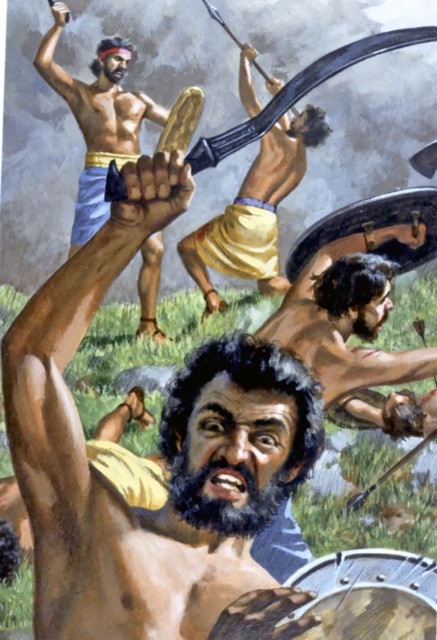
  • In the second battle for Ai in Joshua 8, the Israelites tricked the soldiers of Ai, pretending to run away. This drew the soldiers of Ai from the city. A second army of Israel rushed into the city and set it on fire. Then the city was defeated.

    In the second battle for Ai in Joshua 8, the Israelites tricked the soldiers of Ai, pretending to run away. This drew the soldiers of Ai from the city. A second army of Israel rushed into the city and set it on fire. Then the city was defeated.

    After seven days of marching with the Ark, a final blow of the trumpets and a shout by the people brings the walls of Jericho down (Joshua 6:1-21).

  • Achan’s sin (taking some of the “devoted things” for himself brings about death for about 3,000 in defeat at Ai (Joshua 7).
  • Renewed by the Lord, Joshua takes 30,000 and sets up an ambush that with the Lord’s aid, leads to the fall of Ai.  Joshua builds an altar to the Lord at Mount Ebal, and writes the law of Moses on stones.  With half of the nation, the Levitical priests, elders and all on either side of the Ark in front of Mount Ebal and Mount Gerizim, Joshua blesses them and reads every word of the law (Joshua 8).
/Bob’s boy
___________________
image © V. Gilbert & Arlisle F. Beers

Please note: I did not design the reading plan that I am following in my blog.  All of my comments in this blog, however, are solely my responsibility.  When reading ANY commentary, you should ALWAYS refer first to the scripture, which is God’s unchanging and unfailing word. Reading schedules, as well as a link to the site where you can get the reading plan that I’m currently following for yourself can be found on the “Bible Reading Schedules” page of my website at http://graceofourlord.com.  For questions and help, please see the “FAQ” and “Summaries” pages there.

Psalms 92 – How Great Are Your Works!

English: Palm Tree in Sundankottai,Tamilnadu,India

English: Palm Tree in Sundankottai,Tamilnadu,India (Photo credit: Wikipedia)

The superscription of this psalm proclaims it to be “a song for the Sabbath,” which indeed means it is most appropriate for praise and worship to the Lord.  It is a song which while praising the mighty works of the lord, acknowledges the pleasure and joy that worshiping him brings to the hearts of the righteous (verse 4).  The text rightly says that this is something that the fool (unbeliever) simply cannot understand (verse 6), and is to be pitied for it.

The horn in verse 10 is a symbol of power, stature and prosperity; and relates to the grace and generosity of the lord toward His servant.  The psalmist proclaims that the enemies of the Lord will perish, and notes that the righteous will “flourish like the palm tree and grow like a cedar in Lebanon.”  The significant statement on this (verse 23) is that they are”planted” in the house of the Lord (worship), but they flourish in the “courts of our God” (in His divine presence).

Read or listen to audio of ESV version of this selection from this link.

/Bob’s boy
___________________
some images © V. Gilbert & Arlisle F. Beers

Please note: I did not design the reading plan that I am following in my blog.  All of my comments in this blog, however, are solely my responsibility.  When reading ANY commentary, you should ALWAYS refer first to the scripture, which is God’s unchanging and unfailing word. Reading schedules, as well as a link to the site where you can get the reading plan that I’m currently following for yourself can be found on the “Bible Reading Schedules” page of my website at http://graceofourlord.com.  For questions and help, please see the “FAQ” and “Summaries” pages there.

Job 23 – Where Is God?

gavelIn spite of the harshness of Eliphaz’s last speech, Job chooses to ignore it. Perhaps he had grown weary of the effort.  That seems to be the case with Bildad and Zophar, as they have become silent.  Instead, Job returns to voicing his wish to lay his case out to God – so sure was he that he is innocent of grievous sin.  Note that Job does not consider himself to be without sin at all.  He simply is convicted that he is innocent enough that his judge (God) would acquit him of whatever sins are imagined against him.

But though he remains steadfast in his belief that he has not departed from the words of the Lord, his fear of God is fierce, and the last few lines are the most poetic of the chapter:

Therefore I am terrified at his presence;
when I consider, I am in dread of him.
God has made my heart faint;
the Almighty has terrified me;
yet I am not silenced because of the darkness,
nor because thick darkness covers my face.

Read or listen to audio of ESV version of this selection from this link.

/Bob’s boy
___________________
some images © V. Gilbert & Arlisle F. Beers

Please note: I did not design the reading plan that I am following in my blog.  All of my comments in this blog, however, are solely my responsibility.  When reading ANY commentary, you should ALWAYS refer first to the scripture, which is God’s unchanging and unfailing word. Reading schedules, as well as a link to the site where you can get the reading plan that I’m currently following for yourself can be found on the “Bible Reading Schedules” page of my website at http://graceofourlord.com.  For questions and help, please see the “FAQ” and “Summaries” pages there.

Psalms 123, 79 – Help us, O God!

These two psalms are community laments.  It is hard to judge which one sounds the most desperate.  Psalm 123 seems to be  written at a time when the shame of God’s people before others is at a height, which may indicate a time long into the period of captivity.  The pleas for mercy from God are mixed with the picture of a servant to to his master for comfort.

Temple domePsalm 79 has the air of having been written just following a great defeat of the magnitude of Jerusalem’s destruction before captivity.  There is still some incredulity at the wanton destruction and the defilement of house of the Lord, not to mention the bloody massacre of friends and family members.  The cries from God’s people are not just for mercy for the “sheep of His pasture,” but for vengeance:

“Let the avenging of the outpoured blood of your servants
be known among the nations before our eyes!
Let the groans of the prisoners come before you;
according to your great power, preserve those doomed to die!
Return sevenfold into the lap of our neighbors
the taunts with which they have taunted you, O Lord!”


Read or listen to audio of ESV version of this selection from this link.

/Bob’s boy
___________________
some images © V. Gilbert & Arlisle F. Beers

Please note: I did not design the reading plan that I am following in my blog.  All of my comments in this blog, however, are solely my responsibility.  When reading ANY commentary, you should ALWAYS refer first to the scripture, which is God’s unchanging and unfailing word. Reading schedules, as well as a link to the site where you can get the reading plan that I’m currently following for yourself can be found on the “Bible Reading Schedules” page of my website at http://graceofourlord.com.  

Proverbs 10:3 – Nourishment

“The LORD does not let the righteous go hungry, but he thwarts the craving of the wicked.”

Passover_feastAt first reading, this verse may seem to be about physical nourishment as in food.  But it seems clear that  it relates more correctly to the hunger for righteousness, as in the beatitude of Matthew 5:6 (“Blessed are those who hunger and thirst for righteousness, for they shall be satisfied”).  The Lord will fulfill that need for the righteous, just as he will not withhold wisdom from those who ask for it (James 1:5).  But as the text states, He will thwart the craving of the wicked.  This may not mean that evil never finds its way, but God will not give those who seek it any aid in doing so.

This translation, however, does not preclude the other interpretation stated above.  We should well remember Jesus’ words of comfort in  Matthew 6:25“Therefore I tell you, do not be anxious about your life, what you will eat or what you will drink, nor about your body, what you will put on. Is not life more than food, and the body more than clothing?”

Read or listen to audio of ESV version of this selection from this link.

/Bob’s boy
___________________
some images © V. Gilbert & Arlisle F. Beers

Please note: I did not design the reading plan that I am following in my blog.  All of my comments in this blog, however, are solely my responsibility.  When reading ANY commentary, you should ALWAYS refer first to the scripture, which is God’s unchanging and unfailing word. Reading schedules, as well as a link to the site where you can get the reading plan that I’m currently following for yourself can be found on the “Bible Reading Schedules” page of my website at http://graceofourlord.com.  For questions and help, please see the “FAQ” and “Summaries” pages there.