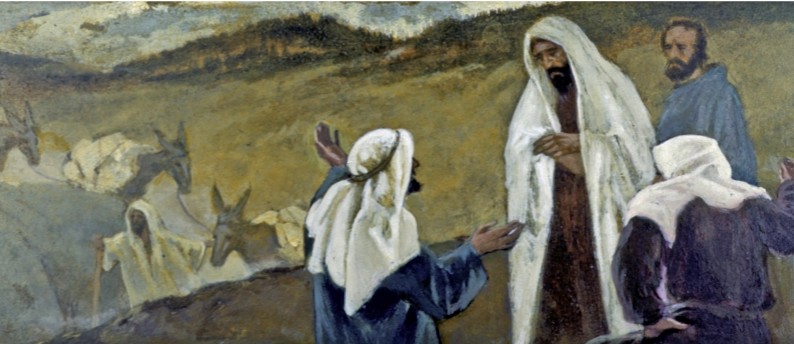
Psalm 140 – Deliver Me, O Lord, from Evil Men

When Absalom rebelled against his father David, and tried to kill his father to become king, Mephibosheth's servant Ziba brought gifts to David, fleeing for his life (2 Samuel 16:1--17:14).

When Absalom rebelled against his father David, and tried to kill his father to become king, Mephibosheth’s servant Ziba brought gifts to David, fleeing for his life (2 Samuel 16:1–17:14).

Psalm 140 is another short psalm of David, asking for the Lord’s deliverance from the wicked and the unjust. Also considered one of the imprecatory psalms, This song also expresses faith and confidence in the grace, mercy and justness of the Almighty.

I know that the Lord will maintain the cause of the afflicted,
and will execute justice for the needy.
Surely the righteous shall give thanks to your name;
the upright shall dwell in your presence.

The Lord, it says is the deliverer of those who are weak and oppressed and will not let those who continue to do such evil go unpunished. But the song also has the definite “feel” of having been written by David during the rebellion of Absalom (2 Samuel 15-18) – note verses 7-8 in particular.

Read or listen to audio of ESV version of this selection from this link.

/Bob’s boy
___________________
some images © V. Gilbert & Arlisle F. Beers

Please note: I did not design the reading plan that I am following in my blog.  All of my comments in this blog, however, are solely my responsibility.  When reading ANY commentary, you should ALWAYS refer first to the scripture, which is God’s unchanging and unfailing word. Reading schedules, as well as a link to the site where you can get the reading plan that I’m currently following for yourself can be found on the “Bible Reading Schedules” page of my website at http://graceofourlord.com.  

Major Prophets (part 4) – Ezekiel, the Captive’s Prophet

Engraved illustration of the "chariot vis...

Engraved illustration of the “chariot vision” of the Biblical book of Ezekiel, chapter 1, after an earlier illustration by Matthaeus (Matthäus) Merian (1593-1650), for his “Icones Biblicae” (a.k.a. “Iconum Biblicarum”). (Photo credit: Wikipedia)

Ezekiel was taken captive by the Babylonians in 597 B.C. and it was there that he was called to be a prophet of God to the other captives. It is uncertain what the “thirtieth year” (spoken of in the first verse) refers to. The best possibility we have heard is that it is the thirtieth year of his life. We learn in Numbers 4:46-49 that the span of a priest’s service is from the ages of thirty to fifty. Separated from the Temple by his captivity, Ezekiel would complete his entire priestly service there. His final vision (Ezekiel 40:1) is dated the 25th year of the exile, which would coincide with the timeline, making him fifty years old.

The first 24 chapters are of his preaching before the fall of Jerusalem. Chapters 25-32 are prophecies of how foreign nations must fall as well. Chapters 33-48 are his preaching and prophecies after the fall of Jerusalem. There were false prophets that were telling the people that the captivity would not last long, and that Jerusalem itself would stand. So the first 24 chapters are Ezekiel’s prophecies that such was not the case at all. Ezekiel continually preached for the full repentance of all, so that there would be some benefit to the years of captivity to come. But his message was not often well received.

Vision of Ezekiel

Vision of Ezekiel (Photo credit: Wikipedia)

The opening vision in chapters 1-3 describes the awesome picture of the coming of the glory of God (Ezekiel 1:1-28), and his call to prophecy which features the swallowing of the scroll that God gives to him (Ezekiel 3:1-3). This signifies God’s word permeating entirely through him, so that he would speak the will of God. But just as the Lord tells him, they will not listen to his message (Ezekiel 3:4-7).  The destruction that he prophecies to the people concerning Jerusalem is often as symbolic as his visions (see chapter 5 for example), but nonetheless graphic. In Ezekiel 3:16-27, God cast him in his role as “the watchman.”

As much of it is apocalyptic literature, some of Ezekiel’s prophecies in this book can be difficult to understand. As such, they are often misinterpreted and misused – like much of the Book of Daniel and the Book of Revelation. When reading, one should not lose sight of the intended audience – the captives in Babylon and those remaining free back in Judah. Context, as always, means everything. Though apocalyptic literature would become more popular in later times, there have been some who believe that Ezekiel’s writings made a significant contribution to the formation of such a genre.

Other highlights include the parable of the eagles and the vine (Ezekiel 17), the parable of the swords (Ezekiel 21), the vision of dry bones (Ezekiel 37:1-14), Gog and Magog (Ezekiel 38-39), the vision of the new temple (Ezekiel 40-42), and the flowing river (Ezekiel 46:17-47:12),

For some great reading on the stunning accuracy of Ezekiel’s prophecy of the fate of Tyre in chapter 26, see this article at Apologetics Press.

/Bob’s boy
___________________
image © V. Gilbert & Arlisle F. Beers

Please note: I did not design the reading plan that I am following in my blog.  All of my comments in this blog, however, are solely my responsibility.  When reading ANY commentary, you should ALWAYS refer first to the scripture, which is God’s unchanging and unfailing word. Reading schedules, as well as a link to the site where you can get the reading plan that I’m currently following for yourself can be found on the “Bible Reading Schedules” page of my website at http://graceofourlord.com.  

Psalm 132 – If Your Sons Keep My Covenant

David dances in the presence of the ark.

David dances in the presence of the ark. (Photo credit: Wikipedia)


This is psalm number 13 of the 15 “Songs of Ascents” (see this previous post for more information). Some have classified this as a post-exillic psalm, but that really does not appear to be the case. If one looks carefully at verses 8-10, it is evident that it was written at a time when the Ark of the Covenant was still in the possession of God’s people:


Arise, O Lord, and go to your resting place,
you and the ark of your might.
Let your priests be clothed with righteousness,
and let your saints shout for joy.
For the sake of your servant David,
do not turn away the face of your anointed one


Also, those verses are quoted at the dedication of Solomon’s temple in 2 Chronicles 6:41. Or perhaps, the passage here is a quotation of that scripture. Either way, the ark seems not to have been missing at the time. In verse 6, Ephrathah, is a district with villages called Bethlehem and Jaar – or Kiriath-jearim, where the ark had been left for a time before coming to Jerusalem (1 Samuel 7:1-2).


The song’s lyrics build the pilgrims’ excitement as they journey to Jerusalem for the Passover and other feasts; and gives them pause for remembering the promise of the Lord to have one of David’s line on the throne forever. this was a conditional promise, though, as they were reminded by the psalm itself in verse 12: “If your sons keep my covenant and my testimonies that I shall teach them, their sons also forever shall sit on your throne.”


Read or listen to audio of ESV version of this selection from this link.


/Bob’s boy


___________________


some images © V. Gilbert & Arlisle F. Beers


Please note: I did not design the reading plan that I am following in my blog.  All of my comments in this blog, however, are solely my responsibility.  When reading ANY commentary, you should ALWAYS refer first to the scripture, which is God’s unchanging and unfailing word. Reading schedules, as well as a link to the site where you can get the reading plan that I’m currently following for yourself can be found on the “Bible Reading Schedules” page of my website at http://graceofourlord.com.  


Job 33 – Elihu Rebukes Job

Elihu, the newest addition to the gathering around Job, finally gets into his speech in this chapter and offers up a slightly different point of view from that of Job’s three friends. He tells Job that in spite of his protests of innocence, he is indeed guilty, and that he needs to own up to it and accept God’s punishments for the corrective measures that Elihu claims them to be.


The Wrath of Elihu, from the Butts set. Pen an...

The Wrath of Elihu, from the Butts set. Pen and black ink, gray wash, and watercolour, over traces of graphite (Photo credit: Wikipedia)


Although Job had never claimed to be completely without sin at all, Elihu makes it sound as if he had, and he rebukes Job sternly for his denial. He launches into a long and involved description of the physical punishments that God brings upon people for their sins, explaining that God is to be praised for doing so because by those actions, he is attempting to bring man “back from the pit.” Of course, Elihu gives no explanation of what the authority is by which he has come to know these things – probably because there is none?


All in all, Elihu says nothing in this chapter to improve the assessment that we made of him in the previous chapter. Still, he continues to make such authority claims even in the last verse: “…listen to me; be silent, and I will teach you wisdom.”


Read or listen to audio of ESV version of this selection from this link.


/Bob’s boy


___________________


some images © V. Gilbert & Arlisle F. Beers


Please note: I did not design the reading plan that I am following in my blog.  All of my comments in this blog, however, are solely my responsibility.  When reading ANY commentary, you should ALWAYS refer first to the scripture, which is God’s unchanging and unfailing word. Reading schedules, as well as a link to the site where you can get the reading plan that I’m currently following for yourself can be found on the “Bible Reading Schedules” page of my website at http://graceofourlord.com.  For questions and help, please see the “FAQ” and “Summaries” pages there.


Psalm 108 – With God We Shall Do Valiantly

With few variances, most of Psalm 108 can be found in two other psalms. The first 5 verses are practically identical to Psalm 57:7-11. The last eight verses are almost identical to Psalm 60:5-12. So why the combination here repeated? As always, whenever God’s word contains passages that are repeated from another passage, it is a sure sign that they are very important.

David hid in one of the many caves near Adullam, a city 13 miles southwest of Bethlehem (1 Samuel 22: 1-12). David was in this area when three of his mighty men risked their lives to get him a drink of water from Bethlehem (2 Samuel 23: 13-17).

David hid in one of the many caves near Adullam, a city 13 miles southwest of Bethlehem (1 Samuel 22: 1-12). David was in this area when three of his mighty men risked their lives to get him a drink of water from Bethlehem (2 Samuel 23: 13-17).

The first five verses come from a psalm that we are fairly certain refers to David’s time when he had fled to a cave to escape from Saul’s murderous intentions. The coinciding verses are of praise to God for His love and faithfulness, written from the context of David’s thankfulness for being delivered. The last eight verses come from a psalm that appears to have been written on the heels of a great military defeat, in which the psalmist is entreating the Lord to again show His favor to His people.

The two parts were likely put together as a combination for a liturgical purpose during a time of great distress and unease concerning the future. Together, they remind God’s people of His matchless mercy and the care for which He regards His people. They make an outstanding unified plea for God’s help in the fight against “the foe” (Satan). But most importantly, it reminds us first that we cannot fight this enemy alone, and secondly, that we do not have to fight alone, for God is with us.

for vain is the salvation of man!
With God we shall do valiantly;
it is he who will tread down our foes

Read or listen to audio of ESV version of this selection from this link.

/Bob’s boy
___________________
some images © V. Gilbert & Arlisle F. Beers

Please note: I did not design the reading plan that I am following in my blog.  All of my comments in this blog, however, are solely my responsibility.  When reading ANY commentary, you should ALWAYS refer first to the scripture, which is God’s unchanging and unfailing word. Reading schedules, as well as a link to the site where you can get the reading plan that I’m currently following for yourself can be found on the “Bible Reading Schedules” page of my website at http://graceofourlord.com.  

Proverbs 20 – The Lamp of the Lord

Creation07Some of the most obvious external evidences to “see” that God exists are the manifestations of the fact that God created man in His own image. The non-believer who truly believes that man is just chemicals and cells that have magically evolved over time into the intricate and intelligent human beings that we are will never be able to adequately explain these things. But we get the answers over and over again from the Bible; and verse 27 is another such example:

The spirit of man is the lamp of the Lord,
searching all his innermost parts

The unbeliever cannot account for the concepts of good and evil, right and wrong, beauty, love, or even how we have a conscience. The knowledge of such things are because of the reflection of our Creator; and along with our eternal souls, they are His gifts to us.

Read or listen to audio of ESV version of this selection from this link.

/Bob’s boy
___________________
some images © V. Gilbert & Arlisle F. Beers

Please note: I did not design the reading plan that I am following in my blog.  All of my comments in this blog, however, are solely my responsibility.  When reading ANY commentary, you should ALWAYS refer first to the scripture, which is God’s unchanging and unfailing word. Reading schedules, as well as a link to the site where you can get the reading plan that I’m currently following for yourself can be found on the “Bible Reading Schedules” page of my website at http://graceofourlord.com.  For questions and help, please see the “FAQ” and “Summaries” pages there.

Psalm 133, 134 – Come Bless The Lord

Mount Hermon is one traditional site for Jesus' transfiguration.

Mount Hermon is one traditional site for Jesus’ transfiguration.

These two short psalms are the final two of the “Songs of Ascents” (see this previous post for more information). Psalm 133 declares the beauty that comes when brothers dwell in unity, comparing it to the things that Israelites of the day would most have valued.  Pilgrimages to the feasts culminating in a unified purpose of presence for God’s people in Jerusalem provided a harmonious sense of brotherhood – at least for a time..

It is like the dew of Hermon,
which falls on the mountains of Zion!
For there the Lord has commanded the blessing,
life forevermore.

Psalm 134 concludes the psalms of Ascents for the Pilgrims that have arrived, calling for them to bless The Lord and praise Him and the Holy Place they have come to.

Lift up your hands to the holy place
and bless the Lord!
May the Lord bless you from Zion,
he who made heaven and earth!

Read or listen to audio of ESV version of this selection from this link.

/Bob’s boy
___________________
some images © V. Gilbert & Arlisle F. Beers

Please note: I did not design the reading plan that I am following in my blog.  All of my comments in this blog, however, are solely my responsibility.  When reading ANY commentary, you should ALWAYS refer first to the scripture, which is God’s unchanging and unfailing word. Reading schedules, as well as a link to the site where you can get the reading plan that I’m currently following for yourself can be found on the “Bible Reading Schedules” page of my website at http://graceofourlord.com.  

Major Prophets (part 3) Book of Jeremiah

Prophet Jeremiah, Russian icon from first quar...

Prophet Jeremiah, Russian icon from first quarter of 18th cen. (Photo credit: Wikipedia)

The Book of Jeremiah is one of the books of the “major prophets,” which are so called not because they are more important than those that we know as the “minor prophets,” but because of their length. There are 5 books of major prophets (Isaiah, Jeremiah, Lamentations, Ezekiel, and Daniel) compared to twelve of minor prophets. Jeremiah is 52 chapters in length.

Jeremiah was a preacher of God’s word – a priest. He was called to be a prophet about 627 B.C. as a youth (Jeremiah 1:6), and served as such for 40 years (Jeremiah 1:2-3), making it likely that he was born ~650-645 B.C. He became a priest living in Anathoth – the land of Benjamin (Jeremiah 1:1). This was where Abiathar, the high priest during David’s reign, lived. But Jeremiah’s ancestral heritage is unknown. Abiathar was removed as priest by Solomon for his part in support of Adonijah (1 Kings 2:12-27), which fulfilled the Lord’s prophecy of the end of the house of Eli as priests way back in 1 Samuel 2:27-36.

Jeremiah is referred to by many as “the weeping prophet” (see this previous post on Lamentations). But this tends to convey a mistaken image of him as weak. Jeremiah was anything but weak. He lived a very difficult life, and was imprisoned, nearly put to death (Jeremiah 26), and even banned from the Temple for preaching the truth as God told Him (Jeremiah 36:5).

At least part of the Book of Jeremiah was dictated to his scribe, Baruch, to write on scroll (Jeremiah 36:1-4). Some scholars have referred to the book by such descriptions as a “scrapbook” or diary that was pieced together by topic or content. The book is not in chronological order, and remembering that as one reads it helps put things in context. For that reason, we have included an approximate chronological order for the book at the end of this blog.

English: "Jeremiah Dictating His Prophecy...

English: “Jeremiah Dictating His Prophecy of the Destruction of Jerusalem to Baruch the Scribe,” oil on canvas, by the American artist Washington Allston. 89 3/8 in. x 74 3/4 in. Yale University Art Gallery, gift of Samuel Finley Breese Morse, B.A. 1810. Courtesy of Yale University, New Haven, Conn. (Photo credit: Wikipedia)

The book is set in the time after the fall of the Assyrians and the rise of the Babylonians to power. Jeremiah witnessed the capture and removal of multiple groups of the people of Judah to Babylon, as well as the destruction of Jerusalem and the Temple. He was called to speak to God’s people during the times of revival under king Josiah, and continued on past the final fall to Babylon.

Summary of Jeremiah

Approximate Chronolgical Order

  • During the reign of Josiah
    • In the 13th year – Chapter 1
    • Later years of Josiah’s reign – Chapters 2-6 and probably a great deal of chapters 7-20
  • During the reign of Jehoiakim
    • Early in his reign – Chapter 26 and probably 7:1-8:3; 22:1-23
    • During the 4th year Chapters 25; 36; 45; 46:1-12
    • After the 4th year – Chapter 35
  • During the reign of Jehoiachin
    • Chapters 22:24-30 and probably ch. 14
  • During the reign of Zedekiah
    • At beginning – Chapters 24 and 49:34-39
    • In the fourth year – Chapters 27-28; 51:59-64
    • In other years – Chapters 21 and 29
    • In early seige, pause, and resumption of seige – Chapters 34, 37, 32; 33; 38; 39:15-18
  • In Judah after Jerusalem’s fall – Chapters 39:1-4; 40:1-43:7
  • In Egypt, after Jeremiah taken there – Chapters 43:8-44:30
/Bob’s boy
___________________
image © V. Gilbert & Arlisle F. Beers

All of my comments in this blog are solely my responsibility.  When reading ANY commentary, you should ALWAYS refer first to the scripture, which is God’s unchanging and unfailing word. Reading schedules, as well as a link to the site where you can get the reading plan that I’m currently following for yourself can be found on the “Bible Reading Schedules” page of my website at http://graceofourlord.com.  

Psalm 118 – His Steadfast Love Endures Forever

Mount Zion was the center of Christian worship from the earliest days of the Church. According to tradition, the events of Pentecost took place on this hill. Later it became the headquarters of the apostles and site of the Church of the Dormition, that dominates the hill.

Mount Zion was the center of Christian worship from the earliest days of the Church. According to tradition, the events of Pentecost took place on this hill. Later it became the headquarters of the apostles and site of the Church of the Dormition, that dominates the hill.

This psalm has so many aspects that it was difficult to choose a title for this particular blog. But in the end, repetition won out, at least to some degree (the words are repeated several times, including in the last verse). And God’s enduring steadfast love certainly does apply to all aspects of the song. It is a song indeed, and some of our hymns have been taken from words within Psalm 118, one of which is the simple, but beautiful “This is the day that The Lord hath made” taken from verse 24.

It is a song almost certainly written by David, and many scholars believe it was written on the occasion of the defeat of Saul, when David had been established as king. That certainly fits well, but there is nothing in the superscription or elsewhere to substantiate that.

One of the most important verses of the psalm is arguably verse 22, which is quoted many places in the New Testament, including Mark 12:10-11 and Luke 20:17: “The stone that the builders rejected has become the cornerstone. This is the Lord’s doing; it is marvelous in our eyes. This refers, of course, to Jesus, and how he was rejected, but has become the cornerstone of His church and the kingdom.

Read or listen to audio of ESV version of this selection from this link.

/Bob’s boy
___________________
some images © V. Gilbert & Arlisle F. Beers

Please note: I did not design the reading plan that I am following in my blog.  All of my comments in this blog, however, are solely my responsibility.  When reading ANY commentary, you should ALWAYS refer first to the scripture, which is God’s unchanging and unfailing word. Reading schedules, as well as a link to the site where you can get the reading plan that I’m currently following for yourself can be found on the “Bible Reading Schedules” page of my website at http://graceofourlord.com.  

Job 32 – Elihu Rebukes Job’s Three Friends

The Wrath of Elihu, from the Butts set. Pen an...

The Wrath of Elihu, from the Butts set. Pen and black ink, gray wash, and watercolour, over traces of graphite (Photo credit: Wikipedia)

In Chapter 32, we are introduced to a new character – Elihu. We are not told exactly when he joined the company of job and his three friends, but he has apparently been listening for some time. So far, this one has not said anything because he is younger in age than all of the others present, including Job. So out of respect for them, and in anticipation of hearing some wisdom, he has remained silent.

Elihu does not say much in this chapter, but he has more to say in the coming chapters. Mostly, he is angry with Job for being “wise in his own eyes,” and angry at the three because they have nothing wise to say to refute him. One writer said of Elihu’s entire speeches that it was nothing but a lot of “rigamarole.” Apparently, the Lord did not have much higher of an opinion, as we shall see in later chapters that He says “Who is this that darkeneth counsel by words without knowledge?”

Read or listen to audio of ESV version of this selection from this link.

/Bob’s boy
___________________
some images © V. Gilbert & Arlisle F. Beers

Please note: I did not design the reading plan that I am following in my blog.  All of my comments in this blog, however, are solely my responsibility.  When reading ANY commentary, you should ALWAYS refer first to the scripture, which is God’s unchanging and unfailing word. Reading schedules, as well as a link to the site where you can get the reading plan that I’m currently following for yourself can be found on the “Bible Reading Schedules” page of my website at http://graceofourlord.com.  For questions and help, please see the “FAQ” and “Summaries” pages there.