Psalm 66 – How Awesome Are Your Deeds!

Psalmist David by Gustave Doré

Psalmist David by Gustave Doré (Photo credit: Wikipedia)


This song is one of great praise to the Lord and acknowledgment of the deeds He has done for His people and for the psalmist in particular. The 15 psalms that precede it have been ascribed to David. In this case, we have nothing that tells us one way or the other. The first 12 verses speak in the first person plural about all of the ways that God has tested them and then brought them into abundance (verses 10-12).


The psalmist switches to 1st person singular in verse 13. This is simply the progression into what the psalmist intends to do personally to show his gratitude for what God has done for all of His people and for him in particular.  While declaring how God has answered his prayers (verses 19-20), the psalm calls for all people to “sing the glory of his name.”


Read or listen to audio of ESV version of this selection from this link.


/Bob’s boy


___________________


some images © V. Gilbert & Arlisle F. Beers


Please note: I did not design the reading plan that I am following in my blog.  All of my comments in this blog, however, are solely my responsibility.  When reading ANY commentary, you should ALWAYS refer first to the scripture, which is God’s unchanging and unfailing word. Reading schedules, as well as a link to the site where you can get the reading plan that I’m currently following for yourself can be found on the “Bible Reading Schedules” page of my website at http://graceofourlord.com.  


Prayers of Habakkuk

Habakkuk the prophet, Russian icon from first ...

Habakkuk the prophet, Russian icon from first quarter of 18th cen. (Photo credit: Wikipedia)

Not much is known about the prophet, Habakkuk. With most of the prophets, we are given at least some minor biographical information, but we are not even told where he came from. Many scholars, however, have somehow deduced that he was from Jerusalem. And the fact that the third chapter is in fact a song – a psalm, suggests quite reasonably to some that he was from the tribe of Levi. Habakkuk 3:1 reads “a prayer of Habakkuk the prophet, according to Shigionoth.” Shigionth is a reference to a type of music that is sung in times of victory.

The date of the book can only be surmised in approximation. In Habakkuk 1:6, the Lord tells Habakkuk that He is raising up the Chaldeans. The Chaldean rise to power was about 612 B.C., with their first invasion of Judah occurring in 605 B.C.  A date shortly before that is reasonable. This would place this prophet as a contemporary of Zephaniah, and possibly Daniel. Likely, the time was during the reign of Josiah (640 – 609 B.C.) or just after his death. There are some non-inspired writings with Habakkuk in them, but the more interesting one is not considered historically accurate.

Although clearly written for their benefit, Habakkuk does not address the people of Judah. The first two chapters consist of Habakkuk’s prayers (and protestations) to God, as well as God’s responses. Habakkuk is taken aback that God would send those who were even more wicked than the people of Judah to exact His punishment on them. This does not seem to him to be the actions of a just God. God assures him that He has every intention of punishing the evil nations involved – but in His own time. By the end of the book, Habakkuk is resigned to the fate, but more importantly,  he realizes that his faith in God means that he must trust Him to take care of justice.

These words were evidently a comfort to the faithful after the captivity, as they struggled to understand. The key verse is Habakkuk 2:4, which says “but the righteous will live by his faith.” That is the lesson of Habakkuk. As His children, we must trust in God to deal with the evil of this world in His time.

/Bob’s boy
___________________
image © V. Gilbert & Arlisle F. Beers

Please note: I did not design the reading plan that I am following in my blog.  All of my comments in this blog, however, are solely my responsibility.  When reading ANY commentary, you should ALWAYS refer first to the scripture, which is God’s unchanging and unfailing word. Reading schedules, as well as a link to the site where you can get the reading plan that I’m currently following for yourself can be found on the “Bible Reading Schedules” page of my website at http://graceofourlord.com.  

Psalm 78:50-72 – With His Skillful Hand

The final section of this historical psalm begins with the re-telling of the final plagues against Egypt (Exodus 12) and God’s deliverance of the Israelites to the Promised Land, where He “drove out the nations” and settled His people in (verse 55 ). The text then turns attention back to their idolatry – always the problem in Israel’s history. In verses 60-62, the phrases “He forsook his dwelling at Shiloh” and “delivered his power to captivity, his glory to the hand of the foe” refer to when the Philistines captured the Ark in 1 Samuel 4.

The lion is the symbol of the Tribe of Judah. ...

The lion is the symbol of the Tribe of Judah. It is often represented in Jewish art, such as this sculpture outside a synagogue (Photo credit: Wikipedia)

The psalm continues, showing once again the Lord’s love for His people, as He delivers them from their enemies in spite of their unfaithfulness to Him. Verses 67-72 then conclude the psalm, noting that God’s ultimate remedy for His people was to choose a shepherd from the tribe of Judah (David, leading of course to Jesus Christ, also from Judah) to shepherd them.  Verse 72 concludes: “With upright heart he shepherded them and guided them with his skillful hand.”

The purpose of the psalm, stated in the first eight verses, was to commit to a song to be remembered the works of God, so that they would be passed on in the generations to come. The words “remember” and “not forget” ring throughout the psalm constantly in order to try to save the future generations from the foolish mistakes of their fathers.

Read or listen to audio of ESV version of this selection from this link.

/Bob’s boy
___________________
some images © V. Gilbert & Arlisle F. Beers

Please note: I did not design the reading plan that I am following in my blog.  All of my comments in this blog, however, are solely my responsibility.  When reading ANY commentary, you should ALWAYS refer first to the scripture, which is God’s unchanging and unfailing word. Reading schedules, as well as a link to the site where you can get the reading plan that I’m currently following for yourself can be found on the “Bible Reading Schedules” page of my website at http://graceofourlord.com.  
Job 39:16-30 – Do You Give the Horse His Might?

This blog concludes the 39th chapter of the Book of Job with God at first speaking more about the ostrich. The bird’s carelessness and even indifference with its young do seem truly unique. The wild ostrich has been known to destroy its nests of eggs that it scatters about in the event that they are discovered by other creatures. He then speaks to her swiftness, which makes us marvel at this flightless bird that, when chased by a horse and rider, can make leaps of nearly 5 meters at a time, reaching speeds of more than 40 miles per hour.

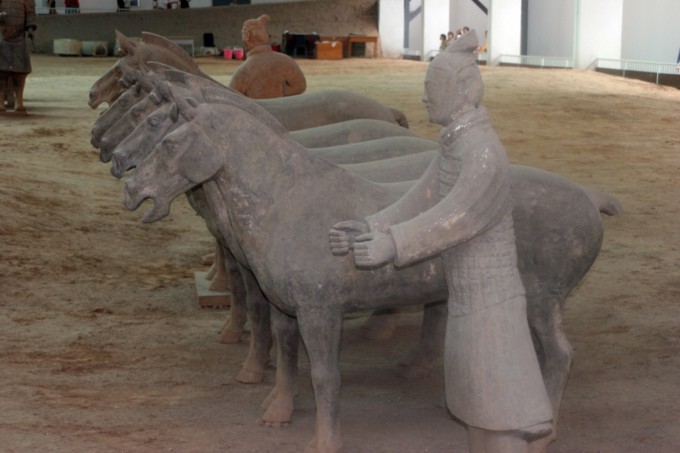
Terracota warriors and horses, Xian, China. These warriors guarded the tomb of Qin Shi Huangdi, a despotic ruler of China about 2,200 years ago. There are 7,000 figures, each originally covered with colorful paint. The ruler forced 70,000 people to work 36 years to build these warriors and the tomb. Archaeological excavations began in 1974 when the site was discovered by a farmer digging a well.

Terracota warriors and horses, Xian, China. These warriors guarded the tomb of Qin Shi Huangdi, a despotic ruler of China about 2,200 years ago. There are 7,000 figures, each originally covered with colorful paint. The ruler forced 70,000 people to work 36 years to build these warriors and the tomb. Archaeological excavations began in 1974 when the site was discovered by a farmer digging a well.

In verses 19-25, God turns to the horse with his fearless nature and awesome power. This marvelous creature was used in war for centuries, fearlessly carrying its warrior to battle straight into the path of the enemy’s weapons. He then turns to the hawk and the eagle. These majestic birds make their homes high upon the rocks of the mountains, spying out their prey, and “where the slain are, there is he.”

These last two chapters show us just a small inkling of His dominion over creation and all living things, each and every one created by God, who is always aware of all that they are and do. The world is a huge, populous, and complicated mechanism filled with individual wonders of all kinds, but none of it is too great for Him too maintain.

Read or listen to audio of ESV version of this selection from this link.

/Bob’s boy
___________________
some images © V. Gilbert & Arlisle F. Beers

Please note: I did not design the reading plan that I am following in my blog.  All of my comments in this blog, however, are solely my responsibility.  When reading ANY commentary, you should ALWAYS refer first to the scripture, which is God’s unchanging and unfailing word. Reading schedules, as well as a link to the site where you can get the reading plan that I’m currently following for yourself can be found on the “Bible Reading Schedules” page of my website at http://graceofourlord.com.  For questions and help, please see the “FAQ” and “Summaries” pages there.

Psalm 106:24-48 – Glory In Your Praise

We pick up the second half of this historical psalm in verse 24, as the psalmist is recounting the history and the sins of the people of Israel. Verses 24-27 continue telling of the failings of the people in the desert as the Lord declares they will wander in the desert forty years, and fall there (Numbers 14:28-35).

Verses 28-31 continue with the great sin of the people in the Baal worship at Peor, and recount how Phinehas intervened and saved them from the plague that ensued (Numbers 25). This led to his family having the priesthood from generation to generation. Verse 32 continues with the story of the waters at Meribah and the sin of Moses there when he struck the rock (Numbers 20).

Jews Led Into Captivity

Jews Led Into Captivity

Verses 34-39 summarize how the people of Israel failed to drive all the Canaanites from their land, and ended up mixing with these nations. This led to their idol worship, just as had been predicted, even sinking to child sacrifice.  Verse 39 says that they “became unclean” and “played the whore in their deeds.”

Verses 40-46 then summarize the punishment of captivity that the judgment of the Lord brought to them. Verses 44-46 show God remembering his promise to Solomon when he heard their cry, and causing them to be pitied by their captors. The historical psalm has turned into a lament now, and the concluding verse indicates that their restoration is not yet realized – which is the plea of this psalm:

Save us, O Lord our God,
and gather us from among the nations,
that we may give thanks to your holy name
and glory in your praise.

Read or listen to audio of ESV version of this selection from this link.

/Bob’s boy
___________________
some images © V. Gilbert & Arlisle F. Beers

Please note: I did not design the reading plan that I am following in my blog.  All of my comments in this blog, however, are solely my responsibility.  When reading ANY commentary, you should ALWAYS refer first to the scripture, which is God’s unchanging and unfailing word. Reading schedules, as well as a link to the site where you can get the reading plan that I’m currently following for yourself can be found on the “Bible Reading Schedules” page of my website at http://graceofourlord.com.  

Proverbs 28 – Blessed “Fear”

Proverbs 28:14:

Blessed is the one who fears the Lord always,
but whoever hardens his heart will fall into calamity

Even when they were old men, Joshua and Caleb remained faithful to the Lord as warriors and leaders of God's people. Here Caleb asks Joshua for the area of Hebron, where he can settle with his family (Joshua 14:6-15).

Even when they were old men, Joshua and Caleb remained faithful to the Lord as warriors and leaders of God’s people. Here Caleb asks Joshua for the area of Hebron, where he can settle with his family (Joshua 14:6-15).

Those who fear the Lord are often blessed with earthly gain as well at various times in their lives, but that is not the real lesson here. Those who live their lives in the light of God’s word, worshiping and reverently serving Him, know a happiness and peace that the unbeliever simply cannot understand. But those who harden their hearts against the Lord will ultimately fall into great peril. This is certainly true of the day of judgment, but given time in this life, such will often catch up with them in the way of earthly troubles as well. We see it in the news quite often. It just sometimes takes longer for some than others.

The Book of proverbs is full of verses that speak about integrity. Solomon obviously placed a high value on it, and rightly so, as it is probably the most visible by-product of the Christian life when that commitment is adhered to. Chapter 28 is no exception, as it deals with character in several verses. Verse 18, for example:

Whoever walks in integrity will be delivered,
but he who is crooked in his ways will suddenly fall

Our integrity is one of the few very precious things we possess that many people are all too willing to give away. Yet those who manage to keep theirs intact will never regret doing so. But those who have sold it will, without exception, one day pay a dear price themselves for having done so.

Read or listen to audio of ESV version of this selection from this link.

/Bob’s boy
___________________
some images © V. Gilbert & Arlisle F. Beers

Please note: I did not design the reading plan that I am following in my blog.  All of my comments in this blog, however, are solely my responsibility.  When reading ANY commentary, you should ALWAYS refer first to the scripture, which is God’s unchanging and unfailing word. Reading schedules, as well as a link to the site where you can get the reading plan that I’m currently following for yourself can be found on the “Bible Reading Schedules” page of my website at http://graceofourlord.com.  For questions and help, please see the “FAQ” and “Summaries” pages there.

Psalm 142 – You Are My Refuge

Caves such as this are common throughout Israel.

Caves such as this are common throughout Israel.

This psalm’s superscription is one of several that refer to a psalm as a maskil of David. The word maskil comes from a term meaning “enlighten” or “enlightened one.” They are poems written as songs for the purpose of instruction – in the case of the psalms, that means instruction about the Lord and of serving Him.  It also says that it was written at or about the time that David was “in the cave.” Presumably, this would refer to an instance when he was being pursued by Saul.

This lament psalm is certainly instructive for us today for prayer, especially in times of great distress, grief and/or anxiety and fear. When the world has become too much for us, these seven verses are a powerful source for putting into words the supplications and feelings of distress that we so desperately need to bring to the Almighty in prayer. It is a personal favorite for me; and part of the Psalm is included below.

With my voice I cry out to the Lord;
with my voice I plead for mercy to the Lord.
I pour out my complaint before him;
I tell my trouble before him.
When my spirit faints within me,
you know my way!

I cry to you, O Lord;
I say, “You are my refuge,
my portion in the land of the living.”
Attend to my cry,
for I am brought very low!

Deliver me from my persecutors,
for they are too strong for me!
Bring me out of prison,
that I may give thanks to your name!
The righteous will surround me,
for you will deal bountifully with me

Read or listen to audio of ESV version of this selection from this link.

/Bob’s boy
___________________
some images © V. Gilbert & Arlisle F. Beers

Please note: I did not design the reading plan that I am following in my blog.  All of my comments in this blog, however, are solely my responsibility.  When reading ANY commentary, you should ALWAYS refer first to the scripture, which is God’s unchanging and unfailing word. Reading schedules, as well as a link to the site where you can get the reading plan that I’m currently following for yourself can be found on the “Bible Reading Schedules” page of my website at http://graceofourlord.com.  

Reversal of Fortunes – Nahum and Nineveh

If the Book of Jonah (see previous blog post) were a photograph, Nahum would be the negative. In what was likely the first half of the eighth century B.C., Jonah reluctantly ventured to Nineveh to warn them of the coming judgment of God for their wickedness. To Jonah’s complete dismay, Nineveh repented and God spared them.

As Sennacherib beautified his capital city, Nineveh, Hezekiah withheld tribute and prepared for battle. The Assyrians advanced toward their rebellious western border, attacking swiftly down the Mediterranean coast. From Lachish, Sennacherib threatened to take Jerusalem, but Isaiah knew his threats would die with him on his return to Nineveh. This map shows the route of Assyrian conquest which started in Nineveh. God promised his people that Nineveh would not escape judgment.

As Sennacherib beautified his capital city, Nineveh, Hezekiah withheld tribute and prepared for battle. The Assyrians advanced toward their rebellious western border, attacking swiftly down the Mediterranean coast. From Lachish, Sennacherib threatened to take Jerusalem, but Isaiah knew his threats would die with him on his return to Nineveh. This map shows the route of Assyrian conquest which started in Nineveh. God promised his people that Nineveh would not escape judgment.

But that repentance did not last long. By 745 B.C. Tiglath-pileser III had made Assyria the most powerful in force in that part of the world., establishing their dominance with torture, massacres, and exiles on a horrific scale. The real estate of the Assyrians was greatly expanded by making vassal kingdoms of other countries (such as the northern kingdom of Israel and the southern kingdom of Judah) until Assyria “terminated” the Northern Kingdom in 722 B.C. Under Sennacherib’s reign (704 – 681 B.C.) Nineveh became the capital of Assyria.

More than a hundred years after Jonah, God sent Nahum to again announce judgment on Nineveh and the fall of Assyria itself. This time, there would be no repentance, and Nahum does not appear to have been reluctant in the least. Nahum 3:8-10 speaks of the destruction of Thebes (an ancient Egyptian city also called No-Amon in this book) in the past tense. We know that it fell to Assyria about 663 B.C. Assyria was conquered by the Medes and Babylonians in 612 B.C., making this book written between 663 and 612 B.C.

During this 50 year period, Assyria’s holdings and power were already in decline. Nahum’s first chapter reads like a prelude to battle, while the second and third chapters move into the real thing, with imagery that strongly suggests that the author saw much with his own eyes. True to the prophecy, Nineveh was destroyed, never to be rebuilt. The ruins lay close to the modern Iraqi city of Mosul.

/Bob’s boy
___________________
image © V. Gilbert & Arlisle F. Beers

Please note: I did not design the reading plan that I am following in my blog.  All of my comments in this blog, however, are solely my responsibility.  When reading ANY commentary, you should ALWAYS refer first to the scripture, which is God’s unchanging and unfailing word. Reading schedules, as well as a link to the site where you can get the reading plan that I’m currently following for yourself can be found on the “Bible Reading Schedules” page of my website at http://graceofourlord.com.  

Psalm 78:25-49 – The Bread of Angels

When the people begged for meat, God sent clouds of quail, but with it he sent a plague (Numbers 11:31-35).

When the people begged for meat, God sent clouds of quail, but with it he sent a plague (Numbers 11:31-35).

Today we take verses 25-49 of this historical psalm, which begins with a lovely poetic section on the way the Lord fed His people in the desert, despite their constant complaints. The first part of this is about the manna, which the scripture calls “the bread of angels.” Then it moves on to when the Lord caused the wind to rain down the quail for meat for them to eat (Numbers 11:31-32):

Man ate of the bread of the angels;
He sent them food in abundance.

He caused the east wind to blow in the heavens,
and by his power he led out the south wind;
He rained meat on them like dust,
winged birds like the sand of the seas;

Verses 31-40 re-tell the story of how even after this, the people grumbled against God. His angered kindled again, He sent a plague, and as it ravaged them they began to repent, and flattered Him with their mouths. But they lied with their tongues (verse 36). Still, He was compassionate to them, though they tested Him time and again in the desert (verses 40-41). But as verses 42-49 complete this section, they forgot all that He had done with His power in the signs with which He had dealt with the Egyptians before they were freed (Exodus 7-12).

Read or listen to audio of ESV version of this selection from this link.

/Bob’s boy
___________________
some images © V. Gilbert & Arlisle F. Beers

Please note: I did not design the reading plan that I am following in my blog.  All of my comments in this blog, however, are solely my responsibility.  When reading ANY commentary, you should ALWAYS refer first to the scripture, which is God’s unchanging and unfailing word. Reading schedules, as well as a link to the site where you can get the reading plan that I’m currently following for yourself can be found on the “Bible Reading Schedules” page of my website at http://graceofourlord.com.  
Job 39:1-15 – Is the Wild Ox Willing To Serve You?

Today’s study of the 39th chapter of the book of Job will be the first 15 verses. Whereas in the previous chapter, God put forth the questions to Job concerning His rule, supremacy, and governance over the world and creation itself, this chapter does the same with God’s care for each living creature.  And it does so in a way that seems strange at the outset. Verses 1-4 deal with His knowledge of even the smallest details of the breeding, mothering, and maturation of families of wild mountain goats.

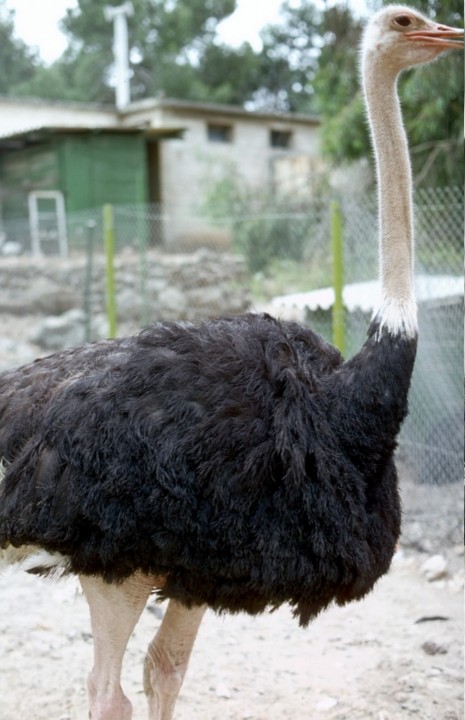
ostrich_001In verses 5-8, the Lord focuses on the habits, freedom, and domain that He has given to the wild donkey. In verses 9-12, He turns to the wild ox, pointing out his strength, and usefulness – yet making clear his independence and power. This was so much the case that hunting this beast was the sport of royalty, much like we would years ago have considered the safaris that we saw depicted in movies and television. In verses 13-15, the Lord  has Job consider the majesty of the winged ostrich, and the careless way that she places and sometimes even scatters her eggs.

Each of these wild creatures represent scores of others that God has created, and in His wisdom understands as nobody else can. No single person can at the same time appreciate, understand, and maintain the balance in the lives of all of these creatures – and though man can put some of them to use for his purposes, he can never fully tame them (verses 9, 11, and 12).

Read or listen to audio of ESV version of this selection from this link.

/Bob’s boy
___________________
some images © V. Gilbert & Arlisle F. Beers

Please note: I did not design the reading plan that I am following in my blog.  All of my comments in this blog, however, are solely my responsibility.  When reading ANY commentary, you should ALWAYS refer first to the scripture, which is God’s unchanging and unfailing word. Reading schedules, as well as a link to the site where you can get the reading plan that I’m currently following for yourself can be found on the “Bible Reading Schedules” page of my website at http://graceofourlord.com.  For questions and help, please see the “FAQ” and “Summaries” pages there.