Ecclesiastes 11 – Cast Your Bread Upon the Waters

There are many different opinions concerning what the author meant in verse one, but the one that seems clearly correct to us is that he is talking about being benevolent. One good explanation of the phrase “cast your bread upon the waters” is that it means to give generously without expecting anything in return. Verse two continues the thought with “give a portion to seven, or even to eight.” The number seven in scripture is often referred to as the perfect number, representing completeness. “Even to eight,” then , would represent going above and beyond.

sea_003Verse 3 reminds us that there is little of importance in this life of which we are in control, and so verse 4 says that we should be about the work that we should be doing, rather than sitting around trying to analyze things. The remainder of the chapter reminds us that we cannot know the ways of God, and that we should make good and joyful use of the time we have here “under the sun.” That time is short and God will bring us into judgment for what we do with it. Verse 10 means that one should not let one’s problems, trials, or afflictions be the overwhelming focus of one’s attention.

Read or listen to audio of ESV version of this selection from this link.

/Bob’s boy
___________________
some images © V. Gilbert & Arlisle F. Beers

Please note: I did not design the reading plan that I am following in my blog.  All of my comments in this blog, however, are solely my responsibility.  When reading ANY commentary, you should ALWAYS refer first to the scripture, which is God’s unchanging and unfailing word. Reading schedules, as well as a link to the site where you can get the reading plan that I’m currently following for yourself can be found on the “Bible Reading Schedules” page of my website at http://graceofourlord.com.  
The Song of Solomon on Sexuality and Marriage

This week, as we finish Ecclesiastes, we will begin reading the Song of Solomon.

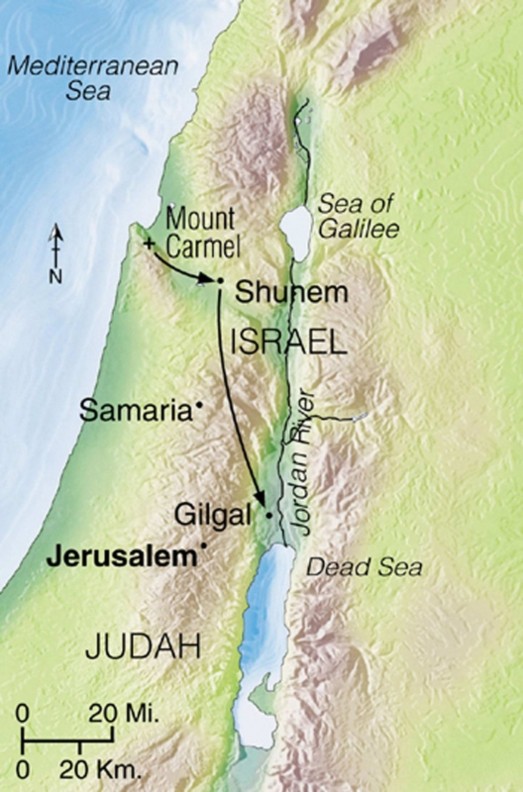
Shunem002Solomon is credited with having written 1,005 songs. Whether or not he wrote this book is just one of the things about the Song of Solomon that is disputed. The bride in the song is a young Shulamite woman (chapter 6:13).  Because of this, it is considered by many that she came from the village of Shunem (mentioned in Joshua 19:17-21 and 2 Kings 4:8), located in the land the tribe of Issachar. Tirzah is mentioned as well, and the towns of Shunem and Tirzah were in the northern kingdom.

It is quite obvious to virtually everyone that reads the book that the sexual relationship is the subject of most of the book. But perhaps partly due to embarrassment, and partly due to the view that sex is a most ungodly subject, one does not need to search very hard to find writers that try to make the book into something else.

One viewpoint comes from traditional Targumim (Targum) explanations, which defines the book as an allegory with the congregation of Israel being the bride, and Solomon a representation of God. Another holds that the Shulamite is the church of Jesus Christ, and that Solomon in the story represents God. Neither of these theories make any sense, however, if one considers the great sin of Solomon with women. Apparently, the song was written fairly early in his exploits, as it only lists “sixty queens and eighty concubines,  and virgins without number” (Song of Solomon 6:8).  This was explicitly forbidden for a king in Deuteronomy 17:15-17. Another theory holds that there are actually three chief characters – Solomon, the Shulamite, and a shepherd boy who is her true love.  But this one makes no sense either, because the Scripture clearly states that the Shulamite’s “beloved” is the king himself (Song of Solomon  1:12-14).

wedding ringsAnything, it seems, would be more palatable than a book of Scripture written about the fundamental and healthy relationship of love between a man and a woman. But such should not be the case if one considers it carefully. Who is there that is more qualified than the Creator of life (and yes, of sex itself), to “breathe out” the word on the subject of the most sacred act between a man and a woman? Time and again in the Bible, God has made it known to man (and woman) under what circumstances the sexual relationship is proper, as well as how it is best enjoyed.

Such “misunderstanding” was apparently not always the case. In his commentary, Franz Delitzsch wrote: “because of its apparently erotic, but in truth mysterious contents, it was a Jewish saying, as Origen and Jerome mention, that the Song should not be studied by any one till he was thirty years of age” (Delitzsch, F. J. Commentary on the Song of Songs and Ecclesiastes, Grand Rapids, Mi.: William B. Eerdmans Publishing).

Read or listen to audio of ESV version of this selection from this link.

/Bob’s boy
___________________
some images © V. Gilbert & Arlisle F. Beers

Please note: I did not design the reading plan that I am following in my blog.  All of my comments in this blog, however, are solely my responsibility.  When reading ANY commentary, you should ALWAYS refer first to the scripture, which is God’s unchanging and unfailing word. Reading schedules, as well as a link to the site where you can get the reading plan that I’m currently following for yourself can be found on the “Bible Reading Schedules” page of my website at http://graceofourlord.com.  

Ecclesiastes 10 – Wisdom and Folly

At first reading, chapter 10 seems a little out of place. All of these proverbs look like they belong in a different book. But the theme of the chapter is the same as some previous chapters, and most of the proverbs relate to two contrasting things – wisdom and folly. Verse 4 seems to encourage those who serve in a position close to authority to stand their ground with gentleness under adversity. The evil “under the sun” Solomon speaks of in verse 5 refers to the fact that “fools”often are put in places of high position. One should not assume a person in such a position necessarily knows what they are doing.


English: Ecclesiastes, (קֹהֶלֶת, Kohelet, &quo...

English: Ecclesiastes, (קֹהֶלֶת, Kohelet, “son of David, and king in Jerusalem” alias Solomon, Wood engraving (Photo credit: Wikipedia)


Verses 8-9 remind us that those who plan evil often fall victim to such things. Verse 10 indicates the value of working smarter – not harder. The wise man will take the time to sharpen the saw, whereas the fool struggles with the dull instrument. The remainder of the chapter deals with the proper conduct of those in authority, but verse 20 warns that one’s lips can easily get one into trouble when it comes to voicing unfavorable opinions of those in power. Better to not gossip in the first place.


Read or listen to audio of ESV version of this selection from this link.


/Bob’s boy


___________________


some images © V. Gilbert & Arlisle F. Beers


Please note: I did not design the reading plan that I am following in my blog.  All of my comments in this blog, however, are solely my responsibility.  When reading ANY commentary, you should ALWAYS refer first to the scripture, which is God’s unchanging and unfailing word. Reading schedules, as well as a link to the site where you can get the reading plan that I’m currently following for yourself can be found on the “Bible Reading Schedules” page of my website at http://graceofourlord.com.  


Ecclesiastes 9 – Joy In Life and Love

Verses 1-3 continue the thought of the last chapter that man cannot know what awaits him in this life – what will happen along the way. The preacher says that there is one fate for all – for the righteous and the wicked. For those who serve the Lord, and for those who do not, it is all the same – their fate “under the sun” is death. Solomon says that this fact is “an evil” in verse 3, meaning that it is an “unfair” fact of life.

sunset_002It does seem most unfair that good is often not rewarded in this life, while at the same time, evil’s punishment often does not come quickly. And then in the end they both are dead anyway. This also means that the wicked not only get the same end under the sun, but seeing no consequences for their evil they just continue – thumbing their noses at the rest of the world. So what is the advantage for those who try to do good while “under the sun?”

It is in verse 4 that the preacher begins to answer that question – while we are living under the sun, we still have hope. For the dead, there is no reward to work toward. Their fate is determined, and the Lord will judge their deeds.  In verse 5, a “living dog” being better that a “dead lion” means that no matter how great and powerful one may be while under the sun, once dead there is (for them) no more love, no more hate, and no more share of things in this life. But again the living still have hope.

This leads up to an important point that the wise man is making. It is a fact that our own pleasure and happiness while “under the sun” are not God’s foremost concern, nor should they be ours. But while serving God and leading others to do the same, we should not neglect to have joy in what we have been blessed with here – in this mere breath of a life (verse 9).  Verse 10’s admonition (whatever your hand finds to do, do it with your might”) is the basis for the hymn “To the work!”

The preacher then points out that being the fastest runner, the strongest in battle, or the most intelligent person – none of these guarantee one’s successes. The variable of chance will often find its way into the equation when one takes his own abilities too seriously. This leads to the final point Solomon makes in verses 13-18. Wise council may be ignored and unappreciated if it does not come from those that are favored among men, but it is no less valuable.

Read or listen to audio of ESV version of this selection from this link.

/Bob’s boy
___________________
some images © V. Gilbert & Arlisle F. Beers

Please note: I did not design the reading plan that I am following in my blog.  All of my comments in this blog, however, are solely my responsibility.  When reading ANY commentary, you should ALWAYS refer first to the scripture, which is God’s unchanging and unfailing word. Reading schedules, as well as a link to the site where you can get the reading plan that I’m currently following for yourself can be found on the “Bible Reading Schedules” page of my website at http://graceofourlord.com.  

Ecclesiastes 8 – Man Cannot Know God’s Ways

Verse one means that a wise man is easily identified by people because it makes itself uniquely apparent to others in their actions and their judgment. Verses 2-9 note the supremacy of a ruler’s power and how it can be abused, and his subjects oppressed as well. Solomon is preaching civil obedience here, but there is also a warning that one should not do evil at their command. Defying such power can be dangerous, but such power does not mean he has power over his own death. Therefore, those who come before him should wisely determine when to make a stand. Serving the Lord comes first – anything at odds with that is unacceptable.

The Temple Mount of Jerusalem. The Temples of Solomon, Zerubbabel, and Herod were all built on this site.

The Temple Mount of Jerusalem. The Temples of Solomon, Zerubbabel, and Herod were all built on this site.

Verses 10-13 carry forward the thought of verse 9, pointing out that those who do evil often become complacent because “the sentence against an evil deed is not executed speedily.” They may do wrong a hundred times with no consequences. But sooner or later, all will not be well with them because they do not fear God.  Solomon has witnessed the burial of such men.

In verses 14-17, “the Preacher” talks about sometimes observing the righteous receive a fate we would rather see come to a wicked person, and vice-versa. At this, Solomon again states (as in chapter 2:24-26) that man has nothing better than to eat and drink, and find joy in his work during the days that God has given him “under the sun.” We cannot know why things happen as they do, nor can we know which of those things are part of God’s plans, and which of them are not. Verse 17 implies that the wise man may well have spent considerable time trying to understand the work of God “under the sun.” But it just is not within man’s ability to know.

Read or listen to audio of ESV version of this selection from this link.

/Bob’s boy
___________________
some images © V. Gilbert & Arlisle F. Beers

Please note: I did not design the reading plan that I am following in my blog.  All of my comments in this blog, however, are solely my responsibility.  When reading ANY commentary, you should ALWAYS refer first to the scripture, which is God’s unchanging and unfailing word. Reading schedules, as well as a link to the site where you can get the reading plan that I’m currently following for yourself can be found on the “Bible Reading Schedules” page of my website at http://graceofourlord.com.  

Ecclesiastes 7- On Wisdom and Folly

Chapter 7 is full of proverbs, most of which are inter-related. The first few verses speak first of the value of a good reputation, followed by declarations that the day of the death of such a person is better than the day of their birth, partly because of the good name that person has made for himself.  In verses 2-6, “the heart of the wise” and “the heart of fools” means simply that those who are predisposed to wisdom take to heart the acts of sharing the important things of life – and of death – with other people, while others would rather be entertained.

Mourning in Old Testament Israel lasted for a week for an ordinary person, and usually for a month for an important leader, and often included professional singers and mourners.

Mourning in Old Testament Israel lasted for a week for an ordinary person, and usually for a month for an important leader, and often included professional singers and mourners.

Verses 7-12 teach the relationship of goodness to wisdom, and of wickedness to folly, and make contrasts between the former and the latter that are manifested in the way people react to life, and how they behave to others.  Then verses 13-14 point out that having prosperity or adversity in one’s life largely depends on the will of God, as His work is done. We should remember this when we have the latter, and be joyful with the former.

That is a great segue into verses 15-18, the last three verses of which are admittedly difficult to understand; and people have long differed greatly on their meaning. Verse 15 points out that, in this life, a righteous person may receive the fate we would rather see come to a wicked person, and vice-versa. Verses 16-17 are not a license to be sinful, as some have said. They simply mean that one should not believe one’s self to be more righteous or wise than they really are, and therefore deserving of God’s favor – any more than they should be brazenly wicked or completely foolish in their beliefs and actions. As verse 18 points out, it is the one who fears God that will come ahead in the end.

The rest of the chapter continues to elaborate on this relationship of wisdom, folly, good, and evil, with a warning in verses 21-22 not to take everything that others say about us to heart (good or bad). The good things said can lead one to foolishly believe in one’s own righteousness. The bad things said will not matter if we fear God.

Read or listen to audio of ESV version of this selection from this link.

/Bob’s boy
___________________
some images © V. Gilbert & Arlisle F. Beers

Please note: I did not design the reading plan that I am following in my blog.  All of my comments in this blog, however, are solely my responsibility.  When reading ANY commentary, you should ALWAYS refer first to the scripture, which is God’s unchanging and unfailing word. Reading schedules, as well as a link to the site where you can get the reading plan that I’m currently following for yourself can be found on the “Bible Reading Schedules” page of my website at http://graceofourlord.com.  

Ecclesiastes 6 – Smelling the Roses

Solomon's Temple Vista

Solomon’s Temple Vista (Photo credit: arbyreed)

Chapter 6 is a difficult one to understand; and there is some variety among some commentators as to what is meant by some of it.  The “evil” that is spoken of in verses 1-3 seems to us to refer to a person who is blessed with much material wealth and standing among others, yet is so self-centered that he takes much for granted, and is never satisfied.  That line of thought is continued in verses 4-6. The NASB translates the reference to burial as a “proper burial.”  This could mean that this self-centered person who had so much was not so honored in his death.  Solomon once again refers to someone who never lived being better off than such a person (verse 3).

Verses 10-12 are seen as a very pessimistic outlook on life by Solomon, and indeed it may be so.  But the somewhat elusive meaning could be more along the lines that people must learn to accept the hand that has been dealt them and move on.  It does no good to fret and worry about what will be.  In the end, he does not know what will come next “under the sun” after he is gone. It seems to us that Solomon is merely continuing to stress that one must find his pleasure in his work and his life in the few days that he has been blessed with on this earth, remembering that what comes next is what really matters.


Read or listen to audio of ESV version of this selection from this link.

/Bob’s boy
___________________
some images © V. Gilbert & Arlisle F. Beers

Please note: I did not design the reading plan that I am following in my blog.  All of my comments in this blog, however, are solely my responsibility.  When reading ANY commentary, you should ALWAYS refer first to the scripture, which is God’s unchanging and unfailing word. Reading schedules, as well as a link to the site where you can get the reading plan that I’m currently following for yourself can be found on the “Bible Reading Schedules” page of my website at http://graceofourlord.com.  

Book of Joshua (Part 2) – Taking the Promised land

Ai - Joshua's soldiers were first defeated here, but then God provided a stunning victory.

Ai – Joshua’s soldiers were first defeated here, but then God provided a stunning victory.

Picking the Book of Joshua back up in chapter 9, the next few chapters are filled with more conquest, and a deception that will have lasting consequences.

  • The Gibeonite Deception (Joshua 9:1-27).  Upon hearing of what had happened at Jericho and Ai, the various Canaanite kings gathered together and joined forces to do battle against the approaching Israelites.  But the people of Gibeon came up with a plan of their own.  Altering their appearance to make themselves look like they had traveled a long distance, they went straight to the Israelite camp and to Joshua, claiming they had come from a distant country, and asking to make a covenant with them.
    • The deception worked, and they extracted an oath of cooperation and protection from the leaders and elders of the congregation.  When the deception was discovered, the anger of the people was kindled, but the oath had been made and would be honored.  But  because of their trickery, many of them would serve the congregation forever, just like servants, as woodcutters and drawers of water.
    • So just as the Lord (and Moses) had specifically warned them many times not to do (as in Deuteronomy 7:2), the Israelites had made a covenant with people in Canaan before the battles were even half over.  And the blame for this horrible mistake lays in their failure to seek counsel from the Lord (Joshua 9:14-15).
  •    The defense of Gibeon and the conquest of the south (Joshua 10:1–43)
    • Gibeon_001

      Gibeon, view north of El Jib; the Gibeonites tricked Joshua to make a treaty with them.

      Gibeon was no small city, and its men were known warriors.  So when the king of Jerusalem, Adoni-zedek, heard of the peace between them and Israel, he was afraid.  Summoning the kings of Hebron, Jarmuth, Lachish, and Eglon, he gathered all of their forces to make war against Gibeon.  The men of Gibeon then went to Joshua at Gigal seeking their help.

    • Bound by the oath they had made, Joshua prepared his mighty men to do battle, and the Lord told him in Joshua 10:8 “Do not fear them, for I have given them into your hands. Not a man of them shall stand before you.”  It was during this battle that the famous “long day” occurred, upon which Joshua commanded the sun to “stand still.”  For our comments on this event, see this previous post.

    • After the victory, Joshua and the men hunted down and executed the five kings.  Then, with God fighting on their side, they won victory after victory in the south, capturing their kings and taking the land “from Kadesh-barnea as far as Gaza.”

  • Joshua 11-12 details the victories of the Israelites in the northern part of the land, with Joshua 12:1-6 recounting the kings that had been defeated under the leadership of Moses (some of which was told in Numbers 21).
/Bob’s boy
___________________
image © V. Gilbert & Arlisle F. Beers

Please note: I did not design the reading plan that I am following in my blog.  All of my comments in this blog, however, are solely my responsibility.  When reading ANY commentary, you should ALWAYS refer first to the scripture, which is God’s unchanging and unfailing word. Reading schedules, as well as a link to the site where you can get the reading plan that I’m currently following for yourself can be found on the “Bible Reading Schedules” page of my website at http://graceofourlord.com.  For questions and help, please see the “FAQ” and “Summaries” pages there.

Ecclesiastes 5 – Fear God

In verses 1-6, Solomon admonishes the reader about taking seriously the worship of the Lord. The “sacrifice of fools,” spoken about in 1-3, refers to those that do not show proper reverence for the Lord, but are simply “going through the motions” of worship. Such people believe that they are complying with the acts of worship that are expected of them. But their hearts are not in it, so they would be better off simply observing and learning.

In verses 4-6, he warns about making rash vows to God. God has always taken vows seriously (and indeed still does). The Nazirite vow (Numbers 6:1-21) was one taken very seriously by the faithful that dedicated themselves to such a life. By fulfilling this special vow to the Lord, they set themselves apart from others in many ways.  But it was a decision that would last a lifetime, and God expected it to be kept.  But perhaps the most well known is Hannah’s vow, which she fulfilled in giving her child Samuel over to the service of the Lord (1 Samuel 1:9-28).

God gave Hannah the promised son Samuel, so Hannah gave Samuel to God, to serve Him at the Tabernacle. Each year she made Samuel new clothes (1 Samuel 2:1-21).

God gave Hannah the promised son Samuel, so Hannah gave Samuel to God, to serve Him at the Tabernacle. Each year she made Samuel new clothes (1 Samuel 2:1-21).

But people would also (especially in times of trouble) come to the Temple and make vows to the Lord that required less commitment – possibly involving some sort of sacrifice. Solomon’s warning was to those who would make such vows without keeping them – possibly never even trying very hard. Note verse 5 (“it is better that you should not vow than that you should vow and not pay”) and verse 7 (“God is the one you must fear”).

Ah, but one might think “that was then –  we don’t make vows like that in our worship today.” Nothing could be further from the truth. When we make the decision to become a Christian, we set ourselves apart from the world, and even our baptism itself becomes part of that vow – to serve the Lord. As Paul put it in Galatians 2:20: “I have been crucified with Christ. It is no longer I who live, but Christ who lives in me. And the life I now live in the flesh I live by faith in the Son of God, who loved me and gave himself for me.” And if we turn our backs on that vow, it would be better if we had never made it (2 Peter 2:20-21).

The remainder of the chapter speaks of injustice and of how those who love riches will never be satisfied with them. But probably the best wisdom of this section comes from the last three verses.  In verse 18, Solomon says “good and fitting is to eat and drink and find enjoyment in all the toil with which one toils under the sun the few days of his life that God has given him…” Then in verse 20: “for he will not much remember the days of his life because God keeps him occupied with joy in his heart.”

Read or listen to audio of ESV version of this selection from this link.

/Bob’s boy
___________________
some images © V. Gilbert & Arlisle F. Beers

Please note: I did not design the reading plan that I am following in my blog.  All of my comments in this blog, however, are solely my responsibility.  When reading ANY commentary, you should ALWAYS refer first to the scripture, which is God’s unchanging and unfailing word. Reading schedules, as well as a link to the site where you can get the reading plan that I’m currently following for yourself can be found on the “Bible Reading Schedules” page of my website at http://graceofourlord.com.  

Ecclesiastes 4 – Evil Under the Sun

The “preacher” speaks compassionately at the beginning of this chapter about those people who suffer oppression. The preacher speculates that those oppressed who have died are better off than those who are still alive.  No longer “under the sun,” they have gone on to eternity. But he also says that those who have never even been born are better off still because they have not seen the evil deeds that man does. 

powerful_and_oppressiveHe has made two points here.  The first is the same message that he has been driving home in this book previously. What really matters is what comes after – when we are no longer “under the sun”; and those who have already moved on are better off.  This is obviously so. But even those people have seen man’s inhumane treatment of his fellow man; and that alone makes them less fortunate than those who have not been born. Seeing the distress, tears, and hopelessness of those who are oppressed is painful to anyone who cares about his fellow man; and clearly, Solomon did.

He then has some things to say about work. Verse 5 agrees with many of the verses in the Book of Proverbs about how foolish it is to be lazy. But then in verse 6, he points out the foolishness of the other extreme – the “workaholic,” saying “Better is a handful of quietness than two hands full of toil and a striving after wind.” Worse yet are the people described in verses 7-8 – those who have no one else or even have isolated themselves through their insatiable hunger for more wealth, and their lack of balance in their lives.

Some have tried to ascribe verses 13-16 to Joseph, but it seems to be simply a parable.  It points out on the one hand that powerful people who become so egotistic that they no longer listen to anyone else can find themselves losing it all.   But even the poor, but wise youth he compares him to (though becoming enormously successful himself) is no better off in the end, for power and riches “under the sun” will not matter in the end.

Read or listen to audio of ESV version of this selection from this link.

/Bob’s boy
___________________
some images © V. Gilbert & Arlisle F. Beers

Please note: I did not design the reading plan that I am following in my blog.  All of my comments in this blog, however, are solely my responsibility.  When reading ANY commentary, you should ALWAYS refer first to the scripture, which is God’s unchanging and unfailing word. Reading schedules, as well as a link to the site where you can get the reading plan that I’m currently following for yourself can be found on the “Bible Reading Schedules” page of my website at http://graceofourlord.com.