Psalm 121 – My Help Comes from the Lord

Psalm 121 is another of those known as a “Song of Ascents” (Psalms 120-134). The superscription in the KJV terms it a “Song of Degrees.” These psalms are otherwise known as “Pilgrim Songs,” “Songs of the Steps”, or “the Gradual Songs.” As tradition holds that these psalms were sung by those making the pilgrimage to Jerusalem, this one appears to be intended to give reassurance to those making that journey.
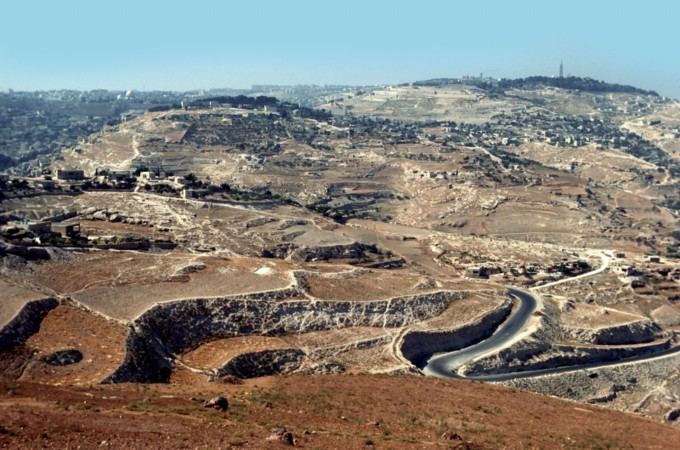
City of Jerusalem from a distance

City of Jerusalem from a distance

Verse one begins with “I lift up my eyes to the hills,” which would fit very well for someone traveling to Jerusalem. The question that follows (“from where does my help come?”) and its answer in verse 2 (“my help comes from the Lord, who made heaven and earth”) both are meant to apply to the traveler in his present circumstance, as well as to all of us throughout life. The idea is that we are in good hands with He “who created the heavens and the earth” as our keeper.

In these eight short verses, the reference to God as the “keeper” is made six times. The line in verse 5 (“the Lord is your keeper; the Lord is your shade on your right hand”),  recalls the words of Psalm 91:1 (“he who dwells in the shelter of the Most High will abide in the shadow of the Almighty”). Verse 7 (“the Lord will keep you from all evil”) does not mean that He will never allow anything bad to happen to His people. The second part of the verse tells the story of the promise of salvation for His people (“he will keep your life”). As Paul said to the Romans, “if God is for us, who can be against us?” (Romans 8:31).

Read or listen to audio of ESV version of this selection from this link.

/Bob’s boy
___________________
some images © V. Gilbert & Arlisle F. Beers

Please note: I did not design the reading plan that I am following in my blog.  All of my comments in this blog, however, are solely my responsibility.  When reading ANY commentary, you should ALWAYS refer first to the scripture, which is God’s unchanging and unfailing word. Reading schedules, as well as a link to the site where you can get the reading plan that I’m currently following for yourself can be found on the “Bible Reading Schedules” page of my website at http://graceofourlord.com.  


Psalm 105, 113 – High Above All Nations!

Psalm 105 is the second of four psalms that contain substantial historical narratives (Psalm 78, 105, 106, and 136).  Unlike Psalm 78, this one does not recount any of the disobedience of the people along the way. The first 15 verses are also found almost word for word in 1 Chronicles 16:8-22, which has prompted some debate over which was written first. Regardless, this is a hymn of praise to God; and the historical content serves to demonstrate God’s faithfulness to His people, the fulfillment of His promises, and His care for them along the way.

Isaac Blessing Jacob, painting by Govert Flinc...

Isaac Blessing Jacob, painting by Govert Flinck (Rijksmuseum Amsterdam). (Photo credit: Wikipedia)

Verses 1-6 are a general call for thanksgiving and praise to the Lord. Verses 7-11 recall His covenant with Abraham, Isaac, and Jacob, and His promise confirmed to Israel of the land of Canaan as an inheritance. Verses 12-15 tell of His care and protection as they sojourned in the land of Canaan prior to Egyptian bondage, and His protection of them from those who might do them harm. Verses 16-22 detail the life and rise of Joseph, while verses 23-25 deal with the years in Egypt leading up to the time of Moses. Egypt is referred to as the land of Ham because in the “table of nations” (Genesis 10), Egypt is named as one of the sons of Ham.

Verses 26-36 detail Moses and Aaron’s arrival on the scene, as well as the plagues God brought on Egypt. Verses 37-42 tell of the Exodus and the wilderness wandering. The chapter concludes in verses 43-45 with confirmation that God gave the land over to them, followed by final words of praise to God for his faithfulness to that promise.

Psalm 113 is a short hymn full of great praise, exalting the Lord our God “who is seated on high.” It is a hymn in which the people sing of a great and majestic God who loves and cares for the poor and those who are in need (verses 7-9). Verses 7-8 are almost word for word a part of Hannah’s song (1 Samuel 2:8).

Read or listen to audio of ESV version of this selection from this link.

/Bob’s boy
___________________
some images © V. Gilbert & Arlisle F. Beers

Please note: I did not design the reading plan that I am following in my blog.  All of my comments in this blog, however, are solely my responsibility.  When reading ANY commentary, you should ALWAYS refer first to the scripture, which is God’s unchanging and unfailing word. Reading schedules, as well as a link to the site where you can get the reading plan that I’m currently following for yourself can be found on the “Bible Reading Schedules” page of my website at http://graceofourlord.com.  

Psalm 85 – Revive Us Again

Daberath, a city in the tribal territories of Issachar and Naphtali near Mount Tabor (background); probably the site of the defeat of the Canaanite king Jabin's army under Sisera (Judges 4). Barak gathered an army here to fight Sisera, and it is one traditional site of the Transfiguration.

Daberath, a city in the tribal territories of Issachar and Naphtali near Mount Tabor (background); probably the site of the defeat of the Canaanite king Jabin’s army under Sisera (Judges 4). Barak gathered an army here to fight Sisera, and it is one traditional site of the Transfiguration.

The vast majority of commentators and scholars attribute this psalm to a post-exilic writing, but that seems hardly to be a given.  Verse 1 is most often used as the basis of that assumption, which in most translations reads “Lord, you were favorable to your land; you restored the captivity of Jacob.” But the ESV translates it as “…you restored the fortunes of Jacob.” Even if the former translation is taken as correct, the sentence structure makes such a conclusion suspect in the first place.

Secondly, even if it does refer to a restoration from captivity, that does not preclude an earlier occurrence of some sort of captivity. As Barnes points out, it likely refers to bondage in Egypt in addition to other instances – which could include any number of such times written about in the Book of Judges, for example. Also, the next few verses indicate that the psalmist is praying for the Lord to restore their fortunes again, and to no longer be angry with them – indicating that their fortunes are once again not so great in the present:

Restore us again, O God of our salvation,
and put away your indignation toward us!
Will you be angry with us forever?
Will you prolong your anger to all generations?
Will you not revive us again,
that your people may rejoice in you?

The plea the psalmist makes for God to revive his people probably means more than to rejuvenate them – probably to strengthen and make them powerful again (rather than the powerlessness that they feel and are experiencing at present). The remainder of the psalm expresses confidence that the Lord will do just that, and suggests that there are many saints – many of those who are of a penitent heart ready to serve. The psalmist prays for those people not to return to their folly:

Let me hear what God the Lord will speak,
for he will speak peace to his people, to his saints;
but let them not turn back to folly.
Surely his salvation is near to those who fear him,
that glory may dwell in our land

The lesson in this psalm for us today is that when we are in desperate times, we need to remember that God cares for us, and that he will deliver the righteous. But our patience for God acting in His time, rather than in our own, must be strengthened along with our faith.

Faithfulness springs up from the ground,
and righteousness looks down from the sky.
Yes, the Lord will give what is good,
and our land will yield its increase

Read or listen to audio of ESV version of this selection from this link.

/Bob’s boy
___________________
some images © V. Gilbert & Arlisle F. Beers

Please note: I did not design the reading plan that I am following in my blog.  All of my comments in this blog, however, are solely my responsibility.  When reading ANY commentary, you should ALWAYS refer first to the scripture, which is God’s unchanging and unfailing word. Reading schedules, as well as a link to the site where you can get the reading plan that I’m currently following for yourself can be found on the “Bible Reading Schedules” page of my website at http://graceofourlord.com.  

Psalm 112 – The Righteous Will Never Be Moved

lake_and_mountainsPsalms 111, 112, and 113 are sometimes referred to as “Hallelujah” psalms because they each begin with that exclamation (the ESV and some other versions translate as “Praise the Lord!”). Psalms 111 and 112 complement each other, as they each consists of an acrostic of 22 clauses or phrases arranged in 10 verses each.  Psalm 111 proclaims God’s greatness, mercy, and righteousness, whereas Psalm 112 considers and encourages the happiness, benevolence, and righteousness of God’s children. It praises God for all of the loving care He gives to those who truly fear Him, but says that such fear encompasses something more – a genuine delight in God’s word (verse 1b).

The righteous are to be blessed by God for treating his fellow-man with generosity, and conducting his affairs with justice. The righteous, the psalmist says, shall never be moved, with his heart steady and firm. He has no need for fear of bad news because he can trust in the Lord, secure in the knowledge that his righteousness endures forever.

Paul quotes from verse 9 in 2 Corinthians 9:9, encouraging the Corinthians to give generously to the collection for the needy brethren. The psalm tells the righteous that the reason they should have no fear is because the Lord will honor and care for him.

Read or listen to audio of ESV version of this selection from this link.

/Bob’s boy
___________________
some images © V. Gilbert & Arlisle F. Beers

Please note: I did not design the reading plan that I am following in my blog.  All of my comments in this blog, however, are solely my responsibility.  When reading ANY commentary, you should ALWAYS refer first to the scripture, which is God’s unchanging and unfailing word. Reading schedules, as well as a link to the site where you can get the reading plan that I’m currently following for yourself can be found on the “Bible Reading Schedules” page of my website at http://graceofourlord.com.  

Psalm 104 – From Your Lofty Abode

This hymn of praise begins in the first few verses with colorful illustrations of God’s splendor and majesty that is full of poetic beauty.

He lays the beams of his chambers on the waters;
he makes the clouds his chariot;
he rides on the wings of the wind;
he makes his messengers winds,
his ministers a flaming fire.

Waimea Canyou, Kauai, Hawaii

Waimea Canyou, Kauai, Hawaii

Then in verse 5, he states the wondrous things that the Lord has created, the power and wisdom that he has in his mighty hands, and then continues with his ongoing care for the world. Verse 5 has been used by skeptics to discredit scientific awareness in the Bible (“He set the earth on its foundations, so that it should never be moved”). But the verse is simply poetry that speaks to the stability and indestructibility of the earth as in Job 26:7.  Knowledge of the shape and placement of the earth is clearly not in question (see also Isaiah 40:22).

The psalmist notes in intricate detail the care with which God has seen to the renewal, nourishment and growth of all things living on the earth, and the beauty with which the lands and oceans are both combined and separated, teeming with “creatures innumerable.” The psalm closes as it began, with “Bless the Lord, O my Soul” and words of praise for the God who rules even the mountains:

May the glory of the Lord endure forever;
may the Lord rejoice in his works,
who looks on the earth and it trembles,
who touches the mountains and they smoke!

Read or listen to audio of ESV version of this selection from this link.

/Bob’s boy
___________________
some images © V. Gilbert & Arlisle F. Beers

Please note: I did not design the reading plan that I am following in my blog.  All of my comments in this blog, however, are solely my responsibility.  When reading ANY commentary, you should ALWAYS refer first to the scripture, which is God’s unchanging and unfailing word. Reading schedules, as well as a link to the site where you can get the reading plan that I’m currently following for yourself can be found on the “Bible Reading Schedules” page of my website at http://graceofourlord.com.  

Psalm 59 – My Fortress

King Saul grew insanely jealous of David because of David's success and the praise people heaped upon him. Before long, Saul made plans to murder David. Eventually Saul's daughter Michal, who was also David's wife, helped David escape (1 Samuel 19).

King Saul grew insanely jealous of David because of David’s success and the praise people heaped upon him. Before long, Saul made plans to murder David. Eventually Saul’s daughter Michal, who was also David’s wife, helped David escape (1 Samuel 19).

According to the superscription, this is another psalm sung to the tune of “Do not destroy.” It also says that it was written at the time when Saul sent men to watch his house to kill him (this occurred in 1 Samuel 19). The psalm fits with that time in his life, if for no other reason, because of his claims of innocence from sin for these events. Verses 3-4 say that they lie in wait and “for no transgression or sin of mine, O Lord, for no fault of mine, they run and make ready.”

Verses 8-10 demonstrate David’s trust in the Lord through all of this, as he says that God laughs at them, and proclaims Him as his fortress in His steadfast love. David then asks God not to kill them because the people would just soon forget. Instead, he wants them subdued so that their punishment can serve as an example to his people.  The verses about them wandering about for food, but not getting their fill are allusions to the comparison he made of them to howling dogs in verse 14. David himself is the prey they seek. But David is unafraid and again promises to sing of God’s strength – his fortress.

Read or listen to audio of ESV version of this selection from this link.

/Bob’s boy
___________________
some images © V. Gilbert & Arlisle F. Beers

Please note: I did not design the reading plan that I am following in my blog.  All of my comments in this blog, however, are solely my responsibility.  When reading ANY commentary, you should ALWAYS refer first to the scripture, which is God’s unchanging and unfailing word. Reading schedules, as well as a link to the site where you can get the reading plan that I’m currently following for yourself can be found on the “Bible Reading Schedules” page of my website at http://graceofourlord.com.  
Psalm 111 – Great Are the Lord’s Works

Preceding Psalm 112, which is clearly a psalm of wisdom, this hymn of praise and thanksgiving begins with recognition of the great works of the Lord on behalf of His chosen people. The theme is the splendor an majesty of the acts of power and might that only God Himself could possibly work.

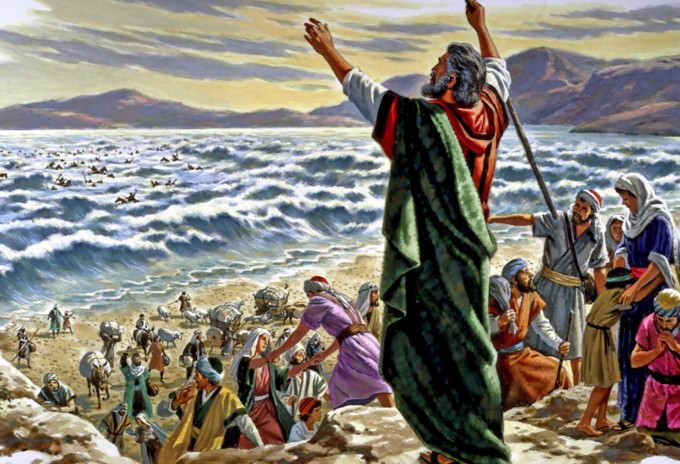
When the Israelites were safely across the Red Sea, crossing on dry land, Moses stretched out his hands and the waters of the sea poured back over the Egyptians and their chariots (Exodus 14:23-31).

When the Israelites were safely across the Red Sea, crossing on dry land, Moses stretched out his hands and the waters of the sea poured back over the Egyptians and their chariots (Exodus 14:23-31).

He has caused His works to be remembered by His people through their grateful word passed down through the generations as He had willed them to do (Exodus 12:25-27, Job 4:1-7) – and by His holy word through His prophets. It reminds us that God cares for His people (“He provides food for those who fear him; he remembers his covenant forever”). Verses 6-9 appear to continue the covenant remembrance as it recalls deliverance from Egypt. The psalm concludes in verse 10 with a phrase pointing to Proverbs 9:10 (“The fear of the Lord is the beginning of wisdom”).

Read or listen to audio of ESV version of this selection from this link.

/Bob’s boy
___________________
some images © V. Gilbert & Arlisle F. Beers

Please note: I did not design the reading plan that I am following in my blog.  All of my comments in this blog, however, are solely my responsibility.  When reading ANY commentary, you should ALWAYS refer first to the scripture, which is God’s unchanging and unfailing word. Reading schedules, as well as a link to the site where you can get the reading plan that I’m currently following for yourself can be found on the “Bible Reading Schedules” page of my website at http://graceofourlord.com.  

Psalm 103 – Bless the Lord, O My Soul

Though both the Northern Kingdom and the Southern Kingdom would be sent into exile, God still promised to bring them back. While Joab and the Israelite army were far off attacking Rabbah, David stayed behind in Jerusalem and eventually committed adultery with Bathsheba, the wife of one of David's best soldiers.

Though both the Northern Kingdom and the Southern Kingdom would be sent into exile, God still promised to bring them back. While Joab and the Israelite army were far off attacking Rabbah, David stayed behind in Jerusalem and eventually committed adultery with Bathsheba, the wife of one of David’s best soldiers.

Again the superscription of this psalm assigns the author as David, while many scholars believe that it’s origin was during the time of Babylonian captivity. The reason there are so many psalms which have this ambiguity and controversy is because the time of captivity and exile bears great similarity to the time when David had his ordeal with Absalom – following his sins with Bathsheba and the murder of Uriah the Hittite. God’s proclamation through Nathan of the woes to come for David were, as always, utterly fulfilled as was the judgment on his people for their idolatry. It was the shame for their sin, repentance and regret, and utter despair at the consequences of their action that was the common denominator.

Psalm 103 is another hymn of praise, declaring the love of the Lord for His people despite the punishment he had brought to pass on them. The recognition in verse 6 of the Lord’s justice for the righteous and the oppressed applies equally to David’s situation as it does to Uriah in his death, as well as to the poor and unfortunate that the people had abandoned in their selfishness, greed, and idolatry before exile. The text speaks of the brevity of life on earth for man contrasted with the everlasting and steadfast love that the Lord has for His people.

Read or listen to audio of ESV version of this selection from this link.

/Bob’s boy
___________________
some images © V. Gilbert & Arlisle F. Beers

Please note: I did not design the reading plan that I am following in my blog.  All of my comments in this blog, however, are solely my responsibility.  When reading ANY commentary, you should ALWAYS refer first to the scripture, which is God’s unchanging and unfailing word. Reading schedules, as well as a link to the site where you can get the reading plan that I’m currently following for yourself can be found on the “Bible Reading Schedules” page of my website at http://graceofourlord.com.  

Psalms 42-43 – As the Deer Panteth

Mount Hermon is one traditional site for Jesus' transfiguration, and is near the site of mount Mizar, mentioned in Psalm 42

Mount Hermon is one traditional site for Jesus’ transfiguration, and is near the site of mount Mizar, mentioned in Psalm 42

Psalms 42-43 compose Book 2 of the Psalms; and many believe that 42 and 43 are actually a single psalm that was divided in error. The case for that claim is strengthened by the fact that the two share a couple of refrains – 42:9 and 43:2 are mostly the same, as are 42:11 and 43:5. When the two psalms are read together, they flow quite smoothly.

Psalm 42 is the basis for the  hymn “As the Deer Panteth,” by Martin Nystrom. It is the song of a child of God who is separated by miles from the place where worship was done. The psalmist longs to be in the presence of God to worship and praise Him in song. It is believed that the psalm was written by David, and Psalm 42’s superscription supports that belief – at least where chapter 42 is concerned. But the circumstances and verses well fit a psalmists possible words during the Babylonian captivity. It is the timeless nature of God’s word that makes these possibilities equally credible.

Read or listen to audio of ESV version of this selection from this link.

/Bob’s boy
___________________
some images © V. Gilbert & Arlisle F. Beers

Please note: I did not design the reading plan that I am following in my blog.  All of my comments in this blog, however, are solely my responsibility.  When reading ANY commentary, you should ALWAYS refer first to the scripture, which is God’s unchanging and unfailing word. Reading schedules, as well as a link to the site where you can get the reading plan that I’m currently following for yourself can be found on the “Bible Reading Schedules” page of my website at http://graceofourlord.com.  
Psalm 110 – The Lord Says To My Lord

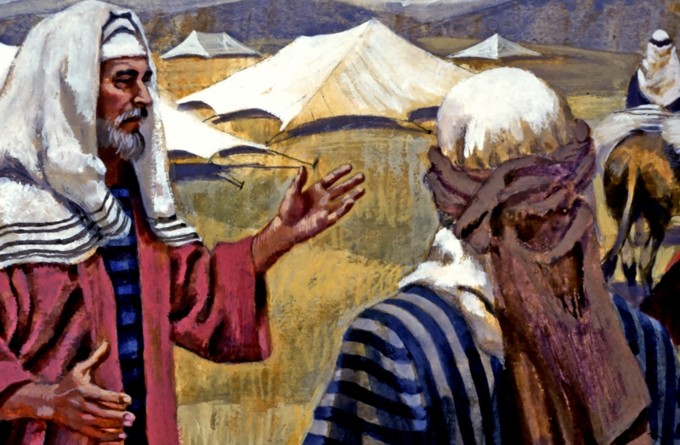
War came to the land in the days of Abram and Lot when five subject kings rebelled against Chedorlaomer, or Kedorlaomer and Lot was captured (Genesis 13:5--14:24). Abraham rallied his men, attacked at night, conquered the enemy, and rescued Lot. In this painting, he is sharing the spoils of battle with Melchizedek, king of Salem.

War came to the land in the days of Abram and Lot when five subject kings rebelled against Chedorlaomer, or Kedorlaomer and Lot was captured (Genesis 13:5–14:24). Abraham rallied his men, attacked at night, conquered the enemy, and rescued Lot. In this painting, he is sharing the spoils of battle with Melchizedek, king of Salem.

This short psalm is cited, or is referred to in several important New Testament passages concerning the Lord Jesus Christ. We find verse one in Matthew 22:44, Mark 12:36, Luke 20:42-43, and Acts 2:34-35, and Hebrews 10:13. Verse 4 (the Lord has sworn and will not change his mind, “You are a priest forever after the order of Melchizedek.”) is cited in Hebrews 7:17-21 and Hebrews 5:6. In Genesis 14:17-18, we learn that Melchizedek was “priest of God Most High,” though he was not even a Jew.

In the gospels, Jesus draws attention to the fact that David called the king “my Lord,” meaning that the king (the Messiah) was greater than David.  Verses 2-7 look to the Davidic king’s rule over God’s people, even when threatened by hostile powers (rule in the midst of your enemies). The people of God will offer themselves freely on the day of your power – as in on the day God exerts his power to bring the Gentiles into the fold (verse 7).

Read or listen to audio of ESV version of this selection from this link.

/Bob’s boy
___________________
some images © V. Gilbert & Arlisle F. Beers

Please note: I did not design the reading plan that I am following in my blog.  All of my comments in this blog, however, are solely my responsibility.  When reading ANY commentary, you should ALWAYS refer first to the scripture, which is God’s unchanging and unfailing word. Reading schedules, as well as a link to the site where you can get the reading plan that I’m currently following for yourself can be found on the “Bible Reading Schedules” page of my website at http://graceofourlord.com.