Festus Meets with Agrippa II and Bernice – Acts 25

Herod Agrippa II was the seventh and last king...

Herod Agrippa II was the seventh and last king of the family of Herod the Great, thus last of the Herodians. (Photo credit: Wikipedia)

After some days, Festus met with King Agrippa II and his sister, Bernice, who was always by his side (one of his other siblings was Drusilla, who was the wife of Festus’ predecessor, Felix). This Agrippa was educated in the court of the emperor Claudius, and was the son of Herod Agrippa I, who in Acts 12:1-3 had the Apostle James killed and Peter arrested, and who the Lord stuck down dead in Acts 12:21-23. He was also the great-grandson of Herod the Great – who had ordered the killing of all the male children of the region around Bethlehem when Jesus was born. As Festus laid out the case against Paul, he concluded by surmising that the matter was a dispute about their religion, and the death of “a certain Jesus, who was dead, but whom Paul asserted to be alive” (verse 19).

The next day, Festus introduced Paul, saying in a nutshell that (interestingly enough) he had found no charge deserving of death for Paul, and therefore he thought it wise to have him appear to Agrippa, so that maybe he (Festus) would have “something to write” before sending him to Caesar.

Schedule for this week
Read or listen to audio of this week’s selection from Acts here
Read or listen to audio of this weeks selection from 2 Chronicles here

/Bob’s boy
___________________

some images © V. Gilbert & Arlisle F. Beers

Please visit this site’s menu item “The Author’s Books” for info on the author’s books, website, and Facebook page.

All of my comments in this blog are solely my responsibility. When reading any commentary, you should always refer first to the scripture, which is God’s unchanging and unfailing word.


Chief Priests Try to Get Paul Sent back to Jerusalem- Acts 25

Antonius Felix was the Roman procurator of Iud...

Antonius Felix was the Roman procurator of Iudaea Province 52-58, in succession to Ventidius Cumanus. (Photo credit: Wikipedia)

Antonius Felix was replaced by Porcius Festus as the Roman procurator of Judea from about 59 to 62 AD. During his reign, hostility to Roman rule was heating to a fevered pitch, preceding the “Great Revolt” (the Jewish-Roman war of AD 66) that ended with the destruction of Jerusalem in AD 70. Wasting no time after Festus assumed his role, verse 2 says that “the chief priests and the principal men of the Jews laid out their case against Paul,” trying to persuade him to send Paul to Jerusalem so they could ambush him.

These “chief priests and principal men” were most likely of the Sanhedrin, and had conspired with more than 40 others to kill Paul in Acts 23:12-15. In verse 9, Festus was ready to send Paul to Jerusalem as a favor to the Jews, when Paul invoked his right as a Roman citizen to appeal to Caesar.

Schedule for this week
Read or listen to audio of this week’s selection from Acts here
Read or listen to audio of this weeks selection from 2 Chronicles here

/Bob’s boy
___________________

some images © V. Gilbert & Arlisle F. Beers

Please visit this site’s menu item “The Author’s Books” for info on the author’s books, website, and Facebook page.

All of my comments in this blog are solely my responsibility. When reading any commentary, you should always refer first to the scripture, which is God’s unchanging and unfailing word.


Felix Keeps Paul in Prison – Acts 24

Coin of Porcius Festus

Coin of Porcius Festus (Photo credit: Wikipedia)

When Felix gave him his turn, Paul laid out his defense in verses 10-21, methodically disputing the accusations with the obvious truth – which his accusers were unable to counter. In verse 14, he “confesses” that he is a part of “the Way” (which Tertullus called “the sect of the Nazarenes,”), through which he worships “the God of our fathers, believing everything laid down by the Law and written in the Prophets, having a hope in God, which these men themselves accept, that there will be a resurrection of both the just and the unjust.” Thus, Paul not only makes the case that he is a “good Jew,” but that Christianity is God’s divine will.

Felix seemed to be aware of Paul’s innocence, but was more interested in the possibility of getting some money from him over a period of time (verse 26), as well as garnering support from the Jews. After two years had passed, he left Paul in prison as a favor to them when he was replaced by Porcius Festus.

Schedule for this week
Read or listen to audio of this week’s selection from Acts here
Read or listen to audio of this weeks selection from 2 Chronicles here

/Bob’s boy
___________________

some images © V. Gilbert & Arlisle F. Beers

Please visit this site’s menu item “The Author’s Books” for info on the author’s books, website, and Facebook page.

All of my comments in this blog are solely my responsibility. When reading any commentary, you should always refer first to the scripture, which is God’s unchanging and unfailing word.


Paul Before Felix – Acts 24

Antonius Felix was the Roman procurator of Iud...

Antonius Felix was the Roman procurator of Iudaea Province 52-58, in succession to Ventidius Cumanus. (Photo credit: Wikipedia)

Having been escorted to Caesarea on the order of Lysias, the Roman tribune, Paul finally appears before Felix after Ananias and the rest of his accusers arrive. Not much is known about the “spokesman,” Tertullus. Some suppose that he may have been a both a Gentile (ironic) and a lawyer. When he addresses Felix, he begins by flattering him with praise about his reforms and the “peace” they enjoy. This was utter nonsense!

Antonius Felix is remembered today for his cruelty, bribe-taking, and general corruption; and the crime rate soared under his reign in Judea. When he went back to Rome after his tenure, he was accused of using a dispute between Jews and Syrians to murder and pillage numbers of the people of Caesarea. He escaped prosecution thanks to his brother, Marcus Antonius Pallas, who had been the secretary of treasury to Emperor Claudius.

Schedule for this week
Read or listen to audio of this week’s selection from Acts here
Read or listen to audio of this weeks selection from 2 Chronicles here

/Bob’s boy
___________________

some images © V. Gilbert & Arlisle F. Beers

Please visit this site’s menu item “The Author’s Books” for info on the author’s books, website, and Facebook page.

All of my comments in this blog are solely my responsibility. When reading any commentary, you should always refer first to the scripture, which is God’s unchanging and unfailing word.


Plot to Kill Paul – Acts 23

English: folio 11 recto of the codex with the ...

English: folio 11 recto of the codex with the beginning of the Acts of the Apostles (Photo credit: Wikipedia)

Appearing before the Sanhedrin, Paul’s statement that set in motion the rage there was “brothers, I am a Pharisee, a son of Pharisees. It is with respect to the hope and the resurrection of the dead that I am on trial;” and every word of it was true. Paul had been raised a Pharisee (Philippians 3:5-9), and it was indeed because of the resurrection of Jesus Christ, and the hope, that he was on trial. The following night, the Lord stood by him for encouragement and told him that he must go to Rome to testify the facts about Him (verse 11).

The Jews then sensed that Paul’s fate was slipping away, so more than forty of them conspired to kill him, taking an oath not to eat or drink until they had done so. Such an oath was a serious matter – not made flippantly (and reminds us of Jezebel in 1 Kings 19:2). Verse 14 leaves no doubt of the extent of corruption there, as we learn that the chief priests and elders were involved in this despicable plot. But Paul’s sister learned of the plot and sent her son to warn him. Paul then sends his nephew to tell the tribune (whose name we learn in verse 26 is Claudius Lysias). Lysias then composed a letter to Felix the governor (verse 26-30), putting himself, of course, in a favorable light. At his orders, Paul gets an escort of two hundred soldiers to deliver him and the letter to Antipatris by the dark of night. Upon reading the letter and questioning Paul as to his birthplace, he ordered Paul held in Herod’s praetorium (one of Herod’s palaces that the governor used for his quarters), as he awaits his accusers for a hearing.

Schedule for this week
Read or listen to audio of this week’s selection from Acts here
Read or listen to audio of this weeks selection from 2 Chronicles here

/Bob’s boy
___________________

some images © V. Gilbert & Arlisle F. Beers

Please visit this site’s menu item “The Author’s Books” for info on the author’s books, website, and Facebook page.

All of my comments in this blog are solely my responsibility. When reading any commentary, you should always refer first to the scripture, which is God’s unchanging and unfailing word.


Paul Before the Sanhedrin – Acts 23

English: St. Paul. From the Acts of the Apostl...

English: St. Paul. From the Acts of the Apostles printed in , Georgia, in 1709 (Photo credit: Wikipedia)

Paul had just begun to speak to the Sanhedrin council, when the high priest unlawfully ordered him to be struck (it was unlawful to strike a man who had not yet been condemned). Paul correctly predicts Ananias’ demise in verse 3, as he will be killed by his own people at the start of the Jewish war. There are a lot of theories (total speculation, of course) about verses 4-5 and Paul’s disrespect for Ananias, but whatever the case, we should take Paul at his word that he did not know who he was addressing. It is noteworthy, however, how quick they were to point out that fact, yet ignore the willful violation made against Paul. At that point, he would have no question (if there was doubt before) about whether he would receive a fair hearing from them.

Paul then uses the fact that the Sanhedrin council was made up of both Pharisees and Sadducees to his advantage.  The Sadducees did not believe in resurrection, but the Pharisees did – and the division between them because of it was great.  Paul’s statement in verse 6 makes that division so sharp that it became violent.  The Roman tribune then feared that Paul would be torn to pieces, and had the soldiers remove him and take him to the barracks.

Schedule for this week
Read or listen to audio of this week’s selection from Acts here
Read or listen to audio of this weeks selection from 2 Chronicles here

/Bob’s boy
___________________

some images © V. Gilbert & Arlisle F. Beers

Please visit this site’s menu item “The Author’s Books” for info on the author’s books, website, and Facebook page.

All of my comments in this blog are solely my responsibility. When reading any commentary, you should always refer first to the scripture, which is God’s unchanging and unfailing word.


Paul Invokes His Roman Citizenship – Acts 22

English: Papyrus fragment of the 9th century w...

English: Papyrus fragment of the 9th century written in Serto variant. A passage from the Acts of the Apostles is recognizable. (Photo credit: Wikipedia)

Paul , speaking to the mob, then tells them about Ananias restoring his sight and his subsequent baptism in verses 12-16. But when he told them of his encounter with the Lord, and how He had told Paul that He was sending him to the Gentiles (verses 17-21), the crowd became wild with anger again. The tribune ordered him to be flogged in order to find out why they were shouting out against him. But as he was stretched out, Paul told the tribune that he was a Roman citizen by birth (verses 25-28); and the Roman tribune became fearful (Roman law forbade flogging a Roman citizen without a hearing or a formal condemnation). So in verse 30, the chapter ends with the tribune having Paul brought before the Sanhedrin, since scourging was not an option.

Schedule for this week
Read or listen to audio of this week’s selection from Acts here
Read or listen to audio of this weeks selection from 2 Chronicles here

/Bob’s boy
___________________

some images © V. Gilbert & Arlisle F. Beers

Please visit this site’s menu item “The Author’s Books” for info on the author’s books, website, and Facebook page.

All of my comments in this blog are solely my responsibility. When reading any commentary, you should always refer first to the scripture, which is God’s unchanging and unfailing word.


Paul Speaks to the Mob – Acts 22

English: St. Paul. From the Acts of the Apostl...

English: St. Paul. From the Acts of the Apostles printed in , Georgia, in 1709 (Photo credit: Wikipedia)

Paul, having been arrested and beaten, had at the close of chapter 22 convinced the Roman tribune to allow him to speak to the mob. When he spoke in Hebrew, it settled them down and they listened. He then gave them a history of himself as a Jew, “educated at the feet of Gamaliel” (a Pharisee and renowned teacher, who was also a member of the Sanhedrin council – see Acts 5:34). He also recounted his own persecution of Christians and the “Way .”

Paul then told of his encounter with the Lord in Acts 9:3-8, in which he was blinded. The re-telling of that event here in verses 6-11 is not contradictory at all, despite what some say. Those who were with Paul on that road could hear what was said, but were not made to understand.

Schedule for this week
Read or listen to audio of this week’s selection from Acts here
Read or listen to audio of this weeks selection from 2 Chronicles here

/Bob’s boy
___________________

some images © V. Gilbert & Arlisle F. Beers

Please visit this site’s menu item “The Author’s Books” for info on the author’s books, website, and Facebook page.

All of my comments in this blog are solely my responsibility. When reading any commentary, you should always refer first to the scripture, which is God’s unchanging and unfailing word.


Paul Arrested in Jerusalem – Acts 21

English: Saint paul arrested

English: Saint paul arrested (Photo credit: Wikipedia)

After arriving in Jerusalem, Paul went to see James and told him and the elders about his travels and the many Gentile conversions, for which they glorified God. They then asked Paul to demonstrate that he was not preaching that Jews had to become like Gentiles and give up all of their customs in order to be a Christian, as many were falsely reporting. So Paul participated with four men under a vow in a purification ritual. This event is the subject of much confusion and controversy. But it does not have to be. Paul never preached that Jews had to give up their entire way of life or never participate in any ritual or feast (remember Romans 14 and 15), nor that they should not circumcise their young. Remember that he circumcised Timothy to avoid offending the Jews they were going to visit in Acts 16:3.

But still Paul was arrested, having been dragged from the temple first and beaten by a mob that had gone wild with accusations and fervor. Until Paul spoke Greek to him, the tribune that arrested him was under the impression that he was an Egyptian revolutionary (verse 38). The event he mentions in that verse was written about by the historian, Josephus. At Paul’s urging, the tribune allows him to speak to the mob; and he does so in Hebrew, as the chapter closes.


Schedule for this week

Read or listen to audio of this week’s selection from Acts here
Read or listen to audio of this weeks selection from 2 Chronicles here

/Bob’s boy
___________________

some images © V. Gilbert & Arlisle F. Beers

Please visit this site’s menu item “The Author’s Books” for info on the author’s books, website, and Facebook page.

All of my comments in this blog are solely my responsibility. When reading any commentary, you should always refer first to the scripture, which is God’s unchanging and unfailing word.


Paul Prepares to Go to Jerusalem – Acts 21

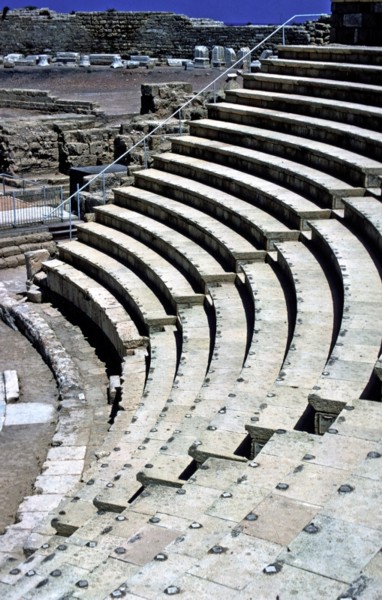
Ruins of the Roman theater at Caesarea

Ruins of the Roman theater at Caesarea

We left the book of Acts after chapter 20, as Paul was in Miletus, with his tearful goodbye to the Ephesian elders. While in that area, Paul wrote the letters to the Corinthians and to the Romans. Now, as he said in his letter to the latter, he is leaving for Jerusalem. They sailed past Cos, Rhodes, Patera, Cyprus and landed at Tyre, where they remained for seven days, then on to Ptolemais and finally Caesarea before setting off on foot to Jerusalem. While in Caesarea, they stayed at the house of Philip, who Luke says was “one of the seven.” Most likely he means that he was one of the seven chosen to serve in Acts 6:1-6, and was the same Philip who converted the Ethiopian eunuch. And after that event, he did end up in Caesarea (Acts 8:40).

Agabus (the prophet who predicted the famine in Acts 11:2-28) came from Judea to tell how the Jews at Jerusalem will bind and deliver Paul into the hands of the Gentiles (verses 10-14). Luke and the others present tried to persuade Paul not to go, but he told them that he was not only ready for prison, but even to die for the Lord Jesus. Notice though, that the words from the prophet were not quoted in these verses as a warning to prevent him from going – but as a statement of fact (verse 11); and Luke and the others finally said “Let the will of the Lord be done.”


Schedule for this week

Read or listen to audio of this week’s selection from Acts here
Read or listen to audio of this weeks selection from 2 Chronicles here

/Bob’s boy
___________________

some images © V. Gilbert & Arlisle F. Beers

Please visit this site’s menu item “The Author’s Books” for info on the author’s books, website, and Facebook page.

All of my comments in this blog are solely my responsibility. When reading any commentary, you should always refer first to the scripture, which is God’s unchanging and unfailing word.