Major Prophets (part 3) Book of Jeremiah

Prophet Jeremiah, Russian icon from first quar...

Prophet Jeremiah, Russian icon from first quarter of 18th cen. (Photo credit: Wikipedia)

The Book of Jeremiah is one of the books of the “major prophets,” which are so called not because they are more important than those that we know as the “minor prophets,” but because of their length. There are 5 books of major prophets (Isaiah, Jeremiah, Lamentations, Ezekiel, and Daniel) compared to twelve of minor prophets. Jeremiah is 52 chapters in length.

Jeremiah was a preacher of God’s word – a priest. He was called to be a prophet about 627 B.C. as a youth (Jeremiah 1:6), and served as such for 40 years (Jeremiah 1:2-3), making it likely that he was born ~650-645 B.C. He became a priest living in Anathoth – the land of Benjamin (Jeremiah 1:1). This was where Abiathar, the high priest during David’s reign, lived. But Jeremiah’s ancestral heritage is unknown. Abiathar was removed as priest by Solomon for his part in support of Adonijah (1 Kings 2:12-27), which fulfilled the Lord’s prophecy of the end of the house of Eli as priests way back in 1 Samuel 2:27-36.

Jeremiah is referred to by many as “the weeping prophet” (see this previous post on Lamentations). But this tends to convey a mistaken image of him as weak. Jeremiah was anything but weak. He lived a very difficult life, and was imprisoned, nearly put to death (Jeremiah 26), and even banned from the Temple for preaching the truth as God told Him (Jeremiah 36:5).

At least part of the Book of Jeremiah was dictated to his scribe, Baruch, to write on scroll (Jeremiah 36:1-4). Some scholars have referred to the book by such descriptions as a “scrapbook” or diary that was pieced together by topic or content. The book is not in chronological order, and remembering that as one reads it helps put things in context. For that reason, we have included an approximate chronological order for the book at the end of this blog.

English: "Jeremiah Dictating His Prophecy...

English: “Jeremiah Dictating His Prophecy of the Destruction of Jerusalem to Baruch the Scribe,” oil on canvas, by the American artist Washington Allston. 89 3/8 in. x 74 3/4 in. Yale University Art Gallery, gift of Samuel Finley Breese Morse, B.A. 1810. Courtesy of Yale University, New Haven, Conn. (Photo credit: Wikipedia)

The book is set in the time after the fall of the Assyrians and the rise of the Babylonians to power. Jeremiah witnessed the capture and removal of multiple groups of the people of Judah to Babylon, as well as the destruction of Jerusalem and the Temple. He was called to speak to God’s people during the times of revival under king Josiah, and continued on past the final fall to Babylon.

Summary of Jeremiah

Approximate Chronolgical Order

  • During the reign of Josiah
    • In the 13th year – Chapter 1
    • Later years of Josiah’s reign – Chapters 2-6 and probably a great deal of chapters 7-20
  • During the reign of Jehoiakim
    • Early in his reign – Chapter 26 and probably 7:1-8:3; 22:1-23
    • During the 4th year Chapters 25; 36; 45; 46:1-12
    • After the 4th year – Chapter 35
  • During the reign of Jehoiachin
    • Chapters 22:24-30 and probably ch. 14
  • During the reign of Zedekiah
    • At beginning – Chapters 24 and 49:34-39
    • In the fourth year – Chapters 27-28; 51:59-64
    • In other years – Chapters 21 and 29
    • In early seige, pause, and resumption of seige – Chapters 34, 37, 32; 33; 38; 39:15-18
  • In Judah after Jerusalem’s fall – Chapters 39:1-4; 40:1-43:7
  • In Egypt, after Jeremiah taken there – Chapters 43:8-44:30
/Bob’s boy
___________________
image © V. Gilbert & Arlisle F. Beers

All of my comments in this blog are solely my responsibility.  When reading ANY commentary, you should ALWAYS refer first to the scripture, which is God’s unchanging and unfailing word. Reading schedules, as well as a link to the site where you can get the reading plan that I’m currently following for yourself can be found on the “Bible Reading Schedules” page of my website at http://graceofourlord.com.  

Major Prophets (part 2) Book of Isaiah

In chapter 6, Isaiah recalls the time of his call to be a prophet. We know from verse one that this was about 740-739 B.C., as that was most likely the year that King Uzziah (2 Chronicles 26) died. Isaiah lived long enough to write of the death of Sennacherib (Isaiah 37:37-38), the Assyrian king who reigned until 681 B.C.

English: Isaiah; illustration from a Bible car...

English: Isaiah; illustration from a Bible card published by the Providence Lithograph Company (Photo credit: Wikipedia)

Traditional secular Jewish and Christian writings state that Jeremiah and Isaiah were the two prophets referred to by the Hebrew writer as having been “sawn in two” (Hebrews 11:37). These writings refer to the persecution under Manasseh, the king of Judah from 687-642 B.C. Other writings in the Book of Isaiah can be dated as well. Chapter 7 was written about 735 B.C.  Chapters 36-38 can be dated about 701, which is the time of the Assyrian invasion.

The book opens with an indictment of the people of Israel, and the declaration that Israel has no excuse for its apostasy (Isaiah 1:1-10). It lists God’s requirements of the people of Israel in order to avert the coming judgment (Isaiah 1:16-20), It also contains the lament over Jerusalem and its coming fate (Isaiah 1:21-23), and a declaration of God’s coming judgment upon the people (Isaiah 1:24-31).

Isaiah is considered to be the most prophetic book of the Bible, and is quoted in the New Testament over 400 times.  The most well-known of his Messianic prophecies are in what is known as the “Suffering Servant” songs. The most beautiful and best understood prophecies that are a source of understanding of the Savior’s purpose as the Messiah are contained in Chapter 53.

/Bob’s boy
___________________
image © V. Gilbert & Arlisle F. Beers

Please note: I did not design the reading plan that I am following in my blog.  All of my comments in this blog, however, are solely my responsibility.  When reading ANY commentary, you should ALWAYS refer first to the scripture, which is God’s unchanging and unfailing word. Reading schedules, as well as a link to the site where you can get the reading plan that I’m currently following for yourself can be found on the “Bible Reading Schedules” page of my website at http://graceofourlord.com.  

Book of Nehemiah – Putting Up a Wall

English: Building the Wall of Jerusalem; as in...

English: Building the Wall of Jerusalem; as in Nehemiah; illustration from Sunrays quarterly (Photo credit: Wikipedia)

There has been much speculation about the author of the Book of Nehemiah. Many believe that the same person that wrote it also wrote the Book of Ezra, but the fact is that we just do not know that; and this writer strongly disagrees. Also, the insistence by many that part of Nehemiah was written by someone other than the prophet himself seems very misguided. For one thing, the opening sentence declares the scripture as “The words of Nehemiah the son of Hacaliah.”

Secondly, although there are a very few select references to “Nehemiah, the governor,” practically the entire book is written in the first person voice. As we have mentioned before, it hardly matters, but there are often good reasons for a lapse into third person narrative mode, particularly when recounting detailed historical events. And it should be noted that the prophet is still writing in the first person throughout the final chapter.

Thanks to Verse one of the first chapter, we do know to the month and year when the news of the destruction of Jerusalem’s wall was brought to Nehemiah. The month of “Chislev” was the ninth month (November/December). “The twentieth year” refers to the twentieth year of the reign of Artaxerxes, which would make it 445 B. C. The reference to Hanani as Nehemiah’s brother in verse 2 is repeated in Nehemiah 7:2, and it seems to mean the relationship was in the literal sense of the word.

Why was the news of the wall’s destruction so devastating to Nehemiah? A city’s walls were much more than a defensive structure. It had tremendous symbolic value, and was a large part of what made a city a real and recognizable city. Without it, civil and sociological progress and status would all be hindered. Jerusalem would be no more significant than a large encampment. Without a wall, there could not even be a single city gate! Beyond their functional use, the gates themselves were significant as gathering places and for conducting business in an important city. Now, they too were gone.

The Persian Empire had reached its height under Cyrus the Great, having added to its borders by swallowing up the Babylonian Empire, including Elam, and its capital, Susa in 540 B.C. It was there that Nehemiah resided as the book opens, serving as the cupbearer to king Artaxerxes (Nehemiah 1:1, Nehemiah 1:11). The Persians had added Israel and Judah to their holdings, and they were known as “Beyond the River” (Nehemiah 2:7). Having released the people of Judah, who had become known as Jews, per the decree of Cyrus, the former captives had begun returning in waves. Following the news from Hanani and the others, Nehemiah obtained the king’s permission to go to Jerusalem, and set out on his journey (Nehemiah 2:7-8).

Nehemiah worked in Susa as a personal assistant for the king of the vast Medo-Persian Empire. When he heard that the rebuilding projects in Jerusalem were progressing slowly, he asked the king if he could go there to help his people complete the task of rebuilding their citys walls. The king agreed to let him go; so he left as soon as possible, traveling along much the same route Ezra had taken.

Nehemiah worked in Susa as a personal assistant for the king of the vast Medo-Persian Empire. When he heard that the rebuilding projects in Jerusalem were progressing slowly, he asked the king if he could go there to help his people complete the task of rebuilding their citys walls. The king agreed to let him go; so he left as soon as possible, traveling along much the same route Ezra had taken.

Chapters 8-10 hold very important significance. The passage includes what is known as the Great Water Gate Revival (a gathering in the square before the Water Gate) and the covenant renewal. A key part of this was the reading of the Law. For many of them, this would be the first time they had ever heard the entire Law of Moses read to them; and it was a very emotional and profound experience.

The Book of Nehemiah is a passionate story of a man’s determination to get something very important done. But it must be remembered that it was the execution of God’s will. God was determined to get the people back entrenched in the work of serving Him as God’s people in their own land after the exile. And when God wants something done, it gets done. Fairly short work was made of what seemed at the outset to many to be a monumental task that could easily take years. The wall was finished in 52 days (Nehemiah 6:15)! But the Book is full of historical detail and makes more complete the renewal of reinstating Mosaic Law that Ezra had begun in the previous chapter.

/Bob’s boy
___________________
image © V. Gilbert & Arlisle F. Beers

Please note: I did not design the reading plan that I am following in my blog.  All of my comments in this blog, however, are solely my responsibility.  When reading ANY commentary, you should ALWAYS refer first to the scripture, which is God’s unchanging and unfailing word. Reading schedules, as well as a link to the site where you can get the reading plan that I’m currently following for yourself can be found on the “Bible Reading Schedules” page of my website at http://graceofourlord.com.  

Book of Ezra – Rebuilding the Temple

English: The Jews Return to Jerusalem in the T...

English: The Jews Return to Jerusalem in the Time of Cyrus; as in Ezra 1:1-11; illustration from a Bible card published by the Providence Lithograph Company (Photo credit: Wikipedia)

The Book of Ezra is one of the books of the Old Testament that is generally classified as one of the books of history. The book is only 10 chapters long; and the first 6 chapters are written about events that occurred before Ezra came on the scene, beginning in 539 B.C. (Ezra did not arrive until 458 B.C.). Although Ezra 7:27 – 9:15 is written in the first person, indicating that Ezra wrote them, the first six chapters (as well as chapter 10) are written in the third person, leaving open the possibility of a different author for those chapters.

Ezra 7:27 – 9:15 is often called the Ezra Memoir. It hardly matters, but the reader should keep in mind the possibility that Ezra wrote that portion in that voice to differentiate the time periods, pointing out that the first six chapters predated him. Chapter 10 is largely a historical record. It documented those who had “broken faith,” taking foreign wives and having children with them. It is thought by some that the author of Ezra wrote the book of Nehemiah. Early rabbinical writings indicate that the two books were counted together as one book. Ezra’s arrival in 458 B.C., over 80 years after the book began, preceded the arrival of Nehemiah (445 B.C.) by 13 years.

English: Ezra Reads the Law to the People (Neh...

English: Ezra Reads the Law to the People (Neh. 8:1-12) Русский: Священник Ездра читает народу Закон (Неем. 8:1-12) (Photo credit: Wikipedia)

As the first verse of the book tells us, that the word of the Lord by the mouth of Jeremiah might be fulfilled,” the book begins with the time of captivity coming to an end. Ezra begins the story of the small remnant of Jews that returned to their ravaged land, including the building and dedication of the second temple . Ezra 2:64, following a more detailed account, tells us that their number “together was 42,360, 65 besides their male and female servants, of whom there were 7,337, and they had 200 male and female singers. Their horses were 736, their mules were 245, their camels were 435, and their donkeys were 6,720.” The book tells of the remnant’s struggle to regain and retain their identity as a chosen people.

For more information on the Proclamation of Cyrus and a link to the archaeological artifact known as the Cyrus Cylinder, which was found in the ruins of Babylon in 1879, see this previous post.

Key Events

  • Cyrus king of Persia captures Babylon     (539 B.C.)     Dan. 5:30–31
  • King Cyrus issues a decree freeing Jewish exiles to return     (538–537 B.C.)     Ezra 1–2
    • The remnant of Jewish exiles, led by Sheshbazzar, return  Jerusalem     (~537 B.C.)     Ezra 1:11
  • The rebuilding of the altar     (537 B.C.)      Ezra 3:1–2
  • The remnant rebuilds the Temple at its original location      (536 B.C. – 516 B. C.)     Ezra 3:8–6:22
    • Opposition and conspiracies against rebuilding / rebuilding ceases      (530-5B.C.)      Ezra 4:24
    • Rebuilding resumes (2nd year of the reign of Darius)     (520 B.C.)     Ezra 5:2; Hag. 1:14
    • Construction completed      (516 B.C.)       Ezra 6:15
  • Ezra the Priest leaves Babylon and comes to Jerusalem to teach the people and establish Mosaic Law (arrives in the 7th year of the reign of Artaxerxes)    (Ezra 7–8)
    • King Artaxerxes gives Ezra the authority to establish the law of Moses     Ezra 7
    • Ezra sets out for Jerusalem with more remnants, bringing royal gifts for the temple      Ezra 8
  • Ezra confronts the issue of Intermarriage / marriage to idolaters      Ezra 9–10
    • The people agree to dissolve the marriages      Ezra 10:1–17
    • Assembly of men from Judah and Benjamin in Jerusalem      (458 B.C.)      Ezra 10:9
    • Investigation  lasts 3 months   (458–457 B.C.)     Ezra 10:16–17
    • The guilty are documented      Ezra 10:18–44
/Bob’s boy
___________________
image © V. Gilbert & Arlisle F. Beers

Please note: I did not design the reading plan that I am following in my blog.  All of my comments in this blog, however, are solely my responsibility.  When reading ANY commentary, you should ALWAYS refer first to the scripture, which is God’s unchanging and unfailing word. Reading schedules, as well as a link to the site where you can get the reading plan that I’m currently following for yourself can be found on the “Bible Reading Schedules” page of my website at http://graceofourlord.com.  

Book of Joshua (Part 2) – Taking the Promised land

Ai - Joshua's soldiers were first defeated here, but then God provided a stunning victory.

Ai – Joshua’s soldiers were first defeated here, but then God provided a stunning victory.

Picking the Book of Joshua back up in chapter 9, the next few chapters are filled with more conquest, and a deception that will have lasting consequences.

  • The Gibeonite Deception (Joshua 9:1-27).  Upon hearing of what had happened at Jericho and Ai, the various Canaanite kings gathered together and joined forces to do battle against the approaching Israelites.  But the people of Gibeon came up with a plan of their own.  Altering their appearance to make themselves look like they had traveled a long distance, they went straight to the Israelite camp and to Joshua, claiming they had come from a distant country, and asking to make a covenant with them.
    • The deception worked, and they extracted an oath of cooperation and protection from the leaders and elders of the congregation.  When the deception was discovered, the anger of the people was kindled, but the oath had been made and would be honored.  But  because of their trickery, many of them would serve the congregation forever, just like servants, as woodcutters and drawers of water.
    • So just as the Lord (and Moses) had specifically warned them many times not to do (as in Deuteronomy 7:2), the Israelites had made a covenant with people in Canaan before the battles were even half over.  And the blame for this horrible mistake lays in their failure to seek counsel from the Lord (Joshua 9:14-15).
  •    The defense of Gibeon and the conquest of the south (Joshua 10:1–43)
    • Gibeon_001

      Gibeon, view north of El Jib; the Gibeonites tricked Joshua to make a treaty with them.

      Gibeon was no small city, and its men were known warriors.  So when the king of Jerusalem, Adoni-zedek, heard of the peace between them and Israel, he was afraid.  Summoning the kings of Hebron, Jarmuth, Lachish, and Eglon, he gathered all of their forces to make war against Gibeon.  The men of Gibeon then went to Joshua at Gigal seeking their help.

    • Bound by the oath they had made, Joshua prepared his mighty men to do battle, and the Lord told him in Joshua 10:8 “Do not fear them, for I have given them into your hands. Not a man of them shall stand before you.”  It was during this battle that the famous “long day” occurred, upon which Joshua commanded the sun to “stand still.”  For our comments on this event, see this previous post.

    • After the victory, Joshua and the men hunted down and executed the five kings.  Then, with God fighting on their side, they won victory after victory in the south, capturing their kings and taking the land “from Kadesh-barnea as far as Gaza.”

  • Joshua 11-12 details the victories of the Israelites in the northern part of the land, with Joshua 12:1-6 recounting the kings that had been defeated under the leadership of Moses (some of which was told in Numbers 21).
/Bob’s boy
___________________
image © V. Gilbert & Arlisle F. Beers

Please note: I did not design the reading plan that I am following in my blog.  All of my comments in this blog, however, are solely my responsibility.  When reading ANY commentary, you should ALWAYS refer first to the scripture, which is God’s unchanging and unfailing word. Reading schedules, as well as a link to the site where you can get the reading plan that I’m currently following for yourself can be found on the “Bible Reading Schedules” page of my website at http://graceofourlord.com.  For questions and help, please see the “FAQ” and “Summaries” pages there.

Book of Joshua (Part 1) – Into the Promised land

The Book of Joshua begins with God affirming the commission of Joshua as Moses’ successor and instructing him in his duties.  Then comes the job of moving an entire nation of people across the Jordan River into Canaan, followed by the actual task of setting about to take the land that has been promised to them.

Crossing into Canaan (Joshua 1-5)

  • God commissions Joshua, giving him His instructions and charging him with responsibility for His people (Joshua 1).
  • Joshua sends two spies to survey the land, particularly Jericho (Joshua 2:1).  At the house of Rahab, they receive her kindness and she gets a promise from them that she and her family will be saved when the invading force enters (Joshua 2).  This is an important event leading to the coming of Christ for two reasons.  First, Rahab is directly in the genealogical line of Jesus Christ (Matthew 1:1-5).  Secondly, it demonstrates God’s saving grace for others in addition to the Israelites.
  • The Jordan River is the only flowing body of water in ancient Palestine. It winds its way from the north into the Sea of Galilee, then empties at the southern end of the sea and resumes its serpentine path until it ends completely in the Dead Sea. Although it is only 70 miles from the Sea of Galilee to the Dead Sea, the river winds 200 miles. Before it enters the Sea of Galilee, it drops 800 feet, then another 600 feet on its way to the Dead Sea. The Jordan River as it leaves the Sea of Galilee.

    The Jordan River is the only flowing body of water in ancient Palestine. It winds its way from the north into the Sea of Galilee, then empties at the southern end of the sea and resumes its serpentine path until it ends completely in the Dead Sea. Although it is only 70 miles from the Sea of Galilee to the Dead Sea, the river winds 200 miles. Before it enters the Sea of Galilee, it drops 800 feet, then another 600 feet on its way to the Dead Sea. The Jordan River as it leaves the Sea of Galilee.

    The Israelites cross the Jordan into Canaan (Joshua 3-4).  The Levitical priests are instructed to carry the Ark of the Covenant 2000 cubits (about 1/2 mile) ahead of everyone else.  In a scene most reminiscent of the crossing of the Red Sea, God causes the waters of the Jordan to stand apart and rise, leaving dry ground for first the priests with the ark, and then the people, to cross over.  This highly symbolic event was orchestrated by Joshua at God’s instruction to demonstrate to the people visibly the leadership that had now passed from Moses to Joshua.

    • Twelve stones (one for each tribe) were gathered from the Jordan and placed as a monument for their descendants to be reminded of this historic event.
  • God’s people observe the first Passover in Canaan (Joshua 5).
    • The sons of Israel (sons of those who had died in the wilderness wandering) are circumcised to prepare for God’s work.
    • After first eating the fruit of the promised land, the manna ceased the next day (Joshua 5:10-12).
    • Joshua encounters a divine manifestation of the Lord in Joshua 5:13-15.

Taking the Land in Canaan (Part 1- Joshua 6-8)

  • In the second battle for Ai in Joshua 8, the Israelites tricked the soldiers of Ai, pretending to run away. This drew the soldiers of Ai from the city. A second army of Israel rushed into the city and set it on fire. Then the city was defeated.

    In the second battle for Ai in Joshua 8, the Israelites tricked the soldiers of Ai, pretending to run away. This drew the soldiers of Ai from the city. A second army of Israel rushed into the city and set it on fire. Then the city was defeated.

    After seven days of marching with the Ark, a final blow of the trumpets and a shout by the people brings the walls of Jericho down (Joshua 6:1-21).

  • Achan’s sin (taking some of the “devoted things” for himself brings about death for about 3,000 in defeat at Ai (Joshua 7).
  • Renewed by the Lord, Joshua takes 30,000 and sets up an ambush that with the Lord’s aid, leads to the fall of Ai.  Joshua builds an altar to the Lord at Mount Ebal, and writes the law of Moses on stones.  With half of the nation, the Levitical priests, elders and all on either side of the Ark in front of Mount Ebal and Mount Gerizim, Joshua blesses them and reads every word of the law (Joshua 8).
/Bob’s boy
___________________
image © V. Gilbert & Arlisle F. Beers

Please note: I did not design the reading plan that I am following in my blog.  All of my comments in this blog, however, are solely my responsibility.  When reading ANY commentary, you should ALWAYS refer first to the scripture, which is God’s unchanging and unfailing word. Reading schedules, as well as a link to the site where you can get the reading plan that I’m currently following for yourself can be found on the “Bible Reading Schedules” page of my website at http://graceofourlord.com.  For questions and help, please see the “FAQ” and “Summaries” pages there.

Book of Numbers (Part 2) – Spies and Rebellion

The Book of Numbers gives us more details and fills in other information in Leviticus and the other Books of the Law.  The  key events for chapter 1:11 through chapter 19 are as follows:

Israel sets out from Sinai to Kadesh

  • The Gershonites and Merarites carry the Tabernacle – Numbers 10:17
  • The Kohathites carry the holy things – Numbers 10:21
  • The glory of the Lord was over them – Numbers 10:34
  • The people complained – God angered at their ingratitude and irreverence, fire at Taberah and plague at  Kibroth-hattaavah – Numbers 11

Miriam and Aaron Speak Against Moses

Moses sent twelve spies into Canaan to see what it was like. Ten gave a bad report of the danger, while Joshua and Caleb gave a good report. (Numbers 13).

Moses sent twelve spies into Canaan to see what it was like. Ten gave a bad report of the danger, while Joshua and Caleb gave a good report. (Numbers 13).

Spies Sent Out to Canaan

Law-giving at Kadesh – (Numbers 15)

Rebellion of rebellion of Korah, Dathan, and Abiram

Aaron’s budding staff – Numbers 17

Duties and privileges of priests and Levites

Cleansing From Death’s Uncleanness

/Bob’s boy
___________________
image © V. Gilbert & Arlisle F. Beers

Please note: I did not design the reading plan that I am following in my blog.  All of my comments in this blog, however, are solely my responsibility.  When reading ANY commentary, you should ALWAYS refer first to the scripture, which is God’s unchanging and unfailing word. Reading schedules, as well as a link to the site where you can get the reading plan that I’m currently following for yourself can be found on the “Bible Reading Schedules” page of my website at http://graceofourlord.com.  For questions and help, please see the “FAQ” and “Summaries” pages there.

Book of Numbers (Part 1) – Census and Dedication

English: Model of the tabernacle, as seen in I...

English: Model of the tabernacle, as seen in Israel, Timna Park Deutsch: Modell der Stiftshütte in Israel, Timna Park. Originalgetreu nachgebaut und begehbar. (Photo credit: Wikipedia)

The Book of Numbers is integral to the other 5 Books of the Law.  The events overlap a great deal with what is written in Leviticus.  In Hebrew, this book is most appropriately named Bemidbar, which loosely translated, means “in the desert – or wilderness.”  The key events for chapters 1 through 10:10 are as follows:

Census and Levite Instructions

  • Chapter 1 – God commanded Moses to take a census in the Sinai wilderness of all of the people of Israel; and specifically exempted the Levites from this census, appointing them care over the tabernacle and its furnishings – including responsibility for taking it down and setting it back up when camp is moved (Numbers 1:47-51).
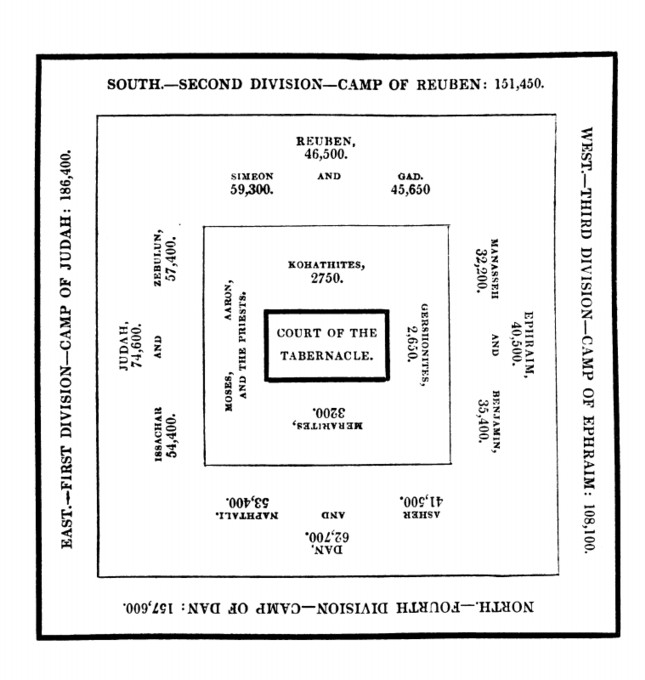
  • Chapter 2 – The Lord reveals the arrangement of the tribes when encamped around the Tabernacle.
  • Chapter 3 – The Lord gives Moses commandments about the Levites; claiming Levites for His own to be priests in Israel, and redeeming all of the first born of the tribes (Numbers 3:44-51).
  • Chapter 4 – The Lord orders a census of the Kohathites, Gershonites, and Merarites, and spells out the duties for the sons of Kohath in Numbers 4:4-15, the sons of Gershon in Numbers 4:24-28, and the sons of Merari in Numbers 4:31-33.

Cleansing of the camp

Completion of the tabernacle

/Bob’s boy

___________________
image © V. Gilbert & Arlisle F. Beers

Please note: I did not design the reading plan that I am following in my blog.  All of my comments in this blog, however, are solely my responsibility.  When reading ANY commentary, you should ALWAYS refer first to the scripture, which is God’s unchanging and unfailing word. Reading schedules, as well as a link to the site where you can get the reading plan that I’m currently following for yourself can be found on the “Bible Reading Schedules” page of my website at http://graceofourlord.com.  For questions and help, please see the “FAQ” and “Summaries” pages there.

Old Testament Facts – Why Read Leviticus?

The third book of the Pentateuch (the Books of Law) – Leviticus – is one of the least understood books of the Bible and, not surprisingly, one of the least read.  Many “read the whole Bible in a year” reading plans have come to a dead stop in the early chapters of this book.  And without question, it can be a difficult book to get through.  But there is much to learn from it that is very relevant to our understanding of the worship of the Lord and the ultimate coming of Jesus the Christ.

Leviticus

In the Septuagint, this book is called “leyitikon,” which means “things concerning Levites.”  There is much that applies to God’s people in general, both with moral and ethical values, as well as with ritual purity.  But the name is appropriate because the Levites were those that were charged with seeing that ritual adherence was maintained. 

It is important for those who read these Scriptures today to remember that although some aspects of these rituals seem strange and difficult at times to understand, it is still the word of God, and there is much we can learn from it.  This is especially true as we relate it to the sacrifice of Jesus Christ, which unlike these offerings, provides for true forgiveness.  A close study of the different offerings will give the reader a deeper understanding and appreciation of the cross.  It is important in that study to know that ritual “uncleanness” and purity have nothing to do with hygiene; and equally important to know the difference (as well as the connection) with moral purity.

So what can we possibly learn from Leviticus that is relevant to New Testament Christianity?

The answer, it turns out, is plenty:

  • The Lord is to dwell with them (Exodus 40:34), so it is the duty of His people to deal with their sins and drive themselves toward holiness.
  • The Lord expects worship to Him to be done according to His will, and He does “sweat the details” (Leviticus 22:17-30)
  • As per the Day of Atonement ritual (Leviticus 16), the cleansing of sins is impossible from the human side.
  • Spiritual leaders bear a heavy burden of responsibility (Leviticus 4, Lev 21).  Compare to elders in 1 Timothy 5:17-25, for example.
  • Sin is dealt with by the grace of the Lord (Leviticus 17:11).

   Key Concepts and Events

/Bob’s boy
___________________
image © V. Gilbert & Arlisle F. Beers


O T Facts (First Book of Law) – Genesis

In this installment of our Old Testament Facts series, we will focus today on the first book of the Pentateuch – Genesis, the first “Book of Law.”   This is not intended to be an exhaustive list of events of this book.  Rather, it is presented as a summary of events that seem most relevant to worship of the Lord and the ultimate coming of Jesus the Christ.

Creation_003Genesis

The book of the beginning and of new beginnings

Genesis 1 – Creation of the universe

Genesis 2 – Adam and Eve created

Genesis 3 – “The fall” – sin enters the world; first promise of the Messiah (Gen 3:15)

Genesis 4 – Cain murders Abel

Genesis 6–9 – Noah and the flood

Mamre, near Hebron. Abraham's home at one time

Mamre, near Hebron. Abraham’s home at one time

Genesis 12 and 15 – God’s covenant with Abraham (promise of land, a “great nation” and the Messiah)

Genesis 21 – Birth of Isaac

Genesis 32:28, Gen 35 – God names Jacob “Israel” (meaning God fights)

Genesis 37 – Joseph sold into slavery

Genesis 41 – Joseph rises to power in Egypt under Pharoah

Genesis 46 – Joseph brings his family to Egypt, is reunited with Jacob

Tabernacle - arrangement of tribes

Tabernacle – arrangement of tribes

Genesis 48 – Jacob (Israel) blesses Joseph’s sons Ephraim and Manasseh, claims them as “his” (Gen 48:5-6), again favoring the younger (Ephraim) over the first-born (Genesis 48:14-20).

Genesis 49 – Jacob blesses his sons, but declares that Simeon and Levi (their descendants) will be scattered among the other tribes (Gen 49:5-7).  So the Twelve Tribes of Israel are named – to include Ephraim and Manasseh (Genesis 49:3-28).  Jacob’s death and burial (Genesis 49:29-50:14).

Genesis 50:22-26 – Death of Joseph – end of Genesis

/Bob’s boy

___________________
image © V. Gilbert & Arlisle F. Beers

Please note: I did not design the reading plan that I am following in my blog.  All of my comments in this blog, however, are solely my responsibility.  When reading ANY commentary, you should ALWAYS refer first to the scripture, which is God’s unchanging and unfailing word. Reading schedules, as well as a link to the site where you can get the reading plan that I’m currently following for yourself can be found on the “Bible Reading Schedules” page of my website at http://graceofourlord.com.  For questions and help, please see the “FAQ” and “Summaries” pages there.