King David’s Favor With God (1 Chronicles 17-18)

English: Nathan advises King David

English: Nathan advises King David (Photo credit: Wikipedia)

It was important for the chronicler to communicate well the events of I Chronicles 17 to the post-exilic Jews because it contains the covenant of God with David. Covered first in 2 Samuel 7, it begins with David wanting to build God a house. But God tells Nathan the prophet to let David know that it would not be him that builds such a house. Instead, God promises that He would build David’s “house” – that David’s offspring (Jesus) would reign forever.

In answer to God’s covenant, David makes a prayer to God (verses 16-27). It is one of the longest prayers in the bible, and incredibly humble and heartfelt. It begins with “Who am I, O Lord God, and what is my house, that you have brought me thus far?” They are words that each of us should ask God in prayer as well. The blessings that He has given us and the promises He has made to us are no less magnificent and undeserved that those made to David.

Hama

Hama (Photo credit: Wikipedia)

Chapter 18 contains some stunning military victories, some of which were reported in 2 Samuel 8. Here, David defeats the Philistines, and also takes Gath. The Moabites are defeated and become servants to David. He also “defeated Hadadezer king of Zobah-Hamath, as he went to set up his monument at the river Euphrates.” The plunder he took from the cities of Hadadezer included 1,000 chariots, 7,000 horsemen, and 20,000 foot soldiers, and shields made of gold.

In addition, verse 9 tells us that Tou king of Hamath was so pleased when he heard of the defeat of Hadadezer that he sent his son with gifts of gold, silver and bronze that Solomon would later use in building the pillars and the sea, and the bronze vessels for the temple.  Hamath is associated with modern Hama, which is located on the Orontes River in western Syria. There is an article with a picture there of a noria (a machine for lifting water into an aqueduct) at this link to Ferrell’s Travel Blog. We also recommend this article at BiblePlaces.com and this one at BiblicalArcheology.org for information on discoveries related to Tou (also called Toi and possibly Taita).

The victories continue against the Syrians and 18,000 Edomites in the Valley of Salt. And the text says that God gave victory to him wherever he went. Verses 14-17 detail how just and fair David was as a ruler, and how stable and well-organized his administration was. Joab was established as military commander, and “Jehoshaphat the son of Ahilud was recorder; and Zadok the son of Ahitub and Ahimelech the son of Abiathar were priests; and Shavsha was secretary; and Benaiah the son of Jehoiada was over the Cherethites and the Pelethites; and David’s sons were the chief officials in the service of the king.”

(This year’s reading plan for Luke, Acts, and 1 and 2 Chronicles averages just 15 verses per day – 5 days per week!)
Schedule for this week
Read or listen to audio of today’s selection from Luke here
Read or listen to audio of today’s selection from 1 Chronicles here

/Bob’s boy
___________________
some images © V. Gilbert & Arlisle F. Beers

Please note: I did not design the reading plan that I am following in my blog.  All of my comments in this blog, however, are solely my responsibility.  When reading ANY commentary, you should ALWAYS refer first to the scripture, which is God’s unchanging and unfailing word. Reading schedules, as well as a link to the site where you can get the reading plan that I’m currently following for yourself can be found on the “Bible Reading Schedules” page of my website at http://graceofourlord.com.  

Enhanced by Zemanta

Shake Off the Dust – (Luke 9)

The opening verses of Luke chapter 9 are about one of the times that Jesus sent His apostles out “to proclaim the kingdom of God and to heal.” In it, Luke tells us that He had given them the power and authority over all demons, and to cure diseases. Jesus gave them instructions about choosing who to stay with, and to “shake the dust from their feet” when they and their message are not well received. This is akin to what Jesus said about not casting “your pearls before swine” in Matthew 7:6. Wasting one’s time continuing to try to convince someone who refuses to hear the truth means time lost that could be used to help someone who will listen. Verse 6 tells us that “they departed and went through the villages, preaching the gospel and healing everywhere.” These facts are the only important points of these few verses.

Jesus' discples were honored to listen to Him teach daily. Jesus had special teaching for The Twelve, His twelve disciples or apostles

Jesus’ discples were honored to listen to Him teach daily. Jesus had special teaching for The Twelve, His twelve disciples or apostles

Nevertheless, we feel the need to address something of less importance here. This account is contained in all three synoptic gospels (see Matthew 10:5-15 and Mark 6:7-13), but there is some difference in the Greek, and in the way that the three writers use those different verbs that is very puzzling, when one compares them (Mark actually appears to tell them to take a staff, while the others say that Jesus said not to). This, of course, makes them very ripe for skeptics who devote their time to trying to prove that there are contradictions in God’s word. There is no contradiction, of course. But this is perhaps the most difficult example to understand, and requires no small amount of critical analysis in order to do so.

Before beginning this analysis, it is important to understand that all three gospel writers are trying to convey a couple of important facts that are related to the confusing language. The first is that the apostles’ mission in this instance is urgent, and time is of the essence. Jesus has plans to send out “the seventy-two” to do the same thing in Luke 10 after the apostles get back (notice that the 72 are told not to carry any sandals, etc.). This training is important, and He has much more training for His apostles, many more miracles to perform, and a great deal of other teaching to do before “His time” is up. Secondly, part of the training Jesus is giving them is to teach them to depend on (and trust) God for their needs.

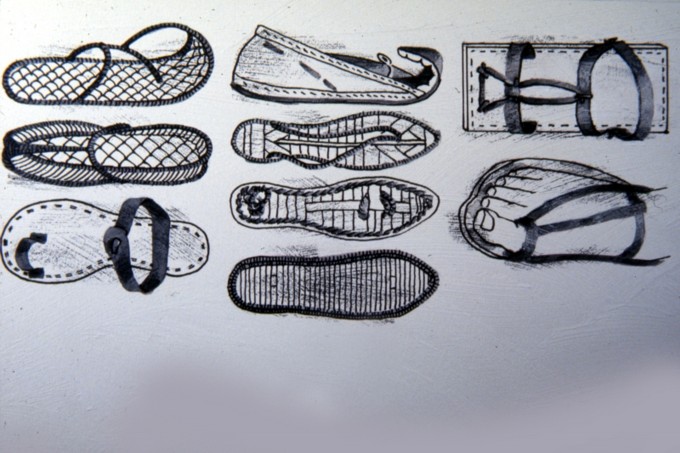
Bible-time shoes were often sandals, such as these.

Bible-time shoes were often sandals, such as these.

So in light of all of this, what the three gospel writers are conveying is that Jesus wants them to go now, and as they are, and do not take extra provisions. Matthew uses the Greek word “ktaomai,” meaning they are not to acquire or procure the things mentioned there. Mark uses the word “airo,” meaning “to take” – instructing them to take the things He tells them to, but not others, and to wear sandals, but to not put on two tunics.

But Luke, in telling them not to take the things mentioned here, does not use the word “ktaomai” because when he uses that word, he uses it in the sense of meaning “to buy or earn” (as in  Luke 18:12, Acts 1:18, and Acts 8:20). Instead, he uses the word “airo,” but he uses it in the sense of the meaning “to acquire” – meaning do not acquire these things (as in Luke 19:21-22). He certainly would not be telling them that they must take their sandals off and leave them behind!

(For a more detailed analysis, please see this article at ApologeticsPress.org).

(This year’s reading plan for Luke, Acts, and 1 and 2 Chronicles averages just 15 verses per day – 5 days per week!)
Schedule for this week
Read or listen to audio of today’s selection from Luke here
Read or listen to audio of today’s selection from 1 Chronicles here

/Bob’s boy
___________________
some images © V. Gilbert & Arlisle F. Beers

Please note: I did not design the reading plan that I am following in my blog.  All of my comments in this blog, however, are solely my responsibility.  When reading ANY commentary, you should ALWAYS refer first to the scripture, which is God’s unchanging and unfailing word. Reading schedules, as well as a link to the site where you can get the reading plan that I’m currently following for yourself can be found on the “Bible Reading Schedules” page of my website at http://graceofourlord.com.  

Enhanced by Zemanta

It’s the Camel Fallacy (Again!)

If one has studied apologetics for a considerable length of time, the recent news stories about the camel bones proving the Bible wrong might very well lead one to react by saying “again? seriously?” The whole thing has been answered quite thoroughly many times already. And not so surprising is the glaring fact that only when disputing the Bible would a conclusion based upon a logical fallacy be so widely reported in the media.

Camel_220214In case you haven’t seen any of the stories, here is a brief summary. The Bible first begins to mention camels as domesticated (in the sense of someone possessing them, rather than simply being in the wild) in Genesis 12:16. Abram and Sarai have come to Egypt, and it is Pharoah that has them, among his other livestock. But we find Abraham himself, Isaac, and Jacob all in possession of the humped animal as well; and the time period is generally accepted as being from 2000 – 1500 BCE.

The source of the dispute is the fact that researchers from Tel Aviv University have studied the bones of camels found at the site of ancient copper mines near the Dead Sea. Through radiocarbon dating, they have determined that the camels were used in those operations around the end of the 10th century BCE. In fairness to these learned researchers, it should be pointed out that (despite what the news stories say) these researchers only wrote one thing in their report that is related to the “patriarchal narrative” (that would be the word of God, folks):

“This together with the depiction of camels in the Patriarchal narrative, has generated extensive discussion regarding the date of the earliest domestic camel in the southern Levant.”

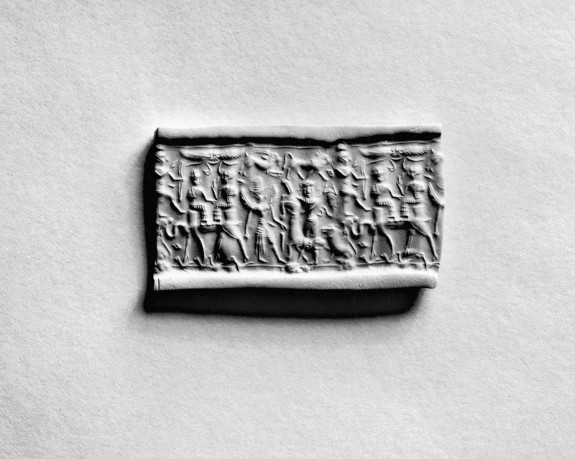
This seal shows a divine couple sitting on the two humps of a Bactrian camel, one of the earliest images of this animal. Above them hovers a winged rosette, which is a protective emblem. A smaller figure holding a bow stands on the head and neck of the camel. A winged female deity, stands off to the side, facing a contest between a man and a beast. The surrounding space is filled with a variety of animals, including a lion, scorpion, bull, and gazelle. 1800-1650 BC (Syria II-III)

This seal shows a divine couple sitting on the two humps of a Bactrian camel, one of the earliest images of this animal. Above them hovers a winged rosette, which is a protective emblem. A smaller figure holding a bow stands on the head and neck of the camel. A winged female deity, stands off to the side, facing a contest between a man and a beast. The surrounding space is filled with a variety of animals, including a lion, scorpion, bull, and gazelle. 1800-1650 BC (Syria II-III)

That’s it. All of the other titles in articles (some we list below) contain things that these researchers did not say. Okay, so now that we have covered that, what is the big deal? Well, since no bones of camels have been found in Israel at sites known to be older than that date, that has led others to the conclusion that there were no domesticated camels in Israel prior to the 10th century BCE. This would mean that the writers of the Old Testament books had to have just inserted camels into the narrative mistakenly because they didn’t exist there at the time they were writing about.

The headlines of the fore-mentioned news stories range from simply misleading and erroneous to downright irresponsible, outlandish, and even insulting. The Huffington Post’s headline reads “Major Discrepancy in the Bible.” The New York Times article proclaims “Camels Had No Business in Genesis,” and writes: “These anachronisms are telling evidence that the Bible was written or edited long after the events it narrates and is not always reliable as verifiable history.” The “Fashion Times” article headlines the “trending news” “Historical ERROR in Bible’s Old Testament, REVEALED.” We’re still mystified as to what camels and the Bible (error or no error) could possibly have to do with the world of fashion, but we digress.

The logical fallacy here is one known by several names:  “argumentum ad ignorantiam,” “appeal to ignorance” or “absence of eveidence.” One common comment about this is that “absence of evidence is not evidence of absence.” This is certtainly true. But in Todd Bolen’s article at BiblePlaces.com (“The Domestication of the Camel: Observations from Heide”), he quotes the following – more aptly put:

A camel in the Haran area, Turkey, known as Charran in ancient Mesopotamia.

A camel in the Haran area, Turkey, known as Charran in ancient Mesopotamia.

“Proving that something did not exist at some time and place in the past is every archaeologist’s nightmare because proof of its existence may, despite all claims to the contrary, be unearthed at some future date.” (p. 337, Heide, Martin, 2011 “The Domestication of the Camel: Biological, Archaeological and Inscriptional Evidence from Mesopotamia, Egypt, Israel and Arabia, and Literary Evidence from the Hebrew Bible”).

We recently underscored that point when we wrote in this previous post about the fact that skeptics claimed for a very long time that the Hittites were a figment of the Bible writers’ imaginations because no evidence had ever been found of their existence. That is, not until such evidence was found. Then it was discovered that they were a vast empire that dated back to the 14th century BCE.

We could easily be persuaded to believe that the camel was not widely used for domestic purposes by the common people until after the 10th century BCE in Israel, which would be one possible explanation of why a plethora of camel bones from earlier periods has not been found. We should remember that Pharaoh and yes, even Abraham, Isaac, and Jacob had been men of considerable wealth (Genesis 13:2, Genesis 26:12-13, Genesis 30:42-43). Many have suggested that Abraham brought his camels from Egypt, and that is certainly possible. But we should also remember that he had been in Mesopotamia – Haran (Genesis 12:4), and Mesopotamia’s ancient domestication of camels is just as well-documented.

So these wild leaps of unwarranted conclusions give skeptics and scoffers fodder to fan the flames of their frivolous fancies. And we find the unbelievers saying “well of course,  the Bible is not an accurate historical record” (a statement already proven time and again to be so absurd that it hardly deserves comment). And many of those who know that the Bible is the word of God – just wait for the truth. And if perchance convincing physical evidence is found in our lifetimes that categorically dates camel bones in Israel much earlier, you can be sure that the news will be relegated to a small blurb in a very inconspicuous place in most publications.

As for us, we know that Proverbs 30:5 is right: “Every word of God proves true.”

If you want to read the truth about what we know outside of the Bible concerning this subject, we suggest the following articles as examples:

“Abraham’s Camels” – ApologeticsPress.org
“The Annual Camels-Disprove-the-Bible Story” – Todd Bolen, BiblePlaces.com
“The Latest Challenge to the Bible’s Accuracy: Abraham’s Anachronistic Camels?”- ChristianityToday.com
“Bronze Age Camel Petroglyphs In The Wadi Nasib, Sinai” – BibleArcheology.org
“The Domestication of the Camel: Biological, Archaeological and Inscriptional Evidence from Mesopotamia, Egypt, Israel and Arabia, and Literary Evidence from the Hebrew Bible” – Martin Heide

(This year’s reading plan for Luke, Acts, and 1 and 2 Chronicles averages just 15 verses per day – 5 days per week!)
Schedule for this week

/Bob’s boy
___________________
some images © V. Gilbert & Arlisle F. Beers

Please note: I did not design the reading plan that I am following in my blog.  All of my comments in this blog, however, are solely my responsibility.  When reading ANY commentary, you should ALWAYS refer first to the scripture, which is God’s unchanging and unfailing word. Reading schedules, as well as a link to the site where you can get the reading plan that I’m currently following for yourself can be found on the “Bible Reading Schedules” page of my website at http://graceofourlord.com.  

About the Recent Debate…

This past week, a much publicized debate occurred between Bill Nye, the popular ’90’s TV icon known as “the Science Guy,” and Ken Ham, the CEO of the “Answers In Genesis” organization that maintains a website presence with a staff of scientists of their own. The subject of the debate was, as is always the case, in the form of a question. The question that was debated in this instance was “Is creation a viable model of origins. As expected, both of these highly intelligent, educated men presented their positions well. Mr Ham remarked that this type of debate has occurred much less frequently since their popularity 30 years ago or so. What he didn’t say was that the reason is largely because the atheists and agnostics have increasingly avoided these debates because they usually did not do so well. It sometimes works out that way when you go up against the truth.

A message from the founder

A message from the founder (Photo credit: ellenm1)

I understand there were no moments when one of the debaters was totally embarrassed by the other. To my knowledge, there were no mass baptisms following the debate. Neither were there mass closings of churches due to loss of faith. And I suspect that most of the people who watched or listened to the debate did not change from non-believer to believer or vice-versa directly afterward. Those who look at the evidence of the natural world in such cases (on both sides) do so with their own presuppositions and an epistemology that they are mostly committed to; and most of them usually leave with their original worldview mostly intact. 

Don’t get me wrong – I love apologetics. I have spent hundreds upon hundreds of hours studying apologetics, and will likely continue to do so until the day that I die. The more I study – the more evidence from the natural world that I examine, the more certain I become of what I already know to be the truth: “In the beginning, God created the heavens and the earth.” It is the same for bible study. I have read the entire Bible – all of it at least once; and I have spent countless hours studying it. And something occurred to me a long time ago. I am convinced that it is not possible to read and study – and I mean TRULY study – the Bible with an open mind and not realize that it really is the word of God. Take one of the caveats out of that sentence, and yeah maybe. But really study it with an open mind, and I do not believe you can miss knowing that Romans 1:19-20 nails it:

For what can be known about God is plain to them, because God has shown it to them. For his invisible attributes, namely, his eternal power and divine nature, have been clearly perceived, ever since the creation of the world, in the things that have been made. So they are without excuse.

Bill Nye the Science Guy at The UP Experience ...

Bill Nye the Science Guy at The UP Experience 2010. Note: this photo is Creative Commons Attribution. You are welcome to use it with “photo by Ed Schipul” (Photo credit: Wikipedia)

But I really don’t like watching debates any more. In fact, I did not watch very much of this past week’s debate. There, I’ve said it. Fortunately, there is no apologist’s registration card or anything that I now have to surrender. But it’s true. Now, I did tune in to pieces of the recording, and heard much of what I expected. I have read and listened to media about a great deal of what “AnswersInGenesis.org” publishes on their website – and I agree with most of it. Their scientists are top-notch, everything is peer-reviewed, and I love reading it.

And Mr. (Dr.?) Nye was quite eloquent in the segments that I saw. He did use a couple of the emotional plea bits that we have come to expect from non-believers arguing their position. You know the type of statement – “you (Christians) seem to think all of the other faiths (some of them much older than your Bible) are all wrong.” To his credit, he didn’t use the old “are you saying my dear sweet mother is going to hell?” bit that Dan Barker used in a debate a few years ago. But like other debates I have seen in recent years, I just didn’t feel good watching it. I do still listen to one debate that I have probably heard 50 or more times – “The Great Debate” between the late Dr. Greg Bahnsen and Dr. Gordon Stein in 1985. Dr. Bahnsen gave us what I believe was the greatest example of defending the faith of our time. I really never seem to tire of it – because, to me, it was a masterpiece.

bibles

bibles (Photo credit: fancycwabs)

But these other debates just make me sad. And I don’t mean just a little bit. They truly get me depressed; and it’s not hard for me to figure out why. Bill Nye was made in God’s image too. To hear and watch a man with such a brilliant mind (who truly believes in what he is saying), and know that if he continues on the path he is on that he will be lost – that just really hurts my heart. It would be different if I could just believe that he was some sort of monster – an evil man. But I happen to believe that the opposite is true – that he is probably a very good man. He, no doubt, has a family that he loves and who love him; and I am sure that he is good to them. No, I just cannot bring myself to truly dislike the man. And so, the debate makes me sad for him. And sad for all of the others who applaud his efforts to show that only idiots believe the Bible is the word of God.

Something else that makes me sad about it is motivation. I can’t help wondering why those who claim not to believe in God feel the need to evangelize people. It just seems that they feel the need to convince themselves, and that by convincing as many other people as possible, they can feel more confident in their own unbelief. After all, if absolutely nobody but Bill Nye was an unbeliever, it would be hard for him to keep that belief very strong. What I think that Bill Nye – and others like him – just don’t get, is that our (the Christian’s) motivation has nothing to do with anything like that. They seem to believe that we are all about imposing our beliefs on others needlessly. They cannot understand that we evangelize because we want to share something very good with others – and that our desire to help others get to heaven is genuine. That’s it, folks. No ulterior motive.

cross_080214And so, I have said a few prayers for Bill Nye, and for those who believe as he does. There is always hope. And that is one of the answers to the question of why I continue to study apologetics so hard; and why I will engage in casual debate myself. The most important reason is, of course, 1 Peter 3:15“in your hearts honor Christ the Lord as holy, always being prepared to make a defense to anyone who asks you for a reason for the hope that is in you.”

And then there is the hope that we have for those who are lost. I must get over the sadness, and thank the Lord that it is not my job to judge. I also thank Him that it is not my responsibility to see to it that every person I meet becomes a believer. Those who simply will not ever believe are spiritually dead, and I cannot raise the dead. It IS my job to speak up, though. It IS my job to try to “plant the seed” of truth any time I have an opportunity. God will take it from there, and I am truly thankful for that.

I find comfort often by thinking of it this way. In the beginning, before sin came into the world, everything was very good. In the end, no matter who is saved and who is lost, God is still in control, and He will make it all very good again. That is where faith truly comes in. I still have to learn to trust Him more.

/Bob’s boy

(This year’s reading plan for Luke, Acts, and 1 and 2 Chronicles averages just 15 verses per day – 5 days per week!)
Schedule for this week

___________________
some images © V. Gilbert & Arlisle F. Beers

All of my comments in this blog are solely my responsibility.  When reading ANY commentary, you should ALWAYS refer first to the scripture, which is God’s unchanging and unfailing word. Reading schedules, as well as a link to the site where you can get the reading plan that I’m currently following for yourself can be found on the “Bible Reading Schedules” page of my website at http://graceofourlord.com.  

Enhanced by Zemanta

Faith Based on Reason – Hittite Accuracy

Every word of God proves true; he is a shield to those who take refuge in him.
Do not add to his words, lest he rebuke you and you be found a liar.

Proverbs 30:5-6

As someone who has spent a substantial number of hours studying in the area of apologetics, the lack of respect by some people for the Bible as a historical source is a source of some irritation for me. Take the Apostle Paul, for example. A question I read recently about evidence for the existence of the man who wrote 13 of the 27 books of the New Testament, was answered by citing Clement of Rome’s letter to the church in Corinth in 95 C.E.  and Iraneus’s “Against Heresies” (written about 175 – 185 C.E.), among others. And yes, these are excellent secular examples of confirmation of what any Biblical scholar already knows about Paul. But personally, I prefer to refer to Luke’s account of his conversion, missionary journeys, etc. in the Book of Acts, or to Peter’s reference to him in 2 Peter 3:14-16.

Archaeologist Prof. Nelson Glueck in Israel, 1956

Archaeologist Prof. Nelson Glueck in Israel, 1956 (Photo credit: Wikipedia)

Seriously, I do understand the desire to find extra-biblical sources that confirm what is written in the Bible. It is comforting for the believer, and can be used as a tool in apologetics – if used correctly. But as Christians, we can be confident in what is written in the bible. We fully stand behind the famous words of one of the greatest archaeologists of the twentieth century, Nelson Glueck. In his book entitled “Rivers In the Desert: A History of the Negev,” he wrote “it may be stated categorically that no archaeological discovery has ever controverted a Biblical reference. Scores of archaeological findings have been made which confirm in clear outline or in exact detail historical statements in the Bible. And, by the same token, proper evaluation of biblical descriptions has often led to amazing discoveries. They form tesserae in the vast mosaic of the Bible’s almost incredibly correct historical memory”(p. 31).

In fact, the Bible is so reliable historically that any reference to an event, place, or date in the Bible that can be checked for accuracy in modern times has always ultimately stood the test. And you had better believe that many have tried very hard to disprove any part of it that they can. If it were just a matter of a few instances of proven facts, they could be explained away as simply some correct details being inserted into an otherwise flawed literary work. But when one begins to string hundreds of such instances together, the overwhelming weight of such evidence makes the divinely inspired nature of the Bible quite obvious.

For the rest of our time here, let us examine just one such instance. The Bible mentions the Hittite people over and over again in the Old Testament. They are first mentioned in Genesis 15:20 and can be found in all five of the Books of Law, and throughout the Books of History (for example, 2 Kings 7:6). But as recently as the 1800’s, skeptics claimed that the Hittites were a purely fictional product of the Bible because no secular evidence had ever been found that they even existed.

English: An ancient Hittite rhyton on display ...

English: An ancient Hittite rhyton on display at the Metropolitan Museum of Art, New York. (Photo credit: Wikipedia)

Then in 1882, Archibald Henry Sayce, a British philologist (the study of language in written historical sources), announced in a lecture to the Biblical Archaeology Society in London that not only had the Hittites existed, but that they could be described as the people of a lost empire. He believed that Boğazkale, a province of the Black Sea region of Turkey, was the capital of this empire. In 1906, Hugo Winckler, a German archaeologist and historian, excavated Boğazkale along with Ottoman Greek archaeologist Theodore Makridi Bey for 6 years, proving that the city was indeed part of a once great empire. Among the finds there, were more than 10,000 clay tablets, written in the Hittite language, that once deciphered, allowed them to begin dating the Hittites back to the 14th century B.C.

Again, this is but one example of such confirmation (and yes, vindication) of Biblical historicity. But it serves very well to emphasize the point made by the Apostle Peter as he quoted Isaiah 40:8 in 1 Peter 1:24-25: “The grass withers, the flower fades, but the word of our God will stand forever.”

(This year’s reading plan for Luke, Acts, and 1 and 2 Chronicles averages just 15 verses per day – 5 days per week!)
Schedule for this week

/Bob’s boy
___________________
some images © V. Gilbert & Arlisle F. Beers

Please note: I did not design the reading plan that I am following in my blog.  All of my comments in this blog, however, are solely my responsibility.  When reading ANY commentary, you should ALWAYS refer first to the scripture, which is God’s unchanging and unfailing word. Reading schedules, as well as a link to the site where you can get the reading plan that I’m currently following for yourself can be found on the “Bible Reading Schedules” page of my website at http://graceofourlord.com.  

Enhanced by Zemanta

A Year in Luke’s Writings! – 2014 Reading Plan

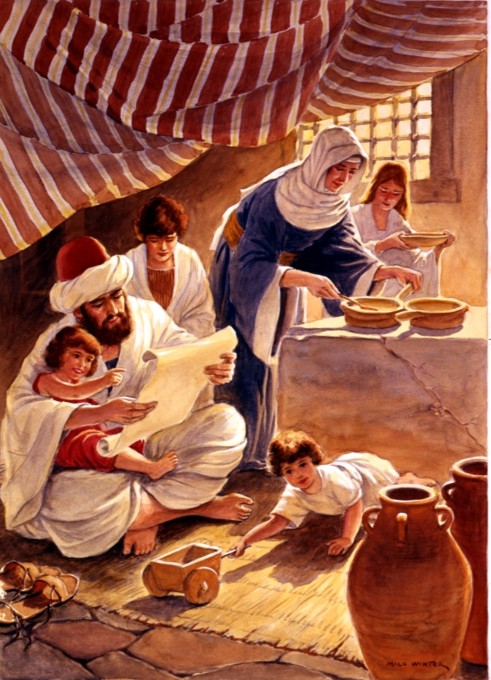
Father reads the Scriptures from a scroll to his family as the mother prepares food to eat.

Father reads the Scriptures from a scroll to his family as the mother prepares food to eat.

Once again, this year we will be following someone else’s reading plan, and once again, it is singularly special! It was not finished at the time of this writing, but I will post the schedule on the “Schedules” tab as soon as I get it.

Here is what I can tell you about it. We will be spending the entire year studying the Book of Luke and the Book of Acts.  The plan’s designer appropriately calls it “Cause and Effect.” We will be reading at the pace of a chapter a week. An easy schedule? Perhaps, but some of the chapters are quite long, and there is no shortage of material to study.

First, 24 chapters of Luke – all focused on the life, death, burial, and Resurrection of the savior, Jesus the Christ. And 28 chapters of the Book of the Acts of the Apostles – from the first gospel sermon ever to the imprisonment of Paul in Rome. It is going to be another great year in God’s word, I can  promise you! And we will start tomorrow!

Science museum, Vancouver

Science museum, Vancouver

But, as our regular readers know, since our reading plans are 5 days per week, we have always done something different on Sundays. And 2014 will be no exception. We will still be writing on various subjects and about several different books of the Bible throughout the year. But we will be doing two things on a fairly regular basis.

First, we will have more frequent articles centered on the subject of Apologetics- articles designed to help the christian strengthen his or her faith in God’s word, and hopefully, help prepare to comply with 1 Peter 3:15: “…always being prepared to make a defense to anyone who asks you for a reason for the hope that is in you; yet do it with gentleness and respect…”

Throughout the wilderness journey, Moses talked to the Lord, often begging Him for help in leading the Israelites.

Throughout the wilderness journey, Moses talked to the Lord, often begging Him for help in leading the Israelites.

Secondly, we will try to devote one Sunday article per month to the subject of prayer – the other half of our communication with the Lord. In doing so, it is our hope that we can improve our ability to pray more effective prayers that are pleasing to the Lord and beneficial to those we pray for – and pray with. With God’s help, we hope this will also be an aid to men who often are called upon to lead public prayers in church services and elsewhere.

We hope and pray that these new items on our agenda for 2014 will help us all to grow spiritually in the coming year. We hope you will join us in this effort!

/Bob’s boy

Reversal of Fortunes – Nahum and Nineveh

If the Book of Jonah (see previous blog post) were a photograph, Nahum would be the negative. In what was likely the first half of the eighth century B.C., Jonah reluctantly ventured to Nineveh to warn them of the coming judgment of God for their wickedness. To Jonah’s complete dismay, Nineveh repented and God spared them.

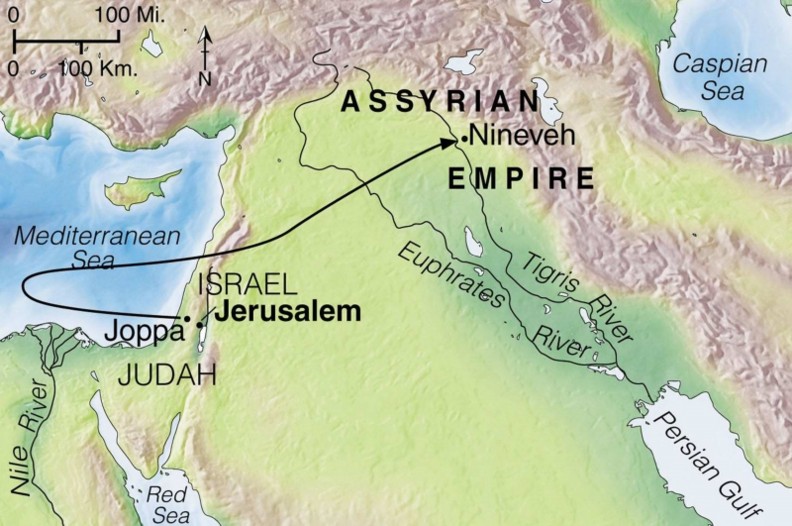
As Sennacherib beautified his capital city, Nineveh, Hezekiah withheld tribute and prepared for battle. The Assyrians advanced toward their rebellious western border, attacking swiftly down the Mediterranean coast. From Lachish, Sennacherib threatened to take Jerusalem, but Isaiah knew his threats would die with him on his return to Nineveh. This map shows the route of Assyrian conquest which started in Nineveh. God promised his people that Nineveh would not escape judgment.

As Sennacherib beautified his capital city, Nineveh, Hezekiah withheld tribute and prepared for battle. The Assyrians advanced toward their rebellious western border, attacking swiftly down the Mediterranean coast. From Lachish, Sennacherib threatened to take Jerusalem, but Isaiah knew his threats would die with him on his return to Nineveh. This map shows the route of Assyrian conquest which started in Nineveh. God promised his people that Nineveh would not escape judgment.

But that repentance did not last long. By 745 B.C. Tiglath-pileser III had made Assyria the most powerful in force in that part of the world., establishing their dominance with torture, massacres, and exiles on a horrific scale. The real estate of the Assyrians was greatly expanded by making vassal kingdoms of other countries (such as the northern kingdom of Israel and the southern kingdom of Judah) until Assyria “terminated” the Northern Kingdom in 722 B.C. Under Sennacherib’s reign (704 – 681 B.C.) Nineveh became the capital of Assyria.

More than a hundred years after Jonah, God sent Nahum to again announce judgment on Nineveh and the fall of Assyria itself. This time, there would be no repentance, and Nahum does not appear to have been reluctant in the least. Nahum 3:8-10 speaks of the destruction of Thebes (an ancient Egyptian city also called No-Amon in this book) in the past tense. We know that it fell to Assyria about 663 B.C. Assyria was conquered by the Medes and Babylonians in 612 B.C., making this book written between 663 and 612 B.C.

During this 50 year period, Assyria’s holdings and power were already in decline. Nahum’s first chapter reads like a prelude to battle, while the second and third chapters move into the real thing, with imagery that strongly suggests that the author saw much with his own eyes. True to the prophecy, Nineveh was destroyed, never to be rebuilt. The ruins lay close to the modern Iraqi city of Mosul.

/Bob’s boy
___________________
image © V. Gilbert & Arlisle F. Beers

Please note: I did not design the reading plan that I am following in my blog.  All of my comments in this blog, however, are solely my responsibility.  When reading ANY commentary, you should ALWAYS refer first to the scripture, which is God’s unchanging and unfailing word. Reading schedules, as well as a link to the site where you can get the reading plan that I’m currently following for yourself can be found on the “Bible Reading Schedules” page of my website at http://graceofourlord.com.  

Job 39:1-15 – Is the Wild Ox Willing To Serve You?

Today’s study of the 39th chapter of the book of Job will be the first 15 verses. Whereas in the previous chapter, God put forth the questions to Job concerning His rule, supremacy, and governance over the world and creation itself, this chapter does the same with God’s care for each living creature.  And it does so in a way that seems strange at the outset. Verses 1-4 deal with His knowledge of even the smallest details of the breeding, mothering, and maturation of families of wild mountain goats.

ostrich_001In verses 5-8, the Lord focuses on the habits, freedom, and domain that He has given to the wild donkey. In verses 9-12, He turns to the wild ox, pointing out his strength, and usefulness – yet making clear his independence and power. This was so much the case that hunting this beast was the sport of royalty, much like we would years ago have considered the safaris that we saw depicted in movies and television. In verses 13-15, the Lord  has Job consider the majesty of the winged ostrich, and the careless way that she places and sometimes even scatters her eggs.

Each of these wild creatures represent scores of others that God has created, and in His wisdom understands as nobody else can. No single person can at the same time appreciate, understand, and maintain the balance in the lives of all of these creatures – and though man can put some of them to use for his purposes, he can never fully tame them (verses 9, 11, and 12).

Read or listen to audio of ESV version of this selection from this link.

/Bob’s boy
___________________
some images © V. Gilbert & Arlisle F. Beers

Please note: I did not design the reading plan that I am following in my blog.  All of my comments in this blog, however, are solely my responsibility.  When reading ANY commentary, you should ALWAYS refer first to the scripture, which is God’s unchanging and unfailing word. Reading schedules, as well as a link to the site where you can get the reading plan that I’m currently following for yourself can be found on the “Bible Reading Schedules” page of my website at http://graceofourlord.com.  For questions and help, please see the “FAQ” and “Summaries” pages there.

Job 38:22-41 – The Lord Answering Job

snow_002In this second half of Job 38, God is continuing His answer to Job. Let us begin by addressing the criticism by skeptics of scientific inaccuracies. One should keep in mind that though such is not the purpose of this book, it has demonstrated several examples of scientific knowledge beyond the times when it was written. Take, for example, the understanding of the hydrological cycle demonstrated in Job 26:8 and 36:27-28.

But when reading the Book of Job – even this chapter- it is good to remember two things. First, like all Scripture, this is the inspired word of God poured out by the Spirit. Secondly, just like the other chapters of the book, it is very poetic, and it should be taken as it was written. For example, one would therefore not take a literal meaning from such things as the “storehouses of the snow”and the “storehouses of the hail” in verse 22, or the places “where light is distributed” and “the east wind is scattered” in verse 23. God is simply communicating to Job, in terms he can understand, that there is more going on with creation and how “all things hold together” (Colossians 1:17) than what is seen in the world by man.

That is the point of this chapter, and it is driven home in the last three verses, where God points out His care for every living creature that is, after all, His creation:

“Can you hunt the prey for the lion,
or satisfy the appetite of the young lions,
when they crouch in their dens
or lie in wait in their thicket?

Who provides for the raven its prey,
when its young ones cry to God for help,
and wander about for lack of food?”

Read or listen to audio of ESV version of this selection from this link.

/Bob’s boy
___________________
some images © V. Gilbert & Arlisle F. Beers

Please note: I did not design the reading plan that I am following in my blog.  All of my comments in this blog, however, are solely my responsibility.  When reading ANY commentary, you should ALWAYS refer first to the scripture, which is God’s unchanging and unfailing word. Reading schedules, as well as a link to the site where you can get the reading plan that I’m currently following for yourself can be found on the “Bible Reading Schedules” page of my website at http://graceofourlord.com.  For questions and help, please see the “FAQ” and “Summaries” pages there.

Saving Nineveh – The Book of Jonah

God told Jonah to go to Nineveh, the capital of the Assyrian Empire. Many of Jonah's countrymen had experienced the atrocities of these fierce people. The last place Jonah wanted to go was on a missionary trip to Nineveh! So he went in the opposite direction. He boarded a ship in Joppa that was headed for Tarshish. But Jonah could not run from God.

God told Jonah to go to Nineveh, the capital of the Assyrian Empire. Many of Jonah’s countrymen had experienced the atrocities of these fierce people. The last place Jonah wanted to go was on a missionary trip to Nineveh! So he went in the opposite direction. He boarded a ship in Joppa that was headed for Tarshish. But Jonah could not run from God.

Jonah was a prophet during the reign of Jeraboam II around 750 B.C. According to 2 Kings 14 23-28, he was the son of Amittai, hailing from Gath-hepher. Gath-hepher (meaning “winepress of the well”) was on Zebulun’s border in ancient Israel. The Book of Jonah has been the subject of some debate and there are those who consider it allegory. But such is not the case. Jesus certainly spoke of the events of the book as historical fact; and Jonah’s adventure is mentioned in Matthew 12:38-41, 16:4, Luke 11:29-32, among other passages.

As for the most famous part of the book, many are quick to point out that the Bible does not say that it was a whale that swallowed Jonah. God in fact, it says, appointed “a great fish” for the deed. The truth is that the taxonomies we use today for classifying such creatures did not exist in their present form, so the distinction between fish and mammals is purely academic and relevant only today. True enough, a creature other than a whale could have been responsible (one such suggestion is a “Sea Dog”). And there have been reports in the past of people surviving after having been swallowed and regurgitated by such. One such incident was reported in “The Boston Post-Boy, October 14, 1771” about a man named Marshall Jenkins (see this article on Christian Evidences) It hardly matters. In any event, it was a miraculous feat completely orchestrated by God for a specific purpose – just as that of the worm (Jonah 4:7).

But this miraculous event aside, the most important aspects of the Book of Jonah lay elsewhere. The Book of Jonah shows us God’s boundless compassion in multiple ways. Any time the early Christians of the first century began to question whether Gentiles were to be part of God’s plan of salvation, they needed only to look at this book. God sent Jonah to give His message to the Ninevites to give them the chance to repent. They were not part of Israel by any stretch of the imagination. But God cared about them, just as He tried to teach Jonah in Jonah 4:1-10.  In God’s eyes, everyone is worth saving.

Jonah sat under a goard vine, waiting and hoping for God to destroy Nineveh. But God taught him an important lesson about forgiveness through the vine (Jonah 3-4).

Jonah sat under a goard vine, waiting and hoping for God to destroy Nineveh. But God taught him an important lesson about forgiveness through the vine (Jonah 3-4).

Jonah’s attempted flight from God shows us a couple of things. First, and most obviously, we cannot hide anything from our Creator. Even the “smallest” of our deeds is known to Him. Secondly, as is shown repeatedly in scripture, when God wants something done, it gets done. He sent His only son to sacrifice His life for us, and establish His kingdom. The misunderstanding some have that Jesus somehow failed at that the first time, but will try again later, is ridiculous.

Finally, Jonah’s attitude and God’s reaction in chapter 4 should give us pause to think about our own compassion for our fellow man. How often do we view others with disdain or even contempt? How concerned are we really about salvation for those outside God’s kingdom? Have we truly committed ourselves to Christ if we are not willing – yes and even eager – to help others to work out their salvation?

Though only 4 chapters, the Book of Jonah is a powerful and important book of prophecy and teaching. Do yourself a favor and read these 47 verses if you have not done so in a while – and do so with these things in mind. It will enrich you in your walk with the Lord.

/Bob’s boy
___________________
image © V. Gilbert & Arlisle F. Beers

Please note: I did not design the reading plan that I am following in my blog.  All of my comments in this blog, however, are solely my responsibility.  When reading ANY commentary, you should ALWAYS refer first to the scripture, which is God’s unchanging and unfailing word. Reading schedules, as well as a link to the site where you can get the reading plan that I’m currently following for yourself can be found on the “Bible Reading Schedules” page of my website at http://graceofourlord.com.