Matthew 28 – The Resurrection and Great Commission

Early Sunday morning, Mary Magdalene and Jesus’ mother Mary went to Jesus tomb, but they met an angel there who told them that Jesus had risen from the dead (Matthew 28:1-7).

(Note: for a summary of the events of this chapter from the resurrection at dawn to Jesus’ first appearances to Mary Magdalene and the other women, please see post at this link.  After the resurrection, Jesus – as He had told the disciples in Matthew 26:32 that He would meet them there – would be with them at the Sea of Galilee, and at a mountain there that He directs them to.  But several other events occur before and after this, the details of which are interspersed throughout the gospels in Luke 24 and John 20.  And events in a single chapter are in some cases separated by days, and even weeks, as Jesus remained for forty days before the ascension.)

Then some of the guard that had been on watch at the tomb went to the chief priests to tell them what had happened.  After deliberating, they gave money to the guards to have them say that His disciples had come and stolen the body while they were asleep, promising to keep them out of trouble if word got back to Pilate.  Their acts of unbelief in the face of these eyewitness accounts is stunning, but such was their love for power that they would not let it be jeopardized.

Jesus meets His apostles in verse 16 on the mountain in Galilee that He had directed them to.  In verses 18-20, Jesus gives the eleven chosen ones the Great Commission – to go and make disciples of ALL nations “baptizing them in the name of the Father and of the Son and of the Holy Spirit, teaching them to observe all that I have commanded you.”  Jesus has confirmed that His Kingdom is open to everyone.  Because this is the end of Matthew, some confuse this event with the time of the ascension.  But that comes later at at a different mountain – Mount Olivet, after they returned to Jerusalem.

Read or listen to audio of ESV version of this selection from this link.

/Bob’s boy
___________________
some images © V. Gilbert & Arlisle F. Beers

Please note: I did not design the reading plan that I am following in my blog.  All of my comments in this blog, however, are solely my responsibility.  When reading ANY commentary, you should ALWAYS refer first to the scripture, which is God’s unchanging and unfailing word. Reading schedules, as well as a link to the site where you can get the reading plan that I’m currently following for yourself can be found on the “Bible Reading Schedules” page of my website at http://graceofourlord.com.  For questions and help, please see the “FAQ” and “Summaries” pages there.

Matthew 27 – The Crucifixion of Jesus

When morning came, the Sanhedrin had Jesus taken to Pilate.  When Judas saw that Jesus was condemned, he had a change of heart, and took the thirty pieces of silver back to them, saying that he had betrayed innocent blood.  But they are unimpressed.  So he threw it down in the temple and went and hanged himself.  Remorse, as we see, does not always include repentance.  The Sanhedrin has no problem with lies and the murder of an innocent man, but they want no part of this blood money, so they use it to buy a potter’s field.  The scripture that this fulfilled, referred to in verses 9-10, is from both Jeremiah 19:1-13 and Zechariah 11:11-13.

Jesus answers Pilate’s question of whether He was a king, but remains silent about the charges against Him.  We find in verse 20 that the chief priests and elders persuaded the people to choose Barabbas when Pilate offered to free one of them.  Fearing a riot, Pilate resigns himself to the will of the crowd, but uses the physical act of washing hands to declare his innocence of “this man’s blood.”  “Having scourged Jesus” is mentioned in passing, but this Roman form of flogging was anything but incidental.  It was a brutally painful beating with a whip weighted with sharp pieces of bone and metal. It was designed to lacerate, often exposing bone and intestines.  Crucifixion was an agonizing and tortuous death, but this beating would be equally painful.  An article about this scourging can be found at this link.

One traditional site of Golgotha is this hill with hollow eye sockets to look like the place of the skull. Another traditional site is in present-day Jerusalem, which in Jesus’ time was just outside the wall. It is called the Church of the Holy Sepulcher.

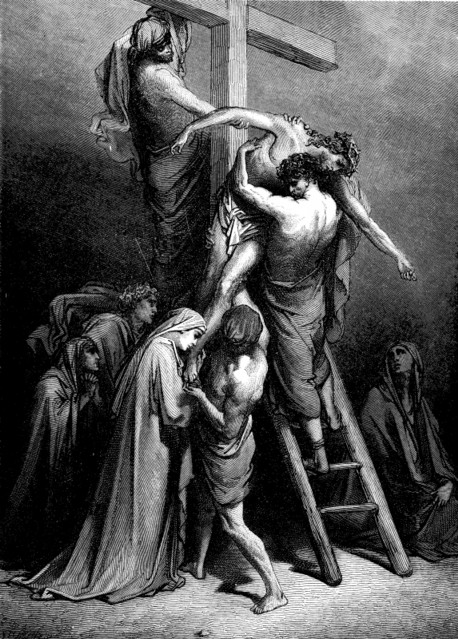
He was mocked and spit upon, stripped and made to wear a crown made of thorns.  Then he was led away to be crucified.  They made a man named Simon of Cyrene to carry His cross, and when they reached Golgatha (which means Place of a Skull), they tried to give him wine mixed with gall (a very bitter herb that could also be poisonous) to drink.  It was intended to dull the sense of pain, but it was God’s will that He should suffer, and He refused.  As they crucified Him, “they divided his garments among them by casting lots” – referring to Psalm 22:18.  Verses 36-44 detail the continued derision, mocking and reviling inflicted on Him as He suffered.

Crucifixion was a slow and excruciatingly painful method of inflicting death, and their are many stories of the cruelty of Roman soldiers experimenting with different poses for crucified victims (Josephus, “Jewish War” 5.449–551).  Hanging by one’s arms caused great difficulty in breathing, only alleviated by the victim pushing up with their feet in order to take the weight off of the arms. But that caused severe pain in the feet, arms, legs, and back, making the exhausted victim slump down again, only to be barely able to breathe again. Finally, he would mercifully die of asphyxiation, if he had not already died as a result of the cumulative effects of the multiple physical traumas inflicted.

In verse 45, there was darkness all over the land from the 6th hour until the ninth hour (about noon to 3:00).  About the ninth hour, Jesus cried out with a loud voice “Eli, Eli, lema sabachthani?” meaning, “My God, my God, why have you forsaken me?”  This is from Psalm 22:1.  This is one of the most puzzling verses in the Bible.  Jesus knows what is happening, and why He is doing it. One explanation that has been posed is that because Jesus did in fact become sin, at this moment Jesus felt the presence of God turn away from Him as He was dying.  Jesus then gave up the spirit with another cry.

Then in verse 51, the curtain of the Temple was torn from top to bottom.  It was between the Holy Place and the Most Holy Place, and was woven from 72 twisted plaits of 24 threads a piece. It was 60 feet high and 30 feet wide. No one was allowed to enter the Most Holy Place behind the curtain except the high priest, and then only on the Day of Atonement.  Being torn in two represents the removal of the separation between God and the people.  A high priest was no longer needed – Jesus is our high priest now.  More elaboration of this event, and what it symbolized, is in Hebrews 9:11–10:22.  Then the earth shook (Palestine sits on a major seismic rift), rocks were split, and tombs were opened.  As Matthew often groups events together topically, he then jumps ahead here in verse 53 to events after the resurrection, as many of the saints were raised and came out of the tombs to appear to many in the city.  We are not told whether they were taken to heaven after these eyewitnesses received these visits.  But clearly, God wanted many witnesses to understand the profoundly momentous significance of what had happened.

In verse 57, a rich man from Arimathea named Joseph came to Pilate that evening to request Jesus’ body.  He took the body and wrapped it in a linen shroud and placed it in his own tomb.  This fulfilled Isaiah 53:9.  Then he rolled a big stone in front of the entrance.  Then the chief priests, remembering how he had said that he would rise after 3 days, went to Pilate voicing their fears that Jesus’ disciples might come and steal the body.  So he gave them a guard of soldiers, and they sealed the tomb and stood guard.

Read or listen to audio of ESV version of this selection from this link.

/Bob’s boy
___________________
some images © V. Gilbert & Arlisle F. Beers

Please note: I did not design the reading plan that I am following in my blog.  All of my comments in this blog, however, are solely my responsibility.  When reading ANY commentary, you should ALWAYS refer first to the scripture, which is God’s unchanging and unfailing word. Reading schedules, as well as a link to the site where you can get the reading plan that I’m currently following for yourself can be found on the “Bible Reading Schedules” page of my website at http://graceofourlord.com.  For questions and help, please see the “FAQ” and “Summaries” pages there.

The Savior Slain and Risen \ Week 36 summary posted

This week, we will read first about the crucifixion.  Then we will spend the rest of the week with some details of the time after the Lord’s resurrection from the perspective of the gospels of Matthew, Luke and John.  We know from 1 Corinthians 15:5-9 that Jesus appeared to more than five hundred in the forty days before His ascension to heaven.  We will focus in the next few days mostly on the time from His appearance to the disciples onward.  Today though, let us spend a bit of time on the first hours of the day of His resurrection.
The Garden Tomb in Jerusalem, one traditional site of Jesus’ burial. It is safe to say that it is not the tomb of Jesus, but it is useful as a realistic example.

We need to keep a few things in mind.  First, as is often the case with the Scriptures, events recorded in the four gospels are not always in chronological order.  Also, as we have discussed before, each of the four was written to a different audience; and we find things phrased differently, as well as additional events in one gospel not found in another.  Finally, we have seen time and again that there are some things we would like to know that the scriptures just do not tell us.  In this case, the commentator James Burton Coffman says it best: “…it was part of the Father’s wisdom to give men just the amount of revelation which would leave them free to make their own moral decision.

The resurrection accounts of the gospels are favorite citations for those unbelievers who feel compelled to invest their time trying to find alleged contradictions.  Of course, such allegations are baseless.  Putting the four gospel accounts together gives us a more complete picture of the events of that great morning.  For a complete comprehensive and easy to read harmonization of the four gospels, I recommend the following book (also available in Kindle format): “The Fourfold Gospel” by John McGarvey (ISBN-10 # 1936341018, ISBN-13 # 978-1936341016).

Keeping Coffman’s caveat  in mind, the following is a summary of the events in all four gospels (Matthew 28:1-10, Mark 16:1-8, Luke 24:1-12, and John 20:1-18) of the early morning of the resurrection up to Jesus’ first appearances to Mary Magdalene and the other women:

1.  Several women came to the tomb of Jesus before dawn on the first day of the week (Sunday) with spices to anoint His body.  From the four gospels, we know that group included at minimum Mary Magdalene, Mary the mother of James (Jesus’ mother), Salome, and Joanna.

2. The Sabbath ended at sundown on Saturday.  The key sentence in Luke 23:56 is that on the Sabbath, the women “rested according to the commandment.”  This means that they would not be preparing the spices and ointments until the Sabbath was over (at sundown).

3. The women set out for the tomb with the spices while it was still dark on the first day of the week.  The translation of the grammar used in Mark confuses many, but the key to understanding is that Mark 16:1-2 simply distinguishes the fact that when they went very early on the first day of the week, they did it in the morning – not just after sundown on Saturday!

4. There was a great earthquake, and an angel of the Lord descended from heaven and rolled away the stone and sat on it.  The fear that brought to the guards is stated – along with the statement that they became like dead men.  Perhaps they were just paralyzed with fear, or perhaps they were made unable to move.  We are not told.  The point is that the seal was broken, and the stone would not be allowed to be moved back in front of the tomb.

The Garden Tomb in Jerusalem, one traditional site of Jesus’ burial. It is safe to say that it is not the tomb of Jesus, but it is useful as a realistic example.

5.  At this point, we know from John that it was Mary Magdalene who ran to tell Peter and John that (as she believes) someone has taken the body.  John and Mark both indicate that Mary had left the other women.  While she is gone, two angels speak to the women she had separated from, telling them that Jesus had risen and they must tell the disciples “and Peter” that He is risen and that they must go to Galilee. Many of the guards leave to go tell the Sanhedrin what has happened, while the other women leave to find the disciples.  It is important to get word to all the disciples.  But Peter is mentioned separately probably because it is important that in his grief, he does not think he would be cast off because of his denial (in Matthew 26:69-75).

6. Peter and John run to the tomb and eventually both go inside and leave, satisfied that Jesus is gone.  John “believes” but Peter is puzzled about what happened.  They went back home and the other women would come tell them (as well as the other disciples) what the angels had said to them.

7. Mary, back at the tomb weeping after Peter and John had left, now looks into it for the first time and sees it empty except for the angels – sitting at the head and foot where Jesus had laid.  Perhaps from her tears blinding her or perhaps prevented from truly “seeing” (as with the disciples in Luke 24:16), she does not react to the angels or recognize Jesus until He calls her name (John 20:16).  Jesus tells her not to delay by clinging to Him, but to go to tell the disciples that He is going to His Father (and their Father).

8. Mary does go and tell the disciples that she has seen the Lord.  The other women are met by Jesus on their way (Matthew 28:9); and they are allowed the delay briefly, as they take hold of His feet and worship Him.  Then He sends them to continue on to the disciples as well.

Summing Up

Each weekend, I am now posting a small PDF of one week of chapter summaries (on the website’s “Summaries” page), current to the beginning of the previous week.  I have posted the summary for Week 36 (September Week 1) of the schedule I am following.  This short PDF document contains condensed comments about John 12, Matt 24 and 25, John 13, and John 14, with hyperlinks to the ESV version of each chapter for listening or reading, and joins the summaries for other weeks already posted there.

/Bob’s boy
___________________
image © V. Gilbert & Arlisle F. Beers

Please note: I did not design the reading plan that I am following in my blog.  All of my comments in this blog, however, are solely my responsibility.  When reading ANY commentary, you should ALWAYS refer first to the scripture, which is God’s unchanging and unfailing word. Reading schedules, as well as a link to the site where you can get the reading plan that I’m currently following for yourself can be found on the “Bible Reading Schedules” page of my website at http://graceofourlord.com.  For questions and help, please see the “FAQ” and “Summaries” pages there.

Matthew 26 – The Plot to Kill Jesus


Having read John’s account, we now move to Matthew’s account of the last supper and Jesus’ arrest.  Since the audience of the gospel of Matthew is the Jews, it makes sense that he would give full attention to certain details of the trial before the Sanhedrin.  Unlike John, who gives the event in more chronological order, Matthew includes the account of the anointing of Jesus by Mary (sister of Lazarus) here in verses 6-13.   he also gives us the details in verses 14-16 of Judas’ conspiracy with, and payment from, the chief priests for his promise to deliver Him.  We also read in verses 17-20 of Jesus sending disciples to a “certain man” to prepare to have Passover at his house.

A model of the way Caiaphas’ house may have looked in the time of Jesus. Caiaphas was the high priest who judged Jesus.

But it is in verses 3-5 that we read of chief priests and the elders plotting in Caiaphas’ palace to  “arrest Jesus by stealth and kill him.”  They were fearful of arresting Jesus openly because of His popularity; and the Feast of Unleavened Bread brought thousands of Pilgrims to the city.  The last thing they wanted was an uprising.  In verses 20-25, Jesus foretells His betrayal by one of them, culminating in an actual exchange between Jesus and Judas.  What was it like to be told by the son of God that it would be better if His betrayer had never been born – knowing that you had already begun that process?  And Jesus’ confirmation that He knew in verse 25 must have been chilling, especially after the fact.

In verses 26-29, Jesus institutes the Lord’s Supper.  The Passover, begun so long ago in Exodus 12 with the sacrifice of a lamb had pointed to this day.  Now this memorial would remind us of the sacrifice of “the Lamb of God who takes away the sin of the world” (John 1:29).  Verse 28 (“…this is my blood of the covenant, which is poured out for many for the forgiveness of sins” is the fulfilling also of the new covenant promise of Jeremiah 31:31-34.

The hymn that they sung in verse 30 is most likely Psalm 113-118, which is known as the Hallel (meaning “praise”).  The scripture Jesus quotes in verse 31 is from Zechariah 13:7, telling the disciples that they will all fall away that very night.  He also predicts Peter’s denial, at which point they all declare that they will remain with Him even if they must die.  His prayer in Gethsemane occurs in verses 36-44.  The traditional site for this now holds the “Church of All Nations” (or “Basilica of the Agony“), which was built over a 4th century Byzantine church.  Note Jesus’ sorrow and fervent petition to God in verses 38-39.  Although He was divine, for our benefit He had the same emotions any man would have knowing the suffering that He was about to endure.

The Mount of Olives, looking from Jerusalem, with the Basilica of the Agony, traditional site where Jesus prayed in the Garden of Gethsemane. Today the garden is at the left of the basilica.

Judas betrays Him with a kiss in verse 49.  We know from John 18:10-11 that it was Peter that cut off the ear of one of Jesus’ captors (Malchus) in verse 51.  When Jesus rebukes him, He says “Do you think that I cannot appeal to my Father, and he will at once send me more than twelve legions of angels?”  (we sing the song “He could have called Ten Thousand Angels”).  Jesus was of course  not going to call for help, but a Roman legion was 6,000 – so twelve of them would be 72,000.  As predicted, all of His disciples fled the scene.

Matthew skips past the meeting with Annas (John 18:12-14, 19-24) and begins next with the appearance before Caiaphas the High Priest and the Council (the Sanhedrin).  They had many witnesses coming forward, but none would give the false testimony they wanted in order to have Him put to death until at last two came and, in verse 61, misquoted Jesus’ actual statement of John 2:19-21.  He remained silent, making no correction,  when Caiaphas questioned Him about it.  But when asked if He was the Christ, He confirmed it with the Greek expression “you have said so” that He had also used with Judas in verse 25.  Then He added that they would see him at the right hand of “Power.”  Caiaphas declared this to be blasphemy, and they spit on Him and slapped Him, saying that He deserved death.  The outcome was assured now.

Peter’s denial in verses 69-74 went just as Jesus had said; and remembering the words of the Lord, Peter’s grief was intense.  Though this apostle would come to understand the necessity of what Jesus was to endure, we can only try to imagine the guilt he would bear.

/Bob’s boy
___________________
some images © V. Gilbert & Arlisle F. Beers

Please note: I did not design the reading plan that I am following in my blog.  All of my comments in this blog, however, are solely my responsibility.  When reading ANY commentary, you should ALWAYS refer first to the scripture, which is God’s unchanging and unfailing word. Reading schedules, as well as a link to the site where you can get the reading plan that I’m currently following for yourself can be found on the “Bible Reading Schedules” page of my website at http://graceofourlord.com.  For questions and help, please see the “FAQ” and “Summaries” pages there.


John 18 – Betrayal and Arrest of Jesus


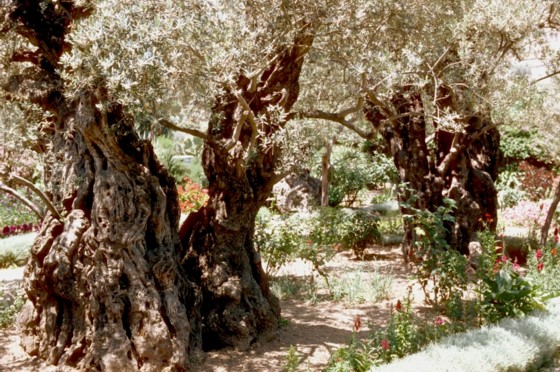
Olive Trees in the Garden of Gethsemane, on the Mount of Olives

Having finished the Olivet discourse, including His prayer, Jesus and His disciples went across the Kidron brook into a garden.  John does not identify Gethsemane as Matthew and Mark do (Matthew 26:36 and Mark 14:32).  But he does say in verse 2 that Judas knew the place where Jesus would be because He often met there with His disciples.  And we know from several scriptures (Luke 21:37 and Luke 22:39, for example)  that it was His custom to go to the Mount of Olives at night.  Knowing that this was the time, Jesus came forward to the soldiers and officers of the Pharisees that Judas had brought.  Much commentary has been written about verse 6 (“When Jesus said to them, “I am he,” they drew back and fell to the ground”) – but we just do not know exactly what happened there.  Clearly however, this was a significant response that we would not have expected from Jesus’ captors.  But it really does seem appropriate for the Son of God at this hour in His life.

Verses 15-17 contain the account of Peter’s denial.  Though we are not told, the “other disciple” mentioned in verses 15-16 is probably John himself (the disciple that Jesus loved – as in John 20:2). John is the only one of the four gospels that gives us the account of Jesus going first to Annas. He had been High Priest from 6-15 A.D., but had been deposed by Valerius Gratus, the former Roman prefect of Judea (Josephus Antiquities 18.26, 34, 95).  But the position stayed in the family – currently his son-in-law, Caiaphas.  Since the position had traditionally been one that was life-long, Annas was still considered a High Priest by many Jews.  Jesus was then taken to Caiaphas.  John does not record the events of that encounter, but the synoptic gospels do (Matthew 26:57-68, Mark 14:53-65, and Luke 22:66-71).  It was Caiaphas that had suggested that Jesus should die back in John 11:49-51.

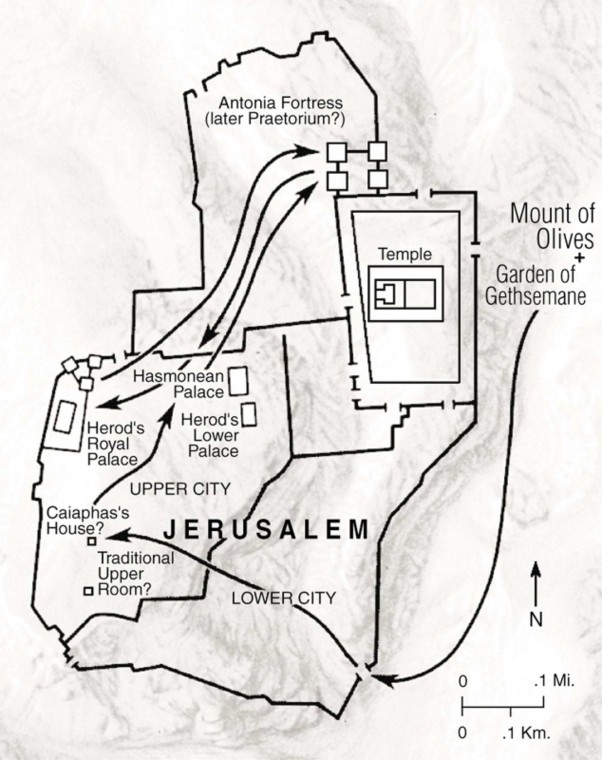
After Judas singled Jesus out for arrest, the mob took Jesus first to Annas, then Caiaphas, the high priest. Jesus then was taken to Pilate

From there, Jesus was taken to the Praetorian – the Roman governor’s residence – to appear before Pilate.  In verse 31, Pilate wants them to “judge him by your own law.”  But the Roman government had supposedly taken away the Sanhedrin’s right to capital punishment (though clearly they exercised exceptions to this, as with Stephen in Acts 7:57-60), and they wanted Him put to death.  Besides, as verse 32 reminds us, it was the Roman method of execution that would fulfill the scripture (Isaiah 52:13, John 12:32-33).  When Pilate speaks with Jesus asking what He had done and whether He was a kink, Jesus lays aside all doubt as to what type of Kingdom He had come to establish in verse 36:

“My kingdom is not of this world. If my kingdom were of this world, my servants would have been fighting, that I might not be delivered over to the Jews. But my kingdom is not from the world.”

Pilate still tries to avoid the responsibility for their blood lust, but he lacks the courage to go against the crowd.  So he offers to free either Jesus or the known criminal Barabbas, no doubt thinking they would choose the latter.

But such was not to be.  Jesus took the place of all of us, including Barrabas.


Read or listen to audio of ESV version of this selection from this link.

/Bob’s boy
___________________
some images © V. Gilbert & Arlisle F. Beers

Please note: I did not design the reading plan that I am following in my blog.  All of my comments in this blog, however, are solely my responsibility.  When reading ANY commentary, you should ALWAYS refer first to the scripture, which is God’s unchanging and unfailing word. Reading schedules, as well as a link to the site where you can get the reading plan that I’m currently following for yourself can be found on the “Bible Reading Schedules” page of my website at http://graceofourlord.com.  For questions and help, please see the “FAQ” and “Summaries” pages there.


John 17 – The High Priestly Prayer

Old Roman steps leading down toward the Kidron Valley. Jesus and his disciples may have walked on these very steps after the Last Supper

In this chapter, Jesus prays first for himself (verses 1-5), for His disciples (verses 6-19), and then for all believers to come (verses 20-26).  He states in verse 4 that He has glorified God on earth “having accomplished the work that you gave me to do”  (meaning that He did not fail to setup His kingdom as some have claimed – or anything else for that matter).  He gave up the glory that He had with God since before the world existed (verse 5), and now asks God to glorify Him in His presence (after the resurrection), which will also achieve the result of the Son glorifying the Father.

As He prays for His disciples, He notes in verse 12 that He has guarded them and not one has been lost other than “the Son of destruction” (Judas) – which fulfilled the Scripture (Psalm 41:9):

“Even my close friend in whom I trusted,
who ate my bread, has lifted his heel against me.”

Verses 6, 11 and 26’s use of God’s name is the manifestation of His character and will that Jesus made known to them through His teaching and His actions.  In verses 20-26, He prays for all who believe in Him, so that they may be with Him to see the the glory that He had “before the foundation of the world” (for all eternity).   Those who believe know that God sent Him.  They will know God through the Son; and the love God has for His son will be in them through Jesus.

Read or listen to audio of ESV version of this selection from this link.

/Bob’s boy
___________________
some images © V. Gilbert & Arlisle F. Beers

Please note: I did not design the reading plan that I am following in my blog.  All of my comments in this blog, however, are solely my responsibility.  When reading ANY commentary, you should ALWAYS refer first to the scripture, which is God’s unchanging and unfailing word. Reading schedules, as well as a link to the site where you can get the reading plan that I’m currently following for yourself can be found on the “Bible Reading Schedules” page of my website at http://graceofourlord.com.  For questions and help, please see the “FAQ” and “Summaries” pages there.

John 16 – Your Sorrow Will Turn into Joy

Jesus continues His farewell discourse in chapter 16, adding to His warning of the persecution they will face noting that they will be put out of the synagogues.  Then the shocking statement that people will kill His disciples in the belief that they serving God by doing so.  Indeed, one who will do that very thing (Saul of Tarsus) will become an apostle.

Jesus giving the Farewell discourse to his ele...

Jesus giving the Farewell discourse to his eleven remaining disciples, from the Maesta by Duccio, 1308-1311. (Photo credit: Wikipedia)

He acknowledges their coming sorrow that He is leaving, but says that He must go for the Helper – the Holy Spirit – to come and guide them.  “And when he comes, he will convict the world concerning sin, righteousness, and judgment” – means that many who do not believe will be given hope because of their repentance.  In verse 21, Jesus makes the analogy of a woman giving birth (“she no longer remembers the anguish, for joy that a human being has been born into the world”).  The statement that their sorrow will turn into joy means that once Jesus is resurrected and the Holy Spirit comes, their full realization of what has been born will replace their sorrow with joy (compare verses 20-21).

Read or listen to audio of ESV version of this selection from this link.

/Bob’s boy
___________________
some images © V. Gilbert & Arlisle F. Beers

Please note: I did not design the reading plan that I am following in my blog.  All of my comments in this blog, however, are solely my responsibility.  When reading ANY commentary, you should ALWAYS refer first to the scripture, which is God’s unchanging and unfailing word. Reading schedules, as well as a link to the site where you can get the reading plan that I’m currently following for yourself can be found on the “Bible Reading Schedules” page of my website at http://graceofourlord.com.  For questions and help, please see the “FAQ” and “Summaries” pages there.

John 15 – I Am the True Vine

Green fields and vineyards grow in the area near Mamre, near Hebron, where Abraham once pitched his tent.

The vineyard references are deeply embedded in the Old Testament as a symbol for Israel, especially in two vineyard songs in Isaiah (Isaiah 5:1-7 and Isaiah 27:2-6).  But Israel failed in bearing fruit.  God as the vinedresser is taken from the first vineyard song.  In that passage, God is depicted tending His vineyard, but the vineyard produced wild grapes (unrighteousness).  Jesus is the true vine, and His disciples are the branches.   The fruit is the outward signs and effect on the world of the Christian life in those branches.  Those who do not bear fruit are not abiding in Jesus – not being true disciples, perhaps just going through some of the motions.  Verse 7 (“If you abide in me, and my words abide in you, ask whatever you wish, and it will be done for you”) is another important point to remember about prayer – abiding in Him means that our prayers reflect His will.

As Jesus again commands them to love each other as He has loved them, He tells them they are His friends,not just servants; and because of that He has made known to them the things of the Father, and the Holy Spirit will come to guide them.  He also warns that just as He was persecuted they will also be persecuted.  The “word that is written in their Law” Jesus referred to being fulfilled in verse 25 comes from Psalm 69:4 and Isaiah 35:19.

Read or listen to audio of ESV version of this selection from this link.

/Bob’s boy
___________________
some images © V. Gilbert & Arlisle F. Beers

Please note: I did not design the reading plan that I am following in my blog.  All of my comments in this blog, however, are solely my responsibility.  When reading ANY commentary, you should ALWAYS refer first to the scripture, which is God’s unchanging and unfailing word. Reading schedules, as well as a link to the site where you can get the reading plan that I’m currently following for yourself can be found on the “Bible Reading Schedules” page of my website at http://graceofourlord.com.  For questions and help, please see the “FAQ” and “Summaries” pages there.

Jesus Farewell Discourse \ Week 35 summary posted

Jesus giving the Farewell discourse to his ele...

Jesus giving the Farewell discourse to his eleven remaining disciples, from the Maesta by Duccio, 1308-1311. (Photo credit: Wikipedia)

This week, we will read the last three chapters of John’s account of what is known as the Farewell Discourse (John 13-17) that we began last week.  Then, we will finish the week with the arrest and trial of Jesus.

Summing Up

Each weekend, I am now posting a small PDF of one week of chapter summaries (on the website’s “Summaries” page), current to the beginning of the previous week.  I have posted the summary for Week 35 (August Week 4) of the schedule I am following.  This short PDF document contains condensed comments about John 9, 11, Mark 10, 11, and Luke 20, with hyperlinks to the ESV version of each chapter for listening or reading, and joins the summaries for other weeks already posted there.

/Bob’s boy
___________________
image © V. Gilbert & Arlisle F. Beers

Please note: I did not design the reading plan that I am following in my blog.  All of my comments in this blog, however, are solely my responsibility.  When reading ANY commentary, you should ALWAYS refer first to the scripture, which is God’s unchanging and unfailing word. Reading schedules, as well as a link to the site where you can get the reading plan that I’m currently following for yourself can be found on the “Bible Reading Schedules” page of my website at http://graceofourlord.com.  For questions and help, please see the “FAQ” and “Summaries” pages there.

John 14 – The Way, and the Truth, and the Life

Jesus continues His farewell discourse in this chapter by softening the blow a bit after having told His chosen ones that He is leaving them.  Verse 2 is translated in ways in some versions that confound the meaning.  The King James says it in such a way as to make people think they will have their own mansion in heaven.  The ESV (and NASB) simply says “In my Father’s house are many rooms (dwelling places),”  not intending to convey that space is small, but to drive home the point that we are going to live with God – not separated from Him.  Jesus is telling them that they will follow Him, and He will prepare a place for them.

Thomas points out that since they do not know where He is going, they do not know the way.  Jesus then said “I am the way, and the truth, and the life. No one comes to the Father except through me.”  In Acts 9:2, Christians are for the first time described as belonging to “The Way,” a term which is repeated in scripture as well as by secular historians (such as Josephus Flavius).  It is hard to imagine that the term did not come from these words of Jesus.

Six of Jesus’ disciples, later called apostles, or The Twelve

In verses 13-14, Jesus says “Whatever you ask in my name, this I will do, that the Father may be glorified in the Son.  If you ask me anything in my name, I will do it.”  We must remember first that other scriptures define prayer properly.  Secondly, in this age, a person’s name represented what that person was as a being – who they were, so to speak.  So praying in Jesus’ name means praying in a way consistent with His will and His character.

Jesus then offers more reassurance to His apostles in verses 15-28, as He confirms that He is one with the Father, and that He is going to Him.  But He will not leave them as “orphans.”  The promise of the Holy Spirit in these verses is for the apostles, not for us.  As those who He is sending, they will need the guidance of the “Helper” to speak His word and make the will of God known.  As His chosen ones, the Holy Spirit also help them remember all that He has told them.  But  Jesus says that He will no longer talk much with them.

The end is very near, but that end will be very much a new beginning.

Read or listen to audio of ESV version of this selection from this link.

/Bob’s boy
___________________
some images © V. Gilbert & Arlisle F. Beers

Please note: I did not design the reading plan that I am following in my blog.  All of my comments in this blog, however, are solely my responsibility.  When reading ANY commentary, you should ALWAYS refer first to the scripture, which is God’s unchanging and unfailing word. Reading schedules, as well as a link to the site where you can get the reading plan that I’m currently following for yourself can be found on the “Bible Reading Schedules” page of my website at http://graceofourlord.com.  For questions and help, please see the “FAQ” and “Summaries” pages there.