Introducing the Books of Chronicles – not what you might think

Map showing the Kingdoms of Israel (blue) and ...

Map showing the Kingdoms of Israel (blue) and Judah (orange), ancient levant borders and ancient cities such as Urmomium and Jerash. The map shows the region in the 9th century BCE. (Photo credit: Wikipedia)

This year, we will read the Books of 1 and 2 Chronicles, along with Luke and Acts. It should not be a surprise that these 2 Old Testament books seldom get very close attention. After all, they just repeat what is contained in part of Samuel and Kings, right? Well, not so fast. It’s true that some passages from Samuel and Kings are contained in Chronicles, and some are even word for word. But certainly, that does not apply to the entire books – and there is more to it than that.

So what is the difference? To start with, the Books of Kings are written chiefly from the perspective of the northern kingdom of Israel, ending with the fall of Judah and the beginning of the Babylonian captivity. The Books of Chronicles are written primarily for the exiles who have returned from captivity (and of course, for us as well). There is much contained in Chronicles that is not written anywhere else, and much more attention is paid to the southern kingdom. In fact, the northern kings are rarely mentioned outside the context of their interaction with the southern kingdom.

Before going into too much more detail about the Books of Chronicles, let us provide a few tips for reading 1 Chronicles – which is where we start the year. First, it is important to point out that most of the first 9 chapters contain almost exclusively genealogies – beginning with Adam, all the way to the post-exilic period. Why? A couple of reasons.

The chief reason is that the Lord wanted the people to have this information documented very well for those returning from exile so that there would be no confusion as to lineage when questions arose concerning such matters as who could serve as a Levitical priest. Secondly, there is much information in these genealogies that explain things that we might not otherwise know. For example, we read much in the Book of Joshua about the Jebusites and the Amorites. But where did they come from? The answer is in the first 14 verses of 1 Chronicles chapter one.

Destruction of Jerusalem under the Babylonian ...

Destruction of Jerusalem under the Babylonian rule. Illustration from the Nuremberg Chronicle (Photo credit: Wikipedia)

So tip #1 when reading these first nine chapters of 1 Chronicles is to remember that your natural inclination will be to hit the “fast forward button” and move ahead. That’s OK, but when you let yourself do that, skim through and make a note of any names or places you may remember being mentioned elsewhere for further investigation. With this easy schedule, you may want to look further into it.

Tip #2: Don’t get impatient and move too far ahead in the schedule of 1 Chronicles. We are just reading less than 30 verses per day – many times, even less than 10! Let God’s word work in you. Remember 2 Timothy 3:16-17: “All Scripture is breathed out by God and profitable for teaching, for reproof, for correction, and for training in righteousness, that the man of God may be complete, equipped for every good work.”

Tip #3: Our daily blog will alternate between a focus on Luke and on the Books of Chronicles. We will do our best to give meaning and understanding to some of the details of these genealogies until we get through them. Once we do, the reward in the following chapters will be well worth the wait.

We will complete this introduction to the Books of Chronicles this week and begin our study of Luke’s gospel as well.

(This year’s reading plan for Luke, Acts, and 1 and 2 Chronicles averages just 15 verses per day – 5 days per week!)
Read or listen to audio of today’s selection from Luke here
Read or listen to audio of today’s selection from 1 Chronicles here

/Bob’s boy
___________________
some images © V. Gilbert & Arlisle F. Beers

All of my comments in this blog are solely my responsibility.  When reading ANY commentary, you should ALWAYS refer first to the scripture, which is God’s unchanging and unfailing word. Reading schedules used by this blog can be found on the “Bible Reading Schedules” page of my website at http://graceofourlord.com.  

Enhanced by Zemanta

Update – Luke, Acts, and Chronicles!

English: the first page of the Gospel of Luke

English: the first page of the Gospel of Luke (Photo credit: Wikipedia)

It’s official. We decided to map out a reading schedule for the blog ourselves this year. The schedule for January has been posted here on the “Schedules” page. We will read a chapter a week of the Gospel of Luke (24) chapters, and then about June, we will start reading the Book of Acts (28 chapters). In addition, we will  read 1 and 2 Chronicles (a total of 65 chapters) this year. Why the Book of Chronicles? Due to an unfortunate placement in our Bibles just after 1 and 2 Kings, these two books are probably the most neglected books of the bible – next to Revelation. Since some of the text in 2 Samuel and in the Books of Kings is contained word for word, most of us get to Chronicles and figure – why read that again?

Well, surprise! the Books of Chronicles are actually very unique in their perspective, and contain much more than a mere repetition of other passages. In fact, our first blog of this year’s schedule (to be published in a couple of hours) will focus on an introduction to Chronicles that we hope you will find informative and helpful.

English: I took photo with Canon camera.

English: I took photo with Canon camera. (Photo credit: Wikipedia)

We will begin the first week with Luke chapter one and the first chapter of 1 Chronicles! The best part is that the pace of reading necessary to keep up with this schedule is quite easy. Although there will be weeks when we may cover 20 to 30 verses per day, on the average, it will only take 15 verses per day to read these four books this year!

Finally, a reading plan that practically anyone can keep up with! 15 verses per day, and you get the whole story of the birth, life, death, and resurrection of our Lord, followed by the details of how the Apostles carried out the commission he gave to them. And all the while, you will learn much of the history of God’s people from the time of Saul, then David, all the way to the end of the Babylonian exile!

And on Sundays, we will be focusing on other New Testament books, the subject of apologetics, and (we feel most importantly) ways to enrich your prayer life. We invite you to join us this year in what we feel will be a very enlightening year of reading and commentary in God’s word

/Bob’s boy
Enhanced by Zemanta

A Year in Luke’s Writings! – 2014 Reading Plan

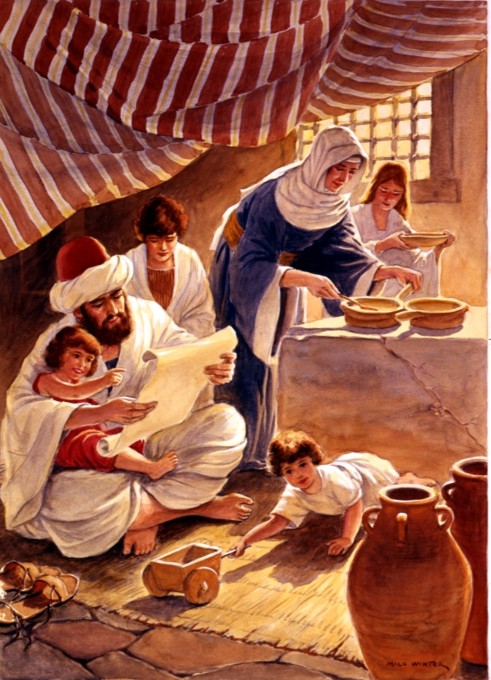
Father reads the Scriptures from a scroll to his family as the mother prepares food to eat.

Father reads the Scriptures from a scroll to his family as the mother prepares food to eat.

Once again, this year we will be following someone else’s reading plan, and once again, it is singularly special! It was not finished at the time of this writing, but I will post the schedule on the “Schedules” tab as soon as I get it.

Here is what I can tell you about it. We will be spending the entire year studying the Book of Luke and the Book of Acts.  The plan’s designer appropriately calls it “Cause and Effect.” We will be reading at the pace of a chapter a week. An easy schedule? Perhaps, but some of the chapters are quite long, and there is no shortage of material to study.

First, 24 chapters of Luke – all focused on the life, death, burial, and Resurrection of the savior, Jesus the Christ. And 28 chapters of the Book of the Acts of the Apostles – from the first gospel sermon ever to the imprisonment of Paul in Rome. It is going to be another great year in God’s word, I can  promise you! And we will start tomorrow!

Science museum, Vancouver

Science museum, Vancouver

But, as our regular readers know, since our reading plans are 5 days per week, we have always done something different on Sundays. And 2014 will be no exception. We will still be writing on various subjects and about several different books of the Bible throughout the year. But we will be doing two things on a fairly regular basis.

First, we will have more frequent articles centered on the subject of Apologetics- articles designed to help the christian strengthen his or her faith in God’s word, and hopefully, help prepare to comply with 1 Peter 3:15: “…always being prepared to make a defense to anyone who asks you for a reason for the hope that is in you; yet do it with gentleness and respect…”

Throughout the wilderness journey, Moses talked to the Lord, often begging Him for help in leading the Israelites.

Throughout the wilderness journey, Moses talked to the Lord, often begging Him for help in leading the Israelites.

Secondly, we will try to devote one Sunday article per month to the subject of prayer – the other half of our communication with the Lord. In doing so, it is our hope that we can improve our ability to pray more effective prayers that are pleasing to the Lord and beneficial to those we pray for – and pray with. With God’s help, we hope this will also be an aid to men who often are called upon to lead public prayers in church services and elsewhere.

We hope and pray that these new items on our agenda for 2014 will help us all to grow spiritually in the coming year. We hope you will join us in this effort!

/Bob’s boy

Philippians 4 – Whatever is Honorable

In this last chapter of the epistle, Paul’s affection for the people of Philippi comes through clearly, calling them his “joy and my crown” in verse one. His first congregation in Europe was still strong and he was certainly proud of them, and the great hope of salvation for them surely brought him joy in his confinement. Appealing to them to “stand firm thus in the Lord,” he uses no less than four terms of endearment. Although not naming the nature of the disagreement, he addresses two women, Euodia and Syntyche, by name asking them to mend their differences. He had evidently done much work in Philippi aided by them, as well as someone named Clement. 

On Paul's Second Missionary Journey, Paul and Silas were imprisoned at Philippi. But when God freed them with an earthquake, the Philippian jailer tried to kill himself (Acts 16:16-40).

On Paul’s Second Missionary Journey, Paul and Silas were imprisoned at Philippi. But when God freed them with an earthquake, the Philippian jailer tried to kill himself (Acts 16:16-40).

The rest of this chapter contains so much wisdom and so many familiar verses that they hardly need comment at all, yet they certainly cannot be ignored here. Beginning with the words that make up the totality of a familiar hymn, he tells them to “Rejoice in the Lord always; again I will say, rejoice.” The intentional repetition is significant, as the words to follow are intended to encourage them to live their lives in a joyous manner that demonstrates to the world what righteous living does for those who live it – as well as how it reflects to others around them (us).

First, there is the peace that the righteous can have in their relationship with the Lord:

Let your reasonableness be known to everyone.
The Lord is at hand; do not be anxious about anything,
but in everything by prayer and supplication with thanksgiving
let your requests be made known to God.
And the peace of God, which surpasses all understanding,
will guard your hearts and your minds in Christ Jesus.

And he extends that further with the righteous living that will inspire and capture the hearts of wayward souls:

Finally, brothers, whatever is true, whatever is honorable,
whatever is just, whatever is pure, whatever is lovely,
whatever is commendable, if there is any excellence,
if there is anything worthy of praise, think about these things.
What you have learned and received and heard and seen in me—practice these things,
and the God of peace will be with you.

Paul closes the letter by thanking them for their concern, for their support, and for the gifts they sent with Epaphroditus. Seeking to put their minds at ease about him, Paul then gives the following inspiring words that we all would do well be able to honestly use to describe our own attitudes in the face of adversity:

I have learned in whatever situation I am to be content.
I know how to be brought low, and I know how to abound.
In any and every circumstance, I have learned the secret
of facing plenty and hunger, abundance and need.
I can do all things through him who strengthens me.

That last line, most often taken out of context, is not meant to imply that we can always be on top of the world no matter what. Rather, it lets us know that with the Lord’s help, we can get through the times when life may not be going so well.

“The grace of the Lord Jesus Christ be with your spirit.”

Read or listen to audio of ESV version of this selection from this link.

/Bob’s boy
___________________
some images © V. Gilbert & Arlisle F. Beers

Please note: I did not design the reading plan that I am following in my blog.  All of my comments in this blog, however, are solely my responsibility.  When reading ANY commentary, you should ALWAYS refer first to the scripture, which is God’s unchanging and unfailing word. Reading schedules, as well as a link to the site where you can get the reading plan that I’m currently following for yourself can be found on the “Bible Reading Schedules” page of my website at http://graceofourlord.com.  

Philippians 3 – The Prize of the Upward Call

This chapter of the epistle begins with Paul telling the brethren to “rejoice in the Lord,” continuing his encouragement. Then he begins his typical “beware” admonition. This time, however, he speaks of “dogs” and evildoers, and then a clever mention of “mutilators of the flesh.” All three of these refer to the same group of people – Judaizers.  This is a faction of the Christian movement who, despite what Paul and the other apostles have made clear, were still teaching others that circumcision was still necessary – in particular, to force such teaching on Gentiles. This was causing problems in the church in many places, and Paul wanted to make sure the brethren at Philippi were vigilant to “nip it in the bud.”

Philippi forum

Philippi forum

Paul tells them that “we are the circumcision, who worship by the Spirit of God and glory in Christ Jesus and put no confidence in the flesh.”  What he means is that the faithful Christians are the new children of Abraham. Referring to these Judaizers as “dogs” is intentionally ironic, as Gentiles were often so called by Jews in times past. It is in verse 4 that he refers to their unjustified pride, noting that if anyone has reason for “being confident in the flesh,” he himself does. He then recounts all of the things that he had always placed a high value on in his life. He was a Jew, circumcised on the eighth day according to the law of Moses. He was from the tribe of Benjamin, had been a Pharisee, and righteous and blameless under the law – a respected Hebrew among Hebrews.

Noting that he had lost all of those things he had valued, he now counts them as rubbish that he may know Christ, become like Him in His death, and attain the resurrection of the dead. It is with this in mind that he urges them to stand fast in the face of their enemies and trials, and press on to that goal.

Read or listen to audio of ESV version of this selection from this link.

/Bob’s boy
___________________
some images © V. Gilbert & Arlisle F. Beers

Please note: I did not design the reading plan that I am following in my blog.  All of my comments in this blog, however, are solely my responsibility.  When reading ANY commentary, you should ALWAYS refer first to the scripture, which is God’s unchanging and unfailing word. Reading schedules, as well as a link to the site where you can get the reading plan that I’m currently following for yourself can be found on the “Bible Reading Schedules” page of my website at http://graceofourlord.com.  

The Book of Acts Tops 2013

Wishing you a Happy and Blessed New Year!

New YearThe annual report for Bob’s Boy’s Christianity Blog has been released, and we want to share the unexpected results with you. In 2013, our readers connected from a total of 129 different countries!

But the congratulations are not for us, but for YOU! You visited us for one reason alone – you  are interested in God’s word through His Scriptures! You weren’t looking for contests, gimmicks, or even glamour. YOU are proof positive that His word will endure forever! The busiest day of the year was March 3rd with 1,313 views. The most popular post that day was Acts 18 – Paul In Corinth.

The Top 5 other favorites:

A BIG THANK YOU to everyone from every country who visited this blog in 2013!

Countries

Here’s an excerpt from our report:

The concert hall at the Sydney Opera House holds 2,700 people. This blog was viewed about 14,000 times in 2013. If it were a concert at Sydney Opera House, it would take about 5 sold-out performances for that many people to see it.

/Bob’s boy

Philippians 2 – Have This In Mind

In this chapter, we learn that the church at Philippi had sent one of their members, Epaphroditus, to minister to Paul’s needs while he was in prison ( verses 25-30). But Epaphroditus became gravely ill (with what, we do not know) and had not returned to them. Furthermore, it has been long enough that word had gotten back to the brethren at Philippi of their brother’s illness. So Paul is sending him back (probably with this letter).

Philippi forum

Philippi forum

He also lets them know that he plans to send Timothy to see them. They would be familiar with Timothy, as he was with Paul and Silas when they first arrived in Philippi a decade or so before. We know from Philippians 1:1 that Timothy assisted Paul in writing this letter – likely acting as Paul’s “secretary.”

In the first chapter of this letter, Paul wrote to them about some brethren who (in light of his imprisonment) were preaching the gospel out of envy, rivalry, and selfish ambition. Now he urges the Philippian brethren to do nothing from selfish ambition, but to “count others more significant than yourselves.” It is in this context that he then wrote what is in verses 5-8 – a passage familiar to many of us:

Have this mind among yourselves, which is yours in Christ Jesus,
who, though he was in the form of God, did not count equality with God a thing to be grasped,
but emptied himself, by taking the form of a servant, being born in the likeness of men.
And being found in human form, he humbled himself by becoming obedient to the point of death, even death on a cross

Philippi Basilica A

Philippi Basilica A

So what did Paul mean when he told them to “have this in mind…?” The same thing that Jesus meant when he gave his disciples an important lesson before the Passover Feast in John 13:1-17. Washing their feet, he told them that, as servants and as messengers of the one who sent them, they are not “greater” than He. They must learn to serve others as he has done.

Jesus gave up everything to come here as a man to die for a purpose. We must keep that in mind in our daily lives, living life in a manner worthy of the gospel of Christ – knowing that our purpose is to serve others, edifying our brethren, and bringing the good news of Jesus Christ to those outside the gospel.

Read or listen to audio of ESV version of this selection from this link.

/Bob’s boy
___________________
some images © V. Gilbert & Arlisle F. Beers

Please note: I did not design the reading plan that I am following in my blog.  All of my comments in this blog, however, are solely my responsibility.  When reading ANY commentary, you should ALWAYS refer first to the scripture, which is God’s unchanging and unfailing word. Reading schedules, as well as a link to the site where you can get the reading plan that I’m currently following for yourself can be found on the “Bible Reading Schedules” page of my website at http://graceofourlord.com.  
Paul’s Letter to Philippi – Chapter 1

Hard to believe a year has just about come and gone since we started reading Wisdom Literature. But now that the the year is drawing to a close, it is time to make some final decisions on the reading schedule for 2014 – to be announced soon. While we wait, we thought a preview of part of what we will be doing on Sundays in 2014 would be a good idea. So we will start here with an overview of Paul’s letter to the Philippians.

There is little descent among scholars as to whether Paul is the author of the Philippian letter. His location when writing it is another story. We know from Paul himself that he was in prison at the time (Philippians 1:13). Some say it was in Caesarea, some say Ephesus, and some say it was in Rome. The latter seems clearly the case because of the mention of Caesar’s household in Philippians 4:22, among other things. The time was likely about A.D 62.

Philippi sat on the Egnatian Way, the main transportation route in Macedonia, an extension of the Appian Way, which joined the eastern empire with Italy.

Philippi sat on the Egnatian Way, the main transportation route in Macedonia, an extension of the Appian Way, which joined the eastern empire with Italy.

The city of Philippi was founded in eastern Macedonia by Philip II in 356 B.C. It was brought under Roman rule in 168 B.C. and re-founded in 42 B.C., when Mark Anthony and Octavian (later titled “Augustus”) defeated the forces of the assassins of Julius Caesar, Cassius, and Brutus in a series of military battles – including the famous Battle of Philippi. As a Roman colony, the city enjoyed full benefits of such, including not having to pay tribute to the emperor.

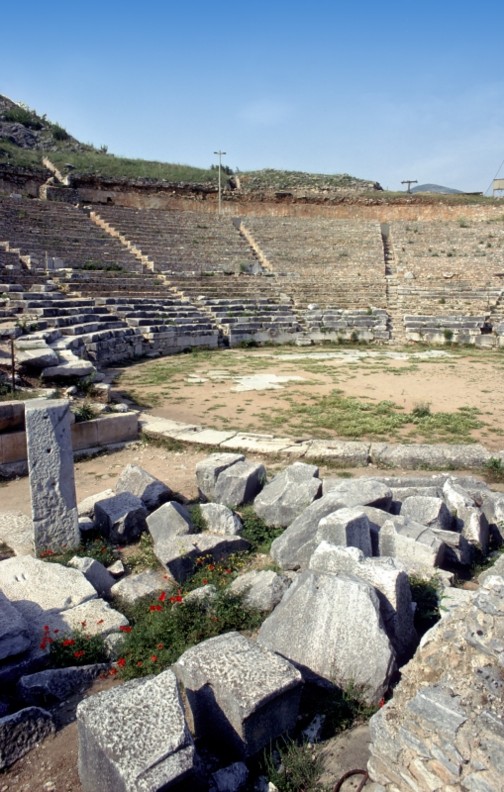
Archaeologists have unearthed much of what existed there during the time of Paul’s visit during his second missionary journey (about 50 A.D.), including the Greek theater, Basilicas, and many Latin inscriptions testifying to the Roman influence.  Philippi was one of the first (if not THE first) of the churches that Paul founded in Europe, so it would no doubt hold a special place in his heart. This fact is clearly voiced in Philippians 1:3-11.

If one had to sum up the letter’s purpose in one word, perhaps “encouragement” would be the proper choice. And chapter one certainly exemplifies that. Indeed, the entire letter offers such encouragement, and is free from the sort of rebukes that Paul had for some of the other churches he wrote to, such as the one at Corinth. No doubt they had their own problems, but it seemed to be a strong church.

Philippi theater

Philippi theater

It is Paul’s words in chapter one, written from prison yet expressing his love for them, his contentment, and his hope for the future in Christ that demonstrate his appreciation for the memories he has of them and for their support during his imprisonment. This latter would mean a great deal, as imprisonment carried with it a stigma even though his cause was righteous. In Philippians 1:12-14, he tells them how he had made it clear “throughout the whole imperial guard and to all the rest”  that his imprisonment is for Christ.

Paul expresses courage and certainty that death would only mean getting closer to the Lord, yet he realizes the work that is needed to be done here by him, as well as by them – and that is to proclaim Christ to the world. He tells them honestly that they will see suffering for Christ’s sake.

Perhaps the most important message for us from this chapter of the letter comes from verse 27, in which he urges them to “let your manner of life be worthy of the gospel of Christ.” This message must never get lost on us as we go about our busy lives. The souls of others may depend on it.

Read or listen to audio of ESV version of this selection from this link.

/Bob’s boy
___________________
some images © V. Gilbert & Arlisle F. Beers

Please note: I did not design the reading plan that I am following in my blog.  All of my comments in this blog, however, are solely my responsibility.  When reading ANY commentary, you should ALWAYS refer first to the scripture, which is God’s unchanging and unfailing word. Reading schedules, as well as a link to the site where you can get the reading plan that I’m currently following for yourself can be found on the “Bible Reading Schedules” page of my website at http://graceofourlord.com.  


Malachi – The Messenger

Malachi is the last book in our arrangement of the Old Testament, the last of the “minor prophets,” and the last time God will talk to His people through them for about 400 years – when he sends His son, our Lord Jesus Christ, to fulfill His plan of salvation for us. The name translates to “my messenger” but some believe it may be the shortened form of “Malachiah,” which means “messenger of the Lord.” Since there is some foreshadowing of the arrival of John the Baptist (as in Malachi 3:1, which says “Behold, I send my messenger, and he will prepare the way before me”), some consider it word-play on the prophet’s name.

Some estimates of the date are about 460 B.C., making him a contemporary of Ezra and Nehemiah. The temple reconstruction  was completed about 516 B.C., and the time was after that, as Malachi 1:10, 3:1, and 3:8-10 clearly allude to an existing temple. But the date may actually be a bit later than that, as the times were somewhat different. The good news is that God’s people finally seem to be rid of the scourge of idolatry here. The bad news is that they are spiritually weak, if not practically dead. They were apathetic toward their worship, and insulted the Lord with their offerings of lame and diseased animals (Malachi 1:6-8).

John the Baptist preaches in the wilderness, preparing people for Jesus' coming as the Messiah -- Matthew 3: 1-12.

John the Baptist preaches in the wilderness, preparing people for Jesus’ coming as the Messiah — Matthew 3: 1-12.

But that is just the beginning of the things that Malachi points out for which the people need to repent. They are divorcing their wives to marry foreign women – again disregarding the law given against doing so (Deuteronomy 7:1-6). Malachi 3:6-12 speaks of how they are robbing God by not honoring their tithes. And one thing certainly had not changed. The people were still plagued by bad leadership, for the priests were to blame for much of this – and they are certainly addressed and rebuked throughout he book. Malachi’s message from the Lord is  that He demands real worship – not simply going through the motions, as they were doing. It was time for God’s people to step up and serve the Lord as their part of the covenant demanded.

Malachi 4:1 warns of the coming judgment for those who continue to show disrespect, indifference, and disregard for the Lord’s will. Both chapter 3 and 4 promise the coming of the Lord’s messenger – named as Elijah the prophet, but clearly a reference to John the Baptist – to “prepare the way.”

/Bob’s boy
___________________
image © V. Gilbert & Arlisle F. Beers

Please note: I did not design the reading plan that I am following in my blog.  All of my comments in this blog, however, are solely my responsibility.  When reading ANY commentary, you should ALWAYS refer first to the scripture, which is God’s unchanging and unfailing word. Reading schedules, as well as a link to the site where you can get the reading plan that I’m currently following for yourself can be found on the “Bible Reading Schedules” page of my website at http://graceofourlord.com.  

James 5 – Cover a Multitude of Sins

We conclude the Book of James, and an entire year of reading the Wisdom Literature of the Bible with this chapter. We hope you have learned as much as we have from this, and that your walk with God will be enhanced.

Elijah fed by ravens

Elijah fed by ravens

Chapter 5 shows us very well why many call the Book of James the “Proverbs of the New Testament.” James has several different gems of wisdom for the reader in this chapter, and we will do as we did with the Book of Proverbs, picking out one or two passages to consider. Verses 1-6 concern those among the rich who have prospered at the expense of the poor – oppressing, defrauding, and even murdering them.  James makes it clear that those people will be dealt with by the Lord in harsh measure upon His coming day.

Upon that premise, he calls upon the righteous to be patient, just as the farmer must be patient for his crops to grow, for the day of the Lord’s coming is at hand. Again he urges patience and steadfastness in verses 10-11, reminding us of the Lord’s compassion and mercy. In the closing verses, James puts great emphasis on the power of faith and of prayers, particularly the prayers of the righteous. He gives Elijah as an example. Time and again, as in verse 16, the scriptures emphasize how important our fellowship with one another in worship is, and how we lift each other up – here we are told to confess our sins to each other and pray together and for each other.

Finally, the charge is given to us to care for one another, particularly for those who have fallen away, and our reward will be great, as verses 19-20 conclude “My brothers, if anyone among you wanders from the truth and someone brings him back, let him know that whoever brings back a sinner from his wandering will save his soul from death and will cover a multitude of sins.”

Read or listen to audio of ESV version of this selection from this link.

/Bob’s boy
___________________
some images © V. Gilbert & Arlisle F. Beers

Please note: I did not design the reading plan that I am following in my blog.  All of my comments in this blog, however, are solely my responsibility.  When reading ANY commentary, you should ALWAYS refer first to the scripture, which is God’s unchanging and unfailing word. Reading schedules, as well as a link to the site where you can get the reading plan that I’m currently following for yourself can be found on the “Bible Reading Schedules” page of my website at http://graceofourlord.com.