Mark 6 – The Death of John the Baptist

Here, we have another account of Jesus returning to His hometown.  Verse 5 simply means that their lack of faith prevented him from doing many mighty works.  Indeed, His own family had already believed him to be out of His mind (Mark 3:20-21).  In verses 7-13, He sends out the apostles, giving them authority over the unclean spirits, and to heal.
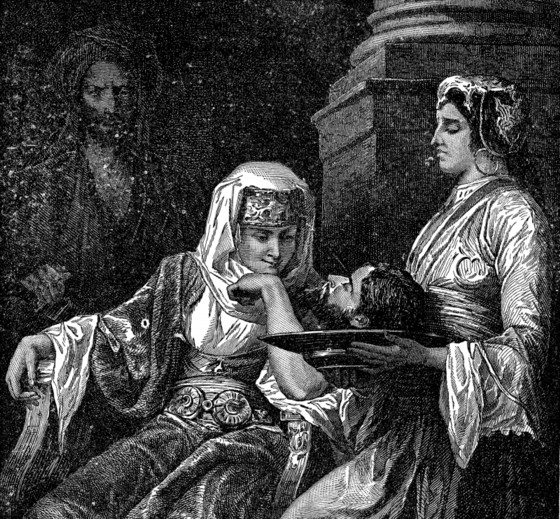
In verses 14-16, we find Herod Antipas leaning toward the belief that Jesus must be John the Baptist raised from the dead – perhaps because of fear from his own guilt in John’s death.  Verse 17-29 detail the death of John the Baptist, as his pronouncement of lawlessness on Herod’s part (he had committed adultery by marrying his brother Philip’s wife, Herodias) cost John his life in an ugly and inhumane act of murder (verses 27-28).

Verse 30 takes up when the apostles return to Jesus, and tell Him all that they had done.  He takes them to a “desolate place” by boat to get away from the crowds and to rest.  But people were already waiting for them when they came ashore.  In verse 34 He “had compassion on them, because they were like sheep without a shepherd,” and began teaching them.  The disciples wanted to send them away so they could eat, but Jesus told them that they would feed them.  This time, there were five thousand men, plus women and children, and they fed them with five loaves of bread and two fish; and they took up twelve baskets full when everyone was full (verse 43).  Two hundred denarii in verse 37 was about 200 days worth of a laborer’s wages.

Jesus sent His disciples ahead to Bethsaida by boat, as He dismissed the crowds and went up to the mountain to pray.  But they were making their way “painfully” because of the wind, and Jesus began walking out to them on the water about the fourth watch (between 3:00 and 6:00 a.m.).  When they saw Him, they thought it was a ghost, but He told them not to be afraid – “it is I.”  As He got in the boat, the wind ceased.  Mark explains that the hardness of their hearts kept them from seeing who He really was, despite the miracle of the loaves or seeing Him walk on the sea with their own eyes.
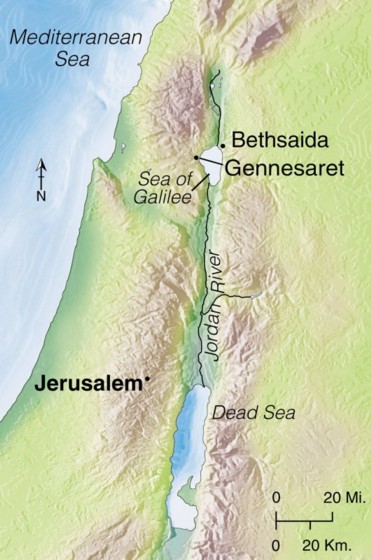
Verse 53 seems to indicate that the wind had taken them southwest of Bethsaida to Gennesaret.  As He came to the villages, cities and countryside, word had spread of His arrival; and people brought the sick to Him.  “On their beds” in verse 55 would indicate some gravely ill people being brought.  Contrast verse 5 with verse 56.  Many just wanted to touch the fringe of His garment, believing that would heal them.  That faith made it so.

Read or listen to audio of ESV version of this selection from this link.

/Bob’s boy
___________________
some images © V. Gilbert & Arlisle F. Beers

Please note: I did not design the reading plan that I am following in my blog.  All of my comments in this blog, however, are solely my responsibility.  When reading ANY commentary, you should ALWAYS refer first to the scripture, which is God’s unchanging and unfailing word. Reading schedules, as well as a link to the site where you can get the reading plan that I’m currently following for yourself can be found on the “Bible Reading Schedules” page of my website at http://graceofourlord.com.  For questions and help, please see the “FAQ” and “Summaries” pages there.

Jesus, The Son of God \ Week 32 summary posted

This week, we will read of Peter’s confession,  the Transfiguration, as well as the death of John the Baptist.  Jesus sends out the twelve apostles, and then sends out more disciples in Luke chapter 10.  Finally, we end the week with a closer look at some more famous parables.

In the middle of all of this, we will read more verses about demons, and people afflicted by them.  Along with the miracles that Jesus and his disciples perform, these scriptures are the target of criticism, and even ridicule, by non-believers.  So, what is the story about these beings, sometimes even mentioned casually in God’s word from the beginning chapters of Matthew onward?  Are they, as some charge, simply ignorant superstitions held about diseases people did not understand?  Or are they fallen angels?  Or devils themselves?

Medieval book illustration of Christ Exorcisin...

Medieval book illustration of Christ Exorcising the Gerasenes demonic (Photo credit: Wikipedia)

While some of the scriptural accounts of people afflicted with demons describe symptoms that resemble people who had diseases or handicaps, the Bible does clearly separate such accounts (see Matthew 4:24, for example).    Just as clearly, the Bible is not speaking of these beings metaphorically.  Instead, time after time, the scripture refers to them as actual spiritual beings that have knowledge of who God is, as well as Jesus (see Matthew 8:29 and James 2:19, for example).

There is no more reliable source of knowledge for a wealth of things of this world, but the truth is that the Bible does not answer all of our questions as to how this came to be such a significant problem in that century, as well as when it began to be so.  Like our curiosity about such things as Urim and Thummim, Cherubim and Seraphim (to name a few), God did not see such knowledge to be essential to our salvation, which is the point of His word.   All we know for sure is that during the first century on through the end of the age of the apostles (and the age of miracles), God for some reason allowed these circumstances to proliferate.  It seems only reasonable that His reasons would have to do with the long-awaited arrival of the Messiah.  In this link to an article at Apologetics Press, one writer makes some very good observations, and the section of the article entitled “THE DIVINE PURPOSE IN ALLOWING DEMON POSSESSION” is recommended reading especially.

Summing Up

Each weekend, I am now posting a small PDF of one week of chapter summaries (on the website’s “Summaries” page), current to the beginning of the previous week.  I have posted the summary for Week 32 (August Week 1) of the schedule I am following.  This short PDF document contains condensed comments about Matthew 5, 6, 7, John 2, and John 3, with hyperlinks to the ESV version of each chapter for listening or reading, and joins the summaries for other weeks already posted there.

/Bob’s boy
___________________
image © V. Gilbert & Arlisle F. Beers

Please note: I did not design the reading plan that I am following in my blog.  All of my comments in this blog, however, are solely my responsibility.  When reading ANY commentary, you should ALWAYS refer first to the scripture, which is God’s unchanging and unfailing word. Reading schedules, as well as a link to the site where you can get the reading plan that I’m currently following for yourself can be found on the “Bible Reading Schedules” page of my website at http://graceofourlord.com.  For questions and help, please see the “FAQ” and “Summaries” pages there.

Matthew 15 – What Defiles a Person

The Pharisees and scribes that came from Jerusalem in verse 1 would have been of considerable import and influence during the day.  They accuse the disciples (and therefore, Jesus) of breaking the tradition of the elders by eating without having washed their hands.  This was not a matter of hygiene on their part, but is a good example of the extra-biblical customs they were fond of imposing upon people – this one is supposed to have been based on the ritual purity commandments for priests (i.e. Exodus 30:17-21), extending them to apply to people and situations beyond that of God’s word .

The response from Jesus is to throw it right back at them.  The Pharisees were breaking the commandment of God – not the traditions of elders!  By making a claim that their money or property was vowed as a gift to God, they would exclude it from their wealth in consideration of their parents in need, and be excused for not caring for them by their own interpretation of the law – and who knows if they ever actually would give the possessions anyway, even after they died?  Jesus does not mince any words in exposing this hypocrisy (verse 7-9).   The prophecy quoted in verses 8-9 is from Isaiah 29:13.  The disciples then point out the obvious to Jesus – that the Pharisees were offended by what He had said.  But Jesus is not surprised by the opposition of the Pharisees, and tells the disciples that they are intentionally blind to the gospel.  Verses 10-20 then are His lesson to them that it is not what goes into the body that corrupts us, but what comes from our hearts.

The conversation with the Canaanite woman in verses 21-28 seems to be harsh toward her, but we must realize that Jesus came to the regions of Tyre and Sidon (verse 21) not by accident – He would be expecting encounters with Gentiles!  Her faith did pass the test, and her daughter was healed.  Remember that He had already healed the Centurion’s servant.

He then goes on by the Sea of Galilee healing still more in verses 29-31.  Verses 32-39 detail the feeding of the four thousand – this was just the number of men, not including women and children.  This numeration, as well as that of the feeding of the five thousand could be an indication of what sort of size crowds the scripture speaks of in other places.  All were fed and satisfied with just seven loaves of bread and a few fish, and the seven baskets of food gathered up afterward represents more than what they even started with.

Read or listen to audio of ESV version of this selection from this link.

/Bob’s boy
___________________
some images © V. Gilbert & Arlisle F. Beers

Please note: I did not design the reading plan that I am following in my blog.  All of my comments in this blog, however, are solely my responsibility.  When reading ANY commentary, you should ALWAYS refer first to the scripture, which is God’s unchanging and unfailing word. Reading schedules, as well as a link to the site where you can get the reading plan that I’m currently following for yourself can be found on the “Bible Reading Schedules” page of my website at http://graceofourlord.com.  For questions and help, please see the “FAQ” and “Summaries” pages there.

Matthew 13 – Parabolic Discourse

The Book of Matthew is considered by many to have five major discourses by Jesus.  The first obviously was the Sermon on the Mount of chapters 5-7.  The second was chapter 10 – the Messiah’s preparation of His disciples for their mission.  Chapter 13 is made up almost entirely of His parables.  In fact, verse 34 says that He said nothing to the crowds on this occasion without a parable.

Landscape with the Parable of the Sower

Landscape with the Parable of the Sower (Photo credit: Wikipedia)

As Jesus sat beside the sea, crowds gathered and he got into a boat and sat to address them.  Jesus  first tells the parable of the sower in verses 3-9.  We are not told about the chronology in the text, but most surmise that Jesus spoke all of the parables from the boat, and the explanation came later, after he went into the house in verse 36 (verse 34 seems to bear that out). When  the disciples came to ask Him why He spoke to the people in parables, He quoted from Isaiah 6:9-10 in verses 14-15, explaining that the difference between them (the disciples that want to learn) and the crowds (those that do not really want to understand, much less accept, the truth) is in their hearts. Those who do not understand and accept what He speaks of to them in plain speech, will never accept what He teaches in parables.  This may be the point He made to Nicodemus in John 3:12.

This is followed up by the explanation of the parable of the sower in verses 18-23, which is the key to understanding all of the parables.  In this case, Jesus is the sower, but it applies to us as sowers as we teach others about the kingdom.  It is up to the individual receiving the seeds to prepare their ground for their proper growth – to plow up the hard ground of their hearts (Jeremiah 4:3-4).

The parable of the weeds, or tares (verses 24-30), is like that of the net (verses 47-50), and refers to the fate of those who will not accept the truth.  It is not our job to gather up the weeds, lest we uproot the righteous as well. The parables of the mustard seed (verses 31-32) and leaven (verse 33) show that the kingdom may be starting very small, but will grow into something very large.  The parables of the hidden treasure (verse 44) and the pearl of great value (verses 45-46) demonstrate that those who truly understand the value of our place in His kingdom will be willing to give up anything in this ordinary world in order to attain it.  The prophecy He cites in verse 35 is Psalm 78:2.  Verse 52 means that true disciples who study God’s word will use their training for the kingdom to teach others, using knowledge of the old law with the new.

English: An etching by Jan Luyken illustrating...

English: An etching by Jan Luyken illustrating Matthew 13:47-48 in the Bowyer Bible, Bolton, England. (Photo credit: Wikipedia)

One might wonder why verses 53-58 are in this chapter, but all of God’s word teaches something.  The rejection of Jesus in His own hometown resulted in Him not wasting much time there (verse 58).  It illustrates very well the points that He made in the earlier parts of the chapter.  The hearts of the people there were hardened to the truth and they could not see.  The ground of their hearts needed plowing as well.

Side note: Though the scriptures do not tell us the location at the Sea of Galilee that Jesus gave the Parable of the Sower, there is a cove that has been suggested as that location.  Interesting studies have been conducted on the acoustics at that cove; and a great article with photos and a sound file made in a test is in this article at BilbePlaces.com.

Read or listen to audio of ESV version of this selection from this link.

/Bob’s boy
___________________
some images © V. Gilbert & Arlisle F. Beers

Please note: I did not design the reading plan that I am following in my blog.  All of my comments in this blog, however, are solely my responsibility.  When reading ANY commentary, you should ALWAYS refer first to the scripture, which is God’s unchanging and unfailing word. Reading schedules, as well as a link to the site where you can get the reading plan that I’m currently following for yourself can be found on the “Bible Reading Schedules” page of my website at http://graceofourlord.com.  For questions and help, please see the “FAQ” and “Summaries” pages there.

Luke 7 – Who Is This?

A centurion was a Roman soldier in charge of a hundred men.  This one was a friend to the Jewish people (see verses 3-5).  When Jesus went with the elders to go to heal the centurion’s servant, he sent people to meet Jesus along the way, and told him not to trouble Himself.  Verses 6-8 show his faith in Jesus was strong enough to believe that his servant would be healed simply by Jesus saying so.  Jesus’s statement in verse 9 “I tell you, not even in Israel have I found such faith”  foreshadows the welcoming of Gentiles into the kingdom.

When a widow of Nain lost her only son, Jesus raised him from the dead, a mighty miracle — Luke 7: 11-17.

His compassion for the widow whose son had died (his death would also mean economic hardship for her) causes him to bring her son back to life in front of a great crowd of people, including those carrying the body.  Imagine the fear among them as he sat up and spoke!  His fame grew even more as verse 17 says “this report about him spread through the whole of Judea and all the surrounding country.”  As word spread back to John the Baptist, he sent two disciples to go and ask Jesus point-blank if He really was the Messiah.  Apparently, even John was expecting a very different savior than this.  After they witnessed Jesus healing numerous people (verse 21), he sent them back to him quoting from Isaiah 35:5-6 and 61:1.

The woman whose sins He forgives in verses 36-50 is not Mary who anoints His feet before the crucifixion in John 12:3-8.  The Pharisee (who we learn in verse 40 is named Simon) had invited Jesus into his home to eat, and did not know that Jesus knew what he was thinking.  He was convinced that Jesus could not be a” prophet,” or else He would not be letting a known sinful woman like this touch Him.  Jesus answers with a short parable and a question, and forgives the woman of her sins, prompting those at table to say in verse 49 “Who is this, who even forgives sins?”

Read or listen to audio of ESV version of this selection from this link.

/Bob’s boy
___________________
some images © V. Gilbert & Arlisle F. Beers

Please note: I did not design the reading plan that I am following in my blog.  All of my comments in this blog, however, are solely my responsibility.  When reading ANY commentary, you should ALWAYS refer first to the scripture, which is God’s unchanging and unfailing word. Reading schedules, as well as a link to the site where you can get the reading plan that I’m currently following for yourself can be found on the “Bible Reading Schedules” page of my website at http://graceofourlord.com.  For questions and help, please see the “FAQ” and “Summaries” pages there.

Luke 6 – Jesus is Lord of the Sabbath

Verses 1-5 have been used to link Biblical teaching to situation ethics, but this comes from a lack of understanding of the scriptures.  The disciples in verse 1 plucked and ate the grain with their hands, not with a sickle.  This was expressly allowed in the Law given in Deuteronomy 23:24-25.  But the Pharisees had made their own interpretation and decided it was the law, rather than God’s word.  Jesus challenged them to speak against David and his men eating the Bread of the Presence, or shewbread (1 Samuel 21:1-6) – which He said in verse 4 was unlawful.  He settles the matter in verse 5, saying that He is “lord of the Sabbath,”  with the unstated conclusion that the Pharisees are not.

English: A dispute with the pharisees. Passeri...

English: A dispute with the pharisees. Passeri. In the Bowyer Bible in Bolton Museum, England. Print 4384. From “An Illustrated Commentary on the Gospel of Mark” by Phillip Medhurst. Section D. Jesus confronts uncleanness. Mark 1:21-45, 2:1-12, 5:1-20, 25-34, 7:24-30. http://pdfcast.org/pdf/an-illustrated-commentary-by-phillip-medhurst-on-the-gospel-of-mark-section-d (Photo credit: Wikipedia)

Verses 6-11 are another Sabbath encounter with the Pharisees, as Jesus was teaching in the synagogue.  Knowing that they are waiting to see if He will heal the man with the withered hand, He poses the question of whether it was lawful to do harm or to do good on the Sabbath.  They would not answer, but when he healed the man, they were angry.  Notice that their malice and desire to do harm to Him blinds them to the fact that the miracles prove He is the son of God.

In verses 12-16, after spending all night in prayer, He chose the twelve apostles from his disciples.   Verses 17-19 show the magnitude of the vast amounts of people He ministers to in the rest of this chapter.  People from Tyre and Sidon would almost certainly be Gentiles.

Some believe that the rest of this chapter is just Luke’s account of the Sermon on the Mount, but we must realize that similar sermons by the Lord would be taught at different times and to different crowds.  Note that in verse 17, after having spent the night praying on the mountain, He “he came down with them and stood on a level place.”  This has resulted in people referring to this as the Sermon on the Plain.  In comparing the “blessed” and the “woes” in this sermon, Jesus is not saying that it is wrong to be rich or that the poor are more righteous.  He is stating the poor and those less fortunate who are in His kingdom will have their reward, while those who may be rich but not part of the faithful already have their reward.

Read or listen to audio of ESV version of this selection from this link.

/Bob’s boy
___________________
some images © V. Gilbert & Arlisle F. Beers

Please note: I did not design the reading plan that I am following in my blog.  All of my comments in this blog, however, are solely my responsibility.  When reading ANY commentary, you should ALWAYS refer first to the scripture, which is God’s unchanging and unfailing word. Reading schedules, as well as a link to the site where you can get the reading plan that I’m currently following for yourself can be found on the “Bible Reading Schedules” page of my website at http://graceofourlord.com.  For questions and help, please see the “FAQ” and “Summaries” pages there.

John 4 – Jesus and the Woman of Samaria

In order to get to Galilee from Judea, one had to either go through Samaria or cross over the Jordan to go around it on the east side.  A strict Jew would do the latter to avoid being defiled by setting foot on Samaritan soil.  After the Assyrians captured Samaria, the Assyrian king brought foreigners from various places in to settle in 722 BC (2 Kings 17:24).  Some Jews remained and intermarried with these foreigners, and the animosity between this mixed race of people and the Jews grew strong over time.

Jesus, however, had come to seek and save the lost and would naturally not avoid these people.  As He approaches Jacob’s well, verse 6 indicates His humanity by saying that He was weary from the journey. Jesus intentionally turns the subject of the conversation with the Samaritan woman at the well to her “husband” in verses 17-19. His thorough knowledge of her history is enough to convince her that He may be who He says He is in verse 26, when Jesus makes a rare admission that He is the Messiah.  After she told others, many came from the town and believed by their own encounters with Jesus that He was the “Savior of the world” (verse 42).

When His disciples return in verse 31, Jesus gives them a lesson about sowing and reaping in the kingdom in verses 34-38.  He points out that the sowers and reapers can rejoice together now, as new believers are brought into His kingdom.

Arriving at Cana in Galilee, he heals the son of an official from Capernaum that was dying, but does so from without going with him because the official believed.  When the man returned, he asked the hour at which his son had started improving, and knew it was the same hour that Jesus had told him “your son will live.”  Note that verse 54 says that this was “the second sign that Jesus did when he had come from Judea to Galilee”  – not that it was the second sign He had done.

Side note: There is an interesting story about the area at Shechem and a picture of what is believed to be Jacob’s well in this article at Ferrell’s Travel Blog.

Read or listen to audio of ESV version of this selection from this link.

/Bob’s boy
___________________
some images © V. Gilbert & Arlisle F. Beers

Please note: I did not design the reading plan that I am following in my blog.  All of my comments in this blog, however, are solely my responsibility.  When reading ANY commentary, you should ALWAYS refer first to the scripture, which is God’s unchanging and unfailing word. Reading schedules, as well as a link to the site where you can get the reading plan that I’m currently following for yourself can be found on the “Bible Reading Schedules” page of my website at http://graceofourlord.com.  For questions and help, please see the “FAQ” and “Summaries” pages there.
Week 31 summary posted

English: The Wedding at Cana (watercolour)

English: The Wedding at Cana (watercolour) (Photo credit: Wikipedia)

Last week we finished the Sermon on the Mount, the Wedding at Cana, and Jesus’ encounter with Nicodemus, and important Pharisee of the day.  This week we will see look at some of the great parables of the Lord, and see His more typical encounters with the Pharisees become more accusatory on their part, as those in power become more afraid of His popularity.  How will Jesus respond to this?

Summing Up

Each weekend, I am now posting a small PDF of one week of chapter summaries (on the website’s “Summaries” page), current to the beginning of the previous week.  I have posted the summary for Week 31 (July Week 5) of the schedule I am following.  This short PDF document contains condensed comments about John 1, Luke 1, Luke 2, and Matthew 3 and 4, with hyperlinks to the ESV version of each chapter for listening or reading, and joins the summaries for other weeks already posted there.

/Bob’s boy
___________________
image © V. Gilbert & Arlisle F. Beers

Please note: I did not design the reading plan that I am following in my blog.  All of my comments in this blog, however, are solely my responsibility.  When reading ANY commentary, you should ALWAYS refer first to the scripture, which is God’s unchanging and unfailing word. Reading schedules, as well as a link to the site where you can get the reading plan that I’m currently following for yourself can be found on the “Bible Reading Schedules” page of my website at http://graceofourlord.com.  For questions and help, please see the “FAQ” and “Summaries” pages there.

John 3 – For God So Loved the World

Nicodemus was a Pharisee.  Verse one says that he was a “ruler of the Jews,” which would make him a member of the Sanhedrin – the Jewish governing council.  In fact, one of the other two places he is mentioned is in John 7:50, as there is division among them concerning arresting Jesus. Nicodemus states his belief that Jesus is sent from God because of the signs that he did, confirming that Jesus did many more miracles than were written in the gospel, as John states in John 20:30-31.  Nicodemus seems to be trying to understand what Jesus means by being born again in a physical manner.  But Jesus is speaking of being re-born by the Spirit by way of baptism (Romans 6:3-4, Colossians 2:12-13).  In verse 14, Jesus refers to Moses lifting up the Bronze Serpent in Numbers 21:5-9 to save the people when they had spoken against God; and gives Nicodemus a preview of His crucifixion, which likely he would also not understand – yet.  He will repeat this reference to being lifted up in John 8:28 and John 12:32-33.

The Bronze Serpent

Verse 16 is one of the most famous of the New Testament, and most Bibles that put the words of Jesus in red assign verses 16-21 as His words.  But many scholars believe that these verses are actually John’s inspired words, and the fact that he speaks of God having given His son in the past tense seems to bear that out.  In any case, these verses are joined with verse 15 in such a way that together they well represent the message of the gospel concerning salvation.  The phrase “God so loved the world” followed by the other references to the world are often overlooked in their significance – not only for salvation being open to all, but the declaration of God’s love for all the world, not just the people of Israel.

It is no coincidence that the text immediately jumps to the baptism being done by John the Baptist (who is not yet in prison in this part of the gospel) and now by Jesus and His disciples (verses 22-26). John’s disciples note that people are going to Jesus for baptism now, and John reminds them that he himself told them that he is not the Christ, but had been sent before him.  And in verse 30, says “He must increase, but I must decrease.”  John had done what God had sent him to do.

Read or listen to audio of ESV version of this selection from this link.

/Bob’s boy
___________________
some images © V. Gilbert & Arlisle F. Beers

Please note: I did not design the reading plan that I am following in my blog.  All of my comments in this blog, however, are solely my responsibility.  When reading ANY commentary, you should ALWAYS refer first to the scripture, which is God’s unchanging and unfailing word. Reading schedules, as well as a link to the site where you can get the reading plan that I’m currently following for yourself can be found on the “Bible Reading Schedules” page of my website at http://graceofourlord.com.  For questions and help, please see the “FAQ” and “Summaries” pages there.
John 2 – The Wedding at Cana


John 2:11 confirms that the event of the wedding at Cana is where Jesus performed His first miracle.  Some make reference to this as an argument for social drinking, but it would be safe to say that the Lord would not be providing a means for people to become drunk with wine.  For Jesus to have done so would have been a sin (Habakkuk 2:15); and the point of this scripture is found in examining the miracle (or sign, as John refers to it) itself.  There were six stone jars, each holding 20-30 gallons.  Note that verse 7 says that He had the servants fill the jars to the brim with water – nothing could have been poured into them afterward, and Jesus never touched them.  Running out of wine at a wedding feast would be particularly awkward.

Addressing His mother as “Woman” in verse 4 would seem disrespectful to people today, but such was not the case in the language of the day.  It was a term of respectful distance.  Note that the anger is righteous anger, as Jesus drives out the merchants and money changers.  The temple area spoken of here would be the surrounding area of the temple itself that would be used for worship as well by worshiping Gentiles.  So these traders would be disrupting that worship.  In verse 18, the Jews present questioned Jesus as to what His authority for doing this was.  He answered “Destroy this temple, and in three days I will raise it up.”  Of course, they did not understand that He was talking about His own body – not the temple He had just cleansed.  But verse 22 confirms that His disciples would remember after the crucifixion.

Read or listen to audio of ESV version of this selection from this link.

/Bob’s boy
___________________
some images © V. Gilbert & Arlisle F. Beers

Please note: I did not design the reading plan that I am following in my blog.  All of my comments in this blog, however, are solely my responsibility.  When reading ANY commentary, you should ALWAYS refer first to the scripture, which is God’s unchanging and unfailing word. Reading schedules, as well as a link to the site where you can get the reading plan that I’m currently following for yourself can be found on the “Bible Reading Schedules” page of my website at http://graceofourlord.com.  For questions and help, please see the “FAQ” and “Summaries” pages there.