Psalm 136 – Give Thanks To the God of Heaven

English: An image of Psalm 23 (King James' Ver...

English: An image of Psalm 23 (King James’ Version), frontispiece to the 1880 omnibus printing of The Sunday at Home. Scanned at 800 dpi. Français : Illustration du Psaume 23 (version autorisée par le roi Jacques), en frontispice de l’édition omnibus du Sunday at home. Version numérisée à 800 dpi. (Photo credit: Wikipedia)

Ok, so I blew it. In a recent blog about another psalm, I had the choice of several ways to go in choosing a title. But I chose “His Steadfast Love Endures Forever” because of the repetition of the phrase in the psalm.  Well guess what? I should have remembered that was true of other chapters of books in the Bible. Psalm 136 repeats this phrase in every one of its 26 verses! So I went with the opening line of its 26th verse – “Give thanks to the God of heaven.” Since this is indeed what the entire psalm actually does, I think it works anyway.

The psalm is very much a psalm of praise and thanksgiving; and like Psalm 135, it goes through several key events in the history of God’s people to do so. It is a very easy and fulfilling psalm to read; and it gives us much to be thankful and praise God for today as well. As verse 24-25 say “It is he who remembered us in our low estate,…and rescued us from our foes,…he who gives food to all flesh,

For his steadfast love endures forever.”

Read or listen to audio of ESV version of this selection from this link.

/Bob’s boy
___________________
some images © V. Gilbert & Arlisle F. Beers

Please note: I did not design the reading plan that I am following in my blog.  All of my comments in this blog, however, are solely my responsibility.  When reading ANY commentary, you should ALWAYS refer first to the scripture, which is God’s unchanging and unfailing word. Reading schedules, as well as a link to the site where you can get the reading plan that I’m currently following for yourself can be found on the “Bible Reading Schedules” page of my website at http://graceofourlord.com.  

Psalm 102 – In the Day of My Distress

Hebrew Psalmist from the Brooklyn Museum

Hebrew Psalmist from the Brooklyn Museum (Photo credit: Wikipedia)

As one reads Psalm 102, there can be no doubt that it was written during the time of Babylonian captivity. Verses 13-21 particularly make it clear that this was the time and setting in which the psalmist lived. And this psalmist must have remembered Jeremiah’s prediction of 70 years in captivity (Jeremiah 25:8-11), as he says in verse 13, confident that the end of captivity is near:

You will arise and have pity on Zion;
it is the time to favor her;
the appointed time has come

Coffman describes three divisions to the psalm: “(1) Psalms 102:1-11 describes the terrible sufferings of the afflicted one. (2) Psalms 102:12-22 dwells upon the hopes for relief. (3) And Psalms 102:23-28 speaks of the unchanging God as contrasted with the changing world.”

Below are verses 25-27 containing the comforting words the psalmist with regards to that third point in relation to the oppressors:

Of old you laid the foundation of the earth,
and the heavens are the work of your hands.
They will perish, but you will remain;
they will all wear out like a garment.
You will change them like a robe, and they will pass away,
but you are the same, and your years have no end.

Read or listen to audio of ESV version of this selection from this link.

/Bob’s boy
___________________
some images © V. Gilbert & Arlisle F. Beers

Please note: I did not design the reading plan that I am following in my blog.  All of my comments in this blog, however, are solely my responsibility.  When reading ANY commentary, you should ALWAYS refer first to the scripture, which is God’s unchanging and unfailing word. Reading schedules, as well as a link to the site where you can get the reading plan that I’m currently following for yourself can be found on the “Bible Reading Schedules” page of my website at http://graceofourlord.com.  
Psalm 138 – Give Thanks To the Lord

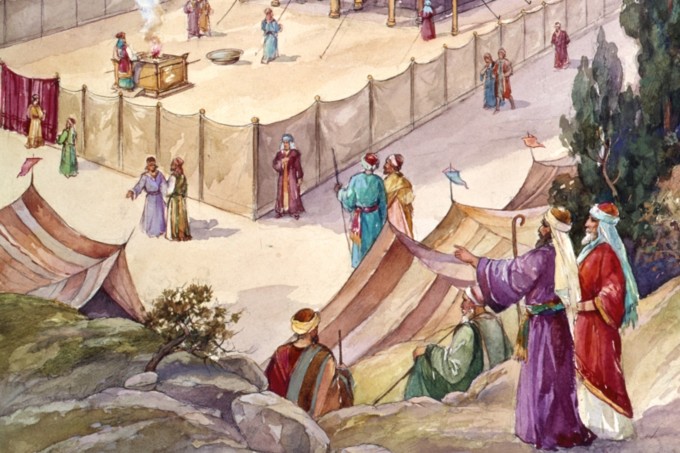
Moses makes the tabernacle in the wilderness -- Exodus 35-40.

Moses makes the tabernacle in the wilderness — Exodus 35-40.

This is another psalm of David to which there has been dispute concerning the authorship – mainly because of this one’s reference to the Lord’s Holy Temple. It seems clear, however, that the psalmist could just as easily be referring to the Tabernacle as to Solomon’s temple – the terms are inter-changeable throughout the scriptures.

The psalm is only eight verses long, but is powerfully written as a hymn of thanksgiving. The second part of verse one is a bit disturbing to some, as it finishes out the verse of praise with the phrase “before the gods I sing your praise.” But it must be remembered that this term “gods” refers not to deity, but to rulers, elders, and such that are held in higher esteem than others (as in Psalm 95:3 and Psalm 82:6). Verse 8 seems to solidify Davidic authorship, with what appears to be a reference to God’s promises to him in 2 Samuel 7:

The Lord will fulfill his purpose for me;
your steadfast love, O Lord, endures forever

Read or listen to audio of ESV version of this selection from this link.

/Bob’s boy
___________________
some images © V. Gilbert & Arlisle F. Beers

Please note: I did not design the reading plan that I am following in my blog.  All of my comments in this blog, however, are solely my responsibility.  When reading ANY commentary, you should ALWAYS refer first to the scripture, which is God’s unchanging and unfailing word. Reading schedules, as well as a link to the site where you can get the reading plan that I’m currently following for yourself can be found on the “Bible Reading Schedules” page of my website at http://graceofourlord.com.  

Psalm 135 – Whatever the Lord Pleases

English: Scroll of the Psalms

English: Scroll of the Psalms (Photo credit: Wikipedia)


This is another “Hallelujah Psalm,” but not to be confused with one of the “Hallel” (Psalms 113-118). It begins and ends by praising and blessing God. The praise covers several times and events in the history of Israel, beginning with God choosing Jacob (Israel) for His own (verse 4).


Verses 5-7 praise God for His majesty and power over earth wind, sea and sky. Verses 8-9 contain specific praise for God’s signs and works against Egypt and Pharaoh, while verses 10-12 speak of his victories over the kings in Canaan, giving their land to Israel. Verses 15-18 praise God, while pointing out silliness of worshiping idols, which are unreal, nonliving, and unintelligent.


The psalm is called a mosaic (Spurgeon said a “tessellated pavement) because there are so many parts of it that are found or quoted in other books of the Old Testament. Verses 1-2 are taken from Psalm 134:1-3, verse 5 from Exodus 18:11,  verse 7 is like Jeremiah 10:13, and verses 15-18 are like Psalm 115:4-8. There are several others.


This harmonious and  poetic arrangement of praise verses was compared also by one writer to flowers arranged in a bouquet. It is a fitting description, and a just reason for the servant of God to present such to the Lord. As Barnes said, “the whole design of the psalm is to excite praise to God, and to show reasons for doing so.” To this end, the psalm does a very good job indeed.


Read or listen to audio of ESV version of this selection from this link.


/Bob’s boy


___________________


some images © V. Gilbert & Arlisle F. Beers


Please note: I did not design the reading plan that I am following in my blog.  All of my comments in this blog, however, are solely my responsibility.  When reading ANY commentary, you should ALWAYS refer first to the scripture, which is God’s unchanging and unfailing word. Reading schedules, as well as a link to the site where you can get the reading plan that I’m currently following for yourself can be found on the “Bible Reading Schedules” page of my website at http://graceofourlord.com.  


Psalm 94 – The Lord Will Not Forsake His People

Babylonian captivity

Babylonian captivity (Photo credit: jimforest)

This psalm appears not to have been written during a time of oppression by a foreign foe, but rather it sounds more like the sufferings due to the wickedness and oppression of Israel’s own rulers. No date or author can be reliably gleaned from the words therein, but if one had to make a guess, then a time preceding the Babylonian captivity would fit the descriptions very well. A time during the reign of Manasseh would fit very well indeed (2 Kings 21).

It describes an arrogant group of sinners that have become so secure in their evil, that they do not believe that God will punish them for such depravity. But it also describes the trust that the faithful have that God will take His vengeance with those evil-doers, and that He will remain faithful to His promises to the righteous who are suffering. Many of the comforting verses are most suitable for prayer today:

For the Lord will not forsake his people;
he will not abandon his heritage;
for justice will return to the righteous,
and all the upright in heart will follow it

When I thought, “My foot slips,”
your steadfast love, O Lord, held me up.
When the cares of my heart are many,
your consolations cheer my soul.
…But the Lord has become my stronghold,
and my God the rock of my refuge.

Read or listen to audio of ESV version of this selection from this link.

/Bob’s boy
___________________
some images © V. Gilbert & Arlisle F. Beers

Please note: I did not design the reading plan that I am following in my blog.  All of my comments in this blog, however, are solely my responsibility.  When reading ANY commentary, you should ALWAYS refer first to the scripture, which is God’s unchanging and unfailing word. Reading schedules, as well as a link to the site where you can get the reading plan that I’m currently following for yourself can be found on the “Bible Reading Schedules” page of my website at http://graceofourlord.com.  
Psalm 140 – Deliver Me, O Lord, from Evil Men

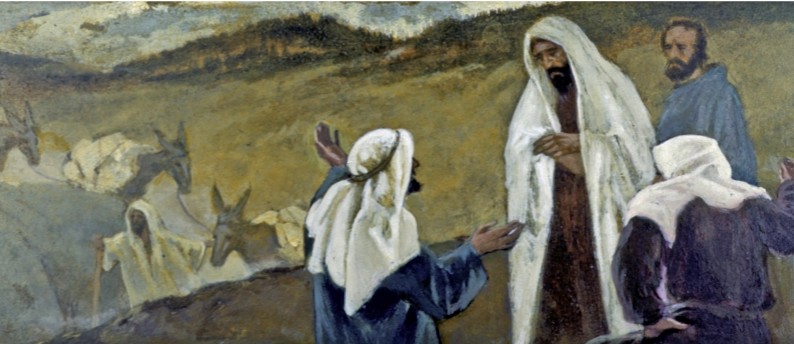
When Absalom rebelled against his father David, and tried to kill his father to become king, Mephibosheth's servant Ziba brought gifts to David, fleeing for his life (2 Samuel 16:1--17:14).

When Absalom rebelled against his father David, and tried to kill his father to become king, Mephibosheth’s servant Ziba brought gifts to David, fleeing for his life (2 Samuel 16:1–17:14).

Psalm 140 is another short psalm of David, asking for the Lord’s deliverance from the wicked and the unjust. Also considered one of the imprecatory psalms, This song also expresses faith and confidence in the grace, mercy and justness of the Almighty.

I know that the Lord will maintain the cause of the afflicted,
and will execute justice for the needy.
Surely the righteous shall give thanks to your name;
the upright shall dwell in your presence.

The Lord, it says is the deliverer of those who are weak and oppressed and will not let those who continue to do such evil go unpunished. But the song also has the definite “feel” of having been written by David during the rebellion of Absalom (2 Samuel 15-18) – note verses 7-8 in particular.

Read or listen to audio of ESV version of this selection from this link.

/Bob’s boy
___________________
some images © V. Gilbert & Arlisle F. Beers

Please note: I did not design the reading plan that I am following in my blog.  All of my comments in this blog, however, are solely my responsibility.  When reading ANY commentary, you should ALWAYS refer first to the scripture, which is God’s unchanging and unfailing word. Reading schedules, as well as a link to the site where you can get the reading plan that I’m currently following for yourself can be found on the “Bible Reading Schedules” page of my website at http://graceofourlord.com.  

Psalm 132 – If Your Sons Keep My Covenant

David dances in the presence of the ark.

David dances in the presence of the ark. (Photo credit: Wikipedia)


This is psalm number 13 of the 15 “Songs of Ascents” (see this previous post for more information). Some have classified this as a post-exillic psalm, but that really does not appear to be the case. If one looks carefully at verses 8-10, it is evident that it was written at a time when the Ark of the Covenant was still in the possession of God’s people:


Arise, O Lord, and go to your resting place,
you and the ark of your might.
Let your priests be clothed with righteousness,
and let your saints shout for joy.
For the sake of your servant David,
do not turn away the face of your anointed one


Also, those verses are quoted at the dedication of Solomon’s temple in 2 Chronicles 6:41. Or perhaps, the passage here is a quotation of that scripture. Either way, the ark seems not to have been missing at the time. In verse 6, Ephrathah, is a district with villages called Bethlehem and Jaar – or Kiriath-jearim, where the ark had been left for a time before coming to Jerusalem (1 Samuel 7:1-2).


The song’s lyrics build the pilgrims’ excitement as they journey to Jerusalem for the Passover and other feasts; and gives them pause for remembering the promise of the Lord to have one of David’s line on the throne forever. this was a conditional promise, though, as they were reminded by the psalm itself in verse 12: “If your sons keep my covenant and my testimonies that I shall teach them, their sons also forever shall sit on your throne.”


Read or listen to audio of ESV version of this selection from this link.


/Bob’s boy


___________________


some images © V. Gilbert & Arlisle F. Beers


Please note: I did not design the reading plan that I am following in my blog.  All of my comments in this blog, however, are solely my responsibility.  When reading ANY commentary, you should ALWAYS refer first to the scripture, which is God’s unchanging and unfailing word. Reading schedules, as well as a link to the site where you can get the reading plan that I’m currently following for yourself can be found on the “Bible Reading Schedules” page of my website at http://graceofourlord.com.  


Psalm 108 – With God We Shall Do Valiantly

With few variances, most of Psalm 108 can be found in two other psalms. The first 5 verses are practically identical to Psalm 57:7-11. The last eight verses are almost identical to Psalm 60:5-12. So why the combination here repeated? As always, whenever God’s word contains passages that are repeated from another passage, it is a sure sign that they are very important.

David hid in one of the many caves near Adullam, a city 13 miles southwest of Bethlehem (1 Samuel 22: 1-12). David was in this area when three of his mighty men risked their lives to get him a drink of water from Bethlehem (2 Samuel 23: 13-17).

David hid in one of the many caves near Adullam, a city 13 miles southwest of Bethlehem (1 Samuel 22: 1-12). David was in this area when three of his mighty men risked their lives to get him a drink of water from Bethlehem (2 Samuel 23: 13-17).

The first five verses come from a psalm that we are fairly certain refers to David’s time when he had fled to a cave to escape from Saul’s murderous intentions. The coinciding verses are of praise to God for His love and faithfulness, written from the context of David’s thankfulness for being delivered. The last eight verses come from a psalm that appears to have been written on the heels of a great military defeat, in which the psalmist is entreating the Lord to again show His favor to His people.

The two parts were likely put together as a combination for a liturgical purpose during a time of great distress and unease concerning the future. Together, they remind God’s people of His matchless mercy and the care for which He regards His people. They make an outstanding unified plea for God’s help in the fight against “the foe” (Satan). But most importantly, it reminds us first that we cannot fight this enemy alone, and secondly, that we do not have to fight alone, for God is with us.

for vain is the salvation of man!
With God we shall do valiantly;
it is he who will tread down our foes

Read or listen to audio of ESV version of this selection from this link.

/Bob’s boy
___________________
some images © V. Gilbert & Arlisle F. Beers

Please note: I did not design the reading plan that I am following in my blog.  All of my comments in this blog, however, are solely my responsibility.  When reading ANY commentary, you should ALWAYS refer first to the scripture, which is God’s unchanging and unfailing word. Reading schedules, as well as a link to the site where you can get the reading plan that I’m currently following for yourself can be found on the “Bible Reading Schedules” page of my website at http://graceofourlord.com.  

Psalm 133, 134 – Come Bless The Lord

Mount Hermon is one traditional site for Jesus' transfiguration.

Mount Hermon is one traditional site for Jesus’ transfiguration.

These two short psalms are the final two of the “Songs of Ascents” (see this previous post for more information). Psalm 133 declares the beauty that comes when brothers dwell in unity, comparing it to the things that Israelites of the day would most have valued.  Pilgrimages to the feasts culminating in a unified purpose of presence for God’s people in Jerusalem provided a harmonious sense of brotherhood – at least for a time..

It is like the dew of Hermon,
which falls on the mountains of Zion!
For there the Lord has commanded the blessing,
life forevermore.

Psalm 134 concludes the psalms of Ascents for the Pilgrims that have arrived, calling for them to bless The Lord and praise Him and the Holy Place they have come to.

Lift up your hands to the holy place
and bless the Lord!
May the Lord bless you from Zion,
he who made heaven and earth!

Read or listen to audio of ESV version of this selection from this link.

/Bob’s boy
___________________
some images © V. Gilbert & Arlisle F. Beers

Please note: I did not design the reading plan that I am following in my blog.  All of my comments in this blog, however, are solely my responsibility.  When reading ANY commentary, you should ALWAYS refer first to the scripture, which is God’s unchanging and unfailing word. Reading schedules, as well as a link to the site where you can get the reading plan that I’m currently following for yourself can be found on the “Bible Reading Schedules” page of my website at http://graceofourlord.com.  

Psalm 118 – His Steadfast Love Endures Forever

Mount Zion was the center of Christian worship from the earliest days of the Church. According to tradition, the events of Pentecost took place on this hill. Later it became the headquarters of the apostles and site of the Church of the Dormition, that dominates the hill.

Mount Zion was the center of Christian worship from the earliest days of the Church. According to tradition, the events of Pentecost took place on this hill. Later it became the headquarters of the apostles and site of the Church of the Dormition, that dominates the hill.

This psalm has so many aspects that it was difficult to choose a title for this particular blog. But in the end, repetition won out, at least to some degree (the words are repeated several times, including in the last verse). And God’s enduring steadfast love certainly does apply to all aspects of the song. It is a song indeed, and some of our hymns have been taken from words within Psalm 118, one of which is the simple, but beautiful “This is the day that The Lord hath made” taken from verse 24.

It is a song almost certainly written by David, and many scholars believe it was written on the occasion of the defeat of Saul, when David had been established as king. That certainly fits well, but there is nothing in the superscription or elsewhere to substantiate that.

One of the most important verses of the psalm is arguably verse 22, which is quoted many places in the New Testament, including Mark 12:10-11 and Luke 20:17: “The stone that the builders rejected has become the cornerstone. This is the Lord’s doing; it is marvelous in our eyes. This refers, of course, to Jesus, and how he was rejected, but has become the cornerstone of His church and the kingdom.

Read or listen to audio of ESV version of this selection from this link.

/Bob’s boy
___________________
some images © V. Gilbert & Arlisle F. Beers

Please note: I did not design the reading plan that I am following in my blog.  All of my comments in this blog, however, are solely my responsibility.  When reading ANY commentary, you should ALWAYS refer first to the scripture, which is God’s unchanging and unfailing word. Reading schedules, as well as a link to the site where you can get the reading plan that I’m currently following for yourself can be found on the “Bible Reading Schedules” page of my website at http://graceofourlord.com.