Psalm 99, 100, 101

Moses and Aaron before Pharaoh (painting by Be...

Moses and Aaron before Pharaoh (painting by Benjamin West) (Photo credit: Wikipedia)

Psalm 99 celebrates the supremacy of God over His creation, enthroned upon the cherubim. Note that the text says that although He is great in Zion, He is exalted over all the peoples of the earth. The verses refer to Jacob, Moses, Aaron and Samuel by name – reminding the reader of the pillar of the cloud (Exodus 13:21),  the holy priesthood, God’s own holiness, his forgiving nature, and the promise of Him avenging wrongs. Psalm 100 is another hymn for giving thanks to God for His faithfulness to all generations, and His shepherding of us, the sheep of His pasture.

Psalm 101 is another royal hymn of David, making music to Lord, declaring his love to the Father for His holy justice, and pledging his faithfulness to Him. David promises to serve the people with integrity of heart and the expectation – yes even the requirement – that they respect one another as well as the Lord Himself.

No one who practices deceit
shall dwell in my house;
no one who utters lies
shall continue before my eyes.

Read or listen to audio of ESV version of this selection from this link.

/Bob’s boy
___________________
some images © V. Gilbert & Arlisle F. Beers

Please note: I did not design the reading plan that I am following in my blog.  All of my comments in this blog, however, are solely my responsibility.  When reading ANY commentary, you should ALWAYS refer first to the scripture, which is God’s unchanging and unfailing word. Reading schedules, as well as a link to the site where you can get the reading plan that I’m currently following for yourself can be found on the “Bible Reading Schedules” page of my website at http://graceofourlord.com.  
 

Psalm 83 – Most High Over All the Earth

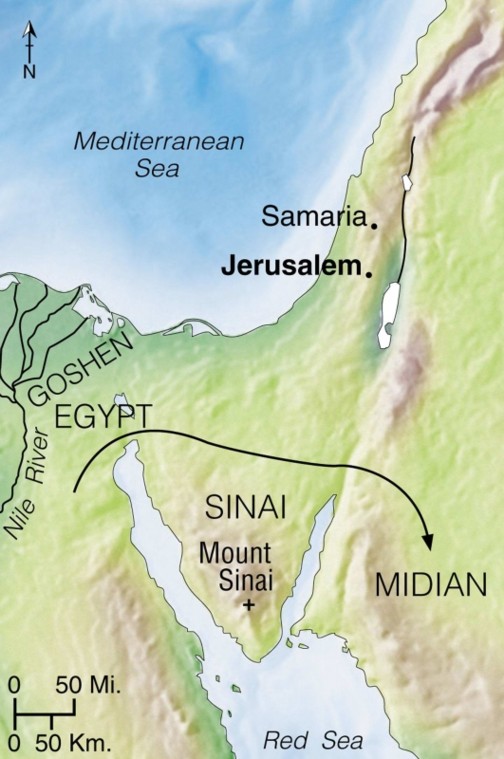
After murdering an Egyptian, Moses escaped into Midian. There he married Zipporah and became a shepherd.

After murdering an Egyptian, Moses escaped into Midian. There he married Zipporah and became a shepherd.

When reading this chapter of Psalms, one could feel as if it were written about the Israel of today. Speaking of the enemies of the nation, the psalmist allows how they would gladly wipe out God’s people:

They say, “Come,let us wipe them out as a nation;
let the name of Israel be remembered no more

Among the conspirators mentioned are such as the Amelikites, the Moabites and Ammonites who are referred to correctly here as the children of Lot (Genesis 19:36-38), the Edomites, the Philistines, and the inhabitants of Tyre. All are Gentile persecutors of God’s people. Today, there are those people who would take joy in the persecution of Christians – a phenomenon that many would argue is beginning to make a somewhat surprising comeback in North America, as well as other parts of the world. The prayer of the chapter which glorifies the Lord is relevant today:

…that they may know that you alone,
whose name is the Lord,
are the Most High over all the earth.

Read or listen to audio of ESV version of this selection from this link.

/Bob’s boy
___________________
some images © V. Gilbert & Arlisle F. Beers

Please note: I did not design the reading plan that I am following in my blog.  All of my comments in this blog, however, are solely my responsibility.  When reading ANY commentary, you should ALWAYS refer first to the scripture, which is God’s unchanging and unfailing word. Reading schedules, as well as a link to the site where you can get the reading plan that I’m currently following for yourself can be found on the “Bible Reading Schedules” page of my website at http://graceofourlord.com.  

Psalm 98 – Let the Sea Roar!

sea_004The 98th psalm is another song of praise in the same vein as the 96th, in that it encourages the singing of “a new song” to the Lord. The psalm is composed of three stanzas of three verses each. The first set of verses extol the marvelous things that the Lord has done. His right hand and holy arm have worked salvation. He has kept His promises with faithfulness to His people; and all the ends of the earth have seen that salvation.

The second set of verses encourage making a joyful noise to the Lord over all the earth and breaking forth in joyous song, singing praises to the Lord. Then the third set of verses call forth to the created wonders of the earth itself to roar their own joyous noise. Jesus Himself, quoting Habakkuk 2:11, said in Luke 19:40 that the very stones would cry out if the people were silent. All creation should sing out in praise to the Creator of all, who will judge the earth with righteousness – and with fairness and equity to the people. This settles forever the question of for whom God’s word was written. It is for everyone!

Read or listen to audio of ESV version of this selection from this link.

/Bob’s boy
___________________
some images © V. Gilbert & Arlisle F. Beers

Please note: I did not design the reading plan that I am following in my blog.  All of my comments in this blog, however, are solely my responsibility.  When reading ANY commentary, you should ALWAYS refer first to the scripture, which is God’s unchanging and unfailing word. Reading schedules, as well as a link to the site where you can get the reading plan that I’m currently following for yourself can be found on the “Bible Reading Schedules” page of my website at http://graceofourlord.com.  

Psalms 92 – How Great Are Your Works!

English: Palm Tree in Sundankottai,Tamilnadu,India

English: Palm Tree in Sundankottai,Tamilnadu,India (Photo credit: Wikipedia)

The superscription of this psalm proclaims it to be “a song for the Sabbath,” which indeed means it is most appropriate for praise and worship to the Lord.  It is a song which while praising the mighty works of the lord, acknowledges the pleasure and joy that worshiping him brings to the hearts of the righteous (verse 4).  The text rightly says that this is something that the fool (unbeliever) simply cannot understand (verse 6), and is to be pitied for it.

The horn in verse 10 is a symbol of power, stature and prosperity; and relates to the grace and generosity of the lord toward His servant.  The psalmist proclaims that the enemies of the Lord will perish, and notes that the righteous will “flourish like the palm tree and grow like a cedar in Lebanon.”  The significant statement on this (verse 23) is that they are”planted” in the house of the Lord (worship), but they flourish in the “courts of our God” (in His divine presence).

Read or listen to audio of ESV version of this selection from this link.

/Bob’s boy
___________________
some images © V. Gilbert & Arlisle F. Beers

Please note: I did not design the reading plan that I am following in my blog.  All of my comments in this blog, however, are solely my responsibility.  When reading ANY commentary, you should ALWAYS refer first to the scripture, which is God’s unchanging and unfailing word. Reading schedules, as well as a link to the site where you can get the reading plan that I’m currently following for yourself can be found on the “Bible Reading Schedules” page of my website at http://graceofourlord.com.  For questions and help, please see the “FAQ” and “Summaries” pages there.

Psalm 119:153-160; Psalm 97 – The Reign of the Lord

resh

This stanza of Psalm 119 begins each verse with the twentieth letter of the Aleph-Bet, “resh.”  Like the previous stanza, it contains verses with pleas to the Lord for help, with the psalmist declaring his love for God’s word, as well as some that remind of God’s promises and His love for the righteous.  Like the previous stanza, it concludes with the eternal truth of God’s word.

Psalm 97 is a beautiful song of praise to God for His power, authority, and supremacy over the heavens, the earth, and mankind.  The psalmist is believed by many to be David, although just as many attribute the writing to some time after the Babylonian captivity.  The psalm does have the “feel” of celebration concerning some victory or similar grand event.

In fact, it reminds us quite a bit of the “Song of Moses” – particularly Exodus 15:6-18, which praised God for His deliverance after the crossing of the Red Sea, as well as sights and sounds from the mountain after their arrival at Mount Sinai in Exodus 19:16-20, with a dash of Psalm 19 for good measure.

The Lord reigns, let the earth rejoice;
let the many coastlands be glad!
Clouds and thick darkness are all around him;
righteousness and justice are the foundation of his throne

Read or listen to audio of ESV version of this selection from this link.

/Bob’s boy
___________________
some images © V. Gilbert & Arlisle F. Beers

Please note: I did not design the reading plan that I am following in my blog.  All of my comments in this blog, however, are solely my responsibility.  When reading ANY commentary, you should ALWAYS refer first to the scripture, which is God’s unchanging and unfailing word. Reading schedules, as well as a link to the site where you can get the reading plan that I’m currently following for yourself can be found on the “Bible Reading Schedules” page of my website at http://graceofourlord.com.  For questions and help, please see the “FAQ” and “Summaries” pages there.

Psalm 119:137-144; Psalm 84 – The Sparrow Hath Found a House

tsadeThis stanza of Psalm 119 begins each verse with the Hebrew letter “Tsade.”  These verses are heavily salted with references to the psalmist’s state of persecution from enemies (verse 141, 143).  The point he makes, and the lesson from the stanza,  is that he takes comfort from God’s word.

Some ascribe Psalm 84 to David (Spurgeon says it “exhales to us a Davidic perfume, it smells of the mountain heather and the lone places of the wilderness, where King David must have often lodged during his many wars”).  Others hold that it was written during times of actual Temple worship during the monarchy (verse 9), suggesting that it was written during Solomon’s reign; and verses 4 and 10 certainly have that air.

In any case, the twelve verses of this hymn of praise are beautiful; and the KJV (which we include below) do better justice to the poetry than other versions IMHO.  The theme of the song is the joy of being in the house of worship to the Lord – a day of which, verse 10 says is better than a thousand elsewhere.  This blogger whole-hardheartedly agrees.  There is no time that I am happier or more at peace than when I am worshiping the Lord with my brothers and sisters.

How amiable are thy tabernacles, O Lord of hosts!
My soul longeth, yea, even fainteth for the courts of the Lord: my heart and my flesh crieth out for the living God.
Yea, the sparrow hath found an house, and the swallow a nest for herself, where she may lay her young, even thine altars, O Lord of hosts, my King, and my God.
Blessed are they that dwell in thy house: they will be still praising thee. Selah.
Blessed is the man whose strength is in thee; in whose heart are the ways of them.
Who passing through the valley of Baca make it a well; the rain also filleth the pools.
They go from strength to strength, every one of them in Zion appeareth before God.
O Lord God of hosts, hear my prayer: give ear, O God of Jacob. Selah.
Behold, O God our shield, and look upon the face of thine anointed.
For a day in thy courts is better than a thousand. I had rather be a doorkeeper in the house of my God, than to dwell in the tents of wickedness.
For the Lord God is a sun and shield: the Lord will give grace and glory: no good thing will he withhold from them that walk uprightly.
O Lord of hosts, blessed is the man that trusteth in thee.

Read or listen to audio of ESV version of this selection from this link.

/Bob’s boy
___________________
some images © V. Gilbert & Arlisle F. Beers

Please note: I did not design the reading plan that I am following in my blog.  All of my comments in this blog, however, are solely my responsibility.  When reading ANY commentary, you should ALWAYS refer first to the scripture, which is God’s unchanging and unfailing word. Reading schedules, as well as a link to the site where you can get the reading plan that I’m currently following for yourself can be found on the “Bible Reading Schedules” page of my website at http://graceofourlord.com.  For questions and help, please see the “FAQ” and “Summaries” pages there.
Psalms 68 – The Procession of My God

This psalm is extolled by commentators as one of the most magnificent hymnal psalms of praise that David wrote – and in some ways, one of the most difficult to outline and interpret.  It is widely accepted as having been written at the time of the removal of “the ark of God from the house of Obed-edom to the city of David with rejoicing” ( 2 Samuel 6:12).  And that certainly seems to be the case, as it starts out in verse one (“God shall arise, his enemies shall be scattered; and those who hate him shall flee before him!”) – the same way the ark was always put on its journey (see Numbers 10:35).

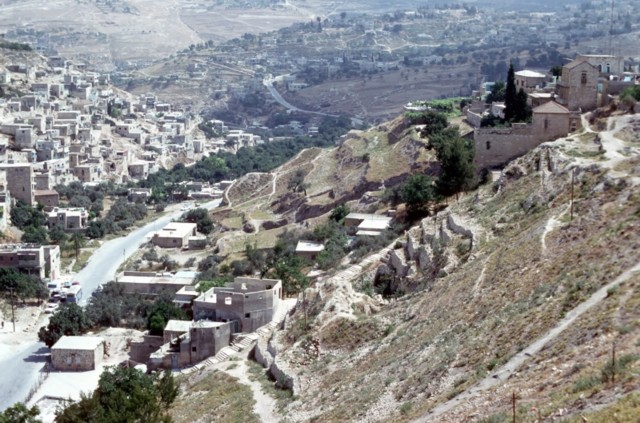
Hill of Ophel, south of Jerusalem, where the city of David was located.

Hill of Ophel, south of Jerusalem, where the city of David was located.

Throughout the chapter, it echoes the praise for God when on a similar journey among His people, He led them from bondage in Egypt (i.e. verses 4, 6, 7-8).  Verse 20 (“Our God is a God of salvation, and to God, the Lord, belong deliverances from death”) is one of few verses in the Old Testament that clearly demonstrates an understanding of God’s saving grace for the righteous in eternity, as we understand now comes to us from the sacrifice of His Son.

But praise for God and His power is the sole intent of this song.  Part of Spurgeon’s description of the singing which follows here conjures quite an image:

“With the words of the first two verses the ark is uplifted, and the procession begins to move. In Psalm 68:3-6, the godly in the assembly are exhorted to commence their joyous songs, and arguments are adduced to help their joy. Then the glorious march of Jehovah in the wilderness is sung: Psalm 68:7-10, and his victories in war are celebrated in verses Psalm 68:11-14. The joyous shouts are louder as Zion comes in sight, and the ark is borne up the hill…”

The psalm concludes majestically:

Awesome is God from his sanctuary;
the God of Israel—he is the one who gives power and strength to his people.
Blessed be God!

Read or listen to audio of ESV version of this selection from this link.

/Bob’s boy
___________________
some images © V. Gilbert & Arlisle F. Beers

Please note: I did not design the reading plan that I am following in my blog.  All of my comments in this blog, however, are solely my responsibility.  When reading ANY commentary, you should ALWAYS refer first to the scripture, which is God’s unchanging and unfailing word. Reading schedules, as well as a link to the site where you can get the reading plan that I’m currently following for yourself can be found on the “Bible Reading Schedules” page of my website at http://graceofourlord.com.  For questions and help, please see the “FAQ” and “Summaries” pages there.

Psalm 33 -The Steadfast Love of the Lord

Psalm 33 is a hymn – a song of praise and prayer to the Lord, by whose word the heavens were made.  And it begins with the reasons for that praise – His word for man, His faithfulness to that word (verse 4), and the fact that He loves righteousness and justice.  The Lord has shown in His word over and over again how faithful He is to the promises He has made to us, and He does love righteousness.  But how fortunate for us that He also loves justice – for the fact that He is just.

201_01_0066_NatureCreationBkgAfter more praise for His creation of the world by His very word (verses 7-9), the psalmist returns to elaborate on that faithfulness and justice (verses 10-12).  Verses 16-17 simply mean that man’s faith in his own power and strength – even in large armies gives him an illusion of safety and a false promise of salvation.  He then points out God’s care for all those who wait upon Him, as He watches over those who fear Him, and see to it they are provided for (verses 18-19).  He finishes with prayer for the love of the Lord, as His people look toward Him with hope.

Read or listen to audio of ESV version of this selection from this link.

/Bob’s boy
___________________
some images © V. Gilbert & Arlisle F. Beers

Please note: I did not design the reading plan that I am following in my blog.  All of my comments in this blog, however, are solely my responsibility.  When reading ANY commentary, you should ALWAYS refer first to the scripture, which is God’s unchanging and unfailing word. Reading schedules, as well as a link to the site where you can get the reading plan that I’m currently following for yourself can be found on the “Bible Reading Schedules” page of my website at http://graceofourlord.com.  For questions and help, please see the “FAQ” and “Summaries” pages there.

Psalm 27-28 – Wait For the Lord

An early printing of Luther's hymn A Mighty Fo...

An early printing of Luther’s hymn A Mighty Fortress Is Our God (Ein feste Burg ist unser Gott) (Photo credit: Wikipedia)

The great hymn “A Mighty Fortress Is Our God” is based upon this psalm.  It begins in verses 1-3 with confidence and trust in God.  The words of verse one bring to mind Paul’s letter to the Romans in 8:31. “If God is for us, who can be against us?”  Verse 10’s statement “For my father and my mother have forsaken me, but the Lord will take me in” probably refers to their deaths, meaning “My parents were my protectors for a time; but the Lord will be my Protector always.”  Verse 14 brings a chiastic end to psalm 27, with trust as the word again:

“Wait for the Lord; be strong, and let your heart take courage; wait for the Lord!” 

It is not easy, but we must trust in God and have patience.  He does His work, as He sees fit –  in His time.

Kyle Yates’ commentary appropriately titled the 28th psalm “The Answered Prayer” as it has just two sections: the prayer (verses -15) and the answer (verses 6-9).  The occasion has been identified by Delitzsch as the time of Absalom’s rebellion; and he says that it is third psalm of that time of persecution.  In verse 7, David says that he trusts the Lord with his heart, not just his lips; and he closes the psalm with the image of a shepherd who often have to carry their sheep.

How many occasions in your life can you look back upon, knowing that God must have “carried” you?  It is something I seldom recognize when He is about the business of doing it.  I am quick to pray for God’s help.  But how often when things eventually worked out well have I failed to recognize that it was His work?  Too often, I fail to praise Him as I should.

Read or listen to audio of ESV version of this selection from this link.

/Bob’s boy
___________________
some images © V. Gilbert & Arlisle F. Beers

Please note: I did not design the reading plan that I am following in my blog.  All of my comments in this blog, however, are solely my responsibility.  When reading ANY commentary, you should ALWAYS refer first to the scripture, which is God’s unchanging and unfailing word. Reading schedules, as well as a link to the site where you can get the reading plan that I’m currently following for yourself can be found on the “Bible Reading Schedules” page of my website at http://graceofourlord.com.  For questions and help, please see the “FAQ” and “Summaries” pages there.