Luke 7 – Who Is This?

A centurion was a Roman soldier in charge of a hundred men.  This one was a friend to the Jewish people (see verses 3-5).  When Jesus went with the elders to go to heal the centurion’s servant, he sent people to meet Jesus along the way, and told him not to trouble Himself.  Verses 6-8 show his faith in Jesus was strong enough to believe that his servant would be healed simply by Jesus saying so.  Jesus’s statement in verse 9 “I tell you, not even in Israel have I found such faith”  foreshadows the welcoming of Gentiles into the kingdom.

When a widow of Nain lost her only son, Jesus raised him from the dead, a mighty miracle — Luke 7: 11-17.

His compassion for the widow whose son had died (his death would also mean economic hardship for her) causes him to bring her son back to life in front of a great crowd of people, including those carrying the body.  Imagine the fear among them as he sat up and spoke!  His fame grew even more as verse 17 says “this report about him spread through the whole of Judea and all the surrounding country.”  As word spread back to John the Baptist, he sent two disciples to go and ask Jesus point-blank if He really was the Messiah.  Apparently, even John was expecting a very different savior than this.  After they witnessed Jesus healing numerous people (verse 21), he sent them back to him quoting from Isaiah 35:5-6 and 61:1.

The woman whose sins He forgives in verses 36-50 is not Mary who anoints His feet before the crucifixion in John 12:3-8.  The Pharisee (who we learn in verse 40 is named Simon) had invited Jesus into his home to eat, and did not know that Jesus knew what he was thinking.  He was convinced that Jesus could not be a” prophet,” or else He would not be letting a known sinful woman like this touch Him.  Jesus answers with a short parable and a question, and forgives the woman of her sins, prompting those at table to say in verse 49 “Who is this, who even forgives sins?”

Read or listen to audio of ESV version of this selection from this link.

/Bob’s boy
___________________
some images © V. Gilbert & Arlisle F. Beers

Please note: I did not design the reading plan that I am following in my blog.  All of my comments in this blog, however, are solely my responsibility.  When reading ANY commentary, you should ALWAYS refer first to the scripture, which is God’s unchanging and unfailing word. Reading schedules, as well as a link to the site where you can get the reading plan that I’m currently following for yourself can be found on the “Bible Reading Schedules” page of my website at http://graceofourlord.com.  For questions and help, please see the “FAQ” and “Summaries” pages there.

Luke 6 – Jesus is Lord of the Sabbath

Verses 1-5 have been used to link Biblical teaching to situation ethics, but this comes from a lack of understanding of the scriptures.  The disciples in verse 1 plucked and ate the grain with their hands, not with a sickle.  This was expressly allowed in the Law given in Deuteronomy 23:24-25.  But the Pharisees had made their own interpretation and decided it was the law, rather than God’s word.  Jesus challenged them to speak against David and his men eating the Bread of the Presence, or shewbread (1 Samuel 21:1-6) – which He said in verse 4 was unlawful.  He settles the matter in verse 5, saying that He is “lord of the Sabbath,”  with the unstated conclusion that the Pharisees are not.

English: A dispute with the pharisees. Passeri...

English: A dispute with the pharisees. Passeri. In the Bowyer Bible in Bolton Museum, England. Print 4384. From “An Illustrated Commentary on the Gospel of Mark” by Phillip Medhurst. Section D. Jesus confronts uncleanness. Mark 1:21-45, 2:1-12, 5:1-20, 25-34, 7:24-30. http://pdfcast.org/pdf/an-illustrated-commentary-by-phillip-medhurst-on-the-gospel-of-mark-section-d (Photo credit: Wikipedia)

Verses 6-11 are another Sabbath encounter with the Pharisees, as Jesus was teaching in the synagogue.  Knowing that they are waiting to see if He will heal the man with the withered hand, He poses the question of whether it was lawful to do harm or to do good on the Sabbath.  They would not answer, but when he healed the man, they were angry.  Notice that their malice and desire to do harm to Him blinds them to the fact that the miracles prove He is the son of God.

In verses 12-16, after spending all night in prayer, He chose the twelve apostles from his disciples.   Verses 17-19 show the magnitude of the vast amounts of people He ministers to in the rest of this chapter.  People from Tyre and Sidon would almost certainly be Gentiles.

Some believe that the rest of this chapter is just Luke’s account of the Sermon on the Mount, but we must realize that similar sermons by the Lord would be taught at different times and to different crowds.  Note that in verse 17, after having spent the night praying on the mountain, He “he came down with them and stood on a level place.”  This has resulted in people referring to this as the Sermon on the Plain.  In comparing the “blessed” and the “woes” in this sermon, Jesus is not saying that it is wrong to be rich or that the poor are more righteous.  He is stating the poor and those less fortunate who are in His kingdom will have their reward, while those who may be rich but not part of the faithful already have their reward.

Read or listen to audio of ESV version of this selection from this link.

/Bob’s boy
___________________
some images © V. Gilbert & Arlisle F. Beers

Please note: I did not design the reading plan that I am following in my blog.  All of my comments in this blog, however, are solely my responsibility.  When reading ANY commentary, you should ALWAYS refer first to the scripture, which is God’s unchanging and unfailing word. Reading schedules, as well as a link to the site where you can get the reading plan that I’m currently following for yourself can be found on the “Bible Reading Schedules” page of my website at http://graceofourlord.com.  For questions and help, please see the “FAQ” and “Summaries” pages there.

Week 31 summary posted

English: The Wedding at Cana (watercolour)

English: The Wedding at Cana (watercolour) (Photo credit: Wikipedia)

Last week we finished the Sermon on the Mount, the Wedding at Cana, and Jesus’ encounter with Nicodemus, and important Pharisee of the day.  This week we will see look at some of the great parables of the Lord, and see His more typical encounters with the Pharisees become more accusatory on their part, as those in power become more afraid of His popularity.  How will Jesus respond to this?

Summing Up

Each weekend, I am now posting a small PDF of one week of chapter summaries (on the website’s “Summaries” page), current to the beginning of the previous week.  I have posted the summary for Week 31 (July Week 5) of the schedule I am following.  This short PDF document contains condensed comments about John 1, Luke 1, Luke 2, and Matthew 3 and 4, with hyperlinks to the ESV version of each chapter for listening or reading, and joins the summaries for other weeks already posted there.

/Bob’s boy
___________________
image © V. Gilbert & Arlisle F. Beers

Please note: I did not design the reading plan that I am following in my blog.  All of my comments in this blog, however, are solely my responsibility.  When reading ANY commentary, you should ALWAYS refer first to the scripture, which is God’s unchanging and unfailing word. Reading schedules, as well as a link to the site where you can get the reading plan that I’m currently following for yourself can be found on the “Bible Reading Schedules” page of my website at http://graceofourlord.com.  For questions and help, please see the “FAQ” and “Summaries” pages there.
John 3 – For God So Loved the World

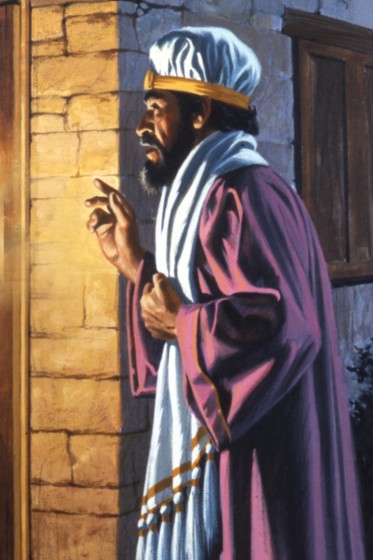
Nicodemus was a Pharisee.  Verse one says that he was a “ruler of the Jews,” which would make him a member of the Sanhedrin – the Jewish governing council.  In fact, one of the other two places he is mentioned is in John 7:50, as there is division among them concerning arresting Jesus. Nicodemus states his belief that Jesus is sent from God because of the signs that he did, confirming that Jesus did many more miracles than were written in the gospel, as John states in John 20:30-31.  Nicodemus seems to be trying to understand what Jesus means by being born again in a physical manner.  But Jesus is speaking of being re-born by the Spirit by way of baptism (Romans 6:3-4, Colossians 2:12-13).  In verse 14, Jesus refers to Moses lifting up the Bronze Serpent in Numbers 21:5-9 to save the people when they had spoken against God; and gives Nicodemus a preview of His crucifixion, which likely he would also not understand – yet.  He will repeat this reference to being lifted up in John 8:28 and John 12:32-33.

The Bronze Serpent

Verse 16 is one of the most famous of the New Testament, and most Bibles that put the words of Jesus in red assign verses 16-21 as His words.  But many scholars believe that these verses are actually John’s inspired words, and the fact that he speaks of God having given His son in the past tense seems to bear that out.  In any case, these verses are joined with verse 15 in such a way that together they well represent the message of the gospel concerning salvation.  The phrase “God so loved the world” followed by the other references to the world are often overlooked in their significance – not only for salvation being open to all, but the declaration of God’s love for all the world, not just the people of Israel.

It is no coincidence that the text immediately jumps to the baptism being done by John the Baptist (who is not yet in prison in this part of the gospel) and now by Jesus and His disciples (verses 22-26). John’s disciples note that people are going to Jesus for baptism now, and John reminds them that he himself told them that he is not the Christ, but had been sent before him.  And in verse 30, says “He must increase, but I must decrease.”  John had done what God had sent him to do.

Read or listen to audio of ESV version of this selection from this link.

/Bob’s boy
___________________
some images © V. Gilbert & Arlisle F. Beers

Please note: I did not design the reading plan that I am following in my blog.  All of my comments in this blog, however, are solely my responsibility.  When reading ANY commentary, you should ALWAYS refer first to the scripture, which is God’s unchanging and unfailing word. Reading schedules, as well as a link to the site where you can get the reading plan that I’m currently following for yourself can be found on the “Bible Reading Schedules” page of my website at http://graceofourlord.com.  For questions and help, please see the “FAQ” and “Summaries” pages there.

Matthew 3 – The Baptism of Jesus

Matthew chapter 3 begins with John the Baptist preaching in the Judean wilderness, telling everyone to “Repent, for the kingdom of heaven is at hand” – which Jesus Himself will proclaim as well.  John’s manner of dress in verse 4 is distinctly similar to that described of Elijah in 2 Kings 1:8, and that appearance, as well as the diet described, were common to the desert people, who would also be the poorer people of the land.  This new and increasingly well-known prophet was attracting much attention from the people, and the religious community (see John 1:19-38).  In verse 7, both Pharisees and Sadducees were coming out to watch his baptisms – no doubt with bad intentions toward him.

The Jordan River

The Jordan River (Photo credit: Wikipedia)

The word “Pharisee” means “separated one,” and they were the more popular of the Jewish sects of the times.  Many seemed very self-righteous, and imposed strict adherence to teachings and “rules” that were not commanded by God’s word.  The term “Sadducees” came from the sons of Zadok, who was the high priest during the days of David and Solomon (1 Kings 1:32-34).   They were known as aristocrats and political opportunists; and they had much political power. Baptism had been required of Gentiles converting to Judaism, but now John was preaching and performing baptism (immersing people in the river Jordan) for repentance – a term not only for remorse and confession, but also for “turning” one’s thinking, way of living, and even one’s mind around to different way.

As verse 3 confirms that John is the one prophesied in Isaiah 40:3,  he is preparing the way for Jesus to be revealed to Israel (John 1:31).  When Jesus comes to have John baptize Him, John is reluctant because he knows He needs no repentance.  But Jesus reminds him in verse 15 that it was God who had told John to start baptizing people in the first place, and how he would know that Jesus is the Son of God (John 1:31-34).  John gives first person account of that in those verses.

Read or listen to audio of ESV version of this selection from this link.

/Bob’s boy
___________________
some images © V. Gilbert & Arlisle F. Beers

Please note: I did not design the reading plan that I am following in my blog.  All of my comments in this blog, however, are solely my responsibility.  When reading ANY commentary, you should ALWAYS refer first to the scripture, which is God’s unchanging and unfailing word. Reading schedules, as well as a link to the site where you can get the reading plan that I’m currently following for yourself can be found on the “Bible Reading Schedules” page of my website at http://graceofourlord.com.  For questions and help, please see the “FAQ” and “Summaries” pages there.