Parable or Practicality? – (Luke 11)

Verses 24-26 come on the heels of Jesus casting out a demon from a man. Nevertheless, this passage, taken as it is, seems completely out-of-place here. One might even wonder why it was even included. Really, how could such information be useful, even to one who had been possessed? The verses speak of an unclean spirit that “goes out” of the subject, and then returns with seven more that are even more evil after the house is swept and placed in order, leaving the subject worse than before. Undoubtedly, the things he speaks of were true of certain demons that afflicted people in the first century. But still, what is the point?

The Pharisees Question Jesus

The Pharisees Question Jesus (Photo credit: Wikipedia)

As is always the case with scripture, context is everything. But let’s first look at the same content, as told in Matthew 12:43-45. Much of Matthew’s gospel was written topically, but that only serves to make context more relevant. In Matthew 12:41-42, Jesus speaks of how Nineveh will rise up on the day of judgment condemning “this generation” (meaning the Jews of His time). Then He says the same about the queen of the south (an obvious reference to the queen of Sheba) who came from the ends of the earth to hear the wisdom of Solomon, “and behold, one greater than Solomon is here.”

Piero della Francesca: Legend of the True Cros...

Piero della Francesca: Legend of the True Cross – the Queen of Sheba Meeting with Solomon , Detail. (c. 1452-66, Fresco, San Francesco, Arezzo, Italy) (Photo credit: Wikipedia)

Then at the end of the passage in Matthew about the 8 spirits, Jesus said So also will it be with this evil generation.” So clearly, the story of the unclean spirits is intended as a parable. And we see the same thing looking closely at Luke. He has already made it clear that “the kingdom of God has come upon you” (verse 20). And after telling the Pharisees in verses 21-22 (in so many words) that He is mightier than Satan, He says “whoever is not with me is against me, and whoever does not gather with me scatters.”

Burton Coffman made an analysis of the parable of the unclean spirits that we feel is pretty close to the mark. We will close with that analysis below, with our own comments in bold:

“The man in whom the evil spirit was = Israel.” Agreed
“The going out of the demon = the rebirth of the nation under the preaching of John the Baptist.” Partly agree – could refer also to Israel since the time after Ezra and Nehemiah, when idolatry finally was under control.
“The swept and garnished period = the emptiness of Israel’s inadequate regeneration. No meaningful change in the people occurred.” Agreed
“The restlessness of the demon = the relentless and unresting hostility against Jesus of the evil powers.” Agreed – hostility and rejection
“His repossession of the victim = total repossession of national Israel by Satan’s evil forces. This refers to the judicial hardening of Israel.” Leaving him in worse condition than before would also seem to refer to the coming judgment of A.D. 70 that looms over them after the crucifixion (Hence, the “Oh Jerusalem” lament of Matthew 23:37-39)

(This year’s reading plan for Luke, Acts, and 1 and 2 Chronicles averages just 15 verses per day – 5 days per week!)
Schedule for this week
Read or listen to audio of today’s selection from Luke here
Read or listen to audio of today’s selection from 1 Chronicles here

/Bob’s boy
___________________
some images © V. Gilbert & Arlisle F. Beers

Please note: I did not design the reading plan that I am following in my blog.  All of my comments in this blog, however, are solely my responsibility.  When reading ANY commentary, you should ALWAYS refer first to the scripture, which is God’s unchanging and unfailing word. Reading schedules, as well as a link to the site where you can get the reading plan that I’m currently following for yourself can be found on the “Bible Reading Schedules” page of my website at http://graceofourlord.com.  

Enhanced by Zemanta

An International Incident – 1 Chronicles 19-20

Landscape with David and Bathsheba

Landscape with David and Bathsheba (Photo credit: Wikipedia)

Most of the events of these two chapters are contained in chapters 10-11 of 2 Samuel, but there are some differences. Most conspicuously absent here is any reference to David’s sin with Bathsheba. This affair and betrayal of Uriah the Hittite took place at the time that “Joab led out the army and ravaged the country of the Ammonites and came and besieged Rabbah” (1 Chronicles 20:1).

Most scholars agree that the account is not left out simply to avoid showing David in a bad light. There are several things that demonstrate David’s goodness which the chronicler did not write about either. But the purpose of the chronicles was to preserve the knowledge (for the returning exiles and their descendants) of God’s covenant with David and reassure them that it was still a promise from God.

As chapter 19 opens, David sends messengers to give his condolences to  Hanun the son of Nahash the Ammonite because Nashash had “dealt kindly” with him. It is unknown what kindness that was. But Hanun, suspecting David’s motives and thinking his servants were spies, he shaved them and cut there clothes off at the hip, sending them on their way. After realizing the seriousness of the international incident he had created, Hanun hired chariots and horsemen from Mesopotamia and surrounding areas and kingdoms in a futile attempt to defeat David’s army.

English: The young Hebrew David hoists the hea...

English: The young Hebrew David hoists the head of the Philistine Goliath (Photo credit: Wikipedia)

After Joab “struck down Rabbah,” David accumulated much gold and other precious plunder – including a crown of gold that was taken from the king’s head. Verse 3 of chapter 20 says that they did the same to all of cities of the Ammonites. Then in verses 4-8, came the defeat of many Philistines, some of which were giants on the order of the Goliath that David killed when Saul was king. The Goliath here is not the same one, obviously.

The one mentioned in verse 6 with the extra digits had a condition called polydactyly, a condition that a small percentage of people are born with to this day – including yours truly (mine was an extra thumb). The man that holds the world record for the most digits is Akshat Saxena in India. He was born in 2010 with 7 digits on each hand and 10 digits on each foot, for a total of 34 digits!

(This year’s reading plan for Luke, Acts, and 1 and 2 Chronicles averages just 15 verses per day – 5 days per week!)
Schedule for this week
Read or listen to audio of today’s selection from Luke here
Read or listen to audio of today’s selection from 1 Chronicles here

/Bob’s boy
___________________
some images © V. Gilbert & Arlisle F. Beers

Please note: I did not design the reading plan that I am following in my blog.  All of my comments in this blog, however, are solely my responsibility.  When reading ANY commentary, you should ALWAYS refer first to the scripture, which is God’s unchanging and unfailing word. Reading schedules, as well as a link to the site where you can get the reading plan that I’m currently following for yourself can be found on the “Bible Reading Schedules” page of my website at http://graceofourlord.com.  

Enhanced by Zemanta

Who Then Is This? – (Luke 8)

In verse 22, Jesus has boarded a boat to go to “the other side of the lake.” That lake, of course, was the Sea of Galilee. Here Luke tells us that Jesus had fallen asleep, significant to us as a reminder that He was indeed a man. And as a man, He experienced fatigue, just as we do, and He did not hesitate to rest when He needed it – just as we must take time to do, when we can.

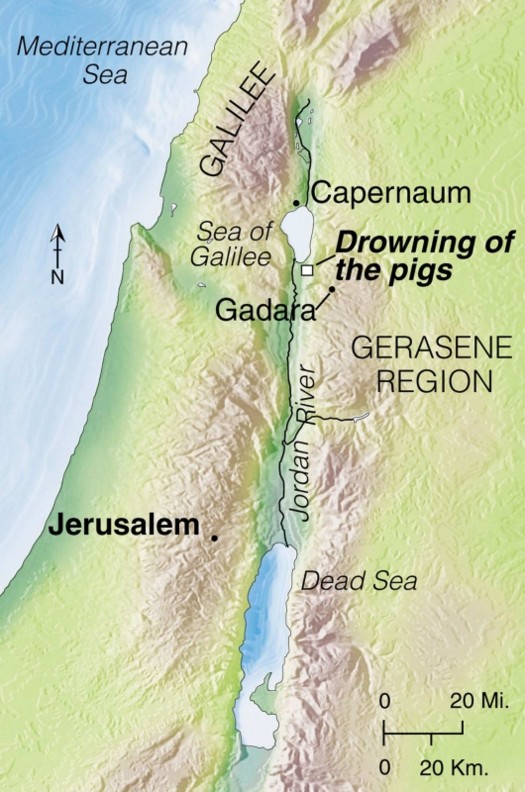
From Capernaum, Jesus and his disciples crossed the Sea of Galilee. A storm blew up unexpectedly, but Jesus calmed it. Landing in the region of the Gerasenes, Jesus sent demons out of a man and into a herd of pigs that plunged over a steep bank into the lake.

From Capernaum, Jesus and his disciples crossed the Sea of Galilee. A storm blew up unexpectedly, but Jesus calmed it. Landing in the region of the Gerasenes, Jesus sent demons out of a man and into a herd of pigs that plunged over a steep bank into the lake.

While He was sleeping, a storm came that was severe enough to begin to fill the vessel with water. Verse 23 confirms the severity, saying that they were indeed in danger. But Jesus remained asleep through it all, demonstrating that He must truly have been exhausted. When they woke him, they were frantic, letting Him know that they were about to die (verse 24). With His verbal command, the winds and the waves calmed, and He asked them where their faith was. The statement “who then is this, that he commands even winds and water, and they obey him?” betrays the fact that they really did not know for sure just who Jesus was yet.

From there, verse 26 says that they sailed to the country of the “Gerasenes” (some manuscripts have it as “Gadarenes”). This is the region around what was known as Gadara, which today is known as Umm Qais, just to the southeast of the Sea of Galilee. Here, Jesus met up with Legion (so-called because he had been possessed by many demons). He wore no clothes, and lived among the tombs. Verse 28 states that at various times, he had been bound and shackled, and placed under guard. But he would escape, and the demons would “drive him into the desert.”

Jesus commanded the demons out, and he cried out and fell down before him and said with a loud voice, “What have you to do with me, Jesus, Son of the Most High God? I beg you, do not torment me.” The demons begged him not cast them “into the abyss,” but to let them enter a herd of pigs that was on the hill. He gave them permission, and after they did, the herd rushed into the lake and drowned.

Christ at Gadara.

Christ at Gadara.

We have commented about such events as these in this age before in this previous post. These accounts are sometimes the source of embarrassment for the believer, and one of scoffing and derision for the unbeliever. But for whatever reason (some we covered in said article) God allowed these things to occur in the age just prior to Jesus’ birth, and into the apostolic age. We will cover this again at a later date. Suffice to say, there is much we do not know about the world of demons. But make no mistake, these were very real events.

The grateful man wanted to come with Jesus, but Jesus sent him away to “declare how much God has done for you,” which he did. The people of the region, however, were not so grateful, but full of fear because of Jesus; and they asked Him to leave. Jesus did depart in a boat, which serves as a lesson to us that if we do not want Him in our lives, He will, (and I am sure, does) accommodate us in that respect.

(This year’s reading plan for Luke, Acts, and 1 and 2 Chronicles averages just 15 verses per day – 5 days per week!)
Schedule for this week
Read or listen to audio of today’s selection from Luke here
Read or listen to audio of today’s selection from 1 Chronicles here

/Bob’s boy
___________________
some images © V. Gilbert & Arlisle F. Beers

Please note: I did not design the reading plan that I am following in my blog.  All of my comments in this blog, however, are solely my responsibility.  When reading ANY commentary, you should ALWAYS refer first to the scripture, which is God’s unchanging and unfailing word. Reading schedules, as well as a link to the site where you can get the reading plan that I’m currently following for yourself can be found on the “Bible Reading Schedules” page of my website at http://graceofourlord.com.  

Enhanced by Zemanta

Simon the Pharisee – Luke 7

Verses 36-50 of Luke chapter 6 prove again that among the hundreds to thousands of Pharisees who lived during the time of Jesus on earth, there were some whose minds were not completely closed, nor totally blind to the truth. One of them named Simon asked Jesus to eat with him. This in itself was a big deal because dining with someone else was viewed very much as an acceptance of that person, as well as of their behavior. Even though this was a very public dinner (as shown in verse 49), having Jesus at his own table was significant. Other Pharisees were very likely much taken aback at Simon for doing this. And so, Simon had invited Jesus into his house to “recline at table.”

anoints Jesus' feet in the house of Simon The Pharisee

anoints Jesus’ feet in the house of Simon The Pharisee

The appearance of the woman in Simon’s house, who would wash the feet of Jesus, may seem strange, but these large dinners attracted many types of people, some for their own entertainment value. There are some misconceptions about this woman, though, as well as some outright falsehoods that have been virtually perpetuated as fact. First, this is not the same woman who anointed Jesus in Matthew 26:6-12, Mark 14:3-8, or John 12:1-8. The woman in those accounts in Bethany was Mary the sister of Martha, and though the name of the man whose house they were in was Simon, it was Simon the leper, not Simon the Pharisee.

Secondly, this woman in Luke is unnamed to us. She is not Mary Magdalene, nor does the Scripture here in Luke say that she was a prostitute. Jesus did say that her sins were many, and that is a possibility, but we do not know. But again, she is not Mary Magdalene. Mary Magdalene is mentioned in chapter 8, but it is in a different setting with other women, and in a different context. We’ll have more to say about that when we come to that chapter. But there is no reason to think she or any of the other women mentioned in chapter 8 are this woman. In fact, at the end of chapter 7, this woman is told to “go in peace.” It is likely that she did just that.

The real point of the events of the verses is the lesson that Jesus gave to Simon about sin and forgiveness, as well as the notice that others paid to Jesus claiming the authority to forgive sins, which He obviously did have. The lesson Jesus gives Simon is that nobody’s sins are too numerous nor too great to be forgiven, and that those who have the most sin in their lives are likely more grateful for that forgiveness – the chance to begin anew.

Time and again, the Bible gives us reason to remember that we should never “write anyone off.” Nobody else’s sins are worse that our own in God’s eyes, nor are they any less deserving of forgiveness.

(This year’s reading plan for Luke, Acts, and 1 and 2 Chronicles averages just 15 verses per day – 5 days per week!)
Schedule for this week
Read or listen to audio of today’s selection from Luke here
Read or listen to audio of today’s selection from 1 Chronicles here

/Bob’s boy
___________________
some images © V. Gilbert & Arlisle F. Beers

Please note: I did not design the reading plan that I am following in my blog.  All of my comments in this blog, however, are solely my responsibility.  When reading ANY commentary, you should ALWAYS refer first to the scripture, which is God’s unchanging and unfailing word. Reading schedules, as well as a link to the site where you can get the reading plan that I’m currently following for yourself can be found on the “Bible Reading Schedules” page of my website at http://graceofourlord.com.  
Enhanced by Zemanta

Confrontation With Tradition

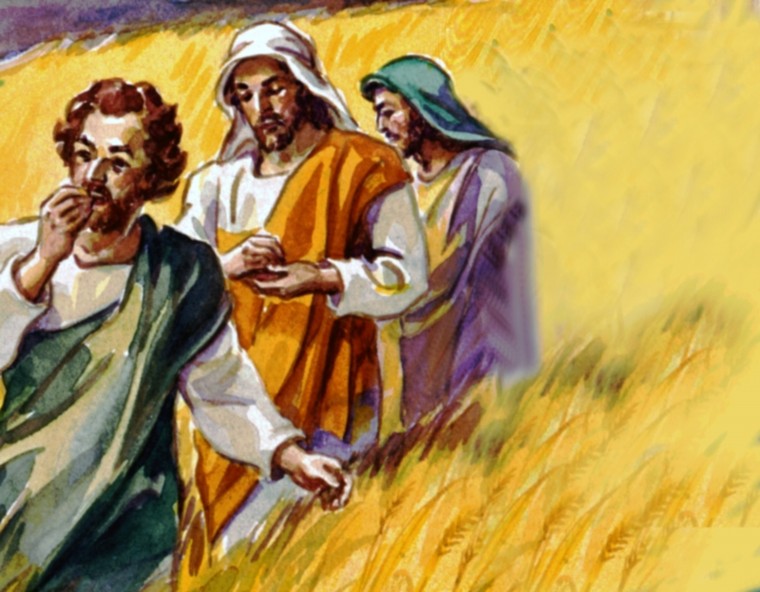
Chapter 6 of Luke contains a couple of the most misapplied and often misunderstood passages in the New Testament. The first comes in verses 1-5, where on a Sabbath, Jesus and his disciples were going through a field, and the disciples plucked and ate some heads of grain. Deuteronomy 23:25 clearly states specifically that this practice is allowed. But the Pharisees had made their own rules up concerning even the smallest of matters; and they had decided that the act of doing this fell into the category of “work,” which was forbidden on the Sabbath.

Jesus' disciples plucked and ate some heads of grain in a grainfield, but were chastized by the Pharisees for doing this on the Sabbath (Matthew 12:1-8; Mark 2:23-28; Luke 6:1-5)

Jesus’ disciples plucked and ate some heads of grain in a grainfield, but were chastized by the Pharisees for doing this on the Sabbath (Matthew 12:1-8; Mark 2:23-28; Luke 6:1-5)

When they confront Jesus, asking why his disciples do what is “unlawful” on the Sabbath, Jesus gives an answer, apparently without denying (at least in the Scripture) any wrong-doing. In His answer, He points them to how David and his men ate the “bread of the Presence” which was unlawful for any but the priests to eat (1 Samuel 21:1-6). The argument by critics and skeptics alike, is that here Jesus endorses “situation ethics.” This is the notion that there is no absolute right or wrong where human needs are concerned – that David and his men were guiltless because of David’s supposed authority and/or the situation that they are in.

This idea is just plain wrong. To begin with, Jesus stated plainly in verse 4 that what David did “is not lawful for any but the priests.” What Jesus did by bringing this up was to point out that David, whom they revered (and whom they would not dare to condemn) had indeed broken the law. Jesus’ disciples were guiltless of breaking any Mosaic law – only the man-made regulations that the Pharisees had imposed on top of, and without authority from, God’s law. Yet they were condemning His disciples. The Pharisees had appointed themselves as “rulers” of the Sabbath, but Jesus pointed out that it was He who was “lord of the Sabbath.”  In the Gospel of Luke, this is the beginning of the more disagreeable encounters with the Pharisees that was sure to make them angry with Jesus.

Verse 6 begins another encounter with the Pharisees that would serve to fan those flames. On another Sabbath, Jesus was teaching in the synagogue. A man was there with a withered hand, and the Pharisees and scribes were watching to see if Jesus would heal Him – so that they could “accuse Him” for working on the Sabbath, thereby violating Mosaic law. It is remarkable that these men could know that Jesus had the power to heal something as definitive as a physical deformity, yet not believe in Him as the Messiah. We can only surmise that they had no desire to believe, but instead wanted to make others believe his power was from evil.

Jesus, of course, knew their thoughts, and he invited the confrontation by telling the man to come to Him. Then, he looked at the group of Pharisees and asked “is it lawful on the Sabbath to do good or to do harm, to save life or to destroy it?” No answer to this question was recorded, so we can assume they gave none. But when he healed the man’s deformity, their anger was certainly kindled, as verse 11 states that they “discussed with one another what they might do to Jesus.”

(This year’s reading plan for Luke, Acts, and 1 and 2 Chronicles averages just 15 verses per day – 5 days per week!)
Schedule for this week
Read or listen to audio of today’s selection from Luke here
Read or listen to audio of today’s selection from 1 Chronicles here

/Bob’s boy
___________________
some images © V. Gilbert & Arlisle F. Beers

Please note: I did not design the reading plan that I am following in my blog.  All of my comments in this blog, however, are solely my responsibility.  When reading ANY commentary, you should ALWAYS refer first to the scripture, which is God’s unchanging and unfailing word. Reading schedules, as well as a link to the site where you can get the reading plan that I’m currently following for yourself can be found on the “Bible Reading Schedules” page of my website at http://graceofourlord.com.  

Enhanced by Zemanta

Acts 23 – A Plot to Kill Paul

Paul appeared before the Jewish council

Paul had just begun to speak to the Sanhedrin council, when the high priest unlawfully ordered him to be struck (it was unlawful to strike a man who had not yet been condemned).  Paul correctly predicts Ananias’ demise in verse 3, as he will be killed by his own people at the start of the Jewish war.  There are a lot of theories (total speculation, of course) about verses 4-5 and Paul’s disrespect for Ananias, but whatever the case, we should take Paul at his word that he did not know who he was addressing.  It is noteworthy, however, how quick they were to point out that fact, yet ignore the willful violation made against Paul.  At that point, he would have no question (if there was doubt before) about whether he would receive a fair hearing from them.

Paul then uses the fact that the Sanhedrin council was made up of both Pharisees and Sadducees to his advantage.  The Sadducees did not believe in resurrection, but the Pharisees did – and the division between them because of it was great.  Paul’s statement in verse 6 makes that division so sharp that it became violent.  The Roman tribune then feared that Paul would be torn to pieces, and had the soldiers remove him and take him to the barracks.  Paul’s statement that set it in motion was “brothers, I am a Pharisee, a son of Pharisees. It is with respect to the hope and the resurrection of the dead that I am on trial;” and every word of it was true.  Paul had been raised a Pharisee (Philippians 3:5-9), and it was indeed because of the resurrection of Jesus Christ, and the hope, that he was on trial.  The following night, the Lord stood by him for encouragement and told him that he must go to Rome to testify the facts about Him (verse 11).

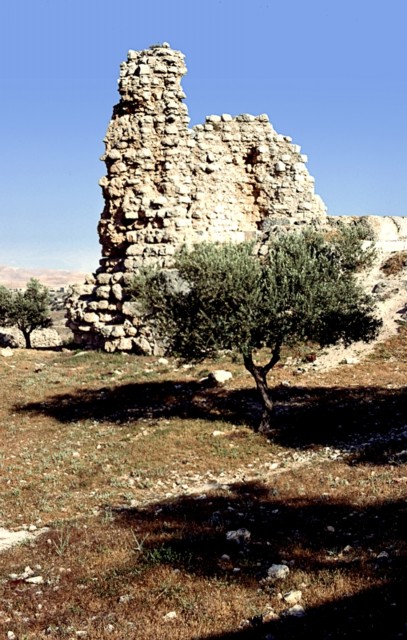
Antipatris was the Old Testament Philistine city of Aphek (1 Samuel 4: 1; 29: 1). The New Testament city was built by Herod the Great in 9 BC. Antipatris was named for Antipater, Herod the Great’s father. Ras el-‘Ain is the site of the ruins of the ancient city. The spring at Antipatris is the source of the River Auja. Paul was taken here (Acts 23: 31) on the way to his imprisonment in Caesarea.

The Jews then sensed that Paul’s fate was slipping away, so more than forty of them conspired to kill him, taking an oath not to eat or drink until they had done so.  Such an oath was a serious matter – not made flippantly (and reminds us of Jezebel in 1 Kings 19:2).  Verse 14  leaves no doubt of the extent of corruption there, as we learn that the chief priests and elders were involved in this despicable plot.  But Paul’s sister learned of the plot and sent her son to warn him.  Paul then sends his nephew to tell the tribune (whose name we learn in verse 26 is  Claudius Lysias).  Lysias then composed a letter to Felix the governor (verse 26-30), putting himself, of course, in a favorable light.  At his orders, Paul gets an escort of two hundred soldiers to deliver him and the letter to Antipatris by the dark of night.  Upon reading the letter and questioning Paul as to his birthplace, he ordered Paul held in Herod’s praetorium (one of Herod’s palaces that the governor used for his quarters), as he awaits his accusers for a hearing.

Read or listen to audio of ESV version of this selection from this link.

/Bob’s boy
___________________
some images © V. Gilbert & Arlisle F. Beers

Please note: I did not design the reading plan that I am following in my blog.  All of my comments in this blog, however, are solely my responsibility.  When reading ANY commentary, you should ALWAYS refer first to the scripture, which is God’s unchanging and unfailing word. Reading schedules, as well as a link to the site where you can get the reading plan that I’m currently following for yourself can be found on the “Bible Reading Schedules” page of my website at http://graceofourlord.com.  For questions and help, please see the “FAQ” and “Summaries” pages there.

John 11 – Jesus Raises Lazarus

When Jesus receives word that Lazarus is ill, he obviously knows that he is going to die.  So some Bible versions are confusing in verse 4.  The New American Standard has the best translation – “This sickness is not to end in death, but for the glory of God, so that the Son of God may be glorified by it.”  Verse 6 may mean that Jesus wanted to give the sisters time to mourn after the death of their brother before He arrived to raise him – all the more effective when the Lord’s power over death is demonstrated.  Verses 9-10 are difficult to understand.  The most likely meaning is that since He is the light of the world, those who seek to kill Him will not be able to do so until his “day” – His time among them – is over.  His disciples do not understand in verse 11 when He says “Lazarus has fallen asleep,” so He tells them plainly in verse 14 that he has died, and that He is glad for their sakes, so that they will believe. Their witness of Him raising Lazarus will be a powerful memory for them.

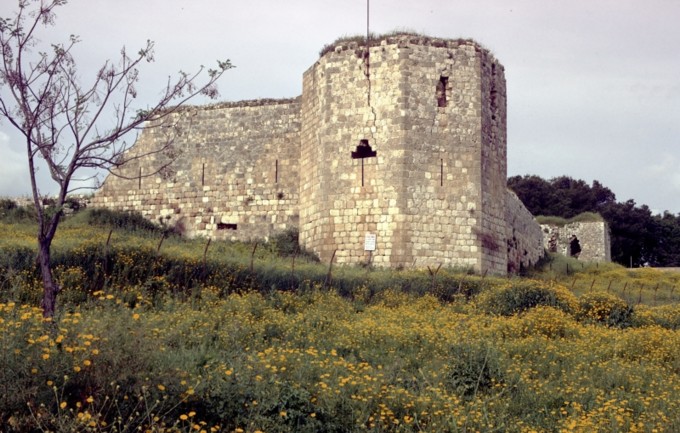
The site that is almost certainly Bethany of John 11 – about two miles east of Jerusalem, on the east slope of the Mount of Olives. Jesus often visited his friends, Mary, Martha and Lazarus here. Jesus raised Lazarus after four days, one of the greatest of his miracles. The modern village, called Azariyeh, el-Azariyeh, Lazariyeh, or el-Lazariyeh to honor Lazarus, has about 1,000 people and is near the ancient village. The tower of the New Church of St. Lazarus rises next to the ruins of Christian churches from the Crusader period, about 1100-1300 A.D.

After He raised Lazarus, the Jews that did not want to believe that He was the Christ went to the Pharisees to tell them what had happened.  Their concern about people believing in Jesus as the Messiah was based on the same misguided expectation that the coming of the Messiah would mean he would be a powerful political and military leader.  A Messiah that would lead believers in a revolt against Roman rule would result in the coming of the Romans to crush it and remove the leaders (and thus, the Sanhedrin itself) from any position of power.  Caiaphas, the high priest of that time (about 18 – 36 AD), proposed that killing Jesus would be best for them all (verse 50).  His prophecy in the following verses was unknowingly very foretelling of His resurrection and its effect on God’s people.

Jesus did not walk freely among the Jews after that (verse 54); and in verse 56, many were wondering if He would come to the Passover feast at all.  Of course He would – He always followed God’s commandments.

Read or listen to audio of ESV version of this selection from this link.

/Bob’s boy
___________________
some images © V. Gilbert & Arlisle F. Beers

Please note: I did not design the reading plan that I am following in my blog.  All of my comments in this blog, however, are solely my responsibility.  When reading ANY commentary, you should ALWAYS refer first to the scripture, which is God’s unchanging and unfailing word. Reading schedules, as well as a link to the site where you can get the reading plan that I’m currently following for yourself can be found on the “Bible Reading Schedules” page of my website at http://graceofourlord.com.  For questions and help, please see the “FAQ” and “Summaries” pages there.
Luke 15 – The Parable of the Prodigal Son

As Jesus was teaching, the tax collectors and sinners had gathered around him.  We are not told what the latter were guilty of, but they obviously had a dubious reputation because of it.  The Pharisee and scribes, of course, were looking for anything to use against Jesus; and they began grumbling about the company He was keeping.  Of the three parables Jesus then tells in this chapter, the parable of the prodigal son is the most famous.  But all three make the point about those who are lost, best stated in verse 7 by Jesus – “there will be more joy in heaven over one sinner who repents than over ninety-nine righteous persons who need no repentance.”

Frans Francken (II) - The Parable of the Prodi...

Frans Francken (II) – The Parable of the Prodigal Son – WGA8205 (Photo credit: Wikipedia)

The image in verse 20 of the father running to his son to embrace him when he returned should be comforting to anyone who has fallen away from the Lord and wants to return.  No matter what we have done, God wants us to come back to Him, and will receive us gladly.  The elder son is upset that his father is celebrating the return of his prodigal brother who, in verse 30,  he does not even want to acknowledge as such (“this son”) because of his anger.  After all, he had remained behind and did not “devour” his father’s “property with prostitutes” (verse 30).   Why should his brother deserve to be received that way?  God will forgive in the same way; and we must realize that it is not because any of us deserve that forgiveness.

Read or listen to audio of ESV version of this selection from this link.

/Bob’s boy
___________________
some images © V. Gilbert & Arlisle F. Beers

Please note: I did not design the reading plan that I am following in my blog.  All of my comments in this blog, however, are solely my responsibility.  When reading ANY commentary, you should ALWAYS refer first to the scripture, which is God’s unchanging and unfailing word. Reading schedules, as well as a link to the site where you can get the reading plan that I’m currently following for yourself can be found on the “Bible Reading Schedules” page of my website at http://graceofourlord.com.  For questions and help, please see the “FAQ” and “Summaries” pages there.

Matthew 16 – Jesus Foretells His Death and Resurrection

The Pharisees and the Saduccees Come to Tempt ...

The Pharisees and the Sadducees Come to Tempt Jesus (Photo credit: Wikipedia)

Normally, the Pharisees and Sadducees were at odds, and had little to do with each other.  But Jesus was perceived by both groups as a threat to their power.  That is why they came together in verse one asking him for a sign – in order to try to get something to use against him as the Pharisees and scribes had done earlier.  Jesus points out their ability to understand meteorological signs (verse 2), but they are unable to understand the signs that He has done (because they choose not to).  In verse 4, he says that no sign will be given except the sign of Jonah  (a repeat of His earlier statement in the encounter in Matthew 12:38-40).  He had told them of His coming death and resurrection already, but they had not understood that either.

In verse 5, the disciples caught up with Him (Jesus had gone over on the boat without them after feeding the four thousand in chapter 15) and realized they had forgotten to bring any bread.  So when He tells them to “beware of the leaven of the Pharisees and Sadducees,”  they still have their minds on bread; and they do not properly understand the statement.  Jesus is using the word “leaven” in the sense of something that influences another – in this case, the corrupt doctrine and hypocrisy of the Pharisees and Sadducees.  It is their (the disciples) faith (verse 8) that is preventing them from understanding the way He wants them to understand Him.  Jesus focuses their minds by reminding them of the miracles of feeding the two groups of thousands and the abundant left-overs, and repeating the warning.  That has the desired effect, and they finally “get it.”

After they arrive in the district of Caesarea Philippi, Peter answers Jesus’ question of verse 15 with the knowledge that He is the son of God. Jesus declares that he was blessed to have such knowledge revealed to him by God Himself (verse 17).  Unfortunately, verses 18-19 are the subject of much confusion and controversy.  Many people get lost in scrutinizing the Greek and Aramaic words for rock, but the simple fact is that Jesus uses a play on words, as scripture very often does, with Peter’s name.  And despite his flaws (and maybe even because of them), most of us really just like Peter.  But the gospel is not about the glory of Peter.  It is about Jesus, and our hope of salvation through Him.

The two verses are not so difficult to understand when you put them in context with verse 20, with the preceding verses, and with Jesus’ previous words about building a house on the rock (Matthew 7:24)  The rock that Jesus is building on is the foundation of the son of God and His teachings; and his church or kingdom (Greek “ekklesia” – congregation or assembly) is the collection, or body, of people who have been saved by their obedience and faithfulness (Ephesians 2:19-22, 1 Corinthians 12:13).  When Jesus says that He will give him the keys to the kingdom (in contrast to the scribes and Pharisees who cause people to be shut out – see Matthew 23:13), He is speaking of the divine revelation of His word, that will be given to the apostles by the Holy Spirit (John 16:12-15) to impart to us to be saved.  That is when they will truly “get it.”  The next part of verse 19 is best translated in the New American Standard Version, which in the correct tense says  “and whatever you bind on earth shall have been bound in heaven, and whatever you loose on earth shall have been loosed in heaven.”  Binding and loosing refer to forbidding and permitting, and the authority for their knowledge of it will be given to them.   This is repeated to all of them in Matthew 18:18.

Jesus then tells them to tell no one that He is the Christ.  Like Peter in verse 22, nobody would understand that the Christ has not come to rule as their earthly king anyway.  Only after He offers Himself in death will that understanding come.  Verse 21 (“From that time…”) is the first of four times from then until His arrival in Jerusalem, that He will tell them in Matthew of His imminent death and resurrection.  We tend to forget that as Jesus was also a man, Peter’s sentiment for keeping Jesus alive would be a temptation, knowing what He has to suffer.  It is in that light that we better understand His strong words to Peter in verse 23.

Verses 24-27 are the essence of what it means to be a Christian.  The knowledge of what the salvation of our souls means to us eternally should be enough to cause us to deny ourselves the worldly pleasures everyone finds so important – those things that would stand in the way of salvation.  If we do not, and we “gain the world,” we still will have lost everything.  The meaning of verse 28 is said by some to be that some of those present will see the Him come into His kingdom at His death and resurrection, which makes sense.  Others believe that it is the Transfiguration that comes in chapter 17, and is a preview of His divine glory to come.  Both answers have merit; and both may well be correct.  The point is that the time is coming soon.

Read or listen to audio of ESV version of this selection from this link.

/Bob’s boy
___________________
some images © V. Gilbert & Arlisle F. Beers

Please note: I did not design the reading plan that I am following in my blog.  All of my comments in this blog, however, are solely my responsibility.  When reading ANY commentary, you should ALWAYS refer first to the scripture, which is God’s unchanging and unfailing word. Reading schedules, as well as a link to the site where you can get the reading plan that I’m currently following for yourself can be found on the “Bible Reading Schedules” page of my website at http://graceofourlord.com.  For questions and help, please see the “FAQ” and “Summaries” pages there.
Matthew 15 – What Defiles a Person

The Pharisees and scribes that came from Jerusalem in verse 1 would have been of considerable import and influence during the day.  They accuse the disciples (and therefore, Jesus) of breaking the tradition of the elders by eating without having washed their hands.  This was not a matter of hygiene on their part, but is a good example of the extra-biblical customs they were fond of imposing upon people – this one is supposed to have been based on the ritual purity commandments for priests (i.e. Exodus 30:17-21), extending them to apply to people and situations beyond that of God’s word .

The response from Jesus is to throw it right back at them.  The Pharisees were breaking the commandment of God – not the traditions of elders!  By making a claim that their money or property was vowed as a gift to God, they would exclude it from their wealth in consideration of their parents in need, and be excused for not caring for them by their own interpretation of the law – and who knows if they ever actually would give the possessions anyway, even after they died?  Jesus does not mince any words in exposing this hypocrisy (verse 7-9).   The prophecy quoted in verses 8-9 is from Isaiah 29:13.  The disciples then point out the obvious to Jesus – that the Pharisees were offended by what He had said.  But Jesus is not surprised by the opposition of the Pharisees, and tells the disciples that they are intentionally blind to the gospel.  Verses 10-20 then are His lesson to them that it is not what goes into the body that corrupts us, but what comes from our hearts.

The conversation with the Canaanite woman in verses 21-28 seems to be harsh toward her, but we must realize that Jesus came to the regions of Tyre and Sidon (verse 21) not by accident – He would be expecting encounters with Gentiles!  Her faith did pass the test, and her daughter was healed.  Remember that He had already healed the Centurion’s servant.

He then goes on by the Sea of Galilee healing still more in verses 29-31.  Verses 32-39 detail the feeding of the four thousand – this was just the number of men, not including women and children.  This numeration, as well as that of the feeding of the five thousand could be an indication of what sort of size crowds the scripture speaks of in other places.  All were fed and satisfied with just seven loaves of bread and a few fish, and the seven baskets of food gathered up afterward represents more than what they even started with.

Read or listen to audio of ESV version of this selection from this link.

/Bob’s boy
___________________
some images © V. Gilbert & Arlisle F. Beers

Please note: I did not design the reading plan that I am following in my blog.  All of my comments in this blog, however, are solely my responsibility.  When reading ANY commentary, you should ALWAYS refer first to the scripture, which is God’s unchanging and unfailing word. Reading schedules, as well as a link to the site where you can get the reading plan that I’m currently following for yourself can be found on the “Bible Reading Schedules” page of my website at http://graceofourlord.com.  For questions and help, please see the “FAQ” and “Summaries” pages there.