Betrayed and Denied – Luke 22

English: "The Judas Kiss", (Mark 14:...

English: “The Judas Kiss”, (Mark 14:45) by Gustave Doré. Judas kisses Jesus in order to betray him to the guards. (Photo credit: Wikipedia)

As Jesus was still speaking in the Garden of Gethsemane, a crowd was approaching, with Judas leading them. As Luke reminded us earlier, it was His custom to come here, and Judas knew where He went to pray. It must have been quite a scene. Judas kissed his teacher as was customary. Jesus did not let him off easy for that, reminding him that he had just betrayed “the Son of Man with a kiss.”

When they realized what was happening, some of the apostles asked Jesus if they should “strike with the sword.” Peter, of course, did not wait for answer, but cut the ear off of one of them. It is only John who tells us that it was Peter who did this (John 18:10), and that the victim’s name was Malchus. Jesus stopped them from continuing in violence and healed the man’s ear. Then He chastised the chief priests who had come with the crowd, pointing out that they had not laid a hand on Him while He was with them everyday ion the Temple, yet now they come after him like He was a robber.

They took Him to the house of the chief priest, with Peter following at a distance. He settled in with a crowd who had made a fire in the courtyard. It was there that Peter denied knowing Jesus three times. Luke tells us that a rooster crowed immediately, and that Jesus turned and looked at Peter. What a horrible feeling of guilt must have come over Peter at that moment. Despite all of his bravado, he had taken the cowardly way out in fear for his own safety. Now he must live with that knowledge, and Luke tells us that he did indeed go out and “wept bitterly.”

The kiss of Judas and Peter cutting off the ea...

The kiss of Judas and Peter cutting off the ear of Malchus (Photo credit: Wikipedia)

Verses 63-65 tell us how the men that were holding Jesus mocked and blasphemed against Him. They also had Him blindfolded, beating Him, and they would tell Him to “prophesy” by saying which one of them had struck Him. Then at daybreak, He was led to the Sanhedrin, where they questioned Him about whether He was the Christ – the Son of God. Jesus’ answer “you say that I am” is a Greek expression that turns it back on the questioner, but the answer was clear. And that was enough for His accusers. They would deliver Him to Pilate, since they were forbidden by Roman law to execute Him themselves.

(This year’s reading plan for Luke, Acts, and 1 and 2 Chronicles averages just 15 verses per day – 5 days per week!)
Schedule for this week
Read or listen to audio of today’s selection from Luke here
Read or listen to audio of today’s selection from 2 Chronicles here

/Bob’s boy
___________________
some images © V. Gilbert & Arlisle F. Beers

Please note: I did not design the reading plan that I am following in my blog.  All of my comments in this blog, however, are solely my responsibility.  When reading ANY commentary, you should ALWAYS refer first to the scripture, which is God’s unchanging and unfailing word. Reading schedules, as well as a link to the site where you can get the reading plan that I’m currently following for yourself can be found on the “Bible Reading Schedules” page of my website at http://graceofourlord.com.  

Enhanced by Zemanta

Communion and Preparation – Luke 22

As Jesus and his disciples reclined at table to eat the Passover, he told them how much he had looked forward to having this opportunity- his truly last until “it is fulfilled in the kingdom of God” – after his resurrection. He took the cup of the fruit of the vine and the bread, and He had them divide it between them. Note that He gave thanks for the bread and the fruit of the vine separately before doing so, just as is our custom in observing this Lord’s supper which he instituted here.

The Last Supper

The Last Supper (Photo credit: elmas156)

After he explained to them the meaning that these elements now had – his body and his blood, they ate. It was then that he broke the news to them that one of those who were present would betray him. He said that the fact that he was going to go was already determined. But He  told them that it would not go well for the one who betrayed him. This got their attention, and they questioned each other, trying to determine who it was.

Then an odd dispute came up – odd in light of the news that Jesus had just given them. The dispute was over which one of them would be the greatest in Jesus’ kingdom. This goes to show that it still just wasn’t sinking in. It reminds us of the third time that Jesus foretold His death to them in Luke 18:34. The scripture said “this saying was hidden from them, and they did not grasp what was said. It seems clear that they still were not “grasping” it. They were still imagining that Jesus was to become the earthly king of the Jews, and that they were wondering just how high on the “totem pole” each of them was going to be.

So then Jesus turned upside down their notions of greatness and leadership completely. He pointed out that He is one among them who serves. Luke does not recount here the lesson that Jesus taught them about serving when He washed their feet, as John detailed in John 13:12-15. But it is clear that at this point He had given it to them. He also told them that those who would be the “greatest” must become as the youngest – that is, those who were more often traditionally called to serve others. Yet he said that He assigns to them – those who were with Him thru His trials – a place at his table in his kingdom. They just still do not know what “the kingdom” really will mean at this point.

Then Jesus’ conversation turns to Peter, and that deserves some attention. Note verses 31-32:

31 “Simon, Simon, behold, Satan demanded to have you, that he might sift you like wheat, 32 but I have prayed for you that your faith may not fail. And when you have turned again, strengthen your brothers.”

Judas at the Last Supper

Judas at the Last Supper (Photo credit: Lawrence OP)

It is significant that the word translated as you twice in verse 31 is plural. So the verse is emphasizing Satan’s determination to shake the faith of all of the apostles. In verse 32, the word is plural, as Jesus is addressing Peter. Jesus knew by now that Judas was lost, and he knew that Peter was Satan’s next target. But He says, that He has prayed that Peter’s faith would not fail. He knew that the Holy Spirit would fill Peter at the proper time, and that he would strengthen the others. Peter, of course, said he was ready to go to prison or die, but Jesus told him of his coming denial.

He then reminds them of when he sent them out without a moneybag or knapsack (Luke 9:1-6), and asks if they lacked for anything. They answered that they had not. Then he told them:

“But now let the one who has a moneybag take it, and likewise a knapsack. And let the one who has no sword sell his cloak and buy one.

This passage generates much debate. Some see the sword as having a figurative meaning – as in arming themselves for spreading the gospel. But if that were the case, wouldn’t the moneybag and knapsack also be figurative? But how else to explain it? Jesus obviously did not want them to use these swords against the authorities when they came to arrest him. But note that when Peter does cut the ear from one of them when they come to arrest Jesus, Jesus rebukes him – but he does not have him get rid of the sword either.

The most reasonable explanation is that Jesus knows that their lives are about to change. They were safe as long as they were all together with him. But many would scatter and become separated. They would need their moneybags, their knapsacks, and they would need their swords for protection against robbers, and maybe even wild animals. Remember, they weren’t checking into La Quinta on their travels, and seldom were lucky enough to be taken into someone’s home.


(This year’s reading plan for Luke, Acts, and 1 and 2 Chronicles averages just 15 verses per day – 5 days per week!)
Schedule for this week
Read or listen to audio of today’s selection from Luke here
Read or listen to audio of today’s selection from 2 Chronicles here


/Bob’s boy


___________________


some images © V. Gilbert & Arlisle F. Beers


Please note: I did not design the reading plan that I am following in my blog.  All of my comments in this blog, however, are solely my responsibility.  When reading ANY commentary, you should ALWAYS refer first to the scripture, which is God’s unchanging and unfailing word. Reading schedules, as well as a link to the site where you can get the reading plan that I’m currently following for yourself can be found on the “Bible Reading Schedules” page of my website at http://graceofourlord.com.  


Enhanced by Zemanta

Elect Exiles – 1 Peter

Cappadocia was the largest province of Asia Minor, located in what is today eastern Turkey. It became more easily accessible to points south, including Jerusalem, after the Romans constructed roads through the Cilician Gates in the Taurus range. Despite the Roman empire's disdain for Christians, these roads actually helped the Gospel to spread.

Cappadocia was the largest province of Asia Minor, located in what is today eastern Turkey. It became more easily accessible to points south, including Jerusalem, after the Romans constructed roads through the Cilician Gates in the Taurus range. Despite the Roman empire’s disdain for Christians, these roads actually helped the Gospel to spread.

Peter’s first letter begins with him declaring his authorship, and it was accepted as such by the early church fathers. It is addressed to the “elect exiles of the Dispersion in Pontus, Galatia, Cappadocia, Asia, and Bithynia…” These are all in an area of Asia minor which is now northern Turkey. Because Peter speaks to them as “exiles of the Dispersion,” some have taken that to mean that Peter is addressing Jews that have scattered to these lands.

But it is clear from many passages in the letter that Peter is addressing all Christians – and probably Gentiles in particular – in this letter. One such example is 1 Peter 1:14, where Peter urges them not to “be conformed to the passions of your former ignorance,” which is indicative of Gentiles. Obviously, he refers to a more symbolic form of exile and dispersion, as he says they are exiles according to the foreknowledge of God the Father, in the sanctification of the Spirit, for obedience to Jesus Christ.” The best explanation is that these Christians, who will dwell in heaven, are in a strange land – this world is not our home. “The foreknowledge of God” refers to the fact that God always knew that the Gentiles would be part of the kingdom, as evidenced in many passages, all the way back to, and including, Genesis 12:3, where God tells Abraham that in you all the families of the earth shall be blessed.

English: Political map of Asia Minor in 500 BC

English: Political map of Asia Minor in 500 BC (Photo credit: Wikipedia)

Several references in the text indicate that Peter probably wrote this letter before the persecutions by Nero began, putting it about 62-63 A.D. It is also indicated that he wrote it from Rome. The mention of Babylon in 1 Peter 5:13 is believed by most scholars to be a figurative reference to Rome. The order of the churches addressed in that opening section of chapter one is thought by many to be the actual order in which the letter would have been delivered. 1 Peter 5:12 states that it was to be delivered by Sylvanus (another name for Silas). If coming by way of the Black Sea, a logical port for a starting point would be Pontus. Then a counter-clockwise circuit through the other cities would end up at Bithynia.

The letter is full of encouragement for those who are suffering, and reminders of the suffering and resurrection of the Lord, Jesus. There is much encouragement to remember the hope they have of their inheritance of an eternal home (1 Peter 1:3-9); and they admonished to live righteously, abstaining from fleshly passions (1 Peter 2:11; 1 Peter 3:7). But the most famous passage in this letter might be the one that has become synonymous with the area of apologetics (1 Peter 3:15), which says:

“But in your hearts honor Christ the Lord as holy, always being prepared to make a defense to anyone who asks you for a reason for the hope that is in you; yet do it with gentleness and respect…”

(This year’s reading plan for Luke, Acts, and 1 and 2 Chronicles averages just 15 verses per day – 5 days per week!)
Schedule for this week

/Bob’s boy
___________________
some images © V. Gilbert & Arlisle F. Beers

Please note: I did not design the reading plan that I am following in my blog.  All of my comments in this blog, however, are solely my responsibility.  When reading ANY commentary, you should ALWAYS refer first to the scripture, which is God’s unchanging and unfailing word. Reading schedules, as well as a link to the site where you can get the reading plan that I’m currently following for yourself can be found on the “Bible Reading Schedules” page of my website at http://graceofourlord.com.

Enhanced by Zemanta

1 Peter 2 – A Living Stone and a Holy People

Mediterranean Sea near Joppa. Joppa, today called Jaffa, was once the seaport for Jerusalem. Hiram sent cedar logs from Lebanon to King Solomon for the Temple, floating them to Joppa (2 Chronicles 2:15). From Joppa the prophet Jonah ran away from God ( Book of Jonah), sailing from there toward Tarshish. Here Peter raised Tabitha, or Dorcas, from the dead (Acts 9:36-42). Later he was staying here at the house of Simon the Tanner when he saw a vision of unclean animals, which led him to visit Cornelius' house in Caesarea and win him to Christ.

Mediterranean Sea near Joppa. Joppa, today called Jaffa, was once the seaport for Jerusalem. Hiram sent cedar logs from Lebanon to King Solomon for the Temple, floating them to Joppa (2 Chronicles 2:15). From Joppa the prophet Jonah ran away from God ( Book of Jonah), sailing from there toward Tarshish. Here Peter raised Tabitha, or Dorcas, from the dead (Acts 9:36-42). Later he was staying here at the house of Simon the Tanner when he saw a vision of unclean animals, which led him to visit Cornelius’ house in Caesarea and win him to Christ.

Peter continues his admonishment to be holy in this letter, beginning  by urging them to leave behind wickedness, thoughts and deeds of ill will toward others, and to study God’s word.  The reference to the Scriptures as spiritual milk is used in other passages such as Hebrews 5:12 and 1 Corinthians 3:2.  Verse 3’s reference to having “tasted” that the Lord is good, is quoted from Psalm 34:8 appropriately here, as the entire Psalm is about the Lord delivering the righteous who are suffering.  He then describes them as a living stone “rejected by men but in the sight of God chosen and precious,”  being built up as a spiritual house, with Jesus as the cornerstone (Isaiah 28:16, Psalm 118:22).

He addresses Christians in verse 9, referring to them with terms that were reserved for Jews in the past – “a chosen race, a royal priesthood, a holy nation” (Exodus 19:5-6, Deuteronomy 7:6, Isaiah 61:6).  Many of them were Gentiles.  Peter then tells them they must abstain from passions of the flesh, and keep their actions among the Gentiles honorable, referring to unbelievers as “Gentiles.”  Living as a holy people, they must submit to the authority of those who rule, and by doing good amid their suffering and persecution they honor Jesus who suffered, “but continued entrusting himself to him who judges justly.”

The last few verses of the chapter remind them of just how much Jesus suffered for us, and correspond to the Suffering Servant of Isaiah 53 as follows:

Verse 22 – Isaiah 53:9

Verse 23 – Isaiah 53:7

Verse 24 – Isaiah 53:12, 5

Verse 25 – Isaiah 53:6

Read or listen to audio of ESV version of this selection from this link.

/Bob’s boy
___________________
some images © V. Gilbert & Arlisle F. Beers

Please note: I did not design the reading plan that I am following in my blog.  All of my comments in this blog, however, are solely my responsibility.  When reading ANY commentary, you should ALWAYS refer first to the scripture, which is God’s unchanging and unfailing word. Reading schedules, as well as a link to the site where you can get the reading plan that I’m currently following for yourself can be found on the “Bible Reading Schedules” page of my website at http://graceofourlord.com.  For questions and help, please see the “FAQ” and “Summaries” pages there.

1 Peter 1 – Called to Be Holy

Map of the route of Paul's second missionary journey.  Here in the epistle, Peter writes to Christians to the north and east.

Map of the route of Paul’s second missionary journey. Here in the epistle, Peter writes to Christians to the north and east.

Peter opens this letter addressing Christians in the northern and eastern provinces of Turkey (such as Pontus,  Cappadocia, and Bithynia) who had scattered because of persecution – and indeed still suffered such.  It is notable that Peter now refers to Christians – Jew and Gentile – in terms formerly reserved only for the Jews (chosen, elect exiles of the dispersion, etc.).  Because of the blood of Jesus Christ, according to the foreknowledge of God the Father, Christians were now the chosen ones, as Jesus made plain in John 15:16-19.  Peter is offering them comfort, as he reminds them that God in His mercy has caused us to be born again through the resurrection of His son, Jesus, for an imperishable inheritance of salvation.

Ruins in Cappadocia, the largest province of Asia Minor, located in what is today eastern Turkey. It became more easily accessible to points south, including Jerusalem, after the Romans constructed roads through the Cilician Gates in the Taurus range. Despite the Roman empire's disdain for Christians, these roads actually helped the Gospel to spread.

Ruins in Cappadocia, the largest province of Asia Minor, located in what is today eastern Turkey. It became more easily accessible to points south, including Jerusalem, after the Romans constructed roads through the Cilician Gates in the Taurus range. Despite the Roman empire’s disdain for Christians, these roads actually helped the Gospel to spread.

His words of comfort urge them to realize that the persecution they are enduring  will test the genuineness of their faith, but their love for Him and steadfastness will be rewarded by His grace.  He reminds them of the promise of the prophets concerning Christ, who was “foreknown before the foundation of the world” – that they were ransomed by His blood and by His victory over death.  Peter calls on them to not fall back on their old ways – the ways of their fathers – but to purify themselves in love for one another and to be holy.

This latter point is most important.  People often try to excuse their sinful behavior by saying “God wants me to be happy.”   Sure, God wants us to rejoice in  the hope that we have because of Jesus, but He is not nearly so focused on our personal happiness.  He wants us to be holy!  Peter reminds us in verses 15-16 (quoting Leviticus 11:44) “…as he who called you is holy, you also be holy in all your conduct, since it is written, ‘You shall be holy, for I am holy.'”  Verses 24-25 are cited from Isaiah 40:6-8, reminding us to trust in God , whose word endures forever.

Read or listen to audio of ESV version of this selection from this link.

/Bob’s boy
___________________
some images © V. Gilbert & Arlisle F. Beers

Please note: I did not design the reading plan that I am following in my blog.  All of my comments in this blog, however, are solely my responsibility.  When reading ANY commentary, you should ALWAYS refer first to the scripture, which is God’s unchanging and unfailing word. Reading schedules, as well as a link to the site where you can get the reading plan that I’m currently following for yourself can be found on the “Bible Reading Schedules” page of my website at http://graceofourlord.com.  For questions and help, please see the “FAQ” and “Summaries” pages there.

Let’s Hear From Peter \ Week 48 summary posted

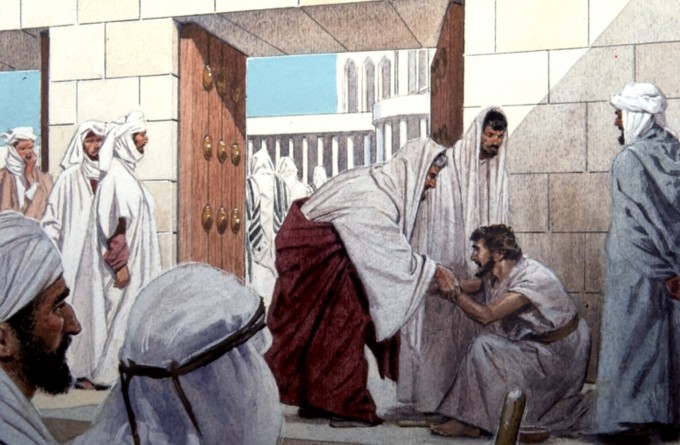
Peter healed a crippled beggar at the Beautiful Gate of the Temple (Acts 3:1-11)

Peter healed a crippled beggar at the Beautiful Gate of the Temple (Acts 3:1-11)

Having finished the Book of Acts and Paul’s Epistle to the Ephesians, this week we will turn from Paul’s writing, first to a letter from Peter (1 Peter), then to the Book of Hebrews.  The former was probably written around 62-63 AD, before Nero’s persecution, but almost certainly during his reign.  As to the Hebrew letter, there has been much conjecture about the authorship, but as one writer put it, “Who actually wrote the epistle, only God knows.”

Summing Up

Each weekend, I am now posting a small PDF of one week of chapter summaries (on the website’s “Summaries” page), current to the beginning of the previous week.  I have posted the summary for Week 48 (November Week 4) of the schedule I am following.  This short PDF document contains condensed comments about Acts 25, 26, 27, 28, and Ephesians 1, with hyperlinks to the ESV version of each chapter for listening or reading, and joins the summaries for other weeks already posted there.

/Bob’s boy
___________________
image © V. Gilbert & Arlisle F. Beers

Please note: I did not design the reading plan that I am following in my blog.  All of my comments in this blog, however, are solely my responsibility.  When reading ANY commentary, you should ALWAYS refer first to the scripture, which is God’s unchanging and unfailing word. Reading schedules, as well as a link to the site where you can get the reading plan that I’m currently following for yourself can be found on the “Bible Reading Schedules” page of my website at http://graceofourlord.com.  For questions and help, please see the “FAQ” and “Summaries” pages there.

Acts 4 – Peter and John Before the Council

While Peter and John were still speaking to the people who had flocked to hear, the priests and the Sadducees became “greatly annoyed” (verse 2).  There were several reasons for them to be disturbed over this sermon.  To begin with, the Sadducees did not believe in resurrection at all (Acts 23:8).  Secondly, they had themselves condemned Jesus to death.  As Campbell wrote in his commentary: “the great popularity of the gospel message threatened their political base, promised to hold them up before the people as murderers, as ignoramuses concerning the Holy Scriptures, and as deserving of universal contempt.”  Peter and John were arrested and put into custody until the next day.  But verse 5 says that many more who had heard “the word” believed. “The word” was the same as it is today: Jesus, the Son of God, has risen from the dead, and it is only through Him “by which we must be saved!”  The number of men alone in the Lord’s church now came to about 5,000.

Sanhedrin, Jewish high council chambers.

The next day, Peter and John faced Annas the high priest, Caiaphas and the rest of the Sadducees, and the elders and scribes, who asked them by what power or what name they had acted. Peter, who had earlier feared these men enough to deny that he even knew the Lord, was now filled with the Holy Spirit.  In verses 8-11, with respect but also with boldness of conviction, he eloquently told them that the lame man had been healed by the name of Jesus Christ of Nazareth, whom they crucified. The reference to Jesus being the cornerstone, rejected by the builders (them) was from Psalm 118:22 and Isaiah 28:16.

After deliberating, the council knew they had no just charge to bring against them, but they warned them not to speak or teach in the name of Jesus any more.  The truth still meant nothing to the Sanhedrin.  But Peter and John would only say that they would have to judge whether it is right to listen to God or the council.  They would speak the truth.  The council gave them another warning before releasing them.  God, through Peter and John, had given these men the chance to repent and they chose to reject the Lord again.

Back with their friends they lifted their voices in prayer to God, quoting Psalm 2:1-2 in verses 25-26 and asking God to “look upon their threats and grant to your servants to continue to speak your word with all boldness.”  In verse 31, when they finished praying “the place in which they were gathered together was shaken, and they were all filled with the Holy Spirit.”  God had given His response.

Read or listen to audio of ESV version of this selection from this link.

/Bob’s boy
___________________
some images © V. Gilbert & Arlisle F. Beers

Please note: I did not design the reading plan that I am following in my blog.  All of my comments in this blog, however, are solely my responsibility.  When reading ANY commentary, you should ALWAYS refer first to the scripture, which is God’s unchanging and unfailing word. Reading schedules, as well as a link to the site where you can get the reading plan that I’m currently following for yourself can be found on the “Bible Reading Schedules” page of my website at http://graceofourlord.com.  For questions and help, please see the “FAQ” and “Summaries” pages there.

John 21 – Jesus Appears to the Other Disciples

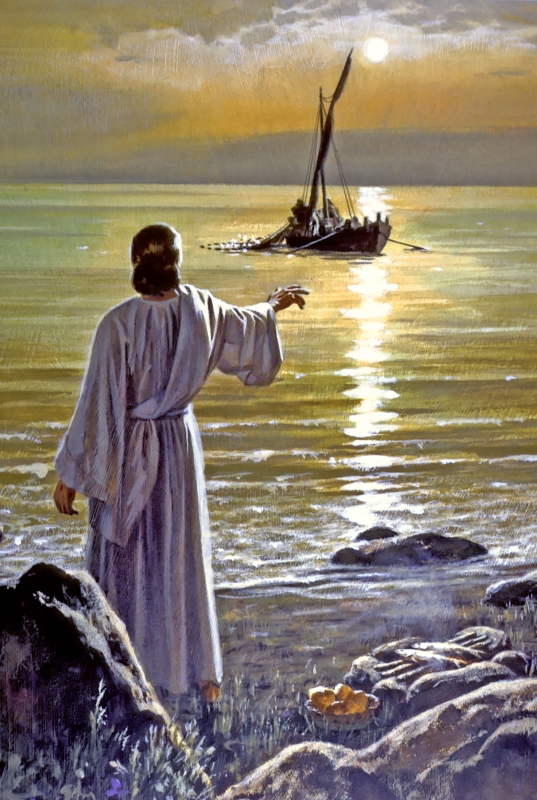
In this final chapter of John’s gospel, Jesus appears to seven of the disciples that have gone fishing on the Sea of Tiberias (Sea of Galilee).  Appearing to them 100 yards from shore at daybreak, they did not recognize Him until they cast their net out where He told them – and then were unable to haul it in, so great was the catch (verse 6).  John must have at once been reminded of the similar incident in Luke 5:4-6, as he exclaimed to Peter that “It is the Lord!”  Peter, impulsive as usual, jumps in to swim to shore while the others drag the fish with the boat.  Jesus had a fire going, and was cooking them breakfast.  There have been many attempts to make some symbolic interpretation of the number of fish they caught (153) in verse 11, but fishermen naturally counted their fish before taking them to market.  Verse 12 is simply an indication that even though they knew this was Jesus, the disciples were still getting used to the fact that He was alive again.

Verses 15-19 make up the “feed my sheep” conversation between Jesus and Peter.  Much has been written and discussed about the two different Greek words for love (agape and phileo) that are in the text.  But the two words are used interchangeably in the book of John, and even throughout the Septuagint.  It is no more valid to make something different of this than the two different words this very same text uses for “feed” and even “sheep.”  There are only two things of significance.  One is that Peter denied Jesus three times; and though it grieved Peter (verse 17) that Jesus asked him whether He loved Him a third time, Jesus knew that it would also be somewhat of a comfort to Peter later.  The command to him to “feed my sheep” came from “the Good Shepherd” Himself (John 10:11,14) for Peter and the other apostles, and is carried forward to all elders to “shepherd the flock of God that is among you” (1 Peter 5:1-4, Acts 20:28).  With verses 18-19, Jesus foretells Peter’s being bound and led to his own crucifixion.

As this gospel wraps up, “the disciple whom Jesus loved” wants us to know that Jesus did so much more while He was here than was written about.

Read or listen to audio of ESV version of this selection from this link.

/Bob’s boy
___________________
some images © V. Gilbert & Arlisle F. Beers

Please note: I did not design the reading plan that I am following in my blog.  All of my comments in this blog, however, are solely my responsibility.  When reading ANY commentary, you should ALWAYS refer first to the scripture, which is God’s unchanging and unfailing word. Reading schedules, as well as a link to the site where you can get the reading plan that I’m currently following for yourself can be found on the “Bible Reading Schedules” page of my website at http://graceofourlord.com.  For questions and help, please see the “FAQ” and “Summaries” pages there.

Luke 9 – The Transfiguration

Mount Hermon is one possible location for the Transfiguration. Caesarea Philippi is near the base of it.

The first 27 verses of this chapter consist of details told in Mark 6 (sending out the Apostles, and the feeding of the five thousand) and Matthew 16 (Peter’s confession, and Jesus’ foretelling of His death and resurrection.   Jesus took Peter, John, and James with Him in verse 28 to pray on the mountain where they witnessed an unforgettable sight, as His appearance and even His clothing are transformed; and Moses and Elijah (representing the Law and the Prophets) appeared and spoke of Jesus departure “he was about to accomplish at Jerusalem.”  This of course , refers to what follows His coming crucifixion and resurrection.  Just as Peter speaks hastily again (verse 33), they hear the voice of God declaring what Peter had said – that Jesus is the son of God.   Peter assumed that Moses and Elijah would stay with them, but they were gone after God spoke, saying “Listen to Him.”  The presence and removal of those two seems significant, as well understand the scriptures today.

As Jesus foretells His death and resurrection in verse 44, verse 45 is one of a few verses that tell us how understanding and recognition was concealed from the disciples at various times until after Jesus departed following His resurrection (see also Luke 18:34 and Luke 24:16).  It is no small wonder then, that they began debating their own importance over each other.  Jesus settles the dispute with another statement in verse 48 that they would not yet understand  – “he who is least among you all is the one who is great.”  He would have more to say about this in Luke 22:26.

The lessons of verses 57-62 are in light of the urgency of the moment at which Jesus encounters them.  Two say that they want to follow Him, and He tells another to follow Him.  He tells one that he will have to make sacrifices in order to do so (verse 58).  The other two speak of matters important to them at the time that they want to take care of first (59, 61).  This was no time for other priorities; and though these instances refer to a more physical following, the application for us is the same – that following Jesus must take first priority in our lives.

Read or listen to audio of ESV version of this selection from this link.

/Bob’s boy
___________________
some images © V. Gilbert & Arlisle F. Beers

Please note: I did not design the reading plan that I am following in my blog.  All of my comments in this blog, however, are solely my responsibility.  When reading ANY commentary, you should ALWAYS refer first to the scripture, which is God’s unchanging and unfailing word. Reading schedules, as well as a link to the site where you can get the reading plan that I’m currently following for yourself can be found on the “Bible Reading Schedules” page of my website at http://graceofourlord.com.  For questions and help, please see the “FAQ” and “Summaries” pages there.

Matthew 16 – Jesus Foretells His Death and Resurrection

The Pharisees and the Saduccees Come to Tempt ...

The Pharisees and the Sadducees Come to Tempt Jesus (Photo credit: Wikipedia)

Normally, the Pharisees and Sadducees were at odds, and had little to do with each other.  But Jesus was perceived by both groups as a threat to their power.  That is why they came together in verse one asking him for a sign – in order to try to get something to use against him as the Pharisees and scribes had done earlier.  Jesus points out their ability to understand meteorological signs (verse 2), but they are unable to understand the signs that He has done (because they choose not to).  In verse 4, he says that no sign will be given except the sign of Jonah  (a repeat of His earlier statement in the encounter in Matthew 12:38-40).  He had told them of His coming death and resurrection already, but they had not understood that either.

In verse 5, the disciples caught up with Him (Jesus had gone over on the boat without them after feeding the four thousand in chapter 15) and realized they had forgotten to bring any bread.  So when He tells them to “beware of the leaven of the Pharisees and Sadducees,”  they still have their minds on bread; and they do not properly understand the statement.  Jesus is using the word “leaven” in the sense of something that influences another – in this case, the corrupt doctrine and hypocrisy of the Pharisees and Sadducees.  It is their (the disciples) faith (verse 8) that is preventing them from understanding the way He wants them to understand Him.  Jesus focuses their minds by reminding them of the miracles of feeding the two groups of thousands and the abundant left-overs, and repeating the warning.  That has the desired effect, and they finally “get it.”

After they arrive in the district of Caesarea Philippi, Peter answers Jesus’ question of verse 15 with the knowledge that He is the son of God. Jesus declares that he was blessed to have such knowledge revealed to him by God Himself (verse 17).  Unfortunately, verses 18-19 are the subject of much confusion and controversy.  Many people get lost in scrutinizing the Greek and Aramaic words for rock, but the simple fact is that Jesus uses a play on words, as scripture very often does, with Peter’s name.  And despite his flaws (and maybe even because of them), most of us really just like Peter.  But the gospel is not about the glory of Peter.  It is about Jesus, and our hope of salvation through Him.

The two verses are not so difficult to understand when you put them in context with verse 20, with the preceding verses, and with Jesus’ previous words about building a house on the rock (Matthew 7:24)  The rock that Jesus is building on is the foundation of the son of God and His teachings; and his church or kingdom (Greek “ekklesia” – congregation or assembly) is the collection, or body, of people who have been saved by their obedience and faithfulness (Ephesians 2:19-22, 1 Corinthians 12:13).  When Jesus says that He will give him the keys to the kingdom (in contrast to the scribes and Pharisees who cause people to be shut out – see Matthew 23:13), He is speaking of the divine revelation of His word, that will be given to the apostles by the Holy Spirit (John 16:12-15) to impart to us to be saved.  That is when they will truly “get it.”  The next part of verse 19 is best translated in the New American Standard Version, which in the correct tense says  “and whatever you bind on earth shall have been bound in heaven, and whatever you loose on earth shall have been loosed in heaven.”  Binding and loosing refer to forbidding and permitting, and the authority for their knowledge of it will be given to them.   This is repeated to all of them in Matthew 18:18.

Jesus then tells them to tell no one that He is the Christ.  Like Peter in verse 22, nobody would understand that the Christ has not come to rule as their earthly king anyway.  Only after He offers Himself in death will that understanding come.  Verse 21 (“From that time…”) is the first of four times from then until His arrival in Jerusalem, that He will tell them in Matthew of His imminent death and resurrection.  We tend to forget that as Jesus was also a man, Peter’s sentiment for keeping Jesus alive would be a temptation, knowing what He has to suffer.  It is in that light that we better understand His strong words to Peter in verse 23.

Verses 24-27 are the essence of what it means to be a Christian.  The knowledge of what the salvation of our souls means to us eternally should be enough to cause us to deny ourselves the worldly pleasures everyone finds so important – those things that would stand in the way of salvation.  If we do not, and we “gain the world,” we still will have lost everything.  The meaning of verse 28 is said by some to be that some of those present will see the Him come into His kingdom at His death and resurrection, which makes sense.  Others believe that it is the Transfiguration that comes in chapter 17, and is a preview of His divine glory to come.  Both answers have merit; and both may well be correct.  The point is that the time is coming soon.

Read or listen to audio of ESV version of this selection from this link.

/Bob’s boy
___________________
some images © V. Gilbert & Arlisle F. Beers

Please note: I did not design the reading plan that I am following in my blog.  All of my comments in this blog, however, are solely my responsibility.  When reading ANY commentary, you should ALWAYS refer first to the scripture, which is God’s unchanging and unfailing word. Reading schedules, as well as a link to the site where you can get the reading plan that I’m currently following for yourself can be found on the “Bible Reading Schedules” page of my website at http://graceofourlord.com.  For questions and help, please see the “FAQ” and “Summaries” pages there.