Acts 28 – Paul Arrives in Rome

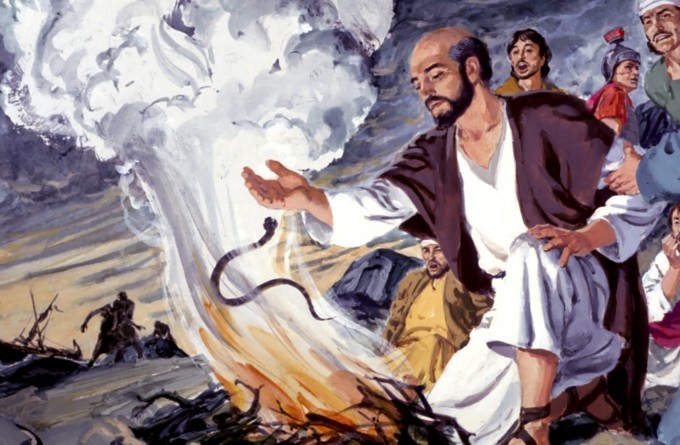
On Paul’s journey to Rome, his ship was wrecked on Melita, or Malta. There he was bit by a poisonous snake, but he didn’t die (Acts 27:39–28:6)

Luke picked up the account after the shipwreck, where they learned that the island they had safely reached is called Malta.  He said that the natives were kind and welcoming, and even helped them with a fire.  But a snake came out because of the heat, and fastened himself to Paul’s hand.  The sight of the deadly creature hanging from his limb just after he had been rescued from a life-threatening shipwreck made them suppose that he must be a murderer, getting his just reward (Greek and Roman tales had long spoken of just such events – “The Argonautica”, for example).  But God was certainly not going to let anything happen to him.  When he neither died nor showed any ill effects from the bite, they then thought Paul himself to be a god.

Publius in verse 7, is described as a “chief man” – the Greek term for which is “protos,” of which term several inscriptions have been found.  Several references to Publius and this chapter, along with photographs can be found in this article at BiblePlaces.com.  Publius’ father was ill with fever and dysentery (the description of which ills fit those of an infection caused by goat’s milk called “Malta fever”).  Paul healed him, as well as others of the island with diseases that were brought to him afterward (verses 8-9).

The shipwreck occurred on Malta, where the ship’s company spent three months. Finally, another ship gave them passage for the 100 miles to Syracuse, capital of Sicily, then sailed on to Rhegium, finally dropping anchor at Puteoli. Paul was taken to the forum on the Appian Way and to The Three Taverns before arriving in Rome.

After three months, they again set sail in a ship from Alexandria that had been wintering there.  Luke describes the ship as having a figurehead of the “twin gods” (Castor and Pollux, the mythological twin sons of Zeus and Leda, were seen as the protectors of seamen).  They put in at Syracuse for three days, then ended up in Puteoli, where they stayed with brethren they had found for seven days, then to Rome.  The brethren there heard, and came from as far away as “The Three Taverns” and the “Forum of Appius” (hence, the name, the Appian Way) (verses 12-16).

Paul spent considerable time preaching and trying to convince the Jews there of the good news of Jesus through the words of Moses and the prophets.  Some believed, but others did not – the latter leaving disagreeably (verses 23-25).  Paul quoted Isaiah 6:9-10 to them in verses 26-27; and then told them that now this news of the salvation of God will be brought to the Gentiles, for they will listen.

Verses 30-31 close out the book of Acts with the word that Paul remained there two full years, at his own expense, “teaching about the Lord Jesus Christ with all boldness and without hindrance.”  No further word is given of Paul’s appearance before Caesar, or any confirmation of secular writings that suggest he fulfilled his desire to go and preach in Spain, nor of a second imprisonment before his martyrdom.  As much as we would like to know of the rest of Paul’s story, the inspired word of God does not tell us because the book of Acts is not Paul’s biography, but the word “breathed out by God and profitable for teaching, for reproof, for correction, and for training in righteousness…” (2 Timothy 3:16).

So, one might wonder, if it was so important for Paul to appear before Caesar, why is there nearly a chapter and a half about the journey and shipwreck, and not a word about what was so important about that appearance?  The answer is that first, God had some reason for Paul to go to stand before Caesar that fulfilled His purpose, but there have been countless events since creation important to Him that are not  important for us to know about for teaching, for reproof, for correction, or for training in righteousness.  But the journey and shipwreck teach a couple of important lessons.  One is that when God wants something done, it gets done, period!  Nothing will stop it from completion.  The other is that God, as we have seen since Genesis, always keeps His promises.  Paul was imprisoned, betrayed, the target of assassination, 2,000 miles away from his destination, shipwrecked, stranded on an island, and had a deadly snake bite him severely enough to have hung from his hand.  Yet God wanted him to be in Rome, and had promised that he would get there safely.  We can take comfort, knowing that His will is going to be done, and that He has promised salvation for His faithful.

Read or listen to audio of ESV version of this selection from this link.

/Bob’s boy
___________________
some images © V. Gilbert & Arlisle F. Beers

Please note: I did not design the reading plan that I am following in my blog.  All of my comments in this blog, however, are solely my responsibility.  When reading ANY commentary, you should ALWAYS refer first to the scripture, which is God’s unchanging and unfailing word. Reading schedules, as well as a link to the site where you can get the reading plan that I’m currently following for yourself can be found on the “Bible Reading Schedules” page of my website at http://graceofourlord.com.  For questions and help, please see the “FAQ” and “Summaries” pages there.

Acts 25 – Paul Appeals to Caesar

After Festus arrived in Caesarea to become governor instead of Felix, he judged Paul

Antonius Felix was replaced by Porcius Festus as the Roman procurator of Judea from about 59 to 62 AD.  During his reign, hostility to Roman rule was heating to a fevered pitch, preceding the “Great Revolt” (the Jewish-Roman war of AD 66) that ended with the destruction of Jerusalem in AD 70.  Wasting no time after Festus assumed his role, verse 2 says that “the chief priests and the principal men of the Jews laid out their case against Paul,” trying to persuade him to send Paul to Jerusalem so they could ambush him.  These “chief priests and principal men” were most likely of the Sanhedrin, and had conspired with more than 40 others to kill Paul in Acts 23:12-15.  In verse 9, Festus was ready to send Paul to Jerusalem as a favor to the Jews, when Paul invoked his right as a Roman citizen to appeal to Caesar.

After some days, Festus met with King Agrippa II and his sister, Bernice, who was always by his side (one of his other siblings was Drusilla, who was the wife of Festus’ predecessor, Felix).  This Agrippa was educated in the court of the emperor Claudius, and was the son of Herod Agrippa I, who in Acts 12:1-3 had the Apostle James killed and Peter arrested, and who the Lord stuck down dead in Acts 12:21-23.  He was also the great-grandson of Herod the Great – who had ordered the killing of all the male children of the region around Bethlehem when Jesus was born.   As Festus laid out the case against Paul, he concluded by surmising that the matter was a dispute about their religion, and the death of “a certain Jesus, who was dead, but whom Paul asserted to be alive” (verse 19).

The first Herod, called The Great, wanted to honor his patron, Augustus Caesar, with a fine harbor. Joppa was not fitting since it was dominated by strong Jewish, anti-Roman, feelings. So Herod spent twelve years building a magnificent harbor and naming it Caesarea. Here Paul was imprisoned for two years and brought to trial before governors Felix and Festus, King Agrippa, and Bernice. Ruins here are from both Roman times and later Crusader times, about 1100-1300 A.D. Ruins of the Crusader city.

The next day, Festus introduced Paul, saying in a nutshell that (interestingly enough) he had found no charge deserving of death for Paul, and therefore he thought it wise to have him appear to Agrippa, so that maybe he (Festus) would have “something to write” before sending him to Caesar.

Read or listen to audio of ESV version of this selection from this link.

/Bob’s boy
___________________
some images © V. Gilbert & Arlisle F. Beers

Please note: I did not design the reading plan that I am following in my blog.  All of my comments in this blog, however, are solely my responsibility.  When reading ANY commentary, you should ALWAYS refer first to the scripture, which is God’s unchanging and unfailing word. Reading schedules, as well as a link to the site where you can get the reading plan that I’m currently following for yourself can be found on the “Bible Reading Schedules” page of my website at http://graceofourlord.com.  For questions and help, please see the “FAQ” and “Summaries” pages there.


2 Corinthians 6 – The Temple of the Living God

Corinth turkish watering place

Paul quotes Isaiah 49:8 in verse 2, noting that now is the favorable time for their salvation.  Receiving God’s grace in vain refers to having been saved and now running the risk of slipping away.  He points out that they experience great persecution unjustly (verses 8-10), but they endure hardships and adversities by the gifts of the spirit within them.  Verses 14-18 are often taken to mean that Christians should not have any associations with unbelievers, but such is not the case since he tells us in 1 Corinthians 5:10 that we would have to “go out of the world” in order to do that; and we must be “in the world” in order to spread the gospel.  Jesus prayed about being “in the world” but not “of the world” in John 17:15-16.  But their association with idol worshipers is problematic; and it may drag many back into its clutches (verses 14-18)s.

The applications for us are 1) that our faith in Jesus as Lord is our anchor when we suffer adversity and 2) that if we have a sinful inclination that we have overcome, we should not put ourselves in a position to be taken back into that sin. Just as it would be a mistake for someone who had been an alcoholic to return to frequenting bars for company, those who had previously worshiped idols should not return to spending time at those temples.

Read or listen to audio of ESV version of this selection from this link.

/Bob’s boy
___________________
some images © V. Gilbert & Arlisle F. Beers

Please note: I did not design the reading plan that I am following in my blog.  All of my comments in this blog, however, are solely my responsibility.  When reading ANY commentary, you should ALWAYS refer first to the scripture, which is God’s unchanging and unfailing word. Reading schedules, as well as a link to the site where you can get the reading plan that I’m currently following for yourself can be found on the “Bible Reading Schedules” page of my website at http://graceofourlord.com.  For questions and help, please see the “FAQ” and “Summaries” pages there.

2 Corinthians 3 – Ministers of the New Covenant

It would seem that some of those false teachers at Corinth that had caused some much trouble there had come forward with letters of recommendation from other brethren and/or churches that lent credence to their positions, while claiming that Paul was falsely promoting himself as a spiritual authority that had no basis in reality.  He responds in verses 2-4 by saying that the brethren at Corinth are his letter of recommendation “written not with ink but with the Spirit of the living God, not on tablets of stone but on tablets of human hearts.”    The transformation of their hearts and their lives (not to mention the spiritual gifts given them by the Spirit) served as their own testament to the fact that Paul was “an apostle of Christ Jesus by the will of God (2 Corinthians 1:1).”

And behold, the curtain of the temple was torn in two, from top to bottom. And the earth shook, and the rocks were split.

Paul’s points in verses 4-11 are that it was not anything in himself or his brethren that made a difference, but the sufficiency given by God as ministers of the new covenant.  The old covenant (the law of Moses , which was deficient only because of man’s sins) was the ministry of condemnation (because man could not uphold the law).  But the end of the old covenant is marked by the removal of the veil (which also could allude to the veil of the temple), which is removed through Christ, revealing the glory of the Lord (verses 14-18).

Read or listen to audio of ESV version of this selection from this link.

/Bob’s boy
___________________
some images © V. Gilbert & Arlisle F. Beers

Please note: I did not design the reading plan that I am following in my blog.  All of my comments in this blog, however, are solely my responsibility.  When reading ANY commentary, you should ALWAYS refer first to the scripture, which is God’s unchanging and unfailing word. Reading schedules, as well as a link to the site where you can get the reading plan that I’m currently following for yourself can be found on the “Bible Reading Schedules” page of my website at http://graceofourlord.com.  For questions and help, please see the “FAQ” and “Summaries” pages there.
 

1 Corinthians 15 – The Resurrection of the Dead

In chapter 15, Paul now moves to the subject of the Resurrection of the dead; and he has much to say to them on the subject, making this the longest chapter of all his epistles.  There were some at Corinth saying that there is no resurrection of the dead. Despite the nature of some of the problems Paul has had to address with them, this was probably the most troubling, since it is among the most basic facts of the gospel.  We do not know the source of these false teachings.  It is plausible that it was Sadducee influence among the brethren, but it just as likely came from the philosophic influence from those of Greek origin.  It seems somewhat hard to imagine this lapse of faith accompanying a continued practice of their Christianity – and so soon after they had been converted, as well as blessed with spiritual gifts!

After His resurrection, Jesus appeared many times to His disciples.

In any case, Paul points out that denial of resurrection would necessarily include that of Jesus; and if Jesus was not raised, their entire faith is futile (verses 16-17).  Paul most aptly states the obvious in verse 19 – “If in Christ we have hope in this life only, we are of all people most to be pitied.”  He then recounts the eyewitness accounts by the apostles of Jesus death and his appearances to them after he was raised.  Then he makes the point that they (the apostles) were all threatened and constantly in danger of losing their lives for continuing to boldly bear that witness to others.  It was absurd to suggest that they would continually risk their lives for an outright lie!

Verse 29 seems to be a very difficult passage, and is interpreted by some as indicating Paul’s approval of people being baptized (by proxy) for the dead.  Whether or not this verse is actually talking about such baptisms is disputed by many.  Parsing the Greek for the words translated “for the dead” in this verse has led many to different theories, but we can reach the proper conclusion easily by taking these and other scriptures into account for what Paul and the other apostles taught about baptism.  Advocating the baptism of living people in place of those who have died would run contrary to the importance of the active profession of faith and of repentance that the Scriptures require (Acts 2:38, John 3:18), as well as the conscious act of putting on Christ that Paul speaks of in relation to baptism in Galatians 3:27.

So then in verse 35, Paul turns to the question of what sort of body the risen will have if we are truly to be raised from the dead.  He uses the seed as an illustration of this, as they are well familiar with the fact that the seeds that are buried and decompose become reborn into something more magnificent – that God gives it a body just as he has chosen.  Paul reveals that the resurrection body will be incorruptible, glorious, powerful and spiritual, and that even those who are living will be transformed at the same time when Christ comes again (verse 51 – “We shall not all sleep, but we shall all be changed…”). 

The Lord, who has created all things, is certainly able to accomplish this promise to have the mortal and perishable body put on immortality (verses 53-54).  Just as we bear the image of the first Adam while we are here, we will bear the heavenly image of the last Adam (Jesus), who became a life-giving spirit (verses 45-49).  Paul refers to Hosea 13:14 in verse 55 then, as verse 26 promised, says in verse 57 “thanks be to God, who gives us the victory through our Lord Jesus Christ.”  What comfort!

Read or listen to audio of ESV version of this selection from this link.

/Bob’s boy
___________________
some images © V. Gilbert & Arlisle F. Beers

Please note: I did not design the reading plan that I am following in my blog.  All of my comments in this blog, however, are solely my responsibility.  When reading ANY commentary, you should ALWAYS refer first to the scripture, which is God’s unchanging and unfailing word. Reading schedules, as well as a link to the site where you can get the reading plan that I’m currently following for yourself can be found on the “Bible Reading Schedules” page of my website at http://graceofourlord.com.  For questions and help, please see the “FAQ” and “Summaries” pages there.
1 Corinthians 1 – Christ the Wisdom and Power of God

Corinth – Temple of Apollo

As he did in his letters to the Romans, Colossians, Galatians and Ephesians, Paul opens the letter in his greeting with the declaration of his apostleship being given by the will of God – not by his own assertion.  As with the Galatians, it appears that some false teachers had called his apostleship into question at Corinth (1 Corinthians 9:1, 2 Cor 11:4-5, 2 Cor 12:11-13).  he reminds them that they are sanctified (set apart) from the world in Christ Jesus, as are all Christians.  He recognizes their God-given talents, and emphasizes the spiritual gifts that they had been blessed with by God by being “called into the fellowship of his Son, Jesus Christ our Lord” (verses 4-9).

So the problems at Corinth were not caused by ignorance of the word of God, or by a lack of intelligence.  We will see that their problems, as is often the case today, stem from such age-old problems as envy, pride, jealousy, and lust.  Some people have taken verse 17 to be stating that baptism is not necessary.  But if that were the case, why would he have baptized anyone (as he gives some of the many examples of doing so in the preceding verses)!  Paul himself makes clear the importance of baptism in other scripture, such as Romans 6:3-5, Ephesians 2:5-6, and Ephesians 4:4-6, as did Jesus in the Great Commission (Matthew 28:19). Verses 10-17 is addressing the divisions that had been reported to Paul (we do not know who Chloe was, but probably was one of their members).  Barclay said in his commentary that the word he uses to describe them “…is the word for rents in a garment.  The Corinthian Church is in danger of becoming as unsightly as a torn garment.”

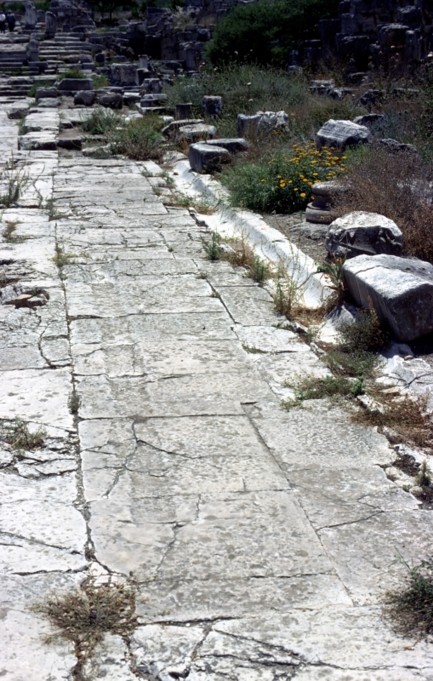
Corinth – Lechaion Road

In verses 18-31, Paul ironically speaks quite eloquently, as he decries the foolishness of pride.  He declares the folly of men who think themselves wise, and speech that is eloquent but empty.  There was no shortage of philosophers in their Greco-Roman society nor, therefore, those who were “wise in their own eyes.”  He points out that not many of the saints at Corinth had been powerful, or of noble birth, or wise by worldly standards.  But God, through the crucifixion of Jesus Christ, had given even those who were considered foolish, weak, lowly or despised the blessing over the “wise” or “strong” or “powerful,” who choose not to believe – so that no human being has the right to boast about anything other than Christ Jesus.  Verse 19 is quoted from Isaiah 29:14.  Verse 20’s rhetorical question is a timeless illustration of the impudence of human confidence in their superior intelligence – “Has not God made foolish the wisdom of the world?”

Read or listen to audio of ESV version of this selection from this link.

/Bob’s boy
___________________
some images © V. Gilbert & Arlisle F. Beers

Please note: I did not design the reading plan that I am following in my blog.  All of my comments in this blog, however, are solely my responsibility.  When reading ANY commentary, you should ALWAYS refer first to the scripture, which is God’s unchanging and unfailing word. Reading schedules, as well as a link to the site where you can get the reading plan that I’m currently following for yourself can be found on the “Bible Reading Schedules” page of my website at http://graceofourlord.com.  For questions and help, please see the “FAQ” and “Summaries” pages there.

Galatians 1 – Paul Called by God

Paul’s letter to the Galatians was one of the earliest written epistles; and there is much speculation as to which Galatians it was written.  It was a circular letter, almost certainly written to the churches of southern Galatia that he established on his first missionary journey with Barnabas.  The context of the letter can be understood best if one keeps in mind that many of the circumcision party – Judaizers – had come after Paul teaching, as was their custom, that in order to be saved, the Gentiles had to be circumcised, and had to keep the law of Moses.  In effect, they were being taught that they first had to be converted to Judaism.

Paul visited several cities in Galatia on each of his three missionary journeys. On his first journey he went through Antioch in Pisidia, Iconium, Lystra, and Derbe, and then retraced his steps; on his second journey he went by land from Antioch of Syria through the four cities in Galatia; on his third journey he also went through those cities on the main route to Ephesus.

It is clear from Paul’s writing in the first chapter that these Judaizers had also suggested, if not outright declaring, that Paul was not really an apostle – certainly not on the level of the original twelve.  He opens the letter with a greeting that immediately declares his apostleship – something he only does in his letters to churches that were unfamiliar with him or where his authority was questioned (Romans, Corinthians, Ephesians, and Colossians), as opposed to the letters to Philippians and Thessalonians.  He goes to some length in chapter one to be candid about his background as a persecutor of the church, and to declare that he was called by the Lord himself to proclaim the gospel to the Gentiles (verses 11-16).

Paul often opens his letters with a commendation, but instead he opens with a rebuke here, as he declares his astonishment at hearing that many of them had accepted this false teaching.  He strongly proclaims that if anyone (even he himself, or an angel from heaven) would proclaim to them a different gospel than was preached to them previously, they were to be accursed.  This false teaching threatened the very foundation of Christianity and had to be quashed immediately and thoroughly.

One final note on this chapter is worthy of comment.  Verses 17-20 contain statements affirming (strongly underscored in verse 20) that Paul had not been among apostles other than Peter and James, the Lord’s brother, in the first years after the Lord had called him.  This point was important because efforts to disparage his apostleship had also suggested that he had merely been approved by them, or had been given his knowledge of the gospel by them.  The reference to James, the Lord’s brother, as an apostle should be understood in light of 1) his relationship to Jesus and/or 2) the fact that James became the official leader of the church in Jerusalem.  As Coffman pointed out, this James was not a plenary apostle, as were the twelve and Paul.

Read or listen to audio of ESV version of this selection from this link.

/Bob’s boy
___________________
some images © V. Gilbert & Arlisle F. Beers

Please note: I did not design the reading plan that I am following in my blog.  All of my comments in this blog, however, are solely my responsibility.  When reading ANY commentary, you should ALWAYS refer first to the scripture, which is God’s unchanging and unfailing word. Reading schedules, as well as a link to the site where you can get the reading plan that I’m currently following for yourself can be found on the “Bible Reading Schedules” page of my website at http://graceofourlord.com.  For questions and help, please see the “FAQ” and “Summaries” pages there.

Acts 12 – Peter Is Rescued

Verse one begins with “About that time Herod the king laid violent hands on some who belonged to the church.”  The words “about that time” obviously refer to a time period in which the events of the end of chapter 11 occurred.  Secular history accurately dates the death of this Herod (Herod Agrippa I – grandson of “Herod the Great”) in 44 A.D.  Verse 2 continues in the KJV with:

“And he killed James the brother of John with the sword…”

When Jesus was transfigured on a mountain. Moses and Elijah join him. Jesus had brought his closest 3 disciples with him – Peter, James and John –Matthew 17: 1-13; Mark 9: 1-13; Luke 9: 28-36.

Burton Coffman wrote concerning this verse: Only seven words in the Greek, translated by eleven in English, recount the martyrdom of the first apostle; and such restraint by the sacred historian shows how different are the words of inspiration from those of ordinary writers.

Indeed.  If one was simply writing a story rather than the word of God, one would certainly have more to say about the death of one of Jesus’ “inner circle,” James the son of Zebedee, than these few words.  The rest of the verse states that “…when he saw that it pleased the Jews, he proceeded to arrest Peter also.”  The Jewish religious leaders – certainly much of the Sanhedrin – would have been pleased to have gotten rid of one the twelve men who were so instrumental in proclaiming that Jesus was the risen Lord.  This was during the Feast of Unleavened Bread; and Herod intended to bring Peter out after Passover and undoubtedly do the same with him as he had done with John’s brother.

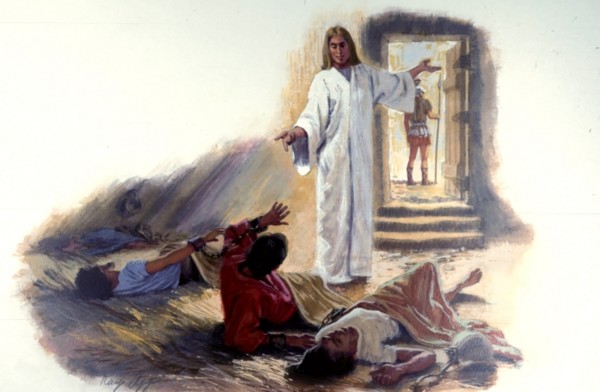
But on the night before Herod was to bring him out, an angel of the Lord came to Peter as he slept between two soldiers, made the chains fall off of him, led him past two guards and compelled the iron gate to open on its own, as they walked through.  And with that, the angel left.  Up to this point, Peter had been thinking that he was having another vision.  But in verse 11, he realizes that the Lord had sent his angel to rescue him “from the hand of Herod and from all that the Jewish people were expecting.”

Although sixteen soldiers guarded Peter when he was thrown into prison, an angel came personally to rescue Peter (Acts 12).

Peter heads to the house of Mary, the mother of John Mark (verse 12).  The consensus of scholars is that this may be because of the personal attachment Peter had for John Mark, who would write the gospel of Mark (of which writing there are convincing arguments that Peter stood behind).  At any rate, many of the church are gathered there.  At first, none of them believed the servant girl that it was Peter at the gate.  When they opened it, he cautioned them to be silent, then told them how he had been freed from prison.  As he left, he told them to tell James (this James would be the Lord’s brother) and the brothers what had happened.

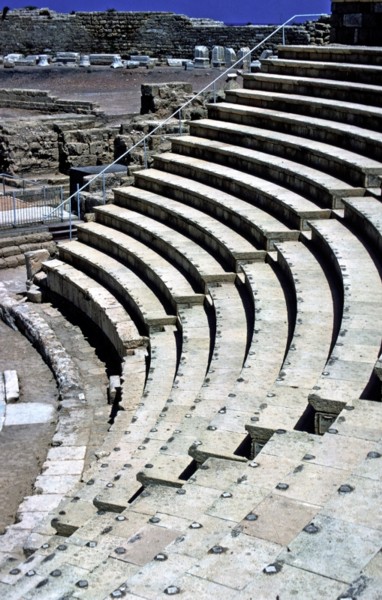
The first Herod, called The Great, wanted to honor his patron, Augustus Caesar, with a fine harbor. He spent twelve years building a magnificent harbor and naming it Caesarea. Ruins of the Roman theater, built before the time of Jesus.

When it was discovered that Peter was gone, Herod had the sentries executed.  The he went to Caesarea, where verses 20-23 describe the events of his death, relating that an angel of the Lord struck him down and in the end “he was eaten by worms.”  Some suggest that both he and his grandfather died of Fournier’s gangrene, but the Scripture gives no other information that would verify this.  His vanity and acceptance of the praise proclaiming him to be a god led to his death.  Another purpose was served though, as he had already proved to be a dangerous enemy to the apostles.

Side note: In this article by Todd Bolen of BiblePlaces.com, the author makes some very convincing arguments for the actual location of Herod Agrippa, when he was struck down, to have been at the city amphitheater, rather than the theater itself (where the historian Josephus  wrote that it occurred).  He also makes some interesting observations about the ruler and his predecessor’s and the practice of the emperor being honored as a god.  Very interesting reading.

Read or listen to audio of ESV version of this selection from this link.

/Bob’s boy
___________________
some images © V. Gilbert & Arlisle F. Beers

Please note: I did not design the reading plan that I am following in my blog.  All of my comments in this blog, however, are solely my responsibility.  When reading ANY commentary, you should ALWAYS refer first to the scripture, which is God’s unchanging and unfailing word. Reading schedules, as well as a link to the site where you can get the reading plan that I’m currently following for yourself can be found on the “Bible Reading Schedules” page of my website at http://graceofourlord.com.  For questions and help, please see the “FAQ” and “Summaries” pages there.
Paul and Barnabas Week \ Week 39 summary posted

Derbe is southeast of Lystra some thirty miles, in modern Turkey. In the Lycaonian District, this town was at the extreme edge of cities considered “Galatian”. The town was small, but the work of Paul and Barnabas yielded a number of followers. Among them, Gaius was converted and much later joined Paul’s team on the Third Missionary Journey.

Last week, in just five chapters of the book of Acts, we saw so much growth and movement in the Lord’s church.  Now things are starting to happen quickly; and this week will be no different.  By the time we end chapter 11, more than a decade will have passed since Saul was converted.  We’ll see more integration of Gentiles into Christianity –  Apostles arrested, stoned and even killed.  Then we will end the week with what will come to be known as the Jerusalem conference.

Summing Up

Each weekend, I am now posting a small PDF of one week of chapter summaries (on the website’s “Summaries” page), current to the beginning of the previous week.  I have posted the summary for Week 39 September Week 4) of the schedule I am following.  This short PDF document contains condensed comments about Matthew 27, 28, John 20, 21, and Luke 24, with hyperlinks to the ESV version of each chapter for listening or reading, and joins the summaries for other weeks already posted there.

/Bob’s boy
___________________
image © V. Gilbert & Arlisle F. Beers

Please note: I did not design the reading plan that I am following in my blog.  All of my comments in this blog, however, are solely my responsibility.  When reading ANY commentary, you should ALWAYS refer first to the scripture, which is God’s unchanging and unfailing word. Reading schedules, as well as a link to the site where you can get the reading plan that I’m currently following for yourself can be found on the “Bible Reading Schedules” page of my website at http://graceofourlord.com.  For questions and help, please see the “FAQ” and “Summaries” pages there.

Acts 10 – Peter’s Vision

The book of Acts just continues to present us with such momentous occasions; and chapter 10 is clearly one of special significance.  Cornelius of Caesarea was a Gentile soldier of an Italian cohort.  a cohort could consist of from 600 – 1000 men, with 6 centurions in charge.  A centurion was paid anywhere from 5 to as much as 20 times as much as the average Roman soldier, so Cornelius was likely considered wealthy.  Identified in several verses as a God-fearer, he would have been attached to a synagogue and a believer in God, but not circumcised.  An angel came to him in a vision telling him to have Peter brought to him, as well as where to find him.

Joppa, today called Jaffa, was once the seaport for Jerusalem. Hiram sent cedar logs from Lebanon to King Solomon for the Temple, floating them to Joppa (2 Chronicles 2:15). From Joppa the prophet Jonah ran away from God ( Book of Jonah), sailing from there toward Tarshish. Here Peter raised Tabitha, or Dorcas, from the dead (Acts 9:36-42). Later he was staying here at the house of Simon the Tanner when he saw a vision of unclean animals, which led him to visit Cornelius’ house in Caesarea and win him to Christ. This is the traditional site of the home of Simon the Tanner.

Meanwhile, on the housetop at the home of  Simon the tanner, Peter had a vision of his own (verses 9-16) that was perplexing to him at first.  The vision occurred three times of all sorts of animals descending from heaven that he was commanded to eat – some of whom were unclean by Jewish law.  Peter argued at first, but the voice said to him “What God has made clean, do not call common.”  Peter would come to understand that this landmark vision was not referring just to animals and food, but also to men.  While he was still sorting through this, the Spirit told him about Cornelius’s men who were now at his gate – that he was to go with them.

Being led by the Spirit, Peter judiciously took some of the brothers with them for witnesses of what was to occur.  When they arrived from Joppa into Caesarea, Cornelius had gathered his friends and family and fell at Peter’s feet.  Whatever was in Cornelius’ heart, Peter knew it was wrong to allow that sort of worship, and rebuked him in verse 26.  In verses 28-29, Peter acknowledges that under Jewish tradition, coming to the house of a Gentile (let alone, eating with them) would make one ceremonially unclean, but says that God has told him that he “should not call any person common or unclean.”  So, he asks why Cornelius has sent for him.

When Peter visited the Roman centurion Cornelius, this important soldier fell at Peter’s feet.

So Cornelius tells him of his vision and that all present were commanded to hear what Peter has to say.  With that, Peter preaches to them about Jesus and forgiveness of sins through His name.  It was then that the Holy Spirit fell upon all present.  The baptism of the Holy Spirit had previously been done directly from God to only the apostles, with it given to others only through the apostles laying on hands.  But now, to the amazement of all circumcised believers who had come with Peter (verse 45), this second baptism was being poured out even to Gentiles.

Peter, acknowledging the gift that was given to them, then commanded that they be baptized with water as well.  Peter’s perspective had changed forever concerning non-Jews.  Now the Lord’s Kingdom would grow even faster!  But this new perspective would not come without some resistance to change.

Read or listen to audio of ESV version of this selection from this link.

/Bob’s boy
___________________
some images © V. Gilbert & Arlisle F. Beers

Please note: I did not design the reading plan that I am following in my blog.  All of my comments in this blog, however, are solely my responsibility.  When reading ANY commentary, you should ALWAYS refer first to the scripture, which is God’s unchanging and unfailing word. Reading schedules, as well as a link to the site where you can get the reading plan that I’m currently following for yourself can be found on the “Bible Reading Schedules” page of my website at http://graceofourlord.com.  For questions and help, please see the “FAQ” and “Summaries” pages there.