Psalms 91 – My Refuge and My Fortress

Moses_003Psalm 91 is generally considered to be another psalm of Moses; and even Spurgeon (who almost always ascribes authorship of all psalms to David) concedes the possibility.  Satan misapplied a quotation of verses 11-12 in one of his temptations of Jesus (see Luke 4:10-11) – “For he will command his angels concerning you to guard you in all your ways. On their hands they will bear you up, lest you strike your foot against a stone.”

This psalm speaks to the care and protection that children of God enjoy under his watch, an example of which is from verse 10 – “no evil shall be allowed to befall you, no plague come near your tent.”  This does not mean that Christians are exempt from any misfortune or harm in this life.  It simply means that under God’s watchful care, the faithful will be safely delivered through every situation, even that of death, safely into His loving arms. Consider verses 7-8:

A thousand may fall at your side,
ten thousand at your right hand,
but it will not come near you.
You will only look with your eyes
and see the recompense of the wicked.

This, along with the language of verses 3-6 (deliverance from “the snare of the fowler” and pestilence – and, in verse 10, plague), lend credence to Mosaic authorship, as well as explain the perspective. In the time of God’s judgment on man, those who “dwell in His shelter” have nothing to fear, for He is their refuge and fortress.

Read or listen to audio of ESV version of this selection from this link.

/Bob’s boy
___________________
some images © V. Gilbert & Arlisle F. Beers

Please note: I did not design the reading plan that I am following in my blog.  All of my comments in this blog, however, are solely my responsibility.  When reading ANY commentary, you should ALWAYS refer first to the scripture, which is God’s unchanging and unfailing word. Reading schedules, as well as a link to the site where you can get the reading plan that I’m currently following for yourself can be found on the “Bible Reading Schedules” page of my website at http://graceofourlord.com.  For questions and help, please see the “FAQ” and “Summaries” pages there.

Psalm 90 – From Everlasting to Everlasting

Psalm 90 begins Book 4 of the Book of Psalms.  It is one of four psalms classified as penitential in this book – the other three being 91, 94, and 101.  The superscription says it is “a prayer of Moses, a man of God.”  This is disputed by some commentators mainly because of verse 10, which says “The years of our life are seventy, or even by reason of strength eighty,” while Moses lived to be 120.

Wilderness through which the Israelites crossed on their way to the Promised Land.

Wilderness through which the Israelites crossed on their way to the Promised Land.

But that argument is completely without merit.  First of all, after the great flood, God Himself said that man’s years would be 120 (Genesis 6:3).  That of course was not intended to be an exact hard and fast number, and certainly at the upper end of the scale, especially as more degeneration in the genome came to pass. We hear of people over 110 even today, even though 70 -80 is certainly a more realistic expectation.  Secondly, although Aaron also lived to be over 100, most of the young men 30 -40 years old died after 40 years of the wandering. Moses, obviously not dead when he wrote the psalm, was speaking in general terms.

Now that we’ve spoken our mind on that matter, verse 10 is certainly not the point of this psalm, however.  The psalmist begins with noting the timelessness of the Lord, (“from everlasting to everlasting you are God”).   It is in verse 4 that a misunderstanding of the text leads some to try to count the days of Genesis 1 as being possibly eons of time For a thousand years in your sight are but as yesterday when it is past, or as a watch in the night.”  Not only does this ignore the context of the verse, but it also ignores the fact that every other occurrence of the word for “day” in Scripture that is connected to a number is most certainly a 24 hour period. A thousand years are not a significant amount to God, certainly. But the same does not apply to us.

The point of this poetic passage is to note the brevity of man’s life compared to the ageless God and His creation.  And the plea is for the favor of the Lord, and the gift of wisdom to make the best use of the years that we have by being in His service.

Read or listen to audio of ESV version of this selection from this link.

/Bob’s boy
___________________
some images © V. Gilbert & Arlisle F. Beers

Please note: I did not design the reading plan that I am following in my blog.  All of my comments in this blog, however, are solely my responsibility.  When reading ANY commentary, you should ALWAYS refer first to the scripture, which is God’s unchanging and unfailing word. Reading schedules, as well as a link to the site where you can get the reading plan that I’m currently following for yourself can be found on the “Bible Reading Schedules” page of my website at http://graceofourlord.com.  For questions and help, please see the “FAQ” and “Summaries” pages there.

Psalm 77 – Has God Forgotten?

This psalm has been seen both as a national (or community) lament and a personal lament.  It is appropriate for both because the underlying question is the same in either case – “has God abandoned me?”  The psalmist raises the questions not disrespectfully, but in genuine wonder and distress.  The problem is not an uncommon one for any of us.  How do we deal with the doubt that can come over us when there are times in lives that result in grave trouble or great sorrow?

crying_002No matter whether the trials are from illness, loss of a loved one, loneliness, or any kind of suffering at all, how do we come to terms with the pain and suffering we feel and reconcile those feelings with a loving, just, and gracious God? When the trials continue for long periods of time with seemingly no relief, do we not have the same questions of God that this psalmist has?  (“Has God forgotten to be gracious? Has he in anger shut up his compassion?” “Has His steadfast love ceased forever?” “Will the Lord spurn forever, and never again be favorable?”)

The devil uses those feelings to bring our doubts to their fullest heights in the hope that our faith will ultimately fail.  Little by little (or sometimes a lot by a lot) he tries to wear us down and bring doubt to our Christian hearts.  There is no reason to suppose that God is offended by the questions.  We already have the answers after all.  God is love – His love never ceases.

He cannot forget to be gracious because His grace is everlasting.  Repeatedly, the Scriptures tell us that “The LORD is slow to anger and abounding in steadfast love, forgiving iniquity and transgression” (Numbers 14:18).  Remember Psalm 27:14: Wait for the LORD; Be strong and let your heart take courage” – and again, verse 14 of this chapter “You are the God who works wonders; you have made known your might among the peoples.”

Read or listen to audio of ESV version of this selection from this link.

/Bob’s boy
___________________
some images © V. Gilbert & Arlisle F. Beers

Please note: I did not design the reading plan that I am following in my blog.  All of my comments in this blog, however, are solely my responsibility.  When reading ANY commentary, you should ALWAYS refer first to the scripture, which is God’s unchanging and unfailing word. Reading schedules, as well as a link to the site where you can get the reading plan that I’m currently following for yourself can be found on the “Bible Reading Schedules” page of my website at http://graceofourlord.com.  For questions and help, please see the “FAQ” and “Summaries” pages there.

Proverbs 31 – The Excellent Wife

Proverbs 31’s superscription states that the psalmist was one King Lemeul.  There have been found no written records of any such king, but that does not necessarily preclude him from having been a king of some state.  There are some who claim that Lemeul was Bathsheba’s pet name for Solomon, but there is nothing to substantiate that claim.

godly womenVerses 1-9 are the mother’s words to the king, admonishing him not to ruin his reign with the self-indulgence of wanton sex and strong drink, as other kings not so wise have done. Instead, she instructs him further, a great king should see that those who are poor and in need of care are attended to properly – a truly excellent king.

The words of the chapter beginning in verse 10 are a most fitting conclusion for the Book of Proverbs.  So much of the written words in the book have been concerned with the evils of wicked women – prostitutes, bad wives, etc.  Now this writer goes into great detail praising the virtues of a truly excellent woman.

It reads like a laundry list of admirable qualities, but it would be a most unfair mistake to take it as a recipe for determining the goodness or worth of any woman.  Rather it is best to consider the qualities as those that any good woman should seek in their lives.  No woman (or man) is going to be that good at all things all of the time. These verses are an acrostic poem that runs the alphabet with a list of the traits of an “excellent woman.” She cares for those who need her – her family, and she also cares about those who are poor and in need. Notice verse 23 is the only one in the poem about the woman’s husband. He is known at the gates, as he sits among the elders of the land. The man would himself be a worthy man for sure, but a large part of why he is successful is because of his wife.

Read or listen to audio of ESV version of this selection from this link.

/Bob’s boy
___________________
some images © V. Gilbert & Arlisle F. Beers

Please note: I did not design the reading plan that I am following in my blog.  All of my comments in this blog, however, are solely my responsibility.  When reading ANY commentary, you should ALWAYS refer first to the scripture, which is God’s unchanging and unfailing word. Reading schedules, as well as a link to the site where you can get the reading plan that I’m currently following for yourself can be found on the “Bible Reading Schedules” page of my website at http://graceofourlord.com.  For questions and help, please see the “FAQ” and “Summaries” pages there.

Psalm 82 – Rescue the Weak and Needy

scales01This psalm is a community lament against the unjust rulers of Israel.  Because of the unfortunate rendering of the word “gods” in the text, some have supposed this to be a reference to angels on earth.  But it merely refers to those who are in a position of authority on earth by God’s will and are therefore His representatives – whether they behave as such or not.    The psalm is a plea to God for justice for those who are weak and for the poor who suffer at the hands of those who are blessed with better stations in life.  Because God does indeed demonstrate throughout the scriptures how very much He cares for the poor, the psalmist is rightly certain that this plea will be heard and answered by the judge most high:

“Arise O God, judge the earth;
for you shall inherit all the nations!”

Read or listen to audio of ESV version of this selection from this link.

/Bob’s boy
___________________
some images © V. Gilbert & Arlisle F. Beers

Please note: I did not design the reading plan that I am following in my blog.  All of my comments in this blog, however, are solely my responsibility.  When reading ANY commentary, you should ALWAYS refer first to the scripture, which is God’s unchanging and unfailing word. Reading schedules, as well as a link to the site where you can get the reading plan that I’m currently following for yourself can be found on the “Bible Reading Schedules” page of my website at http://graceofourlord.com.  

Psalms 74 – Arise O God, Defend Your Cause

Nebuchadnezzar_002It is hard to imagine that this lament psalm could have been written about anything other than the fall of Jerusalem.  In fact, Burton Coffman’s assessment (Coffman, James Burton. “Commentary on Psalms 74”, “Coffman Commentaries on the Old and New Testament”) was that it must have been one of three occasions.  The first possibility is of course the 587 BC destruction of the Temple and the city by Nebuchadnezzar (2 Kings 24).   The second seems much less likely – the 351 BC suppression of a Jewish uprising by Persian King Artaxerxes.  Although the third possibility seems a bit more credible – the profaning of the Temple by Antiochus Epiphanes in 167 B.C – the first seems to fit much better (verse 7 notwithstanding).

Though the superscription assigns this psalm to Asaph, in actuality it would be the “sons” (descendants) of Asaph that were responsible; and the likelihood that it is a prophetic psalm seems quite high.  The psalmist appears to obviously see the destruction to come, yet pleads for hope that it may not all come to pass.  He asks God to remember the covenant and Mount Zion; and to “redeem the tribe” of His heritage.

This moving psalm is very appropriate for any community lament, as the psalmist combines fervor for God’s justice and vengeance against those who scoff, with praise for His power, might, and sovereignty:

Yet God my King is from of old,
working salvation in the midst of the earth…
Yours is the day, yours also the night;
you have established the heavenly lights and the sun.
You have fixed all the boundaries of the earth;
you have made summer and winter.

Read or listen to audio of ESV version of this selection from this link.

/Bob’s boy
___________________
some images © V. Gilbert & Arlisle F. Beers

Please note: I did not design the reading plan that I am following in my blog.  All of my comments in this blog, however, are solely my responsibility.  When reading ANY commentary, you should ALWAYS refer first to the scripture, which is God’s unchanging and unfailing word. Reading schedules, as well as a link to the site where you can get the reading plan that I’m currently following for yourself can be found on the “Bible Reading Schedules” page of my website at http://graceofourlord.com.  For questions and help, please see the “FAQ” and “Summaries” pages there.


Proverbs 30 – Lest He Rebuke You

Chapter 30 begins another section of the book of Proverbs, actually ending the format that began in chapter 10.  The superscription says that these are “the words of Agur son of Jakeh.”  Some believe this may be a nickname for Solomon, but that seems unlikely, as the writing style is completely dissimilar.  There is nothing else in the scriptures that mentions this Agur.  The claim by this writer that he is stupid is surely not true.  The wisest thing that this blogger notes in his writing is from verses 5-6:

Every word of God proves true;
he is a shield to those who take refuge in him.
Do not add to his words,
lest he rebuke you and you be found a liar.

Creation_005All of the word of God is important without question.  But when word tells us essentially the same thing more than once in different Scriptures, it behooves us to take notice that it must be singularly important. Deuteronomy 4:2 says “You shall not add to the word that I command you, nor take from it, that you may keep the commandments of the Lord your God that I command you.”  Deuteronomy 12:32: “Everything that I command you, you shall be careful to do. You shall not add to it or take from it.”  The warning becomes much stronger in Revelation 22:18-19, and the consequences are spelled out in no uncertain terms.

No matter what the intentions, people have often found themselves in precarious positions by trying to “help God out.”  That goes for trying to so by our actions (as Abraham did by going into Hagar in an effort to fulfill God’s promise of offspring.  And it can be justifiably applied to the interpretation of Scriptures.  God’s word tells us plainly that God created the heavens and the earth by speaking it into existence (Genesis 1, Psalm 33:9, Romans 4:17).  Yet some people, because of either their weakness of faith in God and His divine word, and/or a desire to please men in their vanity about their own wisdom feel the need to suggest that God needed to use evolution to achieve His purpose.

Since the beginning, man has never gone wrong by putting his faith in the unchanging word of God, and that time-tested truth can always be counted on.

Read or listen to audio of ESV version of this selection from this link.

/Bob’s boy
___________________
some images © V. Gilbert & Arlisle F. Beers

Please note: I did not design the reading plan that I am following in my blog.  All of my comments in this blog, however, are solely my responsibility.  When reading ANY commentary, you should ALWAYS refer first to the scripture, which is God’s unchanging and unfailing word. Reading schedules, as well as a link to the site where you can get the reading plan that I’m currently following for yourself can be found on the “Bible Reading Schedules” page of my website at http://graceofourlord.com.  For questions and help, please see the “FAQ” and “Summaries” pages there.

Psalms 73 – The Prosperity of the Wicked

Psalm 73 begins Book III, which is composed of psalms 73-83, known as the Asaph group. The rest of the psalms in Book III are supposed to be written by the Sons of Korah.  the first part of the psalm starts with a note about the psalmist’s envy of the wicked and their prosperity.

It is a characteristic generality that Satan has us draw, for not all wicked people behave as this describes, nor do all prosper.  But it is sometimes hard for the poor servant of the Lord who struggles from day-to-day to watch the easy life of those who never know what it is to struggle, and then behave and speak irreverently to God, and even to deny him.

poverty_01In that respect (economic snobbery not withstanding) the wealthy are not as fortunate as the poor because it is not very easy for those who do not depend on God for their daily bread to acknowledge their dependence on Him for anything else.  We do well to remember the 40 years that the Lord’s people spent in the wilderness with God providing their manna daily to teach them to depend on the Lord for all things.

With that, we should count ourselves blessed if we lack in earthly riches, for our reward comes later.

Whom have I in heaven but you?
And there is nothing on earth that I desire besides you…
For behold, those who are far from you shall perish;

you put an end to everyone who is unfaithful to you.
But for me it is good to be near God; I have made the Lord God my refuge,

that I may tell of all your work

Read or listen to audio of ESV version of this selection from this link.

/Bob’s boy
___________________
some images © V. Gilbert & Arlisle F. Beers

Please note: I did not design the reading plan that I am following in my blog.  All of my comments in this blog, however, are solely my responsibility.  When reading ANY commentary, you should ALWAYS refer first to the scripture, which is God’s unchanging and unfailing word. Reading schedules, as well as a link to the site where you can get the reading plan that I’m currently following for yourself can be found on the “Bible Reading Schedules” page of my website at http://graceofourlord.com.  For questions and help, please see the “FAQ” and “Summaries” pages there.

Psalms 62, 64 – My Soul Waits for God Alone

Psalm 13:5

Psalm 13:5 (Photo credit: [Share the Word])

The superscription of Psalm 62 reads “according to Jeduthun,” who along with his sons was set aside by David for musical service (1 Chronicles 16:7-42, 1 Chronicles 25:1-4).  The poetry of this psalm is so obviously David’s that there can be no doubt who wrote it (“my rock and my salvation, my fortress”).  This is sometimes known as the “only” psalm.  Some translations use the word “alone” in place of “only,” but it is used often: “For God alone my soul waits in silence.  He alone is my rock and my salvation.”  The psalm ends with the sweet prayer of praise:

“Once God has spoken;
twice have I heard this:
that power belongs to God,
and that to you, O Lord, belongs steadfast love”

In Psalm 64, David asks for God’s help against those who plot against him.  “The secret plots of the wicked” could refer to the early days of Absalom’s conspiracy (2 Samuel 15).  The message he bears to those who hear the song is one of hope.

Let the righteous one rejoice in the Lord
and take refuge in him!
Let all the upright in heart exult

Read or listen to audio of ESV version of this selection from this link.

/Bob’s boy
___________________
some images © V. Gilbert & Arlisle F. Beers

Please note: I did not design the reading plan that I am following in my blog.  All of my comments in this blog, however, are solely my responsibility.  When reading ANY commentary, you should ALWAYS refer first to the scripture, which is God’s unchanging and unfailing word. Reading schedules, as well as a link to the site where you can get the reading plan that I’m currently following for yourself can be found on the “Bible Reading Schedules” page of my website at http://graceofourlord.com.  For questions and help, please see the “FAQ” and “Summaries” pages there.

Psalms 72 – Blessed Be His Glorious Name Forever

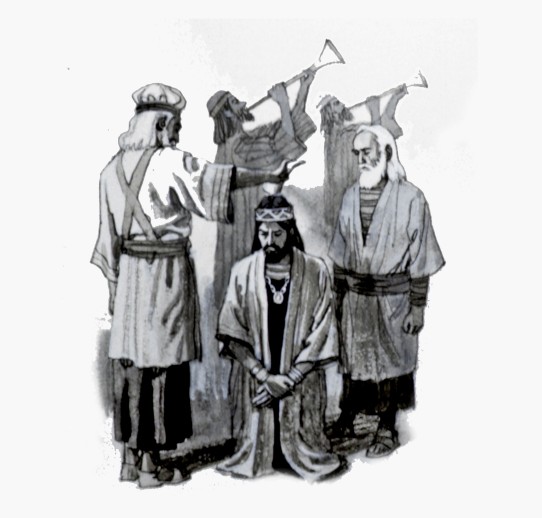
While David was still living, he arranged for his son Solomon to become king

While David was still living, he arranged for his son Solomon to become king

Psalm 72 is the last psalm in “book 2” of the Psalms, and contains the books doxology at the end.  The superscription deems it a song “of” Solomon, obviously as the young heir to David’s throne.  Some have attributed authorship to Solomon himself, but Matthew Henry’s view that it is David’s prayer on behalf of Solomon is likely correct.

There are some obvious Messianic aspects to the psalm in addition to the obvious parts in which there is fervent prayer for the earthly king.  The care for the poor and the needy in verse 4 certainly sounds like Jesus during His ministry; and verses 12-14 referring to one who delivers and redeems are pointing to Him as well.

The prayer ends with the doxology and praise to the Lord:  “Blessed be his glorious name forever; may the whole earth be filled with his glory!  Amen and Amen!”  The last line – “The prayers of David, the son of Jesse, are ended” could refer to this psalm, but could also refer to the assembling of this section of the psalms by the psalter.  Matthew Henry took the view that it referred to the ending of Psalms 71 and 72 as a whole, having been written in David’s old age.  Now with a young king to take his place, his “prayers have ended.”

Read or listen to audio of ESV version of this selection from this link.

/Bob’s boy
___________________
some images © V. Gilbert & Arlisle F. Beers

Please note: I did not design the reading plan that I am following in my blog.  All of my comments in this blog, however, are solely my responsibility.  When reading ANY commentary, you should ALWAYS refer first to the scripture, which is God’s unchanging and unfailing word. Reading schedules, as well as a link to the site where you can get the reading plan that I’m currently following for yourself can be found on the “Bible Reading Schedules” page of my website at http://graceofourlord.com.  For questions and help, please see the “FAQ” and “Summaries” pages there.