Psalm 140 – Deliver Me, O Lord, from Evil Men

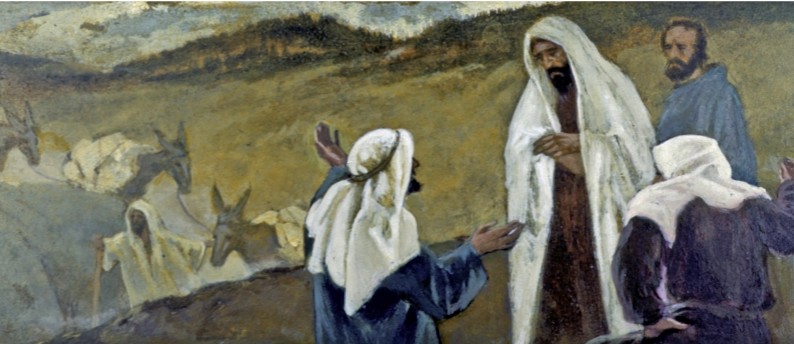
When Absalom rebelled against his father David, and tried to kill his father to become king, Mephibosheth's servant Ziba brought gifts to David, fleeing for his life (2 Samuel 16:1--17:14).

When Absalom rebelled against his father David, and tried to kill his father to become king, Mephibosheth’s servant Ziba brought gifts to David, fleeing for his life (2 Samuel 16:1–17:14).

Psalm 140 is another short psalm of David, asking for the Lord’s deliverance from the wicked and the unjust. Also considered one of the imprecatory psalms, This song also expresses faith and confidence in the grace, mercy and justness of the Almighty.

I know that the Lord will maintain the cause of the afflicted,
and will execute justice for the needy.
Surely the righteous shall give thanks to your name;
the upright shall dwell in your presence.

The Lord, it says is the deliverer of those who are weak and oppressed and will not let those who continue to do such evil go unpunished. But the song also has the definite “feel” of having been written by David during the rebellion of Absalom (2 Samuel 15-18) – note verses 7-8 in particular.

Read or listen to audio of ESV version of this selection from this link.

/Bob’s boy
___________________
some images © V. Gilbert & Arlisle F. Beers

Please note: I did not design the reading plan that I am following in my blog.  All of my comments in this blog, however, are solely my responsibility.  When reading ANY commentary, you should ALWAYS refer first to the scripture, which is God’s unchanging and unfailing word. Reading schedules, as well as a link to the site where you can get the reading plan that I’m currently following for yourself can be found on the “Bible Reading Schedules” page of my website at http://graceofourlord.com.  

Psalm 132 – If Your Sons Keep My Covenant

David dances in the presence of the ark.

David dances in the presence of the ark. (Photo credit: Wikipedia)


This is psalm number 13 of the 15 “Songs of Ascents” (see this previous post for more information). Some have classified this as a post-exillic psalm, but that really does not appear to be the case. If one looks carefully at verses 8-10, it is evident that it was written at a time when the Ark of the Covenant was still in the possession of God’s people:


Arise, O Lord, and go to your resting place,
you and the ark of your might.
Let your priests be clothed with righteousness,
and let your saints shout for joy.
For the sake of your servant David,
do not turn away the face of your anointed one


Also, those verses are quoted at the dedication of Solomon’s temple in 2 Chronicles 6:41. Or perhaps, the passage here is a quotation of that scripture. Either way, the ark seems not to have been missing at the time. In verse 6, Ephrathah, is a district with villages called Bethlehem and Jaar – or Kiriath-jearim, where the ark had been left for a time before coming to Jerusalem (1 Samuel 7:1-2).


The song’s lyrics build the pilgrims’ excitement as they journey to Jerusalem for the Passover and other feasts; and gives them pause for remembering the promise of the Lord to have one of David’s line on the throne forever. this was a conditional promise, though, as they were reminded by the psalm itself in verse 12: “If your sons keep my covenant and my testimonies that I shall teach them, their sons also forever shall sit on your throne.”


Read or listen to audio of ESV version of this selection from this link.


/Bob’s boy


___________________


some images © V. Gilbert & Arlisle F. Beers


Please note: I did not design the reading plan that I am following in my blog.  All of my comments in this blog, however, are solely my responsibility.  When reading ANY commentary, you should ALWAYS refer first to the scripture, which is God’s unchanging and unfailing word. Reading schedules, as well as a link to the site where you can get the reading plan that I’m currently following for yourself can be found on the “Bible Reading Schedules” page of my website at http://graceofourlord.com.  


Psalm 108 – With God We Shall Do Valiantly

With few variances, most of Psalm 108 can be found in two other psalms. The first 5 verses are practically identical to Psalm 57:7-11. The last eight verses are almost identical to Psalm 60:5-12. So why the combination here repeated? As always, whenever God’s word contains passages that are repeated from another passage, it is a sure sign that they are very important.

David hid in one of the many caves near Adullam, a city 13 miles southwest of Bethlehem (1 Samuel 22: 1-12). David was in this area when three of his mighty men risked their lives to get him a drink of water from Bethlehem (2 Samuel 23: 13-17).

David hid in one of the many caves near Adullam, a city 13 miles southwest of Bethlehem (1 Samuel 22: 1-12). David was in this area when three of his mighty men risked their lives to get him a drink of water from Bethlehem (2 Samuel 23: 13-17).

The first five verses come from a psalm that we are fairly certain refers to David’s time when he had fled to a cave to escape from Saul’s murderous intentions. The coinciding verses are of praise to God for His love and faithfulness, written from the context of David’s thankfulness for being delivered. The last eight verses come from a psalm that appears to have been written on the heels of a great military defeat, in which the psalmist is entreating the Lord to again show His favor to His people.

The two parts were likely put together as a combination for a liturgical purpose during a time of great distress and unease concerning the future. Together, they remind God’s people of His matchless mercy and the care for which He regards His people. They make an outstanding unified plea for God’s help in the fight against “the foe” (Satan). But most importantly, it reminds us first that we cannot fight this enemy alone, and secondly, that we do not have to fight alone, for God is with us.

for vain is the salvation of man!
With God we shall do valiantly;
it is he who will tread down our foes

Read or listen to audio of ESV version of this selection from this link.

/Bob’s boy
___________________
some images © V. Gilbert & Arlisle F. Beers

Please note: I did not design the reading plan that I am following in my blog.  All of my comments in this blog, however, are solely my responsibility.  When reading ANY commentary, you should ALWAYS refer first to the scripture, which is God’s unchanging and unfailing word. Reading schedules, as well as a link to the site where you can get the reading plan that I’m currently following for yourself can be found on the “Bible Reading Schedules” page of my website at http://graceofourlord.com.  
Proverbs 20 – The Lamp of the Lord

Creation07Some of the most obvious external evidences to “see” that God exists are the manifestations of the fact that God created man in His own image. The non-believer who truly believes that man is just chemicals and cells that have magically evolved over time into the intricate and intelligent human beings that we are will never be able to adequately explain these things. But we get the answers over and over again from the Bible; and verse 27 is another such example:

The spirit of man is the lamp of the Lord,
searching all his innermost parts

The unbeliever cannot account for the concepts of good and evil, right and wrong, beauty, love, or even how we have a conscience. The knowledge of such things are because of the reflection of our Creator; and along with our eternal souls, they are His gifts to us.

Read or listen to audio of ESV version of this selection from this link.

/Bob’s boy
___________________
some images © V. Gilbert & Arlisle F. Beers

Please note: I did not design the reading plan that I am following in my blog.  All of my comments in this blog, however, are solely my responsibility.  When reading ANY commentary, you should ALWAYS refer first to the scripture, which is God’s unchanging and unfailing word. Reading schedules, as well as a link to the site where you can get the reading plan that I’m currently following for yourself can be found on the “Bible Reading Schedules” page of my website at http://graceofourlord.com.  For questions and help, please see the “FAQ” and “Summaries” pages there.

Psalm 133, 134 – Come Bless The Lord

Mount Hermon is one traditional site for Jesus' transfiguration.

Mount Hermon is one traditional site for Jesus’ transfiguration.

These two short psalms are the final two of the “Songs of Ascents” (see this previous post for more information). Psalm 133 declares the beauty that comes when brothers dwell in unity, comparing it to the things that Israelites of the day would most have valued.  Pilgrimages to the feasts culminating in a unified purpose of presence for God’s people in Jerusalem provided a harmonious sense of brotherhood – at least for a time..

It is like the dew of Hermon,
which falls on the mountains of Zion!
For there the Lord has commanded the blessing,
life forevermore.

Psalm 134 concludes the psalms of Ascents for the Pilgrims that have arrived, calling for them to bless The Lord and praise Him and the Holy Place they have come to.

Lift up your hands to the holy place
and bless the Lord!
May the Lord bless you from Zion,
he who made heaven and earth!

Read or listen to audio of ESV version of this selection from this link.

/Bob’s boy
___________________
some images © V. Gilbert & Arlisle F. Beers

Please note: I did not design the reading plan that I am following in my blog.  All of my comments in this blog, however, are solely my responsibility.  When reading ANY commentary, you should ALWAYS refer first to the scripture, which is God’s unchanging and unfailing word. Reading schedules, as well as a link to the site where you can get the reading plan that I’m currently following for yourself can be found on the “Bible Reading Schedules” page of my website at http://graceofourlord.com.  

Psalm 118 – His Steadfast Love Endures Forever

Mount Zion was the center of Christian worship from the earliest days of the Church. According to tradition, the events of Pentecost took place on this hill. Later it became the headquarters of the apostles and site of the Church of the Dormition, that dominates the hill.

Mount Zion was the center of Christian worship from the earliest days of the Church. According to tradition, the events of Pentecost took place on this hill. Later it became the headquarters of the apostles and site of the Church of the Dormition, that dominates the hill.

This psalm has so many aspects that it was difficult to choose a title for this particular blog. But in the end, repetition won out, at least to some degree (the words are repeated several times, including in the last verse). And God’s enduring steadfast love certainly does apply to all aspects of the song. It is a song indeed, and some of our hymns have been taken from words within Psalm 118, one of which is the simple, but beautiful “This is the day that The Lord hath made” taken from verse 24.

It is a song almost certainly written by David, and many scholars believe it was written on the occasion of the defeat of Saul, when David had been established as king. That certainly fits well, but there is nothing in the superscription or elsewhere to substantiate that.

One of the most important verses of the psalm is arguably verse 22, which is quoted many places in the New Testament, including Mark 12:10-11 and Luke 20:17: “The stone that the builders rejected has become the cornerstone. This is the Lord’s doing; it is marvelous in our eyes. This refers, of course, to Jesus, and how he was rejected, but has become the cornerstone of His church and the kingdom.

Read or listen to audio of ESV version of this selection from this link.

/Bob’s boy
___________________
some images © V. Gilbert & Arlisle F. Beers

Please note: I did not design the reading plan that I am following in my blog.  All of my comments in this blog, however, are solely my responsibility.  When reading ANY commentary, you should ALWAYS refer first to the scripture, which is God’s unchanging and unfailing word. Reading schedules, as well as a link to the site where you can get the reading plan that I’m currently following for yourself can be found on the “Bible Reading Schedules” page of my website at http://graceofourlord.com.  

Psalm 125, 129, 130 – The Lord Surrounds His People

Today we look at three of the fifteen “Songs of Ascents” at once (see this previous post for more information on those fifteen psalms). These three are all very short psalms (as most of the “ascent” psalms are), totaling only 21 verses between them. These 15 psalms are called by some the songbook of the Jewish pilgrim, as they were often sung on the way “up” to Jerusalem during a time of feast.

English: Village of below Mount Zion.

English: Village of below Mount Zion. (Photo credit: Wikipedia)

Psalm 125 uses the geographical metaphor of Jerusalem being surrounded by mountains with the assurance that God surrounds His people. There are seven mountains that surround Jerusalem. The area around Moriah is where the first and second temples were built, and is synonymous with Mount Zion in the Bible. But Mount Zion is referred to as the whole range, as well as a specific portion of it, which was the Jebusite stronghold that David conquered. Then there are Bethsaida, Mount Scopus, the Mount of Olives, Ghareb (sometimes called Calvary), and Mount Opel.

Psalm 129 may not appear so as it begins, but it is a song of hope and assurance. The psalm begins with a short lament over the ways that God’s people have been oppressed and have struggled for so long amid ungodly foes. But as the singer gazes into the distance at Zion, he sees visible evidence of God’s mercy and faithfulness to His promises. Verse 4 gives the hearer the message: “The Lord is righteous; he has cut the cords of the wicked.”

Psalm 130 is a song of pleas for mercy and forgiveness – not corporate forgiveness for Israel itself, but for the individual. The singer recognizes that if the Lord should “mark iniquities,” nobody could stand. But he trusts in the Lord and His saving grace; and he will wait and put his faith and hope in God’s word.

For with the Lord there is steadfast love,
and with him is plentiful redemption.
And he will redeem Israel
from all his iniquities.

Read or listen to audio of ESV version of this selection from this link.

/Bob’s boy
___________________
some images © V. Gilbert & Arlisle F. Beers

Please note: I did not design the reading plan that I am following in my blog.  All of my comments in this blog, however, are solely my responsibility.  When reading ANY commentary, you should ALWAYS refer first to the scripture, which is God’s unchanging and unfailing word. Reading schedules, as well as a link to the site where you can get the reading plan that I’m currently following for yourself can be found on the “Bible Reading Schedules” page of my website at http://graceofourlord.com.  

Proverbs 19 – A Man of Great Wrath

When reading the Book of Proverbs, it is good to remember two useful facts. One of those is that some of the proverbs are often about the way things are – not the way that they should be. Another is that some of them should be considered a general truth, and that there can be exceptions from time to time. Could Proverbs 19:19 be an example of the latter?

A man of great wrath will pay the penalty,
for if you deliver him, you will only have to do it again

The prison, Reading Built in 1844 and immortli...

The prison, Reading Built in 1844 and immortlised by Oscar Wilde in his Ballad of Reading Gaol. He wrote De Profundis whilst incarcerated here from 1895 to 1897. Today it houses young offenders. For more information see the Wikipedia article Reading (HM Prison). (Photo credit: Wikipedia)

Possibly. Anyone can change. And there is no such thing as impossible where the Lord is concerned. If God is at work in the life of any man (or woman), any sort of turnaround is not only believable, but historically proven. But violent crime often results from anger that becomes outright rage; and very often, those who cannot (or will not) control themselves in one such situation are very likely to not be able to control themselves when they find themselves in that state again.

In an article for “The Telegraph” in the UK, it was reported that more than half a million crimes were committed by repeat offenders in the previous year. Separate figures showed 134 dangerous criminals were suspected of carrying out serious further offences such as murder, rape and other violence despite being monitored by the authorities (Tom Whitehead, 27 Oct 2011, Telegraph Media Group Limited). In a story reported by Samantha Donavan and Simon Lauder for ABC News “The World Today,” an expert is quoted as saying that parole is not appropriate for dangerous repeat offenders (http://www.abc.net.au/worldtoday/content/2013/s3784879.htm).

Whether it is considered to be for the protection of innocent people in the future and/or for the good of the offender himself, we would do well to note that the proverb does warn us that saving someone from paying the penalty for
such rage does invite a disregard for future consequences.

Read or listen to audio of ESV version of this selection from this link.

/Bob’s boy
___________________
some images © V. Gilbert & Arlisle F. Beers

Please note: I did not design the reading plan that I am following in my blog.  All of my comments in this blog, however, are solely my responsibility.  When reading ANY commentary, you should ALWAYS refer first to the scripture, which is God’s unchanging and unfailing word. Reading schedules, as well as a link to the site where you can get the reading plan that I’m currently following for yourself can be found on the “Bible Reading Schedules” page of my website at http://graceofourlord.com.  For questions and help, please see the “FAQ” and “Summaries” pages there.

Psalm 128, 131 – Blessed Is Everyone Who Fears the Lord

IMG_7320

IMG_7320 (Photo credit: six steps )

Psalms 128 and 131 are two more of those known as “Songs of Ascents” (see this previous post for more information).

Psalm 128 begins the hymn by proclaiming some of the ways that the individual who fears the Lord (is obedient and serves with awe and reverence) is blessed. It finishes by calling for corporate service and fear of the Lord, and beseeches the blessings of God for all.

Psalm 131 is a song of hope and trust in God. This very short psalm is an humble proclamation to The Lord that acknowledges that there are great and marvelous things that only God Himself controls. Instead of worrying about those things, the psalmist says, he has quieted his soul with that very knowledge – that God is in control. He calls for the corporate hope and trust in the Lord with that same calmness – like that of a weaned child (verse 2).

Both psalms offer the assurance that comes with trusting in God and keeping His commandments. We seek always to do the right thing, to labor admirably in His vineyard. We then can rest assured that, come what may, God is in control, and His will is going to be done.

Read or listen to audio of ESV version of this selection from this link.

/Bob’s boy
___________________
some images © V. Gilbert & Arlisle F. Beers

Please note: I did not design the reading plan that I am following in my blog.  All of my comments in this blog, however, are solely my responsibility.  When reading ANY commentary, you should ALWAYS refer first to the scripture, which is God’s unchanging and unfailing word. Reading schedules, as well as a link to the site where you can get the reading plan that I’m currently following for yourself can be found on the “Bible Reading Schedules” page of my website at http://graceofourlord.com.  

Psalm 116 – I Love the Lord

On the first Passover, the Israelites who painted their doorways with blood were passed over when the angel of death came through the land of Egypt (Exodus 11).

On the first Passover, the Israelites who painted their doorways with blood were passed over when the angel of death came through the land of Egypt (Exodus 11).

Psalm 116 is the fourth psalm in what is known as the Paschal Hallel (Psalms 113-118), and is often viewed in connection with the deliverance out of Egypt. It was often sang in connection with the slaying of the lambs at Passover, which causes many to believe that it was one if the songs Jesus and the disciples sang on the might before His crucifixion (Matthew 26:30).
As one of these songs of praise, it shines with poetic beauty and thankfulness to the Ancient of Days. It begins with “I love The Lord,” and then tells of the great mercy and generosity He has shown to the psalmist. As such, the words of the psalm have been timeless, and will continue to be so.

Verses 12-14 contain some beautiful thoughts and an attitude all Christians today should have:
What shall I render to the Lord
for all his benefits to me?
I will lift up the cup of salvation
and call on the name of the Lord,I will pay my vows to the Lord
in the presence of all his people.

We find this final verse recurring  throughout the psalm, which is the light we are to let shine (Matthew 5:14-16). We must let our commitment to Christ permeate our lives for all to see – not for our own glory, but for encouragement to others and to further His kingdom.

Read or listen to audio of ESV version of this selection from this link.

/Bob’s boy
___________________
some images © V. Gilbert & Arlisle F. Beers

Please note: I did not design the reading plan that I am following in my blog.  All of my comments in this blog, however, are solely my responsibility.  When reading ANY commentary, you should ALWAYS refer first to the scripture, which is God’s unchanging and unfailing word. Reading schedules, as well as a link to the site where you can get the reading plan that I’m currently following for yourself can be found on the “Bible Reading Schedules” page of my website at http://graceofourlord.com.