Solomon’s Prayer Answered – 2 Chronicles 7

Chapter 7 contains God’s response to Solomon’s prayer. It starts with God sending fire down from heaven that consumes the burnt offering and sacrifices. Then the glory of the Lord filled the temple, and the priests could not even go inside. What a sight it must have been! Then
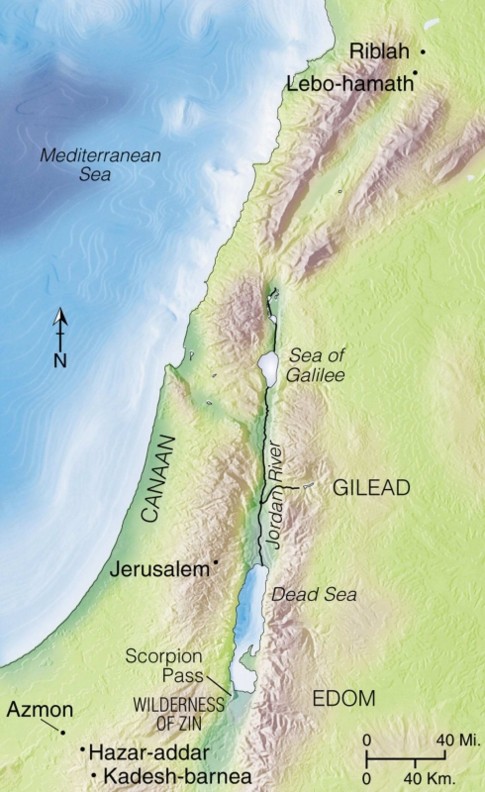
The borders of the Promised Land stretched from the wilderness of Zin and Kadesh-barnea in the south to Lebo-hamath and Riblah in the north, and from the Mediterranean seacoast on the west to the Jordan River on the east. The land of Gilead was also included.

The borders of the Promised Land stretched from the wilderness of Zin and Kadesh-barnea in the south to Lebo-hamath and Riblah in the north, and from the Mediterranean seacoast on the west to the Jordan River on the east. The land of Gilead was also included.

King Solomon and all of the people offered up 22,000 oxen and 120,000 sheep as a sacrifice. There had not been anything like it since David had the ark of the covenant brought to Jerusalem. So vast was the celebration that verses 7-8 says:

“Solomon consecrated the middle of the court that was before the house of the Lord, for there he offered the burnt offering and the fat of the peace offerings, because the bronze altar Solomon had made could not hold the burnt offering and the grain offering and the fat.” At that time Solomon held the feast for seven days, and all Israel with him, a very great assembly, from Lebo-hamath to the Brook of Egypt. And on the eighth day they held a solemn assembly, for they had kept the dedication of the altar seven days and the feast seven days.

Then God answered Solomon’s prayer, and He did tell Him all of the ways that He would bless them as Solomon had prayed. But He also made this promise:

“But if you turn aside and forsake my statutes and my commandments that I have set before you, and go and serve other gods and worship them, then I will pluck you up from my land that I have given you, and this house that I have consecrated for my name, I will cast out of my sight, and I will make it la proverb and a byword among all peoples.”

Of course, the post-exillic people that the chronicler was addressing here would know very well that the Lord meant to keep even these last promises. So9me of them had experienced it first-hand.


(This year’s reading plan for Luke, Acts, and 1 and 2 Chronicles averages just 15 verses per day – 5 days per week!)
Schedule for this week
Read or listen to audio of today’s selection from Luke here
Read or listen to audio of today’s selection from 2 Chronicles here

/Bob’s boy
___________________
some images © V. Gilbert & Arlisle F. Beers

All of my comments in this blog, however, are solely my responsibility.  When reading ANY commentary, you should ALWAYS refer first to the scripture, which is God’s unchanging and unfailing word. Reading schedules, as well as a link to the site where you can get the reading plan that I’m currently following for yourself can be found on the “Bible Reading Schedules” page of my website at http://graceofourlord.com.  

Enhanced by Zemanta

The Death of Jesus – Luke 23

Joseph of Arimathaea Seeks Pilate to Beg Permi...

Joseph of Arimathaea Seeks Pilate to Beg Permission to Remove the Body of Jesus (Photo credit: Wikipedia)

Luke tells us that it was about the sixth hour, and darkness came over the land until the ninth as the sun’s light failed. Then the Temple curtain was torn in two. This grand event obviously orchestrated by God was certainly very symbolic. No longer  would there be a need for a high priest, as Jesus is now our new high priest (Hebrews 4:14). Jesus gave up His spirit as He said “Father, into your hands, I commend my spirit.”

A centurion who saw all of these things, glorified God and said that surely this man is innocent. And all the crowds who witnessed these things returned home “beating their breasts.” Indeed, how many people witnessed all of these things that had shouted “crucify him,” and were now afraid for what they had done? Luke also says that Jesus’ “acquaintances” watched all these things and the women who had followed from Galilee  This would likely include those written about in Luke 8:1-3.

Joseph of Arimathea was a member of the Sanhedrin council who had not consented to their decision to railroad the Lord. Luke says that he was a good and righteous man, and was looking for the kingdom. He got custody of the body of Jesus from Pilate, and wrapped it in a linen shroud. Then he placed it in a tomb that was cut in stone and had never been used for burial. The women prepared ointment and spices. And then they rested on the Sabbath rested as commanded.

(This year’s reading plan for Luke, Acts, and 1 and 2 Chronicles averages just 15 verses per day – 5 days per week!)
Schedule for this week
Read or listen to audio of today’s selection from Luke here
Read or listen to audio of today’s selection from 2 Chronicles here

/Bob’s boy
___________________
some images © V. Gilbert & Arlisle F. Beers

All of my comments in this blog, however, are solely my responsibility.  When reading ANY commentary, you should ALWAYS refer first to the scripture, which is God’s unchanging and unfailing word. Reading schedules, as well as a link to the site where you can get the reading plan that I’m currently following for yourself can be found on the “Bible Reading Schedules” page of my website at http://graceofourlord.com.  

Enhanced by Zemanta

To Paradise – Luke 23

One traditional site of Golgotha is this hill with hollow eye sockets to look like the place of the skull. Another traditional site is in present-day Jerusalem, which in Jesus' time was just outside the wall. It is called the Church of the Holy Sepulcher.

One traditional site of Golgotha is this hill with hollow eye sockets to look like the place of the skull. Another traditional site is in present-day Jerusalem, which in Jesus’ time was just outside the wall. It is called the Church of the Holy Sepulcher.

As Jesus was taken away to be crucified, there were two criminals taken with him to be put to death. This fulfilled Isaiah 53:12, which said he would be numbered with transgressors. Luke says that they came to a place known as the skull. It is also known as Golgatha which comes from an Aramaic word for skull. There, they crucified Him and the criminals with one on each side of Him. Jesus said “Father forgive them, for they know not what they do.”

The soldiers cast lots and divided his garments among them, which fulfilled what was written in Psalm 22:18.  People watched and the rulers scoffed at Him, saying  “He saved others; let him save himself, if he is the Christ of God, his Chosen One!” The soldiers also mocked, offering Him sour wine to drink.

North door of iconostasis. Icon of Paradise: A...

North door of iconostasis. Icon of Paradise: Abraham’s Bosom with the Good Thief entering to the left (Photo credit: Wikipedia)

One prisoner began to mock as well, but the other rebuked him and asked Jesus to remember him when He came into His kingdom. Jesus told him that this day he would be with Him in paradise (verse 43). Jesus, as we saw in other passages, did have the authority to forgive sins, and He exercised it there. So what did Jesus mean by that? Since His body was to be in the tomb for three days, after which He would arise from the dead, how could He be with this criminal in Paradise that day? And just what is this Paradise?

This is a point that many of us have spent some time reflecting upon, as much confusion is caused surrounding this topic. Does the soul merely sleep after the body dies until resurrection day? Paul wrote in 1 Thessalonians 4:13: “…we do not want you to be uninformed, brothers, about those who are asleep, that you may not grieve…” Or was that merely a statement that they are not really dead? When Jesus raised Jairus’ daughter from the dead (Luke 8:54-55), he had told those present that she was merely sleeping.

The birth of Benjamin was a time of joy and sorrow--joy that a new son, held by the midwife, was born; mourning for Rachel who died in childbirth (Genesis 35:16-20).

The birth of Benjamin was a time of joy and sorrow–joy that a new son, held by the midwife, was born; mourning for Rachel who died in childbirth (Genesis 35:16-20).

The scripture also says that on the occasion of that girl’s resurrection, her spirit returned. We have other scripture where people are dying, saying their souls departed (such as Jacob’s wife Rachel in Genesis 35:18). There is, of course, much we do not yet know, but we can surmise from all of this that there is a place indeed called Paradise that our souls do go to when we die. Paul also spoke of it in 2 Corinthians 12:2-4.

The parable Jesus told in Luke 16:22-26 about the poor man, Lazarus, who died and was at Abraham’s bosom may be allegorical, but it certainly contains some truths about death and what happens to the soul thereafter. Jesus told parables to instruct. This writer does not believe that He would have done so with misleading or even incorrect facts in those parables. The rich man of that parable was consciously aware of what was going on in the place where his soul went. And he saw Lazarus in his place also alert to his surroundings. I believe that at the very least, this depiction of their states must be a fair representation of the status of the soul upon death of the body.

It appears then, that the Christian can take comfort in knowing that faithful loved ones who have gone on before are not just unconscious souls waiting for judgment day. Like Lazarus in Luke 16:25, they are being comforted there. And because of Jesus’ victory over death, we will be raised in a new spiritual body one day.

(This year’s reading plan for Luke, Acts, and 1 and 2 Chronicles averages just 15 verses per day – 5 days per week!)
Schedule for this week
Read or listen to audio of today’s selection from Luke here
Read or listen to audio of today’s selection from 2 Chronicles here

/Bob’s boy
___________________
some images © V. Gilbert & Arlisle F. Beers

All of my comments in this blog, however, are solely my responsibility.  When reading ANY commentary, you should ALWAYS refer first to the scripture, which is God’s unchanging and unfailing word. Reading schedules, as well as a link to the site where you can get the reading plan that I’m currently following for yourself can be found on the “Bible Reading Schedules” page of my website at http://graceofourlord.com.  

Enhanced by Zemanta

The Green Wood – Luke 23

Pilate was ready to release Jesus (following a sound beating, of course), but the chief priests and the rulers and the people that he had called to give this news to all cried out to him to take Jesus away and release Barrabas. Barrabas was in prison for insurrection and murder, but the Romans by custom would release one prisoner on Passover. Pilate tried again to reason with them, as he wanted to release Jesus. But the shouting to crucify him began.

Jesus helped by Simon of Cyrene, part of a ser...

Jesus helped by Simon of Cyrene, part of a series depicting the stations of the Cross. Chapel Nosso Senhor dos Passos, Santa Casa de Misericórdia of Porto Alegre, Brazil. Oil on canvas, XIXth century, unknown author. (Photo credit: Wikipedia)

Pilate tried again, saying “Why? what evil has he done? I have found in him no guilt deserving death. I will therefore punish and release him.” But they grew more demanding, and eventually he released Barrabas and gave in to their demands. As they led Him to His fate, they got Simon of Cyrene to carry His cross. (Cyrene is now an archeological site in present-day Lybia. It was a settlement of the Greeks, but became Roman Province in 74 B. C.). There was a great crowd of people following Him, and women who were weeping for Him. But Jesus then said to them:

“Daughters of Jerusalem, do not weep for me, but weep for yourselves and for your children. For behold, the days are coming when they will say, ‘Blessed are the barren and the wombs that never bore and the breasts that never nursed!’ Then they will begin to say to the mountains, ‘Fall on us,’ and to the hills, ‘Cover us.’ For if they do these things when the wood is green, what will happen when it is dry?”

Part of this, Jesus quotes from Zechariah 12:10-14, which speaks of mourning for “him whom they have pierced.” For the second time (the first being when He arrived at Jerusalem in Luke 19:41-44), Jesus is foretelling the destruction of Jerusalem which will occur about 40 years from then. “They” in that last sentence means the Romans. The green wood represents the innocent savior, and the dry is what will be left of that Jerusalem generation after He is gone.

(This year’s reading plan for Luke, Acts, and 1 and 2 Chronicles averages just 15 verses per day – 5 days per week!)
Schedule for this week
Read or listen to audio of today’s selection from Luke here
Read or listen to audio of today’s selection from 2 Chronicles here

/Bob’s boy
___________________
some images © V. Gilbert & Arlisle F. Beers

Please note: I did not design the reading plan that I am following in my blog.  All of my comments in this blog, however, are solely my responsibility.  When reading ANY commentary, you should ALWAYS refer first to the scripture, which is God’s unchanging and unfailing word. Reading schedules, as well as a link to the site where you can get the reading plan that I’m currently following for yourself can be found on the “Bible Reading Schedules” page of my website at http://graceofourlord.com.  

Enhanced by Zemanta

The Sanhedrin Sham – Luke 23

Verse one says that the “whole company of them arose and brought him before Pilate.” The Sanhedrin council was delivering the Son of God to Pilate. During his first questioning, Pilate could not find anything to accuse Him about, despite the Sanhedrin’ s urging – and even a lie they told him. Jesus never told anyone that they should not pay tribute to Caesar.  But when Pilate found out He was from Galilee, he decided to send Him to Herod because that was his jurisdiction, and he knew that Herod was in Jerusalem at the time.

Christ before Pontius Pilate, Mihály Munkácsy,...

Christ before Pontius Pilate, Mihály Munkácsy, 1881 (Photo credit: Wikipedia)

Herod had been wanting to meet Jesus for a long time, so he was very glad to see him. He wanted to see some sort of “sign” from Him. But Jesus was not participating in some dog and pony show for Herod. Verse 9 says that he questioned Him at some length, but got no answer from Him. This fulfilled the prophecy in Isaiah 53:7:

He was oppressed, and he was afflicted,
yet he opened not his mouth;
like a lamb that is led to the slaughter,
and like a sheep that before its shearers is silent,
so he opened not his mouth

Unamused with the Lord, Herod and his soldiers treated Him with contempt and mocked Him. Then they dressed Him in “splendid” clothing – solely as mockery of His claim to be king of the Jews. He was then sent back to Pilate (who the scripture says became good friends with Herod that day). But Pilate called the chief priests and elders in and told them that neither he nor Herod had found Jesus guilty of their charges. Nothing deserving death had been done, he said. So he was going to punish Him and release Him.

This not what the Sanhedrin had in mind at all.

(This year’s reading plan for Luke, Acts, and 1 and 2 Chronicles averages just 15 verses per day – 5 days per week!)
Schedule for this week
Read or listen to audio of today’s selection from Luke here
Read or listen to audio of today’s selection from 2 Chronicles here

/Bob’s boy
___________________
some images © V. Gilbert & Arlisle F. Beers

Please note: I did not design the reading plan that I am following in my blog.  All of my comments in this blog, however, are solely my responsibility.  When reading ANY commentary, you should ALWAYS refer first to the scripture, which is God’s unchanging and unfailing word. Reading schedules, as well as a link to the site where you can get the reading plan that I’m currently following for yourself can be found on the “Bible Reading Schedules” page of my website at http://graceofourlord.com.  

Enhanced by Zemanta

Betrayed and Denied – Luke 22

English: "The Judas Kiss", (Mark 14:...

English: “The Judas Kiss”, (Mark 14:45) by Gustave Doré. Judas kisses Jesus in order to betray him to the guards. (Photo credit: Wikipedia)

As Jesus was still speaking in the Garden of Gethsemane, a crowd was approaching, with Judas leading them. As Luke reminded us earlier, it was His custom to come here, and Judas knew where He went to pray. It must have been quite a scene. Judas kissed his teacher as was customary. Jesus did not let him off easy for that, reminding him that he had just betrayed “the Son of Man with a kiss.”

When they realized what was happening, some of the apostles asked Jesus if they should “strike with the sword.” Peter, of course, did not wait for answer, but cut the ear off of one of them. It is only John who tells us that it was Peter who did this (John 18:10), and that the victim’s name was Malchus. Jesus stopped them from continuing in violence and healed the man’s ear. Then He chastised the chief priests who had come with the crowd, pointing out that they had not laid a hand on Him while He was with them everyday ion the Temple, yet now they come after him like He was a robber.

They took Him to the house of the chief priest, with Peter following at a distance. He settled in with a crowd who had made a fire in the courtyard. It was there that Peter denied knowing Jesus three times. Luke tells us that a rooster crowed immediately, and that Jesus turned and looked at Peter. What a horrible feeling of guilt must have come over Peter at that moment. Despite all of his bravado, he had taken the cowardly way out in fear for his own safety. Now he must live with that knowledge, and Luke tells us that he did indeed go out and “wept bitterly.”

The kiss of Judas and Peter cutting off the ea...

The kiss of Judas and Peter cutting off the ear of Malchus (Photo credit: Wikipedia)

Verses 63-65 tell us how the men that were holding Jesus mocked and blasphemed against Him. They also had Him blindfolded, beating Him, and they would tell Him to “prophesy” by saying which one of them had struck Him. Then at daybreak, He was led to the Sanhedrin, where they questioned Him about whether He was the Christ – the Son of God. Jesus’ answer “you say that I am” is a Greek expression that turns it back on the questioner, but the answer was clear. And that was enough for His accusers. They would deliver Him to Pilate, since they were forbidden by Roman law to execute Him themselves.

(This year’s reading plan for Luke, Acts, and 1 and 2 Chronicles averages just 15 verses per day – 5 days per week!)
Schedule for this week
Read or listen to audio of today’s selection from Luke here
Read or listen to audio of today’s selection from 2 Chronicles here

/Bob’s boy
___________________
some images © V. Gilbert & Arlisle F. Beers

Please note: I did not design the reading plan that I am following in my blog.  All of my comments in this blog, however, are solely my responsibility.  When reading ANY commentary, you should ALWAYS refer first to the scripture, which is God’s unchanging and unfailing word. Reading schedules, as well as a link to the site where you can get the reading plan that I’m currently following for yourself can be found on the “Bible Reading Schedules” page of my website at http://graceofourlord.com.  

Enhanced by Zemanta

Agony – Luke 22

Having finished instituting the Lord’s supper and some final words for His apostles, Jesus went to the Mount of Olives to pray. Luke says that an angel came to strengthen Him. This likely refers to helping Him with physical strength, as they did following His 40 days in the wilderness. Twice in this section, He told disciples to pray that they “enter not into temptation.” The temptation He was referring to was likely just as He had told them at Passover – Satan desired to have them all.

English: Mount of Olives, from Sherover-Hass-G...

English: Mount of Olives, from Sherover-Hass-Goldman promenade in East Talpiot (Photo credit: Wikipedia)

Luke’s description of Jesus’ agony as He prayed is more detailed than the other gospels. He asks that “this cup” – the ordeal He must bear be taken away, if it is God’s will. He sweats, and it is believed by many that Luke’s description of the blood is literal. There is a condition we know of called Hematidrosis that has been known to cause blood-mingled sweat, etc. – especially in cases of severe stress.

What stress and agony it must have been. It is one thing for someone who is condemned to death to be awaiting the hour of their own execution. It is quite another to be able to see in your mind’s eye just how painful, cruel and inhumane, and how horrible an ordeal it will actually be. To be able to correctly envision the degree of suffering you would have to endure is a fearful situation this writer cannot adequately imagine. Now combine that with the fact that Jesus has always been with God. It is only possible for Him to now taste of death because of a willingness to fulfill this plan for our salvation. To go from having always been with the “Ancient of Days,” to suffering a cruel and painful mortal death must have been truly agonizing indeed.

He did not have to do this. He could have called those angels that we sing about to deliver Him from this. But He bore this burden for us because He wanted us to be saved. Think of that next time you take the Lord’s supper.

(This year’s reading plan for Luke, Acts, and 1 and 2 Chronicles averages just 15 verses per day – 5 days per week!)
Schedule for this week
Read or listen to audio of today’s selection from Luke here
Read or listen to audio of today’s selection from 2 Chronicles here

/Bob’s boy
___________________
some images © V. Gilbert & Arlisle F. Beers

Please note: I did not design the reading plan that I am following in my blog.  All of my comments in this blog, however, are solely my responsibility.  When reading ANY commentary, you should ALWAYS refer first to the scripture, which is God’s unchanging and unfailing word. Reading schedules, as well as a link to the site where you can get the reading plan that I’m currently following for yourself can be found on the “Bible Reading Schedules” page of my website at http://graceofourlord.com.  

Enhanced by Zemanta

Communion and Preparation – Luke 22

As Jesus and his disciples reclined at table to eat the Passover, he told them how much he had looked forward to having this opportunity- his truly last until “it is fulfilled in the kingdom of God” – after his resurrection. He took the cup of the fruit of the vine and the bread, and He had them divide it between them. Note that He gave thanks for the bread and the fruit of the vine separately before doing so, just as is our custom in observing this Lord’s supper which he instituted here.

The Last Supper

The Last Supper (Photo credit: elmas156)

After he explained to them the meaning that these elements now had – his body and his blood, they ate. It was then that he broke the news to them that one of those who were present would betray him. He said that the fact that he was going to go was already determined. But He  told them that it would not go well for the one who betrayed him. This got their attention, and they questioned each other, trying to determine who it was.

Then an odd dispute came up – odd in light of the news that Jesus had just given them. The dispute was over which one of them would be the greatest in Jesus’ kingdom. This goes to show that it still just wasn’t sinking in. It reminds us of the third time that Jesus foretold His death to them in Luke 18:34. The scripture said “this saying was hidden from them, and they did not grasp what was said. It seems clear that they still were not “grasping” it. They were still imagining that Jesus was to become the earthly king of the Jews, and that they were wondering just how high on the “totem pole” each of them was going to be.

So then Jesus turned upside down their notions of greatness and leadership completely. He pointed out that He is one among them who serves. Luke does not recount here the lesson that Jesus taught them about serving when He washed their feet, as John detailed in John 13:12-15. But it is clear that at this point He had given it to them. He also told them that those who would be the “greatest” must become as the youngest – that is, those who were more often traditionally called to serve others. Yet he said that He assigns to them – those who were with Him thru His trials – a place at his table in his kingdom. They just still do not know what “the kingdom” really will mean at this point.

Then Jesus’ conversation turns to Peter, and that deserves some attention. Note verses 31-32:

31 “Simon, Simon, behold, Satan demanded to have you, that he might sift you like wheat, 32 but I have prayed for you that your faith may not fail. And when you have turned again, strengthen your brothers.”

Judas at the Last Supper

Judas at the Last Supper (Photo credit: Lawrence OP)

It is significant that the word translated as you twice in verse 31 is plural. So the verse is emphasizing Satan’s determination to shake the faith of all of the apostles. In verse 32, the word is plural, as Jesus is addressing Peter. Jesus knew by now that Judas was lost, and he knew that Peter was Satan’s next target. But He says, that He has prayed that Peter’s faith would not fail. He knew that the Holy Spirit would fill Peter at the proper time, and that he would strengthen the others. Peter, of course, said he was ready to go to prison or die, but Jesus told him of his coming denial.

He then reminds them of when he sent them out without a moneybag or knapsack (Luke 9:1-6), and asks if they lacked for anything. They answered that they had not. Then he told them:

“But now let the one who has a moneybag take it, and likewise a knapsack. And let the one who has no sword sell his cloak and buy one.

This passage generates much debate. Some see the sword as having a figurative meaning – as in arming themselves for spreading the gospel. But if that were the case, wouldn’t the moneybag and knapsack also be figurative? But how else to explain it? Jesus obviously did not want them to use these swords against the authorities when they came to arrest him. But note that when Peter does cut the ear from one of them when they come to arrest Jesus, Jesus rebukes him – but he does not have him get rid of the sword either.

The most reasonable explanation is that Jesus knows that their lives are about to change. They were safe as long as they were all together with him. But many would scatter and become separated. They would need their moneybags, their knapsacks, and they would need their swords for protection against robbers, and maybe even wild animals. Remember, they weren’t checking into La Quinta on their travels, and seldom were lucky enough to be taken into someone’s home.


(This year’s reading plan for Luke, Acts, and 1 and 2 Chronicles averages just 15 verses per day – 5 days per week!)
Schedule for this week
Read or listen to audio of today’s selection from Luke here
Read or listen to audio of today’s selection from 2 Chronicles here


/Bob’s boy


___________________


some images © V. Gilbert & Arlisle F. Beers


Please note: I did not design the reading plan that I am following in my blog.  All of my comments in this blog, however, are solely my responsibility.  When reading ANY commentary, you should ALWAYS refer first to the scripture, which is God’s unchanging and unfailing word. Reading schedules, as well as a link to the site where you can get the reading plan that I’m currently following for yourself can be found on the “Bible Reading Schedules” page of my website at http://graceofourlord.com.  


Enhanced by Zemanta

Preparing For Passover – Luke 22

English: Judas Iscariot The face of Judas Isca...

English: Judas Iscariot The face of Judas Iscariot peers from carved foliage whilst carvings of the other 11 disciples adorn the pulpit in St.James’ church http://www.geograph.org.uk/photo/740582 (Photo credit: Wikipedia)

The members of the Sanhedrin council (chief priests) were already trying to figure out how to kill Jesus. And now one of the reasons he has come to Jerusalem – the Passover Feast was approaching. Verse 3 says that Satan already entered into Judas Iscariot, and he slipped off to meet with the chief priests to make plans for his betrayal of Jesus.  They agreed on payment for his part in the deed to come.  Now all he had to do was find the right time and place away from the crowds. Judas would be just as afraid of what the crowds around Jesus might do as the Sanhedrin had already proved to be.

On the day of unleavened bread, the Passover lamb had to be killed. It was on this day that Jesus sent Peter and John to find a place for them to prepare the Passover. He described a man carrying a jar that would meet them and take them to an upper room where they could do so. And when they went where Jesus had told them to go, they found the man just as He had said. They told him what Jesus had told them to say, and he did indeed take them to the upper room Jesus had spoken of.

On proper reflection, the reader should realize something about all of that. Since Jesus could foresee these details so clearly, he surely saw what was soon to be done to him just as clearly. What a chilling burden to carry around!

(This year’s reading plan for Luke, Acts, and 1 and 2 Chronicles averages just 15 verses per day – 5 days per week!)
Schedule for this week
Read or listen to audio of today’s selection from Luke here
Read or listen to audio of today’s selection from 1 Chronicles here

/Bob’s boy
___________________
some images © V. Gilbert & Arlisle F. Beers

Please note: I did not design the reading plan that I am following in my blog.  All of my comments in this blog, however, are solely my responsibility.  When reading ANY commentary, you should ALWAYS refer first to the scripture, which is God’s unchanging and unfailing word. Reading schedules, as well as a link to the site where you can get the reading plan that I’m currently following for yourself can be found on the “Bible Reading Schedules” page of my website at http://graceofourlord.com.  

Enhanced by Zemanta

Solomon Furnishes the Temple – 2 Chronicles 4-5

Moses Consecrates Aaron and His Sons and Offer...

Moses Consecrates Aaron and His Sons and Offers Their Sin Offering (illustration from the 1728 Figures de la Bible) (Photo credit: Wikipedia)

Solomon had an altar made of bronze. Depending on the size of the cubit in 2 Chronicles 4:1, it could have been as big as 30 ft. long, 30 ft. wide, and 15 ft. high! To this, one commentator we read concerning this chapter, said: “What was wrong with this? Ten cubits was a height of something like fifteen feet, which required that steps would have to be used by the priests in making sacrifices upon it; and God had specifically commanded Israel, “Neither shalt thou go up by steps unto my altar'” (Exodus 20:26).

This commentator also said that there were “also countless concessions to paganism, as seen in the images of the bulls (politely called oxen here) placed under the layer. The bulls, calves, oxen, whatever they were called, were the usual images under which the old Canaanite fertility god Baal was worshiped. Even the Jewish historian Josephus condemned Solomon for what he did in this (Antiquities of the Jews p. 255).”

Could it be that Solomon had sinned so greatly in furnishing the Temple? Let us take the commandment not to go up steps to the altar. If you read Exodus 20:26, it actually says “And you shall not go up by steps to my altar, that your nakedness be not exposed on it.’” This problem was alleviated, however, in Exodus 28:42, when God told Moses “You shall make for them linen undergarments to cover their naked flesh. They shall reach from the hips to the thighs; and they shall be on Aaron and on his sons when they go into the tent of meeting or when they come near the altar…”

Moses with the tablets of the Ten Commandments...

Moses with the tablets of the Ten Commandments, painting by Rembrandt (1659) (Photo credit: Wikipedia)

As for the oxen, the Decalogue (Ten Commandments) forbade making a graven image – but as an object of worship. These twelve oxen that held up the “sea” were obviously representative of the twelve tribes. They were in no way part of the act of worship. Also, we know that later, the “glory of the Lord” filled the Temple after the dedication. So obviously, God approved of the construction and the furnishings.

The “sea” in verse 10 was a large circular water tank used by priests for ceremonial cleansing, just like the bronze basin of Exodus 30:18-21. In chapter 5, the ark of the covenant was brought into the “Most Holy Place” under the wings of the cherubim. Verse 10 says that there was nothing inside the ark except the two tablets (it had once contained Aaron’s rod and a jar of manna).

(This year’s reading plan for Luke, Acts, and 1 and 2 Chronicles averages just 15 verses per day – 5 days per week!)
Schedule for this week
Read or listen to audio of today’s selection from Luke here
Read or listen to audio of today’s selection from 2 Chronicles here

/Bob’s boy
___________________
some images © V. Gilbert & Arlisle F. Beers

Please note: I did not design the reading plan that I am following in my blog.  All of my comments in this blog, however, are solely my responsibility.  When reading ANY commentary, you should ALWAYS refer first to the scripture, which is God’s unchanging and unfailing word. Reading schedules, as well as a link to the site where you can get the reading plan that I’m currently following for yourself can be found on the “Bible Reading Schedules” page of my website at http://graceofourlord.com.  

Enhanced by Zemanta