A Savior, Who Is Christ the Lord

The Birth of Our Lord Jesus Christ

The Birth of Our Lord Jesus Christ (Photo credit: Wikipedia)

Verse 8 of Luke chapter 2 picks up with the shepherds who are out in their field at night. Depending on the version you read, they were in the same region as Mary and Joseph or in the same country. The translation has the same effect in either case – so that we are not sure exactly how far away they are, but certainly not in a separate country. When the angel of the Lord appeared to them, “the glory of the Lord shone around them and they were filled with fear.” Any time that term is used, it is accompanied by great light – whatever else it means. In this case, certainly not as bright as what Paul (Saul) encountered on the road to Damascus (Acts 9), but in a dark field in a time when there were no distant city lights, it would be quite substantial and unnerving.

Gabriel making the Annunciation to the Virgin ...

Gabriel making the Annunciation to the Virgin Mary. Painting by El Greco, 1575 (Museo del Prado, Madrid). (Photo credit: Wikipedia)

Calming them, the angel told them of the good news of the birth in the city of David of “a Savior, who is Christ the Lord,” and old them how they would know him when they went to see. The sudden appearance with the angel of “a multitude of the heavenly host”  raises the question of what makes up a heavenly host. Generally, a “host” is a military term, where the collective group is associated with fighting a battle or guarding something. In the case of the Lord, they are associated as being at His side, praising Him, and ready to do his bidding (Psalm 103:21, Daniel 7:10). And verse 15 gives us the answer. After they finished praising the Lord Jesus, the verse tells us that the “angels” went away into heaven. Since only one angel had appeared before the heavenly host came, that tells us what sort of multitude they were.

When they arrived and saw Jesus, verse 17 says they “made known” what had been told to them by the angel, which created an understandable stir. But Mary, it said, treasured all of these things in her heart – no doubt recalling the visit from the angel Gabriel before the conception. And then on the eighth day, he was circumcised according to the Law of Moses and given the name Jesus, just as Gabriel had told her. And just like that, the will of God that He made known to the serpent way back in Genesis 3:15 was brought to fruition:

I will put enmity between you and the woman,
and between your offspring and her offspring

(This year’s reading plan for Luke, Acts, and 1 and 2 Chronicles averages just 15 verses per day – 5 days per week!)
Schedule for this week
Read or listen to audio of today’s selection from Luke here
Read or listen to audio of today’s selection from 1 Chronicles here

/Bob’s boy
___________________
some images © V. Gilbert & Arlisle F. Beers

All of my comments in this blog, however, are solely my responsibility.  When reading ANY commentary, you should ALWAYS refer first to the scripture, which is God’s unchanging and unfailing word. Reading schedules can be found on the “Bible Reading Schedules” page of my website at http://graceofourlord.com.

Enhanced by Zemanta

Unremarkably Momentous

English: A statue of the first Roman Emperor A...

English: A statue of the first Roman Emperor Augustus (r. 27 BC – 14 AD) as a younger Octavian, this sculpted artwork dated to around 30 BC. It is located in the Museo Capitolino of Rome, Italy. (Photo credit: Wikipedia)

Luke chapter 2 opens the story of the birth of Jesus with two verses that skeptics, always quick to pounce on perceived biblical contradictions, are happy to use in their repertoire. The verses in the NKJV read “And it came to pass in those days that a decree went out from Caesar Augustus that all the world should be registered. This census first took place while Quirinius was governing Syria.”

The problems with the two verses are two-fold. First, Quirinius was the governor of Syria beginning in 6 A.D. Herod the Great died in 4 B.C., and we know from scripture that Jesus was born during the reign of Herod. Secondly, although there is secular record of the census during the governorship of Quirinius, no historical record of the previous census has been found.

There are several answers that have been proposed to this supposed dilemma that include the fact that it is recorded in the “Acts of Augustus” that he authorized censuses throughout the empire in 28 B.C., 8 B.C., and 14 A.D. Further, it is known that provincial censuses were held in 14 year intervals, which would fit with the known census of 6 A.D. Jesus was born sometime from 7 B.C. to 4 B., which would fit the beginning date in 8 B.C. for that census. Also, Publius Sulpicius Quirinius, served at the favored pleasure of Augustus as governor of Crete and Cyrene, as a soldier, and as consul beginning about 14 B.C.

We do well to note the meticulous detail and accuracy of Luke’s writings throughout both of his books. For example, he knew about and acknowledged the 6. A.D. census in Acts 5:37. In the second place, we must remember that the Bible, as God’s inspired word, has stood the test of time, and has been found historically accurate numerous times, even when previous secular history showed no corroboration. Take for example, the fact that skeptics once believed that Pontius Plate was a mythological concoction of the Bible until the Italian archaeologists found the “Pilate Stone” in 1961.

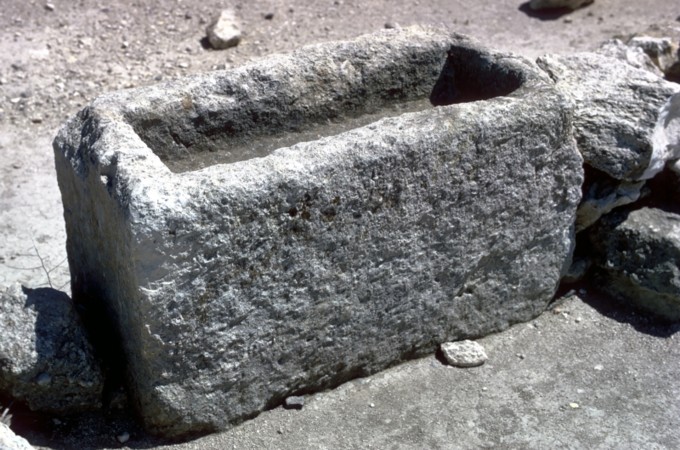
Stone manger from Bible times, perhaps similar to the one that cradled the baby Jesus in Bethlehem. The manger held food for animals.

Stone manger from Bible times, perhaps similar to the one that cradled the baby Jesus in Bethlehem. The manger held food for animals.

“All the world” in verse one means all of the roman Empire, of course. Since everyone went to register in their home town, this is how Jesus came to be born in Bethlehem instead of Nazareth – thus fulfilling prophecies such as that of Micah 5:2. This is because Joseph was of the house of David. When Joseph and Mary arrived there, there was no room in the inn. So when she gave birth, she wrapped our Lord in swaddling clothes, and put him in a manger (a feeding trough for animals) for his bed. It is here in just 2 verses (5-7) that we learn of the birth of the most important person ever born in this world – with absolutely no fanfare.

(This year’s reading plan for Luke, Acts, and 1 and 2 Chronicles averages just 15 verses per day – 5 days per week!)
Schedule for this week
Read or listen to audio of today’s selection from Luke here
Read or listen to audio of today’s selection from 1 Chronicles here

/Bob’s boy
___________________
some images © V. Gilbert & Arlisle F. Beers

All of my comments in this blog, however, are solely my responsibility.  When reading ANY commentary, you should ALWAYS refer first to the scripture, which is God’s unchanging and unfailing word. Reading schedules can be found on the “Bible Reading Schedules” page of my website at http://graceofourlord.com.
Enhanced by Zemanta

Gabriel Appears To Mary

Gabriel making the Annunciation to the Virgin ...

Gabriel making the Annunciation to the Virgin Mary. Painting by El Greco, 1575 (Museo del Prado, Madrid). (Photo credit: Wikipedia)

Verse 26 of Luke chapter one begins ” in the sixth month,” which refers to the time following Elizabeth’s conception of John the Baptist. Note that the description of Nazareth’s location by Luke is further evidence of his intended Gentile audience. Any Jew would know very well where Nazareth was. The angel Gabriel was sent by God to a virgin named Mary, who was betrothed to Joseph, of the house of David. Betrothal in those days was nothing like the sense in which we imagine such a term. Rather, it was a negotiated agreement that was binding upon both the bride and the groom to the extent that they were legally and religiously married in all respects – except that of living together.

Gabriel told Mary, who did not “know a man,”  that she would bear a son by the power of the Holy Spirit and the “Most High” (verse 35), and name Him Jesus. This  reference to God as “Most High” (Elyon, used seven times in Luke) is seen first in Genesis 14:18-20 when Abram met Melchizedek, and was used quite often thereafter – seen often in the Psalms, Numbers 24:16, and Daniel 3:26, and 4:24,34. He also told her some very important things about Jesus: 1) that He will be called holy – the Son of God, 2) that God will give Him the throne of David, his father, from which He will reign over the house of Jacob forever and 3) that of His kingdom there shall be no end. Before he left, Gabriel told Mary of the pregnancy of her elderly relative, Elizabeth, which was his offering of a sign for Mary’s encouragement in what he had told her.

John the baptist Church in Ein Karem Jerusalem...

John the baptist Church in Ein Karem Jerusalem, Israel, 2006 (Photo credit: Wikipedia)

Mary went to see her relative, and when she arrived, we are told that Elizabeth’s baby (who was filled with the holy Spirit) leaped for joy in her womb at the presence of the Lord – providing yet another affirmation for the Christian of the sanctity of life in the womb. Mary stayed with her for about three months before returning home. Verses 47-55 contain Mary’s song – a psalm of praise to God that has come to be known at the “Magnificat” – a title which comes from the Latin translation.

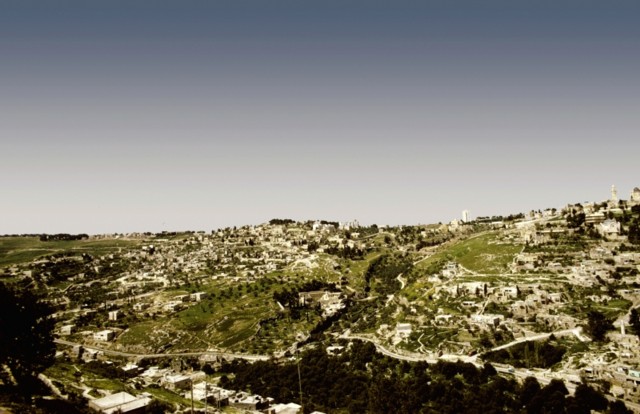
Side note: In verse 39, when Mary went to see Elizabeth, the text says that she went “into the hill country to a town in Judah.” We do not really know where in that area it actually was, but traditional belief widely held is that the home of John the Baptist was in Ein Karem, about 5 miles west of Jerusalem. There is an interesting article with some pictures of the area in this feature at Ferrell’s Travel Blog.

(This year’s reading plan for Luke, Acts, and 1 and 2 Chronicles averages just 15 verses per day – 5 days per week!)
Read or listen to audio of today’s selection from Luke here
Read or listen to audio of today’s selection from 1 Chronicles here

/Bob’s boy
___________________
some images © V. Gilbert & Arlisle F. Beers

All of my comments in this blog, however, are solely my responsibility.  When reading ANY commentary, you should ALWAYS refer first to the scripture, which is God’s unchanging and unfailing word. Reading schedules can be found on the “Bible Reading Schedules” page of my website at http://graceofourlord.com.

Enhanced by Zemanta

Luke’s First Prologue to Theophilus

Gospel Book, Title page to the Gospel of Luke,...

Gospel Book, Title page to the Gospel of Luke, Walters Manuscript W.528, fol. 116r (Photo credit: Walters Art Museum Illuminated Manuscripts)

The Gospel According to Luke is one of the synoptic gospels (Matthew, Mark, and Luke), so named because they all include similar material concerning the Lord Jesus – whereas John is much different. The fact that Luke was the author is well-supported by early church tradition, and we find arguments to the contrary without merit. It is generally accepted to have been written in the early to mid-60’s. The book is addressed to “Theophilus,” who we can assume to be a Gentile (Greek, the name suggests, as it is assumed that Luke is as well). Considering the way that Luke addresses him in verse 3, it is supposed that he might be some sort of government official – likely a man of some means as well. The first four verses of chapter one tell us a great deal about what we can expect from the Book of Luke:

Inasmuch as many have undertaken to compile a narrative of the things that have been accomplished among us, just as those who from the beginning were eyewitnesses and ministers of the word have delivered them to us, it seemed good to me also, having followed all things closely for some time past, to write an orderly account for you, most excellent Theophilus, that you may have certainty concerning the things you have been taught.”

The first part tells us that even before Luke had started writing this book, a great deal had already been written by others of the events he was writing about. Many hold that the Gospel of Mark was one of those accounts. Possibly. Best estimates by many scholars suggest a time in the mid-50’s for the writing of Mark. As for Matthew, scholars and early church figures (such as Irenaeus of Lyons) indicate that it was written when both Peter and Paul were alive. So it could possibly have been one of those writings as well. But since Luke refers to “many” narratives, it would seem that there were several written by non-inspired sources as well.

English: The evangelist portrait from the Gosp...

English: The evangelist portrait from the Gospel of Luke (Photo credit: Wikipedia)

Next, Luke indicates that people who were either eyewitnesses to the events of Jesus’ life, death, and resurrection, or who had been brought into teaching the gospel, had related many of the events to him – and to others – already. But note also that his reference to eyewitnesses in verse 2 is in the context of those who were “from the beginning.” Luke had been thorough in his research, as well as in his writing, but he had the advantage of living in precisely the right time, when he could benefit from the accounts and information from so many who were there through it all.

Finally, Luke tells Theophilus that he wanted to write an “orderly” account of these things for him so that he might “have certainty” about the things he had been taught. That tells us that Theophilus, if not already a Christian, had received some instruction concerning Jesus Christ. And that brings us back around to several things we can put into the context of the statement Luke made in verse one, referring to “a narrative of the things that have been accomplished among us.” As Luke began writing this, the Lord had long ago risen and ascended into heaven. The day of Pentecost in Acts Chapter 2, had come and gone, and the church had been established. And, as one Gentile is writing to another quite literally about the gospel of Jesus Christ, we can deduce that Cornelius and his family had already been converted (Acts 10). It is also quite likely then, that the Jerusalem Conference (or Jerusalem Council) of Acts 15 had also taken place.

In our next look at Luke chapter one, we will take a closer look at the parents of John the Baptist.

(This year’s reading plan for Luke, Acts, and 1 and 2 Chronicles averages just 15 verses per day – 5 days per week!)
Read or listen to audio of today’s selection from Luke here
Read or listen to audio of today’s selection from 1 Chronicles here

/Bob’s boy
___________________
some images © V. Gilbert & Arlisle F. Beers

All of my comments in this blog, however, are solely my responsibility.  When reading ANY commentary, you should ALWAYS refer first to the scripture, which is God’s unchanging and unfailing word. Reading schedules can be found on the “Bible Reading Schedules” page of my website at http://graceofourlord.com.  

Enhanced by Zemanta

Job 42 – The Lord Rebukes Job’s Friends

This closing chapter of the Book of Job begins with Job confessing to the Lord that he knows God’s power, His knowledge, and the inevitability of His will, and he repents. Then the Lord turns to Eliphaz and rebukes him (along with Bildad and Zophar) for wrongly speaking about Him. He then requires a sacrifice from them, and states that Job will pray for them because of their folly – it is Job’s prayer only that He will accept on their behalf. This is as much an endorsement of Job as a rebuke for them. The book concludes with Job’s fortunes turning completely around, as God blessed him with great wealth, much in the way of possessions, and 10 more children. Then it says that God blessed him with a very long life.

crucifixion01As we conclude the reading of this great book, it should be noted that it is characterized somewhat incorrectly by most people, in our opinion. Many say that the book of Job is all about the question of why there is pain and suffering in the world. But we do not believe this is the case. Note that at no time did God explain to Job anything about His conversation with the devil. Nor did He state any type of regret to Job or indeed, offer any explanation of suffering whatsoever.

We believe that this book is mostly about teaching us how wrong it is to assume bad things about others without having good reason. Man tends to be harshly judgmental of others, often at the worst times or in the most inappropriate circumstances. It also serves to teach us how to cope with the pain and trials of a life that can often be unfair – and to know that those who fear the Lord will come through it all to a much better end. That is the promise of Job, and it is the promise of God, through the sacrifice of His son, our Lord Jesus the Christ. He is our “mediator” (Job 9:33, Hebrews 4:14-16).

“Let us then with confidence draw near to the throne of grace, that we may receive mercy and find grace to help in time of need.”

Read or listen to audio of ESV version of this selection from this link.

/Bob’s boy
___________________
some images © V. Gilbert & Arlisle F. Beers

Please note: I did not design the reading plan that I am following in my blog.  All of my comments in this blog, however, are solely my responsibility.  When reading ANY commentary, you should ALWAYS refer first to the scripture, which is God’s unchanging and unfailing word. Reading schedules, as well as a link to the site where you can get the reading plan that I’m currently following for yourself can be found on the “Bible Reading Schedules” page of my website at http://graceofourlord.com.  For questions and help, please see the “FAQ” and “Summaries” pages there.

Psalm 78:50-72 – With His Skillful Hand

The final section of this historical psalm begins with the re-telling of the final plagues against Egypt (Exodus 12) and God’s deliverance of the Israelites to the Promised Land, where He “drove out the nations” and settled His people in (verse 55 ). The text then turns attention back to their idolatry – always the problem in Israel’s history. In verses 60-62, the phrases “He forsook his dwelling at Shiloh” and “delivered his power to captivity, his glory to the hand of the foe” refer to when the Philistines captured the Ark in 1 Samuel 4.

The lion is the symbol of the Tribe of Judah. ...

The lion is the symbol of the Tribe of Judah. It is often represented in Jewish art, such as this sculpture outside a synagogue (Photo credit: Wikipedia)

The psalm continues, showing once again the Lord’s love for His people, as He delivers them from their enemies in spite of their unfaithfulness to Him. Verses 67-72 then conclude the psalm, noting that God’s ultimate remedy for His people was to choose a shepherd from the tribe of Judah (David, leading of course to Jesus Christ, also from Judah) to shepherd them.  Verse 72 concludes: “With upright heart he shepherded them and guided them with his skillful hand.”

The purpose of the psalm, stated in the first eight verses, was to commit to a song to be remembered the works of God, so that they would be passed on in the generations to come. The words “remember” and “not forget” ring throughout the psalm constantly in order to try to save the future generations from the foolish mistakes of their fathers.

Read or listen to audio of ESV version of this selection from this link.

/Bob’s boy
___________________
some images © V. Gilbert & Arlisle F. Beers

Please note: I did not design the reading plan that I am following in my blog.  All of my comments in this blog, however, are solely my responsibility.  When reading ANY commentary, you should ALWAYS refer first to the scripture, which is God’s unchanging and unfailing word. Reading schedules, as well as a link to the site where you can get the reading plan that I’m currently following for yourself can be found on the “Bible Reading Schedules” page of my website at http://graceofourlord.com.  
Major Prophets (part 2) Book of Isaiah

In chapter 6, Isaiah recalls the time of his call to be a prophet. We know from verse one that this was about 740-739 B.C., as that was most likely the year that King Uzziah (2 Chronicles 26) died. Isaiah lived long enough to write of the death of Sennacherib (Isaiah 37:37-38), the Assyrian king who reigned until 681 B.C.

English: Isaiah; illustration from a Bible car...

English: Isaiah; illustration from a Bible card published by the Providence Lithograph Company (Photo credit: Wikipedia)

Traditional secular Jewish and Christian writings state that Jeremiah and Isaiah were the two prophets referred to by the Hebrew writer as having been “sawn in two” (Hebrews 11:37). These writings refer to the persecution under Manasseh, the king of Judah from 687-642 B.C. Other writings in the Book of Isaiah can be dated as well. Chapter 7 was written about 735 B.C.  Chapters 36-38 can be dated about 701, which is the time of the Assyrian invasion.

The book opens with an indictment of the people of Israel, and the declaration that Israel has no excuse for its apostasy (Isaiah 1:1-10). It lists God’s requirements of the people of Israel in order to avert the coming judgment (Isaiah 1:16-20), It also contains the lament over Jerusalem and its coming fate (Isaiah 1:21-23), and a declaration of God’s coming judgment upon the people (Isaiah 1:24-31).

Isaiah is considered to be the most prophetic book of the Bible, and is quoted in the New Testament over 400 times.  The most well-known of his Messianic prophecies are in what is known as the “Suffering Servant” songs. The most beautiful and best understood prophecies that are a source of understanding of the Savior’s purpose as the Messiah are contained in Chapter 53.

/Bob’s boy
___________________
image © V. Gilbert & Arlisle F. Beers

Please note: I did not design the reading plan that I am following in my blog.  All of my comments in this blog, however, are solely my responsibility.  When reading ANY commentary, you should ALWAYS refer first to the scripture, which is God’s unchanging and unfailing word. Reading schedules, as well as a link to the site where you can get the reading plan that I’m currently following for yourself can be found on the “Bible Reading Schedules” page of my website at http://graceofourlord.com.  

Psalm 98 – Let the Sea Roar!

sea_004The 98th psalm is another song of praise in the same vein as the 96th, in that it encourages the singing of “a new song” to the Lord. The psalm is composed of three stanzas of three verses each. The first set of verses extol the marvelous things that the Lord has done. His right hand and holy arm have worked salvation. He has kept His promises with faithfulness to His people; and all the ends of the earth have seen that salvation.

The second set of verses encourage making a joyful noise to the Lord over all the earth and breaking forth in joyous song, singing praises to the Lord. Then the third set of verses call forth to the created wonders of the earth itself to roar their own joyous noise. Jesus Himself, quoting Habakkuk 2:11, said in Luke 19:40 that the very stones would cry out if the people were silent. All creation should sing out in praise to the Creator of all, who will judge the earth with righteousness – and with fairness and equity to the people. This settles forever the question of for whom God’s word was written. It is for everyone!

Read or listen to audio of ESV version of this selection from this link.

/Bob’s boy
___________________
some images © V. Gilbert & Arlisle F. Beers

Please note: I did not design the reading plan that I am following in my blog.  All of my comments in this blog, however, are solely my responsibility.  When reading ANY commentary, you should ALWAYS refer first to the scripture, which is God’s unchanging and unfailing word. Reading schedules, as well as a link to the site where you can get the reading plan that I’m currently following for yourself can be found on the “Bible Reading Schedules” page of my website at http://graceofourlord.com.  

Understanding the Cross – now available as eBook

Understanding_the_Cross_coverThe expanded version of our series “Understanding the Cross of Christ” is now available at Amazon.com in Kindle format at this link, in ePub format at Kobo, and for Nook at  BarnesandNobel.com!

/Bob’s boy
___________________
image © V. Gilbert & Arlisle F. Beers

Please note: I did not design the reading plan that I am following in my blog.  All of my comments in this blog, however, are solely my responsibility.  When reading ANY commentary, you should ALWAYS refer first to the scripture, which is God’s unchanging and unfailing word. Reading schedules, as well as a link to the site where you can get the reading plan that I’m currently following for yourself can be found on the “Bible Reading Schedules” page of my website at http://graceofourlord.com.

Psalms 50 – God Himself is Judge

This is the first of 12 “songs of Asaph.”  Asaph was one of David’s chief musicians (1 Chronicles 16:7), and undoubtedly did write some of the psalms (2 Chronicles 29:30), although it is not certain that he wrote all 12 of these, or simply was known to sing some of them.  Most commentators agree however that this one was likely written by him.  Adam Clarke said “The style of David is more polished, flowing, correct, and majestic, than that of Asaph, which is more stiff and obscure.”

Mount Zion, Aceldama, Akeldama, or Hakeldamia, the Field of Blood.

Mount Zion, Aceldama, Akeldama, or Hakeldamia, the Field of Blood.

Some say that this is a prophetic psalm concerning the Messiah, and that does have some merit.  Verse 2 (“Out of Zion, the perfection of beauty,God shines forth”) seems akin to Isaiah 2:3 (“For out of Zion shall go the law, and the word of the Lord from Jerusalem”).  In the latter, “the word” obviously is Jesus (John 1:14).  And in verses 8-14, God tells His chosen ones that He neither needs nor wants their sacrifices (which we are reminded in Hebrews 10:5-7).

He rebukes the wicked among them in verses 16-22 for believing they can live their lives doing any sort of sinful act, as long as they make their sacrifices to atone for it.  God hates fake worship; and the verses are just as relevant for us today.  Too many of us live as pagans Monday through Saturday night, yet still consider themselves Christians on Sunday, as long as they go to worship services.  God will judge us for how we live our daily lives, and His salvation is for he who “orders his way rightly” (verse 23).

Read or listen to audio of ESV version of this selection from this link.

/Bob’s boy
___________________
some images © V. Gilbert & Arlisle F. Beers

Please note: I did not design the reading plan that I am following in my blog.  All of my comments in this blog, however, are solely my responsibility.  When reading ANY commentary, you should ALWAYS refer first to the scripture, which is God’s unchanging and unfailing word. Reading schedules, as well as a link to the site where you can get the reading plan that I’m currently following for yourself can be found on the “Bible Reading Schedules” page of my website at http://graceofourlord.com.  For questions and help, please see the “FAQ” and “Summaries” pages there.