Matthew 28 – The Resurrection and Great Commission

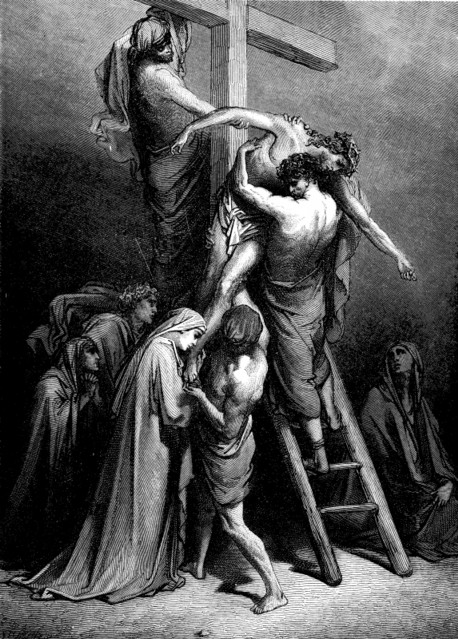
Early Sunday morning, Mary Magdalene and Jesus’ mother Mary went to Jesus tomb, but they met an angel there who told them that Jesus had risen from the dead (Matthew 28:1-7).

(Note: for a summary of the events of this chapter from the resurrection at dawn to Jesus’ first appearances to Mary Magdalene and the other women, please see post at this link.  After the resurrection, Jesus – as He had told the disciples in Matthew 26:32 that He would meet them there – would be with them at the Sea of Galilee, and at a mountain there that He directs them to.  But several other events occur before and after this, the details of which are interspersed throughout the gospels in Luke 24 and John 20.  And events in a single chapter are in some cases separated by days, and even weeks, as Jesus remained for forty days before the ascension.)

Then some of the guard that had been on watch at the tomb went to the chief priests to tell them what had happened.  After deliberating, they gave money to the guards to have them say that His disciples had come and stolen the body while they were asleep, promising to keep them out of trouble if word got back to Pilate.  Their acts of unbelief in the face of these eyewitness accounts is stunning, but such was their love for power that they would not let it be jeopardized.

Jesus meets His apostles in verse 16 on the mountain in Galilee that He had directed them to.  In verses 18-20, Jesus gives the eleven chosen ones the Great Commission – to go and make disciples of ALL nations “baptizing them in the name of the Father and of the Son and of the Holy Spirit, teaching them to observe all that I have commanded you.”  Jesus has confirmed that His Kingdom is open to everyone.  Because this is the end of Matthew, some confuse this event with the time of the ascension.  But that comes later at at a different mountain – Mount Olivet, after they returned to Jerusalem.

Read or listen to audio of ESV version of this selection from this link.

/Bob’s boy
___________________
some images © V. Gilbert & Arlisle F. Beers

Please note: I did not design the reading plan that I am following in my blog.  All of my comments in this blog, however, are solely my responsibility.  When reading ANY commentary, you should ALWAYS refer first to the scripture, which is God’s unchanging and unfailing word. Reading schedules, as well as a link to the site where you can get the reading plan that I’m currently following for yourself can be found on the “Bible Reading Schedules” page of my website at http://graceofourlord.com.  For questions and help, please see the “FAQ” and “Summaries” pages there.

Matthew 27 – The Crucifixion of Jesus

When morning came, the Sanhedrin had Jesus taken to Pilate.  When Judas saw that Jesus was condemned, he had a change of heart, and took the thirty pieces of silver back to them, saying that he had betrayed innocent blood.  But they are unimpressed.  So he threw it down in the temple and went and hanged himself.  Remorse, as we see, does not always include repentance.  The Sanhedrin has no problem with lies and the murder of an innocent man, but they want no part of this blood money, so they use it to buy a potter’s field.  The scripture that this fulfilled, referred to in verses 9-10, is from both Jeremiah 19:1-13 and Zechariah 11:11-13.

Jesus answers Pilate’s question of whether He was a king, but remains silent about the charges against Him.  We find in verse 20 that the chief priests and elders persuaded the people to choose Barabbas when Pilate offered to free one of them.  Fearing a riot, Pilate resigns himself to the will of the crowd, but uses the physical act of washing hands to declare his innocence of “this man’s blood.”  “Having scourged Jesus” is mentioned in passing, but this Roman form of flogging was anything but incidental.  It was a brutally painful beating with a whip weighted with sharp pieces of bone and metal. It was designed to lacerate, often exposing bone and intestines.  Crucifixion was an agonizing and tortuous death, but this beating would be equally painful.  An article about this scourging can be found at this link.

One traditional site of Golgotha is this hill with hollow eye sockets to look like the place of the skull. Another traditional site is in present-day Jerusalem, which in Jesus’ time was just outside the wall. It is called the Church of the Holy Sepulcher.

He was mocked and spit upon, stripped and made to wear a crown made of thorns.  Then he was led away to be crucified.  They made a man named Simon of Cyrene to carry His cross, and when they reached Golgatha (which means Place of a Skull), they tried to give him wine mixed with gall (a very bitter herb that could also be poisonous) to drink.  It was intended to dull the sense of pain, but it was God’s will that He should suffer, and He refused.  As they crucified Him, “they divided his garments among them by casting lots” – referring to Psalm 22:18.  Verses 36-44 detail the continued derision, mocking and reviling inflicted on Him as He suffered.

Crucifixion was a slow and excruciatingly painful method of inflicting death, and their are many stories of the cruelty of Roman soldiers experimenting with different poses for crucified victims (Josephus, “Jewish War” 5.449–551).  Hanging by one’s arms caused great difficulty in breathing, only alleviated by the victim pushing up with their feet in order to take the weight off of the arms. But that caused severe pain in the feet, arms, legs, and back, making the exhausted victim slump down again, only to be barely able to breathe again. Finally, he would mercifully die of asphyxiation, if he had not already died as a result of the cumulative effects of the multiple physical traumas inflicted.

In verse 45, there was darkness all over the land from the 6th hour until the ninth hour (about noon to 3:00).  About the ninth hour, Jesus cried out with a loud voice “Eli, Eli, lema sabachthani?” meaning, “My God, my God, why have you forsaken me?”  This is from Psalm 22:1.  This is one of the most puzzling verses in the Bible.  Jesus knows what is happening, and why He is doing it. One explanation that has been posed is that because Jesus did in fact become sin, at this moment Jesus felt the presence of God turn away from Him as He was dying.  Jesus then gave up the spirit with another cry.

Then in verse 51, the curtain of the Temple was torn from top to bottom.  It was between the Holy Place and the Most Holy Place, and was woven from 72 twisted plaits of 24 threads a piece. It was 60 feet high and 30 feet wide. No one was allowed to enter the Most Holy Place behind the curtain except the high priest, and then only on the Day of Atonement.  Being torn in two represents the removal of the separation between God and the people.  A high priest was no longer needed – Jesus is our high priest now.  More elaboration of this event, and what it symbolized, is in Hebrews 9:11–10:22.  Then the earth shook (Palestine sits on a major seismic rift), rocks were split, and tombs were opened.  As Matthew often groups events together topically, he then jumps ahead here in verse 53 to events after the resurrection, as many of the saints were raised and came out of the tombs to appear to many in the city.  We are not told whether they were taken to heaven after these eyewitnesses received these visits.  But clearly, God wanted many witnesses to understand the profoundly momentous significance of what had happened.

In verse 57, a rich man from Arimathea named Joseph came to Pilate that evening to request Jesus’ body.  He took the body and wrapped it in a linen shroud and placed it in his own tomb.  This fulfilled Isaiah 53:9.  Then he rolled a big stone in front of the entrance.  Then the chief priests, remembering how he had said that he would rise after 3 days, went to Pilate voicing their fears that Jesus’ disciples might come and steal the body.  So he gave them a guard of soldiers, and they sealed the tomb and stood guard.

Read or listen to audio of ESV version of this selection from this link.

/Bob’s boy
___________________
some images © V. Gilbert & Arlisle F. Beers

Please note: I did not design the reading plan that I am following in my blog.  All of my comments in this blog, however, are solely my responsibility.  When reading ANY commentary, you should ALWAYS refer first to the scripture, which is God’s unchanging and unfailing word. Reading schedules, as well as a link to the site where you can get the reading plan that I’m currently following for yourself can be found on the “Bible Reading Schedules” page of my website at http://graceofourlord.com.  For questions and help, please see the “FAQ” and “Summaries” pages there.

Matthew 26 – The Plot to Kill Jesus


Having read John’s account, we now move to Matthew’s account of the last supper and Jesus’ arrest.  Since the audience of the gospel of Matthew is the Jews, it makes sense that he would give full attention to certain details of the trial before the Sanhedrin.  Unlike John, who gives the event in more chronological order, Matthew includes the account of the anointing of Jesus by Mary (sister of Lazarus) here in verses 6-13.   he also gives us the details in verses 14-16 of Judas’ conspiracy with, and payment from, the chief priests for his promise to deliver Him.  We also read in verses 17-20 of Jesus sending disciples to a “certain man” to prepare to have Passover at his house.

A model of the way Caiaphas’ house may have looked in the time of Jesus. Caiaphas was the high priest who judged Jesus.

But it is in verses 3-5 that we read of chief priests and the elders plotting in Caiaphas’ palace to  “arrest Jesus by stealth and kill him.”  They were fearful of arresting Jesus openly because of His popularity; and the Feast of Unleavened Bread brought thousands of Pilgrims to the city.  The last thing they wanted was an uprising.  In verses 20-25, Jesus foretells His betrayal by one of them, culminating in an actual exchange between Jesus and Judas.  What was it like to be told by the son of God that it would be better if His betrayer had never been born – knowing that you had already begun that process?  And Jesus’ confirmation that He knew in verse 25 must have been chilling, especially after the fact.

In verses 26-29, Jesus institutes the Lord’s Supper.  The Passover, begun so long ago in Exodus 12 with the sacrifice of a lamb had pointed to this day.  Now this memorial would remind us of the sacrifice of “the Lamb of God who takes away the sin of the world” (John 1:29).  Verse 28 (“…this is my blood of the covenant, which is poured out for many for the forgiveness of sins” is the fulfilling also of the new covenant promise of Jeremiah 31:31-34.

The hymn that they sung in verse 30 is most likely Psalm 113-118, which is known as the Hallel (meaning “praise”).  The scripture Jesus quotes in verse 31 is from Zechariah 13:7, telling the disciples that they will all fall away that very night.  He also predicts Peter’s denial, at which point they all declare that they will remain with Him even if they must die.  His prayer in Gethsemane occurs in verses 36-44.  The traditional site for this now holds the “Church of All Nations” (or “Basilica of the Agony“), which was built over a 4th century Byzantine church.  Note Jesus’ sorrow and fervent petition to God in verses 38-39.  Although He was divine, for our benefit He had the same emotions any man would have knowing the suffering that He was about to endure.

The Mount of Olives, looking from Jerusalem, with the Basilica of the Agony, traditional site where Jesus prayed in the Garden of Gethsemane. Today the garden is at the left of the basilica.

Judas betrays Him with a kiss in verse 49.  We know from John 18:10-11 that it was Peter that cut off the ear of one of Jesus’ captors (Malchus) in verse 51.  When Jesus rebukes him, He says “Do you think that I cannot appeal to my Father, and he will at once send me more than twelve legions of angels?”  (we sing the song “He could have called Ten Thousand Angels”).  Jesus was of course  not going to call for help, but a Roman legion was 6,000 – so twelve of them would be 72,000.  As predicted, all of His disciples fled the scene.

Matthew skips past the meeting with Annas (John 18:12-14, 19-24) and begins next with the appearance before Caiaphas the High Priest and the Council (the Sanhedrin).  They had many witnesses coming forward, but none would give the false testimony they wanted in order to have Him put to death until at last two came and, in verse 61, misquoted Jesus’ actual statement of John 2:19-21.  He remained silent, making no correction,  when Caiaphas questioned Him about it.  But when asked if He was the Christ, He confirmed it with the Greek expression “you have said so” that He had also used with Judas in verse 25.  Then He added that they would see him at the right hand of “Power.”  Caiaphas declared this to be blasphemy, and they spit on Him and slapped Him, saying that He deserved death.  The outcome was assured now.

Peter’s denial in verses 69-74 went just as Jesus had said; and remembering the words of the Lord, Peter’s grief was intense.  Though this apostle would come to understand the necessity of what Jesus was to endure, we can only try to imagine the guilt he would bear.

/Bob’s boy
___________________
some images © V. Gilbert & Arlisle F. Beers

Please note: I did not design the reading plan that I am following in my blog.  All of my comments in this blog, however, are solely my responsibility.  When reading ANY commentary, you should ALWAYS refer first to the scripture, which is God’s unchanging and unfailing word. Reading schedules, as well as a link to the site where you can get the reading plan that I’m currently following for yourself can be found on the “Bible Reading Schedules” page of my website at http://graceofourlord.com.  For questions and help, please see the “FAQ” and “Summaries” pages there.


Matthew 25 – The Final Judgment

Chapter 25 continues the theme of being prepared that Jesus began in the latter part of chapter 24.  No matter how many times Jesus says in scripture that no one knows what day or hour He will come, still people try to predict it even to this day.   The first parable especially emphasizes the importance of always being prepared.

The parable of the talents, a story about faithful stewardship — Matthew 25: 14-30.

The parable of the talents stresses that we have the responsibility for our own spiritual  growth, and for sharing it with others.  The “talent” in New Testament times was a fairly large amount of money.  The parallel for us is not so much any “talent” we might have as it is just using our abilities productively.  The Lord does not want us to be idle in His Kingdom.  Verse 32 (“Before him will be gathered all the nations, and he will separate people one from another as a shepherd separates the sheep from the goats”) continues the theme from Matthew 24:40-41.

Read or listen to audio of ESV version of this selection from this link.

/Bob’s boy
___________________
some images © V. Gilbert & Arlisle F. Beers

Please note: I did not design the reading plan that I am following in my blog.  All of my comments in this blog, however, are solely my responsibility.  When reading ANY commentary, you should ALWAYS refer first to the scripture, which is God’s unchanging and unfailing word. Reading schedules, as well as a link to the site where you can get the reading plan that I’m currently following for yourself can be found on the “Bible Reading Schedules” page of my website at http://graceofourlord.com.  For questions and help, please see the “FAQ” and “Summaries” pages there.

Matthew 24 – Jesus Foretells Destruction of the Temple

Chapters 24 and 25 are known as the Olivet discourse (Verse 3 – “As he sat on the Mount of Olives…”); and chapter 24 is the source of much discussion and confusion.  The disciples were impressed with the buildings of the temple, and pointed them out to Jesus.  But He tells them in verse 2 that “there will not be left here one stone upon another that will not be thrown down.”  Now the total destruction of this temple was such a dramatic thing to envision, that the only thing they could think of to associate it with was the end of the world.  So their question to Jesus was when all of these things would happen.

Old city of Jerusalem, the Temple, and Dome of the Rock, as seen from the Mount of Olives.

The key to understanding this chapter (as is the case with all scripture) is to first examine the context, and then apply what follows using your God-given logic.  In chapter 23, Jesus had just delivered a very vocal rebuke of the scribes and Pharisees in the temple, calling them the “sons of those who murdered the prophets,” and saying “you brood of vipers, how are you to escape being sentenced to hell?”  He finishes up in verses 37-38 with His broken-hear-ted lament for the coming fate of Jerusalem:

“O Jerusalem, Jerusalem, the city that kills the prophets and stones those who are sent to it! How often would I have gathered your children together as a hen gathers her brood under her wings, and you were not willing! See, your house is left to you desolate.”

In verses 4-35 of chapter 24, Jesus tells them privately of the fate that awaits Jerusalem, as well as what will become of them (they will be persecuted and put to death).  he even tells them of things that will happen before that Roman army does its work in AD 70 – many examples of which Josephus and other historians confirm.  If these verses were speaking of the end of the world rather than the destruction of Jerusalem, it would not matter if it was in the winter (verse 20) – much less, what day it was!  In verse 34, He tells them that all of these things will happen during their generation.  It is not until verse 36 that Jesus begins speaking of  the final judgment – “But concerning that day and hour no one knows, not even the angels of heaven, nor the Son, but the Father only.”  The apocalyptic language throughout the chapter is what makes it difficult to separate.  But such imagery when the scripture prophesies destruction is common (see Isaiah 13:10-13 and Ezekiel 32:7-8, for example).  It is helpful to relate the chapter to Luke’s account in chapter 21, particularly as Matthew 24:15-16 relate to Luke 21:20-21.

For an excellent in-depth analysis, please refer to the article in this link.

Read or listen to audio of ESV version of this selection from this link.

/Bob’s boy
___________________
some images © V. Gilbert & Arlisle F. Beers

Please note: I did not design the reading plan that I am following in my blog.  All of my comments in this blog, however, are solely my responsibility.  When reading ANY commentary, you should ALWAYS refer first to the scripture, which is God’s unchanging and unfailing word. Reading schedules, as well as a link to the site where you can get the reading plan that I’m currently following for yourself can be found on the “Bible Reading Schedules” page of my website at http://graceofourlord.com.  For questions and help, please see the “FAQ” and “Summaries” pages there.

Matthew 16 – Jesus Foretells His Death and Resurrection

The Pharisees and the Saduccees Come to Tempt ...

The Pharisees and the Sadducees Come to Tempt Jesus (Photo credit: Wikipedia)

Normally, the Pharisees and Sadducees were at odds, and had little to do with each other.  But Jesus was perceived by both groups as a threat to their power.  That is why they came together in verse one asking him for a sign – in order to try to get something to use against him as the Pharisees and scribes had done earlier.  Jesus points out their ability to understand meteorological signs (verse 2), but they are unable to understand the signs that He has done (because they choose not to).  In verse 4, he says that no sign will be given except the sign of Jonah  (a repeat of His earlier statement in the encounter in Matthew 12:38-40).  He had told them of His coming death and resurrection already, but they had not understood that either.

In verse 5, the disciples caught up with Him (Jesus had gone over on the boat without them after feeding the four thousand in chapter 15) and realized they had forgotten to bring any bread.  So when He tells them to “beware of the leaven of the Pharisees and Sadducees,”  they still have their minds on bread; and they do not properly understand the statement.  Jesus is using the word “leaven” in the sense of something that influences another – in this case, the corrupt doctrine and hypocrisy of the Pharisees and Sadducees.  It is their (the disciples) faith (verse 8) that is preventing them from understanding the way He wants them to understand Him.  Jesus focuses their minds by reminding them of the miracles of feeding the two groups of thousands and the abundant left-overs, and repeating the warning.  That has the desired effect, and they finally “get it.”

After they arrive in the district of Caesarea Philippi, Peter answers Jesus’ question of verse 15 with the knowledge that He is the son of God. Jesus declares that he was blessed to have such knowledge revealed to him by God Himself (verse 17).  Unfortunately, verses 18-19 are the subject of much confusion and controversy.  Many people get lost in scrutinizing the Greek and Aramaic words for rock, but the simple fact is that Jesus uses a play on words, as scripture very often does, with Peter’s name.  And despite his flaws (and maybe even because of them), most of us really just like Peter.  But the gospel is not about the glory of Peter.  It is about Jesus, and our hope of salvation through Him.

The two verses are not so difficult to understand when you put them in context with verse 20, with the preceding verses, and with Jesus’ previous words about building a house on the rock (Matthew 7:24)  The rock that Jesus is building on is the foundation of the son of God and His teachings; and his church or kingdom (Greek “ekklesia” – congregation or assembly) is the collection, or body, of people who have been saved by their obedience and faithfulness (Ephesians 2:19-22, 1 Corinthians 12:13).  When Jesus says that He will give him the keys to the kingdom (in contrast to the scribes and Pharisees who cause people to be shut out – see Matthew 23:13), He is speaking of the divine revelation of His word, that will be given to the apostles by the Holy Spirit (John 16:12-15) to impart to us to be saved.  That is when they will truly “get it.”  The next part of verse 19 is best translated in the New American Standard Version, which in the correct tense says  “and whatever you bind on earth shall have been bound in heaven, and whatever you loose on earth shall have been loosed in heaven.”  Binding and loosing refer to forbidding and permitting, and the authority for their knowledge of it will be given to them.   This is repeated to all of them in Matthew 18:18.

Jesus then tells them to tell no one that He is the Christ.  Like Peter in verse 22, nobody would understand that the Christ has not come to rule as their earthly king anyway.  Only after He offers Himself in death will that understanding come.  Verse 21 (“From that time…”) is the first of four times from then until His arrival in Jerusalem, that He will tell them in Matthew of His imminent death and resurrection.  We tend to forget that as Jesus was also a man, Peter’s sentiment for keeping Jesus alive would be a temptation, knowing what He has to suffer.  It is in that light that we better understand His strong words to Peter in verse 23.

Verses 24-27 are the essence of what it means to be a Christian.  The knowledge of what the salvation of our souls means to us eternally should be enough to cause us to deny ourselves the worldly pleasures everyone finds so important – those things that would stand in the way of salvation.  If we do not, and we “gain the world,” we still will have lost everything.  The meaning of verse 28 is said by some to be that some of those present will see the Him come into His kingdom at His death and resurrection, which makes sense.  Others believe that it is the Transfiguration that comes in chapter 17, and is a preview of His divine glory to come.  Both answers have merit; and both may well be correct.  The point is that the time is coming soon.

Read or listen to audio of ESV version of this selection from this link.

/Bob’s boy
___________________
some images © V. Gilbert & Arlisle F. Beers

Please note: I did not design the reading plan that I am following in my blog.  All of my comments in this blog, however, are solely my responsibility.  When reading ANY commentary, you should ALWAYS refer first to the scripture, which is God’s unchanging and unfailing word. Reading schedules, as well as a link to the site where you can get the reading plan that I’m currently following for yourself can be found on the “Bible Reading Schedules” page of my website at http://graceofourlord.com.  For questions and help, please see the “FAQ” and “Summaries” pages there.

Matthew 15 – What Defiles a Person

The Pharisees and scribes that came from Jerusalem in verse 1 would have been of considerable import and influence during the day.  They accuse the disciples (and therefore, Jesus) of breaking the tradition of the elders by eating without having washed their hands.  This was not a matter of hygiene on their part, but is a good example of the extra-biblical customs they were fond of imposing upon people – this one is supposed to have been based on the ritual purity commandments for priests (i.e. Exodus 30:17-21), extending them to apply to people and situations beyond that of God’s word .

The response from Jesus is to throw it right back at them.  The Pharisees were breaking the commandment of God – not the traditions of elders!  By making a claim that their money or property was vowed as a gift to God, they would exclude it from their wealth in consideration of their parents in need, and be excused for not caring for them by their own interpretation of the law – and who knows if they ever actually would give the possessions anyway, even after they died?  Jesus does not mince any words in exposing this hypocrisy (verse 7-9).   The prophecy quoted in verses 8-9 is from Isaiah 29:13.  The disciples then point out the obvious to Jesus – that the Pharisees were offended by what He had said.  But Jesus is not surprised by the opposition of the Pharisees, and tells the disciples that they are intentionally blind to the gospel.  Verses 10-20 then are His lesson to them that it is not what goes into the body that corrupts us, but what comes from our hearts.

The conversation with the Canaanite woman in verses 21-28 seems to be harsh toward her, but we must realize that Jesus came to the regions of Tyre and Sidon (verse 21) not by accident – He would be expecting encounters with Gentiles!  Her faith did pass the test, and her daughter was healed.  Remember that He had already healed the Centurion’s servant.

He then goes on by the Sea of Galilee healing still more in verses 29-31.  Verses 32-39 detail the feeding of the four thousand – this was just the number of men, not including women and children.  This numeration, as well as that of the feeding of the five thousand could be an indication of what sort of size crowds the scripture speaks of in other places.  All were fed and satisfied with just seven loaves of bread and a few fish, and the seven baskets of food gathered up afterward represents more than what they even started with.

Read or listen to audio of ESV version of this selection from this link.

/Bob’s boy
___________________
some images © V. Gilbert & Arlisle F. Beers

Please note: I did not design the reading plan that I am following in my blog.  All of my comments in this blog, however, are solely my responsibility.  When reading ANY commentary, you should ALWAYS refer first to the scripture, which is God’s unchanging and unfailing word. Reading schedules, as well as a link to the site where you can get the reading plan that I’m currently following for yourself can be found on the “Bible Reading Schedules” page of my website at http://graceofourlord.com.  For questions and help, please see the “FAQ” and “Summaries” pages there.

Matthew 13 – Parabolic Discourse

The Book of Matthew is considered by many to have five major discourses by Jesus.  The first obviously was the Sermon on the Mount of chapters 5-7.  The second was chapter 10 – the Messiah’s preparation of His disciples for their mission.  Chapter 13 is made up almost entirely of His parables.  In fact, verse 34 says that He said nothing to the crowds on this occasion without a parable.

Landscape with the Parable of the Sower

Landscape with the Parable of the Sower (Photo credit: Wikipedia)

As Jesus sat beside the sea, crowds gathered and he got into a boat and sat to address them.  Jesus  first tells the parable of the sower in verses 3-9.  We are not told about the chronology in the text, but most surmise that Jesus spoke all of the parables from the boat, and the explanation came later, after he went into the house in verse 36 (verse 34 seems to bear that out). When  the disciples came to ask Him why He spoke to the people in parables, He quoted from Isaiah 6:9-10 in verses 14-15, explaining that the difference between them (the disciples that want to learn) and the crowds (those that do not really want to understand, much less accept, the truth) is in their hearts. Those who do not understand and accept what He speaks of to them in plain speech, will never accept what He teaches in parables.  This may be the point He made to Nicodemus in John 3:12.

This is followed up by the explanation of the parable of the sower in verses 18-23, which is the key to understanding all of the parables.  In this case, Jesus is the sower, but it applies to us as sowers as we teach others about the kingdom.  It is up to the individual receiving the seeds to prepare their ground for their proper growth – to plow up the hard ground of their hearts (Jeremiah 4:3-4).

The parable of the weeds, or tares (verses 24-30), is like that of the net (verses 47-50), and refers to the fate of those who will not accept the truth.  It is not our job to gather up the weeds, lest we uproot the righteous as well. The parables of the mustard seed (verses 31-32) and leaven (verse 33) show that the kingdom may be starting very small, but will grow into something very large.  The parables of the hidden treasure (verse 44) and the pearl of great value (verses 45-46) demonstrate that those who truly understand the value of our place in His kingdom will be willing to give up anything in this ordinary world in order to attain it.  The prophecy He cites in verse 35 is Psalm 78:2.  Verse 52 means that true disciples who study God’s word will use their training for the kingdom to teach others, using knowledge of the old law with the new.

English: An etching by Jan Luyken illustrating...

English: An etching by Jan Luyken illustrating Matthew 13:47-48 in the Bowyer Bible, Bolton, England. (Photo credit: Wikipedia)

One might wonder why verses 53-58 are in this chapter, but all of God’s word teaches something.  The rejection of Jesus in His own hometown resulted in Him not wasting much time there (verse 58).  It illustrates very well the points that He made in the earlier parts of the chapter.  The hearts of the people there were hardened to the truth and they could not see.  The ground of their hearts needed plowing as well.

Side note: Though the scriptures do not tell us the location at the Sea of Galilee that Jesus gave the Parable of the Sower, there is a cove that has been suggested as that location.  Interesting studies have been conducted on the acoustics at that cove; and a great article with photos and a sound file made in a test is in this article at BilbePlaces.com.

Read or listen to audio of ESV version of this selection from this link.

/Bob’s boy
___________________
some images © V. Gilbert & Arlisle F. Beers

Please note: I did not design the reading plan that I am following in my blog.  All of my comments in this blog, however, are solely my responsibility.  When reading ANY commentary, you should ALWAYS refer first to the scripture, which is God’s unchanging and unfailing word. Reading schedules, as well as a link to the site where you can get the reading plan that I’m currently following for yourself can be found on the “Bible Reading Schedules” page of my website at http://graceofourlord.com.  For questions and help, please see the “FAQ” and “Summaries” pages there.

Matthew 6 – The Sermon on the Mount – part 2

Verses 1-8 are the Lord’s admonitions to us not to try to parade our righteousness before others, and likewise not to pray with an empty heart.  When we do good works, such as helping those who are in need, to attract the attention, admiration, or approval of others, it taints the very act we are doing by putting the focus on ourselves.  All good instead should be to the glory of God, living by His commandments and doing good because of the reign of the Lord in our hearts and lives.  The “empty phrases” of verse 7 are translated as “vain repetitions” in some versions, causing some to be critical of those praying fervently with over-used and repetitious phrases.  But such is not what Jesus was speaking about (just think of his own heart-felt prayers at Gethsemane in Mark 14:39), but many so-called pious pagans of the day would beseech their “gods” with endless empty chatter. Prayer to the Lord cannot be centered from the heart if the mind is not to be used in earnest.

Most people know verses 9-13 as the “Lord’s prayer.”  But that designation is ours and is unfortunate in some ways, as there is a tendency to use it in the very way that Jesus warned against in the previous verses!  It is an example and a model for our own prayers from our hearts – it was meant to teach us how to pray – with reverence and honor to the Lord, before presenting our petitions.  The “kingdom” was to come in the power of the God’s son which would be fulfilled through the crucifixion and resurrection (Mark 9:1 and Romans 1:4).

The references to fasting in verses 16-18 are not a command for us to fast, though there is nothing wrong with doing so.  The only time that the Old Testament Law required fasting was for the Day of Atonement (Leviticus 16:29-31), but many other days had been added by the people themselves, especially after the events of the destruction of Jerusalem and Babylonian captivity.   And by now, the Pharisees had made it a weekly activity.  The problem came in the fact that people were purposely making themselves look more haggard than they were, so as to draw attention to themselves for their piety.

Verses 19-21 speak to the heart as well.  If we place the most value on the things of this world, we do so at the expense of our spiritual well-being.  The treasures we store in heaven are our own salvation and is all that will truly last.  The “eye” of verses 22-23 is similar to the heart in Jewish literature.  If the eye is healthy, the light that fills the heart comes from devotion to the Lord.

Verses 25-34 do not meant God’s people have no need to work for anything (see  2 Thessalonians 3:10).  But if we put our service to the Lord above all else, that means that we will of necessity be doing all that we should be doing that is right for ourselves as well.   If God takes care of the lowliest of His creation, why should we be worried for our own care?  If we had to spend an inordinate amount of time on that kind of worry, we would have less time to devote to what is important – our salvation and that of others.  Again, it is what we value most that determines where our heart lays.

Read or listen to audio of ESV version of this selection from this link.

/Bob’s boy
___________________
some images © V. Gilbert & Arlisle F. Beers

Please note: I did not design the reading plan that I am following in my blog.  All of my comments in this blog, however, are solely my responsibility.  When reading ANY commentary, you should ALWAYS refer first to the scripture, which is God’s unchanging and unfailing word. Reading schedules, as well as a link to the site where you can get the reading plan that I’m currently following for yourself can be found on the “Bible Reading Schedules” page of my website at http://graceofourlord.com.  For questions and help, please see the “FAQ” and “Summaries” pages there.

Matthew 5 – The Sermon on the Mount

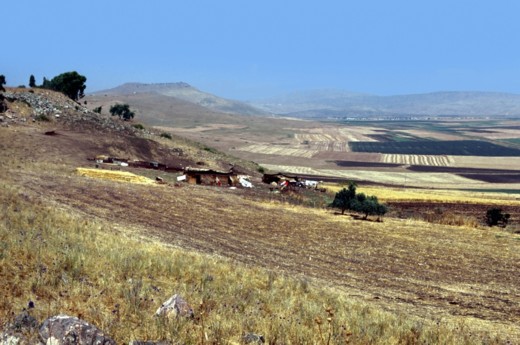
Though we do not really know the location, the Horns of Hattin (above) is one traditional site of the Sermon on the Mount.

Matthew 5 begins what we know as the Sermon on the Mount, and is certainly the best sermon of all time (it is, after all, quite literally the Word from God).  Volumes have been written about chapter 5 alone, so this blog certainly cannot do an adequate job of commentary, but neither should it skip quickly through it.  One can study it over and over and learn something new about being a part of His kingdom each time, and apply it to virtually any question about sin.  Matthew 4:23-25 tells us to some extent how much the Lord’s fame had spread as he taught, proclaimed the gospel, and healed the afflicted – and we can get some idea of the “great crowds” that had begun following Him.  Many of them were hoping for a much different king, and an entirely different type of kingdom, than that which Jesus was proclaiming; but He well described that kingdom to Pilate in John 18:36.

Verses 3-12 contain what we refer to as the Beatitudes.  The translation of the word “blessed” in these verses is confusing to some, as it varies from “happy” to “fortunate.”  “Fortunate” is closer to the real meaning here (someone who is “mourning,” for example, could hardly be described as “happy”), and it relates more to a state of being in a relationship with God that results from His approval.  None of the qualities in these statements refer to a condition that people are born with, inherit, or come by naturally.  Nor are they intended as prescriptions for behavior, some of which the unconverted world at large can simply adopt for the good of mankind.

These are traits of character and attitude that reflect the qualities that Christians must have.  But they are not, as some have suggested, lofty goals – all of which no one person could possibly achieve.  In each one, Jesus says “Blessed are.. ,” indicating that there are people who have these qualities, and that we can ourselves be the people that he describes – that we as Christians, in fact, must be those people.  Yet, we must understand that while having these qualities is what defines us as His people, our place in His kingdom is not something we earn by doing so.  It is, in fact, our full understanding of that fact which enables us to have those qualities in the first place.  It is the understanding that it is only by His grace – totally undeserved on our part – that we have salvation (Ephesians 2:8).  But it is also our commitment to putting the needs, and even the importance of other people above that of our own that must shape our lives.  All of these beatitudes illustrate these two facts, and point clearly to what Jesus Himself said are the two greatest commandments (Matthew 22:35-40).

“Blessed are the poor in spirit, for theirs is the kingdom of heaven”

The “poor in spirit” refers to a condition of the heart much like the tax collector in the parable Jesus tells in Luke 18:11-14.  The latter part of verse 14  says it well – “everyone who exalts himself will be humbled, but the one who humbles himself will be exalted.”  It is likewise the same realization that Job came to when he at last got his audience with God in Job 42:1-6 – that our we are nothing compared to our Creator.

“Blessed are those who mourn, for they shall be comforted”

This refers to same sort of godly grief that comes from the remorse for our disobedience to God personally, as in 2 Corinthians 7:9-11, as well as mourning for the sins of others, as in Psalm 119:136.

“Blessed are the meek, for they shall inherit the earth”
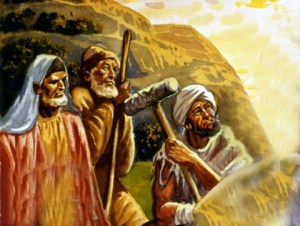
Men listening to Jesus’ Sermon on the Mount

Unfortunately, most people translate meekness into weakness, but that is not what is meant here.  This meekness comes from the conscious decision to control even one’s own strength because of a redirected purpose – that of serving God, and of being genuinely concerned for the salvation of others, instead of serving ourselves.  It is the antithesis of being overly concerned (and sometimes even obsessed) about personal advancement or correcting a perceived injustice to ourselves – to the detriment of others.  They will “inherit the earth” because they put their trust in God, rather than themselves, even if that means being gentle at times when they could use force instead (Psalm 37:11-13).

“Blessed are those who hunger and thirst for righteousness, for they shall be satisfied”

Few that will read this have ever known the sort of immense hunger that comes from being deprived of food for a very long time, but it is this sort of very deep hunger and thirst that is referred to here.  When one becomes a Christian, he commits himself to being a new creature, putting his old pursuit of life behind him (2 Corinthians 5:17), and then thirsts for knowledge and righteousness that comes from the right relationship with God (Romans 12:2).  It is the kind of thirst spoken of in Psalm 42:1-2.

“Blessed are the merciful, for they shall receive mercy”

The mercy referred to here is the sort of mercy Jesus taught in the parable of the unforgiving servant (Matthew 18:23-35), as well as the mercy that equates to compassion, as in the parable of the good Samaritan (Luke 10:25-37).

“Blessed are the pure in heart, for they shall see God”

This purity in heart is what Jesus speaks of in Matthew 15:18-20, and is the sort of sincere devotion to striving for good that we are encouraged to emulate in Philippians 4:8.

“Blessed are the peacemakers, for they shall be called sons of God”

This does not refer to those who settle disputes or conflicts with others, though that sort of peace certainly may be a bi-product of it.  But the word used for peace, shalom, had a much more meaningful usage.  Here it relates not just to striving to be without conflict, but a deep and compassionate desire to instill well-being in one’s self, and especially in others, by having a right relationship with God (Colossians 3:12-15) that encourages others to do the same.  We have peace with God through Jesus (Romans 5:1), and it is in Him through which we are all sons of God (Galatians 3:26).

“Blessed are those who are persecuted for righteousness’ sake, for theirs is the kingdom of heaven”

Jesus used a parable about a Good Samaritan to teach about mercy

Those who serve the Lord have been hated by others for all time.  Genesis 3:15 tells us that it will be that way as the Lord put enmity (a condition of hostility and animosity) between the devil’s offspring and us.  That enmity was there throughout the Old Testament just as with Cain and Abel.  It was there at the time of Jesus, as Herod and others later even sought to kill the Son of God; and that hostility non-believers have for God and His people is still in evidence today.  Jesus named them for who they serve in John 8:44; and Paul explains in Romans 8:7 that those who are hostile to God cannot submit to His law.  This is at the root of their animosity toward God’s people.

Verses 13-16 are referred to as the Similitudes, comparing Christians to salt and light.  The salt they were familiar with would not have come from the round box with a metal spout, but probably from the Dead Sea, containing much impurity that over time would have the salt leached out.  Jesus says that Christians are the salt of the earth.  One way that we can lose our effectiveness (the savor) as such is by allowing our worship, and even the preaching of the Gospel itself, to become watered down by compromising in it so that we may please men, rather than remaining true to God’s commands.  We remain the light of the world by staying true to His commands and letting the world see the results of the beatitudes in our lives.  Verse 20 would be a fairly shocking statement, as the Pharisees certainly would have considered themselves to be the most righteous of all.

Verses 21-30 tell us that although murder and adultery both are certainly wrong, sin is a problem of the heart (going back to the 6th beatitude) as well.  When we allow anger and lust to take it over, we have sinned.  In verses 29-30, tearing an eye out or cutting a hand off are not literal suggestions (one could still lust with one eye, after all).  The verses illustrate how important it is to remove ourselves completely from anything that makes us prone to fall away from the Lord.

Verses 31-32 make it clear that God takes the marriage relationship very seriously; and as Matthew 19:3-9 states, God intended from the beginning for that relationship to be between one man and one woman forever.  Unfortunately, many people have considered the entire lesson of verses 33-37 to be that one should not take an oath, even in a judicial circumstance.  While a Christian should consider that carefully in his heart, that does not seem to be the point that Jesus was making.  Look further – in Matthew 23:16-22 – and consider that the Pharisees distinguished one oath from another, in order to excuse being deceptive – as if a lie would actually not be a lie if that by which you swear was not counted as binding.  If people have to constantly wonder whether or not something one says may be true, one is hardly demonstrating that he hungers and thirsts after righteousness.

One should not take verses 38-42 to mean that there is never an appropriate time to take action or defend against evil.  Once again, a proper reading of  the rest of the New Testament will demonstrate that such is not the case.  But the Pharisees had corrupted the Old Testament law to extend the right of personal revenge to new heights.  Instead, Jesus teaches (and Paul states it well in Romans 12:17-21) that we should not resist evil with evil, but we rather overcome evil with good.

This magnificent chapter concludes in verses 43-48 with the command that we should love even our enemies, and even pray for those who persecute us.  Apart from the fact that it is the right thing to do, and that it is commanded by God, this just makes good sense when we think about it.  If we truly pray for the salvation of those who do wrong to us, we are praying for their hearts and lives to become blessed as in the beatitudes of this chapter.  If that prayer is granted, how could that person continue to do us evil!

Read or listen to audio of ESV version of this selection from this link.

/Bob’s boy
___________________
some images © V. Gilbert & Arlisle F. Beers

Please note: I did not design the reading plan that I am following in my blog.  All of my comments in this blog, however, are solely my responsibility.  When reading ANY commentary, you should ALWAYS refer first to the scripture, which is God’s unchanging and unfailing word. Reading schedules, as well as a link to the site where you can get the reading plan that I’m currently following for yourself can be found on the “Bible Reading Schedules” page of my website at http://graceofourlord.com.  For questions and help, please see the “FAQ” and “Summaries” pages there.